



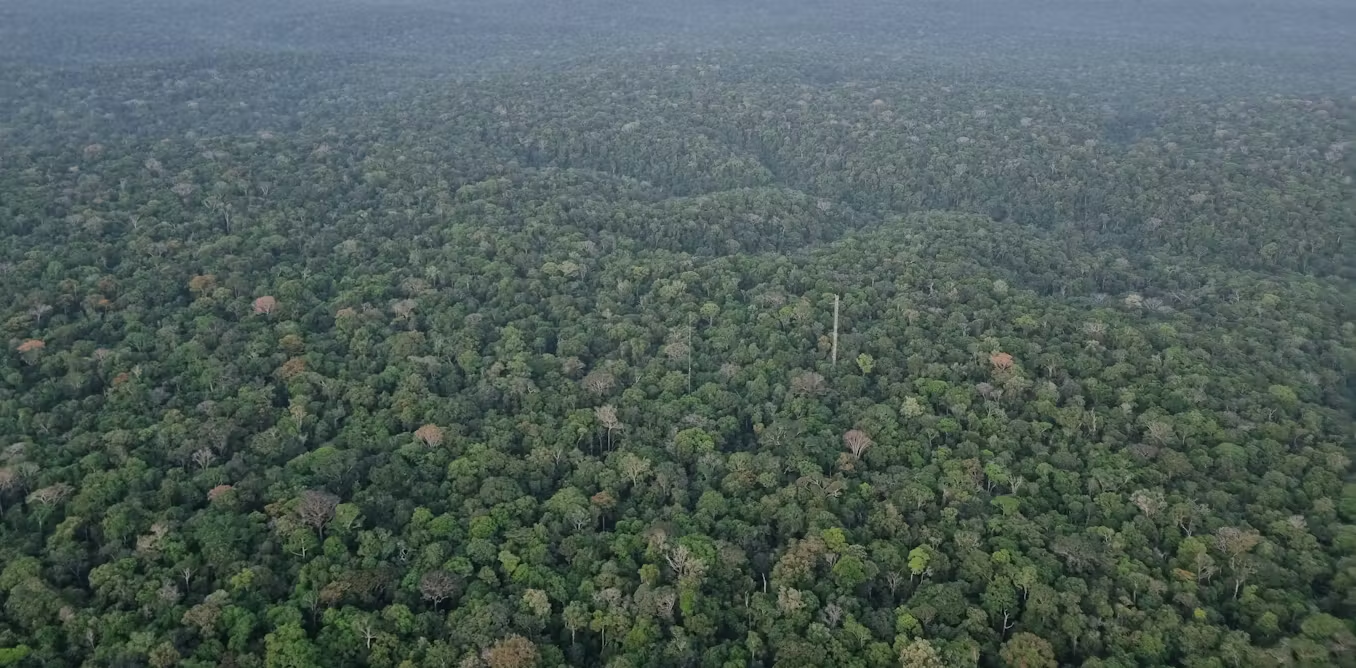
Tropical forests are hot, steamy places. But when large numbers of trees are cut down, they get even hotter. Our recent research shows that clearing large areas of the rainforest exposes hundreds of millions of people to higher temperatures, increasing heat stress (when the body’s way of controlling temperature fails) and, in some cases, contributing to death.
Research suggests that this could be contributing to 28,000 heat-related deaths each year across the tropics every year.
Apart from the shade that the rainforest canopy provides, trees also cool their surroundings by pumping water from the soil into the atmosphere – a process known as evapotranspiration. Like sweat evaporating from our skin, this uses energy and cools the air.
A single large tropical tree provides as much cooling as several air conditioners running continuously. Across the billions of trees in the Amazon or Congo, this “sweating” cools entire regions.
People living in or near tropical forests recognise these cooling benefits. When villagers in rainforest regions in Kalimantan, Indonesia, were interviewed about the benefits tropical forests provide, the most common answer was their ability to keep local temperatures cool.
Despite these benefits, tropical forests are being destroyed at an alarming rate. In 2024, more than 6 million hectares of primary tropical forests (nearly the size of Panama) were destroyed, the fastest rate since records began.
Nike Doggart, CC BY
Tropical deforestation reduces the cooling effect forests provide, leading to local warming – a pattern well documented by previous studies. But how is this warming affecting the lives of people living near tropical forests?
Deforestation is amplifying heat
To answer this, we used satellite data to track how deforestation has affected temperatures over the past 20 years. Over this period, large areas of forest in the Amazon, Congo and south-east Asia were cleared. We compared temperature changes in deforested regions with nearby areas that retained their forests. Tropical regions that retained their forest cover warmed by an average of 0.2°C. In nearby areas where forests were cleared, temperatures rose by 0.7°C – more than three times as fast. This shows that deforestation results in a dramatic regional amplification of climate warming.

Author’s own research., CC BY-SA
To understand the impact on local people, we mapped this warming onto information on where people live across the tropics. We found that more than 300 million people were exposed to higher temperatures caused by deforestation. Exposure occurred right across the tropics: 67 million people in Central and South America, 148 million people in Africa and 122 million people in south-east Asia were exposed to warming.
Some countries with rapid rates of deforestation were particularly affected: 49 million people in Indonesia, 42 million people in the Democratic Republic of Congo and 22 million people in Brazil were exposed to hotter temperatures caused by deforestation.
A hidden public health crisis
Exposure to high temperatures has a range of negative effects on health. For instance, it can reduce the productivity of farmers and reduce the time it is safe to work outdoors. Exposure to high temperatures also causes heat stress that can be lethal. Heat waves in the Amazon are associated with a higher risk of mortality from cardiovascular diseases.

Author’s own., CC BY
We combined information on the number of people exposed to deforestation-induced warming with region-specific heat vulnerability information and non-accidental death rates. We used this to estimate that the heating from deforestation is linked to around 28,000 heat-related deaths each year across the tropics. This means that over the past 20 years more than half a million people have died from heat-related causes as a result of deforestation.
It is well known that tropical deforestation releases carbon dioxide and this contributes to global climate change. Indeed, arguments for reducing deforestation are often focused on carbon. But despite numerous international pledges, tropical deforestation continues to accelerate.
Recognising the public health impact of deforestation could help broaden support for forest protection. Although the local warming effects of deforestation are well recognised by local people, communities and decision-makers often lack precise data on how much deforestation is increasing temperatures in their area. To address this, we developed an online tool that provides information at province level on the warming linked to deforestation. We hope this locally relevant data will help communities and decision-makers make more informed decisions about managing their forests.
There are some promising new initiatives that recognise the value of tropical forests. Brazil is setting up a new fund that will pay tropical nations to keep their forests intact. It recognises the public services provided by tropical forests – including their ability to regulate local climate – and it rewards countries for protecting them. Some European countries supported the development of this facility but other than Norway, few have yet committed substantial funding. Perhaps given the current global crisis they think it is too far away to affect them, or are prioritising other areas. In doing so they are ignoring potential effects on migration flows, global air quality, loss of biodiversity and food supply chains.
For many years, tropical deforestation has been viewed as an environmental issue. Our research shows that it is also an urgent public health issue. Protecting tropical forests is not just about conserving nature or storing carbon. It is about protecting the health – and lives – of hundreds of millions of people.












































You must be logged in to post a comment Login