Woolly mammoths. Sabre-toothed tigers. The dodo. There is one species we can’t allow to end up on this list of vanishing creatures: the bookworm.
In a world where screen time dominates a dwindling attention economy, readers are in serious danger of becoming a dying breed. Recreational reading among children and teenagers in the UK has fallen to its lowest point in two decades, with just one-third of eight- to 18-year-olds saying they enjoy reading in their free time – a 36 per cent decline since 2005. Adults are not much better: only around half of us regularly pick up a book, and even fewer parents like to read to their young kids.
But there are abundant benefits to reading. Young people who get into the habit of reading in early childhood are more likely to achieve high qualifications and upward social mobility later on; they’re more able to build empathy, develop their creativity and spark their imagination. Reading even makes you happier.
Fortunately, in 2026, the fightback has begun. This year, a major nationwide campaign is inviting people to fall back in love with reading. A Department for Education initiative, the National Year of Reading is supported by more than 60 partners, including literary sector charities, funders and pledge partners. Library cards for newborns; 72,000 new books distributed to those who need them most; a £27.5m package for libraries; libraries in Suffolk are even offering an amnesty for 15,000 overdue library books. It’s all about putting a stop to the bookworm extinction. Also working hard to promote the power of books is the Queen’s Reading Room charity, which celebrates its fifth anniversary this year and connects over 186,000 book enthusiasts across more than 180 countries.
Advertisement
And yet for all the benefits of reading, sometimes life just gets in the way. But there are several tips and tricks to help you stay on track with your TBR pile. And who better to advise than some of the world’s leading authors and biggest bookworms?
Not sure where to begin? Helen Fielding, creator of Bridget Jones, recommends prioritising pleasure when it comes to reading (Getty)
Ian McEwan
If you think you’re not reading enough, start with a novella, that entrancing form, short enough to hold you, not long enough to overwhelm you. Instead of a list, here’s one: Reunion by Fred Uhlmann.
Advertisement
Helen Fielding
Don’t google the Beckhams! Or do online shopping or look at your screens. Being hooked by a good book is like nothing else. You have to use your own imagination to do the things that video games, TV, movies and memes do. You have to make all the sights, sounds, smells and effects with your own mind. That’s what makes reading so absorbing, restful and good for the soul.
On that note, don’t read anything where you’re forcing yourself because it’s so heavy going. I ruined my love of Dickens for years by forcing myself to read Bleak House in two days at college because I’d failed to do my summer reading list. Read the books you enjoy – and mix in some classics. They’ve stood the test of time for a reason. And the stories can be even more complex and seductive than the Beckhams.
Salman Rushdie
Advertisement
Reading is a habit. You need to form the habit. Pick a convenient time of day and pick up a book at that time for 15 minutes. Do it every day for a couple of weeks and hopefully you’ll catch the bug. Oh, and make sure it’s a book you enjoy. If you find you’re not enjoying it, discard it and try another one. The book doesn’t matter. The pleasure does.
All it takes is 15 minutes a day to form a habit, says Salman Rushdie (AP)
Andrew Miller
Top tip: a comfy reading chair by a good light, and with a little table for your tea and glasses. You might also wish to invest in an elegant reading robe (or two: one for summer, one for winter).
Advertisement
Kate Mosse
Trust your instincts – reading should be fun, nourishing, life-enhancing, brain-expanding, so if a book isn’t speaking to you, put it aside and try something else. It doesn’t matter. A story that isn’t to your taste now will still be waiting for you when the time is right. Enjoyment is everything.
Ian Rankin
Carve out some time, put down your phone, leave a book in a strategic spot – sofa, bedside, bathroom – and pick it up rather than your device!
Advertisement
McFly star and bestselling children’s author Tom Fletcher listens to audiobooks with his family during car journeys (Getty)
Tessa Hadley
Don’t ever think of reading as a duty. It’s a pure pleasure. Don’t wait till bedtime. Turn your phone off or leave it in another room. Make a cup of tea or pour a glass of wine (a small glass, you need to stay sharp), remove your shoes. Curl up in a comfortable armchair or on a sofa. Exit all the smallness of your life, move through the portal of your books into other worlds, other ways of seeing and thinking and feeling…
Tom Fletcher
Advertisement
Reading doesn’t only include traditional books. Stories live in song lyrics, comics and graphic novels – and audiobooks are a brilliant way to listen on the go. Follow your curiosity, read what excites you and explore your interests, not what you think you should be reading, and shift your mindset about what counts. For example, listening to audiobooks during a car journey is a fun way for families to read books together when the calendar is packed.
Jeanette Winterson
If there is any book you really loved… read it again! Then ask a friend for something they have enjoyed. Read that! Then choose something for yourself… Meanwhile, a short poem every day is like an espresso shot in the morning or a nightcap at bedtime. Try that too!
Advertisement
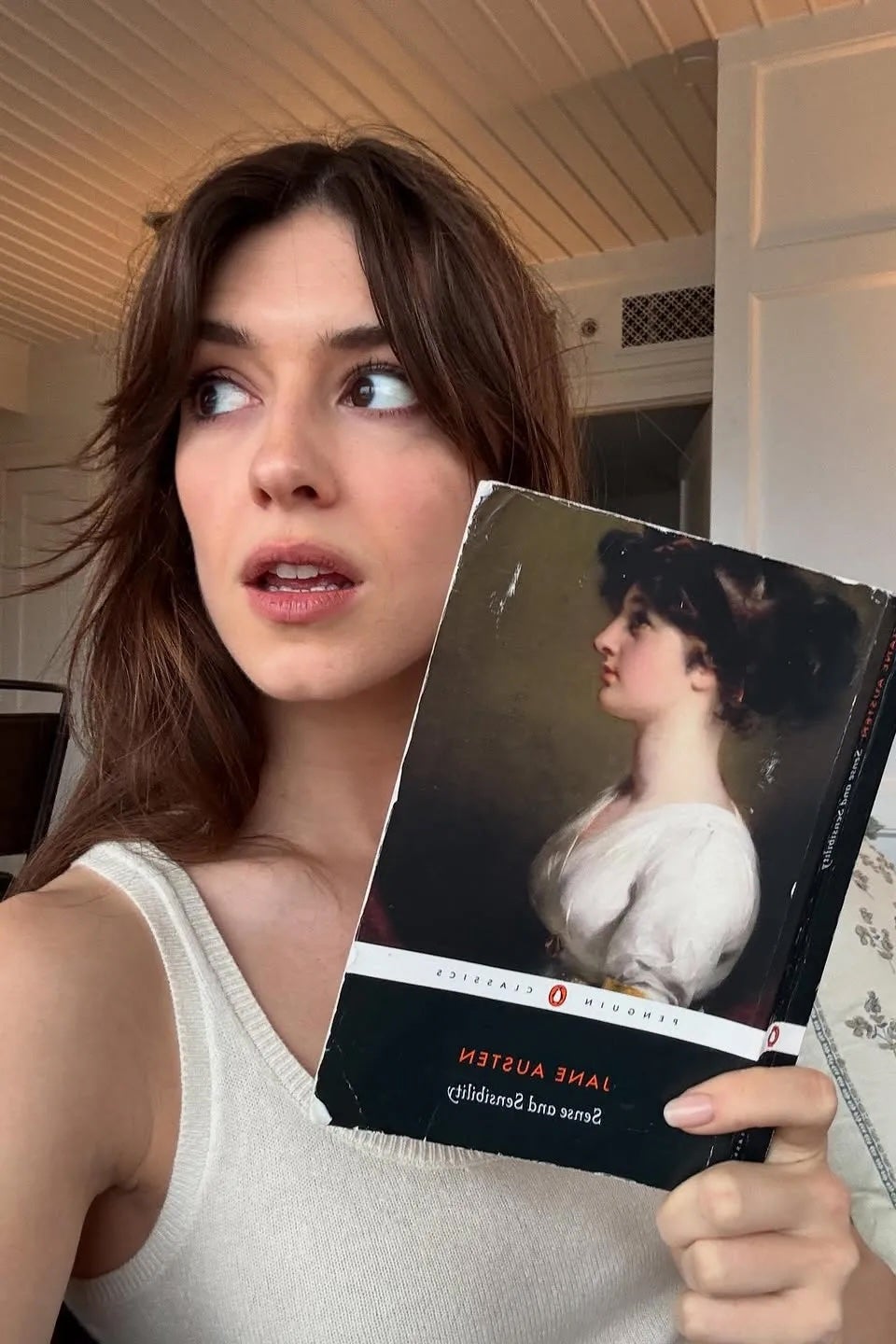
‘Normal People’ star Daisy Edgar-Jones hops aboard the reading train ahead of her role in the new adaptation of Jane Austen’s ‘Sense and Sensibility’ (Instagram/Daisy Edgar-Jones)
Malorie Blackman
Read for pleasure with the emphasis on pleasure. Read what you love, what you care about, what challenges you, makes you think, makes you laugh or cry or feel. If you want to read graphic novels, books about hobbies or listen to audiobooks, then go for it. And enjoy!
David Mitchell
Keep a small fancy notebook on your bookshelf. On 1 January, write the name of the year – just “2026”. Every time you finish a book, write its ordinal number – 1st, 2nd, 3rd… 50th, etc. Do a deal with yourself – every year, you’ll finish more books than last year. You’re allowed to balance out a 900-page Dawn of Everything with a slim novella by Clare Keegan.
Advertisement
Also, as you read, keep a pen close by. (A pencil is better but who carries pencils around?) Whenever you encounter something that you don’t want to forget, put a dot at the top of the page. Put another dot in the margin next to the line where the non-discardable something occurs. When you’ve finished the book, go through the book, looking out for the dots at the tops of pages; transcribe the “dotted somethings” into another notebook. By hand, with a fountain pen. Revisit them from time to time. If you know the author or can reach them on social media, share a few of your favourite dots. Trust me, it will enhance or even transform their day.
Lastly, when tempted to kill an hour on YouTube or a mediocre documentary on Netflix, remember that you will wish you could get those wasted 60 minutes back. Spend that same hour with a good book and you’ll feel mentally richer, less alone, smarter and that bit wiser.
The National Year of Reading campaign enters a troubling time for books, with literacy rates either stalling or declining across the Western world (Getty/iStock)
Elif Shafak
Advertisement
Books are our beloved companions. I think it’s so important that we see reading as a continuous journey where we learn new things every day, sail to new horizons. When we dive into a novel, for a few days or weeks, we become someone else, we transcend the borders of the “self” and see the world through another person’s eyes, feel what they feel. We empathise with their sorrows, their joys, their dreams. Literature dismantles the duality of “us” versus “them”. This is a humbling exercise for the mind, for the soul.
Let’s read anything and everything that speaks to us – from cookbooks to political philosophy to literary fiction. I have never believed in that distinction between “highbrow literature” and “lowbrow literature”. Instead, let’s keep the curiosity of the mind alive and thriving. Let’s be intellectual nomads, constantly searching. That requires reading widely, both fiction and non-fiction. Across the board. If we are reading only one type of genre, or the same kind of books, it means we are not leaving our comfort zones. I find it very important that our reading lists be eclectic, diverse, connecting with multiple cultures, backgrounds, and traditions of storytelling.
As per Tessa Hadley’s advice, pour yourself a glass of wine (a small glass, you need to stay sharp) and dig in (Alamy/PA)
Tim Bouverie
Advertisement
The best tip for reading more is to read great books by amazing authors – Austen, Dickens, Tolstoy, Waugh, Hemingway, etc. But having a dedicated reading time, such as before bed, or commuting to work – any time when you can ignore your telephone and concentrate – can also help. Smartphones are addictive and unwholesome. Reading, when pursued with energy and dedication, is addictive and wholesome.
Adam Weymouth
I’ve had some reading droughts since becoming a parent. Thrillers are often my way back: something inches thick with a hundred chapters. I can devour one in a fraction of the time it takes me to get through something more literary, and by the time I’m done, I’m back in the habit. Robert Ludlum is a particular favourite.
Robin Stevens
Advertisement
The most important thing to me as an author and reader is the concept of fun. A book is a story – it’s entertainment – and I believe you should be looking for the kind of entertainment that truly makes your heart sing. What fun means to you is entirely personal, and nothing to do with how objectively pleasant a story might be (my own favourite genre revolves around at least one person being violently murdered), but as far as I’m concerned, that’s the only metric you should be judging your reading on.
The big format change will take effect from next season
The Championship play-offs will feature six teams from next season.
Advertisement
The EFL announced its clubs had passed a proposal to increase the number of play-off participants from four to six at an all-club meeting on Thursday.
Supporters of the change believe it will create more interest in the run-in to the Championship season, as it gives more teams a chance to qualify for the post-season and a shot at promotion to the Premier League. Teams finishing between third and eighth will be involved.
EFL chief executive Trevor Birch said: “Since their introduction in 1986-87, the play-offs have become a highlight of the domestic football calendar, capturing the drama, suspense and jeopardy that make the EFL so special.
“Following several months of discussion with clubs and other stakeholders, we are confident this change will further strengthen the Championship as a competition and give more clubs and their supporters a genuine opportunity of achieving promotion.”
Advertisement
The National League currently operates a six-team play-off tournament, where the teams finishing second and third progress straight to the semi-finals while those finishing fourth to seventh compete in quarter-finals.
A similar system will be used in the Championship, with teams finishing from fifth to eighth playing in eliminator ties and the winners going on to face the third and fourth-placed teams in two-legged semi-finals.
The final format will be agreed later in 2026.
Content cannot be displayed without consent
The current format in the EFL – with a single-leg final at Wembley preceded by two-leg semi-finals – has been in place since the 1989-90 season.
Advertisement
The Championship play-off final has come to be regarded as the most lucrative single game in world football, given a place in the Premier League is at stake to the winners.
Sunderland were last season’s victors, overcoming Sheffield United 2-1. The success was estimated to have secured a minimum of £200million in extra income for the Black Cats.
The statement issued by the EFL on Thursday read: “At a General Meeting today, EFL Clubs approved changes to expand the number of teams competing in the Sky Bet Championship Play-Offs from four to six, starting in the 2026/27 season.
“The decision is intended to increase the number of competitive fixtures during the closing stages of the campaign, while also giving two additional Clubs the opportunity to reach the Play-Off Final at Wembley Stadium and progress to the Premier League.”
Advertisement
Wrexham are currently in sixth place in the Championship table with nine games remaining in the regular season.
Swansea City currently sit in 16th place, with 11 points between them and the play-off spots.
Emirates has issued a statement to passengers affected by ongoing travel disruptions
Charlotte Smith Senior Lifestyle Content Editor
11:31, 05 Mar 2026
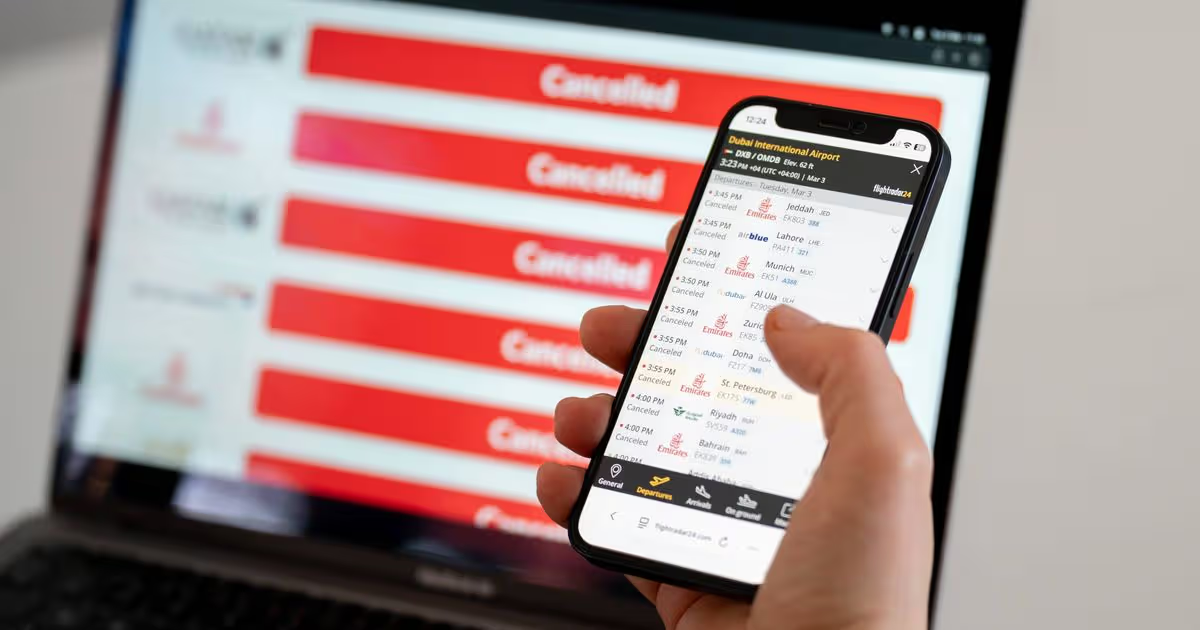
Emirates has released a statement concerning its flight operations amid “ongoing disruptions” stemming from the Middle East conflict. The airline’s support account posted an update on X for affected passengers as numerous services remain grounded.
The carrier has confirmed that all scheduled flights to and from Dubai will remain suspended until the end of March 7, extending beyond the previously announced deadline of March 4. However, they continue to operate “a limited number of passenger repatriation and freighter flights”.
Advertisement
A number of Emirates services have already touched down in the UK, bringing much-needed reassurance to anxious relatives and friends. These flights have landed at multiple airports, including Edinburgh and London.
This development comes as the Iran conflict reaches its sixth day, with numerous flights expected to transport stranded British citizens home from the Gulf area. The first Government charter flight and British Airways commercial service from Muscat were due to arrive in the UK during the early hours of Thursday.
Yet a technical problem at the Omani airport stopped the first chartered aircraft from departing as scheduled. It is now anticipated to depart later on Thursday, reports the Express.
Content cannot be displayed without consent
Emirates’ social media announcement represents the airline’s most recent communication from its support team on X as of March 5. The statement acknowledges that the airline’s support team is managing a substantial number of customer queries and is working to address them at the earliest opportunity.
Advertisement
The carrier stated: “Due to ongoing flight disruptions, our Customer Care teams are experiencing exceptionally high volumes. We’re working to resolve all enquiries as quickly as possible. Rest assured, all cancelled flights will be rebooked or refunded as soon as possible, based on your preference.”
Passengers impacted by the recent wave of cancellations have been provided with guidance on what steps to take. The airline has outlined several options, including making contact, requesting a refund and liaising with your travel agent.
Emirates explained: “Direct Message: DMs are the most efficient way to contact us right now. Please expect a 48-72 hour wait before we are able to respond. You can DM on X at http://emirat.es/xdm.
Advertisement
“Phone: Only call us if you are in need of very urgent assistance. Please be patient and expect a wait on hold of up to 2-3 hours. Contact numbers for your country can be found at http://emirat.es/support.
“Refunds: You can request a refund for your booking if it is on or before 12 March without contacting us. Just fill out the form at http://emirat.es/refund.
“Travel Agents: If you booked via a travel agent, please contact them directly for assistance with rebookings and refunds. If your enquiry is not urgent, please visit http://emirat.es/flightstatus for the latest updates, and contact us at a later time. Please also make sure your contact details are up to date at http://emirat.es/managebooking so we can keep you informed.”
The carrier concluded its statement by outlining additional measures available to travellers needing extra help. “If you need further assistance, DM us with your booking reference and flight details, and we will get back to you as soon as we can. Thank you for your trust and patience,” it said.
The changes will be enforced from the start of the new school year
The government has announced new rules that all schools must follow from September this year. The plans will see UK schools put in place stronger protections for children with allergies.
Advertisement
Under the new rules, announced by the Department of Education on Wednesday, all schools will be required to stock life-saving allergy pens to ensure the safety of their students. Schools must also have a dedicated allergy policy and put teachers through compulsory training to make sure requirements are met.
The changes come into force following campaigns from parents for additional measures to be enforced to protect children with allergies whilst at school. One parent, Helen Blythe, whose son Benedict died in 2021 after having an allergic reaction at school, has welcomed the change, saying the new requirements will now make it “less likely for other families to go through what we’ve been through”.
Get MEN Premium now for just £1 HERE – or get involved in our WhatsApp group by clicking HERE. And don’t miss out on our brilliant selection of newsletters HERE.
The Blythe family campaigned for a law change to mandate allergy safety in schools for four years after their son died from accidental exposure to cow’s milk protein at Barnack Primary School, near Peterborough, in December 2021. An inquest found the school did not follow all the measures in place to prevent the fatal anaphylactic reaction, and that there were risks of contamination and delays in administering an adrenaline pen.
Advertisement
Following campaigns, schools will now be required to have individual healthcare plans in place for pupils with medical conditions. The changes, which come into force in September, will see compulsory training given to teachers on administering adrenaline auto-injectors, with schools also required to have a dedicated allergy policies in place.
Under the plans, from September 2026, schools must:
Stock ‘spare’ adrenaline auto-injectors for use in emergency situations
Provide allergy awareness training for all staff – covering symptoms, emergency response and the use of adrenaline devices
Have a comprehensive policy for supporting children with medical conditions, including Individual Healthcare Plans to record specific arrangements for individuals like an allergy management plan
Commenting on the new rules, Mrs Blythe told the Press Association: “This is something we’ve campaigned for for a long time as a family. It’s been a hard campaign, both work-wise and emotionally.
“These measures will make it less likely for other families to go through what we’ve been through. And for Benedict his memory will be etched into the history books and into time. We’ve always said that his life mattered and his death should matter too. And in this it does, it’s his legacy, and that means a lot.”
Minister for early education Olivia Bailey said: “No parent should have to send their child to school worried that a life-threatening allergic reaction won’t be handled swiftly.
“We have listened to the families and organisations who have campaigned tirelessly on this issue, and we are acting. These new requirements will give parents the confidence that every school has the training, the plans and the equipment in place to keep their child safe.”
However Paul Whiteman, general secretary of school leaders’ union NAHT, said schools need additional funding to make sure they have the staffing capacity to carry out duties and offer specialist health support where it is needed. He said: “Expecting schools to stock ‘spare’ adrenaline auto-injectors for use in emergency situations appears a sensible step, as is training staff to use them effectively.
“However, the Government need to be confident that there are sufficient stocks maintained across the country to ensure each setting can keep a sufficient share of adrenaline auto-injectors.”
Reports said that the men were being aggressive towards station staff and commuters
Men were reportedly “acting aggressively” at Cambridge station on Wednesday (March 4). British Transport Police were called to Cambridge railway station at around 5.30pm after reports of men acting aggressively towards station staff and commuters.
Advertisement
Officers attended. A man was arrested on suspicion of Common Assault and a Section 4 Public Order offence.
A spokesperson for British Transport Police said: “Officers were called to Cambridge railway station at 5.29pm yesterday (4 March) following reports men acting aggressively towards station staff and commuters.
“Officers attended and a man was arrested on suspicion of Common Assault and a Section 4 Public Order offence.”
EFL clubs have voted in favour of expanding the Championship play-offs from four to six teams.
The new system will mirror the format used in the National League and will be introduced for the 2026-27 season.
It means teams finishing from third to eighth will compete for promotion to the Premier League.
Clubs finishing third and fourth will progress directly to the semi-final, while a one-legged quarter final will be played with fifth at home to eighth and sixth hosting seventh.
Advertisement
Semi-finals will remain as two legs and the final will still take place at Wembley at the end of May.
The proposal has been under consideration for a number of seasons and was approved by the EFL board and Football Association.
“The decision is intended to increase the number of competitive fixtures during the closing stages of the campaign, while also giving two additional clubs the opportunity to reach the play-off final at Wembley Stadium and progress to the Premier League,” the EFL said.
The four-bedroom property in the car park of the George and Dragon in Aysgarth is due to be auctioned off next week with a guide price of just £19,000.
The house and pub were sold together at auction in December, when the guide price for the entire site was £300,000.
Aysgarth and District Parish Council has pointed out that no mention is made of a 106 agreement in the latest sale details.
Advertisement
The 106 agreement, issued in 1996 when the Yorkshire Dales National Park Authority (YDNPA) granted planning permission for the property, means the occupant of the property should work in the pub.
Councillor John Dinsdale, chair of Aysgarth and District Parish Council, said: “We are very concerned that someone will buy the property without realising it has a 106 agreement attached.
“I’d hate for a young couple to buy it and lose their savings.”
The parish council is in the process of registering the pub, which closed last year, as an asset of community value.
Advertisement
A spokesperson for the YDNPA said they were aware of the situation and were liaising with the parish council.
Officers have also made contact with the owners of the property and the auction house to offer their help regarding the restrictions in place.
The house is due to be auctioned off online between March 10 and 12.
Sale particulars show the house has been renamed Meadow View.
Advertisement
The description adds: “Located in Aysgarth, a charming village in North Yorkshire, this four-bedroom property is in an ideal location. A beautiful family home or a bolt hole/holiday let as an investment opportunity – it’s one not to be missed.
“It has a large front garden with double garages and three separate access points into the property. It also has a side courtyard exiting from the lounge.”
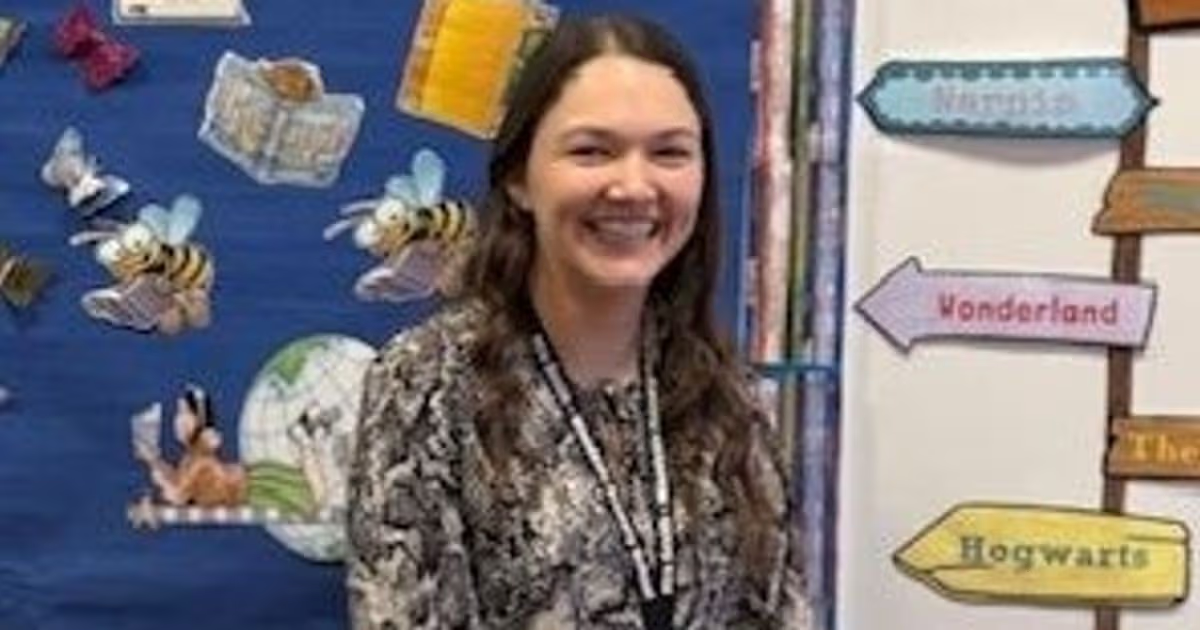
Danielle Smith, a class teacher at Woodside Primary School in the town, was selected as one of four winners of the charity’s award.
A Hamilton teacher has been announced as Scottish Book Trust’s Reading Champion for 2026.
Advertisement
Danielle Smith, a class teacher at Woodside Primary School in the town, was selected as one of four winners of the charity’s award.
The Reading Champion Awards, in association with Browns Books, recognise the reading role models whose fantastic work inspires others to read for pleasure. This includes school librarians, teachers and those who organise book events that promote reading within the community.
Danielle impressed judges with her dedication to creating a ‘Reading for Pleasure’ culture within the school. One of her initiatives included the ‘Reading Rockets’ pupil voice group where children can voice their opinions on how to make reading for pleasure a fun and creative experience within the school.
She also runs a lunchtime ‘Junior Librarian’ club where the children lead the improvements on the library areas throughout the school for their peers. She encourages parents to share their enjoyment of reading with their children, organises activities for Book Week Scotland and invites authors to visit the school, as inspiration for children’s love and writing.
Advertisement
Danielle said: “What an honour to be recognised for something you are so passionate about. The most rewarding part of this journey has been watching the children in my school fall in love with reading and hearing parents say their children can’t put books down.
“When children actively seek me out to chat about their latest book, I know we’re making a real difference. This award celebrates not just my work, but the growing community of readers we’re building together. I’m excited to continue inspiring even more young readers and families to discover the joy of books.”
Winners receive £250 worth of books for their school or library. An independent panel chooses winners based on their impact on reading culture.
The winners were announced during World Book Day. And with 2026 being the National Year of Reading, Scottish Book Trust believes it’s more vital than ever to encourage reading for pleasure. It has been shown to improve pupils’ attainment levels, as well as their mental health and wellbeing.
Danielle was nominated by Eileen McKellar, depute head teacher at Woodside Primary. Eileen said: “Danielle is an excellent ambassador for Reading for Pleasure and it has been amazing to see the effect that her work has had on encouraging pupils to read for enjoyment bug.”
Marc Lambert, CEO of Scottish Book Trust, said: “Congratulations to this year’s Reading Champions who are deservedly being celebrated for their tireless work in promoting the joy of reading to young people. Reading for pleasure has been proven to bring many important benefits to children, including boosting wellbeing, family bonding and attainment levels, and setting them up for a successful future.
Advertisement
“It’s heartening to see the fantastic work these reading champions are undertaking across the country, to inspire children and teens to read for pleasure.”
*Don’t miss the latest headlines from around Lanarkshire. Sign up to our newsletters here.
And did you know Lanarkshire Live had its own app? Download yours for free here.
Edwards’s career ended abruptly in July 2024, when he pleaded guilty to making indecent images of children.
Advertisement
Martin Clunes as Huw Edwards in new Channel 5 drama (Matt Towers/5 Broadcasting Limited/Paramount/Wonderhood Studios)
The new show will look into the former broadcaster’s “double life”, incorporating conversations with those who initially reported the story. Ben Frow, chief content officer at Channel 5, called it “a first for the channel”.
He continued: “This is an important and shocking story of how a man in a position of power and trust betrayed that status.
”By gaining exclusive access to the key individuals involved and those who investigated the story, we explore the human cost behind the headlines.”
Edwards’ downfall began in July 2023 following a report by The Sun alleging a “top BBC Star” had paid a teenager for sexual pictures. Days later, his wife publicly named him as the presenter at the centre of the allegations, leading to his resignation in April on medical advice. He was subsequently charged in June 2024 after a Metropolitan Police investigation.
Advertisement
Huw Edwards pleaded guilty to making indecent images of children in July 2024 (Getty)
A month later, Edwards admitted guilt to making indecent images of children, confirming he possessed 41 photographs on WhatsApp, including seven classified as the most serious type.
The BBC said it was told in November 2023, when Edwards was suspended, that he had been arrested on “suspicion of serious offences”, five months before he resigned from the corporation in April.
Watch Apple TV+ free for 7 day
Advertisement
New subscribers only. £9.99/mo. after free trial. Plan auto-renews until cancelled.
A 43-year-old man in Pontyclun and a 68-year-old man in Powys were also arrested by counter-terrorism officers
10:32, 05 Mar 2026Updated 10:40, 05 Mar 2026
Two men from Wales and one man from London arrested on suspicion of spying for China have been released on bail. David Taylor, the husband of Labour MP Joani Reid, was arrested in London on Wednesday, March 4.
A 43-year-old man in Pontyclun and a 68-year-old man in Powys were also arrested by counter-terrorism officers for the Metropolitan Police after being accused of assisting a foreign intelligence service. All three men have now been released on bail until May.
Three other properties in Cardiff, London and east Kilbride in Scotland have also been searched. For the biggest stories in Wales first sign up to our daily newsletter here
Advertisement
Following Taylor’s arrest Labour Scottish MP Ms Reid, who sits on the Home Affairs Select Committee, said she had “never seen anything to make me suspect my husband has broken any law”.
The men were detained under the Police and Criminal Evidence Act, according to Commander Helen Flanagan, head of counter terrorism policing London.
She said: “Today’s arrests are part of a proactive investigation and while these are serious matters we do not believe there to be any imminent or direct threat to the public relating to this. Our investigation continues and we thank the public for their ongoing support.
“We have seen a significant increase in our casework relating to national security in recent years and we continue to work extremely closely with our partners to help keep the country safe and take action to disrupt malign activity where we suspect it.”
Advertisement
Taylor was special adviser to Peter Hain when he was Welsh secretary and also previously worked for Senedd member Leighton Andrews when he was a backbencher. He was also selected as Labour’s candidate as police and crime commissioner in north Wales in 2016.
Ruthin-born Taylor is listed on the MP’s register of interests as a director of Earthcott Limited, a lobbying firm. He previously founded a cyber security company and his LinkedIn profile states he is director of policy and programmes for an organisation named Asia House.
His profile states: “At Asia House I lead our policy and research teams in delivering programmes and projects for clients across Asia, the Middle East, and Europe. I oversee the development and execution of strategic initiatives that connect senior government officials, business leaders, and thought leaders on critical regional and global issues.”
Get daily breaking news updates on your phone by joining our WhatsApp community here. We occasionally treat members to special offers, promotions and ads from us and our partners. See our Privacy Notice
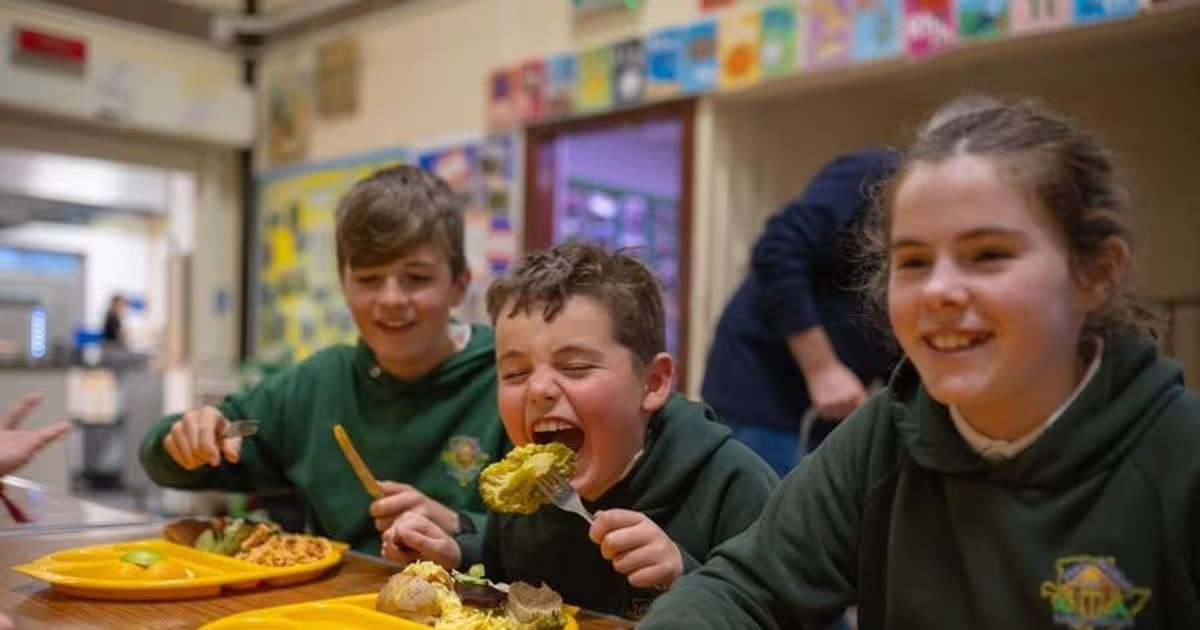
The first evaluation of a mass rollout of free school meals in Welsh primary schools has now taken place
Overcrowded dining rooms as well as special dietary and cultural needs are among the reasons more children are not taking up the offer of free meals in primary schools in Wales.
Universal free school lunches for all primary pupils were rolled out in phases from September 2022 to September 2024 as part of a Welsh Government response to cost of living pressures and pupil hunger. But average uptake is only 69% and in some schools even lower at 57%, the first evaluation shows.
An interim report from the first year of a three-year evaluation on free school meals in primaries has just been published by the Welsh Government. For our free daily briefing on the biggest issues facing the nation sign up to the Wales Matters newsletter here.
Advertisement
It says while the policy has had some positive impact on family finances and pupil behaviour there are also challenges. A free lunch has not improved rates of attendance among the least-well-off children significantly and gaps between them and their better-off peers persist.
There are also worries children eligible for free school meals under the old income rules may not be accessing associated benefits as they are not aware they still need to register.
Special food and cultural needs are “challenges” which “may help explain why some learners and parents/carers continue to prefer packed lunches”, the report says.
“Schools reported using a variety of approaches to manage allergies and medical requirements including bespoke menus, direct chef involvement, visual identification techniques, and coloured trays for special meals.
Advertisement
“While several schools reported effectively meeting these needs issues around cultural suitability (such as unclear halal options or untranslated menus) sometimes result in parents/carers providing packed lunches instead.”
Some school staff raised concerns that operational pressures maybe affecting food quality. Busier lunchtimes were also potentially putting children off.
“Practical measures, such as improving dining room layouts to ease flow or staggering lunchtimes, may help create a more relaxed and enjoyable lunchtime experience and encourage greater participation, ” the interim evaluation advises schools.
Overall the number of children eating free school meals in primaries has gone up now they are free for all, regardless of income, and this has helped families just above the free school meal eigibility threshold in particular.
Advertisement
By July 2024 average uptake across Welsh local authorities reached 69%, with rates ranging from 57% to 82%. Uptake has gradually increased, rising from 67% in September 2022, with the highest participation among younger learners who were eligible from the outset.
“Clear and ongoing communication following rollout is essential for schools, local authorities, and families, including guidance that is accessible, multilingual, and regularly updated, ” the report’s authors recommend.
Schools could also boost uptake by sharing tips on menu variety, meeting dietary and cultural needs, and engaging older learners. Improved data would also help to pinpoint which children may not be fully benefiting..
“There is also a need to ensure that learners with eFSM (eligible for free school meals) status continue to access associated benefits through simplified registration processes, improved communication, or rebranding of eFSM to highlight its wider support offer,” the report adds.
Advertisement
And while hunger is often cited as a reason for poor behaviour only “some school staff” reported “modest but positive effects” on learner behaviour and concentration resulting from universal free school meals.
Those that noticed positive effects said children were more settled, less hungry, and better able to engage in afternoon lessons. Some parents and carers had also seen improvements in their children’s focus and participation at school due to having a meal.
The findings, based on survey responses from 47 schools, in-depth case studies at 13 schools, and interviews with all 22 councils as well as school food providers and others, will be used to help fine tune the policy.
Those in charge will note feedback from school leaders “show mixed results” with some schools, particularly in urban areas, seeing improvements in hunger and food insecurity, while others reported little change.
Advertisement
On attendance the report adds: “Although some anecdotal evidence suggests that some parents/carers may give priority to attendance to ensure their children receive a meal national data shows that although the gap between eFSM learners and their peers has narrowed it remains substantial.”
The Welsh Government said its universal free primary school meal provision has removed financial barriers, increased access to school meals, and reduced stigma.
Releasing the report it said: “An evaluation of the policy found that financial pressures had eased for many families, particularly those previously just above the free school meals threshold, who no longer need to budget for school meals or packed lunches.
“Schools have welcomed universal primary free school meals for reducing stigma around free school meals as removing visible differences between learners has created a more inclusive environment. Several schools also reported that learners who had previously arrived at school hungry were now able to receive at least one hot meal a day.”
Advertisement
Sue Roche, head teacher of Garnteg Primary in Pontypool, said: “The impact is great for giving the pupils the best start to their day and ensuring learners are in school ready to learn whilst enjoying a hot nutritious meal at lunchtime ready for their afternoon session.
“It is also particularly valued by families as it also encourages children to try new foods and ensures every child receives at least one hot, nutritious balanced meal daily.
“Many staff at Garnteg have noticed meals lead to improved concentration, behaviour, and raises pupils’ energy levels throughout the day all leading to better learning opportunities and outcomes.”
Get daily breaking news updates on your phone by joining our WhatsApp community here. We occasionally treat members to special offers, promotions and ads from us and our partners. See our Privacy Notice.
















_announcement-image_Episodic_MT_00010v2_Midres_STRICT-EMBARGO.jpeg)