Connect with us
DAPA Banner
DAPA Coin
DAPA
COIN PAYMENT ASSET
PRIVACY · BLOCKDAG · HOMOMORPHIC ENCRYPTION · RUST
ElGamal Encrypted MINE DAPA
🚫 GENESIS SOLD OUT
DAPAPAY COMING

NewsBeat

World Cup TV pundit wars: All the BBC and ITV’s broadcast stars RANKED – from Ange Postecoglou and Roy Keane to Wayne Rooney and Olivier Giroud – but who comes out on top?

Published

on

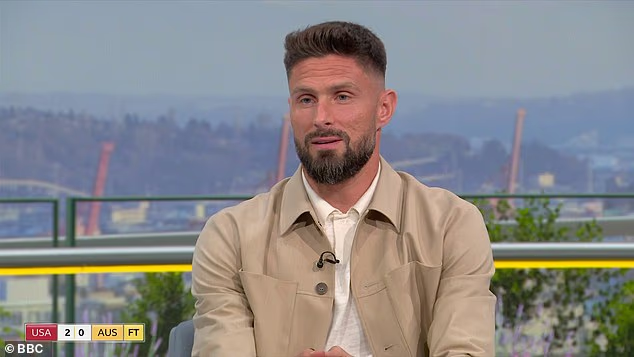
Olivier Giroud has not won many plaudits after a middling start to life as a pundit with the BBC

The BBC and ITV are in stiff competition over every aspect of World Cup coverage – but there’s only one winner when it comes to the television pundits.

Some have been an instant hit with viewers, others a damp squib. Now it it time for Daily Mail Sport to have our say on who has stood out from the crowd.

The main considerations are how influential their opinions are, how distinctive they are as pundits, and how their coverage has been received by the audience.

We have decided to only include the regular television pundits. One-off guests have been cast aside, so our sincere apologies to Gary Lineker after his ITV cameo. 

Advertisement

Let us know your thoughts in the comments. 

25. Olivier Giroud (BBC)

Olivier Giroud has brought a certain je ne sais quoi to his World Cup coverage, but in a very literal sense. People don’t know what he’s talking about.  

The Frenchman has been pelted with rotten tomatoes on social media after a difficult start to life as a pundit. Some have called him a ‘big problem’, ‘boring,’ and ‘clueless’, with others even calling for him to be replaced. A bit harsh on the current Lille striker.

Sadly, the key issue is that his command of the English language, naturally, lags behind high-quality broadcasters and so he does stick out like a sore thumb. He’s only making his baby steps as a pundit, but whether he’ll get a chance to reach adolescence remains to be seen. 

Advertisement

Olivier Giroud has not won many plaudits after a middling start to life as a pundit with the BBC

24. Gael Clichy (BBC)

We promise we don’t have anything against French pundits!

Again, fair play to Gael Clichy for giving punditry a go in a foreign language. One main criticism is that he seems overly attached to Cristiano Ronaldo. He has continually eulogised the Portugal forward when his performances have called for a more balanced critique. 

Advertisement

At least his lack of familiarity with English broadcasting convention led to one funny incident. ‘Ronaldo used to take the p*** out of people,’ he said moments before the Portugal-DR Congo game, well before the watershed. French TV tends to be less puritanical. 

Gael Clichy is another tackling the punditry game in a language foreign to his own

Gael Clichy is another tackling the punditry game in a language foreign to his own 

23. Cesar Azpilicueta (BBC)

Cesar Azpilicueta celebrated his first punditry outing with a 253-word LinkedIn post gushing about how enriching it has been, much like a bright-eyed intern. You can’t fault his enthusiasm.

While the former Chelsea defender hasn’t pulled up any trees, he has looked immediately comfortable on TV at the very least.

Advertisement

Unfortunately he has been the victim of fake quotes being spread on social media. Welcome to the internet, Cesar.

Cesar Azpilicueta hasn't pulled up any trees but looks immediately comfortable on BBC's panel

Cesar Azpilicueta hasn’t pulled up any trees but looks immediately comfortable on BBC’s panel

22. Juan Mata (ITV)

Juan Mata is another punditry newbie and as such he has been given some of the more toilsome work, making his debut for Australia-Turkey at 5am.

It’s early days but the Spaniard has at least demonstrated the conviction to nail his flag to the mast.

Advertisement

Asked by Laura Woods whether he’d rather have Lionel Messi or Diego Maradona in a team, he gave a definitive answer (he opted for little Leo) where others might have equivocated. 

Juan Mata made his World Cup punditry debut during Australia's clash with Turkey on ITV

Juan Mata made his World Cup punditry debut during Australia’s clash with Turkey on ITV

21. Karen Carney (ITV)

Karen Carney is among the most targeted pundits on social media, often due to blatant sexism, so it is to her credit that she soldiers on and earns her crust.

As much as she generates it, Carney doesn’t court controversy. She approaches her work professionally. She has the football IQ to be at the top table. 

Advertisement

However, the overriding sentiment among viewers is that her punditry is bland.

20. Jobi McAnuff (ITV) 

Listen to Jobi McAnuff and you will notice how eloquent he is. No one can fault the depth of his research either. That might sound a bare minimum but it’s not always the case in a land of bleating broadcasters.

Unfortunately the former Reading and Leyton Orient midfielder’s name doesn’t carry the weight to drive the agenda in the way that some of his ITV colleagues can. 

19. Rachel Corsie (BBC)

Former Scotland women’s captain Rachel Corsie clearly prepares well and is a very detail-oriented pundit. 

Advertisement

The BBC has treated her in a very narrow sense of: ‘explain this football match to us.’ She hasn’t been given much of a chance to show her personality or strike up a rapport with fellow Tartan Army pundit Scott Brown, so her input has been quite limited.  

Rachel Corsie is a well-prepared pundit but hasn't been given a very broad remit

Rachel Corsie is a well-prepared pundit but hasn’t been given a very broad remit 

18. Scott Brown (BBC)

Brown has lots of potential as a pundit but failed to really unleash himself at this World Cup and often felt quite monotone.

After Scotland’s 3-0 defeat by Brazil, the strongest adjective he could muster was ‘disappointing,’ which fell short of expressing the feelings of the fans back home. Was this not gut-wrenching and a catastrophe? 

Advertisement

When he spreads his wings, Brown is impressive. He was highly energetic and insightful in some of his recent analyses with tactics correspondent Umir Irfan.  

The BBC could have allowed Scott Brown to spread his wings more for Scotland's coverage

The BBC could have allowed Scott Brown to spread his wings more for Scotland’s coverage

17. Steph Houghton (BBC) 

Former England captain Steph Houghton certainly had the pedigree to talk about World Cups after playing in three of them. Houghton, of course, missed a penalty against the United States in the 2019 World Cup semi-finals. 

That she even finds the capacity to work is remarkable. Her husband, former Liverpool player Stephen Darby, who she has supported so much, is currently suffering from Motor Neurone Disease. 

Advertisement

Like other female pundits, she has faced inestimable levels of vitriol online. Kindness is in short supply. Houghton, when you listen, is well-prepared and knowledgeable. 

16. Lucas Leiva (BBC) 

Lucas Leiva does not look like he has aged a day in the nine years since he left Liverpool – and his cheeky chappy personality hasn’t changed, either. 

The Brazilian has been a good source of knowledge on his homeland, who are more under the radar than usual, and has brought some levity to the late-night broadcasts.

He also had the grace to not stick the boot in too much when the Selecao beat Scotland…

Advertisement

15. Benni McCarthy (BBC)

Former Blackburn striker Benni McCarthy has pulled no punches when talking about his beloved South Africa’s struggles at the World Cup.

The 48-year-old even jokingly offered his own services after their draw against the Czech Republic, quipping: ‘They really could have done with someone like me up front!’

An energetic speaker with splashes of humour – he went viral for his speechless reaction to Bafana Bafana’s opening-day defeat against Mexico – McCarthy is an easy watch.

Former Blackburn striker Benni McCarthy has brought flashes of humour to his BBC punditry

Former Blackburn striker Benni McCarthy has brought flashes of humour to his BBC punditry

Advertisement

14. Bradley Wright-Phillips (ITV)

One thing is for certain with Bradley Wright-Phillips: he tells it like it is.

‘They’ve got no hope,’ he said after Scotland’s defeat against Brazil. ‘They’ve shot themselves in the foot too many times. The worst thing as a player is looking back and regretting. In that camp, they’ll look back and think: “We could have done more.” That’s the hardest thing to live with. No disrespect to Haiti, go and score some goals against them.’

Where the BBC’s pundits were mealy-mouthed on Scotland, he gave a bold opinion. His on-air reunion with his dad, Ian Wright, after 18 months apart was touching.  

13. Ashley Williams (BBC)

Ashley Williams is a good and likeable pundit but unfortunately his standout moment this tournament was getting ribbed on social media.

Advertisement

After Lionel Messi scored twice in Argentina’s 2-0 win over Austria, the former Wales defender appeared to have a lightbulb moment, saying: ‘Are we looking at the greatest player ever? It’s possible. It’s definitely worth the debate. We might have just witnessed the greatest player that football has ever seen.’

Cue all the jokes about him living under a rock for 20 years. That debate has been and gone, Ashley. Kinder viewers will note his analytical skill and tendency to bring his co-panelists into the discussion, giving the broadcast a conversational feel.

Ashley Williams' standout moment this tournament was him getting ribbed on social media

Ashley Williams’ standout moment this tournament was him getting ribbed on social media

12. Patrick Vieira (ITV)

Patrick Vieira is an experienced hand with this punditry dance and isn’t likely to drop many clangers.

Advertisement

Until ITV stick him next to his old rival Roy Keane, they’re probably not going to make the most of him. Not much to note so far.

Experienced Patrick Vieira has had a quiet start to the World Cup but is a safe pair of hands

Experienced Patrick Vieira has had a quiet start to the World Cup but is a safe pair of hands

11. Wayne Rooney (BBC)

Rooney has come on leaps and bounds as a speaker. Watch him now and compare it to a few years back and the contrast is like night and day.

He speaks with a lot more confidence and fluency and appears to be more comfortable in himself. Rooney has previously admitted to his nerves and while there are still a few shaky moments, he is more polished as a pundit now.

Advertisement

His next step is to build a distinctive style as a pundit. Few come close to his level of experience in football and we’re starting to see why the BBC thinks he has potential.

Wayne Rooney has come on leaps and bounds as a speaker as part of BBC's punditry team

Wayne Rooney has come on leaps and bounds as a speaker as part of BBC’s punditry team

10. Ellen White (BBC)

Ellen White has been bunged with some of the less glamorous overnight jobs – Croatia vs Panama at midnight, for example – but has done a good job.

She’s warm, articulate and, where she can, tends to favour praising players than tearing them down.

Advertisement

The Lionesses’ record goalscorer exudes a more traditional charm, rather than pandering to social media with powderkeg opinions or laugh-a-minute tomfoolery. That can see her go under the radar.

9. Joe Hart (BBC)

Joe Hart is arguably the brightest talent among the ‘new wave’ of pundits.

The 75-cap former England captain is genuinely illuminating when talking about his fellow goalkeepers. He’ll break down their footwork, timing, how they jump, hand shape, any minutiae you haven’t even thought of.

His analysis of why so many long shots have gone in – because the Trionda ball doesn’t spin much when it’s flying – is much more detailed than what most of his rivals could ever offer.

Advertisement
Joe Hart is one of punditry's rising stars and offers excellent analysis in the goalkeeper role

Joe Hart is one of punditry’s rising stars and offers excellent analysis in the goalkeeper role

8. Thomas Frank (BBC)

A recent Premier League manager, Thomas Frank is thoughtful and meticulous. You could trust him with the most obscure game and he’ll pick things out other people haven’t noticed.

He carries himself with a slightly eccentric manner – you never quite know which way his thoughts are going to veer – and it makes him an engaging watch. However, he might not be everybody’s cup of tea.

Thomas Frank carries himself with a slightly eccentric manner - which makes him engaging

Thomas Frank carries himself with a slightly eccentric manner – which makes him engaging

Advertisement

7. Ange Postecoglou (ITV)

‘Big Ange’ brings an Australian lilt and charm to his punditry which provides a pleasing contrast to some of his more stiff-collared counterparts. ‘Mate, he’s in an off-side position,’ he drawled at one juncture.

Like Frank, he brings a sharper eye and deeper analysis than most and presents his thoughts in a clear manner. He’s also less predictable than the likes of Gary Neville and Roy Keane, though he will always bang the drum for attacking football.

At times he can stray into being too academic, talking of less familiar concepts such as ‘half-spaces’, but you always come away feeling like you’ve learned something.

Ex-Spurs boss Ange Postecoglou brings charm and thorough analysis to ITV's punditry panel

Ex-Spurs boss Ange Postecoglou brings charm and thorough analysis to ITV’s punditry panel

Advertisement

6. Duncan Ferguson (ITV) 

Former Everton and Newcastle striker Duncan Ferguson has been one of the surprise packages of this tournament’s punditry panel.

He’s honest, passionate, and funny. Not only that, he’s highly adaptable – stick him on any match or in any situation and he looks right at home.

In the same broadcast, he questioned Steve Clarke’s resignation (against the grain) and then put himself forward for the job. He’s bantered with Haitian rapper Wyclef Jean. His self-deprecating touch – joking about his 10 operations, for example, have made him a hit with his co-pundits and the audience. Should be called on more often during the next Premier League season. 

Advertisement

5. Emma Hayes (ITV)

Emma Hayes has the hardest job of any talking head at the World Cup and is making it look like a piece of cake.

Her insights – delivered during FIFA’s money-grabbing hydration breaks – are second to none. The ability to watch a game live, spot trends, and explain them succinctly to viewers is a real skill. She does it at a moment’s notice and without assistance from anyone else in the studio.

The legendary ex-Lionesses manager has withstood a putrid tide of sexist abuse on social media and made her critics look like buffoons. You don’t have to like her, but her authority and competence are unimpeachable.

Emma Hayes has been superb at giving detailed analysis during FIFA's hydration breaks

Emma Hayes has been superb at giving detailed analysis during FIFA’s hydration breaks

Advertisement

4. Micah Richards (BBC)

It’s an interesting thought experiment: can Micah Richards survive when he is unplugged from Roy Keane and Alan Shearer? Does he simply subsist to poke fun at them and laugh at his own jokes, or does he have an alternative setting?

As it turns out, he is more versatile than he gets credit for. Richards is not merely a rent-a-joke entertainer. His experience on Match of the Day and Sky Sports has made him a fine clip analyst.

Any broadcast with Richards on is brighter and bolder. Even in this more constrained mode with the BBC, he stands out for how he brings energy to the discussion and coaxes the best out of the other pundits around him. The best the BBC have got. 

3. Roy Keane (ITV)

It is interesting to see Roy Keane mellow. His most popular moments now are his (intentional) unintentional comedic moments. Re-watch his analysis from Portugal’s demolition of Uzbekistan and you’ll see that he spends most of his time making quips at Gary Neville’s expense.

Advertisement

He still remains one of the only true forthright pundits, a man who will criticise players without fear or favour, though he has toned things down a tad. 

2. Gary Neville (ITV)

Gary Neville has to be in the conversation for king of the jungle. He has nailed the art of punditry.  

As always, Neville has been well-informed and outspoken. On ITV’s airwaves he has held FIFA to account over ticket prices and given a balanced appraisal of Cristiano Ronaldo.

Advertisement

His ongoing commitment to his podcast may detract from his availability for ITV, but he’s an automatic headline dispenser when they’ve got him on, drawing attention to their coverage over the BBC’s. 

Gary Neville has been juggling his ITV work with his ongoing podcast commitment

Gary Neville has been juggling his ITV work with his ongoing podcast commitment 

1. Ian Wright (ITV) 

Ian Wright has become an uncle to the nation. Pretty much anything he says about the beautiful game, at least in the big-picture sense, hits the nail on the head. 

You can trust him to challenge FIFA to the very last breath as they continue to do their worst at running the game. His video posted shortly after Somalian referee Omar Artan was banned from entering the United States has garnered 8.7million views. People care about what he has to say and he connects with the public. 

Advertisement

He has not always behaved perfectly, but in his punditry, he carries himself with a humanity and a natural sympathy for players, particularly young ones. A man who treats his microphone responsibly. ITV bagging him over the BBC is a knockout blow. 

Ian Wright has once again shown himself to be a humane and outspoken pundit

Ian Wright has once again shown himself to be a humane and outspoken pundit 

Verdict

ITV have six of the seven best. The BBC has the three worst. There’s no debate over which broadcaster has won the battle.

How much is David Beckham set to pocket from his World Cup brand deals? Take on our quiz in our newsletter HERE

Advertisement

Source link

Continue Reading
Click to comment

You must be logged in to post a comment Login

Leave a Reply

NewsBeat

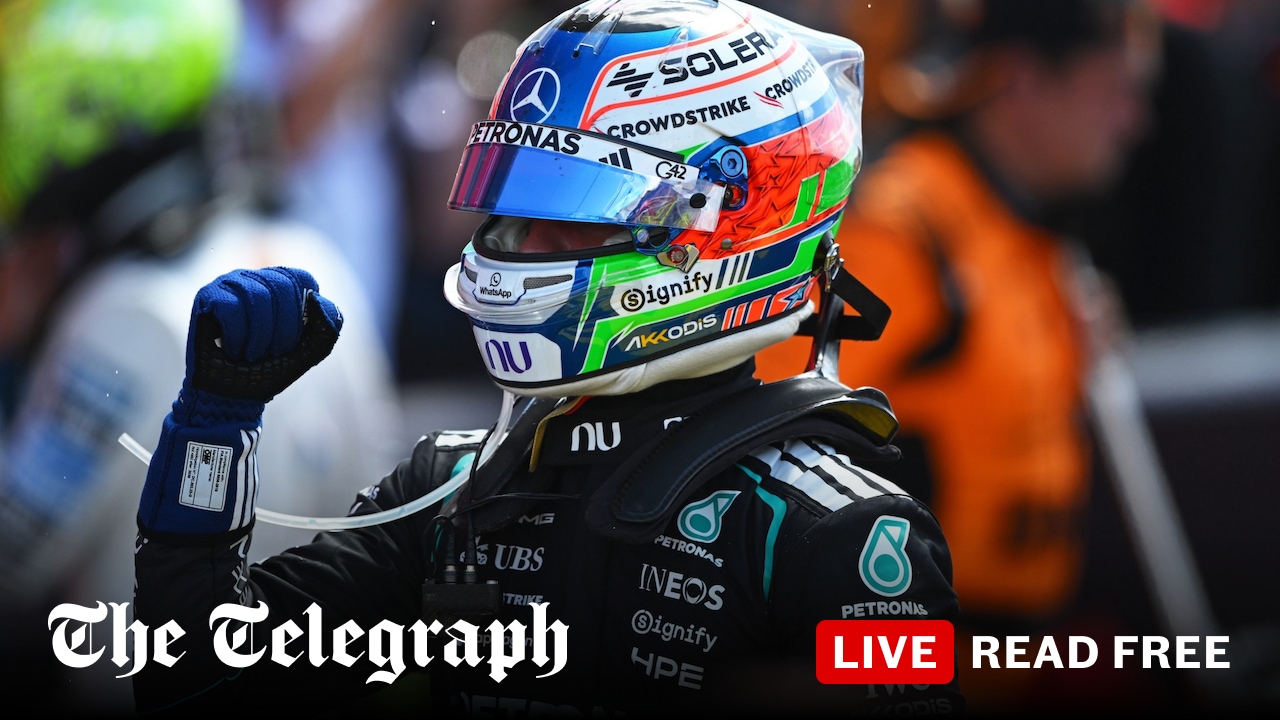
Lewis Hamilton denied by Kimi Antonelli in British GP sprint race

Published

on

Lewis Hamilton denied by Kimi Antonelli in British GP sprint race

Antonelli wasted little time in breaking the one-second gap to Hamilton – in which drivers can deploy “overtake mode” and was able to surge to victory by nearly three seconds, setting the fastest lap on the final lap.

“Kimi, well done. Did the fastest lap make you happier at the end?” Mercedes team principal Toto Wolff asked him.

“Yeah it made me happier,” came the response.

Advertisement

McLaren’s Lando Norris was a distant, albeit encouraging third, ahead of George Russell, who will be increasingly concerned at his inability to match his Mercedes team-mate so far this weekend.

The fans at Silverstone will also be a bit deflated at what this result might mean for Sunday’s feature race.

“It’s tough race to keep the Mercedes behind,” Hamilton admitted. “I did say that would potentially be the case, and also [there was] a big big headwind down the back straight and he came flying past. 

“Once he got the overtake mode I couldn’t hold him back. As soon as that was lost, I knew he was coming.”

Advertisement

Qualifying for the main race takes place at 4pm UK time.

British Grand Prix, sprint classification

  1. Kimi Antonelli, Mercedes 8pts
  2. Lewis Hamilton, Ferrari 7pts
  3. Lando Norris, McLaren 6pts
  4. George Russell, Mercedes 5pts
  5. Charles Leclerc, Ferrari 4pts
  6. Max Verstappen, Red Bull 3pts
  7. Oscar Piastri, McLaren 2pts
  8. Liam Lawson, Racing Bulls 1pt

Source link

Continue Reading

NewsBeat

Darlington market to hold ‘twlight fan zone’ for England v Mexico

Published

on

Darlington market to hold 'twlight fan zone' for England v Mexico

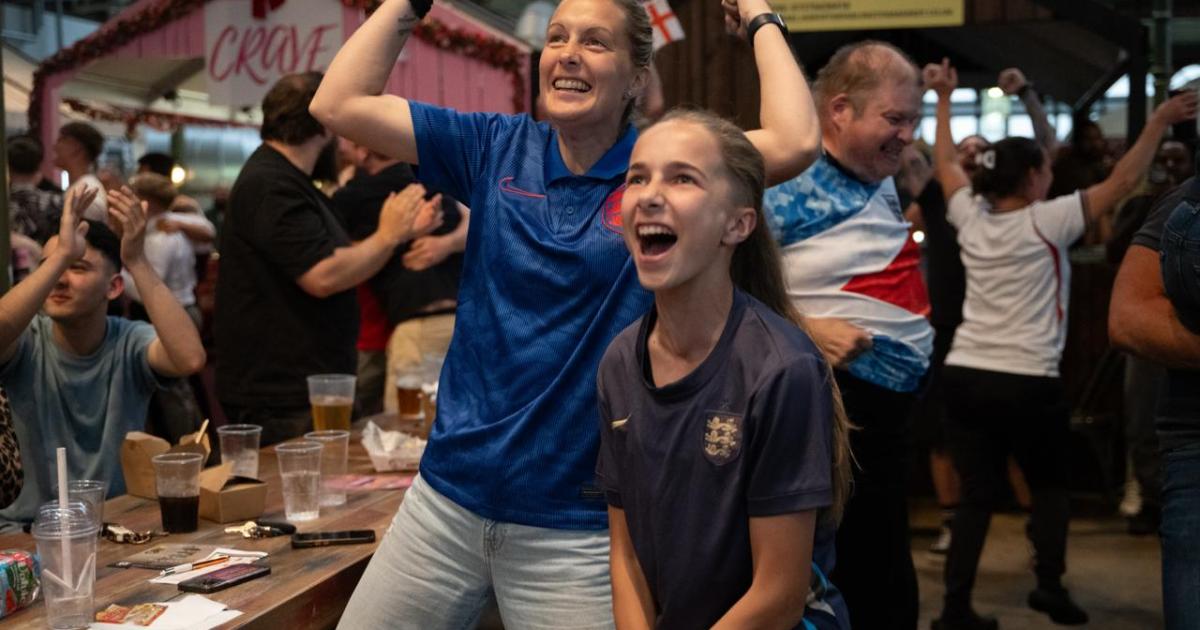
Darlington Market’s Street Food Hall is throwing open its doors on Sunday night, giving supporters a chance to watch England’s last-16 clash on the big screen.

The Market Tap Bar will open at 8pm on Sunday (July 5), giving fans time to settle in, grab a drink, and enjoy food from the market’s independent street food traders before kick-off.

The first game on the big screen will be Brazil v Norway at 9pm, followed by England v Mexico at 1am on Monday (July 6) – with the match taking place at the Azteca Stadium in Mexico City.

(Image: HARRY FUTERS)

England vs Mexico – what you need to know

England qualified from the group stage and now face Mexico in the last 16 in what promises to be one of the most anticipated fixtures of the tournament.

Advertisement

(Image: ANDY FUTERS)

The match will air on BBC One and BBC iPlayer.

Darlington Market fan zone details

Bar opens: 8 pm, Sunday, July 5

Brazil vs Norway kick-off: 9 pm

Advertisement

England vs Mexico kick-off: 1 am, Monday, July 6

The market said: “Get your friends together, wear your England colours, and cheer on the Three Lions with us.”

Will you be heading out to watch the football or staying in? Let us know in the comments.

Advertisement

Source link

Continue Reading

NewsBeat

How the US has celebrated its independence over the years

Published

on

How the US has celebrated its independence over the years

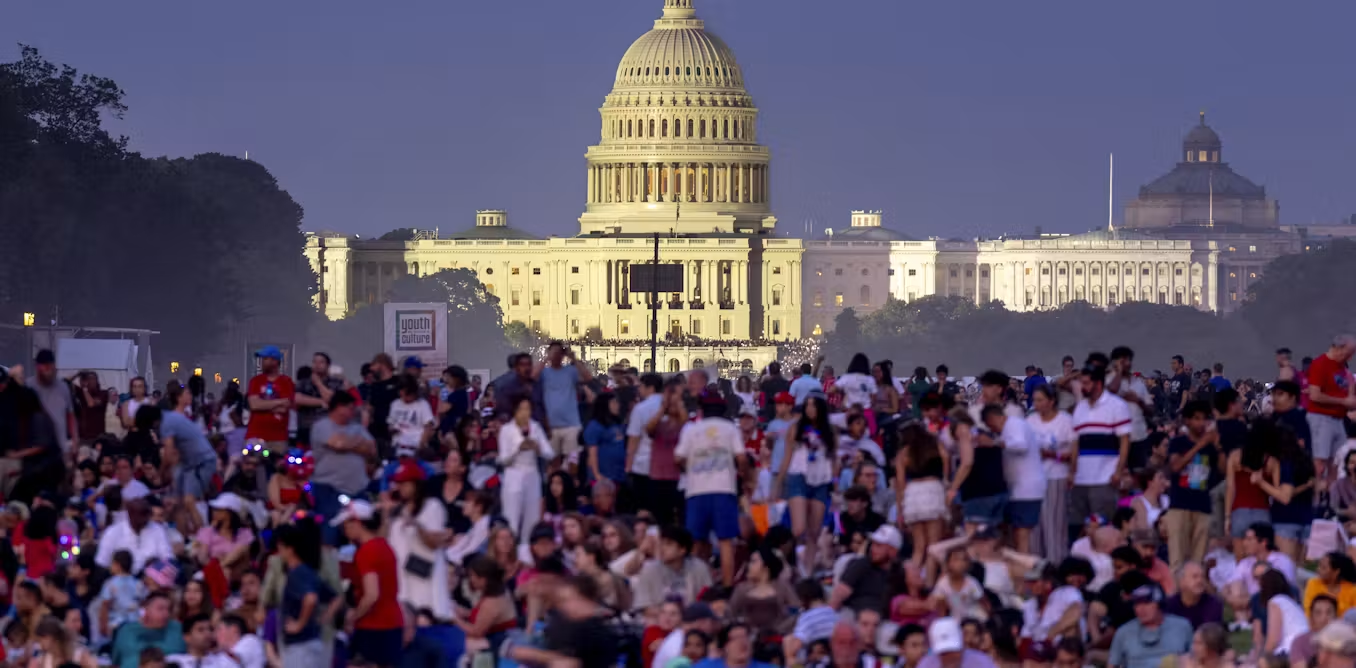
The plans for the 250th anniversary of the American revolution, which kicks off in earnest on July 4, have drawn media scrutiny in the US. One issue has been the subject of recurrent discussion: the role of President Donald Trump.

Behind this scrutiny is the claim that Trump is co-opting the anniversary for his own agenda. His administration’s alleged sidelining of the non-partisan “America250” commission, which was established by Congress in 2016, in favour of his rival “Freedom 250” organisation has drawn particular comment.

The 250th anniversary, it seems, has become a hotly contested battleground.

This is not entirely without precedent. As historian Michael Hattem explains in his 2024 book, The Memory of ‘76, Americans have long argued over the revolution’s lessons and legacy. This can be traced to the late 18th century, when US politics began to assume some of the adversarial qualities all too familiar today.

Advertisement

In the 1790s, the arguments were generally between Alexander Hamilton’s Federalists and Thomas Jefferson’s Democratic-Republicans. For Federalists, who were keen to rebuild the relationship with Britain, July 4 celebrations often emphasised order and strong government.

For the Democratic-Republicans, however, the anniversary offered an opportunity to criticise what they saw as Federalist fealty to Britain. The result was that July 4 commemorations often became highly partisan.

A statue of Alexander Hamilton on the campus of Columbia University in New York.
Spiroview Inc / Shutterstock

Competing claims on July 4 recurred in subsequent decades, especially during the 1850s when sectional tensions between the north and south worsened. At the centre of these tensions was slavery.

For African-American abolitionists, the ideals articulated by the Declaration of Independence provided weapons with which to attack the evil of slavery in the south. The most powerful example of this was an 1852 speech given by Frederick Douglass in which he pointedly asked: “what to the slave is the fourth of July?”

Advertisement

The outbreak of civil war in 1861 further intensified the sectional divide over July 4. Many white southerners even drew parallels between the south’s status in the union and that of the 13 American colonies in the British empire.

According to this view, just as American colonists had been oppressed by the “tyranny” of Britain’s King George III – who they held responsible for the imposition of taxes and restrictive legislation – so was the south similarly oppressed by the north’s refusal to countenance the expansion of slavery.

By tracing this connection, historian Paul Quigley notes that these southerners used July 4 to present “themselves as the real Americans and northerners as traitors”. This was the memory of 1776 used to justify secession. The view of the then-president, Abraham Lincoln, was of course the complete opposite. For him, it was the union which was the true heir to the ideals of July 4.

Yet more arguments over the revolutionary past followed during the centennial of 1876. The anniversary came amid an economic recession and towards the end of the period known as “Reconstruction”. This period had seen the federal government readmit southern states into the union while also attempting to secure the rights of the formerly enslaved.

Advertisement

For some white northerners, the centennial was seen as an opportunity to promote reconciliation with the south. One consequence of this was that African-American contributions to the revolution were marginalised, something black communities in turn actively contested.

Attempts by local elites to dominate July 4 commemorations in cities like Boston similarly provoked pushback from recent immigrants and minority groups determined to ensure their inclusion in the commemorations. As a result of these tussles, the centennial of 1876 was marked by what historian Jack Noe has called “the deep sectional, partisan and racial divisions of an unreconciled nation”.

The 1976 bicentennial

Similar to its predecessor, the 1976 commemorations followed an enormously divisive conflict: the Vietnam war. And, again like the 1870s, the anniversary also unfolded during an era of economic uncertainty. An oil crisis in 1973, caused by an embargo imposed by oil-producing countries in the Middle East, was quickly followed by a recession that lasted until 1975.

There were even accusations of corruption levelled at the Bicentennial Commission, which had been created to plan the 200th anniversary, and linked to the activities of the Nixon administration. The commission was dissolved in 1973 and replaced by a new organisation called the American Revolution Bicentennial Administration.

Advertisement
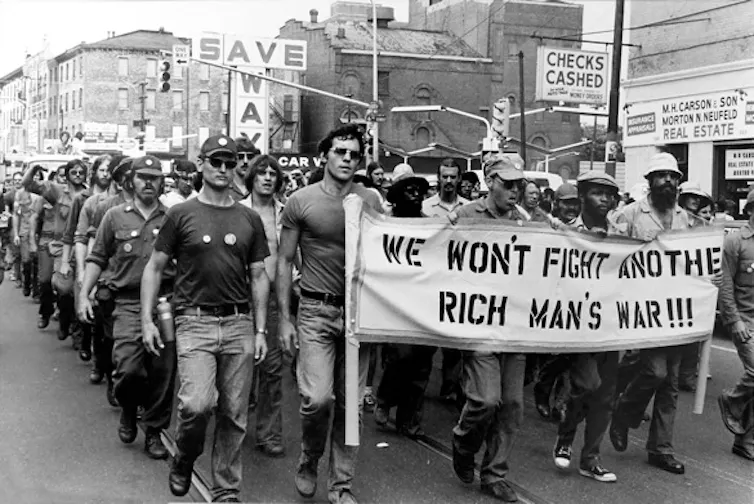
Supporters affiliated with VVAW march in protest during the Bicentennial, Philadelphia 1976
US citzens march the streets of Philadelphia in protest against the Vietnam war, 1976.
Wikimedia Commons

The bicentennial was thus another fraught anniversary. There were high-profile events in New York, Philadelphia and Washington, some of which were attended by Queen Elizabeth II at the invitation of the then-US president, Gerald Ford.

Following the social unrest of the Vietnam era, as well as the political turmoil of the Watergate Scandal which had led to the resignation of Richard Nixon as president in 1974, many Americans found escape in patriotic nostalgia. The anniversary even drew interest abroad. One small village in northern England, Warton in Lancashire, marked the occasion with a ten-day party due to its ancestral connections to George Washington.

Elsewhere though, the 200th anniversary again revealed domestic division. From the left came criticisms of excessive commercialisation, with historian Jesse Lemisch identifying a slew of what he called “bicentennial schlock”.

In some American towns and cities, meanwhile, commemorations likewise exposed discord. In Boston, for instance, the anniversary became tied up with local tensions linked to the desegregation of schools.

The revolutionary past has long been a contested battleground in the US, particularly during periods of partisan politics, social tumult and economic uncertainty. In this regard, the 250th anniversary has much in common with its predecessors.

Advertisement

Source link

Continue Reading

NewsBeat

Prince Harry will NOT bring Meghan, Archie and Lilibet to London: Latest twist in Sussex saga as it emerges family may still visit Diana’s grave

Published

on

The Duchess of Sussex, Prince Archie and Princess Lilibet will not travel to London on Monday after a request for police protection was denied, however they may still visit the UK

The Duchess of Sussex and her young children will not travel to London on Monday with Prince Harry after a demand for extra security was turned down.

The decision by the Sussexes is the latest twist after ten days of fraught discussions which are said to have reduced Harry ‘to tears’.

Harry will fly to London alone on Monday. It is not known if he has accepted his father’s offer to stay at a Royal residence. Several reports have claimed Charles has offered private apartments at Buckingham Palace or Windsor Castle.

But sources close to the couple have not ruled out Meghan and the children coming to the UK later in the week. Archie and Lilibet have not seen King Charles since 2022.

Advertisement

Meghan is due to join her husband at an event in Birmingham on Friday to promote next year’s Invictus Games, the charity for wounded servicemen that Harry set up in 2014.

It is understood Meghan and Harry could bring Prince Archie, seven, and Princess Lilibet, five, with them when they travel to other parts of the UK.

Sources previously claimed there have been ‘real and credible threats’, including threats of terrorism, against Harry and his family in the capital.

The five-day Sussex trip to the UK has been fraught with upset and drama.

Advertisement

The Duchess of Sussex, Prince Archie and Princess Lilibet will not travel to London on Monday after a request for police protection was denied, however they may still visit the UK 

It is understood Prince Harry will meet his father King Charles during the visit, with plans to see each other made privately between them

It is understood Prince Harry will meet his father King Charles during the visit, with plans to see each other made privately between them 

Harry remains enraged that he does not receive around-the-clock police protection during his trips to the UK.

Advertisement

Instead he has to give three weeks’ notice of his visits which are assessed on a ‘case by case’ basis.

Harry’s team originally briefed the Press that he was coming with his wife and children – Meghan has not visited the UK since the Queen’s funeral in September 2022 – but, less than 24 hours later, said he feared for their safety if they came without full-time taxpayer-funded armed police protection and his spokesman said the family would no longer accompany him.

But now Harry’s team are saying that while the family will not travel to London with him there is a chance they may join him during other parts of his UK visit.

It is thought he wants to take his children to his mother Princess Diana’s family home, Althorp, where she is buried on a private island in the middle of a lake.

Advertisement

A source said: ‘Harry longs to bring his children to the UK, to show them where he comes from and to introduce them to their heritage. And he wants to take them to Althorp which is where Diana was raised and where she rests. 

‘It’s important to him that the English side of their heritage is part of their life. But their security is everything. There are real and credible threats and he will not put his family in danger.’

Harry and Meghan had planned to attend other charity events in the UK including a visit to the Royal Hospital Chelsea in London.

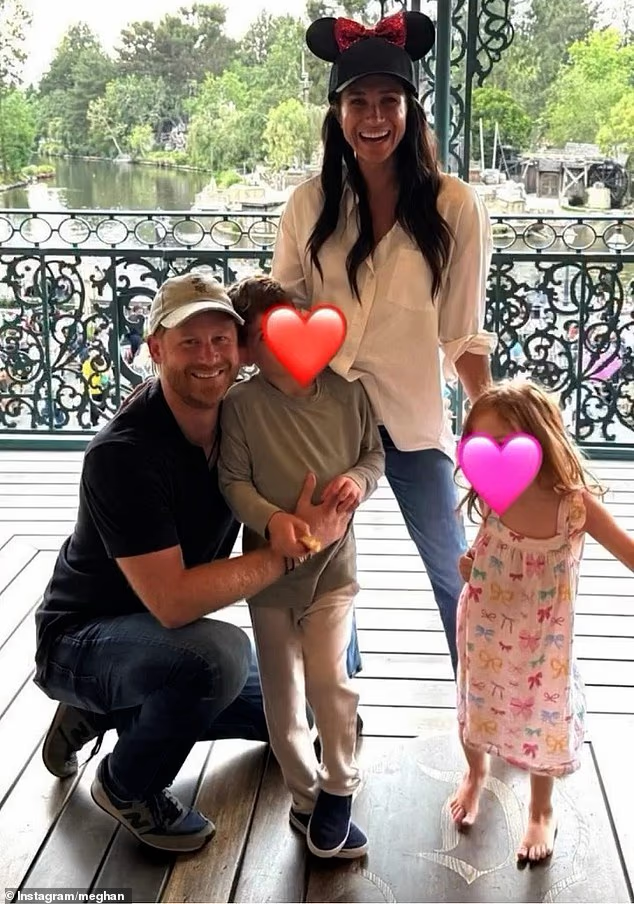
Meghan is expected to make her first return to the UK since 2022, accompanied by her children Prince Archie, 7, and five-year-old Lilibet

Meghan is expected to make her first return to the UK since 2022, accompanied by her children Prince Archie, 7, and five-year-old Lilibet

Advertisement

It is thought Harry will now attend the London events solo.

The Sussex drama has been going on all week.

The family is currently in Europe, possibly at their holiday villa in Portugal, and had been scheduled to travel together on Monday.

The Mail understands there are tentative plans to see members of the Royal Family, including the King, but in a private capacity with courtiers telling the Sussexes they cannot release any photographs of any reunion.

Advertisement

Prince William and Princess Kate are unlikely to see the Sussexes during their visit.

Meghan and Harry flew to Canada and then the US during Megxit in March 2020 when they stepped down as working members of the royal family.

They live in a £14million mansion in Montecito and friends say both Lilibet and Archie have strong American accents.

Harry has previously said it is his ‘ardent wish’ for his children to know about their British heritage.

Advertisement

Meghan’s jam-making business in the US has not been the roaring success she hoped it would be and their $100million Netflix deal was cancelled last year.

A Netflix source said: ‘They need a strong connection to the UK to be relevant in the US. People only care about the fact that Harry is Diana’s son. Their only currency is their proximity to the Royal Family, certainly as far as America is concerned. They need to maintain their links to the King.’

Harry has long argued that security concerns have prevented him bringing his family to Britain after his taxpayer-funded protection changed - he says he wants his children to visit

Harry has long argued that security concerns have prevented him bringing his family to Britain after his taxpayer-funded protection changed – he says he wants his children to visit

Critics have accused Harry of using ’emotional blackmail’ by flip-flopping on his decision about whether to bring his children to the UK.

Advertisement

The King, who is very close to his other grandchildren, has made it clear he would love to see Archie and Lilibet, particularly as he has been fighting cancer.

Harry is due to attend events for WellChild and Scotty’s Little Soldiers during his visit.

The ruling in his case against Associated Newspapers is due on Tuesday, as Harry makes his first speech in the UK. 

He and others accused the Daily Mail of using unlawful means to produce stories, a charge the Daily Mail vehemently denies. 

Advertisement

If he loses the case he could potentially face millions of pounds in legal fees.

Source link

Continue Reading

NewsBeat

The Art of Protest director on hopes for debut York festival

Published

on

The Art of Protest director on hopes for debut York festival

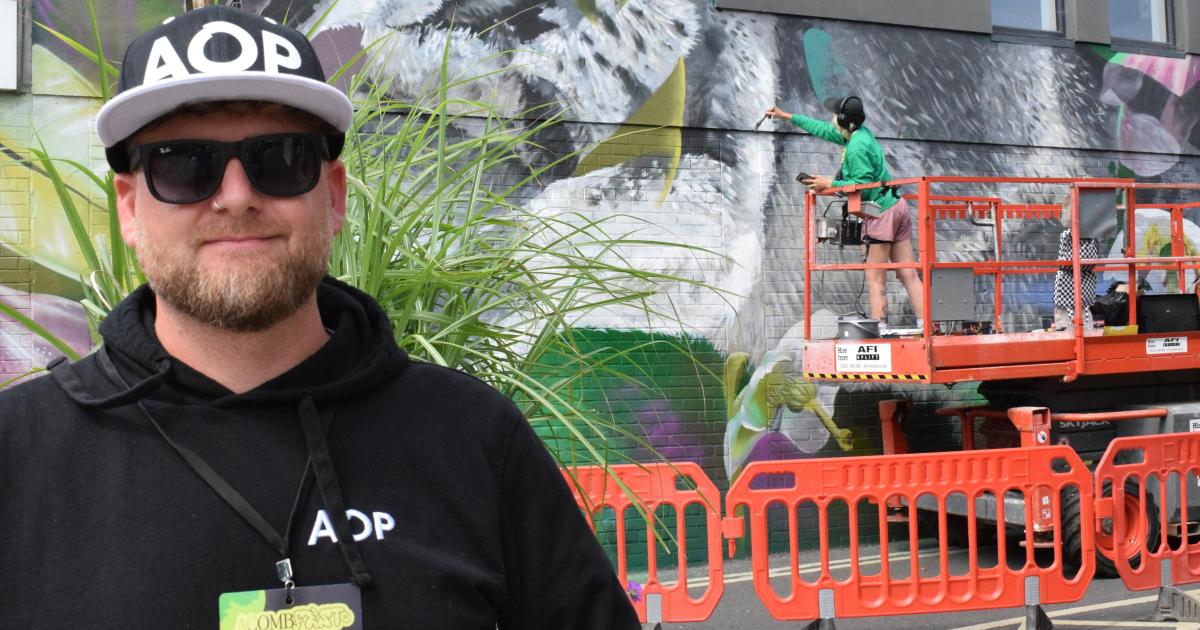
Jeff Clark, creative director of The Art of Protest, who say they are changemakers “dedicated to transforming towns cities and communities – one spray can at a time”, spoke to The Press at something of a homecoming York event – AcombFest 26.

Their mission statements emphasise effecting meaningful change through art and culture, collaborating with local authorities and stakeholders, and creating a stronger sense of vision, belonging and identity in public spaces.


Recommended reading:


For three days starting yesterday (Friday, July 3), Front Street, York Road and the wider urban area are transforming into an open-air gallery, blending art, community, and family fun across the west of the city.

Advertisement

Internationally recognised mural artists and multimedia experts are creating live street art, with large-scale pieces transforming the area under the festival’s “return to nature” theme.

Jeff said the business has been around for the last ten years and he has brought this type of event to all parts of the world.

On returning to Acomb he said: “It was really nice to be able to bring it back to my hometown.

“We have been operating in York a long time – as a business we’re placemakers, we’re specialists in that and we use art as a vehicle to communicate.

Advertisement

“For us, to be able to communicate well to the people, to show how community can be created, it’s a real pleasure.

Acomb, I suppose, it’s our home and it’s where most of the team are.

“It’s where a lot of them grew up.”

A large-scale mural of an owl on the side of a house in AcombCurtis Hylton’s work What Flies Above Us is next to the Post Office in York Road (Image: Kevin Glenton)

Jeff said there are times where curators of events like AcombFest could feel like they are being parachuted into a lot of the communities they tranform.

Advertisement

‘I realised without showing people first, you can’t quite get to it’

“We don’t do that, we work with people because we want to art with people not to them as a collective voice, being here long enough to feel the element of change, he said.

“Look around us right now. It’s buzzing and it’s a fair thing to say that we’re changing the viewpoint and also the conception of the place.”

In the build-up to this inaugural event, The Art of Protest visited nine schools and over 1,100 residents of Acomb to give them a flavour of what to expect and listen to what they want.

Front Street in YorkHundreds of people have descended on Front Street this morning to take a glimpse at the murals and take part in activities that run from Dansbury Drive to Holgate Road (Image: Kevin Glenton)

He said: “Some people don’t quite understand what you’re doing, and I realised without showing people first, you can’t quite get to it, so the first thing we started to do was to show them different types of art – styles, expressionist details on walls how that works and let them learn a little bit more.

Advertisement

“From that we started to actually get workshops up – the incredible spray paint workshops allow people then to build up layers and work on art and we themed that around animals because that’s what was asked for.

“When we went back, the one thing everyone asked for was ‘returning to nature’.

“Why? Because there’s green spaces people aren’t returning to.

“We sit inside our houses, we stare at screens and we know that nature is good for us but somehow it doesn’t get us excited enough to get out there.

Advertisement

“If we interrupt our landscape with a juxtaposition by painting really well-curated beautiful pieces of art it reminds people that they’re a part of something bigger.”

Jeff Clark hopes AcombFest 26 hopefully is just the start of something.

He said: “What we want to see is the inspiration to move people forward, so hopefully it creates new budding artists of the future.

“And when they walk around this space – there’s paint jams, there’s live exhibitions, there’s so many different things we want the people, and the artists to come forward.

Advertisement

“We want more artists.

“We need to slow down the concept of AI and we need to increase the enjoyment of physically making things, use our dexterity.

“We would like to be here next year and creating art again.”

Advertisement

Source link

Continue Reading

NewsBeat

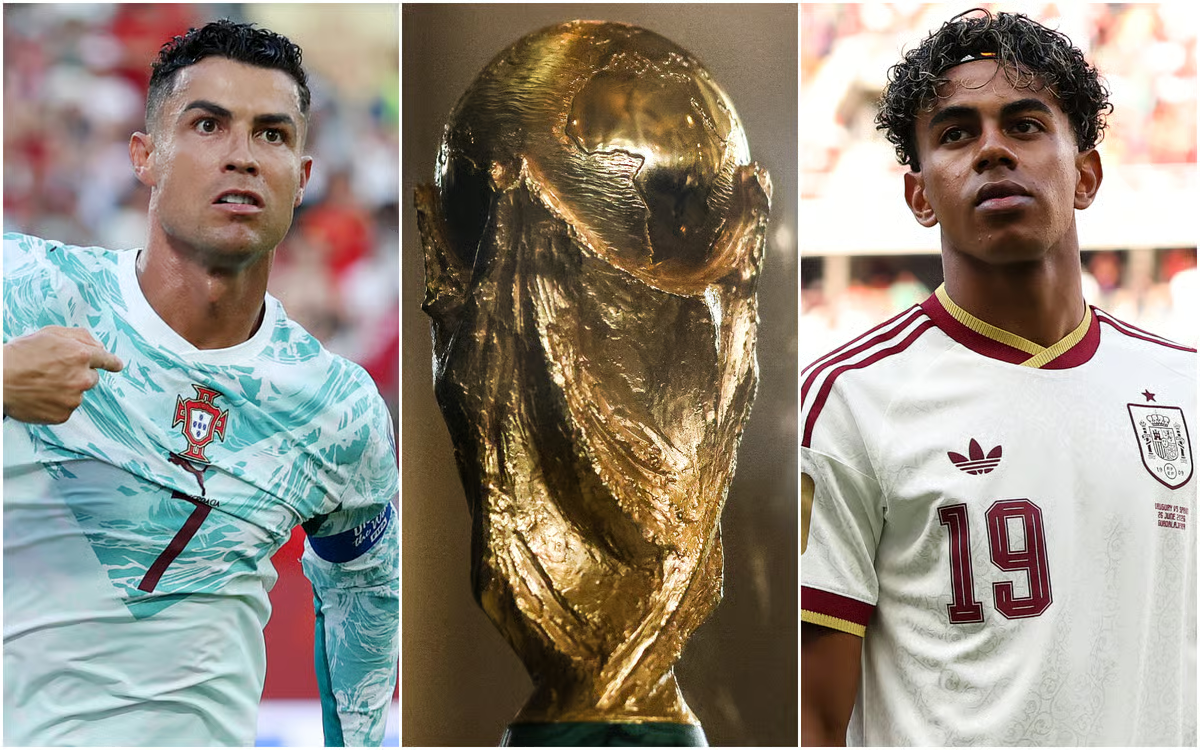
Portugal vs Spain: World Cup 2026 prediction, kick-off time, TV, live stream, team news, h2h results, odds

Published

on

Portugal vs Spain: World Cup 2026 prediction, kick-off time, TV, live stream, team news, h2h results, odds

Source link

Continue Reading

NewsBeat

Police rush to incident on major Cambridge road

Published

on

Cambridgeshire Live

Emergency services are currently at the scene

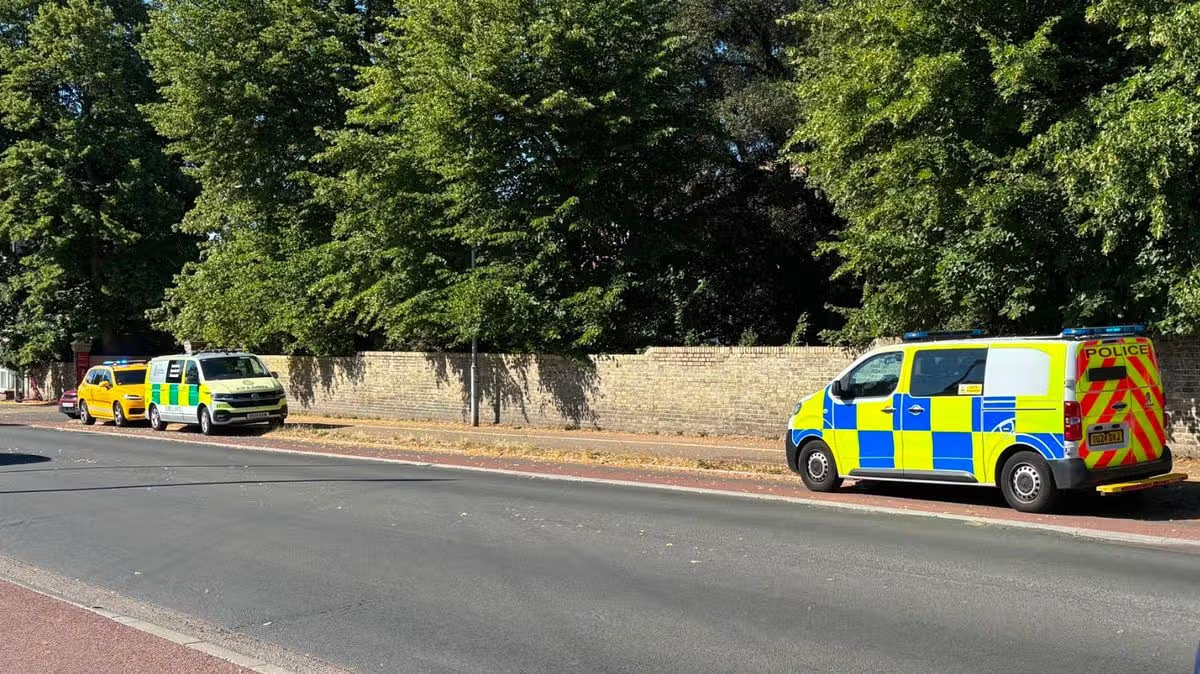
Police rushed to an incident on a busy Cambridge road. Emergency services have been spotted this morning at an incident on Hills Road in Cambridge (Saturday, July 4).

Police cars, a critical care car and an ambulance are at the scene of an incident at a building on Hills Road. Local residents have spotted an ambulance and police cars at the scene.

It is not yet clear what the exact nature of the incident is. Cambridgeshire Police have been contacted but the force refused to comment at this stage. Cambridgeshire Live will bring you updates on the incident when we have them.

Advertisement

Source link

Continue Reading

NewsBeat

Ukrainian drone attack hits oil terminal in St. Petersburg

Published

on

Ukrainian drone attack hits oil terminal in St. Petersburg

A Ukrainian drone attack struck an oil terminal in St. Petersburg on Saturday, Russian officials said, as Kyiv presses on with bombardment of Russia’s oil infrastructure.

Almost daily long-range attacks on Russian oil facilities have created a fuel crisis and heaped political pressure on the Kremlin as its all-out invasion of Ukraine stretches into its fifth year.

Gov. Alexander Beglov said the city’s Kirovsky district on the Baltic Sea was hit. He also said that air defenses shot down 72 Ukrainian drones across Russia’s second-largest city and the surrounding region.

Ukrainian President Volodymyr Zelenskyy described the attack as part of Ukraine’s “long-range sanctions” against Russia. He said that Ukrainian forces also hit a military target on the island of Kronstadt, just off the coast of St. Petersburg.

Advertisement

“The Ukrainian defense forces hit the port oil infrastructure, which earns money for the Russian war, and there were also hits on Kronstadt — an important military target,” he said in a post on Telegram.

St. Petersburg’s Kirovsky district was previously hit in June, ahead of Russia’s flagship St. Petersburg International Economic Forum.

The Crimean peninsula, which Russia annexed in 2014, has suffered particularly from heavy strikes, causing local authorities to suspend gasoline sales to civilians. A Ukrainian attack on Saturday killed one person and injured two more, including a 10-year-old child, the Moscow-installed Gov. Sergei Aksyonov said.

Ukrainian attacks bring the war home

Russian President Vladimir Putin has shrugged off Ukraine’s strikes on Russia’s energy facilities as “not critical,” and insisted the war will continue until his goals are met.

Advertisement

He has described the attacks on Russian energy as an effort by Ukraine to distract attention from its losses on the battlefield, although analysts say the advance of Russian forces has been stymied in recent months.

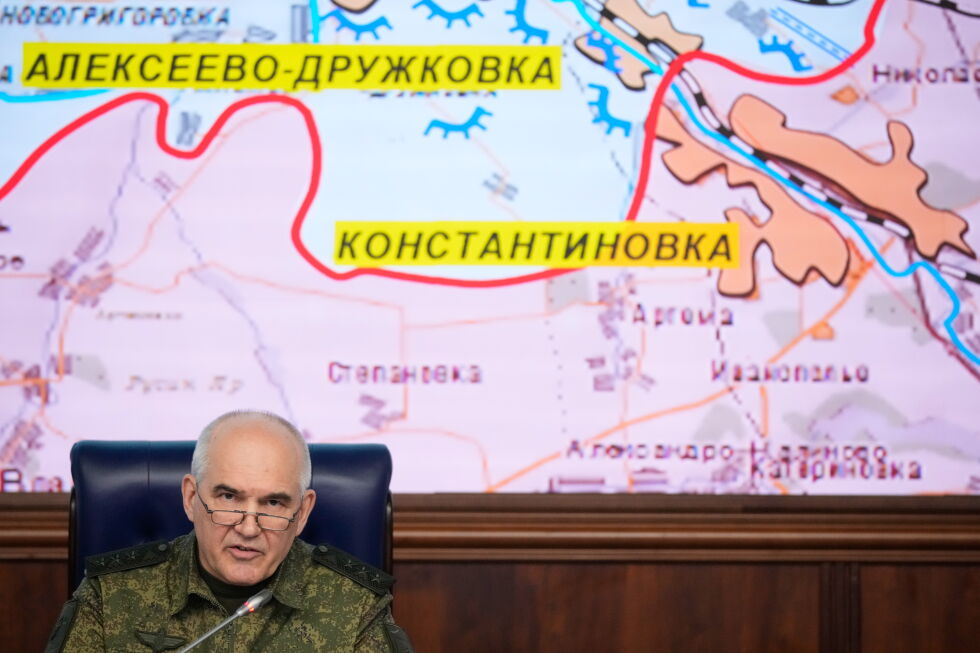
On Friday, Putin visited the Russian military headquarters directing the war in Ukraine and received a report on the capture of the city of Kostyantynivka, after weeks of intense street battles. He hailed it as a key step toward capturing the nearby cities of Sloviansk and Kramatorsk, the key remaining strongholds in the so-called “forest belt” of heavily fortified cities in the Donetsk region that remain in Ukraine’s hands.

The capture of Kostyantynivka, a big transport and industrial hub, is of “major strategic importance,” Putin, clad in military fatigues, said in televised comments.

In a briefing Saturday, Col. Gen. Sergei Rudskoy, the first deputy chief of the General Staff of the Russian armed forces, said that Ukrainian troops had been pushed back several kilometers (miles) and that fighting was taking place on the outskirts of the nearby town of Oleksiievo-Druzhkivka.

“The city is now under our full control. Units of the Southern Army Group are completing the clearance of city blocks, rooting out small groups and individual Ukrainian fighters who may still be hiding in basements and ruins,” he said.

Zelenskyy denied that Russia took control of the city. “It is just another Russian lie, an attempt to generate some kind of a news story,” he wrote on social media Saturday. “If Kostiantynivka were under Russian control, then perhaps Putin would have no problem meeting me there to find a diplomatic way to finally end this war. But the fact is, he won’t cross the front line — reality is very different from Putin’s words.”

Advertisement

Zelenskyy’s post also seemed to appeal to U.S. President Donald Trump. “Now, on the eve of America’s Independence Day, Putin has chosen to lie to the world and to the President of the United States about the situation on the front.”

Putin appears to believe his government can keep the fuel crisis from eroding his authority and support for the war he launched more than four years ago. At the very least, the attacks have brought the war home even more poignantly for millions of Russians, shattering Putin’s narrative of the conflict as something that doesn’t affect the lives of ordinary people in his country.

The border city of Belgorod, which Ukrainian drone strikes have also repeatedly targeted, was left almost completely without power on Saturday due to overnight attacks, local media reported.

Meanwhile, eight people were wounded after a Russian attack struck residential buildings in Ukraine’s southeastern region of Zaporizhzhia, including two children, local authorities said on Saturday.

Advertisement

___

Follow the AP’s coverage of the war in Ukraine at https://apnews.com/hub/russia-ukraine

Advertisement

Source link

Continue Reading

NewsBeat

Parents of toddler, 3, attacked by crocodile share update on his condition

Published

on

Cambridgeshire Live

A fundraising page set up to support the boy’s recovery and rehabilitation has now raised more than £25,000

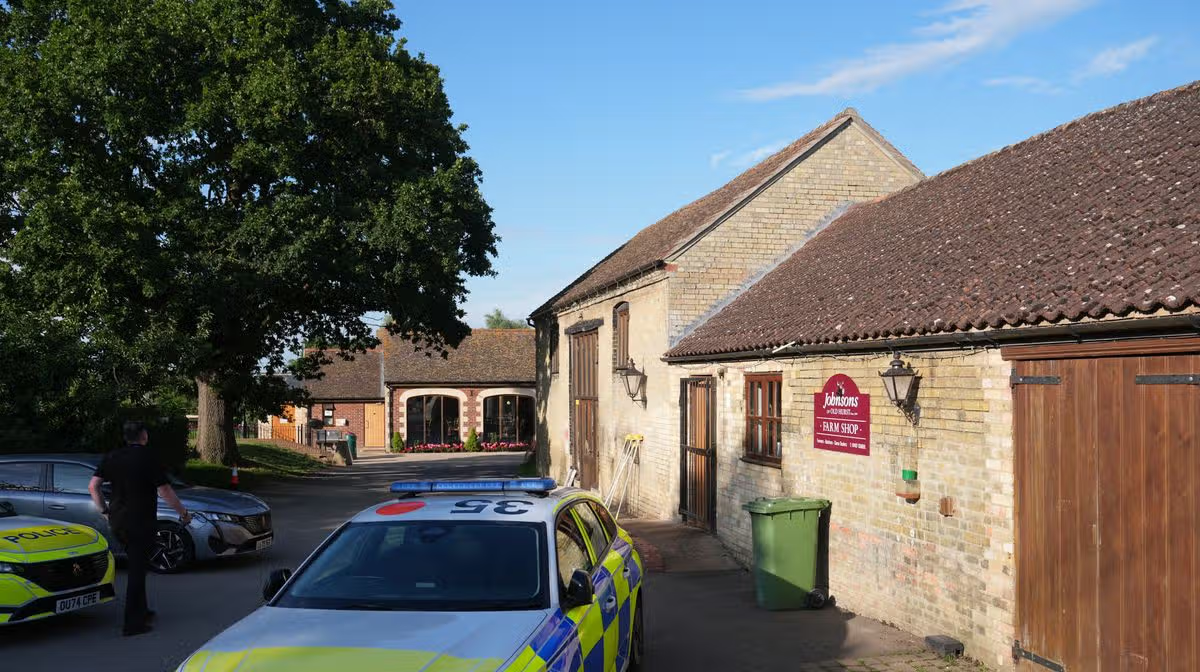
A three-year-old boy who was seriously injured after allegedly being thrown into a crocodile enclosure has underwent five surgeries, and faces more, his family has revealed. The incident happened at Johnson’s of Old Hurst, near Huntingdon, on June 18.

Advertisement

The injured boy, who has not been publicly named, underwent “five surgeries” following the incident, and is set to undergo “at least two more surgeries”, his family stated.

A fundraising page set up to support the boy’s recovery and rehabilitation, as well as to provide the family with financial stability while they are “living at the hospital”, has now raised more than £25,000.

In an update from the toddler’s parents, posted on the fundraising page, they said: “We are extremely grateful for everyone’s generosity. We could never thank you enough for the support you have given our family in this horrible time.

“We have been living at the hospital for 2 weeks now and our son has undergone 5 surgeries. At this moment in time we know that our son is to undergo at least two more surgeries, one of those surgeries being a nerve reconstruction in his arm.”

Advertisement

A 30-year-old man from Norfolk was arrested on suspicion of attempted murder following the incident. He has been released on bail after being found not to be fit for interview.

They said these last two weeks have been a “very uncertain and unsettling time” for them. The parents continued: “His rehabilitation journey is uncertain but we do know that it won’t be a short process. The money that has been donated so far has been used to pay for our expenses. We are both currently away from work and the time in which this will need to be the case is unknown.”

The donations have helped to ease the family’s pressure of these expenses and the parents are “extremely grateful” to everyone. Further donations will be used to support the toddler’s rehabilitation and to “give back to the hospital who have helped us in many ways during this challenging time”, they said.

In a statement, Johnsons of Old Hurst said they were “alerted to reports that a child has allegedly been thrown into one of our crocodile enclosures in the Tropical House”. The statement continued: “Everyone who was on site that day acted with incredible speed and determination.

Advertisement

“Within minutes of the first radio call, the child has been rescued from the enclosure and was receiving first aid. The emergency services arrived very quickly, supported by the MAGPAS Air Ambulance, and we cannot thank them enough for their professionalism, compassion and dedication in such difficult circumstances.”

Source link

Continue Reading

NewsBeat

More US children have been drowning in recent years

Published

on

More US children have been drowning in recent years

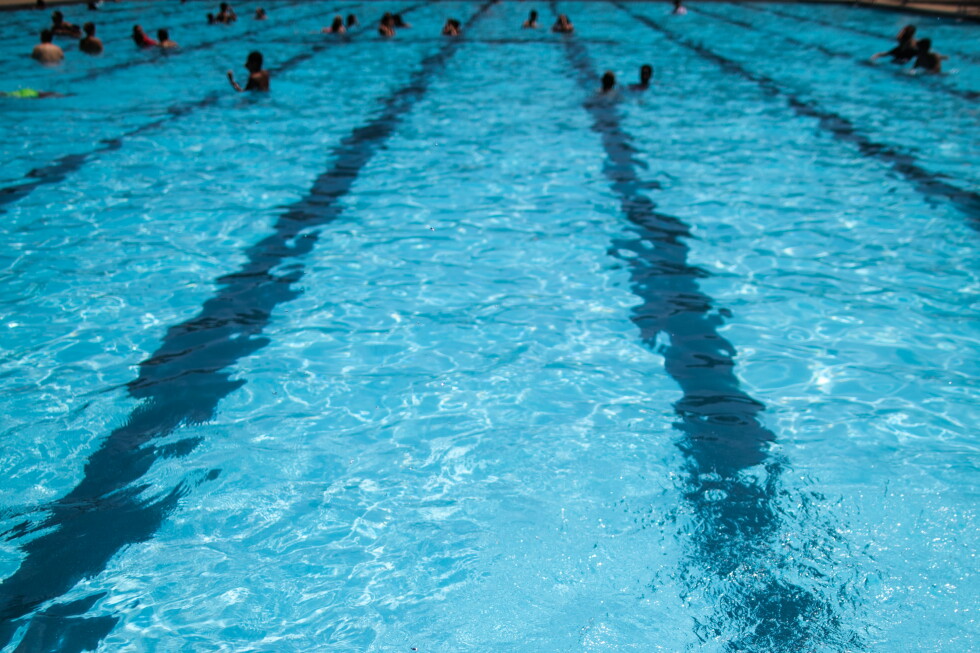
NEW YORK (AP) — Doctors and others are sounding an alarm: More U.S. children have been drowning in recent years.

“When drowning occurs, seconds matter,” said Dr. Rohit Shenoi, the lead author of a recent American Academy of Pediatrics warning. “Quick rescue and resuscitation can mean the difference between life, death and lifelong disability.”

About 4,000 to 5,000 Americans drown each year. Most are adults who die in natural bodies of water, such as lakes, ponds or oceans.

But statistically speaking, drowning is a much larger danger to children. It’s the No. 1 cause of death for kids ages 1 to 4, and one of the top killers of children ages 5 to 14. The drowning rate is higher for white kids in the younger group, but much higher for Black, American Indian and Alaska Native children in the older group.

Advertisement

Drownings of very young children sometimes occur in bathtubs. But most, like Stewie Leonard’s, occur in swimming pools.

This article is part of AP’s Be Well coverage, focusing on wellness, fitness, diet and mental health. Read more Be Well.

A family tragedy leads to a foundation for water safety

The Stew Leonard’s grocery chain offers a Disney-like shopping experience, featuring food-promoting animatronic characters like a dancing banana, a mooing cow and singing avocados. But several of its stores also have an animatronic creature that seems out of place: a life-jacketed duck named Stewie who sings about how not to drown.

The duck is named for the son of Stew Leonard, the grocery chain’s chief executive. The boy was 21 months old when he drowned during a family vacation on the island of St. Martin in 1989.

Advertisement

More than a dozen adults and kids had gathered at a birthday party for Stewie’s older sister, who was turning 3. Stew Leonard was outside hanging balloons and his wife was inside baking a cake.

“I saw Stewie outside and I assumed that he (Leonard) was watching him,” said his wife, Kim, noting that other relatives also were in the area of the pool.

“We never communicated with each other; ‘You’ve got him?’” said Kim Leonard, now 65. “When everyone’s watching, nobody’s watching.”

“There were a couple of balloons floating in the water,” Leonard, 71, recalled. “And you know after a few minutes, sort of everybody was like, ‘Where’s Stewie?’ Unfortunately I was the one who found him. He was face down in the pool.”

Advertisement

His death led the couple to start a foundation that pays for children’s swimming lessons and promotes drowning prevention.

Why are more kids drowning?

Unintentional child drowning deaths in the U.S. fell from around 2,000 a year in the 1980s to below 1,000 a year by the early 2000s, thanks in part to public awareness campaigns, expanded access to swimming lessons, and adoption of pool fencing laws. Between 2000 and 2019, health officials saw a 38% drop.

But then the trend reversed, with the number of child drowning deaths rising from 756 in 2019 to 865 in 2024, the most recent year for which complete data is available. The bulk of them were children younger than 5. The child drowning death rate also increased slightly, from 1.1 to 1.2 per 100,000 children.

What happened?

Advertisement

The COVID-19 pandemic interrupted swimming lessons and lifeguard training programs, and contributed to a national lifeguard shortage. Meanwhile, some data suggests an increase in swimming pool construction and increases in unsupervised swimming, said Tessa Clemens, the CDC Foundation’s senior director for drowning prevention initiatives.

Kym Roberts studies drownings in Australia — where child drownings have been either level or decreasing in recent years. She said “drowning in young children is often associated with falls into water and lapses in direct supervision.”

Some possible good news: Preliminary U.S. data for last year suggests child drownings declined. But it’s not clear whether that’s the start of a trend, and the deaths still remain higher compared to before the COVID-19 pandemic, Clemens said.

Pediatricians push for standards and regulations

Inventors have recognized a need for child water safety measures, and recent years have seen the emergence of immersion alarms that sound if the wristband a child is wearing goes underwater. But manufacturers of such devices note they can serve as an extra warning system, but should not be considered a primary way to keep children safe.

Advertisement

The federal government’s top public health agency, the Centers for Disease Control and Prevention, laid off Clemens and the rest of the staff of its drowning prevention program last year. But new guidance and drowning prevention support continues to come out of other organizations, including the CDC Foundation and the American Academy of Pediatrics.

A CDC Foundation program has paid for basic swimming and water safety skills training for over 35,000 students since 2024. The program operates in 11 states with higher drowning rates: Alaska, Arizona, California, Florida, Georgia, Hawaii, Louisiana, Michigan, New York, Oklahoma and Texas.

Ways to prevent drowning

The AAP says research shows that policies can make a difference, including lifeguard standards, life jacket regulations and requirements that swimming pools be completely surrounded by fences with self-closing, self-latching gates.

Stew Leonard emphasizes two other approaches — swimming lessons for young kids and complete focus by caregivers when young children are around water.

Advertisement

“I mean, I love ballet. I love karate. I love tennis lessons. You know, all the activities that kids can do,” he said. “But the only thing you can do to save their life is put them in swimming lessons.”

His foundation has funded over 250,000 swimming lessons for children and opened two swimming schools — one of them across the street from his company’s headquarters in Norwalk, Connecticut.

Also, “shut your cellphones off when you’re around the pool, watching the kids. Don’t sit there reading a book. Don’t sit there talking to your friends, neglecting your child that’s near the water,” he said.

“This happens in the blink of an eye.”

Advertisement

___

The Associated Press Health and Science Department receives support from the Howard Hughes Medical Institute’s Department of Science Education and the Robert Wood Johnson Foundation. The AP is solely responsible for all content.

Advertisement

Source link

Continue Reading

Trending

Copyright © 2025