




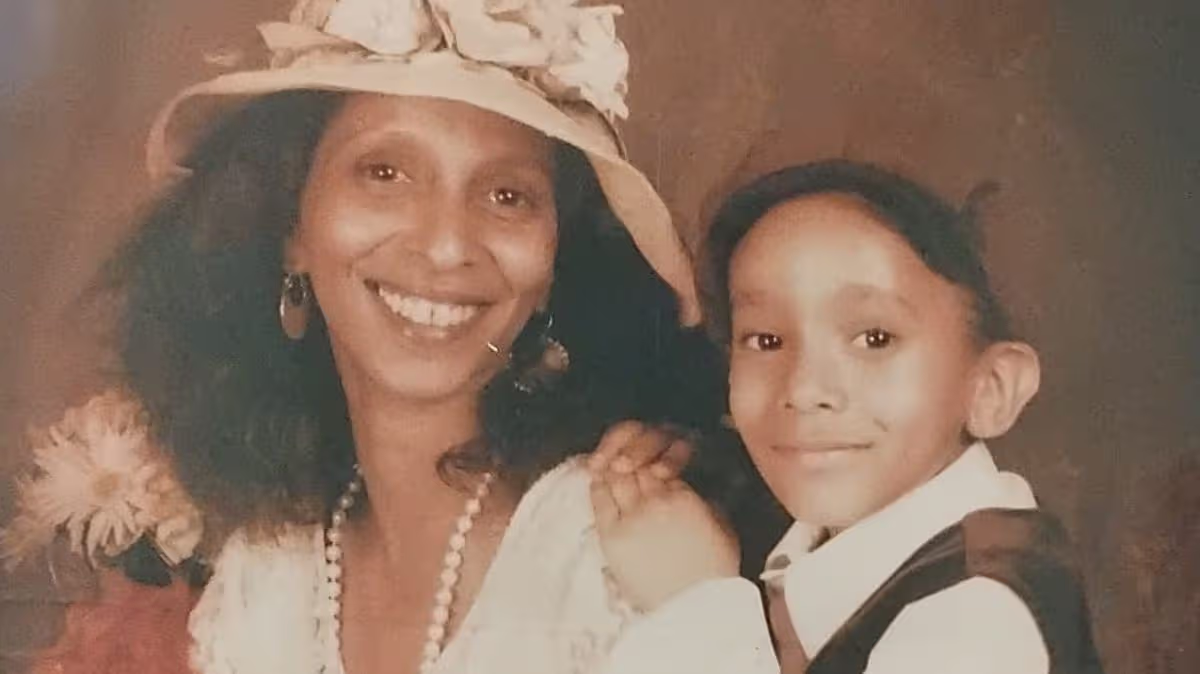
Doting mum Segen Ghebrekidan’s 17-year-old son Solomon was brutally murdered. She tells of his bravery, his heroism, and how he’s not just another victim of knife crime
When a 17-year-old lad from the next road gave Segen Ghebrekidan a hug as she returned home at midday, something felt strangely unsettling. The teenager had happily tucked into a Sunday roast with her family before now and mucked around on the PlayStation with her 18-year-old son, Solomon. But as he walked back to his house on August 15, 2019, Segen, 41, recalls: “I had a strange feeling something wasn’t right.” Her intuition was spot on, as less than two hours later, her life changed forever.
Until her encounter with the youth, Segen’s day had been full of hope. After years working as a carer, she had just completed the final registration process to start a four-year course in health and social care – hoping to build a brighter future for herself, Solomon and his sister Angel, who was just three at the time. She says: “I had an interview that day and everything seemed positive.”
READ MORE: Church leader ends affair with lover with devastating consequences
But Segen never got to start that course. For, at around 1.30pm, Solomon was walking through Brixton, where they lived in south west London, with a female friend, when they passed the same lad near a kebab shop. Exchanging a fistbump greeting, before leaving him and turning into another street, they realised the teenager was following them.
Catching Solomon and his friend up, the youth confronted them, leading to an argument that turned violent. Protective over his female friend, Solomon tried to shield her – pulling the lad away. But, as they struggled, the 17-year-old pulled out a knife and stabbed him repeatedly — six times in the chest, neck and arms. Three witnesses watched in horror as Solomon collapsed onto the pavement and a friend raced to fetch his mother.
Segen doted on Solomon, who was born on June 26, 2001 at St George’s Hospital in Tooting, south west London, a few years after she moved to Britain from Eritrea. Sociable and caring, he made friends easily. Segen says: “He lit up any room he walked into. People just loved him.”
A devoted Manchester United fan, Solomon loved playing football and hanging out with friends on their estate. Studying painting and decorating at nearby Lambeth College, he hoped to have a career in the trade. Raised as a Rastafarian, following the beliefs of his father, who lives in Ethiopia, Solomon was active in the Ethiopian World Federation and regularly helped out at his church.
Segen says: “He played the drums during gatherings, helped prepare food and drinks and was always volunteering. He did charity work and was very well known in the community. He would come with me to community events and help people. If neighbours needed shopping carried upstairs, he would help them. Everyone spoke well of him. He was respectful, kind, always smiling and he adored his little sister. He would do anything for her.”
But as Segen raced to Solomon’s side that August day, she could see that she was losing him. Surrounded by paramedics and police officers, all fighting to save him, Segen recalls: “They were pumping blood into him. There were ambulances, police cars and even a helicopter.”
Doctors worked frantically for 45 minutes, performing emergency treatment behind red medical screens. But his injuries were too severe and he died at the scene. “My world stopped,” Segen whispers. “Half of my heart went with my son that day.”
The killer fled, but was tracked through CCTV and DNA evidence recovered from burnt clothing discovered during police searches. Five days later, on August 20, the 17-year-old handed himself in to police, accompanied by his mother. During interviews he repeatedly answered “no comment”.
But the girl Solomon had protected – who now lives under witness protection – testified in court. And six years ago, in March 2020, following a trial at Woolwich Crown Court, a jury found him guilty of murder. His identity protected because of his age, he was sentenced to detention at Her Majesty’s Pleasure – the juvenile equivalent of a life sentence – with a minimum of 14 years before becoming eligible for parole.
Angela Moriarty from the Crown Prosecution Service said: “Solomon was the victim of a violent and unprovoked attack.” Semen says: “My son died a hero. He stepped between the blade and the girl walking beside him, shielding her as violence erupted.
“’Run,’ he told her. She escaped. Solomon did not. That bravery has never really been acknowledged, but I am so proud of him. He was so selfless.” Since Solomon’s death, Segen has been forced to refute rumours that he was part of gangland culture. She says: “That simply wasn’t true. He had friends everywhere, but he wasn’t part of that life.”
To her horror, Solomon’s grave has been vandalised repeatedly, and threatening videos linked to gang culture appeared online, mocking his death. “It was incredibly disrespectful,” she says. In fact, Segen was so worried about knife crime and the risk of her son becoming involved that she regularly searched his room and pockets. She says: “He used to joke and call me ‘the police officer’.”
Nine days after his murder, Segen organised a memorial gathering at Brixton Town Hall for Solomon, attended by 500 people. Galvanised by her grief, since her son’s murder, Segen has poured all her energy into fighting knife crime. According to the latest government statistics, in the year ending March 2025, there were just over 50,000 police-recorded knife offences in England and Wales – 205 of them were murders.
A voracious campaigner, she organises marches against knife crime, under the banner ‘Brixton Says No to Knife Crime’ and has protested outside Scotland Yard. She’s also created support groups for women whose lives have been shattered by youth violence.
Through community fundraising events and selling donated clothes and books at stalls, she has raised thousands of pounds, funding several bleeding control kits, which are installed around the community in places like shops and chip shops, to help treat victims of knife crime or accidents. She says: “I even carry one myself now. I show people how to use them. If it saves just one life, then something good has come out of this tragedy.”
At the Baytree Centre – a social inclusion and educational charity in Brixton – she runs weekly workshops for women and girls whose families have been touched by knife crime, offering everything from exercise and baking classes to open discussions about grief and trauma.
She says: “It’s a safe space where women can talk about what they’ve been through. Before this, nothing like it existed.” Where knife crime is concerned, Segen believes education is key, as the police cannot stamp it out alone. She says: “The police cannot control everything. Parents and communities need to be involved.”
Meanwhile, Segen says the home she shares with Angel, now nine, feels empty without Solomon. She says: “He was brave. He thought about someone else before himself. My son was a hero. He was not just another victim of knife crime. And I will spend the rest of my life making sure people remember that.”
*Follow Segen’s campaign on Facebook at Solomon Legacy, and on Instagram at Solomon_Legacy_18
READ MORE: Mum-of-five goes on surprise date night before the unthinkable happens













































You must be logged in to post a comment Login