Could Britain be about to get its first female Labour prime minister? Fear not, there’s no sign of Angela Rayner or Lucy Powell stepping up to the plate. It’s Andy Burnham himself who could be ‘Labour’s first woman PM’, a senior Labour source told the Spectator last week, because he is ‘genuinely passionate about all those traditionally female-oriented issues’.
The Labour source who misgendered Burnham went on to explain that, unlike female Conservative prime ministers, a woman Labour leader would ‘have an unashamedly female agenda, focussed on health, education, family finances and issues like safer streets, social care, online safety for kids’. Issues, we were told, that are ‘disproportionately important to women’. And the person with these priorities? ‘Along comes Andy, surrounded by female advisers and backers, but more importantly, genuinely passionate about all those traditionally female-oriented issues, and much less about bombs and budgets.’ Got that, girls? Leave the big stuff to the boys, and focus on the family finances. And Labour wonders why it has a woman problem.
To be fair, the idea that Burnham could be a female prime minister ‘in all but sex’, because he is interested in health and education, is no more bonkers than thinking a man can become a woman simply by donning a frock. And, in the not-too-distant past, this is exactly what Burnham thought.
Advertisement
In an exchange from 2022, our presumptive PM responded to the idea that female toilets should be a space only for women by saying, ‘I think it’s a minority view and quite a small minority view, actually’. He left no room for doubt: ‘I support trans rights, and I want that to be known.’ Indeed, Burnham supported reforming the Gender Recognition Act, and in 2019 co-wrote a letter urging the then Conservative government to back self-identification, which would allow people to change their legal sex without a medical diagnosis of gender dysphoria.
With Downing Street now firmly in his sights, it seems that Burnham now agrees that women should have access to single-sex spaces. The Supreme Court ruling on gender, he said last month, ‘has to be implemented’. And, it seems, he now accepts that he will not be Labour’s first female prime minister. ‘I want to put on record that I never have and never will describe myself as the first female Labour PM!’, he told Labour’s women MPs this week. Phew!
Advertisement
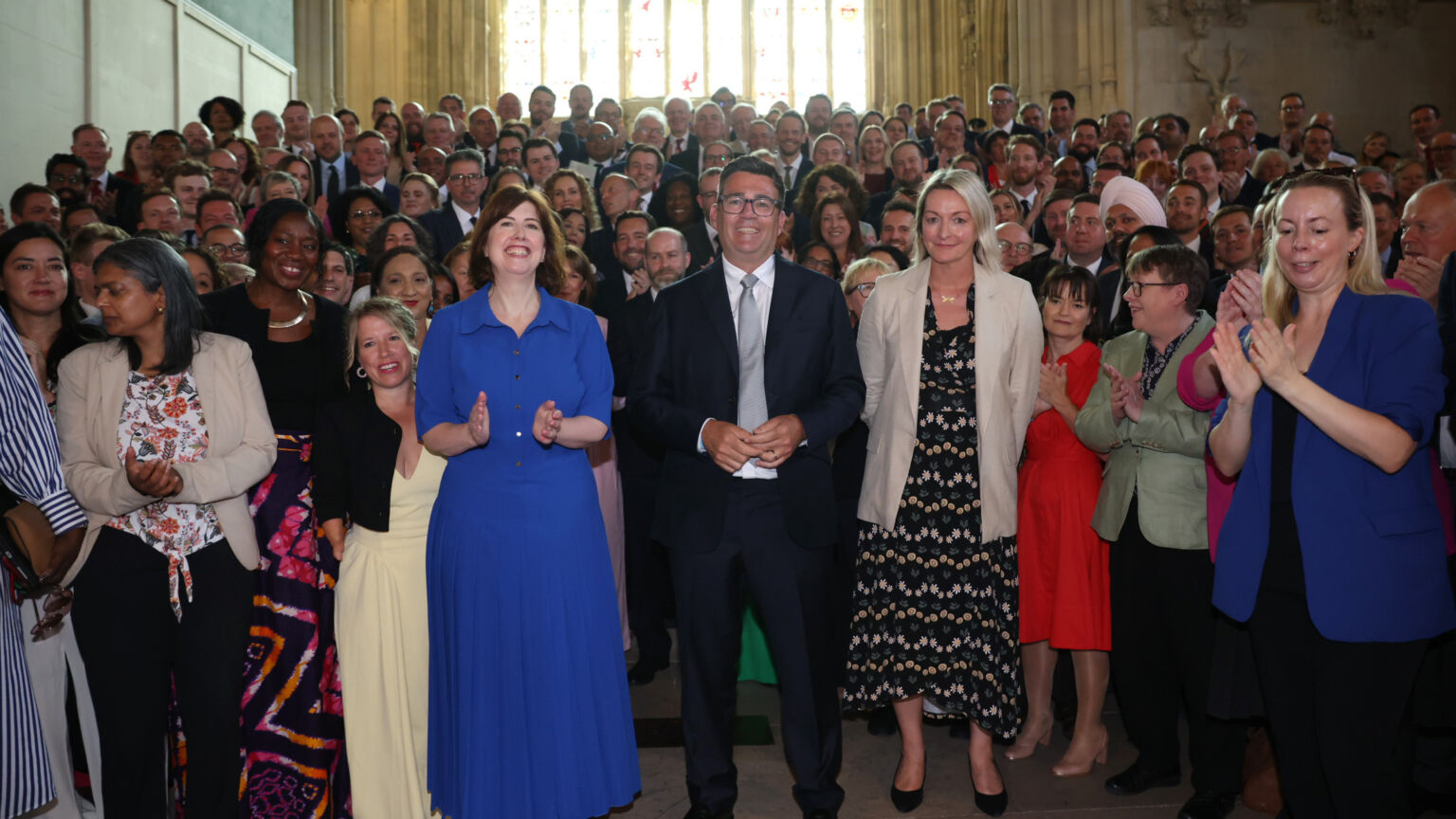
Burnham might not see himself as a literal woman, but he clearly does fancy himself as a feminist. He wants to put an end to the idea that the Labour Party has a woman problem and that Downing Street has been operating as a boys’ club. So he has promised the women in the Parliamentary Labour Party that, when he is in charge, there will no longer be any government meetings ‘with no women in the room’.
Plenty of Labour’s women MPs seem determined to hold him to his word. A group of them have drafted a letter, expected to be sent next week, urging him to address the ‘toxicity and misogyny’ within the party by appointing a named minister with responsibility for women in every department in government, and by ensuring that half of all government jobs go to women.
Advertisement
But Labour’s woman problem is hardly numerical. Almost half of all Labour MPs are women. And there is no lack of shiny-haired women in the top jobs. There’s Shabana Mahmood in charge at the Home Office, Yvette Cooper at the Foreign Office, Rachel Reeves at the Treasury and Bridget Phillipson in the Department for Education. Other than the role of prime minister, nearly all the major offices of state are currently held by women.
Yet still, Burnham is under pressure to go further, and he seems all too happy to oblige. He will end the ‘culture of briefing against female ministers’, he told Labour’s women this week. Anyone who undermines female members of his team will be sacked, he has promised. But what if female ministers deserve criticism? Whether it’s raising employers’ National Insurance contributions or pledging to increase inheritance tax paid by farmers, Rachel Reeves has been a disaster as chancellor. Phillipson’s VAT raid on private schools has cost more money than it has saved and forced hundreds of schools to close. Shabana Mahmood’s one-in, one-out migration deal with France has been an abject failure. It is neither toxic nor misogynistic to point this out.
And then there are Labour’s backbenchers. The party’s deputy leader, Lucy Powell, dismissed grooming gangs as a ‘dog whistle’ issue not worthy of discussion. MPs Stella Creasy and Nadia Whittome are busy trying to overturn the Supreme Court ruling on women. Kim Leadbeater seems to have more to say about women’s right to be helped to die than she does about their right to give birth safely.
Advertisement
If Labour has a woman problem, it lies with Labour’s women themselves. But Burnham’s patronising pledge to use quotas to guarantee women top jobs and then shield them from criticism will only make things worse. He needs to man up and reject such tokenistic demands.
If Andy Burnham wants to win back women voters, he should start by clearly stating that he knows what a woman is. He could pledge that the Supreme Court ruling will be fully implemented and women’s single-sex spaces will be protected. He could put a stop to the planned trial of puberty blockers for children. Defending women’s rights – whether that’s access to single-sex spaces, protecting white working-class girls from rape gangs or ensuring women can give birth without risking their lives – will take more than promoting a few woke women into well-paid government jobs.
Alert readers may note that while Wings has repeatedly noted that the misappropriation of the fundraiser money by the SNP could constitute either fraud OR embezzlement (or both), entirely separate to the embezzlement FROM the SNP by Peter Murrell, the Crown Office continues – as its agent John Logue did in a recent BBC interview – to address only the possibility of fraud, which would be by far the more difficult of the two to prove, and to ignore the elephant in the room, which is that no less a personage than the First Minister has already admitted to spending all of the money on a purpose other than that which it was raised for.
The response is therefore plainly unsatisfactory, which we will deal with in our own reply within the next 24 hours, which will again be drafted by counsel. We will of course publish it here once it’s sent, so stay tuned.
Bosnia salutes their fans after World Cup exit/Alamy
4 min read
Early this morning, Bosnia and Herzegovina’s World Cup journey ended with defeat to the United States. Today, its players begin the journey home.
Advertisement
Yet the most important story was never the result.
Some of these young footballers are the children of survivors of the genocide at Srebrenica. Others come from families that endured the siege of Sarajevo, survived concentration camps or were driven into exile by war.
They represent a generation that exists because their parents and grandparents survived an attempt to destroy both a people and a state.
Advertisement
For the four weeks of the tournament, they achieved something Bosnia’s political leaders—and much of the international community—have failed to accomplish in almost three decades: they gave Bosnians a reason to believe in their country, in one another and in a shared future.
Since the Dayton Peace Agreement ended the war, Bosnia’s nationalist elites have built an entire political economy around division. They do not solve problems; they manufacture crises. They do not govern; they manipulate. Rather than competing over economic growth, education or the rule of law, they compete over fear. Every election is turned into a referendum on ethnic survival. Every reform is portrayed as an existential threat. Every compromise is denounced as surrender.
For secessionists, the argument goes further. They portray Bosnia and Herzegovina as an artificial state—unworkable, unsustainable and destined eventually to disappear. The country’s political dysfunction is treated not as a problem to solve, but as proof that the state itself cannot succeed.
Advertisement
The tragedy is that too much Western policy has accommodated this narrative rather than challenged it. Obstruction has been rewarded in the name of stability. Secessionist threats have been managed rather than defeated. This national team exposed the bankruptcy of that approach.
Its players came from different cities, different communities and families shaped by war in profoundly different ways. Some were born in Bosnia and Herzegovina. Others were raised in the diaspora because conflict forced their families to flee. Their histories were different. Their shirt was the same.
Nobody asked whether the goalkeeper was Bosniak, Serb or Croat before celebrating a save. Nobody cared which entity a defender came from after a last-ditch tackle. The only qualification that mattered was whether a player could help the team win. Merit replaced ethnic arithmetic, and patronage. Shared purpose replaced manufactured division.
That is how successful teams are built. It is also how successful states are rebuilt.
Advertisement
Football cannot rewrite Bosnia’s constitution. It cannot reform public administration, strengthen the judiciary or stop young people leaving. It cannot dismantle the patronage networks that have hollowed out public life.
But it can expose a lie. The lie is that Bosnia’s citizens are incapable of acting together. The lie is that ethnic division is immutable. The lie is that Bosnia and Herzegovina exists only because outsiders insist upon it. For four weeks, millions of Bosnians disproved all three.
That is why reports that public screenings and celebrations were discouraged in some predominantly Serb municipalities should not be dismissed as isolated incidents. They reveal something more profound. A successful Bosnian national team threatens political movements whose legitimacy depends on denying the existence of a shared Bosnian civic identity. A population united by achievement is harder to manipulate through fear.
The players did not defeat nationalism. They demonstrated that nationalism is a political strategy, not a historical inevitability.
Advertisement
No one should romanticise what happened. Bosnia’s constitutional paralysis remains. Corruption remains. Secessionist rhetoric remains. So does the unresolved legacy of genocide, including its denial and the glorification of convicted war criminals by some political leaders.
But one assumption has become much harder to sustain. If a team made up of young people from families shaped by genocide, siege, displacement and exile can unite around a common purpose and earn success through merit alone, what excuse remains for politicians who have spent thirty years insisting that the country itself cannot function?
The players are going home. Bosnia’s nationalist leaders remain exactly where they have always been. They deserve a political red card. Increasingly, so do those in democratic capitals who continue to indulge them.
For too long, the Internal community has, in the name of “stability”, all but legitimised those who undermine Bosnia and Herzegovina’s constitutional order, normalised secessionist threats and treated political spoilers as indispensable interlocutors rather than as the principal obstacle to a secure, democratic European state.
Advertisement
The lesson of this World Cup is that Bosnia and Herzegovina’s citizens have once again demonstrated that they are ready for a country built on merit, competence and shared citizenship. Bosnia is not held together by international supervision or constitutional engineering. It endures because its people continue to choose it.
For any of you who haven’t caught it yet, my interview from Monday’s BBC Scotcast (which is also available on Spotify).
?
Sadly due to a summer scheduling quirk the video version won’t go out on the telly, and seemingly not on the BBC YouTube page either, so you’ll just have to listen to the audio and somehow live without seeing my gorgeous face.
(But it looked like this.)
Advertisement
You may notice the occasional abrupt cut. That’s because 10 minutes were snipped from the recording to fit the show’s timeslot, and they were pretty much the same 10 minutes I’d have cut if I’d been editing it myself, including the bit where I accidentally called Jeffrey Epstein “Brian Epstein”.
(While making the point that Epstein had been jailed but none of his clients had. I hope Peter Murrell doesn’t also commit “suicide” in HMP Dumfries.)
If you’re interested, the other stuff that didn’t make the broadcast discussed:
– Colin Beattie, and how he manifestly obviously wasn’t allowed to see the books any more than Douglas Chapman was, but was a compliant stooge who could be counted on by Murrell and Sturgeon not to ask any awkward questions. (Relating to Martin Geissler’s question about who the Crown Office could actually prosecute.)
Advertisement
– the SNP’s non-existent track record of actively pursuing a meaningful indy strategy, and what I’d have done instead. (Which is detailed here and here.)
– the fact that Alba failed (relating to the question about why I didn’t get involved in politics myself) because almost the only thing Nicola Sturgeon did competently and effectively during its near-decade in power was trash Alex Salmond’s reputation.
– the mystery of why even now no proper newspapers support independence, even as a purely cynical economic move, despite it being backed by half the population.
– the parallels, in terms of online media doing the job the mainstream press failed to, between Wings coverage of the SNP fundraiser scandal and that of the Rangers tax case, possibly because I made a plucky but ill-advised attempt at pronouncing Phil Mac Giolla Bháin’s name.
Tens of thousands have joined pro-Restore Britain Facebook groups being run by people who appear to be based in Pakistan and Bangladesh, an investigation has revealed.
Advertisement
Research by the organisation Institute for Strategic Dialogue (ISD UK) and PoliticsHome has found that multiple Facebook groups showing support for Rupert Lowe and his Restore Britain party are run by individuals who appear to be based in Asia, with the investigation also finding admins based in the United States.
Some of these groups, which have tens of thousands of members, are later being turned into vessels for selling firesticks, download codes and tech support, with admins changing the group name and picture to suit the new purpose.
Siddharth Venkataramakrishnan, Analyst and Editorial Manager at ISD UK who uncovered the groups, told PoliticsHome that the phenomenon was “really a continuation of an increasingly common trend we’ve seen: accounts promoting content that is misleading, politically charged or hateful for clicks”.
“There is obviously a particular irony that groups producing anti-Muslim content are run by Muslims themselves, but we are seeing these groups being run globally.”
Advertisement
Venkataramakrishnan said that the politics in these groups is “incidental”, with the groups ultimately just “a vehicle to monetisation”.
Lowe, the MP for Great Yarmouth, has built a huge following on Facebook compared to other political party leaders. The Restore Britain leader currently has 1.3m followers on the platform. He also has a significant following on X, where, as PoliticsHome recently reported, he has made tens of thousands of pounds since being elected in 2024.
One group uncovered by the investigation, called ‘Rupert lowe [sic] fans’, which was set up in February 2026, is run by Mahiya Mim, Rifaat Alamin and Eliana Maya.
Advertisement
According to their Facebook profiles, Maya is based in New York, while Alamin is based in Sylhet, Bangladesh. Mim does not specify her location but claims to have attended school in Bangladesh. In an added twist, Mim and Alamin appear to be married.
Both Mim and Alamin have been admins for the group since the date it was created, while Maya became an admin two days later.
The posts made on the group range from nostalgic British posts about former high street retailer Woolworths to pictures of women in the burqa, asking: “Do you agree that these should be banned?”
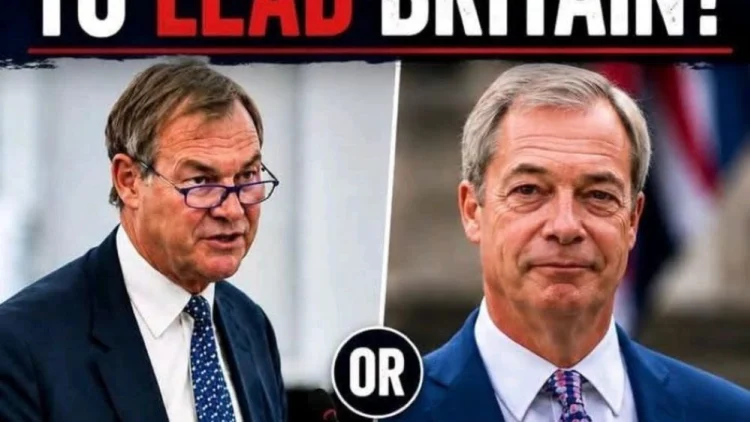
Posts on ‘Rupert lowe fans’ also encourage engagement, posing questions such as “should Muslims be banned from all public office in the UK” and “who do you trust more to lead Britain?” with a picture of Lowe and Reform UK leader Nigel Farage included. The pages also post “relatable” British culture references, such as asking whether local bank branches should be reopened.
While the group has amassed more than 28,000 members, the admins have been recently attempting to push members towards what they call their “new group”, ‘Restore Britain & Rupert lowe [sic] for PM’, which currently has just over 6,000 members and was created in April.
Advertisement
Another similar group called ‘Restore Britain – Rupert lowe [sic] for PM’, which has more than 19,000 followers, was set up in March.
At the time of writing, the admins of this Facebook group are listed as Sheren Dmax, who is based in Birmingham, and Arsala Rauf, who is based in Rawalpindi, Pakistan. As none of the individuals were admins from the group’s inception, it can be presumed they are not the creators.
It is unclear whether the accounts or groups are managing to monetise from the platform, but the income could be coming from elsewhere.
While many of these groups continue to purport to be Rupert Lowe or Restore Britain fan bases, some have been completely changed, with the groups instead becoming advertisements or selling pages for Amazon Firesticks.
Advertisement
Venkataramakrishnan also found evidence of Clarkson’s Farm fan groups being set up and later pivoting to promoting firesticks and tech support.
One Facebook group, which has more than 4,000 members, was created on 4 March 2026 and was originally called ‘Restore Britain Rupert lowe [sic] for pm’. In April, the name was changed to ‘Downloader Codes 2026’.
Originally, the group was politics-focused, including posts about British political party leaders and issues like border control, as well as offensive content like hateful posts about Muslims. However, on 13 April, the group name was changed by Itx Saddam. According to his Facebook page, Saddam lives in Islamabad, Pakistan.
Advertisement
When the group name and picture changed, there was very little pushback from members, apart from Andy Milne, who wrote “FUCK OFF YOU PR1CK, NOT GHE GROUP I FVCKIN JOINED!! [sic]”
While the group claims to be based in the UK, the group is run by Shan Arsal, who is based in Karachi, Pakistan, according to his Facebook profile.
Other listed admins include Fabian Rahlmann (whose location is unknown), Adrian Wystub (who is based in the UK), Adam Chester (based in New York), and Babar Ali (based in Lahore, Pakistan).
Venkataramakrishnan told PoliticsHome: “One part of that is advertising revenue, but these groups are obviously trying to maximise how much money they can get. Promoting questionable goods is just one expansion of that; another likely one is targeting commenters with scams.
Advertisement
“This again just shows how there is a complete disconnect from the impact that these groups have both on those being targeted with hate and the accounts being drawn in – they’re all just avenues to making cash.”
Victoire Rio, executive director of technology charity What To Fix, told PoliticsHome: “We regularly see people ‘hijack’ political issues to ‘warm up’ Facebook pages and groups. This can be a good way to build a targeted following – in this particular case, Brits. There is also a vast resale industry for digital assets, so it’s also possible that these groups are being warmed up for resale.”
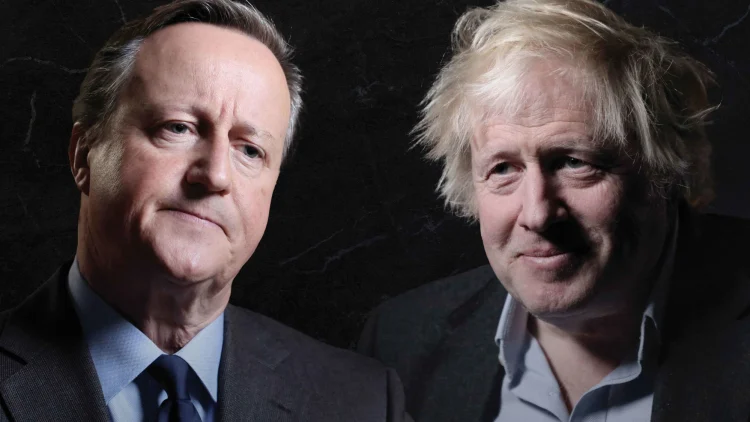
David Cameron and Boris Johnson | Image courtesy of: BBC/Zinc Television
3 min read
Enlightening, fascinating and a little triggering, this collection of first-hand accounts of the Brexit campaign sheds light on a few myths
Advertisement
“Ten years ago! God! Amazing!” Nigel Farage MP at the opening of the BBC’s celebration of the Brexit referendum. And he’s right. It was, this June, a decade ago that we took one of the most consequential decisions of our generation, which was followed by years of hectic debate.
The BBC has done an excellent job, bringing together senior commentators and participants in that hectic battle back in 2026. Unlike many documentaries, Brexit: A Very British Civil War avoids the temptation to editorialise – it’s more a collection of first-hand accounts, brought together to build a clear narrative of a confusing campaign.
But for someone in the trenches of the campaign (on, as it turned out, the losing side), this provides a clear gathering of ideas. Like the British Tommy who, caught in a foxhole during the Battle of the Somme, has an extraordinary first-hand experience, it is only with the help of historians that we know what collectively happened. And that is what the BBC has successfully achieved.
Advertisement
For those of us involved, it sheds some light on a few myths and reveals some unknown elements. Boris has been much mocked for his two articles – one for remain, one for leave – rather unfairly, I always thought. But Boris Johnson’s honesty over his indecision is enlightening. It seems he really was battling with the question of which side to support.
Similarly, it was fascinating to listen to Jeremy Corbyn’s arguments that the free-market economy should not be trusted to deliver prosperity from inside the EU, relying more on state investment to generate growth rather than EU bodies.
But for me, it was, and always has been, a case of who had the best campaign.
Advertisement
There is no doubt about it, a programme like this can be just a little triggering
George Osborne argues that the debate fell into two simple camps. Remain was economic; leave was immigration. But I think it was even simpler than that, and the programmes make the point.
Dominic Cummings – love him or hate him – is a brilliant campaigner. Those of us backing remain banged on about the economic arguments – how much it would cost each person, what would happen to our economy, how being outside the customs union would damage trade with our closest trading partner. So, while remain made these complicated points, leave shouted “Take Back Control” a thousand times. And when remain raised this with the broadcasters at the time, they explained they were giving each side equal airtime. And the three-word-slogan tactic was to revisit us all a few years later, with an election campaign in 2019 calling to “Get Brexit Done”.
Advertisement
There is no doubt about it, a programme like this can be just a little triggering. Some of us – especially those on the government benches through 2016 up to early 2020 – still bear the scars, a touch of PTSD, and a desire to put it all behind us. And I imagine the BBC will have a series of 10-year anniversary programmes – Theresa May’s time in office, Boris’ rise to power. There’s a lot to go on, and the final quote from Boris suggests more to come: “It wasn’t our job to have a plan.”
But it was also a delight to see old footage of colleagues, especially Boris with his hair in order. Who knew he owned a comb?
Jonathan Portes analyses how increasingly strict immigration policies may have impacted the overall economc contribution of migrants in the UK. He argues that if the objective is to maximise economic contribution, the UK system may now be ‘too selective’.
All advanced economies have “selective” immigration policies. Unless a country closes itself off to immigration entirely, or has fully open borders, this is inevitable. And politicians and economists generally agree that one important criterion on which policies should be based is that of economic contribution – that is, giving some preference to those who are likely to contribute positively to the host country’s economy. This is rarely the only criterion – others, such as legal and moral obligation to refugees, the ability of families to reunite across borders, and so on – also matter. And it can be measured in different ways – earnings, current or prospective, likelihood of making a positive fiscal contribution, skills or qualifications that are seen as particularly likely to be beneficial, and so on. But all systems use one or more such measures.
This perspective has informed the UK policy debate before and after Brexit: the coalition government’s desire to reduce migration while attracting the “brightest and the best”, Vote Leave’s promise of a “skill-based points system”, the post-Brexit migration system that equalised conditions for EU and non-EU origin migrants while setting earnings and skills thresholds, and the decisions by both the Sunak government and the current one to substantially tighten these thresholds while barring entry entirely in some occupations, particularly care work, where most workers are relatively low-paid.
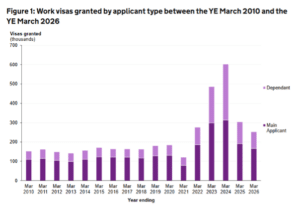
In particular, the story of the post-Brexit period would seem very clear. In the face of post-pandemic labour shortages, and in an attempt to mitigate the negative impacts of Brexit, the system for non-EU migrants was radically liberalised – that is, it became significantly less selective – in 2021. As a consequence, numbers soared, with particularly strong growth among less well-paid migrants, especially in care. More recently, partly as a result of political backlash, policy was tightened substantially in 2024 and 2025 and numbers arriving, especially to work, fell sharply.
Advertisement
Given these changes in selectivity operated primarily through salary thresholds, the obvious implication is that new non-EU migrants arriving after 2021, but before 2024, should have had substantially lower earnings than those arriving either before 2021 (under the pre-Brexit system) or after 2024 (after the substantial rise in salary thresholds that was introduced then). There is just one problem. The data says otherwise.
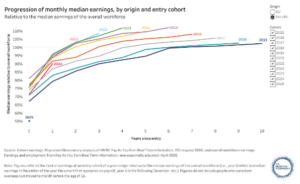
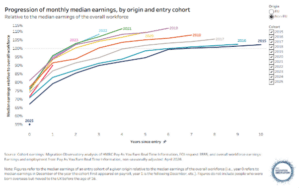
Using HMRC data, we can track the earnings of migrants by the year in which they entered the UK employee workforce. As the above narrative suggests, there was indeed a sharp rise in new entrants from 2021, and a more gradual fall from 2023 to 2025. However, we see no evidence at all that earnings were lower during this period of lower selectivity. Indeed, quite the opposite. The median earnings of non-EU migrants who entered the employee workforce in 2018 attained parity with the whole workforce in three years; for those who entered in 2022 and 2023, it took only two years, a slight but visible improvement.
And what about those who entered in 2024, after the tightening? So far they seem to be tracking the 2018 cohort rather than the later ones. And those who entered in 2025 have extremely low earnings compared to any of their predecessors, although we cannot attach too much weight to the first year figure, which may be dominated by students working part-time. Broader labour market conditions, which seem to have disadvantaged new entrants to the labour market across the board, may also have played a part here.
In other words, the 2021 move to lower selectivity and much higher numbers does not appear to have reduced either initial earnings or early years earnings progression among new non-EU migrants, if anything the opposite; outcomes did not worsen, but may have improved. And the very sharp reversal, designed to increase selectivity, appears, although any conclusions must be very tentative at this stage, to have coincided with a substantial worsening of labour market outcomes – precisely the opposite of what might have been expected and what policy was intended to achieve.
Advertisement
What is the explanation? First, it is important to note that increasing the selectivity of ’economic’ routes may well, paradoxically, reduce the selectivity of the migration system overall. By definition, those coming on work visas are likely to be in full-time work, and, even under a relatively liberal system, most will be on average or higher earnings; by contrast, those coming through other routes – family, refugee routes or asylum – often will not be in work, especially at first, and may often be on low earnings. So reducing work flows may increase the average earnings of work migrants, but may reduce the average earnings of new migrants overall (and indeed the overall workforce).
This seems very likely to be part of the explanation here – while care workers and others in middle-skilled occupations excluded by recent policy changes are not generally highly paid, they and their dependants are not (especially if they work full-time, as most do) at the lower end of the earnings distribution either for new migrants or for the population as a whole.
Second, even within economic migration routes, tightening the rules, supposedly to favour the “brightest and the best” may in fact deter them. As is often observed, we can choose migrants, but they also need to choose us – and those who are most likely to be economically beneficial have the most choice. As thresholds, fees and bureaucratic burdens rise – and policy changes signal a more hostile environment towards immigration and immigrants more generally – these workers may substitute toward alternative destinations, even if they remain formally eligible.
Does this mean that there is no point trying to select migrants on economic grounds? No – as noted above, some selectivity is inevitable, and at some point, lowering requirements will indeed reduce average outcomes. But it suggests that, if the objective is to maximise economic contribution, the UK system may now be ‘too selective’: a liberal and flexible system towards economic migration routes is likely to produce better results overall than one whose primary aim is to limit eligibility to a very narrow set of potential migrants.
Advertisement
[The data in this blog is taken from my work with Ben Brindle and Madeleine Sumption of Migration Observatory, published here. The opinions expressed here are my own.]
By Professor Jonathan Portes, Professor of Economics and Public Policy, Department of Political Economy, King’s College London.
The nexfibre-Netomnia transaction will unlock £3.5bn of investment and create a scaled challenger to BT Openreach. At a pivotal moment for the fibre market, Britain should choose competition over the monopolistic status quo.
Earlier this year, nexfibre agreed to acquire Netomnia, one of the UK’s largest alternative network providers. With planned investment of £3.5bn in full-fibre infrastructure, we are set to establish the first genuine wholesale competitor capable of challenging BT Openreach at national scale.
Advertisement
The decision regulators reach on this transaction will determine whether Britain’s broadband future is defined by vigorous, sustainable competition or continuation of the status quo of monopoly-style dominance. It’s a clear choice.
Openreach still dominates the full-fibre market
Despite a decade of alternative-network (“altnet”) build-out, Openreach retains overwhelming market power. Its expansive footprint, retail relationships and deep balance sheet allow it to set terms that shape the entire sector. Many altnets remain geographically fragmented and financially fragile, limiting their ability to exert sustained, nationwide pressure on the incumbent.
These concerns are echoed in the latest Assembly Research report on the UK full‑fibre market, which warns that Openreach’s grip “risks replicating copper-era monopolies in the fibre age”. Unless a challenger with comparable scale and reach emerges, the UK risks compounding the Openreach dominance that has long constrained innovation and consumer choice. nexfibre’s mission is to change this.
Advertisement
Testing the limits of regulation
Openreach’s latest pricing tactics are testing the boundaries of Ofcom’s Telecoms Access Review (TAR) and are at odds with the government’s aim of promoting long‑term competition, investment and growth in the fibre market.
While headline price cuts may appear attractive for consumers in the short term, these are infact deep and targeted wholesale discounts, which make it uneconomic for rivals to scale. If allowed to proceed, it would entrench BT Openreach’s monopolistic position.
Advertisement
Sustainable competition depends on a level playing field. Ofcom scrutiny, and decisive action, is essential to ensure the market will mature to become sustainably competitive, enabling it to deliver investment, innovation and lower prices over the long term.
Building a national wholesale challenger
The combination of nexfibre’s network, Netomnia, and 2.1 million Virgin Media O2 premises which will also be upgraded to full fibre by nexfibre, will create a scaled, financially secure challenger to BT Openreach, with a full fibre footprint of around 8 million premises by the end of 2027.
When combined with the growing fibre footprint of Virgin Media O2, the two networks will collectively reach 20 million premises and give internet service providers a highly attractive wholesale alternative to the incumbent.
Advertisement
It is a bellwether transaction and will deliver three essential outcomes.
First, it will unlock £3.5bn of new investment at a time when capital for standalone altnets is increasingly scarce.
Second, it will create a financially secure wholesale platform covering millions of premises nationwide, giving internet service providers a meaningful alternative to Openreach.
Third, it will accelerate the full-fibre rollout while supporting AI adoption, cloud services and the productivity gains a modern economy demands.
Advertisement
The latter is a point that I made at the New Statesman Politics Live Conference earlier this week.
The UK is searching for growth, backing AI adoption, and our government is increasingly digitising. nexfibre is a next generation network provider, delivering the latest XGS-PON technology to premises across the country, ensuring Britain is connected – and prepared for the next stage of digital growth. But the full fibre market, which underpins the investment and growth we need, is often taken for granted.
Full fibre is essential growth infrastructure – and we need to make sure the conditions are there to support it – and fast. Every day of delay reinforces the incumbent’s advantage and slows the progress of genuine competition.
Britain’s choice
Advertisement
The UK faces a clear decision. We can allow dominance to deepen and maintain the monopolistic status quo that is holding our country back. Or we can equip the UK with a credible wholesale challenger and a sustainable competitive framework for the full-fibre era.
Britain’s broadband moment is here. Let’s seize it.
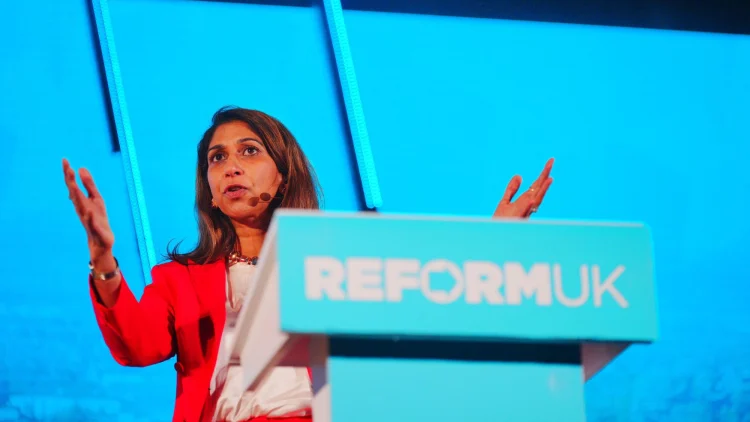
Reform UK’s promise to scrap the Equality Act has raised questions about what will replace it. At the same time, Labour is under pressure from its own side to go further in implementing it. Noah Vickers reports
Advertisement
In February 2018, a junior minister in Theresa May’s government stood up in Parliament to make one thing very clear: post-Brexit Britain would not be a place in which rights and equality laws are rowed back on.
Citing the UK’s “proud record, history and tradition” of “supporting workers, protecting civil liberties and championing human rights”, then-Brexit minister Suella Braverman proudly declared: “Our gender pay gap reporting requirements and our public sector equality duty are world-leading initiatives that go beyond EU law in many ways”.
Braverman was referring to measures enshrined in the 2010 Equality Act – a statute that, eight years later and in a new party, she is now determined to abolish.
Advertisement
Until relatively recently, the Equality Act was not a controversial piece of legislation, and no major political party was proposing changes to it.
“Originally, the Tories resisted it, but then the consensus grew – with [David] Cameron and with Theresa May… about the role of the state in promoting equality,” says Baroness Harman, the architect of the legislation. “There were arguments about how that should be done, but there was a consensus that it should be done.”
When Braverman, now Reform UK’s equalities spokesperson, announced in February that Reform would scrap the Equality Act if it won the next general election, she was re-committing the party to a policy that had already featured in its 2024 manifesto. Removing the legislation, she said, would allow Reform to “build a country defined by meritocracy, not tokenism” and “personal responsibility, not victimhood”.
Advertisement
In June, the Conservatives then set out their own stall on the issue by promising to ditch the Equality Act’s public sector equality duty. The duty requires public bodies to have “due regard” to the legislation’s overarching aims of eliminating unlawful discrimination, advancing equality of opportunity and “fostering good relations” between groups of people with or without different protected characteristics.
Braverman said this “half-baked and half-hearted attempt to copy Reform” was “embarrassing”, but shadow equalities minister Claire Coutinho counters that Reform’s plan would backfire.
“White men have successfully fought discrimination claims under the Equality Act because it protects everyone on the basis of race and sex, not just ethnic minorities and women,” she tells The House. “They would lose this protection under the plans Reform has announced, as would disabled people.”
Coutinho continues: “Reform’s plan would also make positive discrimination and race quotas in the workplace legal. We want to maintain protections against genuine discrimination whilst getting rid of the grievance culture which says minority groups are worthy of special treatment.”
Advertisement
But she confirms that other parts of the Equality Act would also be amended by the Conservatives, as party leader Kemi Badenoch has said removing the duty would only be the start of a wider “overhaul”.
“People should be judged on merit, protected from discrimination and abuse, and free to live their lives with everyone equal under the law,” Coutinho says. “There are other elements of the Equality Act, such as positive action and ‘work of equal value’ pay claims, which are social engineering in a way that undermines those principles.
“We will be rooting out anything that is incompatible with our values, but that doesn’t mean just binning the entire act without properly understanding what’s in it. Just to get a political headline, Reform was willing not just to throw out the baby with the bathwater but pregnant women, new mums and disabled people as well.”
It is a line of attack that Reform is clearly conscious of the need to counter. To replace the Equality Act, the party has pledged to introduce a Workplace Fairness Act that will treat people “as individuals”.
Advertisement
The Equality Act consolidated more than 116 pieces of pre-existing equalities legislation into one statute and Braverman has said that “much of what was valuable” in it stems from those earlier laws.
The Workplace Fairness Act, therefore, would re-consolidate the pre-2010 legislation into a new statute – including, Reform says, protections which apply “both inside and outside the workplace”, despite the proposed legislation’s name. But it will not carry over provisions like positive action or the public sector equality duty.
Braverman has pledged to repeal the Equality Act on “day one” of a Reform government and the party says its Workplace Fairness Act would be implemented on the same day. “The repealing and replacement legislation will be in the same act,” a Reform spokesperson tells The House.
One source familiar with Reform’s political operation says the policy is not so much about broadening the party’s appeal with new voters as it is about firing up its base and the commentariat. It also stems from a concern within the party that the Equality Act could prove an obstacle to parts of its agenda in government.
Advertisement
“The second-order issue is, of course, that the Equality Act can be used to frustrate a whole lot of legislation Reform would want to bring in,” the source says, pointing to the party’s plans to ban foreigners from accessing social housing as an example of a policy that could be challenged under the current equalities framework.
“The big issue for Reform is making it clear – particularly to female voters, where they’re aware they have a weakness – that getting rid of the Equality Act doesn’t therefore mean they want women to go back to the kitchen, or that they’re going to dump maternity rights.” The insider believes Reform has “not successfully communicated that”.
“The genius of the Equality Act is that the branding’s very good. Most people in the modern world are in favour of equality. But, on the other hand, what it creates by [introducing] special categories [of people] is a whole lot of inequality,” they add.
Earlier this month, Reform announced plans for a Women and Motherhood Protection Act, which will consolidate the pre-2010 legislation pertaining to women’s rights, while also building on them, they say – such as by increasing the time limit for pregnancy and maternity discrimination claims from three months to 12 months.
Advertisement
The Trades Union Congress criticised the proposals as “shameless and deceptive”, as Reform’s press release appeared to cast doubt on the Equality Act’s principle of equal pay for work of equal value. Reform said its changes would ensure that “genuine cases of pay discrimination” would be tackled but avoid “allowing courts and tribunals to determine the relative value of fundamentally different occupations”.
“Just to get a political headline, Reform was willing not just to throw out the baby with the bathwater but pregnant women, new mums and disabled people as well”
The Women and Motherhood Protection Act would confer “explicit breastfeeding rights” for mothers. Reform’s spokesperson clarifies for The House that, in practice, this will not necessarily mean women gaining any new rights to breastfeed. Rather, breastfeeding rights that currently exist “across employment legislation and the Equality Act will be brought together and, where necessary, made explicit or further codified”.
Advertisement
In the case of older people, meanwhile, regulations introduced in 2006 were limited to employment. It was only under the Equality Act that older people gained additional rights in other areas like the provision of services.
Caroline Abrahams, charity director at Age UK, tells The House that scrapping the Equality Act “would be a disaster for older people”.
“We would strongly oppose any repealing of this act, because it would legitimise age discrimination, in a way. It’s bad enough with the act – it would be a lot worse without it,” she says. “It’s totemic and it gives a signal to society that we think it’s important to respect different people’s rights.”
The 2010 legislation, she argues, has played an important role in governing how NHS treatment decisions are made, for example.
Advertisement
“Certainly, digital exclusion is another issue that arises here – your ability to physically access or in other ways access a service,” Abrahams adds.
“Older people already have to pay more for things like travel and motor insurance, but without the Equality Act they would have total freedom to be very discriminatory in who they sold their products to.”
Asked whether Reform intends to carry over rights that were introduced for the first time in 2010, a party spokesman replies: “We are considering what additional protections would be needed for genuinely vulnerable groups in society.”
When Disability Rights UK raised similar concerns about protections specific to the 2010 legislation being lost, in an article published by Disability News Service, Reform was adamant that no protections would be removed.
Advertisement
“Of course these protections won’t be scrapped and all provisions for disabled people will be kept,” a spokesperson said. “A Reform UK government will always support protections against discrimination based on disability, including in services. Neither Suella nor the party have ever made any suggestion that we will water down provisions for disabled people.”
At the same time as the Equality Act is under fire, Labour is under pressure to fulfil its manifesto pledge to expand the legislation’s reach.
Section One of the Equality Act – the socio-economic duty – has never been implemented, as Theresa May cancelled its planned enactment within months of taking office as women and equalities minister in 2010.
The duty, which requires public bodies to consider how their decisions might help reduce inequalities associated with socio-economic disadvantage, has since been implemented in Scotland and Wales – but not in England.
Advertisement
In 2024, Labour promised to enact it, but Keir Starmer’s government never confirmed when this would happen.
“It was good that it was in the manifesto, but we should have done it straight away,” Harman, who was appointed as Starmer’s adviser on women and girls in May, tells The House.
“I’m a bit frustrated that two years in, we haven’t set a time for implementing it,” Harman says – not least, she adds, because when she was in government in 2010, working on the Equality Act with the then-chair of the Equality and Human Rights Commission Trevor Phillips, they drew up draft guidance for implementing the duty. “We were ready to go but we lost power. So, that guidance is still there and still ready.”
With the Equality Act’s principles being more politically contested than ever before, she urges: “It’s important for the government to recognise that that consensus is being challenged, and they need to remind everybody why it’s the right thing for this country to be done – and get on with the socio-economic duty.”
Advertisement
Labour says it remains “proud” of the Equality Act and will “robustly” defend it in government.
“It’s fair to say we will be talking more about the importance of it and defending the core principles of it,” says one party source, speaking prior to Starmer’s resignation announcement, “but where it’s challenged, we’ve pushed back pretty firmly.”
When it comes to implementing the socio-economic duty, they admit that the legislative timing is ultimately “a decision of the centre”, though they insist it will be delivered.
In answer to a written question in April, equalities minister Baroness Smith said: “We are currently working toward commencement of the duty, which includes drafting statutory guidance that will clarify how the duty can be applied effectively. As part of this process, we are working with listed public bodies to ensure the guidance supports them effectively.”
Proposed reforms to the criminal justice system promise to tackle mounting court backlogs and improve the efficiency of the justice system. Lord Anderson, Member of the Lords Justice and Home Affairs Committee, writes on these reforms put forward, including the controversial changes to trial by jury
Advertisement
This article was commissioned by the Total Politics Impact team.
The Courts and Tribunals Bill was carried over into the new session, having completed 12 Commons Committee sittings in April 2026. Its central objective is to reduce delays in the criminal justice system, currently standing at some 80,000 cases – twice the pre-pandemic level – in the Crown Court alone. It seeks to do this by rebalancing the respective functions of the Crown Court and magistrates’ courts.
The most radical provisions are in clauses 1-7 of the bill. These allow Ministers to expand magistrates’ sentencing powers by regulation to as much as 24 months, to replace automatic appeals from magistrates by a permission-based system limited to appeals on points of law, and to remove defendants’ right to elect jury trial for “either-way” offences in cases where the anticipated sentence is less than three years. Such intermediate level cases, together with complex financial cases, will in future be eligible for trial by judge alone.
Advertisement
These proposals take their lead from Sir Brian Leveson’s Independent Review of the Criminal Courts but go significantly further in a number of respects. In particular, Leveson advised retaining magistrates’ sentencing powers at 12 months, and would have allocated intermediate cases not to a judge alone but to a judge sitting with two magistrates.
The bill also revises the tests for the admissibility of evidence relating to a complainant’s sexual history and previous bad character and changes the rules around the use of special measures (such as screens and video links) to support vulnerable witnesses. It contains provisions on tribunal leadership and judicial deployment and includes family justice reforms such as removing the statutory presumption of parental involvement in children’s cases.
These proposals take their lead from Sir Brian Leveson’s Independent Review of the Criminal Courts but go significantly further in a number of respects
Advertisement
In its report on the 10 June 2026, the Commons Justice Committee regretted the absence of time for pre-legislative scrutiny, particularly given that the bill will not be implemented before March 2028. It pointed to weaknesses in the evidential basis for the anticipated savings of court time and voiced doubts as to whether the magistrature would be able to expand at the rate necessary to cope with the likely increase in their caseload. The report also drew attention to the lack of diversity of the judges who would sit alone in intermediate cases and referred to the conclusion of the Lammy Report in 2017 that juries are one of the few areas of the criminal justice system where Black and minority ethnic defendants do not face disproportionate outcomes.
With some criminal trials now listed as far ahead as 2030, there can be no doubt that decisive action is needed to reduce delays. But the proposed expansion of magistrates’ powers and roll-back of jury trial are controversial with practitioners and judges: there is no consensus that any time-saving benefit will justify their possible negative effects on the quality of justice and public perceptions of fairness. The House of Lords is not short of relevant expertise: Baroness Levitt, the Justice Minister, was a serving Crown Court Judge until she became a peer in 2024. A vigorous work-out may be expected there.













 There is no doubt about it, a programme like this can be just a little triggering. Some of us – especially those on the government benches through 2016 up to early 2020 – still bear the scars, a touch of PTSD, and a desire to put it all behind us. And I imagine the BBC will have a series of 10-year anniversary programmes – Theresa May’s time in office, Boris’ rise to power. There’s a lot to go on, and the final quote from Boris suggests more to come: “It wasn’t our job to have a plan.”















































You must be logged in to post a comment Login