Politics
Everything You Need To Know About The King’s Speech

King Charles has laid out the government’s plans for the next parliamentary session in a significant moment within the Westminster’s calendar.
The occasion is laden with pomp and pageantry but it has political weight, too, especially as Keir Starmer’s government is facing a moment of jeopardy.
Here’s what you need to know.
What Is The King’s Speech?
The King’s Speech marks the State Opening of the second session of parliament after Labour’s victory in 2024.
Parliamentary sessions divide up each parliament and the government tends to announce a new one roughly every two years.
It’s a formal occasion which gives the government a chance to reset its priorities.
As the head of state, the monarch reads out the government’s agenda in the House of Lords.
He has no say in its contents but his role is symbolic of the sovereign’s position in the constitution.
No substantive parliamentary business can take place in the House of Commons or Lords until after the speech.
MPs will then start a debate the speech’s contents following comments from the leader of the opposition, Tory leader Kemi Badenoch.
The Lords also hold a general, short conversation about the contents of the King’s Speech though they usually do not vote on the contents.
The debate tends to last over several sitting days and each day focuses on a theme before the MPs vote on its contents.
It is possible for the speech to be amended, though that is quite unusual.
It would be deeply embarrassing if MPs were to vote it down, implying the Commons no longer has confidence in the government,
The last time that happened was in 1924, when Stanley Baldwin’s minority government was defeated and he had to resign as prime minister.
What Was In The Speech?
The King said the government would tackle antisemitism, raise living standards and improve trade relations in the next parliamentary session.
Improving trade relations is “vital”, the King said, and ministers will introduce legislation to take advantage of new opportunities – including a bill to strengthen ties with the EU.
The government will also protect “the energy, defence and economic security” of the UK for “the long-term” amid the ongoing conflict in Middle East and Ukraine war.
Bills to back British businesses – including help to tackle late payments and reduce the “burden of unnecessary regulation” – are also scheduled for this parliamentary session.
Ministers will “defend the British values of decency, tolerance and respect for difference under our common flag”, too.
The government will encourage airport expansion, hasten road building, and deliver a “fair deal” for the north of England through the Northern Powerhouse Rail, while also safeguarding domestic production of steel.
The government vowed to continue investing in apprenticeships as well and will push ahead with its controversial plans to launch digital ID plans.
After the scandal around ex-Labour peer Peter Mandelson and his friendship with convicted paedophile Jeffrey Epstein, the government plans to bring forward a “duty of candour” for public servants – and make it possible to strip Lords of their peerages.
Remediation for people living with unsafe cladding will also be sped up.
On the international stage, foreign policy will be based on “calm assessment of national interest” and offering “unflinching support for Ukraine”.
The government also promised to uphold its “unbreakable commitment” to Nato.
Ministers will invest in social housing and reform leaseholds, along with laws to tackle state threats, extreme violence and cyber attacks.
Charles said clean energy will be scaled up amid a “new era of British nuclear energy generation” in a bid to shore up UK’s energy security.
The King said the UK will be a “leading advocate” on social justice issues, too, including climate change and the rights of women and girls.

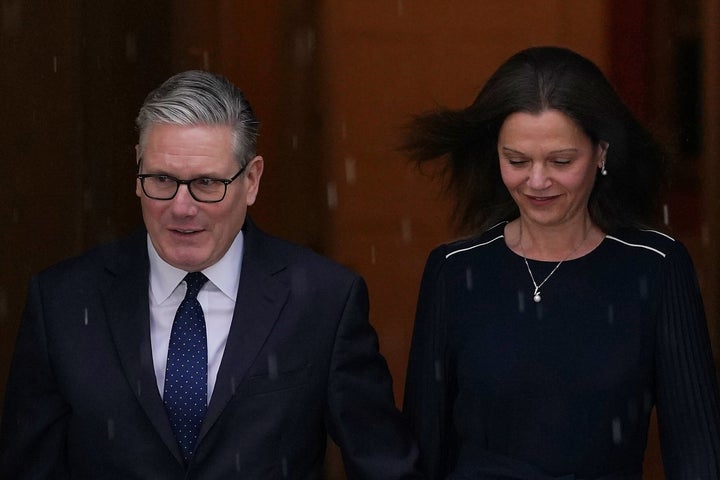
Why Is This A Particularly Tense Moment For The Government?
Starmer’s premiership is hanging by a thread following Labour’s catastrophic losses in last week’s elections in England, Wales and Scotland.
Buckingham Palace allegedly double-checked with Downing Street officials that the speech is still going ahead this week as the government looked like it was about to fall on Tuesday.
More than 80 Labour MPs called for the PM to resign amid mounting fury over the government’s direction.
Four ministers and four ministerial aides have also quit and urged Starmer to set out a timetable for his departure from No.10.
But the prime minister is holding firm, insisting he will not walk away from government.
None of his cabinet ministers have yet resigned meaning the government can limp on, despite the mass discontent.
All eyes are on health secretary Wes Streeting, who has aspirations to be the next PM but is yet to directly challenge the PM.
Subscribe to Commons People, the podcast that makes politics easy. Every week, Kevin Schofield and Kate Nicholson unpack the week’s biggest stories to keep you informed. Join us for straightforward analysis of what’s going on at Westminster.
You must be logged in to post a comment Login