

Politics
French League match cancelled after fans storm pitch

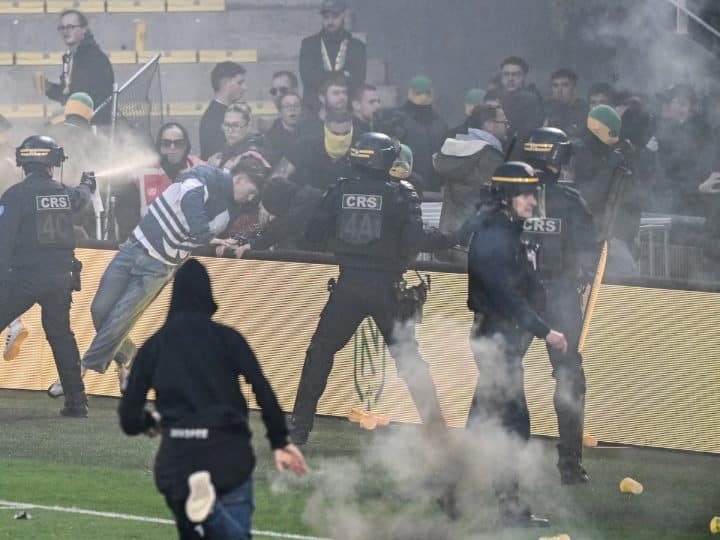

The match between Nantes and Toulouse in the 34th and final round of the French League came to an abrupt end on 17 May. This happened after Nantes fans stormed the field of the La Beaujoire stadium to protest the team’s official relegation to the second division. The scenes were chaotic. As a result, the referee terminated the match.
Tensions from the start
France Info Sport reported that tensions began within the opening minutes. Nantes fans lit flares and threw projectiles towards the pitch, before storming the pitch just 20 minutes into the game.
The sports outlet added that players and staff from both teams quickly left the pitch. They then sought refuge in the locker rooms under security protection. At that point, the referee had ruled that the game must be suspended. This decision came in the absence of security guarantees. In addition, there was ensuing chaos inside and around the stadium.
Riot police deployed
The same outlet reported that riot control forces were deployed inside La Beaujoire stadium to control the situation. They secured the exit of players and referees.
For its part, Ouest-France reported that Nantes fans booed loudly from the beginning of the match, adding that security forces faced difficulty in containing the fans who stormed the pitch from several sides.
Amid a tense atmosphere that the newspaper described as ”chaotic”, the shock was clear on the Nantes players and the technical staff after the match was stopped.
Ouest-France also indicated that there are fears of disciplinary sanctions being imposed on the club by the French League, against the backdrop of riots and fans storming the pitch, on one of the most turbulent nights in the club’s modern history.
Featured image via One Football
By Alaa Shamali

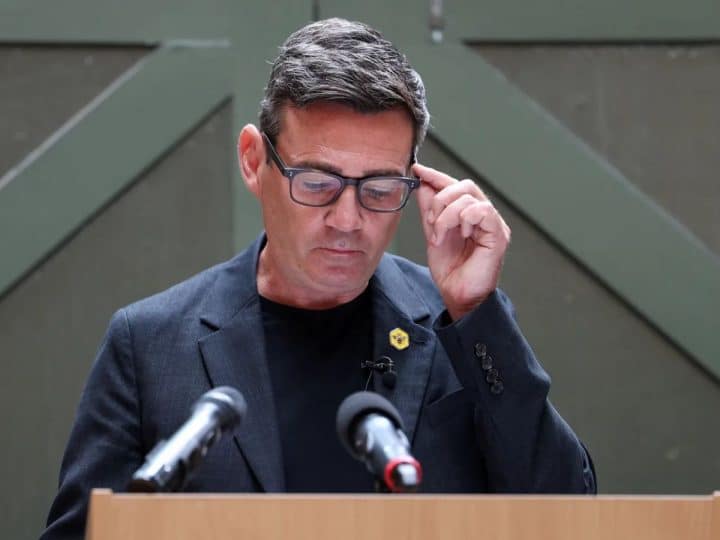
Incoming PM Andy Burnham has said the Labour Party got it wrong on Palestine and will fix up. He’s pledged to put more pressure on Israel, including possible bans and sanctions. But is he to be trusted?
Burnham told the Guardian:
I know many people feel that at the start of Israel’s military action in Gaza my party didn’t get it right and I am sorry about that. The response has too often not been good enough. We need to do better.
We’ve got to do more to put pressure on the Israeli government … Yes, we have taken some important steps … But let’s be honest, the UK was too slow to call for a ceasefire. And we must now do more to strengthen our approach.
As the newspaper pointed out, Burnham has stopped short of naming the genocide for what it is. He prefers to talk about “war crimes”:
I have been absolutely appalled by what I’ve seen and read about the destruction of Gaza. There’s increasing evidence that war crimes appear to have been committed.
There must be accountability for the depth of the suffering the people of Gaza have experienced. Ultimately, however, it must be for the international courts to determine, rather than politicians.
But what to make of it?
Burnham, Israel and the soul of Labour
Burnham is certainly a better communicator than Starmer. But underneath the ‘Manchesterism’ gimmickry, his politics are cut from the same cloth. Not least on foreign policy…
As Jody Macintyre pointed out on 30 June:
Any illusions of Labour Party “change” under Andy Burnham were dispelled last week when he appointed lobbyist, Blairite minister, ex-Labour Friends of Israel chair, and Peter Mandelson’s “boy” James Purnell as his chief of staff.
And:
When Andy Burnham served as a Labour government minister, his most senior special adviser was Jennifer Gerber, an ex-chair and current director of Labour Friends of Israel. Until today, LFI refuses to reveal its donors.
But there is something else here too. And it comes down to what the Labour Party actually is. In the early days of Corbynism, eldritch lord Tony Blair penned one of his rare monthly essays slamming Jeremy Corbyn. He said that the party owed more to Methodist Christianity than Marx.
Socialist writer Richard Seymour contested this idea in his 2016 book ‘Corbyn: The Strange Rebirth of Radical Politics.’ He argued that Labour’s historical trajectory and commitment to empire and capitalism is best explained by the “enduring significance” of “its origins in Victorian Liberalism.”
He added:
Those Labour MPs who, today, find simply unthinkable the break-up of the United Kingdom, the repudiation of Trident, and the end of the ‘special relationship’ with the United States, are in fact authentic legatees of their party’s traditions.
There are lots of arguments to be had about what Andy Burnham will do, or what he thinks on some philosophical level. And they will be had. But what isn’t going to change is that Burnham will lead a party dedicated to US empire and global capitalism. And support for the settler colonial state of Israel is a central and non-negotiable strut of those commitments.
Featured image via TRT
By Joe Glenton

Three years ago, I stood beside my husband Al’s bed and prepared to say goodbye.
After 25 years of marriage, cancer was taking him where I could not follow. Before he died, he looked at me and said something that shocked me at the time.
“Diane, you’ll need another man.”
I immediately dismissed the idea. I was 80 years old. I had already experienced a full life. What on earth would I need another man for? I certainly wasn’t looking for one.
Then life did what life often does. It ignored my plans.
Just a few months after Al died, friends introduced me to a man named Bob. I welcomed it because I was experiencing what I later discovered, after many late-night Google searches, was called “widow’s fire,” a fierce longing for intimacy and closeness after losing a spouse that, despite being surprisingly common, few people talk about.
Some people, including some of my children, thought it was too soon for me to begin dating. But grief doesn’t follow a timeline.
I wasn’t looking to replace Al. No one could. But for 25 years of marriage, I had been part of a pair. Suddenly, I was standing alone. The silence and loneliness were overwhelming.
What I realised was that I didn’t want to spend the rest of my life alone. I wanted companionship, laughter, conversation and, yes, physical attraction. And to my surprise, I found that in Bob, a kind, funny and handsome man who understood that loving him didn’t mean I loved Al any less.
Bob and I have been together for more than two years. We are deeply committed to one another, but marriage isn’t part of our equation. At our age, we’ve learned that relationships don’t need to look a certain way to be meaningful. What works for us is love, honesty and a healthy dose of practicality.
That practicality was put to the test recently when Bob and I embarked on a 22-day adventure through Norway, France and Spain. With me at 82 and Bob at 83, travelling halfway around the world requires a little more planning than it did a few decades ago.
Before we left, I sent an email introducing my daughter and son-in-law to Bob’s brother and sister. Not because we were planning a family reunion. Because we were 82 and 83 years old and about to cross an ocean together.
“Should we get lost along the way and need your assistance,” I wrote, “you now can connect with one another and try to retrieve, grieve or rejoice from our far distant travels.”
I also informed everyone that I had travel insurance in case my body needed to be shipped home and that Bob had thoughtfully prepared his own end-of-life arrangements. My children thought it was hilarious. Bob’s family may have thought I was crazy. They’re not entirely wrong.
But if you’re going to travel the world in your 80s, you learn to laugh about the realities that come with it. Like money. People don’t like talking about finances in matters of romance, but they should.
In our case, I happen to have a larger wallet than Bob. Before we left, we talked openly about expectations. I agreed to pay for the trip itself, including the airline tickets. Bob was perfectly willing to fly economy. I was perfectly unwilling to sit in first class without him. The good Lord knows I’m spoiled, and I wasn’t going to be up front sipping champagne while the man I loved was squeezed into seat 34B. Besides, I like him next to me.
We agreed that he would cover many of the extras along the way, including meals, excursions and spontaneous treats. There were no complicated contracts. Just two adults having an honest conversation.
Widowhood taught me many things. Like I wish more people understood that discussing money isn’t unromantic. Avoiding it is.

Photo Courtesy Of Diane Heiler
The trip itself became a lesson in something even bigger. Standing in Norway, surrounded by glaciers that looked as though they belonged on another planet, I found myself thinking about Al. He loved to travel.
The glacier train rides were breathtaking. The scenery was so beautiful it almost didn’t seem real. It was colder than a witch’s teat but magnificent. Al and I had never made it to Norway together, and I couldn’t stop thinking about how much he would have loved it.
Unexpectedly, I didn’t feel guilty. For a long time, widows are made to feel that happiness somehow betrays grief. It doesn’t. Missing Al and loving Bob can occupy the same space. Both things are true.
Bob understood that. He never tried to compete with my memories. He simply stood beside me while I carried them. That’s one of the many reasons I love him.
Norway also introduced me to two things I never expected: iced cider and brown cheese.
The cheese was downright addictive.
I liked it so much that I packed half a pound of it in my suitcase and hauled it through France, Spain and all the way back home to Florida.
At 82 years old, apparently, I travel internationally with contraband cheese.

Photo Courtesy Of Diane Heiler
The minute we arrived, I announced to Bob, “I could live here.”
It had everything I love: beauty, charm, walkability and friendly people. We spent our days wandering old streets, taking in spectacular views and pretending, just for a moment, that we belonged there.
Of all the places we visited, Normandy affected me the most.
Standing among the endless rows of white crosses at the American Cemetery overlooking Omaha Beach, I felt humbled in a way that is difficult to describe.
The older I get, the more familiar loss becomes. Friends die. My spouse died. Parents die. Even pieces of ourselves disappear. The woman I was at 40 no longer exists. Neither does the woman I was before widowhood.
Yet there I was, halfway around the world, still creating memories. Still laughing. Still planning. Still living.
Spain brought its own lessons.
I use wheelchair assistance because of a painful foot. Bob uses a cane. Airport assistance services managed to leave us at the wrong gate on two separate occasions, causing us to miss our flights.
After missing our second flight, I told Bob I could have learned to become a professional tango dancer in less time than it took airport personnel to move my behind through that airport. For two days we were shuffled from gate to gate while trying not to lose our sense of humour. Thankfully, we succeeded.
By the time we reached Mallorca after nearly three weeks abroad, we realised something. We may have been tourists, but we didn’t particularly want to be around tourists anymore.
Maybe we were tired. Maybe we missed our own beds. Or maybe we had officially become old people. Either way, home was sounding awfully good.
Traveling at 82 also comes with one unexpected advantage: I no longer care about impressing anyone.

Photo Courtesy Of Diane Heiler
When I was younger, I packed as though every day required a completely different outfit, matching shoes, jewellery and accessories. These days, I pack for comfort, practicality and the occasional nice dinner.
For 22 days abroad, Bob and I shared one checked suitcase, and we each carried a small bag. It wasn’t because we were trying to prove anything. It’s simply that we’ve learned what matters and what doesn’t.
I’ve discovered that one scarf, one pair of comfortable shoes and a little confidence can carry you remarkably far. That’s one of the gifts of ageing. You spend less time worrying about how you look and more time enjoying where you are.
At this age, I’ve learned that nobody really cares what you’re wearing, whether your hair is perfect or if you’ve packed the right shoes. What people remember is whether you laughed, loved, showed up and enjoyed the journey.
And that’s true whether you’re standing on a glacier in Norway, wandering the streets of Barcelona or simply sitting beside a koi pond at home with someone you love.
The greatest surprise of the trip wasn’t Norway’s glaciers, Normandy’s history or Barcelona’s architecture. It was realising how comfortable I have become with this unexpected chapter of my life.
If you had told me three years ago, while I was sitting beside Al’s hospital bed, that I’d be crossing Europe with another man, I would have told you that you were out of your mind.
If widowhood has taught me anything, it’s that we don’t honour those we’ve lost by stopping our lives. We honour them by continuing to live them.
When Al died, I thought my story was winding down. Instead, it simply changed genres.

Photo Courtesy Of Diane Heiler
These days, I’m perfectly content sitting beside that pond with Bob discussing books, sports, grandchildren, politics or whatever we’re streaming on Netflix. Twenty years ago, I would have called that boring. Now I call it happiness.
One of the most damaging myths about ageing is that life becomes smaller. I’ve found the opposite. Life becomes more precious. At some point, every one of us realises our time is finite. The horizon becomes visible. Oddly enough, that’s what makes each day matter more.
At 82, the future looks different than I imagined. It includes a new love. A few more aches and pains. Occasionally a wheelchair. And gratitude for every single day I still get to wake up and see what comes next.
Al knew all this before I did. He knew I would need companionship. He knew I would need laughter. He knew I would need someone to sit beside me on airplanes and hold my hand during life’s inevitable turbulence. Most of all, he knew I would need a future.
As it turns out, he knew me better than I knew myself.
Diane Heiler is the author of “A Widow’s Fire: An Intimate Memoir of Heartbreak, Survival and Moving On.” Widowed in 2023 after caring for her husband through his battle with cancer, she writes about grief, resilience and finding joy again after profound loss.
Do you have a compelling personal story you’d like to see published on HuffPost? Find out what we’re looking for here and send us a pitch at pitch@huffpost.com.
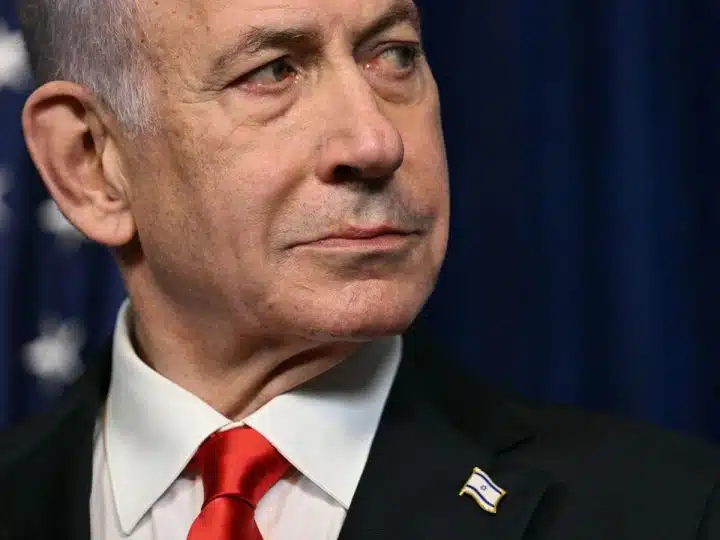
Israeli PM Benyamin Netanyahu has said Israel will occupy Lebanon for as long as required. The settler colonial state pushed deep into the country’s south during the most recent invasion and is still holding swathes of Lebanese territory.
Netanyahu said on 9 July:
We will remain in the security zone in southern Lebanon for as long as necessary to guarantee the security of our communities in the north.
The war criminal PM was addressing a group of Israeli pilots. The Times of Israel reported that he told them:
The war is not over. Alongside old challenges, new ones continue to emerge. Old axes collapse, and new ones arise. We are preparing for every scenario. We know one thing: we must always remain stronger than our enemies.
Preserving Israel’s air superiority is a cornerstone of our national security doctrine. It is equally essential for maintaining stability in the turbulent Middle East.
We achieve this by continually improving both our people and our technology.
Israel, Lebanon’s government and the south
The Canary’s Guy Smallman reported on 4 July that the Lebanese government’s sell-out of the people under occupation in the south has caused widespread outrage.
protestors took to the streets of South Beirut to vent their anger as news spread of the ‘framework agreement’ between the Lebanese government and Israel. Youth on foot, and riding scooters, blocked the main road to the airport with burning barricades. It took the army several hours to regain control of the area.
One local told him:
What kind of president can sign a deal when there are still bodies under the rubble and the battles are still ongoing. How can he even talk to the enemy when our land is occupied and so many people are displaced?
Smallman wrote:
Many here are questioning how this agreement can ever realistically be implemented on the ground in Southern Lebanon. The fighters holding the line against the Israelis reject it, as do the local people.
The Lebanese army are unlikely to intervene on behalf of the government to disarm the resistance, and the speaker of the parliament has just said that the agreement will not be implemented as it threatens serious internal division in a country that was ravaged by civil war for a decade and a half.
For Zionists, Netanyahu among them, Lebanon is already theirs. His belligerent speech about preparation for future wars — and his ongoing ethnic cleansing in Lebanon — speak to the Israeli vision of a land cleansed of its indigenous inhabitants.
Featured image via the Canary
By Joe Glenton
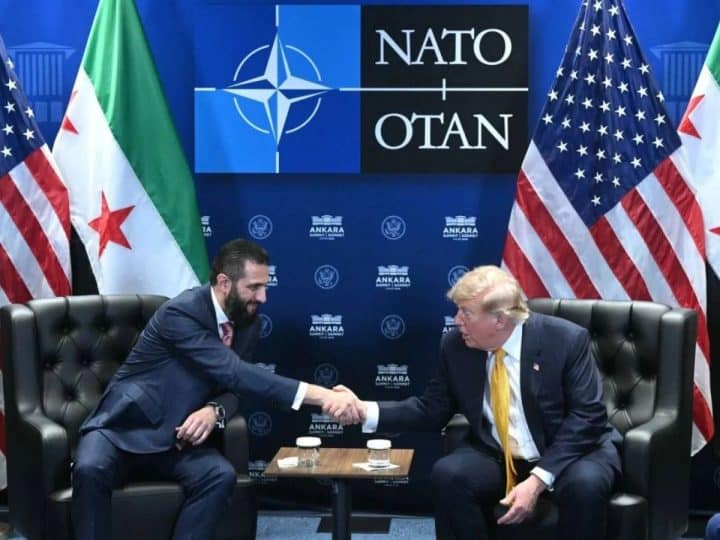
Imagine the significance of what Donald Trump said about the Golan!
The President of the United States effectively reaffirmed Israel’s occupation and annexation of the Golan Heights while Abu Mohammad al-Julani sat beside him without a single objection, not even a reminder that… pic.twitter.com/f6RlXdpmuw
— Kevork Almassian (@KevorkAlmassian) July 9, 2026
The US-UK-Zionist ally, former ISIS-linked Syrian terror leader al-Jolani, recently attended another intimate US-NATO press conference. In the clip, Ahmed al-Sharaa (as he since restyled himself) silently capitulates Syria’s territory to Zionist occupation.
Trump reaffirms Israel’s illegal occupation and annexation of the Golan Heights, while Abu Mohammad al-Jolani sat beside him without any objection. Trump says:
No President has done as much for Israel as I have. Not even close. Just look at all the things: Jerusalem, erm, the Golan Heights. We did things. Nobody has ever done anything for Israel like me.
The Syrian leader’s silence at a moment like this is effectively state policy. When the US president declares the Golan to be Israeli territory, the self-proclaimed ‘President of Syria’ says nothing. The world can only interpret that silence as acceptance of the status quo.
Before unpacking the Golan’s history of occupation and displacement, it’s worth a taking refresher on who the relatively recently-declared Syrian president is. He’s al-Sharaa to some, al-Jolani to others. Either way, we know ever more clearly where his true political allegiances lie.
Most of all, al-Jolani’s post-terrorist era ‘rehabilitation’ entirely undermines decades of narrative-building around the ‘War on Terror’. Whatever alleged inherent opposition US officials, including President Trump, claim to harbour towards Islamic fundamentalists… They clearly don’t mind when interests align.
Starmer removes Syrian ISIS subsidiary HTS from terror ban list
Al-Jolani — Who is the Syrian president?
He was a leader of Hay’at Tahrir al-Sham (HTS), a breakaway of Al Qaeda with links to ISIS. The former, Al Qaeda, reportedly considered HTS too extreme. It has a record of massacring and abusing minoritised groups, including significant numbers of Alawite, Druze, Christian, homosexual and women.
Since at least 2017, al-Jolani was wanted by the US State Department, with a bounty on information about him set at $10m. His bounty was only cancelled in late 2024, after his Sunni jihadist faction, ‘HTS’, took control over much of Syria. Now he poses regularly for photos with Western heads of state.
One helpful article on the London School of Economics’ (LSE) blog page said in late 2025:
On 24 September 2025, al-Sharaa stepped onto the global stage, addressing the United Nations in New York. His speech was more than symbolic: it marked the entry of a former al-Qaeda and ISIL-linked commander into formal diplomacy, ironically in the very city that suffered the 9/11 al-Qaeda attacks. …
Al-Sharaa’s trajectory mirrors the broader story of global Jihad. Under his nom de guerre Abu Mohammad al-Jawlani, he trained under Abu Musab al-Zarqawi in Iraq, fought U.S. forces, and rose through the Islamic State under Abu Bakr al-Baghdadi. In 2012, he crossed into Syria and founded Jabhat al-Nusra, al-Qaeda’s Syrian affiliate, notorious for suicide bombings, kidnappings, and assassinations.
By 2017, he rebranded the group as HTS, distancing himself rhetorically from al-Qaeda. Designated as a terrorist by the U.N. Security Council since 2013, al-Sharaa resurfaced in late 2024 in a suit and tie, shedding his nom de guerre and presenting himself as a statesman. Behind the wardrobe change, the ideology remained unchanged.
Almost a month after al-Jawlani’s appearance at the UN General Assembly, UK Prime Minister Keir Starmer took steps to de-proscribe HTS. This means that Starmer un-banned HTS mere months after proscribing anti-genocide peace activist group Palestine Action a “terror organisation.” This is clearly absurd.
Remind us which was “notorious for suicide bombings, kidnappings, and assassinations,” Sir Keir?
By donning a suit, polishing up his English and compromising himself regionally, al-Jolani was warmly welcomed into the NATO-Zionist-led international regime. When Syrian dictator Bashar al-Assad fled in late 2024, HTS took over and imposed its own dictatorial, fundamentalist regime.
The only difference is that this one was willing to bow to Western imperial interests. And central to those interests in the region, of course, is the Zionist settler-colonial military state project of ‘Israel’.
Golan Heights: more Zionist occupation
The Golan Heights mountain plateau spans some 1,800sq km (700sq miles) in the south-western corner of Syria. It borders Jordan, Lebanon and everyone’s worst neighbour, Israel.
It has been occupied by Israeli Occupation Forces (IOF) following its Six Day War in 1967. The Zionist entity then annexed most of Golan in 1982. The UN upholds a buffer zone on the Syrian side, while only the USA recognises occupied Golan as ‘Israel’. Trump officially recognised it as such in 2019.
Golan land is largely rugged basalt rock: fertile, hilly land where volcanic soil grows apple and cherry orchards and vineyards. The region holds vital water sources feeding the Jordan River, including the Hasbani River, which flows from Lebanon and through the Golan. Not land most Syrians wish to part with…
Yet today, more than 30 Israeli settlements are in the Golan, where more than 25,000 Jewish Israelis now live as illegal occupiers and human shields. Plausibly over 100,000 people, many of them Druze, were displaced and expelled by the IOF in the months and years following the 1967 occupation. Now many live under a similar regime of apartheid to that in occupied Jerusalem and wider Palestine.
In 1981, the UN Security Council unanimously passed a resolution opposing Israel’s occupation of Golan. It called on Israel to rescind its imposition of ‘Israeli law’ on the plateau. It declared Israel’s rule over Golan:
null and void and without international legal effect.
Trump and Biden, both being fundamentalist Zionists and war-criminals, equally dismissed all this.
In late April 2026, Israel approved a $334m plan to move Israelis in while keeping long-displaced Syrians out of occupied Golan. It aimed to bring in another 3,000 Zionist ‘civilians’ — many of whom comprise armed militias — to so-called ‘Katzrin’ city by 2030. Human Rights Watch described it as:
clear statement of intent to commit war crimes.
Golan’s occupation resembles the ‘Crimson Thread’ project: the IOF barrier cutting off Palestine’s essential “breadbasket” agricultural land. The planned 500km IOF barrier would block off Palestinians from a large swathe of some of the most fertile farming land in the entire occupied West Bank.
Legitimise and reintegrate: Syria’s ex-Al Qaeda president to attend G7 conference
Featured image via the Canary
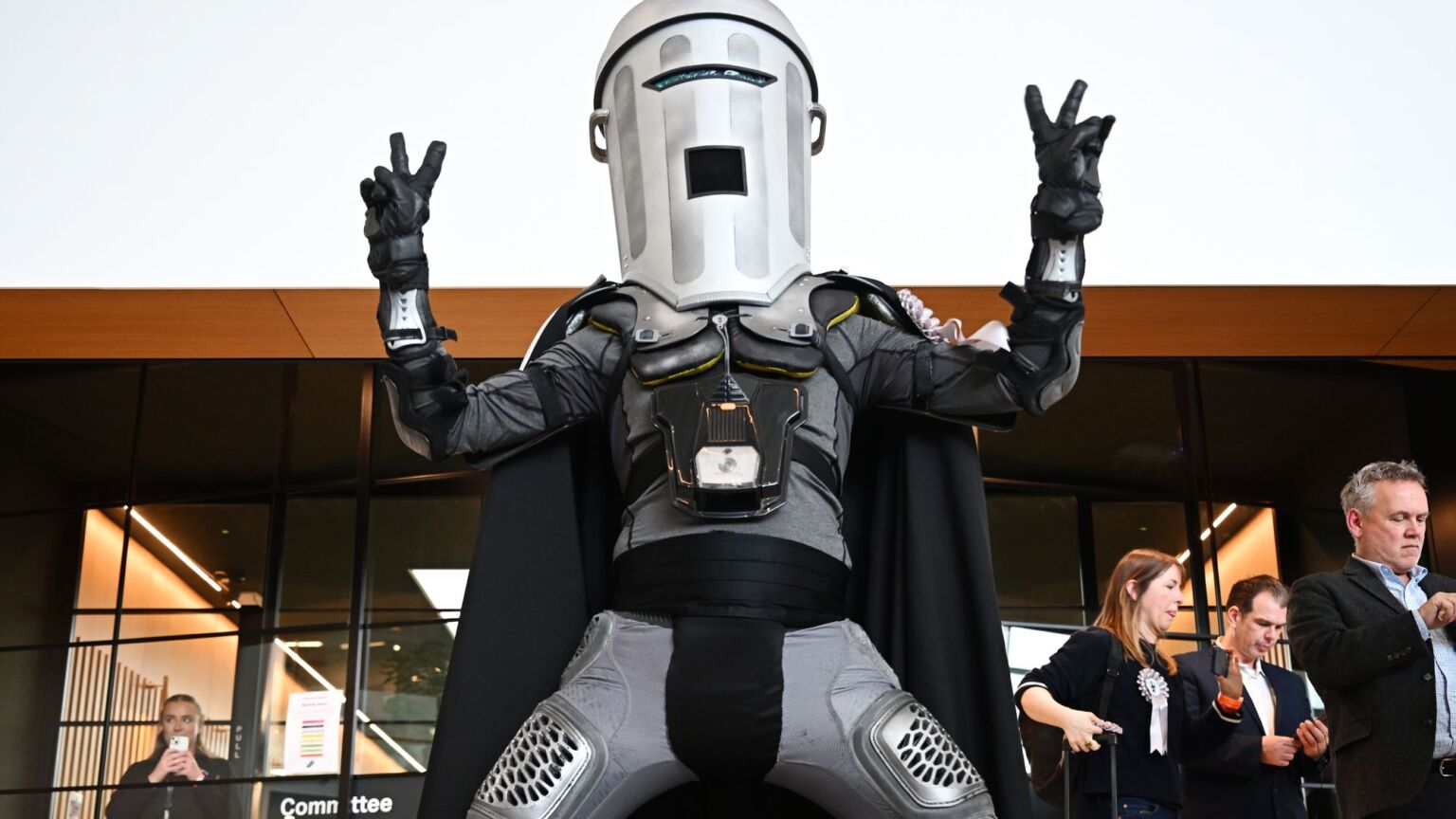
As the next by-election to disfigure Britain’s recent political history gears up in Clacton, it looks likely to be contested between a man whom some still regard as the Rebel Alliance and others as the Empire in business dress, and another who actively promotes the idea that he is from outer space.
There really is a neck-and-neck race in prospect – but it isn’t the one in Clacton, triggered by the recent resignation of Nigel Farage, where, thanks to the refusal of the other parties to stand, the ‘satirical’ candidate Count Binface will be his only major opponent.
I refer, instead, to the race between the overall collapse of the country – perhaps via a fiscal emergency, a sovereign debt crisis, power outages or civil war – and the collapse of the legitimacy of any political process. A race during which we might find someone equal to the task of steering us away from these rocks.
All of which is only part of the reason why Count Binface is not funny.
I am not against politics being ridiculed, of course, by any means possible. If the Count were, as the New Statesman claims, in ‘a proud British tradition’ of mocking power and all its pretensions, and especially the illusion of meaningful choice at the ballot box, then fine. If voting for him was just an opportunity to cock an active snook at the whole shooting match, a snook that simply refusing to attend the polling station would fail to register, I would applaud him or at least endure him in grim, mute acquiescence.
But Count Binface clearly isn’t mocking power and all its pretensions. I know, because I remember the beginnings of the Official Monster Raving Looney Party, which did.
The OMRLP was inaugurated by ‘Screaming’ Lord Sutch way back in 1982, when dull men in grey suits really did dominate both sides of the chamber (despite the prime minister being ostensibly a woman). The party was named in an attempt to go beyond the merely ‘Silly’ party that featured in Monty Python’s immortal Election Special, in 1970, which also cocked snooks at a rate of about three per minute.
As with Python, Sutch’s intent was to satirise the boring conformity of the main parties. To ridicule the stale, sweat-infused atmosphere of Westminster and the whole drab, dismal Larkinesque air of inevitable failure that surrounded the rituals.
As it happens, Sutch also introduced manifesto pledges that did in due course enter statute, such as lowering the voting age from 21 to 18. But this was by the bye. And even if the joke, like all jokes, wore thin over ensuing years, Sutch remained a fondly regarded part of Britain’s slightly shabby electoral machinery brought out every cycle – machinery that always looked as if it had been kept in a not quite weatherproof shed since the last democratic pantomime.
The subtext to Count Binface on the other hand – and whether the honorific is a pun on the electoral process or just an attempt to lure me into making the single most obvious typographical joke in the lexicon, I don’t know – is quite different. It seems to be not to mock the charade, the traditional legacy parties, the uniparty fiasco, the political elite that has relentlessly ignored the most clearly articulated wishes of the electorate since at least 1997 and brought us to this sorry pass. Rather, Count Binface is designed to mock those who presume to do something about that. To mock, not the weak, but rather those who are just beginning to sense their own strength. To speak, as the estimable @bovrilG on X put it, Power to Truth.
This is far from new, of course. The breed has even been given an epithet – ‘regime humour’. I have to work with these people – or at least quaff apéritifs at swanky receptions with them – so would prefer not to name too many names. But my attack on Ian Hislop and Have I Got News for You in these digital pages a few weeks ago identifies the tendency.
Hislop’s infamous ribbing of Rupert Lowe, for instance, for haplessly mistaking a British rowing crew for a boatful of illegal, undocumented migrants, is a classic of the genre. A joke which purported to undermine the entire proposition that such boats exist and are a concern. Silly old bear!
By dressing up as both a bin and an intergalactic traveller in time and space, Binface might seem to outflank Farage as an ‘outsider’ – I mean, what could be more ‘outside’ than a dustbin. But his actual policy proposals, far from being the ‘centrist dada-ism’ that one amusing X user thought he’d seen, are distinguishable from those of Starmer’s front bench only by the slightly muffled delivery occasioned by his stupid prosthetic head.
Don’t get me wrong. I too wish that Britain’s best hope for real change wasn’t led by a man who surrounded himself with billionaires and dodgy aristocrats. But Reform UK is what we’ve currently got. Don’t be fooled by the Rag Week get-up. The establishment candidate in Clacton is Binface.
Oh yes. And he’s also a cunt.
Simon Evans is a spiked columnist and stand-up comedian. Tickets for his tour, Staring at the Sun, are on sale here.
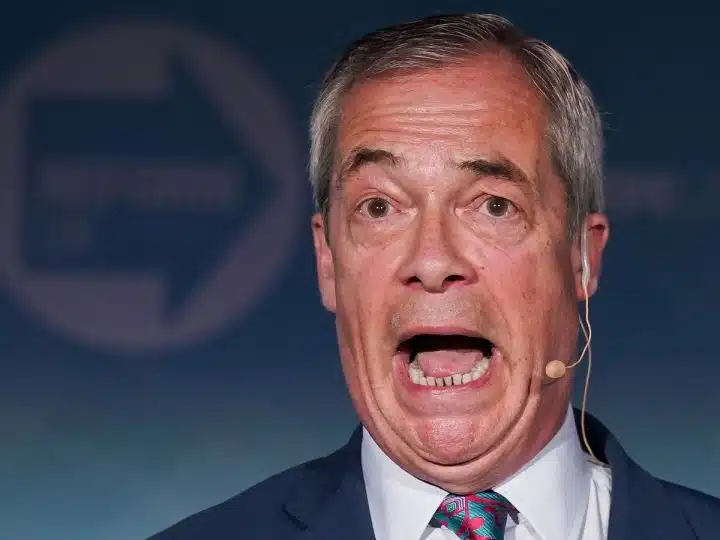
Scandal-riddled Nigel Farage “routinely” introduced criminal crypto-financier ‘Posh’ George Cottrell as his “chief of staff”, according to new revelations in the Guardian.
Cottrell is one of two donors at the centre of the scandal of Farage’s massive undeclared donations, which he was legally obliged to report on becoming an MP. Farage is now trying to staunch the bleeding by resigning his Clacton parliamentary seat and standing for re-election. However, his claim that the donations have been a purely personal matter among friends is shattered by the latest exposure.
Farage panic
As well as his own donations and the alleged provision of vehicles to Reform MPs, bank staff suspected that a £1m donation from Cottrell’s mother was not her own money. Reform denies Cottrell had any “official role”.
The introductions and other issues mire Farage even further in a scandal of his own making. Even his attempted ‘reset’ is in trouble. Panicked Reform is begging supporters to ignore the Manchester mayoral contest and get to Clacton to campaign after bookmakers made comedy candidate ‘Count Binface‘, Farage’s only real challenger, only 5/1 to defeat him in the now-vacated seat.
Featured image via the Canary
By Skwawkbox

As the Canary revealed exclusively on Tuesday, disgusted members of Your Party’s (YP) executive committee (CEC) called for a no-confidence vote in the CEC’s chair and secretary. The call came after their removal of three well-known CEC members for attending a socialist conference. Skwawkbox can now reveal that the motion received enough support to force a vote, which will be held online from 6pm this Sunday, 12 July 2026.
Your Party — Majority support
Skwawkbox understands that a clear majority of members have said they will support the no-confidence motion. A senior figure told Skwawkbox that YP’s parliamentary leader Jeremy Corbyn has been trying to deflect anger or at least postpone the vote to allow times for anger to cool. Some CEC members have tried to dismiss the meeting — quorate under YP rules — as ‘unofficial’.
Angry members backing the vote have said the intransigence of the officers and a refusal to accept diplomatic overtures has made the vote unavoidable. Party rules mean that the three members who were ‘suspended’ will be eligible to attend and vote. They have already backed a call for an investigation into the chair’s and secretary’s actions.
Former Crewe Labour MP Laura Smith has already resigned as CEC vice-chair on 4 July. If the no-confidence motion succeeds, it will remove the chair and secretary from those roles, but not as ordinary elected CEC members.
Featured image via YP
By Skwawkbox
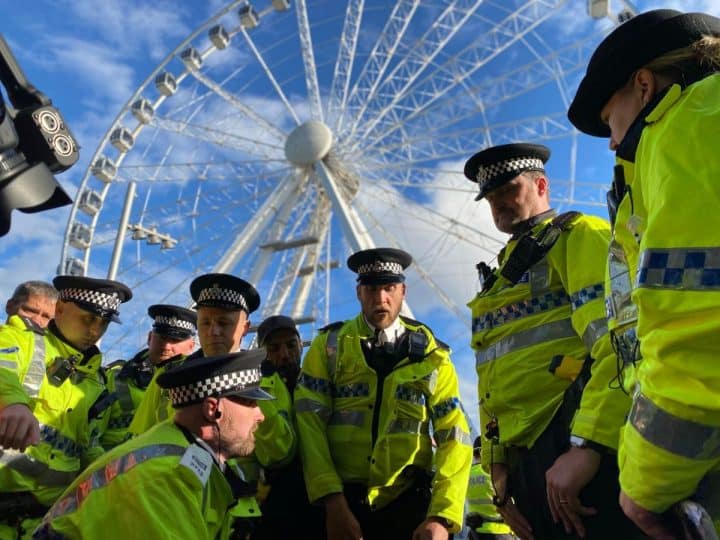
Defend our Juries activists have been hit with five police raids in one day. The campaign group said the raids were linked to Palestine Action solidarity messages. Three raids were originally reported on 10 July according to an X post:
Defend Our Juries can confirm that at least three home raids have taken place this morning. Individuals who have shared videos online declaring support for the unjustly proscribed direct action group Palestine Action were arrested.
Saving lives is not terrorism.
HOME RAIDS
Defend Our Juries can confirm that at least three home raids have taken place this morning. Individuals who have shared videos online declaring support for the unjustly proscribed direct action group Palestine Action were arrested. Saving lives is not terrorism. pic.twitter.com/yf1I37sWHd
— Defend Our Juries (@DefendOurJuries) July 10, 2026
Defend our Juries posted later that police had carried out a further two raids:
UPDATE – FIVE RAIDED
Counter-terror police have so far raided the homes of 5 out of more than 60 individuals who have shared videos online declaring their support for Palestine Action.
All have taken place in the Midlands.
We won’t be intimidated – more ‘terror’ videos soon! https://t.co/rOVJEbdouH — Defend Our Juries (@DefendOurJuries) July 10, 2026
The group campaigns to defend British rights and liberties against the current authoritarian onslaught meted out by Keir Starmer’s government.
Their website warns:
From the UK Government’s plans to severely restrict jury trials, to judges removing legal defences in activist trials, and the Home Office criminalising protest groups or designating them as “terrorist organisations” – the British justice system is being weaponised to serve corporate interests against our democracy and civil liberties.
A major part of their work is opposing the proscription of Palestine Action:
The unjust ban on Palestine Action was not an accident, it is part of a strategic effort for the UK government to be able to ban whichever group they don’t agree with.
The group claims the ban will inevitably turn into further attacks on basic rights:
They have now also begun sentencing direct actionists as “terrorists” without them ever being convicted on any terrorism charge. If we do not oppose our government’s attempts to corrupt UK law, who will they choose to ban next? Trade Unions? Striking workers? Disability rights groups?
The group also posted a video of Jon, one of their activists, whose home was targeted on the 10 July raids:
Here’s what Jon said that caused counter-terror police to raid his home this morning.
We can all agree that this response is totally absurd and unnecessary. Saving lives is not terrorism.
Palestine Action is not a terrorist group, regardless of the unjust ban.
Lift the ban. pic.twitter.com/L4IOw3iVwY
— Defend Our Juries (@DefendOurJuries) July 10, 2026
You can read more about Defend our Juries here. UK state power is growing more repressive and hard-won rights to free speech and protest are being hacked away. Groups like Defend our Juries are at the forefront of the fight to retain the basic liberties which are essential to democracy.
Featured image via Twitter
By Joe Glenton

England’s last‑16 win over Mexico came at a cost. Jarell Quansah, starting at right‑back in the Azteca stadium, was sent off just before the hour mark and has now been handed a two‑match suspension after FIFA ruled his challenge on Jesús Gallardo amounted to serious foul play. The decision leaves Thomas Tuchel short of options on the right side of defence as England prepare for Norway on Saturday.
Corrupt FIFA extends ban
The incident came in the 54th minute. Quansah slid in on Gallardo, catching him high on the shin. Referee Alireza Faghani initially let play continue, but VAR intervened. After reviewing the monitor, Faghani produced a straight red.
FIFA’s disciplinary committee later confirmed Quansah had breached article 14 of the code of conduct, which carries a mandatory two‑game ban for serious foul play. England cannot appeal. Only Donald Trump can do that. World Cup regulations do not allow challenges to red‑card decisions, apparently.
The ruling means Quansah will miss the quarter‑final against Norway and, if England progress, the semi‑final against either VARgentina or Switzerland.
England not happy with VAR
England were left unhappy with how the VAR review unfolded. Their frustration centred on the sequence of replays shown to referee Alireza Faghani, particularly the initial still frame highlighting the studs‑to‑shin contact rather than the full speed of the challenge, which included Quansah playing the ball before colliding with Jesús Gallardo.
The FA raised concerns about the presentation of the footage, but the disciplinary committee maintained its position. Under IFAB guidance, playing the ball does not mitigate a challenge if it endangers an opponent’s safety, and FIFA judged that Quansah’s tackle met that threshold. The two‑match ban therefore stands, ruling him out of the quarter‑final and any potential semi‑final.
Right‑back dilemma
Quansah’s suspension deepens England’s problems at right‑back. Reece James has not played since suffering a hamstring injury in the second group game against Ghana. Djed Spence, who missed the final training session before the Mexico match, was only fit enough for the bench and came on late.
Tuchel now faces a difficult call. One option is to move Ezri Konsa who has been his first‑choice centre‑back throughout the tournament, across to right‑back. But that would weaken England centrally, especially with Erling Haaland waiting in the quarter‑final. Konsa’s physicality has been crucial, and removing him from the middle would leave England lighter against one of the world’s most imposing strikers.
England have only one natural left‑back in Nico O’Reilly and limited depth on both flanks. The suspension has arrived at the worst possible moment.
The decision comes in the wake of the 12-month ban handed to US striker, Folarin Balogun, after his red card against Bosnia‑Herzegovina. This also drew scrutiny due to political pressure from US president Donald Trump. England’s camp has not publicly linked the two cases, but the contrast in sanctions has been noted across the tournament.
England’s route not easy
England’s path to the final was already challenging. Norway, led by Haaland, present a physical test. A semi-final against VARrgentina or Switzerland would demand defensive stability. Losing Quansah, who had been trusted to start at right‑back in a knockout match, forces Tuchel into reshaping his back line at a critical stage.
The red card itself was a turning point in the Mexico match. England had been in control, but the dismissal shifted momentum and forced a tactical reshuffle. They held on for a 3‑2 win, but the consequences have now stretched far beyond the 90 minutes.
What happens next
England will continue preparations in New Jersey, with medical staff assessing whether James or Spence can contribute more minutes. Konsa remains the most likely emergency option, though Tuchel must weigh the risk of weakening the centre of defence.
Quansah will be eligible to return only if England reach the final.
A costly moment in the azteca.
Quansah’s challenge was not malicious, but FIFA’s ruling is clear — the tackle endangered Gallardo and warranted a stronger sanction. England must now navigate the next two matches without him, in a tournament where defensive depth is already stretched thin.
Tuchel’s side have shown resilience throughout the group stage and last‑16. They will need more of it now.
Featured image via the Canary
By Faz Ali

Nigel Farage’s statement on Tuesday afternoon, broadcast live from Reform UK headquarters, was supposed to be sensational. After weeks of relative quiet, Farage teased his intervention with a statement on social media, promising an update on his “future in public life”. The scene was set.
In Trumpian tones, Farage furiously portrayed an anti-Reform conspiracy spanning the political class, press and parliament. He addressed the damaging accusations, centred on unregistered donations of cash and support, but insisted that he had done nothing wrong. The political class was guilty, he said, of employing “foul means” to thwart his political project and “threatening” the security of his family.
Farage resolved to stand down as a member of parliament, promising a “people versus the establishment by-election” and an opportunity to “continue the political revolution”.
Farage’s political calculus is prejudiced towards spectacle. He reasoned that a limited contest in Clacton, the Reform capital of Great Britain, would reconfigure the political narrative – distracting from Andy Burnham’s coronation and sidelining reports of Reform sleaze.

MDU warns Chancellor clinical negligence system ‘not fit for purpose’

Northern Ireland RE curriculum is ‘indoctrination’ – Supreme Court
Farage succeeds when politics is played on his terms. A preemptive assault on the parliamentary standards regime, characterised by populist appeals to “people” and scathing castigations of a conspiratorial establishment, could also restore Reform’s lost momentum.
The wheeze rested on some fairly reasonable assumptions. The purpose of self-imposed by-elections, according to their instigators, is to force a genuine test of principle onto a reluctant political class. If there is a constituency in the country willing to accept Farage’s tale of martyrdom at the hands of a vengeful establishment, it is Clacton.
So the stakes could be controlled. There would be no chance of Reform losing; instead, the likely landslide would be seized upon as a sign of popular vindication. The raw political power of Farage’s victory would delegitimise the parliamentary inquisition.
But in at least one crucial respect, Farage and Reform’s political operation badly miscalculated: their plan depended on opponents playing along.
One by one, the established parties – Labour, the Conservatives and Liberal Democrats – acted according to their obvious incentives and declined to engage. Speaking to the Daily Mail on Wednesday, Farage confessed that he had been wrong-footed by this remarkable show of strategic unity on the part of the established parties. Asked if he had considered the possibility of fighting as the only candidate from a major political party, Farage responded: “No, of course not.”
This abstention, following the recent precedent of the 2008 Haltemprice and Howden by-election, upends Farage’s gambit. Reform’s failure to register the possibility that the parties might refuse to engage points to a distinct lack of strategic clarity.
Count Binface, the satirical candidate and self-styled intergalactic space-warrior, has now emerged as Reform’s principal rival. The 2026 Clacton by-election still promises spectacle then; just not on Farage’s terms. Andy Burnham, Britain’s next prime minister, believes Binface is “carrying the hopes of the nation”.
In the 2024 general election, the Labour, Liberal Democrat and Green candidates secured a collective 11,399 votes (24.8%) in Clacton. The incumbent Conservative candidate, Giles Watling, placed second with 12,820 votes (27.9%). Assuming much of the Conservative vote in Clacton is resilient – since voters sympathetic to Reform would likely have migrated to Farage in 2024 – there remains a genuine anti-Reform bloc in Clacton.
But Binface’s candidacy does not need to threaten Farage electorally to be damaging. His campaign could prove the perfect counterpoint to the Reform leader’s martyr complex.
As with Liz Truss and the lettuce, a serious political saga – in this case Farage’s finances and political future – could find itself reduced to a single, absurd image. These stories have a habit of embedding themselves in the public consciousness. Already, Ipsos polling suggests that one in three British adults (33%) would prefer Count Binface to win the Clacton by-election, versus 21% who support Farage.
Farage trades in political theatre, and increasingly in internet virality. While he will surely survive his brush with Binface, a protracted campaign against a novelty candidate, whose whole brand rests on attracting attention, could leave some not inconsiderable battle scars.
The source of Reform’s success in recent years, which extended to the Scottish Parliament and Senedd Cymru in May, has been its professionalisation as a political operation. Research conducted since the 2024 general election suggests that a growing number of Britons see Farage as a credible candidate for Downing Street. A by-election in which Reform’s main competitor is Count Binface will do little to support Reform’s argument that it is a serious alternative to the established parties. Rather, the campaign will be characterised as an amusing sideshow as Andy Burnham enters Downing Street. Simply put, Farage will be forced to own the farce he has invited upon his Clacton constituents.
The campaign will also provide an extended platform for Farage’s opponents, including his more conventionally dressed critics, to address his funding controversies. The contest will bring allegations of Reform sleaze into the full glare of the electorate, priming the public for the release of the standards committee report and any resulting sanctions. Labour and the Conservatives can spend weeks honing their attack lines.
But even more pertinently, Farage’s by-election strategy reflects a strategic regression into Trumpian rhetoric. Robert Jenrick, the Reform Treasury spokesperson, has called the parliamentary investigation into Farage “a kangaroo court” and “a stitch-up”. In his Daily Mail interview, Farage said the committee would issue a “completely subjective judgment”, adding: “There’s no objectivity in this.”
Farage’s Trumpist turn might resonate with his base, consolidating support among the converted, but it risks shrinking Reform’s appeal in the long run. According to YouGov polling, a full 57% of Reform voters in 2024 support or strongly support Farage’s decision to call the Clacton by-election, with only 7% strongly opposed. Among all voters, 32% are strongly opposed to the decision to trigger the by-election and 11% are somewhat opposed. Meanwhile, 40% of Reform voters believe Farage has been honest about his financial affairs, compared to 12% of the country at large; 60% of the country believes that Farage has not been honest.
For Reform, the greatest danger is that Farage’s populist posturing steers the party away from the median voter and reveals the underlying limits of its coalition.
After all, the extent of Farage’s miscalculation can be explained in terms of what he wanted, and what – in a matter of days – has come to pass.
Farage sought a symbolic confrontation with the establishment – a referendum on his leadership and Reform’s platform in the most favourable conditions imaginable. After two successive by-election defeats, he wanted his own Makerfield moment. He hoped to generate momentum and change the narrative, distracting from damaging media scrutiny. A conquest in Clacton, he calculated, would infuse the Reform project with renewed energy and purpose.
Instead, Farage is defending his 8,405-vote majority against a bin. The lack of a “real” rival will produce a campaign dominated by media scrutiny, thus compounding the very crisis the wheeze was designed to resolve. All the while, the Farage sideshow will be a source of ammunition for camp Burnham as the handover is completed later this month.
Farage turned to Clacton in search of popular vindication, but humiliation awaits.
Politics.co.uk is the UK’s leading digital-only political website. Subscribe to our daily newsletter for all the latest news and analysis.

Andy Burnham offers milquetoast sop to Palestine. Sadly for him we weren’t born yesterday
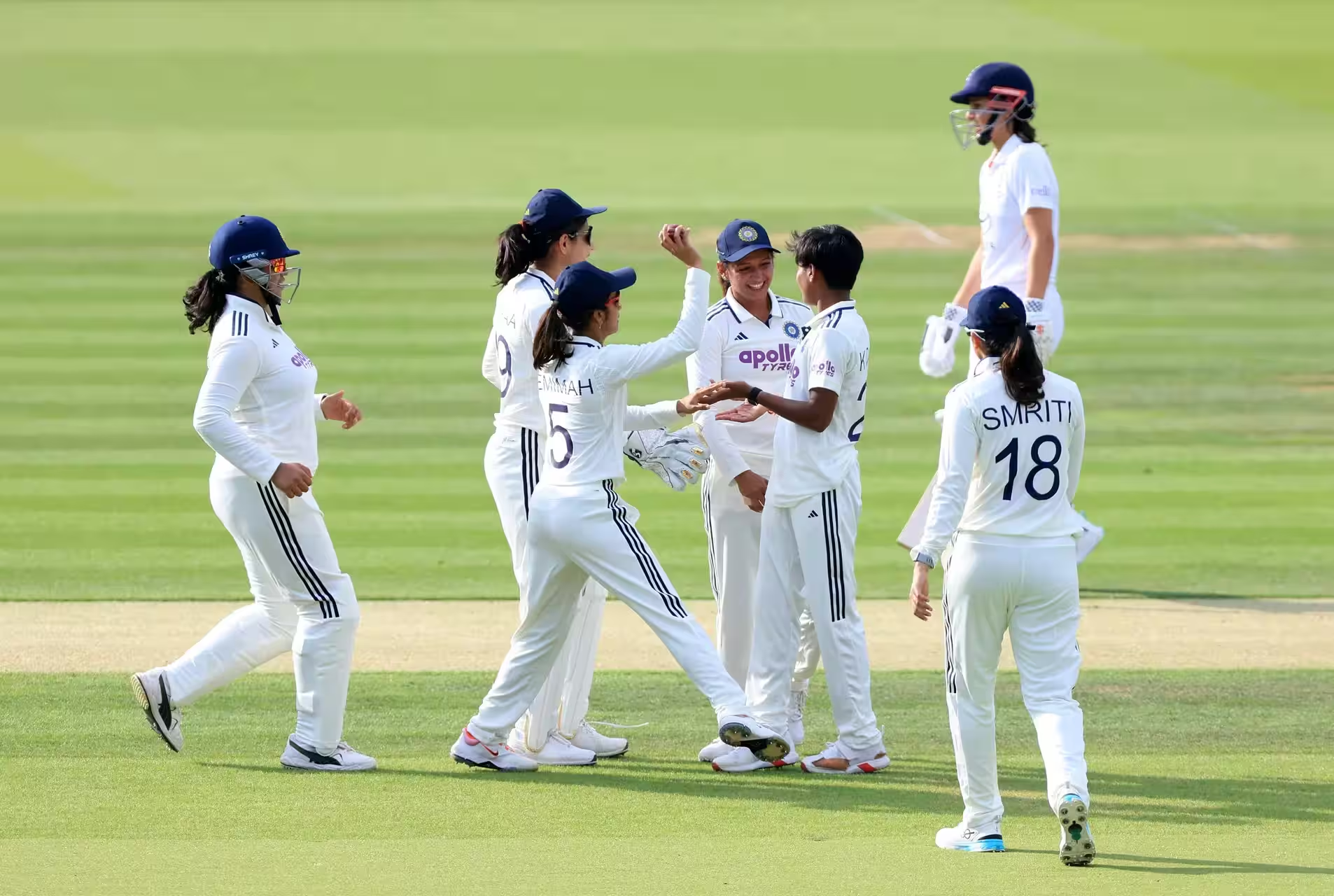
England Women 21/1 in 11.0 Overs

Phia accused of ‘cookie stuffing,’ taking affiliate credit on purchases it didn’t earn

No Jackpot Winner as $257 Million Prize Rolls Over to $269 Million Monday Draw

Renter of Home in Anne Heche Crash Denies Settlement With Son

Weekend Open Thread: Staud – Corporette.com

DAVID SANG THIS EVERY MORNING FOR HIS FINANCIAL MIRACLE | 10 Psalms of God’s Supply #psalms

How To Hit Financial Freedom SO Fast It’s Almost Unfair

Live GOLD and CRYPTO Scalping Trading | DAY 277 #goldtrading #cryptotrading #bitcoin
-
 NewsBeat6 days ago
Taylor Swift and Travis Kelce wedding staffer hilariously struggles to keep her cool while checking in megastars
-

 Fashion5 days ago
Open Thread: What Great Books Have You Read Recently?
-

 News Videos4 days ago
Whats Hidden Inside This Cash Register? #treasure #reselling #money
-

 Fashion2 days ago
Loro Piana Fall 2026 Enters Houston’s Art Scene
-

 Fashion10 hours ago
Weekend Open Thread: Nutriplenish Leave-In Conditioner
-
 Tech4 days ago
Anthropic’s new “J-lens” reveals a silent workspace inside Claude that mirrors a leading theory of consciousness
-

 Business5 days ago
AXT Shares Jump Nearly 14% as Semiconductor Materials Maker Rebounds on AI-Linked Indium Phosphide Demand
-

 Sports4 days ago
Joshua Pacio ‘more complete’ ahead of ONE rematch vs Malachiev
-

 Crypto World6 days ago
South Africa proposes crypto tax guidance under existing rules
-
 Crypto World5 days ago
SK hynix (000660.KS) Stock Dips as $28B Nasdaq ADR Offering Drives AI Memory Expansion
-

 Crypto World5 days ago
$1,000 Credit Alert! BlockDAG X Exchange Pre-Registration Now Officially Open, Polkadot Dips & Zcash Rebounds
-

 News Videos5 days ago
Best Time to Enter Small Caps Right Now? Another Bull Run? | Financially Free
-

 Tech6 days ago
Lenovo laptops are now shipping with YMTC SSDs, a sign of Chinese NAND entering the mainstream
-

 Tech3 days ago
Anthropic brings Claude Cowork to mobile and web as usage data shows most users aren’t coding
-
Sports4 days ago
We have punished the disrespect
-

 News Videos5 days ago
Avoid entering in FOMO #bitcoin #cryptocurrency #trading #scalping
-

 Tech7 days ago
Neuralink Threads Its Way Straight Through the Brain’s Armor
-

 Crypto World4 days ago
Binance lists Strategy’s STRC stock as company expands Bitcoin funding
-
 Crypto World7 days ago
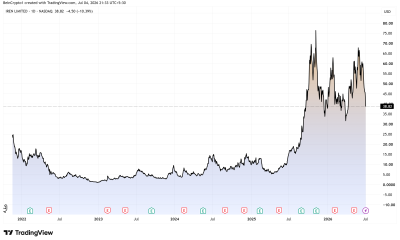
Bitcoin Miner IREN Falls After $700 Million CEO Stock Award
-
 Tech4 days ago
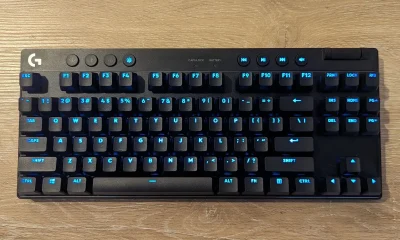
9 Best Keyboards (2025), Tested and Reviewed
You must be logged in to post a comment Login