

Politics
Game Of Thrones Film ‘Confirmed’ To Be In The Works


One final chapter in the Game Of Thrones saga is coming to our screens – this time in the form of a feature-length film.
Almost seven years on from one of the most polarising finales in TV history, screenwriter Beau Willimon – best known for his work on House Of Cards and the Star Wars off-shoot Andor – is said to be writing the script for a new movie version of Game Of Thrones.
The news was first reported by Page Six, and later confirmed by The Hollywood Reporter.
Game Of Thrones came to an end in 2019, with a dramatic turn of events that saw Jon Snow offing Daenerys Targaryen, and Sansa Stark ending up on the Iron Throne.
While the last episodes of Game Of Thrones weren’t exactly well-received by fans at the time, that certainly hasn’t stopped the Westeros universe from expanding in the years since.
The popular prequel series House Of The Dragon, set two centuries before the events of Game Of Thrones, is expected to air its third season next year, with James Norton and Tom Cullen among those joining regulars Matt Smith, Emma D’Arcy, Olivia Cooke and Rhys Ifans. A fourth has already been commissioned by US broadcaster HBO.

Meanwhile, a spin-off of a very different nature premiered earlier this year, in the form of A Knight Of The Seven Kingdoms, based on Game Of Thrones author Tales Of Dunk And Egg books.
The series was notable in that it vastly differed tonally from other adaptations set in the Game Of Thrones universe, with much more emphasis on comedy than fans are probably used to – which split critics down the middle.
A spin-off centred around the hero Jon Snow was also heavily rumoured to be in the works, but this project was eventually shelved when Kit Harington pulled out.
Game Of Thrones, House Of The Dragon and A Knight Of The Seven Kingdoms are all streaming on Now and Sky in the UK.


Mitchell Palmer is an economist at the Adam Smith Institute.
The British housing market is broken, especially in the South East of England. In London, the average private renter spends more than 40 per cent of their income on rent, while more than 15 per cent of private rentals are not deemed ‘decent’ for human habitation. At the same time, first-home buyers struggle to accumulate a deposit. This creates misery, as well as unmeetable demand for social housing.
But the consequences are even more dire than they first appear. Since the Global Financial Crisis, Britain’s economic output per capita has remained basically static. As new research from the Adam Smith Institute shows, housing is to blame for much of this stagnation. Of the 10–20 per cent of additional growth we identified as available, fixing our planning system alone accounts for around 7 percentage points. It is the largest single pro-growth move we could make.
The reason is simple. When homes are scarce and expensive, everything else suffers. Workers can’t relocate to better opportunities. Businesses struggle to recruit. Families spend more of their income on subpar housing and less on everything else. Productivity falls, wages stagnate, and growth slows.
Despite this obvious catastrophe, Britain has made it harder and harder to build. Our planning system gives councils wide discretion to delay or block development, even in places crying out for homes. Layers of regulation add years of uncertainty and cost, especially for small and medium-sized builders who once delivered much of the country’s housing.
The result is a supply crunch that never seems to ease. Even when demand softens, the underlying shortage remains. That’s why prices rebound so quickly, and why rents barely ever fall.
Everyone knows the conventional solutions offered to this problem. The left proposes more social housing. Both sides demand tougher rules on private landlords. On a good day, politicians even propose loosening rules that restrict the supply of high-density housing in town centres or near railway stations. These three proposals are not equal, but all are insufficient. They do not solve the monopoly problem at the heart of the housing crisis.
What we need are competitive urban land markets.
Landowners must feel a rush to build for fear of a missed opportunity and someone else satisfying demand. To make this threat real, governments must enable development on a wide variety of different plots, both inside and outside the city limits, and at a scale much larger than anticipated housing demand. Much of this housing will never be built; it simply needs to be threatened.
This is the concept at the heart of New Zealand’s successful housing reforms. As the Kiwi housing minister Chris Bishop recently put it, ‘abundant development opportunities [will] drive down land prices and create housing choice’. The reforms are still in progress, but they are already paying dividends. Auckland – a city of 1.5 million – is now building three times as many dwellings as London – a city of 9 million. Unsurprisingly, rents are now 19 per cent more affordable, relative to incomes, than they were in 2015.
To create competitive urban land markets in this country, we will need to throw out the discretionary planning system entirely. It should be replaced with a transparent framework of pre-determined, liberal development rights, so landowners know that building is not a special favour granted by the state but a normal economic activity. Crucially, these rights should respond to market signals: If land prices surge in a city, more land should automatically be released for development.
At the same time, councils should abandon the idea of merely meeting minimum housing targets, which entrenches scarcity and monopoly power, and instead enable housing wherever it can reasonably be accommodated, letting the market choose between abundant sites.
Finally, Britain must relax green belt constraints and invest in transport to cut commuting times. Done properly, this growth can pay for itself through land value uplift, just as the Metropolitan Railway once did and Japan’s railways still do today.
Politicians talk a lot about ‘boosting growth’. Unfortunately, a few new towns or tower blocks won’t solve Britain’s housing crisis. De facto rent controls and higher social housing obligations certainly won’t. If the government is serious about making it easier to build homes they need to commit to reshaping our broken urban land market. Until we fix that, Britain’s housing crisis will keep doing what it’s done for years: quietly making us all poorer.

A Labour MP has spoken out after her husband was arrested on suspicion of spying for China.
Joani Reid’s spouse, lobbyist David Taylor, was arrested along with two other men – one of whom is understood to be the partner of a former Labour MP.
The Metropolitan Police said the suspects – aged 39, 43 and 68 – were arrested by counter-terrorism officers in London and Wales after being accused of assisting a foreign intelligence service.
All three men remain in custody and searches have been carried out at the addresses where they were arrested, the force added.
Reid, the MP for East Kilbride and Strathaven, said: “I have never seen anything to make me suspect my husband has broken any law.
“I am not part of my husband’s business activities and neither I nor my children are part of this investigation, and we should not be treated by media organisations as though we are. Above all I expect media organisations to respect my children’s privacy.”
She continued: “I have never been to China. I have never spoken on China or China related matters in the Commons. I have never asked a question on China-related matters.
“As far as I am aware I have never met any Chinese businesses whilst I have been an MP, any Chinese diplomats or government employees, nor raised any concern with ministers or anyone else on behalf of, even coincidentally, Chinese interests.
“I am a social democrat who believes in freedom of expression, free trade unions and free elections. I am not any sort of admirer or apologist for the Chinese Communist party’s dictatorship.”
Updating the Commons, security minister Dan Jarvis said there will be “severe consequences” if it is proven that China attempted to interfere with UK sovereign affairs.
He said the investigation “relates to China” and “foreign interference targeting UK democracy”.
He told MPs: “Let me be clear, if there is proven evidence of attempts by China to interfere with UK sovereign affairs, we will impose severe consequences and hold all actors involved to account.”

US Secretary of State Marco Rubio has been forced to backtrack. The hapless Rubio told reporters ahead of a classified briefing to Congress members that Israel made US join the attack on Iran.
Rubio had previously said that:
a plan from Israel to attack Iran spurred the Trump administration to take pre-emptive strikes.
His statement was then contradicted by US President Donald Trump who said on 3 March:
If anything, I might have forced Israel’s hand.
Rubio then told reporters by way of backtracking (and without reference to his original statement):
I told you, this had to happen anyway, the president made a decision, and the decision he made was that Iran was not going to be allowed to hide behind its ballistic missile program
Once the president made a decision that negotiations were not going to work … the decision was made to strike.
Adding:
The bottom line is this. We, the president, determined we were not going to get hit first.
Democrats go anti-war
US Democrats received a classified briefing from Rubio, defence secretary Pete Hegseth and other senior officials on 3 March. There are limits on what those briefed can disclose to the public.
Senator Elizabeth Warren posted on X on 3 March:
It is so much worse than you thought.
You are right to be worried. The Trump administration has no plan in Iran. This illegal war is based on lies, and it was launched without any imminent threat to our nation.
I just left a classified briefing with the Trump Administration about the war in Iran.
I was worried before, but I’m more worried now. pic.twitter.com/HoSWLVWrR8
— Elizabeth Warren (@SenWarren) March 3, 2026
The death toll in the war has risen rapidly to over 1000 as of 4 March:
🚨At least 1,097 civilians have been killed in U.S.-Israeli attacks on Iran since Feb. 28, including 181 children under 10, according to monitor HRANA.
In the past 24 hours, the group recorded 104 attacks across 19 provinces, with strikes hitting military bases, medical… https://t.co/dBi6DraVkL
— Drop Site (@DropSiteNews) March 4, 2026
The US-Israel attack on Iran is now pulling in European countries like France, Greece and the UK. Israel has begun a ground invasion of Lebanon. In Washington DC, the heart of US empire, they’re debating matters of procedure.
Featured image via the Canary

German chancellor Friedrich Merz said of last year’s illegal US-Israeli attacks on Iran that “Israel is doing the dirty work for us all”. Now he has said that the protections of international law shouldn’t apply to Iran. Because rogue states ignore international law.
Except that when he says ‘rogue states’, he doesn’t mean Israel and the US, which just ditched international law to murder Iranian schoolgirls, assassinate Iran’s leader and blow up around twenty Iranian hospitals. He doesn’t mean their enablers – like the German and UK governments – who ignored international law to support the Epstein class’s genocide and now to abet its latest illegal war.
He means Iran.
German double standards
Merz said that “now is not the time” (we’ve heard that before) to “lecture” the US and Israel about their lawbreaking. But apparently now is the time to lecture the victims and tell them international law doesn’t protect them because that doesn’t suit Trump or Netanyahu.
Because Iran hasn’t done the ‘right’ thing and surrendered completely to US and Israel’s demands and the amplification of their European cheerleaders, as he made clear:
Appeals from Europe, including from Germany, and condemnations of Iranian violations of international law, and even extensive sanctions, have achieved little over the years and decades…international legal assessments will have relatively little effect. This is all the more true if they remain largely without consequence… therefore, now is not the time to lecture our partners and allies.
What international law?
Süddeutsche Zeitung’s Wolfgang Janitsch described the comments as “a long farewell to international law”.
Even in Germany, which has a genocide-long record of brutal repression of protests against Israel’s crimes, Merz’s comments caused outrage. So his spokesperson tried to backtrack without backtracking, insisting both that Germany respects international law and doesn’t at the same time:
Germany does not question international law. I want to make that absolutely clear. But there is also a security interest that is not addressed by international law.
Responsible Statecraft summed up the situation succinctly:
Craven Europeans give US and Israel a blank check for illegal war. They frame the crisis not as an act of war against a UN member state, but as a natural consequence of Tehran’s failure to capitulate unconditionally.
Perhaps it’s Merz, like Starmer and his fellow criminals, who needs the protection of international law – but only of his right to a fair trial in the Hague before going down for crimes against humanity.
Featured image via the Canary

Palestine activists are preparing to lobby Welsh pension bosses. And they’ll be pushing the case for divestment, human rights and justice for Palestinians. The push will call on the Wales Pension Partnership to divest pension money from companies complicit in the oppression of Palestinians.
The activists, from the Palestine Solidarity Campaign and others, will come to Cardiff from all over Wales. They’ll form a Red Line protest from 9.30am on 10 March at County Hall in Cardiff during a meeting of the Wales Pension Partnership. And they’ll call on the pension fund to divest from genocide.
The Red Line for Gaza campaign takes inspiration from symbolic ‘red line’ protests around Wales and the world. Protesters carry a symbolic red line fabric. The red lines the Israeli government continues to cross include starvation as a weapon of war, and targeting and killing civilians seeking safety (including children), journalists, medics and care givers.
The Wales Pension Partnership
The Wales Pension Partnership invests £1.1bn on behalf of Welsh local authorities in companies enabling Israel’s genocide. They include Elbit, Palantir, Barclays Bank and companies critical to the West Bank settlements. The United Nations has declared these settlements illegal.
Despite the declared ceasefire, Israel continues to attack Gaza and the West Bank, with hundreds killed and infrastructure destroyed. According to the United Nations Children’s Fund (UNICEF), Israel has killed over 100 children in Gaza since the ceasefire. Israel has intensified, not relaxed, land confiscation – especially in the West Bank.
Ten Welsh councils have already voted to back divestment by their pension funds, yet the Wales Pension Partnership refuses to act. On 4 March Rhondda Cynon Taf council will debate and hopefully pass a divestment motion. While on 5 March Pembrokeshire council will debate divestment by Dyfed Pension Fund.
The Wales Pension Partnership approach is what it calls “constructive engagement” with companies identified as potentially complicit in human right abuses.
Bethan Sayed is co-chair of PSC Cymru. PSC Cymru is the Welsh branches of the Palestine Solidarity Campaign. Ahead of the protest, she said:
The Wales Pension Partnership prefers to write polite letters to companies selling the means of genocide than pulling the rug on them. It’s not good enough, and that’s why we call on the WPP to change course and set about pulling money out of these companies.
Our focus is firmly on the lack of decisive divestment despite most councils in Wales demanding it. Genocide continues.
Featured image via the Canary
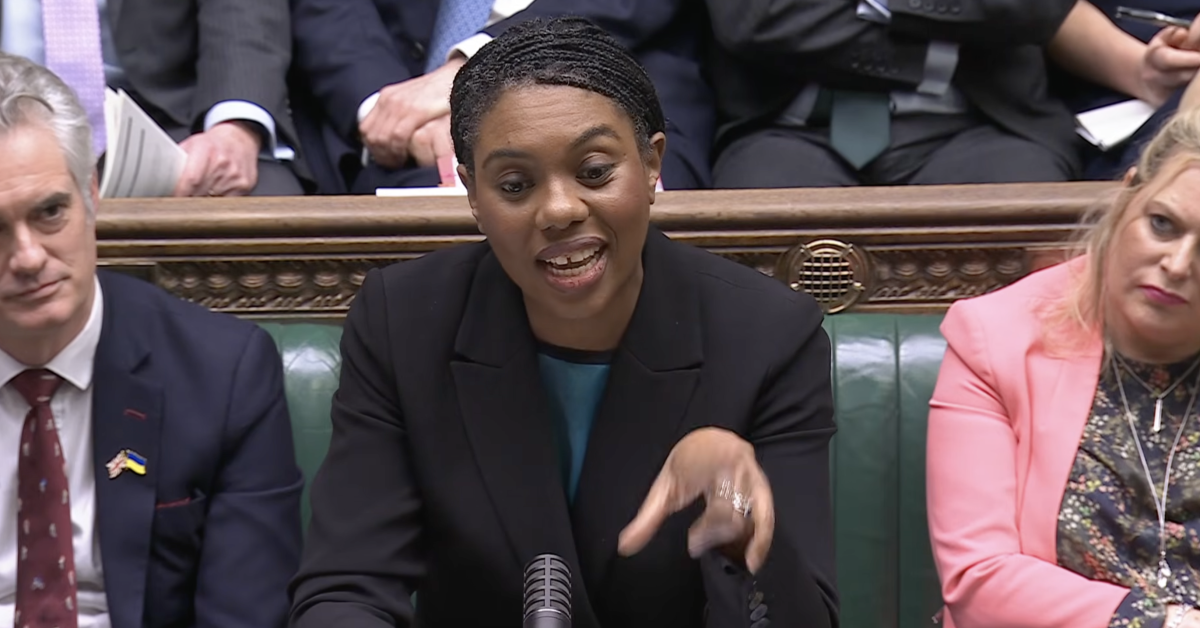
The post PMQs: Badenoch “The PM is catching arrows not dealing with the archers” appeared first on Conservative Home.

Commanders at more than 30 US military locations have told their troops that the US is attacking Iran to cause “armageddon” and hasten the second coming of Jesus – passing on an apparent message from deranged defence secretary Pete Hegseth.
The message includes a combat unit commander telling unit non-commissioned officers – sergeants and corporals – that US president Donald Trump is:
anointed by Jesus to light the signal fire in Iran to cause Armageddon and mark his return to Earth.
Hesgeth leading ‘Christian’ charge
According to the Military Religious Freedom Foundation (MRFF), in just a three-day period from the start of the illegal US-Israel attacks on Iran, MRFF has been “inundated” by more than 110 complaints from various units across thirty different bases in every branch of the US military about this messaging.
Hegseth reportedly attends, at least weekly, a White House ‘bible study’ led by a Zionist ‘pastor’ who insists the US must support Israel no matter what.
The news has horrified many US Christians as well as the rest of the right-thinking world. Baptist News Global covered the revelations and noted MRFF’s disgust with the bloodthirstiness of the so-called ‘Christian nationalism‘ Hegseth and his ilk espouse:
These calls have one damn thing in freaking common: Our MRFF clients (service members who seek MRFF aid) report the unrestricted euphoria of their commanders and command chains as to how this new ‘biblically-sanctioned’ war is clearly the undeniable sign of the expeditious approach of the fundamentalist Christian ‘end times’ as vividly described in the New Testament book of Revelation,” Weinstein said.
Many of their commanders are especially delighted with how graphic this battle will be zeroing in on how bloody all of this must become in order to fulfill and be in 100% accordance with fundamentalist Christian end-of-the-world eschatology.
A horror show run by paedophiles, fanatics and heretics who threaten the world and feed on the innocent: the US government under Donald Trump (and not only his administration).
Featured image via the Canary

More exclusive footage from Skwawkbox sources on the ground in Qatar shows the scale of Iran’s retaliatory barrage on US military facilities in the Qatari capital – and the number of interceptors the US base there is burning through in an attempt to stop them:
Thousands of migrant workers are trapped in Qatar and neighbouring states. They have little prospect of repatriation despite the danger the US and Israel have created for those in Gulf states through their reckless and illegal imperialist war on Iran.
Featured image via the Canary
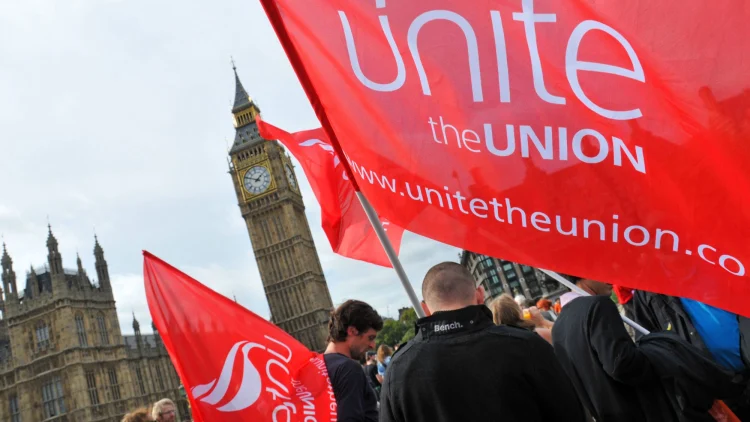

Unite, one of the UK’s biggest trade unions, has carried out a survey of parliamentary staff on the pay offer for 2026-27 (Alamy)

3 min read
Parliamentary staff have overwhelmingly rejected a pay offer that falls below the salary increase awarded to MPs, according to a trade union survey.
The Independent Parliamentary Standards Authority (IPSA) announced on Monday that MPs’ basic salary will rise by 5 per cent to £98,599 a year from April, while also aiming to move towards a salary of around £110,000 by the end of the Parliament, due in 2029. The MPs’ pay decision for 2026-27 includes a 1.5 per cent benchmarking adjustment, as well as a 3.5 per cent cost-of-living increase.
However, MPs’ staff are only being offered an ‘optional’ 3.5 per cent pay increase, despite months of lobbying by the trade union and some MPs for a substantial rise in staffing budgets due to low pay and unsustainable workloads.
In a survey of parliamentary staff by trade union Unite, seen by PoliticsHome, 91.5 per cent of respondents said they would reject the 3.5 per cent automatic pay uplift for staff salaries for 2026-27. Only 4.6 per cent of the more than 600 respondents voted to accept the offer, while 3.8 per cent abstained.
Parliamentary staffers told PoliticsHome on Monday that there was widespread “fury” over the proposals, with one saying that IPSA “treats MPs’ staff with total contempt”.
The Speakers Committee on IPSA are meeting later on Wednesday afternoon, with trade unions hoping to get the chance to challenge the IPSA budget. The committee technically has the power to veto or amend the budget, though this power has not been exercised before.
Trade unions representing parliamentary staff are hopeful that IPSA will come back to the table with a new offer.
In an email to staff on Tuesday morning, Unite asked all parliamentary staff – including non-members – to fill in the survey and “join the union to challenge this injustice and ensure a fair pay settlement”. The union recommended that respondents reject the 3.5 per cent offer.
A spokesperson for the Unite Parliamentary Staff Branch said the survey of MPs’ staff showed the “widespread outrage at yet another year of real terms pay cuts”.
“Offering staff a pay rise less than MPs and lower than inflation is nothing short of an insult,” they said, demanding that IPSA explain why the larger uplift applied to MPs would not apply to staff “who carry the bulk of the work and absorb the worst pressures of the job”.
Parliamentary staff have had a 14.6 per cent real-terms pay cut since 2020, based on RPI, with many caseworkers earning little more than the minimum wage.
“Our offices are chronically under-resourced, with staff often required to work unpaid overtime, provide practical and emotional support for constituents facing difficult situations, and support MPs in high-pressure situations,” the spokesperson continued.
“Our jobs are fundamentally insecure, yet our pay and pensions lag far behind those of comparable jobs in the civil service and local government.
“We are proud of the work we do to serve our communities and support our MPs, but stress and burnout are at an all-time high. If we want a thriving democracy, we need to start by paying the people who make it work fairly.”
IPSA does not have the power to set exactly how much a member of MPs’ staff should be paid; instead, it is proposing an automatic 3.5 per cent pay uplift for all staff, funded by a 5 per cent increase to staffing budgets, and an increase of at least 5 per cent to the minimum of each pay band. In practice, this could mean some staff salaries could rise by more than 9 per cent.
However, MPs have the authority to block their staff from receiving the 3.5 per cent pay rise. PoliticsHome understands some parliamentarians, including Labour MPs, signed to prevent their staff from getting pay uplifts last year.
Politics
Mark Yale: From Disraeli to to the present there is an important legacy of ‘One Nation’ thinking

Mark Yale is a Conservative activist and Treasurer of One Nation Conservative Network, a new grassroots movement supporting pragmatic, inclusive centre-right politics.
“Progress must be extended and accelerated not by subordinating the individual to the authority of the State, but by providing the conditions in which no one shall be precluded by poverty, ignorance, insecurity, or the selfishness of others from making the best of the gifts with which Providence has endowed him” – 1945 Conservative Manifesto
It is easy to think that One Nation Conservatism is a new phenomenon because of its association with the post-Thatcher shift towards the centre led initially by Sir John Major and more recently Lord Cameron. However, as the quote shows, the Conservative Party has a strong and long history of standing on a centre-right, pragmatic platform.
This tradition was carried forward in the post-war period by figures such as Rab Butler, whose role in shaping the 1944 Education Act and accepting much of the post-war settlement reflected a practical commitment to social reform within a Conservative framework.
At its core, One Nation Conservatism is about ensuring that opportunity is widely and fairly shared, that economic freedom is balanced with social responsibility, and that everyone has a stake in the nation’s success. It is not about ideological purity, but rather the practical goal of governing effectively for the whole nation.
Today, the country is increasingly facing social division and a growing gap between the experiences of those doing well economically and those less well. A good example of this is that the ability to get on the housing ladder is becoming increasingly defined by whether parents or grandparents are able to help financially. As a result of this growing economic divide, there is a risk that we return to the two-nation society that Benjamin Disraeli wrote about in his novel Sybil.
It is easy to claim that we have tried this type of Conservatism and that it failed – evidenced by the defeat we suffered at the 2024 general election.
But this is not a fair criticism. Analysis from Lord Ashcroft after the general election showed that the number one reason people stopped voting Conservative was that we had lost the people’s trust. Why we lost the people’s trust is easily explained by the other reasons highlighted by those asked; “Conservative government had not been competent”, “Partygate and other scandals”, and “The Liz Truss mini-budget of 2022”.
None of those reasons are linked to the ideological direction of the party, but rather our ability to do what a government should be doing – delivering for voters, improving the country and improving individuals’ circumstances.
There has been much discussion about what the future direction of the Conservative Party should be. Narrowing our appeal by rejecting policy or ideas from the traditional centre-right and shunning those who are nearer the centre is a mistake and will only make being re-elected harder.
The party is better when it is a broad church with mass appeal. Polling for Prosper UK by More in Common identified millions of voters in the centre ground who feel that they are politically homeless and that no party represents them.
So why would we want to ignore this mass of potential voters?
Those who identify as traditional centre-right or as a One Nation Conservative are pragmatic and recognise the centre has shifted, in particular on immigration, and are not trying to remould the party in our image or reject the concerns of certain voters, but rather ensure it remains a broad church, with both sides being listened to.
To help maintain this tradition within the party, a new grassroots initiative – the One Nation Conservative Network – has been established. It wants to help ensure the party remains a broad church through a focus on the grassroots, activists and councillors, and supporting candidates during election campaigns. Additionally, we want to bring One Nation Conservative ideas outside of Westminster and show how they can benefit voters at a local level.
One Nation Conservatism plays an important role in ensuring that the party remains rooted in its historic mission to govern responsibly and for the whole nation. From Disraeli’s warning of a divided society to the principles set out in the 1945 manifesto, the Conservative tradition has long recognised the importance of social responsibility.
At a time of economic uncertainty and social division such as we are currently experiencing, accommodating this strand of Conservatism will help ensure that the party speaks not only to one section of the country, but the whole country.

American And European Tow Hitches Are Different In More Ways Than You Think

Ethereum sendet JETZT ein Signal, das wir nicht verpassen sollten!
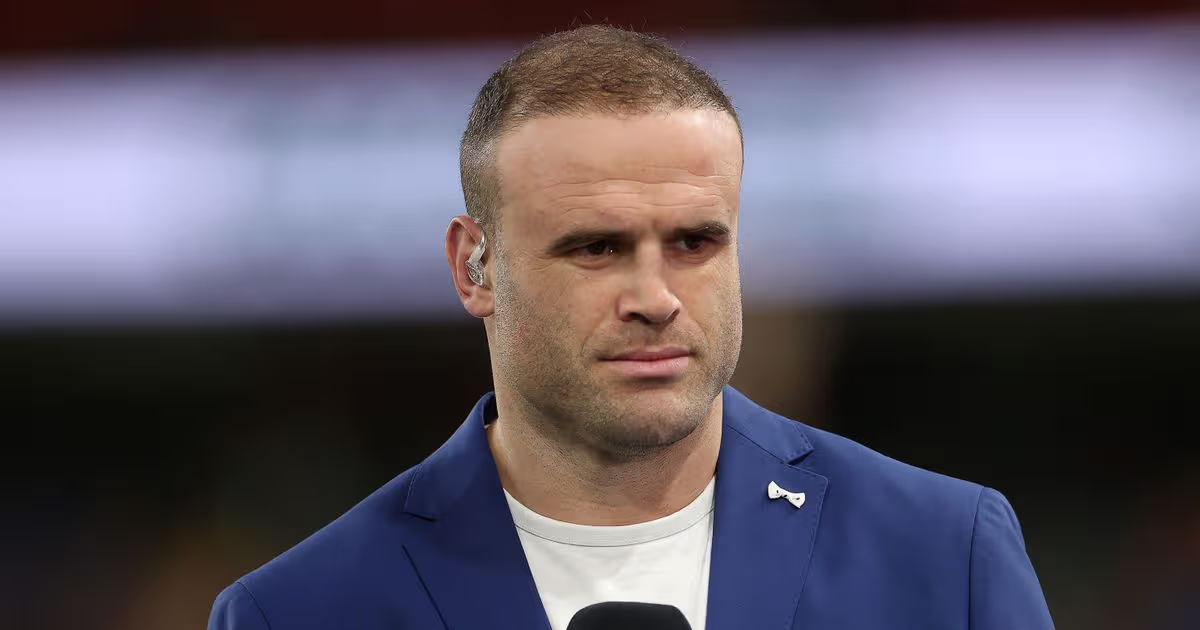
Jamie Roberts says ‘the scalp is coming’ and makes Ireland v Wales prediction


-

 Politics6 days ago
ITV enters Gaza with IDF amid ongoing genocide
-

 Politics1 day ago
Alan Cumming Brands Baftas Ceremony A ‘Triggering S**tshow’
-

 Fashion5 days ago
Weekend Open Thread: Iris Top
-

 Tech3 days ago
Unihertz’s Titan 2 Elite Arrives Just as Physical Keyboards Refuse to Fade Away
-

 NewsBeat7 days ago
Cuba says its forces have killed four on US-registered speedboat | World News
-
Sports4 days ago
The Vikings Need a Duck
-
 NewsBeat4 days ago
Dubai flights cancelled as Brit told airspace closed ’10 minutes after boarding’
-
 NewsBeat7 days ago
Manchester Central Mosque issues statement as it imposes new measures ‘with immediate effect’ after armed men enter
-

 NewsBeat3 days ago
‘Significant’ damage to boarded-up Horden house after fire
-
 NewsBeat4 days ago
The empty pub on busy Cambridge road that has been boarded up for years
-

 NewsBeat4 days ago
Abusive parents will now be treated like sex offenders and placed on a ‘child cruelty register’ | News UK
-

 Business6 days ago
Discord Pushes Implementation of Global Age Checks to Second Half of 2026
-

 Entertainment2 days ago
Baby Gear Guide: Strollers, Car Seats
-

 Business6 days ago
Only 4% of women globally reside in countries that offer almost complete legal equality
-
 Tech5 days ago
NASA Reveals Identity of Astronaut Who Suffered Medical Incident Aboard ISS
-
Politics4 days ago
FIFA hypocrisy after Israel murder over 400 Palestinian footballers
-
 NewsBeat3 days ago
Emirates confirms when flights will resume amid Dubai airport chaos
-

 Crypto World6 days ago
From Crypto Treasury to RWA: ETHZilla Retreats and Relaunches as Forum Markets on Nasdaq
-

 NewsBeat2 days ago
Is it acceptable to comment on the appearance of strangers in public? Readers discuss
-

 Tech3 days ago
Viral ad shows aged Musk, Altman, and Bezos using jobless humans to power AI