Politics
Gorton and Denton: A three cornered fight in a seat of two halves
Ahead of the Gorton and Denton by-election on Thursday 26 February, Rob Ford analyses the prospects for Labour, Reform and the Green Party.
Next week voters in the South Manchester seat of Gorton and Denton will choose a new MP in the second by-election of Keir Starmer’s administration. Last May Labour lost the formerly safe seat of Runcorn and Helsby and with the government unpopular and unstable, Labour could again struggle in this once rock-solid constituency, and the loss of a second safe seat in less than a year could see the questions around Keir Starmer’s leadership get louder once again.
Gorton and Denton is a Frankenstein’s monster constituency, created in 2024 when the Boundary Commission stitched together pieces of three earlier Manchester seats. The seat is shaped like a battle axe, with the handle running Southwest through diverse and gentrifying wards in Manchester city council, while the head of the axe in the Northeast covers the three Tameside wards of Denton.
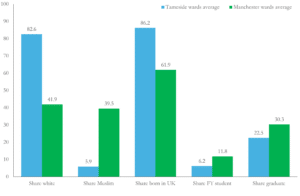
Demographic differences: Tameside and Manchester wards of Gorton and Denton

Source: Census 2021
Though both parts of the seat have long voted Labour, they are poles apart demographically. The four Manchester wards are on average nearly 60% non-white and 40% Muslim, and 42% of the residents are either students or graduates. These wards resemble places Labour has struggled in the last couple of years with challenges on the left. The three Tameside wards of Denton are on average 83% white, 86% UK born, and with a high share of residents doing working class jobs. Reform UK made hay in wards like this in last May’s local elections. But the two chunks of the seat are not equally matched – about two thirds of the population live in the more diverse, graduate and student heavy Manchester wards.
Gorton and Denton has long been deep red. Labour won 50.8% here in 2024, making the seat one of just 70 where Labour won an absolute majority, but this share was down sharply on an estimated 67.2% in 2019. The seat was one of four in central/south Manchester where Labour support dropped by double digits, all with large Muslim communities and many students and young graduates. Both the Greens and the Worker’s Party made major gains at Labour’s expense in 2024, winning nearly a quarter of the vote between them. While the Greens start in third place on 13.2%, the Worker’s Party are not standing in the by-election and have all but endorsed the Greens, saying “Labour and Reform must lose.” Reform are now the largest right wing party locally, having won nearly 15% in 2024, while the Conservatives, already marginal have now become irrelevant, having fallen to fifth place with less than 8% of the vote
2019 and 2024 election results in Gorton and Denton
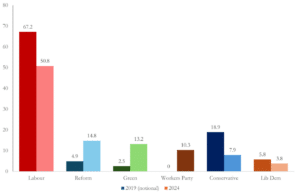

Dark bars on left – 2019 notional results (Rallings and Thrasher); light bars on right – 2024 results
Three routes to victory
On paper, Gorton and Denton should not be a hard seat for Labour to hold. They have won every general election in this seat and its predecessors for generations, and almost every local election in every ward here since 2011. This is a Labour leaning seat in a Labour leaning city in a Labour leaning region. Alas things are not so simple for a governing party polling below 20%, led by the most unpopular Prime Minister in polling history, a Prime Minister who has particularly struggled with the young progressives and Muslim voters who congregate in the seat’s Manchester wards.
Labour’s national troubles provide a local opening for the Greens, who are campaigning both as the vehicle for discontent with the Starmer government among young progressives and Muslims and as the strongest local opponent to Reform. The Greens are hoping they can to do to Labour in Gorton and Denton what Plaid Cymru did to Labour in Caerphilly – convince disaffected Labour voters that they can indeed have their cake and eat it – voting for a party who are both more progressive than Labour nationally and better able to stop Reform locally.
But the Greens face greater obstacles in Gorton and Denton that Plaid Cymru did in Caerphilly. Plaid had an exceptionally high profile candidate, and benefitted from national polling showing them well ahead of Welsh Labour. The Greens have little organisation and no presence in local government in Gorton and Denton’s wards, and their candidate is little known in the area. With national polling ambiguous and no reliable seat polling, Labour and the Greens have been waging an intense leaflet war over who is the strongest “stop Reform” option.
The risk to both, and the opportunity to Reform, is that neither side wins that argument and the left vote splits evenly. A split left is likely a necessary condition for Reform success, but not a sufficient one, in an area which has never been receptive to right wing politicians of any stripe. The combined Conservative and Reform vote in 2024 was just 22.4% – whereas in Runcorn and Helsby, where Reform defeated Labour by just six votes last May, it was 34.1% (18.1% Reform, 16.0% Tory). Reform will need everything to go their way if they are to take this seat. They will need to dominate the vote in the more Reform friendly Denton wards, an even split between Labour and the Greens in the Manchester wards, and low turnout in less Reform friendly areas to reduce the inherent advantages to their opponents. There is a route to Reform victory here but it is a narrow one.
This fragmented and uncertain contest will go to the wire, but one thing is already certain: defeat for Labour would be a disaster for the Starmer government, regardless of who inflicts it. This would be the second time in less than a year that Labour loses one of the 70 seats where it started with an absolute majority. Results like that are not “typical mid-term blues” but signs of an existential crisis. The political fallout could be severe, as the drumbeat of defeat in once rock-solid areas, set to get louder still in May’s local and devolved elections, will lead ever more Labour legislators to worry not only about their own electoral prospects, but about the future viability of their party.
By Professor Rob Ford, Senior Fellow, UK in a Changing Europe and Professor of Politics, University of Manchester.
A longer version of this article was previously published at “The Swingometer”