Connect with us
DAPA Banner
DAPA Coin
DAPA
COIN PAYMENT ASSET
PRIVACY · BLOCKDAG · HOMOMORPHIC ENCRYPTION · RUST
ElGamal Encrypted MINE DAPA
🚫 GENESIS SOLD OUT
DAPAPAY COMING

Politics

I Worried My Daughter Loved Her Toys Too Much. Then, Another Family Lost Everything.

Published

on

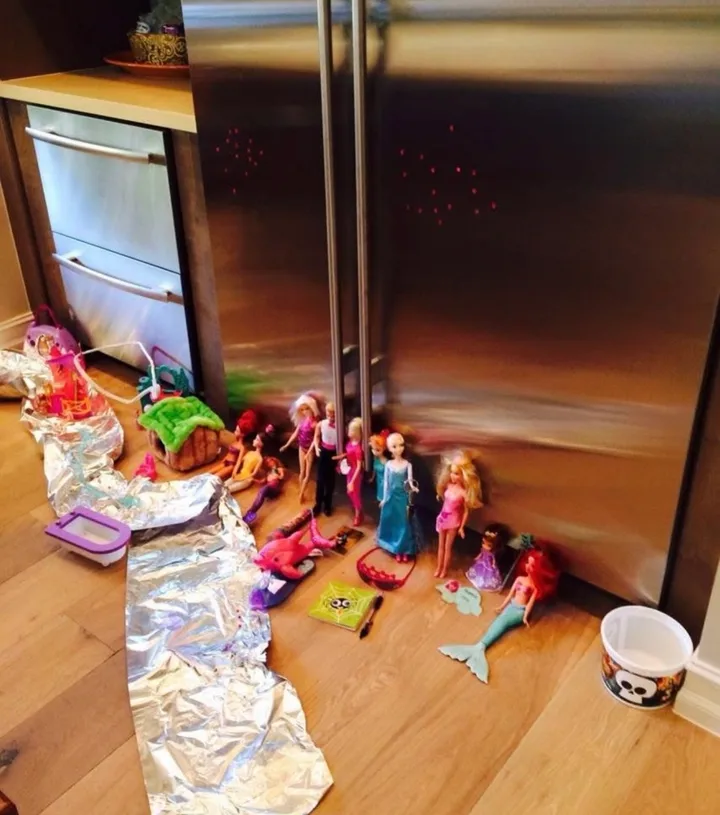
A portion of the author's daughter's doll collection, with aluminum foil "water"

When our daughter was preschool-aged, Princess Ariel dolls littered every room. Our once tranquil interior – a blend of coastal and cottage design – looked like an ill-kept aquarium full of plastic ornaments but no actual fish.

Our child dressed the part, too: Whether headed for the playground or grocery store, her tiny toes poked out beneath a sparkling green fishtail.

As a former clinical social worker, I knew imaginative play served an important role in child development, but I worried about the degree of fantasy we were helping her cultivate. I was also exhausted. While she twirled in a red wig, I was miscast in the role of Prince Eric. My throat ached from forcing a deep voice each day.

One evening, I found rose petals scattered around plastic doll furniture and knew a wedding ceremony was imminent, but I couldn’t bear another moment of make-believe. I begged my husband, Tomer, to take over.

Advertisement

“No way,” our daughter said. “Daddy’s no good at dolls. Mommy’s the best.”

It was a contest I wanted to lose, but never did. Tomer insisted he lacked creativity, but I suspected he was feigning incompetence to gain more personal time. When would I reclaim an adult life? His career was thriving, but I’d traded mine for full-time parenting.

Tomer tried to help out, but when left alone with our kid, he took her shopping for more toys. It was a strategy he employed to avoid actual playtime.

“I can’t sit on the floor,” he said. “It hurts my back.”

Advertisement

One morning, I found scissors beside a life-size styling head and followed a trail of synthetic hair into the bathroom, where red clumps clogged the toilet.

As I plunged the bowl, guilt churned my stomach. After all, I depended on their shopping sprees to catch a break. Determined to change course, I insisted Tomer try something new – maybe an art project – while seated comfortably at the table.

Later that afternoon, laughter echoed from the dining room. Were they crafting? Yes. It seemed a miracle until I looked up and saw toilet paper, probably three rolls of it, dangling from the chandelier.

“It’s a coral reef,” they explained.

Advertisement

Tomer winked. “I did the parts she couldn’t reach.”

Our daughter jumped around. “I did the rest all by myself.”

The “rest” amounted to stacked paper cups and piled pillows. A roll of alluminum foil covered our wood flooring to achieve water’s reflective quality. In the middle of the table was a silver-plated fork.

She beamed. “That’s Ariel’s hairbrush.”

Advertisement

I frowned. “That’s fancy cutlery.”

“That we never used,” Tomer said.

What could I say? The man had done as I’d asked. I went to bed feeling a mix of hope and dread.

By morning, the coral reef had grown. Paper cups climbed the stairs; alluminum foil lined the banister. I could’ve cleaned up or made them do it, but I lacked energy, so the reef kept expanding.
Advertisement
A portion of the author's daughter's doll collection, with aluminum foil "water"

Photo Courtesy Of Jen Gilman Porat

A portion of the author’s daughter’s doll collection, with aluminum foil “water”

Whatever our daughter didn’t own, she created from found materials. For a mermaid carnival, she sprinkled sugar on lint gathered from the clothes dryer and called it cotton candy. I couldn’t help but feel proud of her resourcefulness; moreover, since the mess was homemade, I thought things were improving.

Then, Disney released a new movie. Tomer took our daughter to see it, and when they returned, she ran straight to the chandelier and ripped off the toilet paper. As Scott Tissue drifted down, our kid shouted, “Let it snow!”

By nightfall, a new cast of characters moved in. For every Queen Elsa, there was also a Princess Anna. A single snowman named Olaf seemed to reproduce despite having no mate. Ariel’s ocean turned to ice, but our daughter still invited mermaids to every “Frozen”-themed event.

When I complained about the new purchases, Tomer pushed back. “It makes me happy to see her happy, and nothing makes her happier than another doll.”

Advertisement

But there was one night that Tomer seemed to share my concern. He came home hungry, peered into the refrigerator, and found nothing but dolls, apple juice and faux food.

“Olaf is hosting an ice cream social,” I explained.

“This is out of control,” he said.

“But look at her creativity.” I pointed at the bottom shelf, where she’d placed a sea monster molded from Play-Doh and green Jell-O.

Advertisement

Tomer sighed and ordered a pizza.

Our marriage dynamic resembled a seesaw. When one of us overindulged, the other would try and contain the madness. Then, we’d swap places all over again. Meanwhile, we never conquered the clutter, and I worried the mess amounted to worse than aesthetic harm.

“What if she ends up caring more about material possessions than human relationships?”

“She’s not going to care about toys forever,” Tomer said.

Advertisement
More dolls

Photo Courtesy Of Jen Gilman Porat

More dolls

Time proved him right. In late 2019, our daughter stopped playing. It seemed sudden and felt sad. Then, the Covid-19 pandemic arrived, and we got stuck at home with all those abandoned toys. Like everyone else, we ran low on toilet paper, too. Oftentimes, I caught myself gazing at the chandelier, longing for the backup supply that had once draped down.

Another month into lockdown, I learned through Facebook that a local family’s home had caught fire. Everyone survived, but they’d lost all their possessions.

Our daughter made an announcement. “Those kids need toys, and my toys need kids. I want to give everything away.”

Together, we moved her playthings outside the front door. Our daughter used ribbon to tie makeshift masks over every miniature mouth. She hid lollipops and Post-it notes inside Queen Elsa’s ice castle. Enjoy! Stay safe!” Tears leaked from my eyes as she kissed each Olaf goodbye.

Advertisement

We watched from the window as a truck pulled into the driveway. Out popped the parents and their three kids. They ran toward the mountain of toys, and what had seemed like too much for one child instantly transformed into the perfect amount to share.

Our daughter grinned. “Look. They’re so happy.”

Her empathy exposed my foolishness. I’d wasted precious years worried that our daughter’s attachment to toys amounted to selfishness, but our daughter had always demonstrated kindness in all of her imagined scenarios. No doll was ever bullied or left out. I’d been focused on the cluttered surface and missed the deeper level where our child had been developing interpersonal skills and moral character all along.

Regret overwhelmed me. I wanted to go back, but of course, time kept moving forward.

Advertisement
The last remaining mermaids looking over the author's office

Photo Courtesy Of Jen Gilman Porat

The last remaining mermaids looking over the author’s office

More recently, our daughter celebrated her Sweet 16. Before we started decorating, she insisted on removing the final traces of the coral reef: three plush mermaids were still hanging from the chandelier. They’d watched over our holiday meals for longer than a decade.

Today, the mermaid trio sits in my office. Maybe a future grandchild will spark generosity, but for now, they’re all mine. A source of inspiration whenever I’m facing a new challenge, I notice the pastel plushies decorating my bookshelf and am reminded to search for deeper meaning in whatever seems to be taking up too much time and space.

Do you have a compelling personal story you’d like to see published on HuffPost? Find out what we’re looking for here and send us a pitch at pitch@huffpost.com.

Advertisement

Source link

Continue Reading
Click to comment

You must be logged in to post a comment Login

Leave a Reply

Politics

Trump Storms Out Of ‘Meet The Press’ Interview When Kristen Welker Challenges His Claims

Published

on

Trump Storms Out Of 'Meet The Press' Interview When Kristen Welker Challenges His Claims

President Donald Trump dipped into his arsenal of insults as he grew increasingly frustrated with “Meet the Press” host Kristen Welker doing her job as a journalist before he eventually stormed out of an interview that aired on Sunday. (Watch in the clip below.)

Trump’s crash-out arrived minutes after Welker asked him about the $1.8 billion “anti-weaponisation” fund, a concept that the administration says its “not moving forward” despite the president not ruling out the idea of January 6 rioters getting taxpayer-funded payouts.

After expressing his openness to paying those who attacked police officers during the Capitol riot, he dropped several false, baseless claims regarding the attack, including one about FBI agents “ushering” people into the building and those who pled guilty to assaulting cops.

Welker challenged the president’s fog of falsehoods on multiple occasions, later taking on his talk of “rigged” primary elections that took place in California, evidence of which is about as present as the dodo bird.

Advertisement

“Let me tell you, it’s four days, and they aren’t even close to coming up
with the—,” Trump started.

“That’s how they count the votes in California,” Welker interjected.

“Do you know why they’re doing that? Because they’re cheating on the election,” Trump continued.

“There’s… What? Do you have evidence to support that?” the host asked.

Advertisement

“It’s — all I have to do is look. All I have to do is look,” Trump replied.

“But that’s not evidence,” Welker reminded the president.

Trump went on to accuse California election officials of being “crooked” before attacking Welker, adding, “Just like you’re crooked, your press is crooked. And ‘Meet the Press’ is crooked.”

“You’re either crooked or you’re stupid,” Trump told Welker.

Advertisement

He continued his tantrum about the “crooked” media, a rambling set to the tune of rain hitting the metal roof of a farm building in Wisconsin, the site of the interview.

“You’re a one-sided crooked network. Sorry. Let’s call it quits because I’ve had enough. Thank you, darling. Have a good time,” he said as he tossed his microphone to the ground and made a dismissive hand gesture toward Welker.

“Mr. President, let’s ― please, I travelled all the way to Wisconsin,” she pleaded.

“I’ve sat in the rain with you,” said the president, pointing to the roof.

Advertisement

“I know. I travelled all the way—,” she replied.

“I sat in the rain with you for an hour,” repeated Trump as he looked directly at Welker. “On and off in the rain, and I’ve given you enough time. You ought to straighten out your press, because you know what? A country can never be great with a dishonest press.”

He then signalled for his team to leave, got up from his seat and proceeded to walk off camera.

After the interviewed aired, Welker said she spoke with the president Saturday and the two acknowledged the “complications” posed by the rain during the interview. Trump has agreed to sit down for another interview, per Welker.

Advertisement

Source link

Advertisement
Continue Reading

Politics

Israeli soldiers murder 7-month-old in Occupied West Bank

Published

on

West Bank

West Bank

Israeli soldiers shot and murdered a seven-month-old baby in the Tel Rumeida area of Hebron, West Bank, on Friday, June 5.

Sam Fahd Abu Haikal was in his mother’s arms when Israeli soldiers killed him. The IOF opened fire on a car which was carrying the infant and his family. They shot despite the car having complied with an order to stop, injuring both his parents.

Sam Fahd Abu Haikal was critically injured and evacuated in critical condition to a hospital. He later died from his injuries. Fahd’s 11-year-old son and mother were also in the car.

Abu Haikal’s wife is still in critical condition, with shrapnel close to her heart.

Advertisement

According to Fahd Abu Haikal, Sam’s father, a bullet passed through his hand and struck his son, Sam, who his mother was holding in the back seat. The family had been driving through Hebron when IOF soldiers signalled the vehicle to stop. 

Abu Haikal told Haaretz:

The soldier signalled me to stop. I brought the car to a complete halt and raised my hands on the steering wheel. Immediately afterwards, they opened fire on the vehicle. The soldier was about 10 metres away from me. He saw me, he saw my wife and the children.

The windows were not tinted, it was broad daylight and everything was clear. You can’t say he didn’t see that it was a family. I stopped as I was instructed to, and then they simply shot at the car.

There was no clear checkpoint, just soldiers standing in the street. I stopped when I was asked to, and then the shooting started.

Advertisement

This was after the IOF claimed that troops:

perceived a vehicle accelerating toward them and one of the soldiers responded with single shots toward the vehicle.

‘Single shots’ is a funny way of saying open fire, or multiple rounds. But I guess Israel will do anything to avoid accountability.

West Bank and Gaza — A pattern

As of September 2025, Israel had murdered over 20,000 children in Gaza, or two percent of all children in Gaza. That is the equivalent of at least one Palestinian child every hour over nearly 23 months of genocide. 

Of these, at least 1,009 were under the age of one, and half of these were born and then killed during the genocide. Israel had injured an additional 42,011 children and left 21,000 permanently disabled, as of September. Thousands more are presumed to be under the rubble.

Advertisement

This shows a pattern. Israel deliberately carpet bombs civilian areas and targets children.

Israel is doing exactly the same in Lebanon. In the first 25 days of the ‘ceasefire‘ that definitely isn’t a ceasefire, Israel killed or injured more than four children per day. This brings the total number of children that Israel has killed in Lebanon since March 2 to 199.

In July 2024, UNICEF reported that Israel had killed 143 Palestinian children in the West Bank since October 2023. That’s one child every two days. Additionally, Israel has injured more than 440 Palestinian children with live ammunition.

The West Bank has seen an increase in large, militarised law enforcement operations over the past few years. Of course, this is illegal under international law, and the IOF has no right to be in the West Bank.

Advertisement

Where’s the morality?

Israel and its terrorist army have no morality and no conscience. It bombs hospitals, murders and maims babies, and carpet bombs whole cities under the guise of ‘defeating terrorists’. We all know it’s real M.O — a Greater Israel, and to make that happen, it has to ethnically cleanse every single Palestinian from their native land.

No doubt Israel will tell us that a seven-month-old was the mastermind behind October 7. Or it was antisemitic.

But one thing is clear — anyone who supports Israel supports babies being murdered in cold blood.

Feature image October 7News/Youtube

Advertisement

By HG

Source link

Continue Reading

Politics

Reform retract grim attack ad following legal challenge

Published

on

Nigel Farage in front of the offending image - Reform UK

Nigel Farage in front of the offending image - Reform UK

On 30 May, Reform UK posted a grim AI slop post which depicted refugees holding ‘Vote Andy‘ banners. Now, the party has been forced to take down the post following a legal challenge from the creator of the banner image:

Stanley Chow VS Reform

Stanley Chow is the artist who created the now-familiar cartoon of a dour-looking Burnham with a red background. Chow is a Mancunian and a second-generation immigrant, and has said that Reform’s AI monstrosity “misrepresents what the image stands for and what I believe in”.

He added:

For me, this is straightforward – my work has been used without permission to share a message that I fundamentally disagree with. To see my portrait, created to represent something positive about Manchester and Andy’s vision for the city, being used without my permission to push agendas, including an anti-immigration message, is fundamentally unfair and wrong.

Chow sent a letter to Reform HQ requesting at least £5,000 in damages and an apology. Reform claimed in response that their post was fair use, and that the party has:

Advertisement

removed the posts in good faith and without any admission of liability on our part

Reform also claimed the legal action was “politically motivated”. Given that Reform is a political party, it can argue any action against itself is ‘politically motivated’. In other words, its spokespeople shouldn’t get away with using it as a get-out-jail-free card.

Dehumanisation

Regardless of whether the post ends up being legally sound or not, it was clearly disgusting. The people who travel by small boats to the UK are human beings who face tremendous risks. Turning them into a sick joke like this demonstrates that Farage & .co put very little value on human life.

If you think they don’t have a similarly low opinion of British lives, by the way, you’re going to be in for a shock should they ever take power.

Featured image via Carl Court (Getty Images)

Advertisement

By Willem Moore

Source link

Advertisement
Continue Reading

Politics

Teachers Reminisce About The Days Of Brutally Honest School Reports

Published

on

Teachers Reminisce About The Days Of Brutally Honest School Reports

A headteacher once wrote in Dame Judi Dench’s school report: “Judi would be a very good pupil if she lived in this world.” Meanwhile, Sir Stephen Fry fared worse: “He has glaring faults and they have certainly glared at us this term.”

And it seems this level of brutal honesty is sorely missed among some of those teachers penning today’s school reports.

In an eye-opening r/TeachingUK post, one educator shared that “every year it quite annoys me how we aren’t allowed to just flat out tell the truth about a child in the report, everything has to be reworded as a positive as not to offend anyone”.

“For example, the child in my Y4 class who throws chairs and calls me a stupid c*** every day is now being described as ‘working towards making more positive choices in the school day’,” they noted.

Advertisement

“I remember getting my school report back (I was mostly a good kid) which explained how I spent most of the time chatting and not listening, and my mum went mad, best believe I sat and listened as to not get another report like that.”

While they caveated that some school reports in the 1990s did go “a bit far”, the teacher suggested “everything has to be worded positively” in modern-day school reports. And many seemed to be in agreement.

“Yeah it’s gone too far the other way,” said one commenter. “There’s a difference between saying a kid is rude and cruel vs saying they have been acting rude and cruel, and we should be able to say the latter.”

Another chimed in: “It’s daft. I think there’s a lot of reasons honesty should be allowed in reports. One of them being that we are seeing many cases of undiagnosed SEN [special educational needs] such as ADHD, ASD etc where school reports can be a vital piece of info.”

Advertisement

Some suggested that because reports used to be handwritten, teachers “got to be brief, and absolutely brutal”.

“I’ve seen ones that boiled down to ‘John has no aptitude for science and should not continue’. That was it; no euphemisms, no niceties, just absolute honesty,” shared a teacher.

“We were discussing today that we should be allowed to rank the child in parental discussions about behaviour. If that child is the number 1 problem in class you should absolutely be able to call them out on it and make it crystal clear to parents that their child is the worst; not this ‘well other kids in the class…’, ‘boys will be boys…’ excuse-making you get, the cold hard reality that your child is the worst kid in the class.”

But there were a handful of respondents who disagreed that school reports decades ago were not so different to those of today.

Advertisement

“Nah, I’ve read my old school reports from the 90s and they were full of the same old banalities that we use today,” said one educator.

“There’s this false nostalgia for the days of honest school reports, whatever that means. The biggest difference between the reports I received as a child and the reports I write now as a teacher is that the former were handwritten! Can you imagine going back to that?”

Another teacher said that there’s more contact between schools and parents nowadays, meaning serious issues are usually raised before report season, “whereas for some in the 90s, the report and parents evening were nearly the only contact they had with school”.

They ended: “In my view, the long, detailed school report itself is a bit of an anachronism now because of this change in the home-school dynamic.”

Advertisement

There’s been growing discontent with school reports for some time, both from teachers and parents. Back in 2015, The Guardian reported how both parties were increasingly unhappy with “robotic” school reports.

Source link

Advertisement
Continue Reading

Politics

Here’s What Vanilla Is Really Made From

Published

on

Here's What Vanilla Is Really Made From

We’ve written before at HuffPost UK about the fact that cloves and capers are both technically flower buds, while figs are technically inverted flowers.

(Don’t even get me started on their horrific historic relationship with wasps).

So, what about vanilla, which comes in a pod? I’ve never quite been sure whether it counts as a fruit, a vegetable, bean, or something else – never mind how it’s actually grown.

Where does vanilla come from?

Advertisement

Vanilla beans are not actually beans – they’re really the unripe fruit of an orchid. So, vanilla itself is a fruit.

The pods grow on the climbing plant of the flower’s vine. This long, thin fruit can grow up to 20cm long and can take up to nine months to mature.

They aren’t harvested when they’re fully ripe, though; vanilla is usually picked when its base turns golden-green.

These fruits barely have any smell when they’re picked. The famous vanilla scent comes from enzymatic reactions in the fruit as it’s cured.

Advertisement

Traditionally, the pods were steamed and cured in the sun for about 10 days before five to six months of drying. This process leads to tiny crystals called vanillin – responsible for that sweet smell and taste – forming on the surface of some pods.

The higher the grade of vanilla, the more of these crystals it may have.

Something similar happens to capers; when they’re cured and/or salted, they release mustard oil and rutin. That leads to their signature tang and the little white spots you sometimes see on their skin.

Why is vanilla so expensive?

Advertisement

The vanilla orchid is hand-pollinated, even to this day.

While they can be pollinated by insects, too, only one tiny species of bee is designed for the task. These don’t live in all the countries that produce vanilla, either.

And it’s not like the bees (or hand-pollinators) have got a huge window to do their jobs, either. Vanilla flowers tend to stay open for just six to eight hours at a time and usually only do so once a year.

Hand pollination is “an extremely tricky process done with a slim toothpick,” Kew Gardens explained.

Advertisement

After that’s done, you have to wait almost a year for a usable fruit.

The long curing process, along with “the practice of manual pollination, makes vanilla one of the most expensive spices (after saffron),” spice and extract company McCormick’s Science Institute said.

Is there fake vanilla?

Yes, lots of it. In fact, I’m now convinced I’ve never eaten real vanilla in my life.

Advertisement

Imitation vanilla is a far cheaper, though arguably less delicious, version of the flavour made from manufactured extracts.

Less than 1% of the world’s vanilla flavour (vanillin) comes from vanilla orchids, Scientific American said.

Other ways to achieve a similar taste involve guaiacol, a fragrant liquid made by distilling wood-tar creosote or tree resin. That’s responsible for about 85% of the world’s vanilla flavour.

And manufacturers use lignin for the rest, a substance found in things like cow manure and wood pulp.

Advertisement

So, Kew Gardens explained, “much of the ‘vanilla essence’ commonly used today is actually made from wood pulp or coal tar”.

Source link

Advertisement
Continue Reading

Politics

Jon Snow, Former Channel 4 News Star, Shares Alzheimer’s Diagnosis

Published

on

Jon Snow at the TV Baftas in 2016

Veteran news presenter Jon Snow has disclosed that he has been diagnosed with Alzheimer’s disease.

The 78-year-old shared during a new interview with the Daily Mail that he was told he had the disease, which is the most common form of dementia, four years ago.

He explained that he wanted to go public with his condition to raise awareness around Alzheimer’s, saying: “If I don’t speak out, who will?”

Jon will dive deeper into living with Alzheimer’s in a new film, Jon Snow: A Last Big Story, which will air on Channel 4 on Saturday 20 June.

Advertisement

Having stepped down from Channel 4 News in 2021, after more than 30 years with the broadcaster, he came out of retirement for his latest project, which saw him investigating the aftermath of a mining disaster in Zambia.

In the film, Jon is heard saying: “At the beginning I wanted to hide [my diagnosis], there’s so much prejudice. Any sort of hint of mental decay, you’re sort of dead.

“There are moments when it pops up but it’s not an all day every day condition, and that’s what I cling onto.”

Jon Snow at the TV Baftas in 2016

David Fisher/Shutterstock

Jon’s wife, Dr Precious Lunga, said: “Life doesn’t end with an Alzheimer’s diagnosis, but it changes dramatically. You can have Alzheimer’s and still be a valuable member of society but you need support to navigate it.”

Advertisement

The Bafta Fellowship recipient began his career in journalism at LBC in the 1970s, before he moved to ITN, serving as its Washington correspondent and diplomatic editor.

In 1989, he then made the jump to Channel 4 News, where he remained until the early 2020s.

The CEO of Alzheimer’s Society, Michelle Dyson, said: “Jon’s decision to talk publicly about his dementia diagnosis is a real act of courage and his story will resonate with so many.

“His support for Alzheimer’s Society will help spark a national conversation about dementia that we so desperately need. Despite being the UK’s biggest killer, dementia is still not treated with the same urgency as other major health conditions like cancer.

Advertisement

“Alongside his wife Precious, Jon is shining a light on the need for faster, fairer access to diagnosis. An early diagnosis can unlock vital support, help families plan ahead and potentially open the door to participation in clinical trials.

“Yet too many people across the country are still waiting far too long for a diagnosis. We look forward to working with Jon, whose long-standing commitment to speaking out against injustice will help ensure the harsh realities of dementia cannot be ignored by the UK Government and the NHS.”

Source link

Advertisement
Continue Reading

Politics

More Brits than not disapprove of Farage’s riot-stoking Henry Nowak rhetoric

Published

on

Nigel Farage, the Southampton white riot, and a poll

Nigel Farage, the Southampton white riot, and a poll

On 2 June, Nigel Farage gave a speech in which he called on Britons to react with “pure, cold rage”. He said this in response to the conviction of Sikh murderer Vickrum Digwa, and to a recording of how the police treated his victim Henry Nowak. On the same day that Farage made his speech, a white riot erupted in Southampton; since then, Sikhs have face increased harassment.

Clearly, Farage is banking on more Britons than not buying into his violent rhetoric. According to a new poll, however, things aren’t going how he planned:

Farage — Incitement

After the initial backlash, Farage warned that the white riots we saw in Southampton were “just the beginning”. Obviously, those who thought Farage incited the riots saw this as a threat, and with clear reason. His argument for it being “just the beginning” was this:

Advertisement

large numbers of young white males think the police are prejudiced against them.

Oh, do they?

And why do they think that?

Is it because you’re telling them that, despite all evidence pointing to the opposite being true?

The police officers who handcuffed the stabbed Nowak committed the grossest of gross misconduct, but suggesting this one incident completely invalidates decades of evidence on racist policing is willful incitement.

Advertisement

Farage’s cynical reasons for riling up the far right are obvious. In the Makerfield by-election, Reform UK is facing a challenge from its right – specifically from Restore Britain. Reform politicians are trying to neutralise this challenge by presenting themselves as even more far-right than their rival.

Response

In the Opinium poll, more people than not disapprove of Keir Starmer’s response too. Starmer’s response was fairly measured, but it’s predictable that the public would react negatively, because he’s a polarising figure.

Zack Polanski also attracted more disapproval than approval, albeit with a significantly lower levels for each. This is likely because Polanski didn’t make an obvious play for political capital, and with good reason. After all, this is what the father of Henry Nowak said following the conviction of Digwa:

Advertisement

Advertisement

The fact that Farage ignored these words no doubt added to the negative response against him.

The only politician above to attract more approval than disapproval was Kemi Badenoch. As we reported, though, Badenoch was every bit as dishonest as Farage; she was simply less violent with her rhetoric.

Specifically, we took issue with Badenoch saying she’s tired of people arguing about ‘whether Black or white lives matter more’:

Of course, this was never the message of the Black Lives Matter movement. Badenoch is suggesting otherwise because she — like Farage — is a liar and an opportunist.

The Black Lives Matter movement sprung up in response to racist policing in the US. These police officers were responsible for a disproportionate number of Black deaths, giving the impression that Black lives were less important than white lives in the eye of the American state. The slogan, then, was created to state that Black people’s lives do matter – not that they matter more than anyone else’s.

Advertisement

The fact that Badenoch was able to make this case without being corrected shows how effective the anti-Black propaganda has been since the 2020 BLM marches. And make no mistake; it’s precisely this sort of propaganda which has driven voters towards Reform UK.

As Opinium also notes, the majority of voters ticked ‘neither’ or ‘don’t know’. This suggests many simply aren’t tuned into the culture wars which are raging every day on social media.

Polarising

According to one poll, Reform and Restore currently occupy the second and third places in the Makerfield by-election. Obviously it’s grim that so many Britons are willing to offer their support to the far-right. At the same time, the people who don’t support Reform really don’t support Reform. Farage’s big challenge, then, isn’t going to be any one party; it’s going to be tactical voting.

We’ve become accustomed to thinking Reform is doing ‘well’ despite appealing to fewer than a third of all voters:

Advertisement

Many of the 70%+ who can’t stand Reform are going to be working to keep the party out. And the more Farage doubles down on white supremacy, the truer that will be.

Advertisement

Featured image via Ryan Jenkinson (Getty Images) / Finnbarr Webster (Getty Images)

By Willem Moore

Source link

Advertisement
Continue Reading

Politics

Rees-Mogg urges Tories to step down for Reform

Published

on

Reform Kemi Badenoch, Jacob Rees-Mogg, and Nigel Farage

Reform Kemi Badenoch, Jacob Rees-Mogg, and Nigel Farage

Speaking to Laura Kuenssberg, Jacob Rees-Mogg has argued that the Tories should step down for Reform UK in the Makerfield by-election. The problem with his argument is that Reform seemingly wants to replace the Tories, and so any attempt to work with them will just benefit Farage:

Advertisement

Reform, Restore, replace

In the clip above, Kuenssberg puts the following to Rees-Mogg:

Nigel Farage had a big fallout with a man called Rupert Lowe, who was a reform MP, and he set up [Restore Britain]. Do you think there’s a risk that Reform might lose because of that fallout and the right splits?

Kuenssberg was referencing the fact that Restore could be the difference between Reform or Labour winning the Makerfield by-election:

The right split isn’t happening because of a personal beef between two men; it’s happening because of the growing contradictions between Reform UK’s rhetoric and its actions.

As an example of this, take Zia Yusuf. Yusuf is one of Reform’s most prominent politicians, and he’s constantly arguing that white people are the most oppressed group in the UK:

Advertisement

If you’re a far-right voter who buys into this, why would you vote for the party with Zia Yusuf and Suella Braverman in it? Why wouldn’t you vote for the all-white Restore Britain, which is more obviously following through on Reform’s propaganda?

If you are that sort of voter, no doubt you’ve been trained to believe every prominent Black or Muslim person in the UK got where they are at the expense of a more qualified white person. Yusuf has literally made the argument himself:

Advertisement

How did Yusuf not understand how easily this would be turned against him?

Reform politicians have also argued that the sight of Black and Asian people on the TV should make a person apoplectic:

Advertisement

Advertisement

Reform think they can create an environment in which voters are hopping mad at the sight of prominent non-white people, but also that they’ll gleefully vote for Yusuf and Braverman.

Restore have realised this isn’t wholly the case.

And this is why the British far-right has split.

Delusional

Back to the interview, Rees-Mogg responded:

Advertisement

Well, I keep on banging on that the right should come together. We need to work out how we can cooperate to win elections like this. There’s a by-election in Aberdeen South going on at the same time. What I suggested is the Tories should help reform in Makerfield in return for reform helping us in Aberdeen South. That If we could win both of those, that would be very positive for the small C Conservatives in British politics.

And I think Restore, Restore vote is a wasted vote. I mean, it is not helping anybody.

First things first, Reform UK clearly aren’t “small C Conservatives”. We’re talking about a party which threatened to build detention centres in the constituencies of those who refused to vote Reform; not a party which is looking to rein-in the deficit a bit.

Secondly, Rees-Mogg is off his penny farthing if he thinks this idea is going to benefit the Tories. The reason Reform is doing well is because the party has done to the Tories what Restore is now doing to Reform. Successive Tory prime ministers talked a big game on being anti-migration while simultaneously increasing migration. This created space for a party to their right to call out the contradictions and to capitalise on them.

While the Tories are greatly diminished, the reason they’ve retained any sort of vote share is because not every Tory vibes with the uncouth Farage or the army of shitheads who worship him. Should the Tories start validating Reform by entering into electoral pacts, they’d be at risk of losing what voters they have left.

Advertisement

In other words, Rees-Mogg is either considerably less intelligent than his education might suggest, or he’s working to promote Farage’s interests. And there are other signs that he is indeed Farage’s man:

Advertisement

Divide and divide again

It’s worth noting that the contradictions which have become glaringly apparent in the Tories and Reform aren’t unique to them. Restore is also facing criticism for failing to follow through on its promise of ‘blood and soil’ white supremacy – specifically for working with the Pakistani-born Ben Habib:

Reactionary right-wing politics are just that – a reaction to whatever’s happening. And in their cynical attempts to rile up voters, all of these parties are at risk of collapsing in on themselves.

The duty of anyone who actually cares about this country is to help ensure the collapse happens sooner rather than later.

Featured image via Ian Forsyth (Getty Images) / Alishia Abodunde (Getty Images) / Ryan Jenkinson (Getty Images)

Advertisement

By Willem Moore

Source link

Advertisement
Continue Reading

Politics

How Much Money Do OnlyFans Models Make?

Published

on

"I’m making roughly over a million dollars a month right now, which still feels surreal to say out loud. But I’ve worked incredibly hard to build this business and make it successful," said Skylar Mae.

OnlyFans launched in 2016 as a social media platform designed to help influencers, musicians and other creators connect directly with their fans through paid subscriptions.

Adult content creators, in particular, flourished on the platform, with some earning six figures annually – and others bringing in that much in a single month.

While that kind of money may sound enticing in a “should-I-quit-my-day-job-and-give-it-a-shot?” kind of way, the work isn’t easy.

OnlyFans creators say that building a fan base, streamlining your workflow and maintaining a content calendar takes far more strategy and consistency than many people realise.

Advertisement

Plus, the platform itself can be unpredictable: in 2021, OnlyFans announced plans to ban sexually explicit content, only to reverse course days later following intense backlash.

What does it take to make bank on the site? What kind of explicit content are they offering, exactly?

Below, OnlyFans adult content creators who are making it work delve into that, and what they think of the recent controversial Euphoria storyline involving Sydney Sweeney’s character, Cassie, joining the site.

Responses have been edited and condensed for clarity.

Advertisement

Skylar Mae: “I’m making roughly over $1 million dollars a month right now.”

"I’m making roughly over a million dollars a month right now, which still feels surreal to say out loud. But I’ve worked incredibly hard to build this business and make it successful," said Skylar Mae.
“I’m making roughly over a million dollars a month right now, which still feels surreal to say out loud. But I’ve worked incredibly hard to build this business and make it successful,” said Skylar Mae.

“I got into OnlyFans while I was in dental school. My family was struggling with medical bills after Covid, and I wanted a way to help support them financially. At first, I saw it as a side hustle, but it quickly became my full-time career. The growth happened really fast. My first month was honestly mind-blowing, and by the second month, I realised this was something real that I needed to fully focus on. Eventually, everyone at my dental job found out, and I ended up getting fired.

When I first started on OnlyFans, I was only posting bikini and lingerie content. There was no nudity at all in the beginning. Over time, my content naturally evolved month by month into more suggestive content, and years later, I eventually released my first boy-girl video.

Across all my platforms, I have around 9 million social media followers total – 4.5 million on Instagram, over a million on TikTok, and another 1 million on Twitter. Building that audience has taken years of consistency and hard work. I’m making roughly over $1 million dollars a month right now, which still feels surreal to say out loud. But I’ve worked incredibly hard to build this business and make it successful.

One of the biggest misconceptions is that this job is somehow easier than a traditional 9-to-5. In reality, I work constantly – holidays, birthdays, weekends, all of it. When you run your own business and want to succeed at a high level, you’re always ‘on.’

Advertisement

Another misconception is that success on OnlyFans only comes from doing extreme or outrageous content. I completely disagree with that. I’m one of the top creators on the platform, and I’ve built my business by creating content I’m personally comfortable making. If your audience connects with what you create, you can absolutely be successful without constantly pushing boundaries.

As for Euphoria, I actually think it’s great publicity when mainstream shows reference OnlyFans because it opens the door for people to better understand how the platform works. Of course, some portrayals are exaggerated or unrealistic, but overall I think it helps normalise conversations around creators and online work.” ― Skylar Maye

Jessica Barton: “You go from 9-to-5 to 24/7.”

"Content creation is no joke, and it kind of sucks that it’s hard for normal people to understand that, but you go from 9-5 to 24/7," Jessica Barton said.
“Content creation is no joke, and it kind of sucks that it’s hard for normal people to understand that, but you go from 9-5 to 24/7,” Jessica Barton said.

“I was working in a strip club during Covid and we immediately shut down, so I had to pivot. Who knew that pivot would change my life forever? I started off more Playboy style: very clean and basic but sensual and sexy. Legs closed.

Then I have gotten more sexually comfortable with myself and exploring new things, so my levels have increased to toy play, but I keep things solo. I have 550,000 subscribers, and I make about $175,000 to $225,000 a month. A bit over $2 million a year.

Advertisement

Content creation is no joke, and it kind of sucks that it’s hard for normal people to understand that, but you go from 9-to-5 to 24/7. We never sleep. We never stop, and we are always hunting for the next creative idea, which can also be draining.

I think that people never understand the business side of it [and think] you can just do this for fun or quick money. That’s not how it works, and you will not succeed, and this will be all over the internet forever. You dive in headfirst, or don’t dive at all. It can be life-changing in both ways, good and bad.” Jessica Barton

Jade Vow: “I jumped straight in at the deep end and started filming content with my partner.”

"I don’t shy away from showing as much personality as possible, and I pride myself on my content feeling relatable and authentic," said Jade Vow, who creates content with her boyfriend.

Photo courtesy of Jade Vow

“I don’t shy away from showing as much personality as possible, and I pride myself on my content feeling relatable and authentic,” said Jade Vow, who creates content with her boyfriend.

“In 2018, I jumped straight in at the deep end and started filming content with my partner Josh. The majority of my content is filmed in a super amateur style, leaving in all of the awkward and funny moments. I don’t shy away from showing as much personality as possible, and I pride myself on my content feeling relatable and authentic.

Advertisement

Over the years, I’ve managed to curate a strong brand and build a loyal following, so now I have a steady income and a relatively chilled workflow, but it took a lot of hard work and consistency to get here. On OnlyFans alone, I tend to make anywhere between $10,000 to $40,000 per month. It varies a lot. There are also other platforms where I make a few thousand a month as well – it all adds up.

I’ve worked 9-to-5s where I’d come home and collapse out of exhaustion at the end of the day, so I know how hard it can be. But there are times where I actually miss that. And it can also be quite challenging knowing that your entire income could change overnight and be completely out of your control if an account gets deleted or if a rule changes. It was only a few years ago that OnlyFans themselves said they were banning adult content on their platform altogether. Scary times. Luckily, they quickly backtracked on that, but these are the kinds of life-changing decisions that are out of our control.

[Before], if someone asked what you did for a living and you said ‘OnlyFans’ or ‘amateur porn,’ people were shocked, curious and entertained. Nowadays, if you tell someone what you do, it’s more like, ‘Ah yeah, so does my aunt.’

– Jade Vow

Advertisement

I’m not keen on the Euphoria plot line. Firstly – and this is a little selfish – but I like sex work feeling taboo. Before lockdown, when so many new people joined and it became more well-known, if someone asked what you did for a living and you said ‘OnlyFans’ or ‘amateur porn,’ people were shocked, curious and entertained. Nowadays, if you tell someone what you do, it’s more like, ‘Ah yeah, so does my aunt.’ It’s not a dirty little secret anymore – it’s mainstream – and as someone who got into the industry because they have a true love for the naughty things in life, that takes away a bit of the appeal.

Secondly, popular non-sex-worker-run shows tend to paint OnlyFans in a bad, or at least inaccurate, light. Wearing a diaper and dressing up as a baby, as Cassie does, is massively against the rules, for example. There are already so many negative opinions surrounding sex work – we don’t need shows like Euphoria creating new harmful stereotypes and damaging opinions of the industry even more.” ― Jade Vow

Majesty Nasty: “Sex work has taught me how to fully live in my truth.”

"My fans honestly love my personality and humor. I have fans who ask me to do story times, and then I have fans who just want me to just exist," said Majesty Nasty.

Photo courtesy of Majesty Nasty

My fans honestly love my personality and humor. I have fans who ask me to do story times, and then I have fans who just want me to just exist,” said Majesty Nasty.

“I got into OnlyFans when I was about to be engaged but I didn’t know my partner had already exposed our home videos to the world. I decided not to be sad but just embrace it. When I decided to join, Covid had just hit and I was tired of working three jobs. I was working at a club bartending, working as a home aid and I was serving at a restaurant. In 2022 I finally decided to quit all my jobs and do OF full time. I make $200,000 to $400,000 per year, depending on the economy and my energy that year.

Advertisement

When I first started, I was only shooting solos and randomly dropping tapes that me and my ex had together. Once I decided to make it full-time, I started to explore more into women. I decided to finally live in my truth about the love I have for women. My content now is [broader] than it was when I first started.

After actually locking in with it, I felt more open and free. Sex work has taught me how to fully live in my truth. My fans honestly love my personality and humour. I have fans who ask me to do story times, and then I have fans who just want me to just exist. My favourite request I have ever gotten has to be the time I had to do a karaoke video. The fan knew I liked to sing, so he just wanted to see me happy. Sex work has helped me be able to finally feel liberated about my body. As someone who has dealt with sexual assault, it has helped me gain my feeling of power.

But I hate the way TV depicts sex workers, because they make it seem like we’re just girls who were fucked up and decided, ‘let me do porn.’ With Euphoria, I feel like some points in the show were valid, but it doesn’t depict the industry as a whole. I am a Black woman in this industry, so I get treated a different way than others. On the show, Cassie was praised by the internet and people love her, but I don’t get that love fully. I get mainly hate, with a few dashes of love. I’m labeled as a whore, whereas if you’re white, it’s labelled as liberating. ” ― Majesty Nasty

Holly Johnston: “I was excommunicated from the Mormon church” because of OnlyFans.

Advertisement

“I started OnlyFans in the summer of 2021 after my husband passed away. I was trying to support three kids on a middle-income salary while working in HR hiring nurses, and I was drowning in medical bills my husband had acquired before he passed. I also wanted to be present for my kids and be there when they got home from school. One day I was sitting on the couch watching TV when I saw a news segment about another OnlyFans model. The media highlighted how much money she was making, and she was around my age. I thought, ‘That could be me.’ At the time, I didn’t even know what OnlyFans was, but I immediately started researching, building social media accounts, creating a business plan, and launched a few months later.

My first month was good, and within a few months, things were going so well that I quit my job. With content, I started slow. At first, it was more Playboy-style content and tease videos, but over time, it evolved into full adult content. That transition was more about business strategy than comfort. During my first year, I was making over $50,000 a month, and by the next year, I had reached seven figures. This was not luck. It was hard work. And I was excommunicated from the Mormon church, which I grew up in, after I was outed as an OnlyFans creator. But you couldn’t pay me any amount of money to go back to working for someone else.

Today I have over 4 million followers across multiple social media platforms, and it took about two years to build that audience. That growth came from consistency and work ethic. I posted four times a day across platforms, constantly created content, engaged with followers, studied algorithms and built relationships online. Most people think the money comes from OnlyFans itself, but the reality is that the majority of the work happens outside the platform through marketing, social media strategy, content creation, editing, messaging and behind-the-scenes admin work. I regularly work 80-hour weeks.” ― Holly Johnston

Kit Barrus: “If it was so easy, the average girl on OnlyFans wouldn’t be making like $200 a month.”

Advertisement
"I make anywhere between $250,000 to $360,000 a month, depending on the month, and I have made that for the last six months or so," said Kit Barrus.
“I make anywhere between $250,000 to $360,000 a month, depending on the month, and I have made that for the last six months or so,” said Kit Barrus.

“In early 2022, I was unable to really pay my bills at the time working as a personal trainer and going to school, so I made an OnlyFans to make ends meet. I have now left the traditional job market to do OnlyFans exclusively, although I did choose to finish my degrees.

I started off immediately making vanilla content. It was really just me masturbating and interacting with my audience and with the camera. I was really good at talking, so I did a lot of JOIs [jerk off instructions] and just really worked on interfacing and creating this rapport with my audience, so it was a lot of talking, a lot of storytelling, that kind of thing. My content has evolved, it now includes other people, although I’ve maintained that theme of storytelling and trying to really talk and establish some intimacy with the audience, but nowadays I offer girl-girl, boy-girl, fantasy, funny stuff, role playing, like all kinds of different things.

I make anywhere between $250,000 to $360,000 a month, depending on the month, and I have made that for the last six months or so. Doing this is definitely easier for me than a standard job, but it’s… I wouldn’t say that it would be easier for most people. I have really bad ADHD, so this kind of job allows me to hyperfixate, but then back off a little bit. It’s constantly changing, constantly evolving, and that fits in with my brain and how my brain works.

But I think that, like, for most normal people, they’d find it very stressful and they would find it very difficult to establish any kind of rhythm or consistency. If it was so easy, more people would be doing it and the average girl on OnlyFans wouldn’t be making like $200 a month. If it were so easy, everybody on OnlyFans would be making thousands and thousands of dollars, but that’s just not the case. I’ve met girls who are grinding, grinding, grinding and not necessarily making very much money.” ― Kit Barrus

Advertisement

Source link

Continue Reading

Politics

David Lammy denies police are ‘institutionally racist’

Published

on

David Lammy and Laura Kuenssberg

David Lammy and Laura Kuenssberg

Speaking to Laura Kuenssberg, David Lammy has denied that the police are institutionally racist. In doing so, he referenced the Casey Report — a report which found evidence of institutional racism in 2023. Lammy claimed the force has moved on since then, which is surprising to hear, because the Met refused to accept the findings of the report:

Advertisement

David Lammy — Left in the past

Justice secretary and deputy PM David Lammy was speaking to Laura Kuenssberg, who asked him:

Do you think that the police are institutionally racist?

Lammy responded:

I actually think we’ve moved on from that period of institutional racism that was very real in the Stephen Lawrence era. That’s not my experience when I see policing. Of course, there are problems. But as a result of the work that Louise Casey did a few years ago, I do, I have seen seen a response from the police here in London.

Because this was within her world view, Kuenssberg accepted this response, and asked Lammy to be even clearer in his agreement with her:

And so the problem is not of the scale that it used to be. And that phrase “institutionally racist” shouldn’t, in your view then, be applied to 2026?

Lammy responded:

Advertisement

I don’t personally recognise that as the appropriate description today.

So, what did the Casey review actually find?

The Casey Report

This is what Maryam Jameela wrote for the Canary when the Casey Report was released:

A review into the Metropolitan police has found the force to be institutionally racist, sexist and homophobic. The report, written by government official Louise Casey, was commissioned after serving Met police officer Wayne Couzens was charged with the kidnap, rape, and murder of Sarah Everard. Since then another officer, David Carrick, has also been jailed for life for dozens of rapes and sexual assaults stretching back two decades. Furthermore, many other Met scandals have emerged.

Without hinting at how bad things were a mere three years ago, Lammy suggested that the Met have now rid themselves of their many prejudices – prejudices which have tainted them for decades. Contrary to this opinion, our own recent reporting has covered:

Additionally, as Rachel Charlton-Dailey reported for the Canary:

There’s also the fact that the police are already massively biased towards disabled people within the Met. In the Casey review, it was found that 33 per cent of staff with a disability or long-term illness had been bullied by other officers. The report stated

disability discrimination is the most frequent claim type brought against the Met. But there is no willingness to learn from these cases.

Unasked questions

The evidence we have suggests UK police forces are still institutionally racist, sexist, ableist, and more. And this evidence doesn’t go away because Nigel Farage found a single case which might suggest an anti-white bias (if you ignore the actual details).

Advertisement

If Kuenssberg was a competent interviewer, she would have drawn attention to the continuing allegations of institutional bigotry that the police attract (particularly the Met). Because she isn’t — or because Lammy’s answer supported her worldview – these points went unmade.

Featured image via BBC

By Willem Moore

Source link

Advertisement
Continue Reading

Trending

Copyright © 2025