
Politics
Inaccurate, misleading and intrusive press reporting is causing serious harm


Inaccurate, misleading and intrusive press reporting is causing serious and ongoing harm to individuals and deepening tensions between communities. That’s the verdict of the Press Recognition Panel’s (PRP) 10th Annual Report on the Recognition System.
The report illustrates how irresponsible press coverage is being amplified online and across social media platforms. And this continues to stoke divisions and hatred, and lead to community tensions.
Stories circulate far beyond their original context, with misleading headlines repeated and reframed at scale. This is creating patterns of harm that impact a wide range of people, including women and children, and particularly marginalised groups.
More than 35 stakeholders responded to the PRP’s recent Call for Information. These included regulators, publishers, journalists, academics, campaigners, civil society organisations, and members of the public.
Groups including Amnesty International UK, the Runnymede Trust, Imkaan, the Campaign Against Antisemitism, the End Violence Against Women Coalition, Sport in Mind, and Trans Media Watch, reported widespread impacts and a lack of effective routes to redress.
Public wants better press regulation
Public polling reviewed in the report shows strong and consistent support for regulation independent of government and the press industry. Over half (54%) want a regulator independent of both, 22% favouring a statutory model. But only 3% support an industry-run body, an example of which would be the Independent Press Standards Organisation.
More than a decade has passed since the establishment of the Recognition System following the Leveson Inquiry. Yet Impress remains the only regulator to have demonstrated that it is independent, has proper funding, and is able to protect the public. Most major national publishers continue to operate outside this system, relying instead on membership of a trade complaints body or in-house arrangements.
This means that, across much of the press, accountability is not independently assessed, systemic issues are rarely subject to formal investigation, and access to low-cost arbitration is limited. This creates a system in which only the very wealthy can seek redress through the courts.
Legislative incentives designed by parliament to encourage participation in the Recognition System were never commenced and have since been repealed. This leaves the public with uneven access to redress and justice, and with limited protection against modern press harm. The Labour Party was once a staunch supporter of the Leveson framework. But it has yet to articulate a clear policy direction since taking office.
Kathryn Cearns, chair of the Press Recognition Panel, said:
The substantial harm caused by inaccurate, misleading and intrusive press reporting to individuals and communities across the UK is clearly evident. Lives are being destroyed, intruded upon, and marginalised groups in particular face sustained and enduring attacks.
Digital distribution, algorithmic amplification, and AI-assisted production, coupled with weak and inconsistent oversight, are magnifying this problem, sowing division and stoking community tensions.
The existing fully independent Recognition System remains operational. It protects the public through clear and consistent complaints processes, high standards, structural safeguards, and an independently assessed arbitration scheme that offers low-cost redress.
Yet despite this, most news providers have chosen to remain outside the system, overseeing their own output, leaving ordinary people at the mercy of political and industry choices.
The PRP is calling for new incentives to encourage publishers to join a recognised, truly independent regulator, reform existing bodies, or form new bodies that could apply for recognition.
Featured image via the Canary

The Guardian, along with other ‘mainstream’ media, have reported that press and analysts are “baffled” by Melania Trump’s sudden, supposedly unauthorised, and deeply self-justifying statement denying a relationship with serial child-rapist Jeffrey Epstein.
ITV News even wondered, in all-caps, “WHY DID SHE DO THIS?”:
Any kind of examination reveals it may not really be all that baffling, but the Guardian and others completely ignore the plural ‘elephants in the room’. Let’s take a look at them.
The Wolff case
Melania Trump is being sued by writer Michael Wolff, himself no stranger to Epstein’s circle, who alleges that she threatened him with a $1bn lawsuit for his claims about her closeness to Epstein in an attempt to curtail his rights to free speech. Trump’s new denial speech boasts of her successes in using similar threats to force publishers and others to apologise.
This is an obvious parallel with the Wolff case. Yet she never followed through on her threat sue Wolff after he refused to back down. And she has been accused of hiding from Wolff’s attempts to serve her with notice of his own lawsuit – then tried to get the case thrown out because he hadn’t been able to ‘serve’ her at her guarded Mar a Lago residence in Florida.
But the Guardian’s article, despite the obvious lead-in, makes no mention of Wolff at all. Neither does ITV or other UK ‘msm’. Trump may have had notice that her attempt to kick out Wolff’s case will be rejected by the court and is trying to ‘get ahead’ of the fall-out and the fact that it will open the way for Wolff to ‘depose’ her and her husband and to demand full disclosures. Or another story about her and Epstein may be about to break and she wants to get her denials in early.
FBI files: “EPSTEIN introduced MELANIA TRUMP to DONALD TRUMP.”
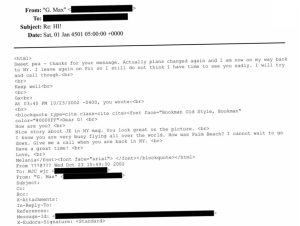
In her speech yesterday, Trump referred to an email she sent to Epstein’s partner-in-paedophilia Ghislaine Maxwell – to whom Trump referred chummily as “dear G”. Trump denied the email, in which she gushed about ‘G’s appearance and how she couldn’t wait to go to Palm Beach – and asked ‘G’ to call her when she was in New York. Maxwell responds, calling Trump “Sweetpea” and regretting that she “sadly” probably wouldn’t see her on her current trip to New York:

Despite this cosiness, in her speech, Melania Trump denied knowing Maxwell well and claimed that the exchange was merely “polite” and “tribal” – presumably meaning ‘trivial’. The Guardian and ITV do refer to this email. But, inexcusably, they don’t refer to an even more significant email – one that is directly relevant to Trump’s denial that she was introduced to her husband by Epstein.
Among the entities Melania Trump boasted that she has forced to apologise to her is US news website the Daily Beast. The site had streamed an interview with Michael Wolff in which he made claims noted above about Trump’s closeness to Epstein. But while the threat of a $1bn lawsuit might have cowed the site into backing down over that interview, it has not deleted a separate article about FBI evidence about how she met Donald Trump.
In that article, published in February 2026, the Daily Beast notes that among the evidence gathered by FBI agents on Epstein is a sworn statement (download here) from one of his employees. In that evidence, the employee claims directly that:
EPSTEIN introduced MELANIA TRUMP to DONALD TRUMP.

As the Daily Beast article notes, it is a criminal offence in the US to lie to the FBI. The sworn statement directly relates to Melania Trump’s denial in her speech and the Daily Beast has not deleted this article, evidently because quoting an official law enforcement document could not be defamation. But none of the ‘mainstream’ publications or broadcasters have bothered to refer to it, while streaming or quoting Trump’s denial.
According to the Longman dictionary, the phrase “the elephant in the room” refers to “an important subject or problem that everyone knows about but no one mentions”. There are at least two in Melania Trump’s bizarre speech. Rather than address them, the UK ‘mainstream media’ prefer to wonder rhetorically what could possibly have prompted Trump to make her speech, while remaining conspicuously silent about obvious potential causes.
Featured image via the Canary
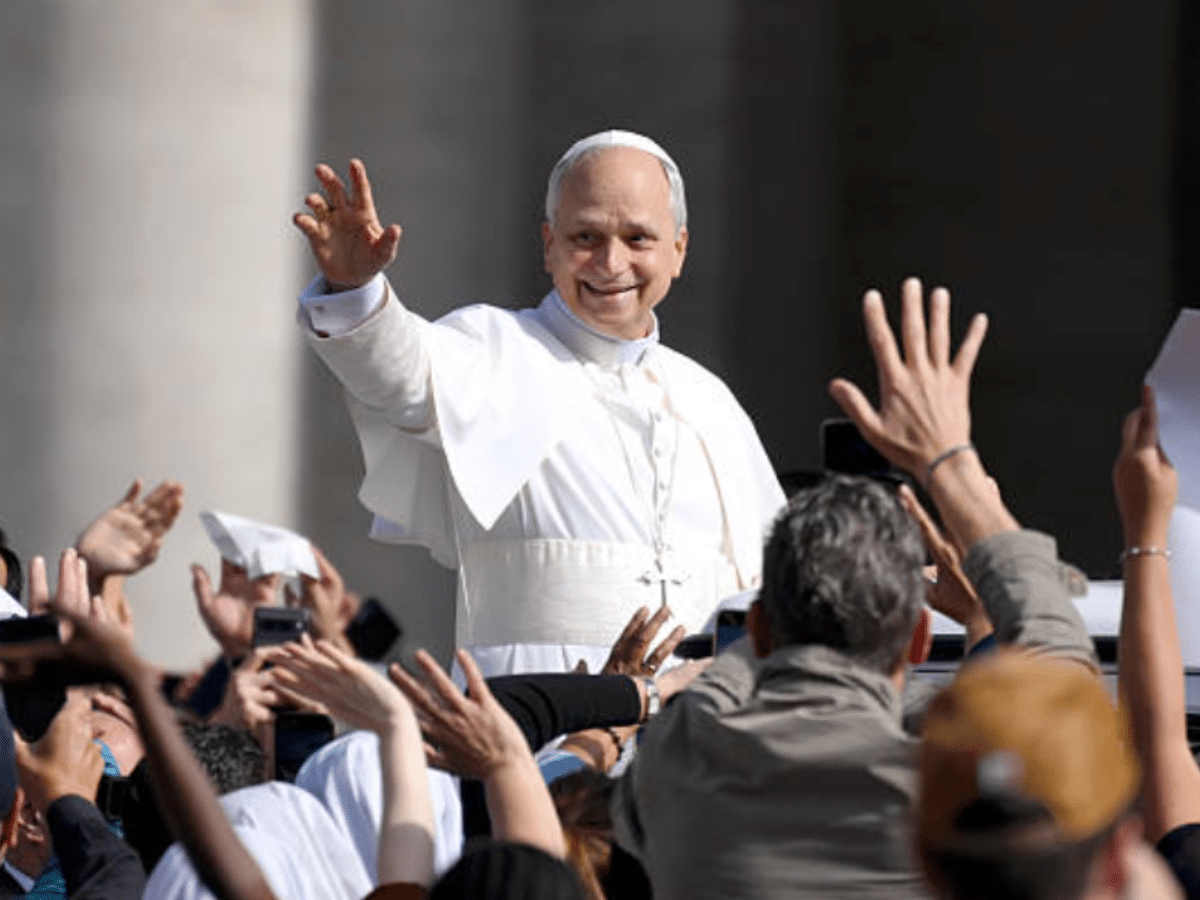
A Vatican official has stated that pope Leo may refuse to visit the US whilst Donald Trump remains in office. The news comes alongside reports of a widening divide between the Catholic church and US.
Pope Leo became the first pope to be born in the US after his appointment in 2025. Since then, he has been a vocal critic of Trump’s vicious warmongering and immigration policies. In particular, both his January and Easter addresses called for peace and criticized warlike states.
In response, the Trump administration has reportedly told the church that it has the military power to do “whatever it wants”. Reports also allege that one US official made reference to the use of force against the papacy itself.
Trump administration ‘the church had better take its side’
On 6 April, the Free Press broke a story on an unprecedented meeting between the Pentagon and a senior Vatican official. The US ‘department of war’ reportedly called for a meeting with Vatican diplomat cardinal Christophe Pierre, having taken offense at the pope’s calls for peace during a January address.
Speaking to the Vatican’s diplomatic corps in the new year, the pope criticised states “completely undermining” world peace. Breaking from tradition by giving the speech in English, rather than Italian or French, he added that:
A diplomacy that promotes dialogue and seeks consensus among all parties is being replaced by a diplomacy based on force, by either individuals or groups of allies.
In spite of Leo naming no individual countries, the Trump administration reportedly took this as a direct attack. In a first-of-a-kind occurrence, the Pentagon requested an audience with cardinal Pierre. Anonymous Vatican sources characterised the meeting as a:
bitter lecture warning that the United States has the military power to do whatever it wants — and that the Church had better take its side.
Avignon Papacy
Further even than this, the Free Press stated that:
one U.S. official went so far as to invoke the Avignon Papacy, the period in the 1300s when the French Crown leveraged its military power to dominate the papal authority.
The Avignon Papacy is sometimes referred to as the ‘Babylonian Captivity’ within Catholic circles. Following military and political threats from king Philip VI of France, pope Clement V moved the seat of the church from Rome to Avignon. It remained there between the years 1309 and 1377.
During that period, all seven elected popes were French. Likewise, 111 of the 134 new cardinals were also French. Although the level of Philip’s direct influence over the papacy during the Avignon residence is still hotly debated, critics hold that it was a time of unprecedented hegemony for the French crown.
As such, the force of this threat from a US official to the Vatican can hardly be underestimated. However, the Pentagon has flatly denied the Free Press’ characterisation of events. Instead, it issued a statement holding that:
In light of grossly false and distorted recent reporting, the Department of War repeats its statement: Recent reporting of the meeting is highly exaggerated and distorted. The meeting between Pentagon and Vatican officials was a respectful and reasonable discussion. We have nothing but the highest regard and welcome continued dialogue with the Holy See.
This take on the meeting is belied directly by a senior Vatican official, who told the Free Press that, following the meeting:
The Pope may well never visit the United States under this administration.
The pope has reportedly refused an invite from Trump to join him for the US 4 July celebrations. Instead, he will visit the Italian island of Lampedusa, a common entry point into Europe for North African asylum seekers.
‘Light the signal fire in Iran’
Beyond this direct clash with Vatican envoys, the US military has taken on increasingly apocalyptic evangelical Christian overtones under ‘secretary of war’ Pete Hegseth. The Washington Post described the situation:
Every month at the Pentagon, Hegseth hosts evangelical worship services that legal experts say are unprecedented. His social media profile and public comments routinely espouse his understanding of Christianity, which is one that would dominate American life and cast those who disagree with him as God’s enemies. He has brought clergy from his small Christian denomination to preach at the Pentagon, including a prominent pastor who says women shouldn’t have the right to vote.
By 4 March, the Military Religious Freedom Foundation (MRFF) had received over 200 complaints of increased sectarianism. One noncommissioned officer stated that their commander had:
urged us to tell our troops that this was ‘all part of God’s divine plan’ and he specifically referenced numerous citations out of the Book of Revelation referring to Armageddon and the imminent return of Jesus Christ. […]
He said that ‘President Trump has been anointed by Jesus to light the signal fire in Iran to cause Armageddon and mark his return to Earth’.
At a worship service held within the Pentagon on 25 March, Hegseth prayed for God to:
Give [US soldiers] wisdom in every decision, endurance for the trial ahead, unbreakable unity, and overwhelming violence of action against those who deserve no mercy. Preserve their lives, sharpen their resolve, and let justice be executed swiftly and without remorse that evil may be driven back and wicked souls delivered to the eternal damnation prepared for them….We ask these things with bold confidence in the mighty and powerful name of Jesus Christ, King over all kings and amen.
It’s hard to find something new to say in the face of such openly bloodthirsty rhetoric and actions. The US military is controlled by zealots who claim belief in waging a holy war. They’re spurred on by an apparently genuine desire to bring about the end of the earth.
These aren’t things that you’re trained to write about. There’s no reasoning with this cocktail of religious hatred, white supremacy, and naked greed. Not even direct condemnation from arguably the most senior Christian on earth has given them pause.
Featured image via the Canary
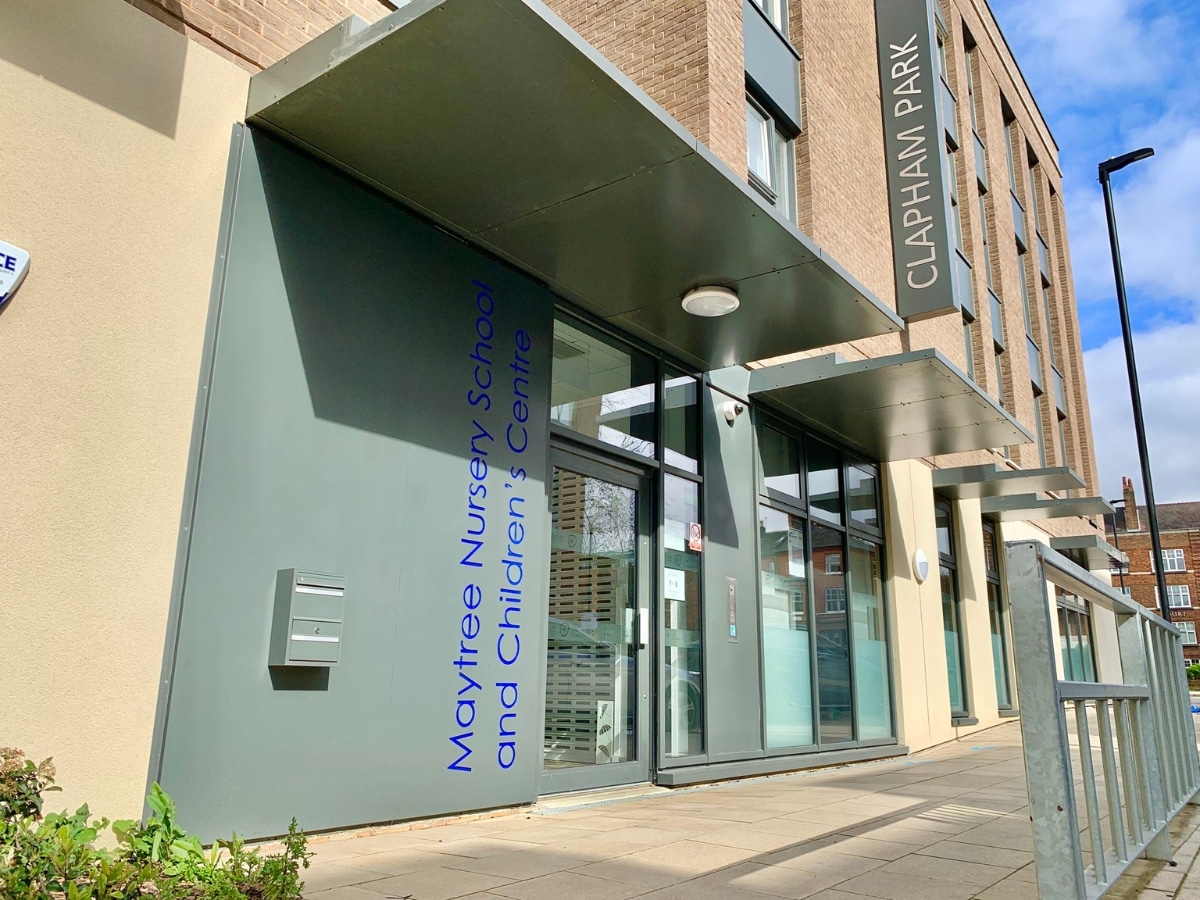
Lambeth council announced consultations on the potential closures of Effra, Triangle and Maytree nurseries in January. There had been no prior consultation with the nursery leadership, staff or parents.
Then in March, the Labour-run council announced it was withdrawing the consultations. It said this was due to new government proposals changing the “national policy and funding landscape”.
But local Greens say this is an “embarrassing u-turn” for Labour, even though it provides some respite for families and staff. They argue that continuing uncertainty over the future of the nurseries is leaving people “in limbo”.
Since the March announcement, nursery staff, green councillors and even a local Labour MP have tried and failed to engage with the council. So far it has refused meetings and blocked requests for information.
A petition launched by local parents calling for an end to the consultations had gained over 1,000 signatures. However, the Greens, along with other local campaigners, have criticised Labour. They say the ruling party is cynically putting off difficult decisions until after the May elections.
Lambeth Labour claims
Lambeth Labour claims the potential closures are due to a 38% drop in pupil numbers caused by falling birthrates and families leaving the borough, leading to a substantial budget deficit. However, there are still waiting lists for the nurseries, so these numbers do not reflect the full reality.
However, the Lambeth Nursery School Federation, which runs the three nurseries marked for closure, has said the council’s approach of three separate consultations on closures would not solve the issues facing the nurseries even if all three closed.
Senior nursery staff provided detailed proposals for restructures that could ease financial pressures back in November, but Labour ignored these. Parents are calling for a working group which includes staff, unions and parents to shape the future of the nurseries.
The Federation also highlighted that the council’s figures were different to its own. The council consultations stated the monthly deficit was £450,000 whereas its figures were far less at £101,000. The consultations conflated historic deficits and projected deficits, among other inconsistencies.
The decision to withdraw the consultations is a victory for local campaigners. But senior staff at the nurseries have said it is only a temporary one.
The Greens are demanding that, when decisions are made about the future of the nurseries, Lambeth Labour listens to parents, staff and nurseries, and “puts families first”.
Meanwhile, parents and staff remain in a state of anxiety and uncertainty about the future of the nurseries they rely on.
Paul Valentine, Green Party councillor for Herne Hill & Loughborough Junction, said:
This has been a shambles from the very start when Labour ambushed parents and staff by launching these consultations with no prior consultation. Labour have blocked all attempts at meaningful engagement from the nurseries, parents, unions and councillors.
Now, facing a furious backlash, they’ve been forced into an embarrassing u-turn. It’s a great relief to parents, but only a temporary reprieve. The future of the nurseries still isn’t clear and families remain in limbo while Labour prioritises doing damage control ahead of the elections in May.
These nurseries are loved by the community and provide irreplaceable specialist early years teaching. Yet Labour are treating them, along with the families who rely on them, with complete contempt. When it comes to deciding a way forward, Labour must learn from their mistakes and listen to the nurseries.
This mess perfectly sums up the defensive, unaccountable culture Labour have cultivated in Lambeth in the past 20 years. In May, Lambeth can vote Green and choose a new way of doing things.
Sarah Ahmed, a parent at Effra Nursery, said:
Effra, Triangle and Maytree nurseries are a lifeline for so many families. The experience and care of the staff, and the provision for SEND, are irreplaceable. We know the council stopped the consultation process because of parents and staff organising against it.
The consultations were inaccessible and full of misleading information. The council saw an opportunity to stop them using the new government’s additional funding for SEN as an excuse, but we know the real reason is they knew it would cost them seats at the local elections.
The community is determined to keep fighting against the closures. We know this is just a delay tactic and we want to make sure that whoever gets in will fight to keep those amazing nurseries and children centres open for the sake of our children and communities. We are sick and tired of Lambeth council and its cuts affecting the most disadvantaged in our communities.
The council should be fighting for us. We are grateful for the support we have received on this issue from Helen Hayes and from Green councillors. We will be approaching all prospective candidates ahead of the elections demanding that they commit to keeping the nurseries open and protecting the staff’s jobs and our children’s education.
Featured image via the Canary

!function(n){if(!window.cnx){window.cnx={},window.cnx.cmd=[];var t=n.createElement(‘iframe’);t.display=’none’,t.onload=function(){var n=t.contentWindow.document,c=n.createElement(‘script’);c.src=”//cd.connatix.com/connatix.player.js”,c.setAttribute(‘async’,’1′),c.setAttribute(‘type’,’text/javascript’),n.body.appendChild(c)},n.head.appendChild(t)}}(document);(new Image()).src=”https://capi.connatix.com/tr/si?token=19654b65-409c-4b38-90db-80cbdea02cf4″;cnx.cmd.push(function(){cnx({“playerId”:”19654b65-409c-4b38-90db-80cbdea02cf4″,”mediaId”:”4f977cde-102d-499d-af5f-36efff39e7ec”}).render(“69d8fd5be4b0ccb589ec7f35”);});

We hope you love the products we recommend! All of them were independently selected by our editors. Just so you know, HuffPost UK may collect a share of sales or other compensation from the links on this page if you decide to shop from them. Oh, and FYI — prices are accurate and items in stock as of time of publication.
I never thought I’d say this, but YouTube star Emma Chamberlain has created a home collection I actually love.
The vlogger turned multi-hyphenate coffee magnate/ fashionista/ podcaster/ actor launched her collaboration with West Elm online in the UK today, and it’s filled with home decor pieces to inject a little fantasy into your world.
That might sound like too much, but trust me, it’s somehow still tasteful and timeless. Given its extremely reasonable price point, it could be exactly the home upgrade you’ve been looking for in the supposed ‘year of whimsy’.
Whether you’re looking for a sweet home decor upgrade, fresh bed sheets, or even a new vanity, here are my top picks from the Emma Chamberlain x West Elm collab. Just be quick – the Pinterest girlies will be all over this!
Emma Chamberlain x West Elm is available online now and in stores from 17 April.

The sentiment is so often-repeated that it feels like common sense: the blue light from your phone tricks your brain into staying awake when you should be sleeping, and is more likely to suppress sleep hormone melatonin than, e.g., yellow light.
For that reason, some phones have a “night mode” which turns the colour of your screen warmer in the hours before your bedtime. Many sleep experts advise steering clear of screens at night altogether.
But this finding isn’t as consistent as you might think. The BBC recently published a report suggesting that it “isn’t ruining your sleep” at all.
The research around blue light is mixed
Yes, there are lots of papers which have found that blue light at night can mess up your Circadian rhythm, thus negatively impacting your sleep.
However, others found different results.
A 2023 study from the University of Basel in Switzerland and the Max Planck Institute for Biological Cybernetics in Germany exposed participants to three light conditions, including blue and yellow light, an hour and a half after their bedtimes.
All light forms seemed to negatively affect sleep. But the scientists found “no conclusive evidence” that blue light was any worse than others.
Other research has found that blue light from our screens probably doesn’t affect our melatonin levels as much as we might expect.
A systematic review published in Frontiers in Physiology reads, “in general, the specific effects of blue light exposure seem still to be a murky field and more investigations are needed before final firm and evidence-based conclusions can be drawn”.
And a review of studies involving blue-light blocking lenses found mixed results, noting that often, researchers didn’t compare the effect of blue light to that of other light on people’s sleep, even though “exposure to even moderate light levels, in addition to short-wavelength light, can acutely suppress melatonin”.
Does that mean screens before bed are A-OK?
There’s more to consider here than just blue light. Some screen activities, like games, may excite more activity in the brain than others.
Still, Dr Michael Gradisar, head of sleep science at Sleep Cycle, said that “We published a review of scientific investigations into the links between screens and sleep, and the data do not support the recommendation that people avoid screens in the hour before bed.”
Instead of avoiding them entirely, he added, it might be “more effective to encourage individuals to try less engaging, less disruptive devices before bed as a practical path to better sleep,” like TV.
Additionally, while researchers don’t agree on whether blue light is uniquely bad for us, any artificial light at night has the potential to mess with our body clock.
We do know that morning sunlight is especially good at keeping our internal rhythms on track, and that “zeitgebers,” or time markers like meals and exercise, can help too.
But if you’re happy with your sleep despite your nighttime scrolling, not everyone is convinced there’s enough evidence to give up the habit entirely.
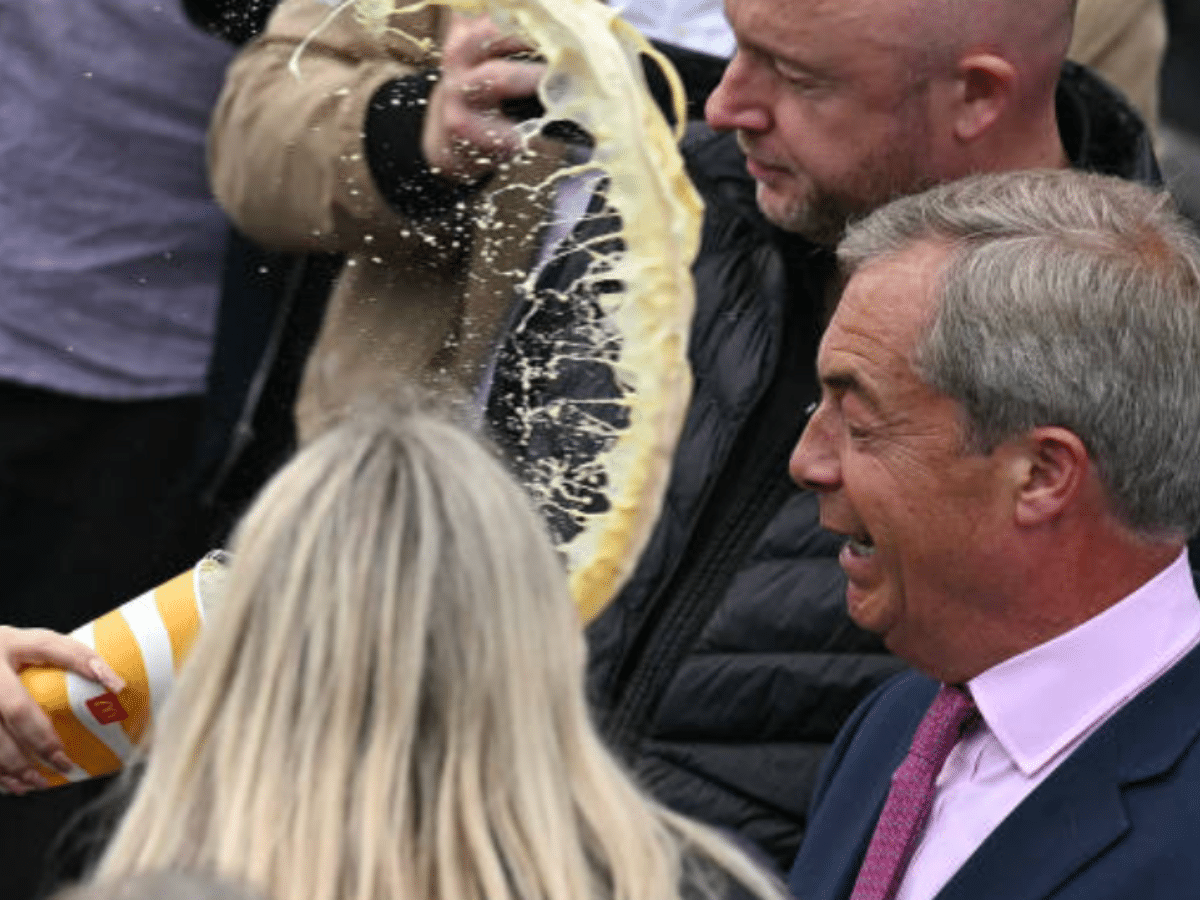
Supporters of Sunderland AFC have launched a petition to keep Nigel Farage away from the football club.
Farage and Reform are predatory in working-class cities like Sunderland
The Reform UK leader was in Sunderland last month to launch the party’s local election campaign. For the first time all of Sunderland’s 75 council seats will be up for reelection. There are fears across the city that Reform could muscle in due to the working-class population’s dissatisfaction with Labour.
In 2024 Sunderland city centre came under attack during far-right riots. Reform denied any part in the riots, despite their voters massively supporting them.
Whilst in Sunderland for the local election launch, Farage told ITV News:
I am hoping to go to a home game there at some point before the end of the season.
He continued:
I have been talking to one of the directors and they would very much like to see me there for a home game. If I can make it, I will.
ITV reports that the director in question was Juan Sartori, whom Farage met at the World Economic Forum in Davos earlier this year.
In response, a petition has been launched to ‘keep Nigel Farage out of Sunderland AFC‘
The petition says:
We, the undersigned Sunderland supporters, call on the club and its directors not to extend any invitation to Nigel Farage, or any other politician, whether at the Stadium of Light or elsewhere.
Reform does not represent Sunderland or SAFC
It sets out many reasons why fans should oppose a potential visit. These include that Farage’s visit would be a publicity stunt to secure votes:
He doesn’t care about the club, has never mentioned it before, and has no real connection with it… Such behaviour is totally inappropriate for any politician, from any party. It’s also totally inappropriate for any football club to enable such actions.
The petition also lays out that it would reflect badly on the club, especially since it’s been actively involved in Show Racism the Red Card. It also highlights that many current and former players have experienced racism on and off the pitch.
The petition also points out that while you don’t need to belong to a particular political party to support Sunderland, Farage’s politics are in complete opposition to the club’s values and foundations:
The working-class, socialist history of the fan base, who often worked as shipbuilders or miners, still resonates. There’s a reason why Durham Miners’ Association banners are still paraded at the Stadium of Light. There’s a reason why the road next to the stadium is named after Keir Hardie. There’s a reason fans sing The Red Flag. Hosting Farage in particular is a slap in the face to the history of our club, what it stands for, and fans, past and present.
Ipswich Town have recently come under fire after Farage visited the club’s stadium ahead of a rally in Ipswich later that day. He posed for photos in the dressing room and on the pitch. The petition says the publicity stunt by Farage left Ipswich fans ashamed and that Farage:
seized on the chance for a photo opportunity and to pander to their fans for votes, then left.
The petition is calling on SAFC to:
1. Withdraw any existing invitations to Nigel Farage – or any other politician – to visit the club.
2. Affirm the club’s independence from party politics.
3. Affirm that the club will never allow itself to be exploited as a platform for shallow political stunts and promotion.
4. Explain to fans if an invitation was extended to Farage and, if so, when, by whom, and in what form and capacity.
5. Affirm that no one involved in running the club will unilaterally invite any politicians to the club or seek to use their position for personal gain.
If you are a Sunderland fan, live in Sunderland or want to show solidarity, you can support the petition here
Featured image via the Canary

Satellite imagery flagged by the @mhmiranusa account on X indicates that US & Israeli Zionist war criminals have been bombing Iranian pistachio warehouses. The account owner said:
The pistachio warehouses of Iranian Pistachio Company near Rafsanjan Airport were targeted by American/Israeli fighter jets in the first week of Farvardin.
The attached before and after images show clear differences, with many buildings seemingly no longer standing. The blog The Dissident suggests a reason for the destruction, saying it’s:
…likely a gift to Lynne and Stewart Resnick, the Zionist billionaires who own the California-based Wonderful company, the largest producer of pistachios in the world.
As the writer elaborates, the Resnicks have benefited from over four decades of brutal US sanctions on Iran:
For as long as anyone can remember, Iran had been the world’s main supplier of pistachios. But Carter’s 1979 embargo on the country effectively cut off Iranian pistachio growers from the American market and created a need for alternative pistachio production, which was virtually nonexistent in the United States.
Over much of that period, the Resnicks have built up a farming empire in California, with:
…nearly 160 square miles…growing cotton, pistachios, almonds, oranges, lemons and grapefruit.
Sanctions on Iran boost US pistachio industry
A picture tells a thousand words, so this image best shows the effect Washington’s sanctions have had on the relative success of pistachio markets in the US and Iran.

This degrading of Iran’s capacity to produce the foodstuff gives the US – and the Resnicks in particular – an opening into a global market worth over $5 billion. Iran and California are two of only a few areas in the world where pistachios are grown.
The Zionist plutocrats have certainly contributed to the current shape of the market, with Mondoweiss documenting how:
…the Resnicks did what any smart and ruthless American would do: they made common cause with oil companies, Islamophobes, neocons and Likudniks, and began funneling money to think tanks and political advocacy groups that take a hardline approach with Iran. Economic sanctions, sabotage, vilification—all these things worked in the Resnicks’ interest. Bombing some of Iran’s pistachio fields wouldn’t be so bad, either.
The pair are:
…on the board of trustees of the highly influential Washington Institute for Near East Policy think tank, which was created as an AIPAC spin-off in the ’80s. In the realms of US government mid-east policy and media reporting about the region, the think tank is considered to be one of the most influential in the country. It is also ridiculously hawkish on Iran, calling for heavy sanctions and military strikes against the country.
Given so-called ‘Israel’ gleefully bombs schools, hospitals, mosques and even synagogues, it wouldn’t be a stretch for it to bomb a nut factory to help out one of their key advocates and financial backers. The terrorist land theft project has an entire military philosophy predicated on attacks against non-military targets, known as the Dahiya Doctrine.
Centuries of violent intervention to protect profits
It would also be entirely in line with centuries old corporation-backing imperial policy. It stretches back at least as far as Britain using its military might to back the East India Company which pillaged South Asia. Famously, the United States staged a coup in Guatemala in 1954 to overthrow the country’s legitimate president Jacobo Árbenz Guzmán. The illegal attack was done to help out the United Fruit Company, with Árbenz planning to redistribute their vast land holdings.
And of course, most relevant of all in the current context is what happened just one year earlier – Operation Ajax. This was the British-US plot in which they overthrew Iran’s elected prime minister Mohammad Mossadegh.
They acted after Mossadegh sought to put oil profits in the hands of Iranians, rather than imperial powers. He aimed to do this by nationalising the Anglo-Persian Oil Company, now known as BP. Iran has not had democratic governance since.
The Resnicks’ offences extend beyond backing Zionist war crimes. A documentary called Pistachio Wars highlights their hoarding of water in California:
As drought intensifies and communities struggle for access to water, this film exposes the hidden systems of power, greed, and corruption shaping the future of food, farming, and survival in the American West.
It is executive produced by Adam McKay, who directed Vice, the excellent skewering of mass murderer Dick Cheney.
The illegal attack on Iran has caused fuel prices to soar, and that will soon have a knock-on effect on the price of everything else. If you’re paying more for pistachios in particular, you now know why.
Featured image via the Canary
As all alert readers will know, this site likes to keep a watchful eye on the shady and disturbing activities of paedophilia-plagued charity LGBT Youth Scotland. So were were naturally intrigued to hear that they’d hired a new convenor last month.

And if you’re sitting there thinking, “Blimey, AI Christopher Walken looks very very ill”, well, stay tuned, because this story gets more and more interesting.
The image above comes from a story published on charities website Third Force News three weeks ago, but which had vanished when we tried to click on it this morning.

And the reason may be that there’s remarkably little verifiable evidence anywhere that Mr Westwood actually exists.


Wings has been unable to verify any of the claims made on LGBT Youth Scotland’s bio page for Westwood.

If you Google his name in connection with the British Red Cross, for example, the only results returned are the LGBTYS bio page.

The same thing happens with Amnesty International.

His supposed work with Citizens Advice draws an even bigger blank.

As does Pride In London.

The only way to get more results is to use “Tim” instead of “Timothy”, but then they’re all about (what we assume and hope is) a different person.


To be honest, readers, if we were taking up a senior position at an organisation with a horrific record of links to child rape, the very least we’d do would be supply them with a photo so that people would definitely know we weren’t THAT Tim Westwood.


(Charles Rennie, incidentally, was freed a few months ago.)

At a minimum, Mr Westwood’s ostensibly distinguished career seems to have made so little detectable impact anywhere that one wonders why he was headhunted for his new role in the troubled organisation which could probably do with some time away from media scrutiny and controversy for a change, but which the Scottish Government nevertheless continues to throw public money at with, er, gay abandon.


The SNP simply adores LGBTYS, which was once headed by former SNP MP Alyn “Daddy Bear” Smith, who is likely to be elected as an MSP at next month’s election. But even so, you might like to imagine they’d want a little more, er, transparency than this for their money.

We wait agog for Mr Westwood’s first public appearance, if indeed he is a real human. There are an awful lot of questions to be cleared up about his CV. But then in Scotland, questions about anything, and questions about LGBT Youth Scotland in particular, are rarely answered.

Mish Rahman is a former – and longstanding – member of the national executive committee (NEC) of the Labour party. He is now a member of the Greens. And he has outed the hypocrisy and racism of Labour’s desperate attempt to smear a London Green candidate as antisemitic.
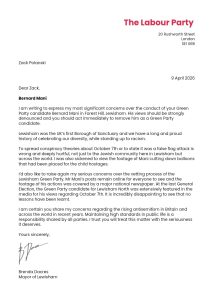
Labour is clearly still stung by its humiliating defeat in the Gorton and Denton parliamentary by-election and terrified of the outcome of May 2026’s local elections. It is just as clearly still desperate to propagate the Israel lobby’s attacks on the Greens for opposing Israel’s genocide. Hence the hollow arrogance of Lewisham mayor Brenda Dacre’s blatantly electioneering letter to Green leader Zack Polanski demanding the removal of Forest Hill candidate Bernard Mani:

Dacre’s pretext for her demand is that he has apparently questioned Israel’s atrocity narrative concerning 7 October 2023. The fact that the narrative has already been completely debunked seems to have escaped her notice – or at least her computer keyboard.
But according to Rahman, who has extensive experience of Dacre when she was a Labour party functionary, her ability to ignore facts has previously protected racists, rather than attack opponents of genocide. In a post on X, he recounted one such experience:
I chaired a disciplinary panel with Brenda Dacres and one other white bloke.
We interviewed a racist who called a Muslim female Cllr Jezbollah in public – refused to apologise and said he stands by his comments.
Brenda and Merton voted to reinstate him outvoting me 2-1 https://t.co/VBzn7MMaFp
— Mish Rahman (@mish_rahman) April 9, 2026
Labour and bigotry
Appalling. But Dacre is anything but an anomaly in her party, which has a long record of anti-Black, anti-Muslim, and anti-Roma racism.
The Labour Muslim Network published a damning report on the rampant Islamophobia among the Labour right. Keir Starmer and his sidekick David Evans promised to immediately implement all the LMN report’s recommendations, but two years later LMN had to report that the situation continued unabated and was so serious that most Muslim party members had no confidence in Starmer or his interest in tackling the issue. Three years later still, and Starmer is no better.
Anti-Black racism, meanwhile, has run riot among the Labour right, with whole swathes of Black councillors deselected – in at least one case, involving the removal of every Black councillor in a London borough. Unlike the Abbott suspension, the issue was ignored by the so-called ‘mainstream’ media. In 2026, Starmer’s party is busy trying to normalise it across UK society.
And MPs who made or propagated grossly racist comments against Gypsy Roma people went unpunished by the party and were even appointed to Starmer’s front bench. Those who hound left-wing Muslim and Black MP women MPs, by contrast, are enabled and protected.
So rampant was the issue and so uninterested was the leadership in doing anything about it that in 2021, Black party members went on campaign ‘strike’ in protest – and in 2022, black MPs and activists protested publicly against the leadership’s complete inaction over the racist abuses highlighted in the Forde report.
Even on the issue of antisemitism, Starmer and co are selective: while left-wingers including many Jews are thrown out of the party for legitimate criticism of Israel or even for wanting to discuss the so-called ‘IHRA working definition’, right-wingers who have made clearly antisemitic statements have been allowed to remain on the front bench or even promoted.
Polanski’s record of tackling Israel lobby smears head on suggests that he will tell – may already have told – the desperate Labour mayor to stick her demands somewhere sunlight doesn’t reach. He certainly should.
Featured image via the Canary

After a Lifetime of Gas, I Switched to an Induction Stove. I’m Never Going Back

Are financial advisors worth it?
Keanu Reeves’ New 83-Minute Movie Lands Among His Worst-Rated Projects Ever


-

 Fashion7 days ago
Weekend Open Thread: Spanx – Corporette.com
-

 Business5 days ago
Three Gulf funds agree to back Paramount’s $81 billion takeover of Warner, WSJ reports
-

 Sports6 days ago
India men’s 4x400m and mixed 4x100m relay teams register big progress | Other Sports News
-

 Business6 days ago
Expert Picks for Every Need
-

 Tech3 days ago
How Long Can You Drive With Expired Registration? What Florida Law Says
-

 Business5 days ago
No Jackpot Winner, Prize to Climb to $231 Million
-

 Fashion4 days ago
Massimo Dutti Offers Inspiration for Your Summer Mood Board
-

 Fashion3 days ago
Let’s Discuss: DEI in 2026
-

 Crypto World2 days ago
Bitcoin recovers as US and Iran Agree a Ceasefire Deal
-

 Business6 days ago
Akebia Therapeutics, Inc. (AKBA) Discusses Pipeline Progress and Strategic Focus on Kidney Disease Treatments at R&D Day – Slideshow
-

 Crypto World1 day ago
Canary Capital Files SEC Registration for PEPE ETF
-

 Politics6 days ago
The UK should not pay a penny in slavery reparations
-

 Tech4 days ago
Samsung just gave up on its own Messages app
-

 Tech4 days ago
Haier is betting big that your next TV purchase will be one of these
-

 Fashion7 days ago
Weekly News Update, 4.3.26 – Corporette.com
-
Sports7 days ago
A Kevin O’Connell Theory Can Now Be Retired
-

 NewsBeat7 days ago
Kemi Badenoch talks ‘spring cleaning’ Reform defections
-

 Tech4 days ago
Gamer Restores the Original PlayStation Portal From Two Decades Ago
-

 Business4 hours ago
OpenAI Halts Stargate UK Data Centre Project Over Energy Costs and Copyright Row
-

 Tech4 days ago
The Xiaomi 17 Ultra has some impressive add-ons that make snapping photos really fun
You must be logged in to post a comment Login