
Politics
Israel using white phosphorus again in Lebanon


Israel has used white phosphorus, an illegal chemical weapon, over homes in Yohmor al Beqaa, Lebanon.
NEW: The Israeli military unlawfully used white phosphorus over homes on March 3, 2026, in the Lebanese town of Yohmor.
The use of white phosphorus over residential areas is extremely alarming and will have dire consequences for civilians.
Read more: https://t.co/ulrNyd9Ceh pic.twitter.com/DlUTViKwo7
— Human Rights Watch (@hrw) March 9, 2026
Israel using chemical weapons again
Human Rights Watch verified and geolocated eight images, which show:
airburst white phosphorus munitions being deployed over a residential part of the town and civil defense workers responding to fires in at least two homes and one car in that area.
As the Canary previously reported, white phosphorus is a chemical substance which ignites instantly upon contact with oxygen. It’s incredibly hard to extinguish and sticks to surfaces like clothes and skin. White phosphorus is extremely harmful to people, no matter the route of exposure. It causes deep and severe burns – often down to the bone, breathing problems, and burning of the eyes and respiratory tract.
The human body can absorb the chemical, causing dysfunction in multiple organs, including the liver, kidneys and heart.
It burns at more than 800 degrees Celsius (nearly 1,500 degrees Fahrenheit). That is high enough to melt metal.
Importantly though:
The incendiary effects of white phosphorous can cause death or cruel injuries that result in lifelong suffering.
The use of chemical weapons in civilian areas is a war crime for exactly this reason. Generations of Lebanese people will now suffer the consequences of Israel’s indiscriminate and illegal attacks.
According to the World Health Organisation:
The use of white phosphorus may violate Protocol III (on the use of incendiary weapons) of the Convention on Certain Conventional Weapons (CCCW) in one specific instance: if it is used, on purpose, as an incendiary weapon directly against humans in a civilian setting.
War crimes
There is plenty of evidence of Israel’s unlawful use of white phosphorus. Since October 7, Israel has carried out over 1,000 illegal white phosphorus strikes in Gaza.
According to the Euro-Med Monitor, in 40 minutes alone, the IDF launched 300 white phosphorus strikes on a packed residential square in the northern Gaza town of Beit Lahia.
That same evening, reports of multiple white phosphorus shells were recorded in a crowded area of Gaza City. Israel launched similar attacks in the Al-Shati refugee camp, west of Gaza, and the Jabalia town and camp in the Strip’s north.
But it’s not just Palestine. Amnesty International reported that the Israeli army fired artillery shells containing white phosphorus along Lebanon’s southern border in October 2023.
Human Rights Watch also verified Israel’s use of white phosphorus on two locations along the Israel-Lebanon border and over Gaza City’s port.
US origins
As the Canary previously investigated, the US Army supplies Israel with white phosphorus-filled projectiles.
The chemical agent can be deployed through artillery shells, bombs, rockets or grenades.
The white phosphorus itself comes from Israel Chemicals Ltd. (ICL), which has a chemical manufacturing plant in St. Louis.
The US government contracted ICL to produce white phosphorus for the US Army, for:
a 5-year, indefinite-delivery, indefinite-quantity, fixed-price contract at $3,342,150.
ICL has 10 illegal quarries in the occupied West Bank, according to a report by the Israeli Ministry of Interior. Notably, ICL is also operating in the occupied Syrian Golan.
Of course, it is no surprise that a country with a history steeped in colonialism is supplying chemical weapons to a genocidal terrorist state.
Israel’s entire existence is based on colonialism, war crimes, and the displacement of indigenous populations.
So now Israel is once again using illegal chemical weapons to further its terrorist agenda at the expense of indigenous communities – we are not surprised. But Israel knows it can and will get away with it, which is why it’s even more important that international communities take a stand.
Featured image via FRANCE 24 English/ YouTube screenshot



FRAUDTUITOUS: Gov. Kathy Hochul has spent the last four months beating the auto-insurance affordability drum and fighting the trial lawyers and unconvinced lawmakers who stand in her way.
She’s proposing limiting the ways car crash victims — especially those deemed at fault for the collision — can sue for damages, a move she says will cut the cost of auto insurance. She also wants to target insurance fraud and staged crashes.
It’s been a massive sticking point in negotiations to finish her now-late budget.
“If, God forbid, you are the majority reason that there’s an accident, you will no longer be entitled to pain and suffering,” Assembly Speaker Carl Heastie told reporters Wednesday. “That’s a pretty serious thing for people to accept. I mean, accidents do happen.”
But as Hochul hopes to draw the Assembly and Senate to her side, it just so happens that federal prosecutors in the Southern District of New York dropped indictments this week targeting a close personal friend of former Mayor Eric Adams and alleging a massive car-crash-victim-fraud scheme.
Perfect! Timing!
“This alleged scheme is exactly the type of fraud Governor Hochul’s auto insurance reforms are designed to curb in New York State,” Hochul spokesperson Kristin Devoe told Playbook in a statement.
Her office is arguing that the scheme might never have happened had Hochul’s proposed changes been in place.
“The Governor’s proposals would strengthen enforcement, allow more time to investigate suspected fraudulent claims and crack down on the networks and providers that make this type of fraud possible in the first place,” Devoe said.
Our colleague Chris Sommerfeldt reported this morning that federal prosecutors dropped a superseding indictment Thursday in their fraud case against Zhan “Johnny” Petrosyants, the man who hobnobbed, dined and clubbed with Adams during his tenure, as Hizzoner tested New York City’s nightlife “product.” The superseder alleged businessmen Vladislav Stoyanovsky and Dmitriy Khavko participated in the scheme as well. All three men pleaded not guilty.
Prosecutors claim the men had car crash victims in medical clinics undergo dubious procedures conducted by clinicians who were part of the scheme. The indictment also alleges the men behind the operation billed insurers for procedures that never happened.
Petrosyants, Stoyanovsky and Khavko then allegedly filed no-fault claims to the insurance companies, who, under state law, are required to pay out the claims in just 30 days. The scheme brought in tens of millions of dollars, prosecutors said.
Hochul’s office wants to change that. The governor says she’d give insurers more time to investigate whether a no-fault claim is fraudulent. Right now, if an insurer delays a payout, it can’t defend itself in court by saying it was busy investigating the claim. Insurers would still have to pay interest on delayed payouts. And if someone sues to force a reluctant insurer to pay up, the insurer would have to cover attorneys fees.
The cost of paying out bogus insurance claims is a main factor in the high cost of auto insurance in New York, contends Team Hochul. Last year, insurance carriers reported 43,811 incidents of suspected auto insurance fraud to regulators, an 80 percent jump compared to 2020.
The Trial Lawyers Association says Hochul’s proposals would give insurance companies more time to delay and deny claims.
“Stripping away consumer rights while insurers rake in record profit is a giveaway to the industry that leaves New Yorkers to pick up the tab,” association spokesperson Sabrina Rezzy said in a statement. — Jason Beeferman
From the Capitol

TIGHTENING ALBANY’S BELTWAY: The much-derided I-787 — an asphalt apron familiar to Capital Region drivers who commute downtown to the statehouse — is one step closer to a makeover.
Hochul announced Thursday the state is opening a community outreach center amid an environmental review focused on how to improve waterfront access. I-787 runs parallel to the Hudson River.
“Reimagining the I-787 corridor is a once-in-a-generation opportunity to shape the future of downtown Albany, so it is imperative that the people who live and work in the area have a major voice in how this project progresses,” Hochul said. — Nick Reisman
FROM THE CAMPAIGN TRAIL

BLACKBURN’S BONDI PAST: In 2016, years before she became one of the Trump administration’s most prominent and polarizing officials, then-Florida Attorney General Pam Bondi had a young intern in her office named Conrad Blackburn.
That fact is now being seized on by Blackburn’s critics as he runs for a Harlem-based Assembly seat as a democratic socialist and unabashed enemy of Trump.
“It is unconscionable that Conrad Blackburn chose to work for Pam Bondi at the very moment she was leading the charge to keep more than a million Floridians, including one in five Black adults, permanently locked out of the voting booth,” Uptown Democratic Club President Donna-Marie Gibbons told Playbook, referencing Bondi’s effort to preserve a Florida law that made it difficult for felons to regain voting rights after serving time. “Anyone who signed up to work in that office while she was fighting to preserve this racist, Jim Crow-era machinery has questions to answer about their commitment to our community.”
Trump fired Bondi as his U.S. attorney general Thursday.
Blackburn, who grew up in Florida, said criticism of his stint with the attorney general there says more about his haters than it does about him.
He told Playbook he took the unpaid, two-month internship in Bondi’s criminal appeals bureau while in law school — and the experience drove him to become a public defender, a role he continues to serve in to this day.
“I did not need very long to say that the system was broken and I needed to spend my time working to protect Black folks from it, with actions, not just words,” Blackburn said.
“I am happy to debate my record on its merits,” he continued. “But harkening back to my days as a 1L, as a poor kid trying to work in the criminal appeals bureau of the Florida AG’s office as some kinda gotcha? That is everything wrong with politics now. If the powers that be in this district focused on the issues, they would have to explain the lack of meaningful change in the community…Heck, if the powers that be did their jobs, I may not be running in this race at all.”
Blackburn is facing off in June’s Democratic primary against Assemblymember Jordan Wright, the son of Manhattan Democratic Party head Keith Wright.
New York Focus reported today that Charlie King, a longtime aide to former Gov. Andrew Cuomo, is launching a super PAC to boost Wright, whose district Mayor Zohran Mamdani comfortably won in last year’s election. — Chris Sommerfeldt
IN OTHER NEWS
— ARRESTS SURGE: ICE arrested more New Yorkers between November and January than in any comparable period since 2022, according to federal data. (Times Union)
— ONE MAN’S TRASH: Reports show that progress in New York’s composting push slowed after officials halted fines and enforcement efforts. (Gothamist)
— BLESS THIS MESS: Competing lobbying groups in Hochul’s car insurance reform fight are clashing over dueling clergy letters and even disputing who actually signed which. (City and State)
Missed this morning’s New York Playbook? We forgive you. Read it here.
Let’s just deal with this quickly.

Because the truth is that we should all be quietly sending BBC Scotland bouquets in appreciation for doing the independence movement a favour for once.
Belief in an independent Scotland IS as strong as ever, which is to say it’s pretty much where it’s been since 2014 – two or three points either side of 50%. But while it’s true, that fact certainly WASN’T demonstrated by last Saturday’s pathetic march and cursory “rally”, which at the very, very highest estimate was attended by just a twentieth as many people as used to regularly show up at such events.
“We are the 45”, a performer sang at one point to a crowd which numbered only slightly more than that.

“With strength in numbers, Scotland shall prevail”, he continued, leading any rational observer to conclude that Scotland’s chances of prevailing must be roughly on a par with those of our capturing the World Cup in America this summer.

The march was the latest in a series of similar embarrassments, which would have attracted nothing but mockery and pity if broadcast on the evening news. What it demonstrated was that the roughly 50% of people who support independence are as actively committed to making it happen as the roughly 50% of people who want to bring back hanging and the roughly 50% who want to get rid of Trident, two things which are just as far away from the current political agenda.

This is an extraordinary misunderstanding of news values from someone who used to be the editor of a national newspaper. The march was announced seven months ago, has been relentlessly promoted since then, was officially supported by the SNP (which the 100,000+ AUOB marches never were), took place in the runup to an election and featured the First Minister as its headline speaker AND STILL ALMOST NOBODY BOTHERED TURNING UP.
That’s the only thing even remotely and tentatively approaching being a news story here: Widely Promoted Event About Supposedly Incredibly Vital And Urgent Subject Supported By Half The Population And Government Party Who Will Win Imminent General Election Attracts Comically Low Attendance.
We should be weeping with gratitude that the BBC didn’t run that story. Even the march organiser didn’t show up, and nor did most of the SNP, who were focused on keeping their members on the gravy bus come May.

Breaking: 3,000 people mooching down the High Street for an hour and half of them climbing Calton Hill to listen to a desultory handful of awful speeches for another 45 minutes is NOT, in fact, “more than enough” to end the British state’s 300-year control of Scotland. (If it was, obviously, we’d have been independent by Monday.)

Once again: if it had really had the potential to do that, why didn’t more people turn up? At least 1.6 million Scots support independence. Yet fewer than two out of every thousand of them could be arsed with getting a bus or train to the nation’s capital on a bright sunny day to register their interest and have a nice social day out.
Not even SNP supporters think independence is on the political agenda.

And nor do they much care. Independence is not even in SNP voters’ top three priorities, because even people so dumb they’re still voting SNP know that the SNP have neither a strategy nor any motivation for achieving independence. The SNP’s interests lie entirely in maintaining the status quo, as the party’s last former CEO accidentally pointed out in The Courier this week.

And even if the SNP did want independence, we know how it goes by now.
[SNP wins election]
SNP: “We demand another referendum!”
UK GOVERNMENT: “No.”
SNP: “Okay then! See you in another five years!”
More to the point, Richard Walker knows that too. In the article, he just comes right out and says “We should deploy this strategy even though we know it won’t work and when it doesn’t work everything will be over”.

For the sake of brevity we’ll draw a veil over some of the more farcically ludicrous passages in the article. But the line below merits a brief mention, because it’s either a breathtakingly audacious lie or self-delusion on level that in less enlightened times would have seen someone put in a jacket whose arms fastened round the back:

Because on the evidence of last Saturday, the biggest favour UK media can possibly do the independence movement right now is to not draw attention to what a pitiful, withered, irrelevant and impotent state it’s in.

Parliament is in recess, and MPs are once again scattered across the country, back in their constituencies. In North West Essex, Kemi Badenoch will be pleased: once again, she tops ConservativeHome’s Shadow Cabinet League Table, with a net satisfaction rating of +82.1 (up 0.5 points).
It is the third Shadow Cabinet League Table in a row in which she has come first. The first time she reached pole position was shortly before Robert Jenrick’s defection to Reform UK. It underlines the marked shift from her earlier performances in ConservativeHome’s polling, when there were times that she was languishing on zero.
But it also reflects the way her personal polling has improved dramatically in recent months. Badenoch is now the most popular of all the party leaders. According to the think tank More in Common, the Tory leader’s net approval rating has risen to -9. That may not sound like much, but it puts her ahead of the pack. Sir Keir Starmer is on -42, while Nigel Farage and Zack Polanski are both on -16, with Ed Davey on -11.
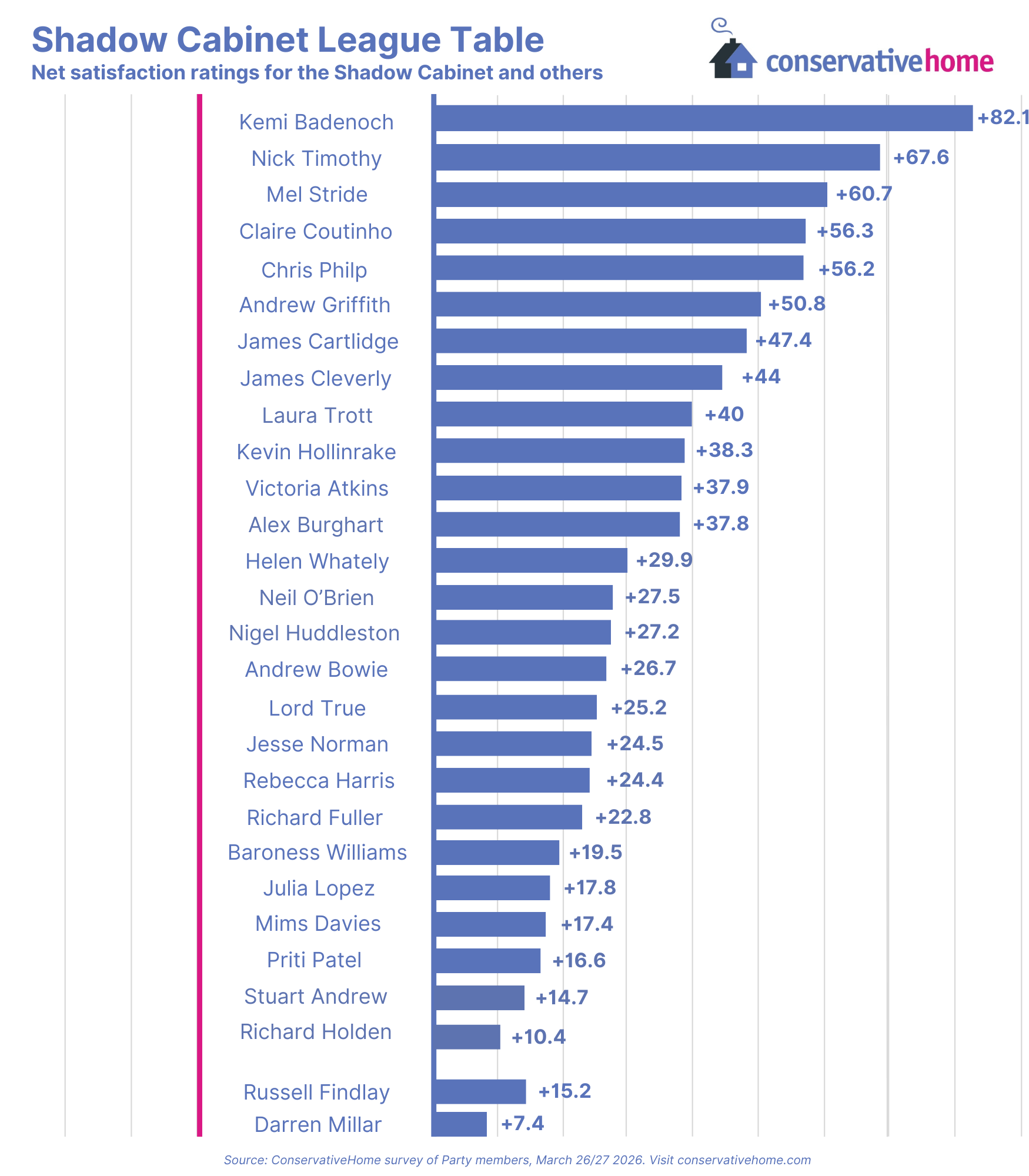
Behind Badenoch in ConservativeHome’s league table is shadow justice secretary Nick Timothy (+67.6), who retains second place since joining the shadow cabinet. He has recently been at the centre of controversy after describing a Ramadan prayer event in Trafalgar Square as “an act of domination” from an “Islamist playbook”.
The Tory leader rowed in behind him, but some fellow Conservative MPs – including some in the shadow cabinet and the whips’ office – have privately raised concerns about Timothy’s comments and his subsequent doubling down, which one senior Tory described as “extremely unhelpful”. But it has done nothing to dent his standing with Conservative members.
This Shadow Cabinet poll was conducted after Timothy’s remarks, and he still sits above all his shadow cabinet colleagues bar the Tory leader herself. In fact, he has increased his rating from +56.9 to +67.6.
The rest of the top five is unchanged from our last league table: shadow chancellor Mel Stride remains in third (+60.7), followed by shadow energy secretary Claire Coutinho (+56.3) and shadow home secretary Chris Philp (+56.2). Despite recent rumours – including in the Mail on Sunday – of a forthcoming reshuffle that would move Stride and Philp, both have held their positions since our last Conservative Home poll.
Another name that has surfaced in reports of a shadow cabinet refresh is shadow foreign secretary Priti Patel, who finds herself near the other end of the table, third from bottom on +16.6 — ahead only of shadow health secretary Stuart Andrew (+14.7) and shadow transport secretary Richard Holden (+10.4), who remains rooted to the foot.
Talk of a reshuffle seemed to lose some of its sheen as Parliament headed into recess. But I understand that, at senior levels within CCHQ, discussions are still ongoing about using a refresh as part of a broader plan to get the Conservative Party back on the front foot after the local elections.
And speaking of those elections: in the run-up to the Scottish and Welsh contests in May, things are not looking especially rosy for either Tory leader. In Scotland, Russell Findlay has slipped from +17 to +15.2 since our last survey. In Wales, Darren Millar is on +7.4, down only fractionally from +7.5. Still, the polls that matter are the ones coming next month.
The post Shadow Cabinet League Table: Badenoch extends her lead, Timothy holds second appeared first on Conservative Home.

I should have felt shocked when I read that one in eight parents now report that their child has a disability. That means that 12 per cent of British children – around 1.7million young people – are classified as suffering from a long-term illness, disability or impairment, according to figures just released by the Department for Work and Pensions (DWP).
These figures have almost doubled since 2015, when around seven per cent of parents reported that their child had a disability. This massive expansion in the number of children deemed to be disabled has been driven by a dramatic increase in the number of kids diagnosed with so-called behavioural issues, such as autism and ADHD. According to the DWP, ‘behavioural issues’ now account for two-thirds of childhood disabilities.
The reason I’m no longer surprised by the rise and rise of childhood disability is that I have been tracking this development for well over three decades. Back in 1996, I remember when UK government officials discovered that between 1985 and 1996, there had been a 40 per cent increase in the proportion of British people who consider themselves disabled. According to the survey, the increase was much higher among teenagers between the ages of 16 and 19. It seemed that the younger you were, the more likely it was that you would have a disability.
The authors of that survey concluded that the difference between the 1985 and 1996 figures ‘appears too large to be explained by a real increase in the prevalence of disability’. This is hardly a surprise. After all, there had been no war or outbreak of serious disease in this period that would have rendered swathes of the population infirm. That the authors couldn’t explain this epidemiologically extraordinary figure in the 1990s is entirely understandable. Thirty or 40 years ago, society had a far more limited view of who was considered disabled.
The explanation for this unexpected rise in the number of young disabled people does not lie in the field of epidemiology, but in the realm of a culture that invites people to classify themselves as infirm. It is important to stress that how people cope with negative experiences is strongly influenced by the cultural and historical factors that shape the way people make sense of them. Such cultural factors may increase or reduce the ability of the individual to cope with adverse circumstances.
In recent decades, the meaning of disability has undergone a dramatic semantic shift. This is part of a broader trend by which negative aspects of human experience and behaviour have become medicalised. In addition, an enormous disability lobby has emerged, which constantly demands that a variety of newly discovered disabilities be recognised with a formal diagnosis. The most important achievement of this lobby has been to alter public perceptions of the relationship between ability and disability. It has also succeeded in transforming what used to be characterised as children’s bad or problematic behaviour into medical issues.
Many of the ‘behavioural problems’ now designated to children have always been part of family life. Disobedience, aggression, disruptive and anti-social behaviour – now defined as ‘oppositional defiant disorder’ – have always posed a challenge to parents and schools. Yet these difficult patterns of behaviour are now often branded as psychological or medical issues. And so they become accepted, rather than something to be amended by adult guidance or firm discipline.
Clearly, parents are now actively courting disability diagnoses for their children. After all, the discovery of newly invented childhood disorders provides a welcome explanation for their children’s bad behaviour or poor performance in school: ‘She isn’t naughty, she is ill.’ It is also undeniable that the many welfare benefits now offered to parents with disabled children have also played a role. Nor can we ignore the role of teachers, some of whom are promoting the diagnosis of ADHD as an alternative to managing bad behaviour in the classroom through discipline and authority. A pupil’s failure to finish homework, inability to focus on class discussion and boredom in school are now blamed on some ‘condition’.
Unsurprisingly, over the past 30 or so years, children have internalised the disability narrative. Today’s young people readily communicate their problems in a psychological vocabulary. They describe their feelings in terms of stress, trauma and depression.
One of the gravest consequences of the disability culture is that many children no longer attend school at all. Last year, it was reported that the number of children missing more than 50 per cent of the school year in Oxfordshire had increased by more than five times in 10 years. This has been put down to ‘emotionally based school avoidance’, in which a child cannot attend school due to anxiety or stress. Half of UK secondary pupils avoided school due to anxiety at some point in the past year.
As a child, I can testify that my friends and I were more than happy to avoid going to school, and we had more than our share of anxiety. But we also knew that our parents and the rest of adult society had no sympathy for our predicament, and that not going to school was not an option. These days, adult society has become complicit in normalising truancy.
It is about time that society woke up to the fact that the current epidemic of childhood disability is not a medical problem. It is a cultural failure. Telling children that they are disabled, and unable to cope with the demands of life, is setting them up for a life of dependency and unfulfilled potential. Our children deserve better.
Frank Furedi is the executive director of the think-tank, MCC-Brussels.
 lead image
In the early hours of 25 March 2026, Israeli occupation forces (IOF) and police entered homes in Silwan, in occupied East Jerusalem, escorting settlers as Palestinian families were forced out of their properties in the Batn al-Hawa neighbourhood.
East Jerusalem — evicted after 10 year legal battles with settler organisation
16 Palestinian families, approximately 100 people, who had lived in the area for decades, were forcibly evicted from their homes. Their apartments were then emptied of their possessions. In many of these cases, illegal settlers from the settler organisation Ateret Cohanim moved into the properties immediately after the families were removed.
These evictions come after Israeli occupation courts upheld ownership claims based on pre-1948 Jewish property rights, which had been fought by Palestinian residents since 2016. Since 7 October, 2023, the Israeli occupation has forcibly displaced 28 Palestinian households from Batn al Hawa. Another 15 families are also expecting to be evicted from the neighbourhood imminently, by the same court order.
A law, known as the Legal and Administrative Matters Law of 1970, exclusively enables Jews to “reclaim” property in East Jerusalem. This is one of the many examples of the occupation’s discriminatory, apartheid policies. The many thousands of Palestinians who were forcibly displaced during the ethnic cleansing of the Nakba, in 1948, have not been allowed to return to their homes.
Since “Israel” occupied East Jerusalem, in 1967, it has expanded its presence and control over East Jerusalem, and attempted to alter the city’s religious identity, history, and demography- to Judaise Jerusalem. It has done this by exploiting its discriminatory laws and policies And through a combination of evictions, demolitions and restrictive planning policies, such as in Silwan, “Israel” is able to dispossess Palestinians of their land and property. .
Israeli occupation demolishing homes in al Bustan for biblical park tourist attraction
Several days after the Batn al Hawa evictions, on 30 March, the occupation’s police, military and bulldozers stormed the al-Bustan neighbourhood of Silwan, to demolish four Palestinian properties. No prior warning was given before the homes belonging to the Awad, Abu Shafaa, and Al-Ruwaidi families were destroyed. Retaining walls, gates and fences were also destroyed, roads bulldozed, and nearby infrastructure damaged,


The demolition of homes in the al Bustan neighbourhood, has been driven by the occupation’s plans to transform the area into public gardens, Torah-related projects, and settlers’ parking. He also highlighted that this neighborhood, located near the Al-Aqsa Mosque, is one of the most affected by Judaization and settlement initiatives.Demolitions accelerated in 2024 and 2025, and by February 2026, the occupation had demolished 35 homes and issued 17 additional demolition orders in al-Bustan. A total of 1500 Palestinians in the area have demolition orders on their homes, so further ethnic cleansing is expected any day.
The Israeli occupation’s interest in Silwan is due to its location, against the southern walls of the Old City and close to al Aqsa, which would allow the zionist regime to cement control over East Jerusalem. Archaeological tourism projects, settlement expansion, and court-backed property claims are all being used to forcibly displace Palestinians, and ethnically cleanse occupied Jerusalem of Palestinians.
Featured image via the author
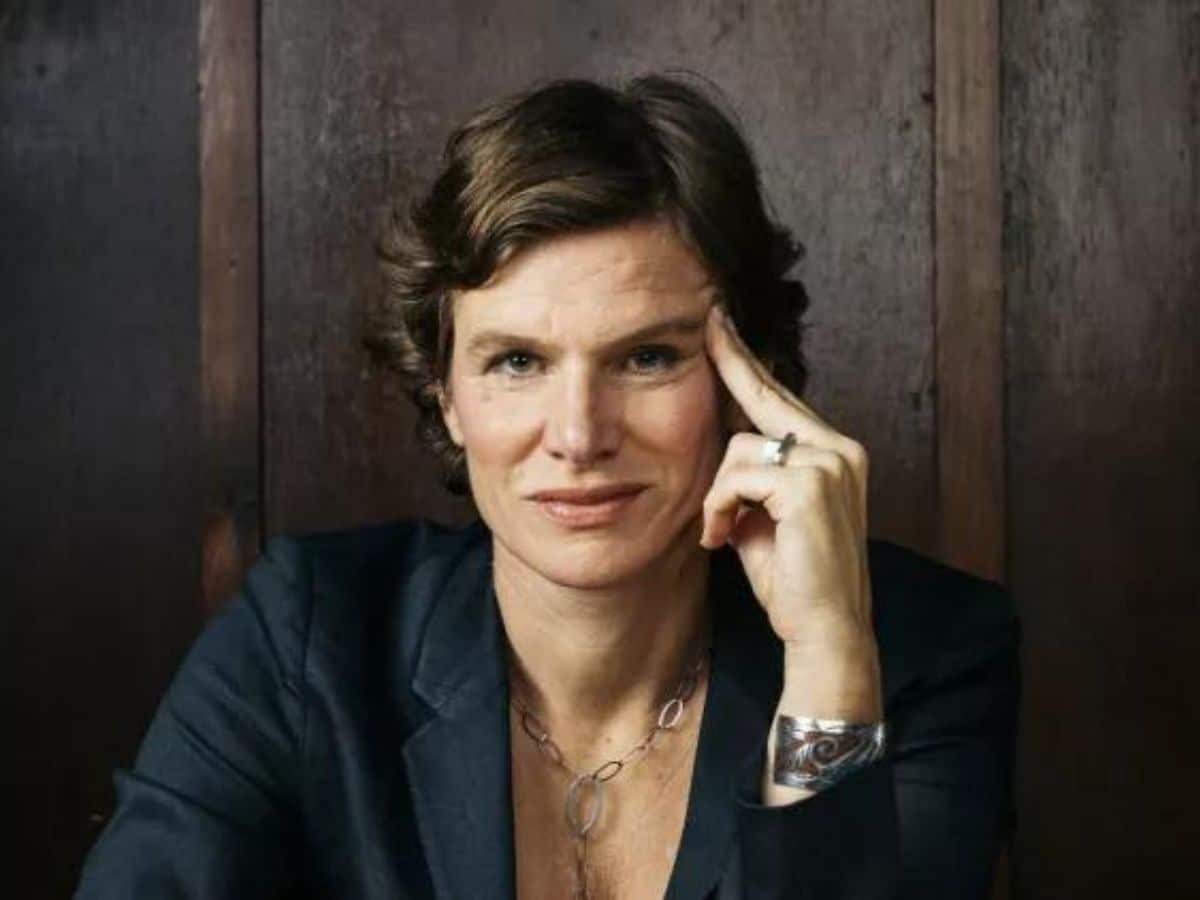
Mariana Mazzucato, professor at UCL, has shown how Labour should be less willing to simply hand out public money to corporations. Instead, she says that subsidies and grants should come with a guarantee of public benefit.
‘Conditionalities’ — types of public benefit
There are various possibilities for making the most out of public money when it comes to partnering with the private sector.
Mazzucato outlines them in four categories. The first, ‘access’, means requiring that the resulting products or services that the government puts money towards are affordable to the population. The second, ‘directionality’, means mandating that the company follows desirable goals such as green power. The third, ‘profit sharing’ means that the company returns some of the profits to the government. This could go further, with the government taking a stake in company. The fourth, ‘reinvestment’, means that some of the company’s profits are reinvested into socially desirable activities.
Of course, a government could use the mandate and popular support of a manifesto to at least take basic essentials into public ownership, to deliver common good without relying on corporations. But if large corporations still dominate some sectors, equitable partnerships could be the way forward.
Mazzucato — No nonsense approach
The government can already use legislation to ensure companies act in a certain way. Failing that, public-private partnerships can be useful.
Direct subsidies are not the only way the government hands out money to corporations.
22% of The Union of Shop, Distributive and Allied Workers receive universal credit (UC). That means the public purse is essentially subsidising the profits of companies like Tesco, which makes £6,150 of profit per employee.
This parliament, the government is providing £2.5bn to the steel industry. And that’s without taking a stake or profit-sharing with steel companies.
Although, the government has said that Tata Steel, which is receiving a £500m grant, will have to transition to Electric Arc Furnaces (EAFs) to address climate change or share its profits with the government. This is an example of a conditionality as Mazzucato outlines, but alone is quite the piecemeal approach to the neoliberal system.
Featured image via UCL

Today, Thursday 2 April, the Guardian ran an exclusive based on comments from the Prevent assistant commissioner, Laurence Taylor. He claimed that counter-terrorism scheme was being overwhelmed by a massive influx of referrals.
Trends indicate that Prevent will receive over 10,000 referrals in 2026. That represents a 33% increase compared to 2024. However, Taylor asserts that this doesn’t necessarily represent an uptick in the radical ideologies that Prevent was (nominally) set up to combat.
In fact, the majority of these referrals are apparently unrelated to extremist ideologies. Instead, they’re issued over concerns about people becoming interested in violence. As such, Taylor claims that Prevent’s time is being wasted, leaving it less able to deal with actual threats.
We at the Canary might phrase this another way. That is, the UK has invested so much in the very idea that (Muslim) terrorism is the greatest threat to our safety that we’ve actively started to damage the capacity to respond to non-terror threats.
‘Violence-fascinated individuals’
Back in July, interim independent Prevent reviewer David Anderson issued a report which responded, in part, to the scheme’s (mis)handling of the cases of Axel Rudakubana and Ali Harbi Ali.
The teenage Rudakubana murdered three young girls and wounded eight other people during his attack on a dance hall in Southport in 2022.
Ali was determined to have been motivated by Islamist ideology. However, Rudakubana displayed no clear motive, and was determined to have been driven by no fixed ideology. Anderson was appointed to:
identify remaining gaps or shortcomings that require further improvement and assure action to address them.
Released last July, the Anderson report stated that:
Several years before the attacks, both the perpetrators had been referred by their schools to Prevent … Prevent’s Channel programme for early interventions had the capacity to address concerns of the kind that were raised in these referrals. But in neither case did it do so.
In fact, Prevent declined to take on Rudakubana’s case three times. As such, Anderson recommended that Prevent’s remit be expanded radically to include non-terror threats. Alternatively, he also suggested that the government create a separate scheme to deal with non-ideological ‘violence-fascinated individuals’ (VFIs).
Prevent — ‘Overwhelmed with referrals’
Another report into the Southport attack is scheduled for release later this month. It’s expected to provide a damning indictment of local authorities, health services, and of course, Prevent itself.
After the attack, Prevent referrals started to rise dramatically. However, more than 50% of the individuals concerned had no clear ideological motivation. Assistant commissioner Taylor pinned this on the fact that there’s simply nowhere else to report these kinds of concerns.
However, he also claimed that this volume of non-terror referrals:
increases the risk of us not spotting somebody that is … because the system is overwhelmed with referrals.
He went on:
The challenge we have in the Prevent system is there is no triage that sits above it, so Prevent currently is the only bucket into which all of these referrals can sit.
We see people with material from Isis and neo-Nazis. We see people watching beheadings and school shootings. We see the gamification of that. So it’s people who are just absorbing horrible stuff that is creating concern for the people who refer them, but they’re not motivated by an ideology specifically, ie extreme rightwing or Islamist.
‘I wouldn’t like to say’
Taylor then rattled off increasing threat levels from states such as Iran and Russia, along with terror groups like Daesh. However, when faced with the question of whether Donald Trump and the American far-right was having a polarising effect, he suddenly became reticent to make a political statement.
Rather, per the Guardian, he characterised Trump as “one of several factors behind rising tensions”:
We’ve seen for a number of years an increasing polarisation, without doubt. You only need to look at the level of protest in London and the diversity of protest in London to see how many different views there are …. Whether you could directly attribute that to the US and Trump, I wouldn’t like to say.
I think there are many, many things at play here, of which that is but one.
If that isn’t the UK justice system’s attitude to ‘ideology’ in a nutshell, we don’t know what is. Is a fascist in the White House causing an uptick in radical ideology? Who’s to say? But look over there at the protesters!
Prevent, despite ostensibly being set up to target all extremist ideology, has disproportionately targeted Muslims from its outset. In fact, hundreds of babies and toddlers have been referred to the scheme, overwhelmingly due to “Islamist concerns”.
In 2022, the Shawcross review even had the nerve to call for a renewed focus on Islamic extremism, calling the definition of neo-Nazism has “expanded too widely”.
And now, we’re being told that non-ideological motivations are falling through the cracks precisely because of the state’s obsession with terrorist ideology? And, in fact, we have no real mechanisms in place for concerns of non-terrorist violence?
If the UK were any less Islamophobic, there’d be a lesson in all this. Pity, that.
Featured image via the Canary
Jeremy Corbyn-led Your Party won’t be fielding councillors in the upcoming local elections. They will, however, be backing various independents. Now, we’re learning such independents could include ex-Tory councillors:
‼️BREAKING | Your Party’s candidates for 2026 include three councillors who were Conservative members as recently as January 2026
Gaz Ali, Amo Hussain, Izzy Hussain all sat as Tories on Walsall Council until Jan ’26. Now backed by Corbyn.
(Leaflet edited to hide phone numbers) pic.twitter.com/azYoWufF0a
— Stats for Lefties 🍉🏳️⚧️ (@LeftieStats) April 2, 2026
“Endorsed by Jeremy Corbyn”
One thing to note is that the above flyer states “endorsed by Jeremy Corbyn” rather than ‘endorsed by Your Party‘. Corbyn is free to support whoever he likes, but as the party’s parliamentary leader, people will interpret his endorsement as the position of Your Party.
The endorsement was first highlighted by the Green Party’s Mish Rahman:
the candidates in my area are 3 deselected Tory cllrs, all cabinet portfolio holders part of the local Tory administration lol
They have moved wards as indys and are standing against me in the same ward. pic.twitter.com/b4Em7up7Ur— Mish Rahman (@mish_rahman) April 2, 2026
Rahman was a Labour NEC member between 2020 and 2024. When defecting to the Greens in January 2026, he said:
Politics must be about clarity and courage.
We are facing a convergence of crises: the rise of the far right, a cost of living emergency pushing working-class people to the brink and civil liberties eroded by successive governments. These are not abstract threats, they are lived realities for millions.
Today I have joined The Green Party because it is prepared to confront these challenges honestly: to defend democracy, stand up for social justice, and recognise that economic fairness and environmental responsibility are inseparable.
Earlier today (2 April), we reported on Your Party’s plans for the local elections:
As party structures continue to develop, Your Party will support around 250 candidates across England. The vast majority of these will be standing as Independents or for allied local community parties.
Your Party targets
Key targets for allied groups include:
- Tower Hamlets, run by Lutfur Rahman’s Aspire since 2022.
- Redbridge (see below).
- Newham, where the Newham Independents Party has recently won multiple by-elections.
- Bradford, where Labour’s support has been in massive decline.
Later in the day – and after the Mish Rahman tweet – New Statesman’s Ava-Santina posted that Walsall is in the mix too:
NEW: Your Party unveil their “get Labour out” local election strategy.
Full list of YP candidates coming later today
– Walsall
– Bradford
– Southport
– Oldham
– RedbridgeCorbyn: “These elections are the beginning of the fightback against austerity, privatisation and fear.
— Ava-Santina (@AvaSantina) April 2, 2026
This could be ex-Tories highlighted above, or it could be the ex-Labour independents who joined Your Party last year.
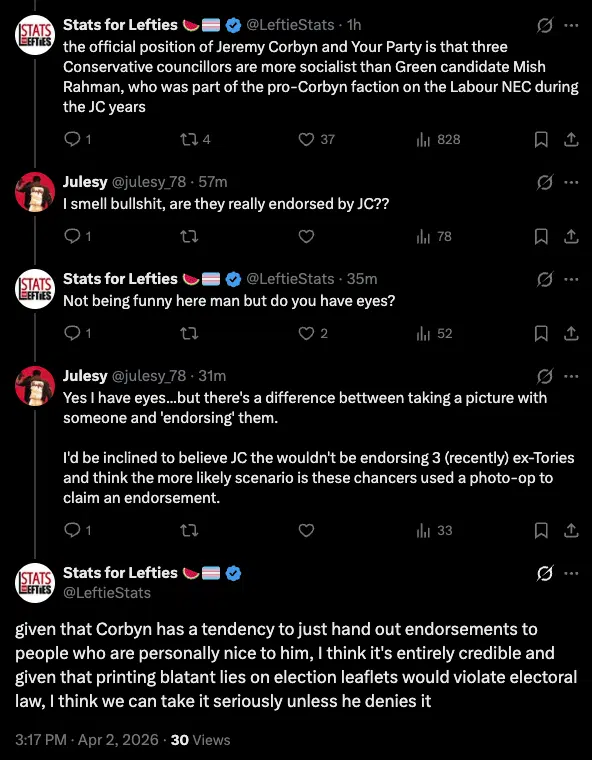
Stats for Lefties engaged in the following discussion on whether the endorsement is real (we’ve got to admit; we do keep rubbing our eyes and glancing back at it):

People outside Your Party have reacted as follows:

Independents
As reported by Birmingham Live, Gaz Ali and Amo Hussain were actually deselected by the Conservatives. In other words, if they didn’t go independent, they couldn’t have defended their council seats in the upcoming local elections.
In a statement on why the three men subsequently quit the Conservative Party, they said:
Our decision is driven by a number of factors. First and foremost is the treatment of several of our colleagues within the Aldridge and Brownhills Conservative Association. The exclusion of good, hard-working councillors, individuals who have given years of loyal service, has been deeply troubling.
In particular, the failure to approve respected councillors such as Keith Sears, who has dedicated over 50 years of service to Walsall and to the Conservative Party, is something we cannot overlook.
We are also increasingly concerned about the direction of the national Conservative Party. The tone and rhetoric emerging from parliamentary leadership appear divisive and risk marginalising communities.
We have always believed that politics should bring people together, and that the party should be inclusive and unifying. Regrettably, this is no longer a position we feel able to align ourselves with.
Ah yes – the Conservative Party – those great unifiers of modern Britain.
Who could forget how unified we felt when we suffered through the devastating austerity cuts of the 2010s – cuts which didn’t touch the rich even slightly.
It just doesn’t wash, does it?
Corbyn Endorsing Deselected Tories as “Independent Socialists” is no surprise, since we’ve already seen a near year of the “Social Conservative” shite from His Party.
Honestly, he should have just ran for London Mayor & Kept whatever respect he had left. He could have even won. https://t.co/VieTmnFXxi— Michael Walsh (@thatbloodyMikey) April 2, 2026
The big question is this: would the trio have quit if not for being deselected?
The answer is ‘we don’t know’.
Forgetting that, Corbyn and Your Party should have a policy of never endorsing anyone who’s ever had anything to do with the Tories.
And never in a million years did we think we’d need to explain that.
How did it come to this?
It’s not controversial to say Your Party has not turned out how many hoped it would.
Despite attracting 800,000 signups upons its announcement, the party would go on to secure a fraction of that number once it opened up to members. Since then, the party has failed to place in most polls, while the Green Party has captured much of Your Party’s initial enthusiasm.
There are good people in the party, and we know that many of them are struggling to process this latest development.
That’s quite enough for me, I think. What a massive disaster this has all been. Shame on those who squandered this opportunity to build a genuinely decent political alternative. https://t.co/G8Z6DHUCfj pic.twitter.com/eWWBi4ofpR
— chloe (@Dykeocletian) April 2, 2026
Solidarity with all those who just wanted Your Party to be a clear alternative to Labour and the Tories.
We contacted Your Party to confirm the endorsement, but had not heard back at the time of publication.
Featured image via X/Twitter

A UK airline has permanently cancelled a flight due to pressure from the energy crisis caused by the US attack on Iran. Skybus operated an internal flight between London and the Cornish town of Newquay. The firm’s cancellation could be the first of many as air travel is hit by increasing pressure.
The National reported on 2 April:
Skybus operates daily flights between London Gatwick and the seaside town of Newquay.
The service was due to end on May 31, however the airline has announced that it will be ending now – nearly two months earlier than planned.
Adding:
The airline’s managing director Jonathon Hinkles said it was due to various reasons including the increase in fuel costs.
Hinkles said:
At a time of great economic uncertainty and steps being taken to conserve energy worldwide, it is neither environmentally nor economically sound for us to continue flying with vastly reduced passenger numbers.
It does beg a question: who the hell flies from London to Cornwall?
UK — Widespread price hikes
But bigger providers say they are under pressure too. Ryanair CEO Michael O’Leary said:
We don’t expect any disruption until early May, but if the war continues, we do run the risk of supply disruptions in Europe in May and June and obviously we hope the war will finish sooner than that and that the risk to supply will be eliminated.
The UK has been hit in other ways too. UK Pm Keir Starmer has tried to allay fears, but Brits are feeling the impact:
Families with a 55-litre diesel car face paying more than £100 at the pump for the first time since December 2022.
LBC reported on 23 March:
The Prime Minister chaired the meeting on Monday afternoon, during which the Chancellor spoke about steps she will set out in a statement to Parliament tomorrow.
Ms Reeves, Governor of the Bank of England Andrew Bailey and Energy Secretary Ed Miliband gave updates on the situation and stressed that de-escalation and ending the Iran conflict was “the best thing we can do for the economy”, Downing Street said in a readout.
It is unclear when the war will end and on what terms.
US-Israel attacked Iran first on 28 February without provocation. Iran was offering unprecedented concessions in negotiations at the time. The Pentagon has since stated there was no imminent threat from Iran. And the UN’s atomic watchdog, the IAEA, has said there is no evidence Iran was developing a nuclear weapon.
The US has achieved none of its original war aims. Iran predictably closed the Straits of Hormuz, a vital oil channel, once attacked – creating a global energy crisis. Far from being defeated, Iran has said the war will continue until “the enemy’s inevitable and permanent humiliation, disgrace, regret, and surrender”. Trump came to power on an anti-war ‘America First’ ticket. He now faces worldwide humiliation.
Featured image via Aerospace Global News
Canberra urges Easter travel as fuel shortages hit rural Australia

Netflix Confirms New Price Hike, and Its 2026 Plans May Explain Why

OMG XRP JUST GOT UPGRADED!??! (It’s about to get REAL)


-

 NewsBeat1 day ago
Steven Gerrard disagrees with Gary Neville over ‘shock’ Chelsea and Arsenal claim | Football
-

 Business1 day ago
No Jackpot Winner and $194 Million Prize Rolls Over
-
Entertainment4 days ago
Fans slam 'heartbreaking' Barbie Dream Fest convention debacle with 'cardboard cutout' experience
-

 Fashion8 hours ago
Weekend Open Thread: Spanx – Corporette.com
-

 Crypto World2 days ago
Gold Price Prediction: Worst Month in 17 Years fo Save Haven Rock
-

 Tech5 days ago
The Pixel 10a doesn’t have a camera bump, and it’s great
-
 Entertainment6 days ago
Lana Del Rey Celebrates Her Husband’s 51st Birthday In New Post
-
Crypto World4 days ago
Dems press CFTC, ethics board on prediction-market insider trades
-

 Tech5 days ago
Avatar Legends: The Fighting Game comes out in July and it looks pretty slick
-

 Sports3 days ago
Tallest college basketball player ever, standing at 7-foot-9, entering transfer portal
-

 Tech4 days ago
EE TV is using AI to help you find something to watch
-

 Fashion6 days ago
Amazon Sundays: Soft Spring Layers
-

 Business2 days ago
Login and Checkout Issues Spark Merchant Frustration
-

 Fashion7 days ago
When Evening Dressing Gets Colorful for Spring
-

 Tech6 days ago
Elon Musk’s last co-founder reportedly leaves xAI
-

 Tech4 days ago
How to back up your iPhone & iPad to your Mac before something goes wrong
-

 Tech4 days ago
Apple will hide your email address from apps and websites, but not cops
-

 Politics4 days ago
Should Trump Be Scared Strait?
-

 Crypto World4 days ago
U.S. rule change may open trillions in 401(k) funds to crypto
-

 Tech4 days ago
Flipsnack and the shift toward motion-first business content with living visuals
You must be logged in to post a comment Login