Connect with us

Politics

Labour doctor by-election poll

Published

on

Labour doctor by-election poll

On 24 February 2026, a poll came out suggesting Labour, the Green Party, and Reform are neck and neck in the Gorton by-election.

Throughout the race, Labour have claimed they’re the only ones who can beat Reform. As such, it’s not surprising to see them report on the poll like this:

Momentum

For reference, here’s what the poll looks like with the Greens and other parties included:

Labour have created a paradox for themselves here.

On the one hand, they want you to believe this poll is accurate; on the other, they want you to think they’re the only ones who can beat Reform.

Advertisement

Which is it?

The poll also shows something else, and it’s that the Greens have the momentum.

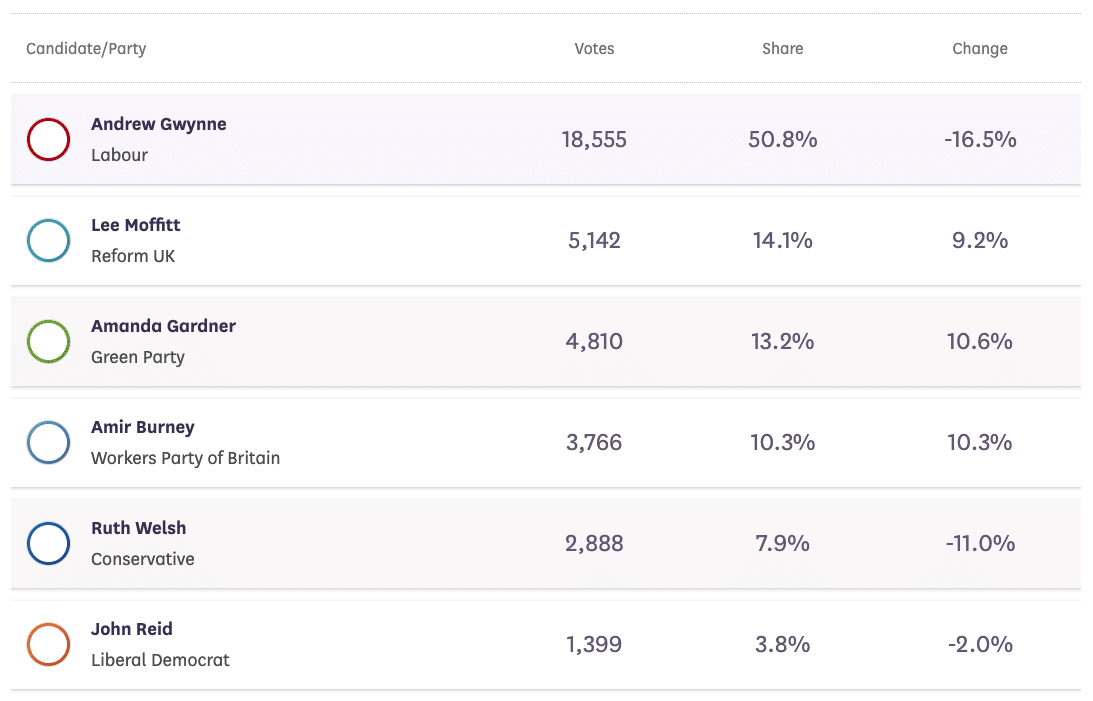
This is what the vote share looked like in the 2024 election:

Should the Opinium poll play out it would mean the parties experienced the following shifts:

Advertisement
  • Greens: 10% <<< 28%
  • Reform:  9% <<< 27%
  • Labour: 50% >>> 28%

Obviously this means voters have abandoned Labour to vote Green (or Reform). So at this stage in the race, which of the two options do you think is most likely?

  • Seeing the way the wind is blowing, more voters abandon Labour for the Greens.
  • The voters who abandoned Labour decide to un-abandon them despite polling showing the Greens seem most likely to win.

People clocked what Labour are up to anyway, including former Canary contributor Curtis Daly:

All to play for

Journalist Barry Malone said this polling may clarify why Starmer turned up to support the Gorton & Denton race:

We noted yesterday that it was strange for Starmer to show up given his record unpopularity. He’s so unliked, in fact, that he tends to turn voters against whatever he supports, which is why we covered it as follows:

Clearly, Starmer thinks there’s a shot at victory, and he wants to pretend it came because of him – not despite of him.

Advertisement

If the Opinium poll is correct, Labour are doing better than we expected. At the same time, this is clearly a party in decline. And if they do lose, expect the rumours of a leadership challenge against Starmer to increase.

Featured image via Barold

Advertisement

Source link

Continue Reading
Click to comment

Leave a Reply

Your email address will not be published. Required fields are marked *

Politics

Greens are ‘hammering’ Labour in Gorton & Denton

Published

on

Greens are ‘hammering’ Labour in Gorton & Denton

According to an unnamed cabinet minister, the Greens are “hammering” them in Gorton & Denton. This is a stark admission from a party insider, demonstrating that they gravely underestimated the Greens:

Hammered

The above post is from the Times‘ political editor Steven Swinford. Perhaps the most interesting part is this quote from an unnamed ‘senior cabinet minister’:

The Greens are whipping up hatred and deliberately raising the salience of Gaza. They’re hammering us. They’re a totally different party to the one we thought they were. They’re just like Respect — it’s like fighting a by-election against George Galloway.

Just think about that.

Labour are upset that a rival party is highlighting an important issue that voters are justifiably upset about — said issue being that successive UK governments provided political and material support to a foreign nation committing a genocide.

What did they expect?

Advertisement

Well, we know what they expected, and it was to sweep the issue under the rug.

Under the duopoly of Labour and the Conservatives, there was always a tacit agreement that the two parties and the establishment media would ignore certain issues. The problem is that between parties like the Greens and independent outlets like the Canary, there is now a voice for the legitimate grievances people feel.

Eleanora O’Cualáin (Stats for Lefties) said the following:

The previous Green Party administration ‘hung candidates out to dry’ for opposing Zionism and genocide. The Canary writer Maddison Wheeldon was one such candidate, and she wrote Polanski ‘must hold firm’ if the failed centrists try to reassert control.

Greens are appealing to voters

Swinford also reported:

Hannah Spencer, the Green candidate, has distributed leaflets in Gorton & Denton in Urdu, saying that voters should “make Labour pay” and accusing them of pushing “racist, dog whistle gutter policies”

On the leaflet, she is wearing a keffiyeh, the Middle Eastern scarf commonly associated with Palestine

Advertisement

On Monday, the party circulated a campaign video in Urdu accusing Matt Goodwin, the Reform UK candidate, of being someone who will “fuel the flames of Islamophobia”

The video shows Starmer shaking hands with Narendra Modi, the Hindu nationalist prime minister of India, and also shows David Lammy, the deputy prime minister, shaking hands with Binyamin Netanyahu, the prime minister of Israel. The video cuts to aerial footage of Gaza as Spencer, speaking in Urdu, says: “Politicians aren’t working for us.”

Labour want you to believe it’s unfair to speak to the issues voters care about; that it’s wrong to worry about anything besides the establishment-approved problems they permit us to consider.

Well, we’re sorry, Labour, but those days are over.

Advertisement

Featured image via Barold

Source link

Advertisement
Continue Reading

Politics

Politics Home | Prevention of Violence Against Women and Girls Awards: Nominations Now Open

Published

on

Prevention of Violence Against Women and Girls Awards: Nominations Now Open

Today marks the launch of the Prevention of Violence Against Women and Girls Awards, recognising and celebrating individuals, teams and organisations across the UK working to prevent abuse and support victims and survivors.

With this issue high on the national agenda, the awards, produced by Total Politics, provide a timely platform to recognise leadership, innovation and sustained commitment. 

Advertisement

The awards aim to shine a spotlight on those who champion change, challenge injustice and provide vital support in communities across the country. From frontline services and charities to policymakers and campaigners, the Prevention of Violence Against Women and Girls Awards will honour the leadership and innovation driving progress in this critical area. 

The 2026 awards are proudly sponsored by TSB, reflecting a shared commitment to supporting survivors, raising awareness and driving meaningful change across sectors. Organisations and individuals are invited to submit entries highlighting outstanding achievement, impactful initiatives and inspirational leadership in preventing violence against women and girls. 

Full details of the award categories and the nomination process can be found here.

Advertisement

Angus Parsad-Wyatt, Director of Political Engagement at Total Politics, said: “Through Total Politics and our media title The House magazine, we are proud to provide a national platform to recognise those leading work to prevent violence against women and girls. These awards shine a light on the individuals and organisations strengthening support, shaping policy and delivering vital services across the UK.” 

Kate Osiadacz, TSB Head of Responsible Business said: “Supporting the Prevention of Violence Against Women and Girls Awards reflects TSB’s commitment to helping people escape their abuser and access safety. Through initiatives like the TSB Flee Fund and the Safe Spaces available in our branches, we are working to provide practical and immediate support for those who need it most. These awards highlight the individuals and organisations whose dedication is driving real change, and we are committed to standing alongside them.” 

Those working across the sector are encouraged to nominate colleagues, volunteers, teams or organisations whose dedication and impact deserve recognition. 

Source link

Continue Reading

Politics

Politics Home | Labour And Greens Clash Over Betting Influence On Manchester By-Election Campaign

Published

on

Labour And Greens Clash Over Betting Influence On Manchester By-Election Campaign

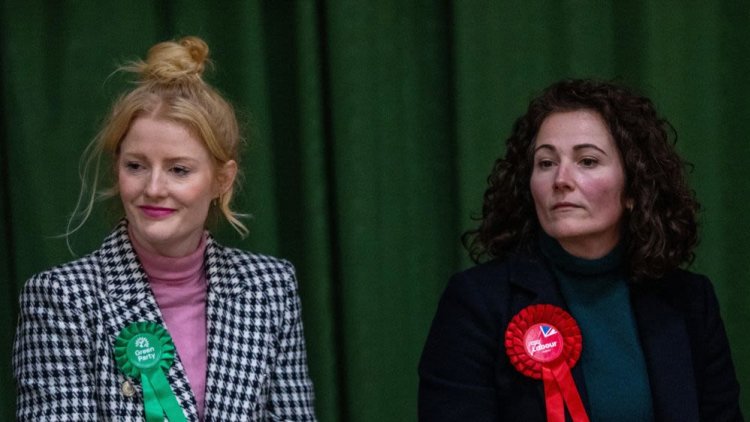
Hannah Spencer (Green Party) and Angeliki Stogia (Labour Party) candidates in the Gorton and Denton By-election (Alamy Live News)


4 min read

Exclusive: The Labour Party and the Greens have clashed over the influence of political betting on the eve of the Gorton and Denton by-election, triggering claims that the market should be regulated.

Advertisement

“It’s something that should be looked at,” a Labour Party source told PoliticsHome.

In response, a Green Party source said it was “utter desperation” from Keir Starmer’s party ahead of the high-stakes by-election.

The Gorton and Denton area in Greater Manchester has been represented by Labour for over a century, but a three-way battle has been underway for the seat since incumbent Andrew Gwynne resigned in January.

Advertisement

Labour and the Greens have been fighting to be seen as the party best-placed to stop Reform UK from winning the seat.

In the run-up to polling day on Thursday, bookmakers have tended to show the Green Party as the favourites to win the by-election, often with Labour trailing in third place behind Reform UK. 

Although Labour odds have shortened in the last 24 hours following Keir Starmer’s Monday visit to meet activists on the local campaign, there are concerns in Labour that a small number of big bets can easily change the narrative around a high-profile by-election such as this one.

A small number of large bets on a particular party can result in its odds narrowing significantly, which, in turn, could influence how voters behave when they reach the ballot box, especially if they want to vote tactically to stop a certain candidate.

Advertisement

This morning, former Green Party leader Natalie Bennett posted on X: “Not in any way endorsing betting, but it is an independent source of information for any voters uncertain about which way to go to stop Reform.”

In a recent letter to Green leader Zack Polanski, Labour deputy leader Lucy Powell wrote: “Can I just ask how you feel ethically about sharing betting odds on the election which are based on a couple of very suspect big money bets? 

“It doesn’t sit easily with me and I’m surprised by your association with big money election betting.”

Advertisement

A Labour source told PoliticsHome: “The small number of big money political bets we’ve seen in this campaign and their use in misinformation is of real concern. 

“It’s an easy way for opponents to cook the books and has provided ammunition to our opponents that isn’t based on any real evidence of what is happening in this seat. 

“It’s a straight fight between Labour and reform in Gorton and Denton, but dodgy bets could skew the campaign. It’s something that should be looked at.”

HuffPost reported earlier this month that a £90,000 bet had been placed on Green candidate Hannah Spencer winning the contest.

Advertisement

The Green Party has responded by accusing Labour of “playing politics” and “flapping around” ahead of the by-election result.

A Green Party spokesperson told PoliticsHome: “This is utter desperation. Labour are literally making stuff up when they know they’re losing. This is playing politics when they should be showing how they can make people’s lives better. 

“If Labour want to talk about gambling, though, it’s a shame it’s taken a few betting markets that have put Labour behind the Greens for the Labour Party to finally call for additional regulation on gambling after the weak changes they have made to date. 

“Until now, Labour has wanted to prioritise ‘growing the gambling industry’, which means policies that encourage more gambling. We welcome their latest U-turn, although it will probably upset their gambling industry donors. 

Advertisement

“Labour are flapping around because they know the Greens are the only party that can beat Reform tomorrow.”

There is a feeling that the by-election could be very closely fought, potentially requiring a recount. An Opinium poll published on Tuesday put Labour and the Greens level on 28 per cent, with Nigel Farage’s Reform UK on 27 per cent. 

Reform’s hopes of victory in Gorton & Denton hinge on the progressive vote being evenly split between the other two parties.

The parliamentary by-election in Runcorn and Helsby in May last year was decided by just six votes. It saw Reform UK win its first MP in the North West.

Advertisement

At the Welsh Parliament’s Caerphilly by-election later in the year, in October, Plaid Cymru ended Labour’s 100-plus-year-long representation of the area. The governing party was pushed into third place, with Reform UK coming second.


Source link

Continue Reading

Politics

The Claudia Winkleman Show: BBC Announces Start Date And Celebrity Line-Up For First Episode

Published

on

The Claudia Winkleman Show: BBC Announces Start Date And Celebrity Line-Up For First Episode

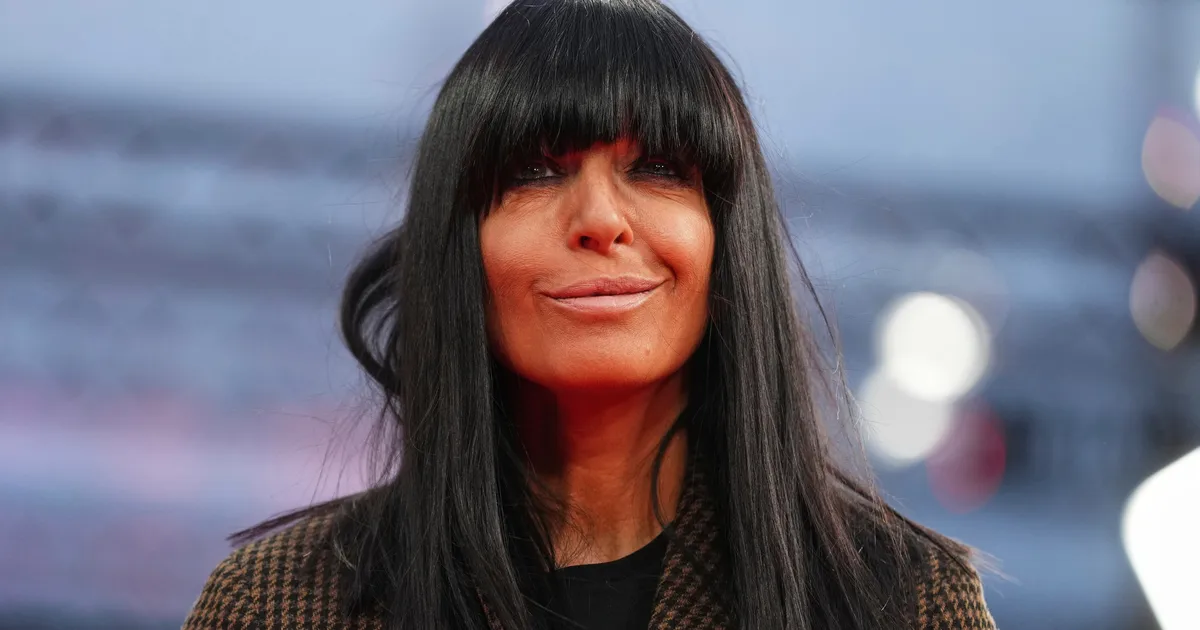
The first guests to appear on Claudia Winkleman’s new BBC talk show have been unveiled.

Back in December, it was confirmed that Claudia had landed her own celebrity chat show, from the makers of The Graham Norton Show, after winning over viewers when she filled in for the Irish presenter earlier in 2025.

On Wednesday afternoon, the BBC announced the start date for The Claudia Winkleman show – and fans don’t have long to wait.

Advertisement

When does The Claudia Winkleman Show start – and which celebrities will be interviewed?

It’s been confirmed that the inaugural episode of The Claudia Winkleman Show will premiere on Friday 13 March at 10.40pm on BBC One – with a star-studded line-up of guests.

Joining Claudia for her first ever show will be Wicked star Jeff Goldblum, British screen treasure Jennifer Saunders, three-time Emmy nominee Vanessa Williams and comedian Josh Widdicombe.

The BBC previously revealed that the initial series will run for a total of seven episodes.

Advertisement

Self-deprecatingly as ever, the Traitors enthused (sort of…) last year: “I can’t quite believe it and I’m incredibly grateful to the BBC for this amazing opportunity.

“I’m obviously going to be awful, that goes without saying, but I’m over the moon they’re letting me try.”

Last year, Claudia and her Strictly Come Dancing co-host Tess Daly announced they were both stepping down from the long-running BBC reality series.

Since then, she’s fronted the hugely successful fourth season of The Traitors, with a second run of the show’s celebrity counterpart due to premiere in the autumn.

Advertisement

Claudia will also present the fourth season of the cult Channel 4 talent search The Piano later this year, alongside returning judges Mika and Jon Batiste.

Source link

Advertisement
Continue Reading

Politics

Punch The Monkey: Why Plush Toys Help Humans And Animals

Published

on

Punch The Monkey: Why Plush Toys Help Humans And Animals

Primate expertise provided by Dr Luke Duncan, a postdoctoral research fellow, primatologist, and part of the University of Warwick’s ApeTank. Therapy comment by relationship therapist and author at Passionerad, Sofie Roos.

If you’re 1) on social media and 2) have something resembling a heart, chances are it’s been broken by the Japanese macaque, Punch, from Ichikawa City Zoo in Japan.

The adorable monkey, whose mother abandoned him, has gone viral for clutching an IKEA orangutan plush to help manage his feelings of abandonment (the burnt orange stuffed toy has since sold out in multiple stores).

But why do animals, including humans, so often turn to stuffed toys in our times of need, or as a more everyday source of comfort?

Advertisement

One study suggests that dogs can become almost “addicted” to their toys, which another paper says may boost their welfare. Over a third of adults sleep with a plush every night.

Here, we spoke to primate expert Dr Luke Duncan and therapist Sofie Roos about the “cuddle therapy” a variety of species can get from stuffed toys.

Emotional support plushes are pretty common among adults, and could be helpful for distressed animals

Punch’s toy orangutan was given to him to help him handle the loss of his parent. According to Dr Duncan, that move makes sense.

Advertisement

“Young primates are biologically programmed to cling to their mother ― it’s a normal and essential part of emotional and psychological development,” he told us.

“Harry Harlow’s foundational research in the 1950s and 1960s showed that infant rhesus monkeys overwhelmingly preferred a soft cloth surrogate over a wire one that provided milk, demonstrating that tactile comfort is a powerful driver of attachment behaviour in infants.”

So, while the goal should always be to provide a “safe, living social partner of the same species,” in a pinch, “A soft surrogate, in the form of a plush toy, can… provide meaningful comfort for an orphaned infant primate.

“While a plush toy cannot replace a real mother, it may help alleviate distress in the short term.”

Advertisement

And Roos said that while humans – and almost certainly other animals – know our toys aren’t really alive, they can “work as a ‘transition object’, which… stands as a symbol for safety when an important person is no longer with us”.

Among adults, she added, stuffed toy use offers a kind of “cuddle therapy”, which provides a combination of physical touch and pressure that a lot of animals find soothing.

“Physical touch, [even] from an object, can make our body calm and feel safe.”

Then, there’s the fact that, generally, toys don’t leave us.

Advertisement

“For people who lose someone important, and have wounds connected to abandonment and an insecure attachment, the cuddly toy can give a feeling of not being completely alone, which for some becomes a saviour,” the therapist said.

“We’re born with a… need to… belong, and this need stays with us until the day we die. A stuffed animal doesn’t get any less good at giving us this just because we grow older.”

Perhaps that’s why 44% of adults hold on to their childhood toys.

The therapist doesn’t think it’s that different to using meditation apps

Advertisement

Lots of animals, including humans, “are born social, and seek closeness, warmth and touch. A cuddle toy can work as a complement to give that safety, care and attachment we so strongly seek, especially if we feel lonely,” said Roos.

This is not unlike what may be happening with Punch: Dr Duncan shared, “Physical contact with a soft object can help regulate [primate] stress responses and provide a sense of security during a vulnerable period”.

Roos continued, “Many also connect the cuddle toy with childhood, a time most look back at as easier and more protected, where the stuffed animal can stand as a symbol for that time when we felt cared for, comforted and soothed in another way.”

In fact, the therapist doesn’t think relying on a stuffed toy for “cuddle therapy” is all that different to other forms of self-soothing.

Advertisement

“When looking at what the cuddle toy does for you, it’s not far away from what using mindfulness apps, yoga, stress balls or weighted blankets do – the stuffed animal is just less socially accepted, even though in my [opinion], it works better than many other more accepted methods of dealing with stress, loneliness, overthinking and anxiety.”

Source link

Advertisement
Continue Reading

Politics

Simon’s Sketch: Punch the Monkey Tries on a Gorilla Suit for PMQs

Published

on

Simon’s Sketch: Punch the Monkey Tries on a Gorilla Suit for PMQs

What a sight the Treasury bench made. The lost souls sat in a particular purgatory, not actually dead but lacking any vital signs. Rusty Reeves was possibly on the edge of another melting moment (it was too much to hope for). Lisa Nandy, setting the theme, stared into Ed Miliband’s abyss. Who knows what horrors they…

Source link

Continue Reading

Politics

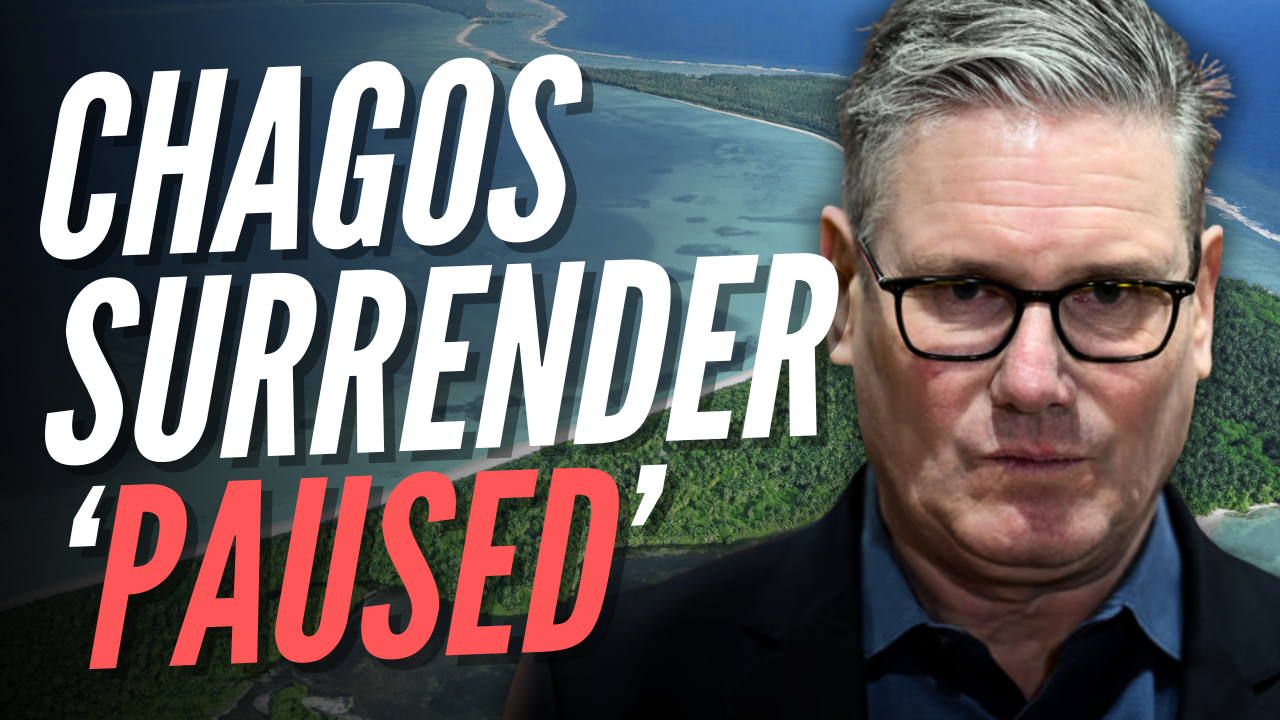
Chagos Surrender Paused

Published

on

Chagos Surrender Paused

Later in Hamish Falconer’s statements to the Commons, the crucial line, that US concerns are “very significant“: “We are now discussing those concerns with the United States directly. We have a process going through Parliament in relation to the treaty. We will bring that back to Parliament at the appropriate time. We are pausing for…

Source link

Continue Reading

Politics

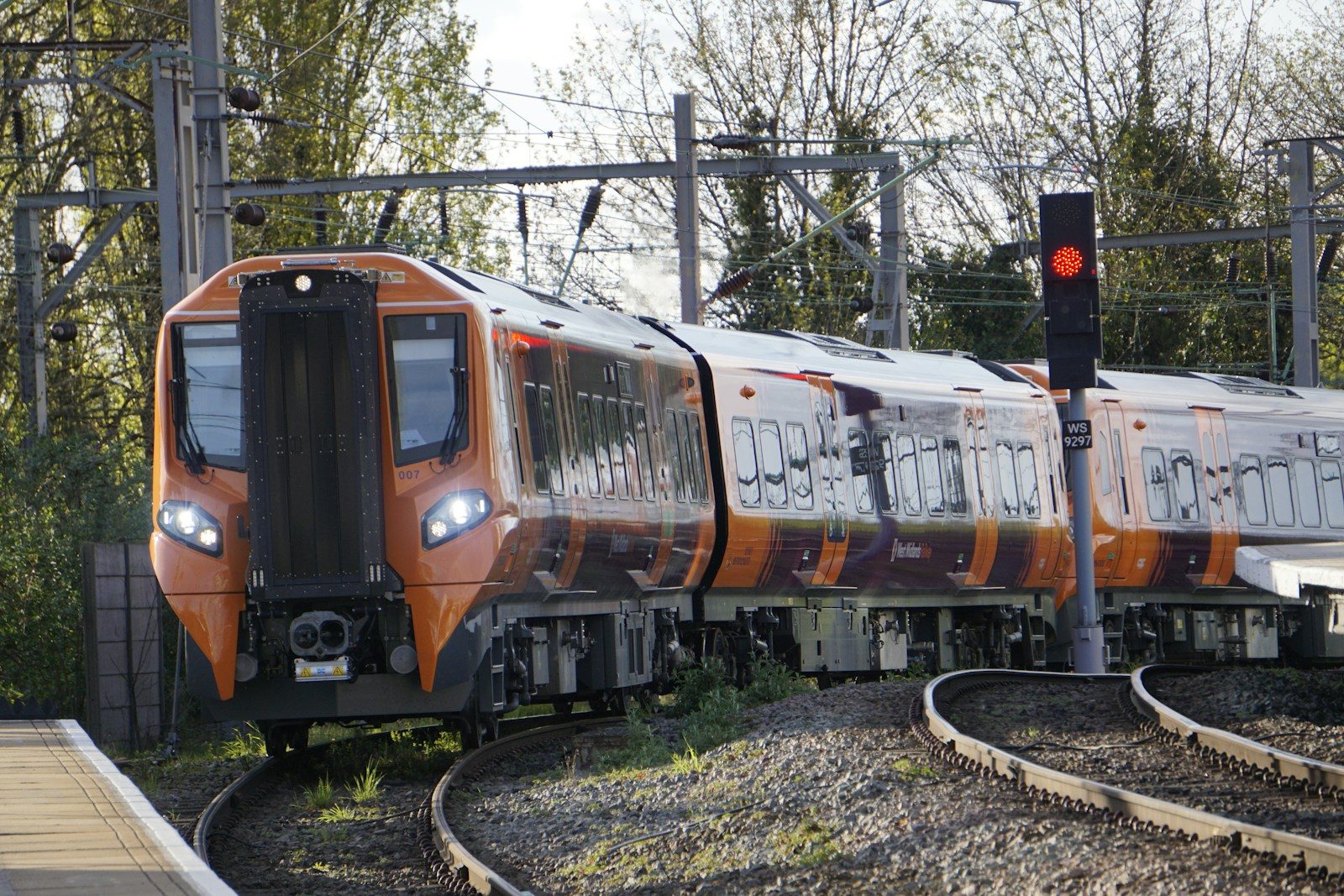
Jerome Mayhew: The Government’s Railways Bill is coming down, and potentially off, the tracks

Published

on

Jerome Mayhew: The Government's Railways Bill is coming down, and potentially off, the tracks

Jerome Mayhew is Shadow Rail Minister and MP for Broadland and Fakenham.

Labour are botching the rollout of their Railways Bill, no matter whichever way you come at it.

Instead of siding with passengers to break down barriers to competition, they have backed their union paymasters with wholesale nationalisation. Labour should be reshaping rail to encourage private investment into improved infrastructure and rolling stock in order to refine competition and improve services for passengers.

Sadly for Labour, it doesn’t matter that there isn’t a single nationalised industry that is known for management dynamism (you try it); it doesn’t matter that privatisation has increased passenger numbers from 735m journeys a year to 1.75bn and counting; it doesn’t matter that privatisation has poured £6 billion since 2015 into upgraded rolling stock and improved services. What matters to this Labour government is the triumph of socialist dogma and union backscratching over passengers, and we will all pay the price.

Advertisement

The problems don’t stop with nationalisation. The Railways Bill creates Great British Railways, lumping Network Rail and nationalised train operating companies together. As a part of this Great British Railways will also take on much of the role of the independent regulator as well, marking its own homework and creating a massive conflict of interest.

GBR will be the decision maker for all applications for access to the network – from rail freight companies or other Open Access operators. In effect, GBR will be asked to decide if it wants competition. And get this, there will be no right of appeal against its decision. A blatant conflict of interest.

It’s the same with independent retailers, like Trainline, GBR is planning to go head-to-head with ticketing services, but Labour are set to prevent a level playing field for competition by restricting access to service data.

The wider rail industry is, rightly, deeply concerned about the government’s approach. Freight operators have stated, “We are really concerned about the scope and definition of the appeals function as proposed in the Bill”. Trainline has told the Government, “There is a need to be certain that the retail part of GBR will compete in the market in the same way as everybody else”.

Advertisement

And what about passengers? The government is making a song and dance about a new Passenger Council, which will monitor the performance of GBR. You might ask, so what? If it finds fault in GBR this Passenger Council has no enforcement powers. All it can do is provide a report to the, much diminished, Office of Rail and Road, which can ignore it or start another investigation of its own, creating confusion and delay – trademarks of this Government, this time by design. The Transport Select Committee has published a report listing its concerns about the Bill, recommending several amendments including increasing the bite of the Passenger Council.

Even disadvantaged groups are being ignored.

Whilst fare discounts for children, the elderly and the disabled are protected, Labour voted ten times against Conservative proposals for similar protection for Veterans’ and Armed Forces Family railcards as well as the Young Persons’ railcard. The minister said they have ‘no plans’ to reduce the discounts, and yet that is what they said about raising taxes before the general election. It’s what they said about the family farm tax and business property relief. It’s what they said about winter fuel payments.

Amendments to rectify these glaring errors? All voted down by Labour. In fact, the Conservative team tabled more than 180 amendments to the Bill to stand up for passengers, to give the Passenger Council proper enforcement powers, to protect the independence of the economic regulator, to give a genuine right of appeal against self-service GBR decisions, and many, many more.

Advertisement

The government is paralysed by chaos at the top, with a Prime Minister without the backbone to stand up to the rail unions and fight for consumers rather than the producer interest. Nationalisation is already making things worse, with discount fares already being removed in the name of “ticket simplification” and delay-repay compensation mooted to be reduced in the name of “standardisation”. Passengers get what they’re given with nationalisation, whilst train drivers get 15 per cent pay rises with no strings attached.

There is still time for genuine change to this bill, both in the Commons and then in the Lords. But the Government needs to stop and listen to the concerns of the industry. So far, we have seen no sign that they are listening at all.

Source link

Advertisement
Continue Reading

Politics

Rochelle Blakeman: The populist right likes lecturing about fertility and childlessness. Conservatives should avoid it

Published

on

Rochelle Blakeman: The populist right likes lecturing about fertility and childlessness. Conservatives should avoid it

Rochelle Blakeman is a public affairs professional, a writer and Conservative supporter.

In 2023, the global fertility rate (GFR) fell to 2.2 children per woman, below the replacement rate of 2.3. In England and Wales that same year, the TRF was at the lowest value on record – 1.44 children per woman.

In contrast to 20th century scaremongering about there being “too many people” on the planet, demographers are now concerned about a population implosion. Whilst politicians of all colours are grappling with this, the populist-right has been particularly broody.

Notably, The Independent recently unearthed a 2023 Substack article by Reform’s Matt Goodwin in which he explored ideas influenced by demographer Paul Morland on how to solve Britain’s falling birth rates. These included a “negative child benefit tax” on “those without offspring”, removing personal income tax for women with two or more children and establishing a “pro-family culture” by having a national day to celebrate families and parenthood. The paper later spotlighted a YouTube video in which Matt Goodwin said that “many women in Britain are having children far too late in life” and called on young women to be given a “biological reality check.”

Advertisement

Social conservatives may agree with Matt Goodwin’s sentiment, but I believe that the Conservative Party must resist the temptation to emulate a top-down, state-knows-best approach to fertility in the UK. This impulse would not only be ineffective at increasing historically low birthrates, but at odds with everything the Conservative party should stand for. Whilst the ideas in Goodwin’s Substack piece are not official Reform policy, the ideas should be challenged for the sake of argument to reiterate the importance of limiting state involvement in anyone’s personal business.

Kemi Badenoch has been effective in highlighting the Labour Government’s overreach and overspend, and so too should Conservatives be wary of the overreach and economic fantasy flirted with by Goodwin.

The prospect of a tax on the childless and scrapping income tax for those with two or more children would be inherently unfair, as the childless already contribute more to the public purse than they take out. In addition to not claiming child benefits, childless households have fewer members to use public services such as the NHS and state education. The working childless do, however, pay taxes, thereby supporting the public services that those with children likely utilise to a greater extent.

Far from creating a “pro-family culture” in Britain, Goodwin’s proposals would breed justified resentment among those with the misfortune to have such a tax imposed on them. Hard working people would be less able to enjoy their childfree years, with less disposable income to spend on holidays, hobbies or whatever else they pleased. And those aspiring to have children would have less to save up to achieve this goal, whilst watching their hard-earned money enable people who happen to already be parents reap the benefits of a disproportionate tax cut.

Advertisement

Aside from indulging in economic fantasy, pro-natalist populists make moralistic assumptions about having offspring which have no bearing in the messy, unpredictable real world. They imply that having or not having a child is a “choice”, as if akin to deciding which route to take on a morning walk.

It may be convenient to caricature the childless as having made a series of deliberate “choices” that enable them to live a “carefree” life. But many singletons have not consciously “chosen” to be without a partner. Many young professionals have not “chosen” to be trapped in high-pressured corporate careers with limited work life balance. People are not “choosing” to struggle to get on the housing ladder. Most poignantly, nobody “chooses” to be afflicted with a medical condition or fertility problems which may prevent them from having children.

And conversely, common knowledge reminds us that many people with children will not necessarily have planned to become parents at all.

These complex and deeply human factors highlight how flawed a reward-and-punishment approach to encouraging more births would be. It reveals the clumsiness of the populist tendency to blame low birthrates on lifestyle “choices” – usually gunning for women’s “choices” – disregarding the sheer element of luck that is involved in the panning out of anyone’s personal, romantic or family life.

Advertisement

The state has no place in the most personal and visceral aspects of our lives. Whilst low fertility rates do pose social and demographic challenges, these problems are surmountable without dictating to the public how we should live, and without making moral judgements about anyone’s reproductive proclivity.

Indeed, an IEA paper by family economist Clara E. Piano presents research which indicates that government intervention through financial incentives makes little to no difference to birthrates. However, there is evidence to suggest, in the context of the United States, that in areas of lower regulatory burdens in labour and childcare markets, smaller “fertility gaps” exist (the gap between the number of children a woman has and the number she would like to have) implying that in more flexible market conditions, people are more likely to achieve their family goals. This may explain the cases of Italy and Japan – two countries with strictly regulated labour markets and historically low birthrates.

The cost of housing too is a significant factor pushing couples to have children later in life than would be ideal. The Conservative party has long been divided between liberalising the planning system and protecting our green and pleasant land. But if the party is serious about helping young people to gain more control over their aspirations, it needs to reject the populist-right’s impulse to deliver biology lectures and instead offer material solutions that would make acquiring a family home more achievable. Pledging to simplify the planning system and cut red tape would be a step in the right direction.

Anyone who believes in economic and personal freedom should be concerned with the growing populist obsession with childbearing. It demonstrates an instinct to lecture the public and entertain centralist measures that would significantly interfere in personal freedom.

Advertisement

Conservatives who still believe in a small state, in freedom under the law and in allowing for personal choice and aspiration should resist the populist approach; they should focus on improving economic outlooks and accept that overbearing political tools are often too blunt an instrument for the nuanced, sensitive matter of fertility, children and family life.

Source link

Advertisement
Continue Reading

Politics

Labour Pauses Chagos Handover Deal For More Talks With US After Trump Outburst

Published

on

Labour Pauses Chagos Handover Deal For More Talks With US After Trump Outburst

The government has paused its plans to hand the Chagos Islands over to Mauritius after criticism of the deal by Donald Trump.

Labour announced last year that it intended to cede sovereignty of the archipelago while paying £99 billion to lease back the UK-US military base on the largest island, Diego Garcia, for the next 99 years.

Trump initially backed the agreement but rowed back on his support in January amid a wider spat with European allies over Greenland’s sovereignty.

A phone call from Keir Starmer then convinced the president this was the “best deal” available.

Advertisement

But last week, Trump U-turned again, calling the plan a “blight” on the UK in an explosive social media post.

He wrote on TruthSocial that he had told the UK PM “leases are no good when it comes to countries” and that Britain was “making a big mistake by entering a 100 year lease”.

He added: “Prime minister Starmer is losing control of this important Island by claims of entities never known of before. In our opinion, they are fictitious in nature.”

The president also claimed the US might need the islands if Iran does not agree to a new nuclear deal.

Advertisement

Foreign office minister Hamish Falconer admitted to MPs on Wednesday that the statement from Trump was “very significant”.

He added that the government is “now discussing those concerns with the United States directly”.

“We have a process going through parliament in relation to the treaty,” the minister said. “We will bring that back to parliament at the appropriate time. We are pausing for discussions with our American counterparts.”

But a Foreign, Commonwealth and Development Office spokesperson later said: “There is no pause.

Advertisement

“We have never set a deadline. Timings will be announced in the usual way.
“We are continuing discussions with the US, and we have been clear we will not proceed without their support.”

The government has always insisted that this Chagos agreement is the “only way to guarantee the long-term future of this vital military base”.

The Conservatives’ shadow foreign secretary Priti Patel said: “The Chagos Surrender deal is an appalling act of betrayal. It undermines our national security and that of our allies, including the United States.

“I am in Washington lobbying senior administration figures on this issue and I am pleased the UK government has been forced to pause the legislation.

Advertisement

“But ministers must go further: now it is time for Keir Starmer to face reality and kill this shameful surrender once and for all before it does any more damage.”

Source link

Advertisement
Continue Reading

Trending

Copyright © 2025