Politics
Lord Ashcroft: My survey of Reform members – Will they win? How will the Civil Service react? Who should follow Farage?
Lord Ashcroft KCMG PC is an international businessman, philanthropist, author and pollster. For more information on his work, visit lordashcroft.com
Last month I surveyed 850 members of Reform UK, asking about their priorities for government, their attitudes to Britain, Conservative defectors, how they see prominent figures inside and outside the party, whether they trust elections, and how they think the civil service and the political establishment would react to a Reform victory. A separate survey of the general population allows us to compare their views with those of the general public.
Policies and priorities
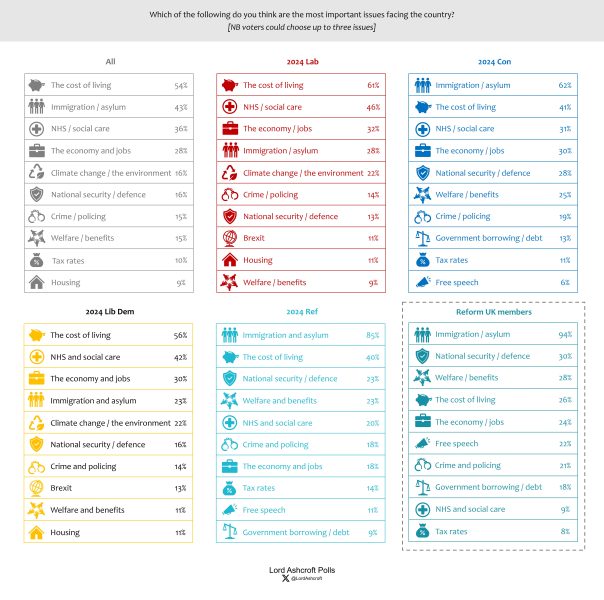

Ninety-four per cent of Reform members named immigration and asylum among the three most important issues facing the country. Second was national security and defence, chosen by 30 per cent, followed by welfare and benefits. The cost of living was in fourth place chosen by just over a quarter. The general public were more than twice as likely as Reform UK members to choose the cost of living, less than half as likely to choose immigration and asylum, and four times as likely to choose the NHS and social care. Reform members were more than four times as likely to mention free speech as the general public.
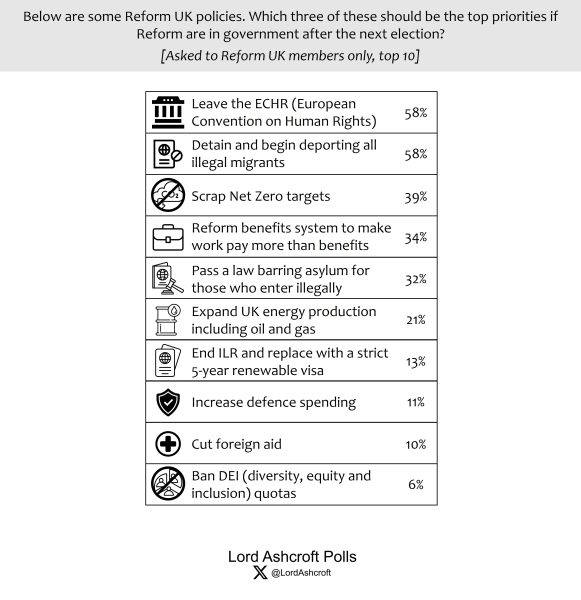

Asked which Reform policies they see as the most important priorities for government, party members were most likely to choose leaving the ECHR and detaining and deporting illegal migrants. These were followed by scrapping net zero targets, reforming welfare and ensuring that anyone entering Britain illegally is ineligible for asylum.


Presented with a selection of policy ideas (not currently Reform UK policies), Reform UK members were most supportive of a law stating that women-only spaces should be defined by biological sex (98 per cent, compared to 68 per cent of the general public), banning the burqa and other religious coverings (also 98 per cent, compared to 51 per cent of the general public), deporting illegal migrants even if they have since been granted asylum (96 per cent, compared to 54 per cent of the general public), and requiring civil servants to sign a contract promising to implement the wishes of the elected government (also 96 per cent, compared to 40 per cent of the general public).
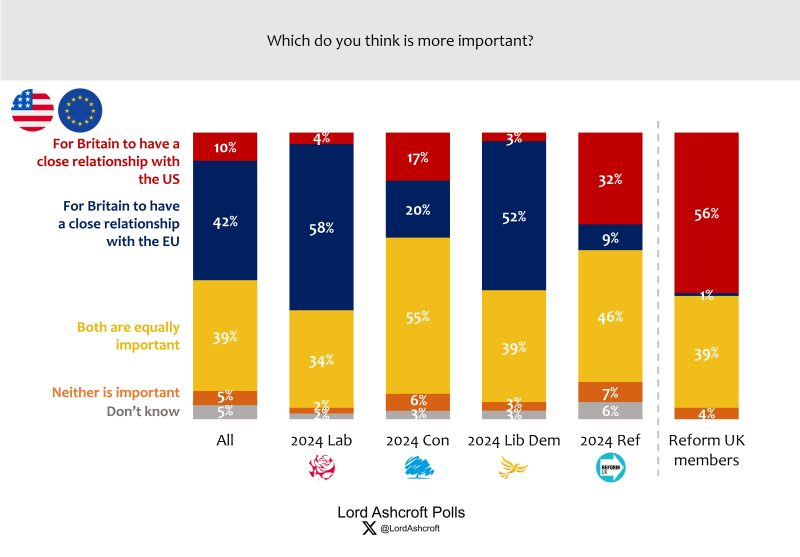

A majority of Reform UK members said it was more important for Britain to have a close relationship with the US than with the EU. A further 39 per cent thought the two were equally important. Only one in a hundred thought it was more important to have a close relationship with the EU than with the US. The general public were as likely as Reform UK members to say the two were equally important, but were much more likely to prioritise the EU relationship than the US one.
Nigel Farage, Reform leadership and other political figures
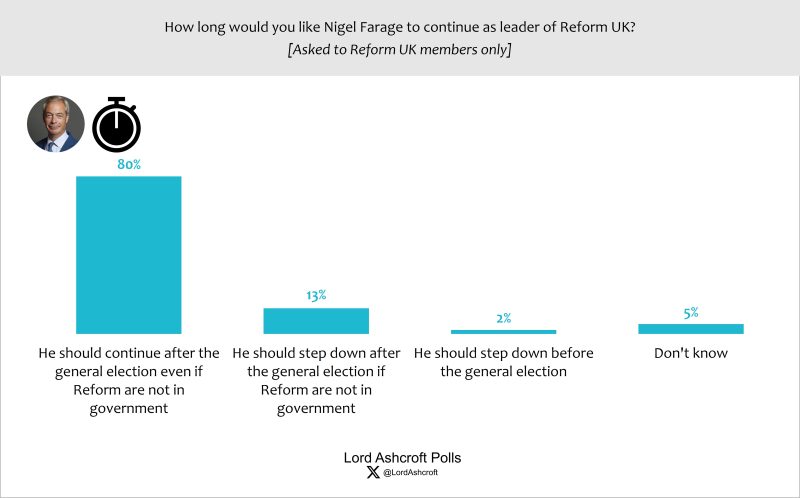

Four out of five Reform UK members said they would want Nigel Farage to continue as leader even if the party is not in government after the general election. Thirteen per cent said he should step down if Reform UK are not in government.


Just under two thirds of Reform UK members said they think Farage attracts more people to the party than he puts off. Just under three in ten think he attracts and repels people in equal numbers. Only 3 per cent think he puts more people off than he attracts. Voters as a whole were slightly more likely to think Farage puts off more people than he attracts than the reverse.
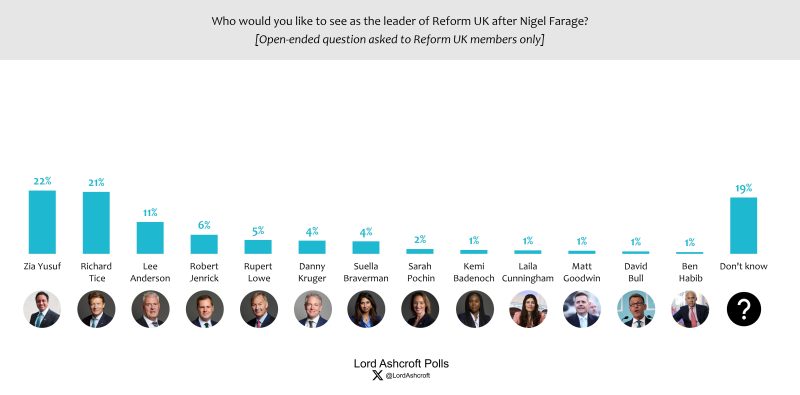

Asked unprompted to say who they would like to see as the next Reform UK leader, party members were most likely to name Zia Yusuf, closely followed by Richard Tice. Just over one in ten named Lee Anderson, with 6 per cent suggesting Robert Jenrick.


The most popular political figures among Reform UK members were Nigel Farage, Richard Tice, Lee Anderson and Zia Yusuf. More members gave a positive score to Kemi Badenoch than to Danny Kruger, Rupert Lowe or Nadhim Zahawi.
Conservative defectors
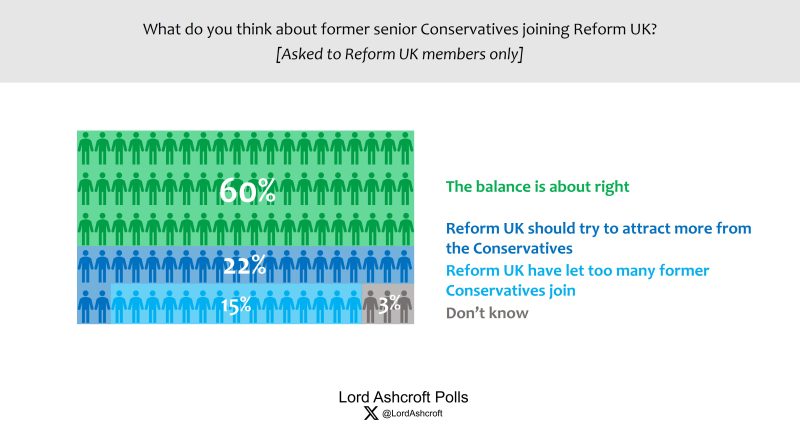

Three quarters of Reform UK members thought either that the party had let too many former Conservatives join or that the balance was about right. Only just over one in five said Reform should try to attract more from the Conservatives.
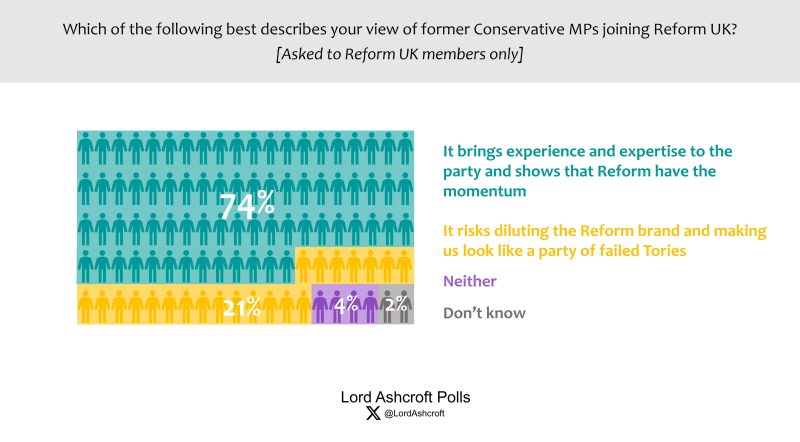
Nearly three quarters of Reform UK members said Conservative MPs joining Reform UK brought expertise and experience to the party and showed that Reform had the momentum. Just over one in five said it diluted Reform’s brand and made it look like a party of failed Tories.
The next general election
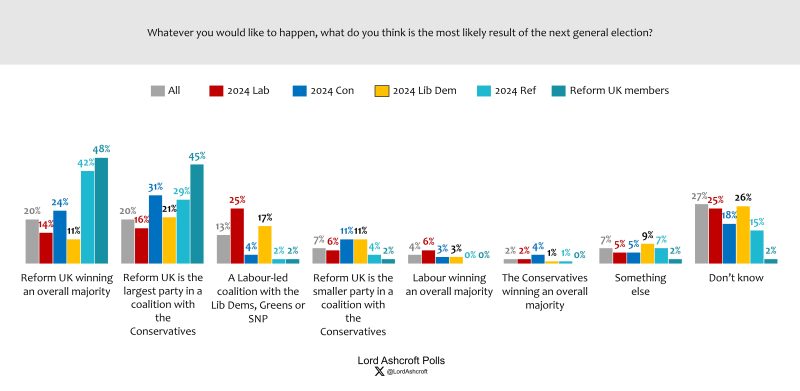

Just under half of Reform UK members expected the party to win the next general election with an overall majority. A further 45 per cent said the most likely result was Reform UK being the largest party in coalition with the Conservatives. Overall, 95 per cent of members expected the party to be in government after the election. The public as a whole were equally likely to expect a Reform UK majority or a Reform-Conservative coalition (20 per cent each), with 13 per cent expecting a Labour-led coalition with other parties of the left.
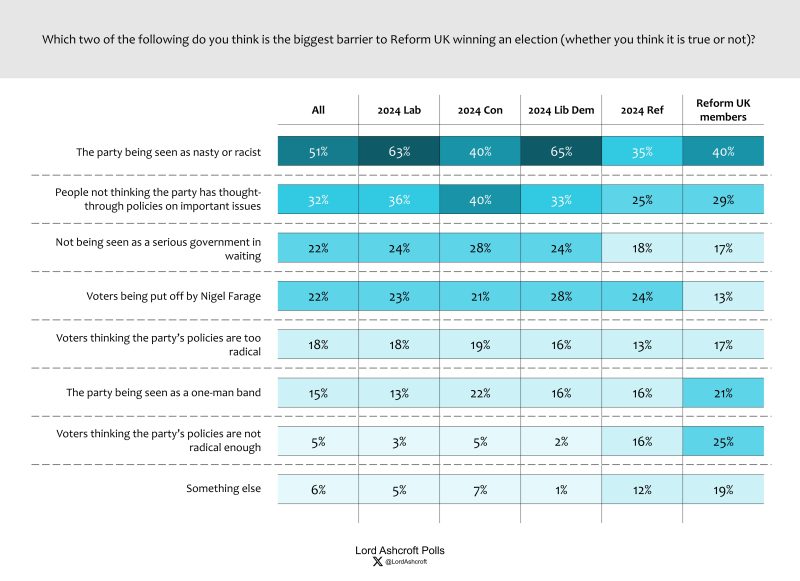

Reform UK members were most likely to see “the party being seen as nasty or racist” as one of the biggest barriers to winning the next election, followed by “people not thinking the party has thought-through policies on important issues”. They were more likely to think the party’s policies not being radical enough was a potential obstacle than being seen as too radical. Only 13 per cent thought voters being put off by Farage himself was one of the biggest barriers.
Voters as a whole agreed with Reform UK members on the two biggest barriers (the party being seen as nasty or racist, and not having thought-through policies). However, they thought the next biggest obstacles were not being seen as a serious government in waiting, and voters being put off by Nigel Farage.
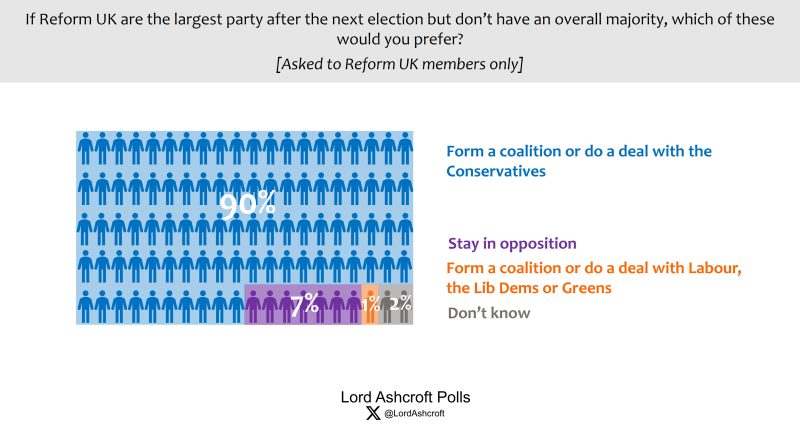
Nine out of ten Reform UK members said they would want a coalition or a deal with the Conservatives if Reform were the largest party after the election but don’t have an overall majority. Seven per cent said they would rather stay in opposition.
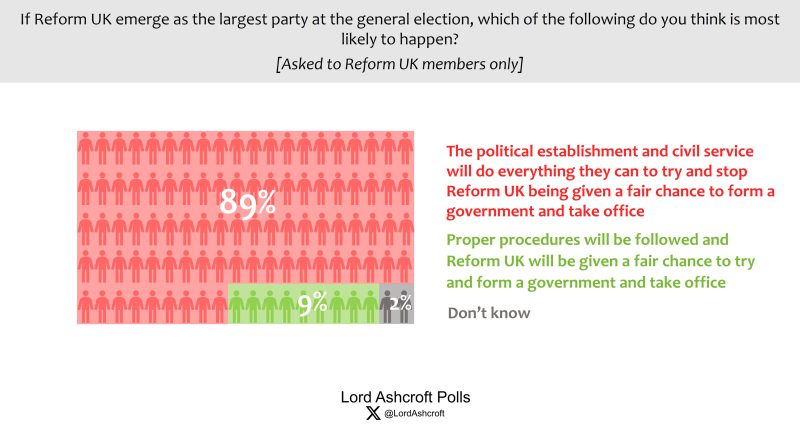
Fewer than one in ten party members think Reform UK would be given a fair chance to form a government and take office if they emerge as the largest party after the general election. Nearly nine out of ten think the political establishment and the civil service will do everything they can to stop this happening.


A majority of Reform UK members said they were not confident that elections in Britain are conducted fairly. This included 17 per cent who said they were not at all confident. Among the public as a whole, two thirds said they were somewhat or completely confident that British elections are conducted fairly.
A Reform UK government and the civil service
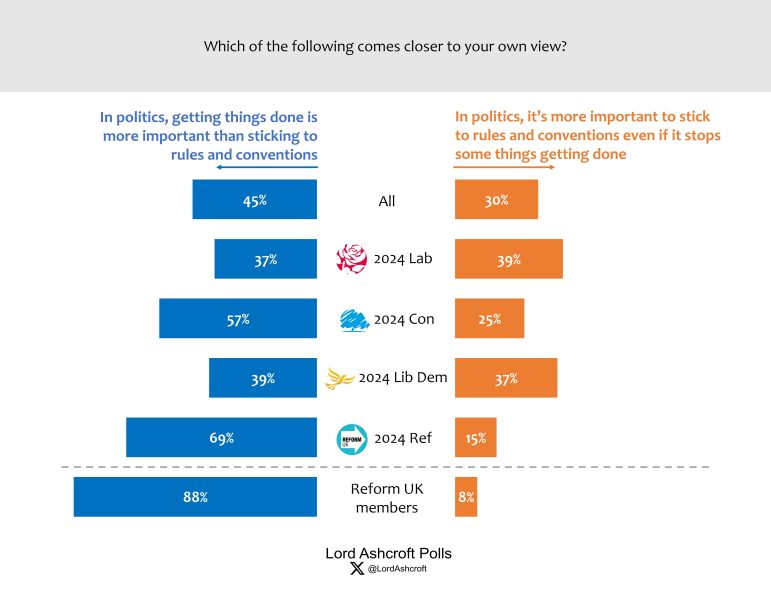

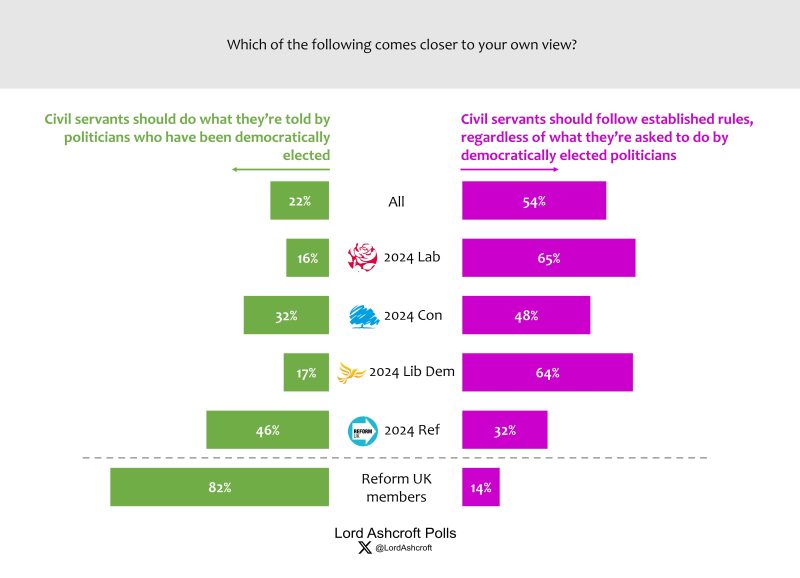

More than eight out of ten Reform UK members said civil servants should do what they’re told by politicians who have been democratically elected. Fourteen per cent said they should follow established rules regardless of what elected politicians ask them to do. By contrast, a majority of the general public said civil servants should follow established rules regardless of what they’re asked to do by elected politicians.
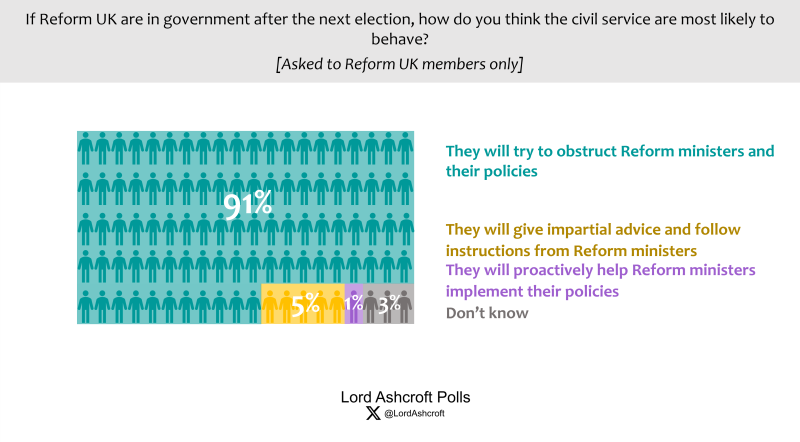
More than nine out of ten Reform UK members think the civil service will try to obstruct Reform ministers and their policies if the party is in government after the election. Only 0ne in twenty think civil servants would give impartial advice and follow instructions, and only 1 per cent think they would proactively help Reform ministers implement their policies.
Attitudes to Britain
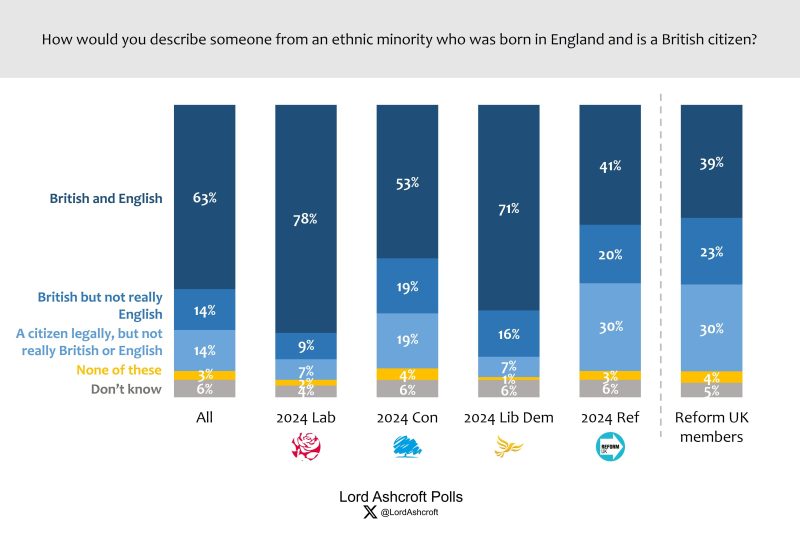

Just under four in ten Reform UK members said they would describe someone who was from an ethnic minority, was born in England and was a British citizen as both British and English. Just under a quarter said the person would be British but not really English. Three in ten said the person would be a citizen legally, but not really British or English. Among the public as a whole, a clear majority said the person would be both British and English.
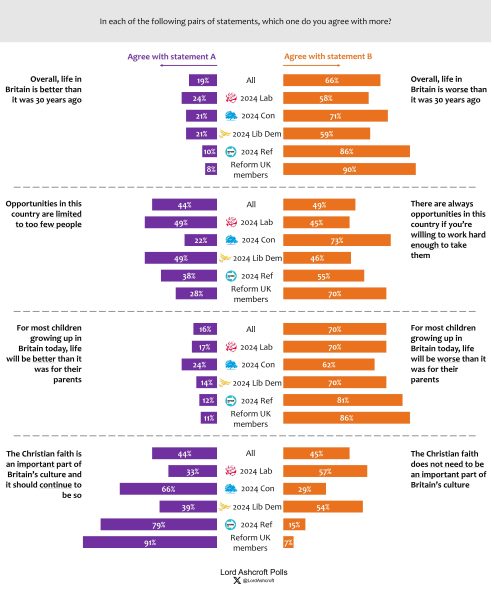

Nine in ten Reform UK members say life in Britain is worse than it was 30 years ago, compared to two thirds of the public as a whole. Seven in ten Reform UK members say there are always opportunities in this country for people willing to work hard enough to take them, compared to 49 per cent of the general public. Nearly nine in ten Reform UK members think that for most children growing up in Britain today, life will be worse than it was for their parents, compared to 70 per cent of the public as a whole. More than nine in ten Reform UK members say the Christian faith is an important part of Britain’s culture and should continue to be so, compared to 44 per cent of the general public.
Previous support and alternative parties


Nearly three quarters of Reform members said they had supported the Conservatives before Reform UK. 8% named the Brexit Party, with 6 per cent each naming Labour and UKIP. A further 6 per cent said Reform was the first party they had supported.


Asked who they would vote for if no Reform candidate was available in their constituency, 42 per cent of Reform UK members named Restore Britain. One in three named the Conservatives. A further 13 per cent said they would not vote.
Full data tables at LordAshcroftPolls.com
You must be logged in to post a comment Login