Politics
Lord Ashcroft: The SNP’s record, the independence debate, what matters to voters, and is Nicola Sturgeon an asset or a liability? My latest Scottish polling
Lord Ashcroft KCMG PC is an international businessman, philanthropist, author and pollster. For more information on his work, visit lordashcroft.com
With Holyrood elections just over six weeks away, my latest polling looks at Scottish public opinion towards the SNP government’s record, the parties and leaders, the independence debate, and the issues that will shape the outcome in May. The full report, including thoughts from our focus groups around the country, is here. My commentary on the research for Holyrood magazine is here.
The SNP government’s record


Offered three statements about the SNP government’s record, just under one in five Scots said they thought it was doing a good job. This included 40 per cent of those who voted SNP in 2021, and only just over half of those intending to back the party at the 2026 election. A further 22 per cent overall, including nearly four in ten likely SNP voters, said the SNP was doing a bad job but was still better than the alternatives. The combined overall total of 41 per cent thinking the government was doing a good job or was better than the alternatives matched the proportion who said the SNP was doing a bad job and they would rather have someone else running the Scottish government.


Looking in more detail at the SNP government’s record, its best marks overall were for “standing up for Scotland” – a majority of all voters say it has done a good job on this score, including three quarters of 2021 SNP list voters and nearly nine in ten of those intending to vote
for the party this year. On other things, the proportion saying the SNP government had done a good job did not exceed 35 per cent (“making life better for people in Scotland”) and fell to as low as 26 per cent for “honesty and integrity” – though majorities of both 2021 and likely 2026 SNP voters said the Scottish government had performed well on this score.
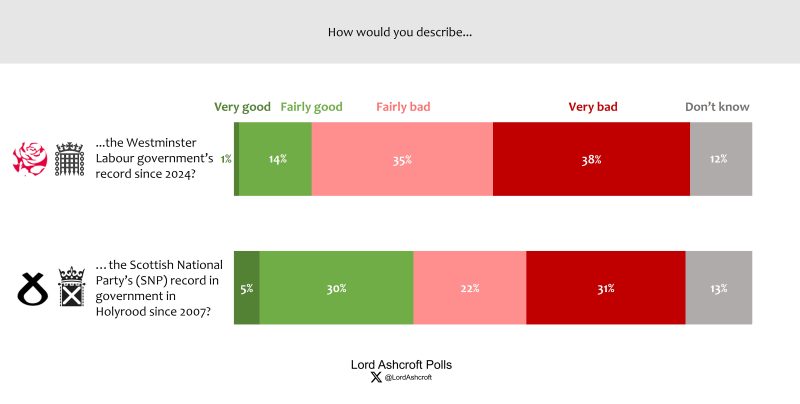

Scots said they thought the Westminster Labour government’s record since the 2024 election was bad, by 73 per cent to 15 per cent. Those who had voted Labour in 2024 said it was doing a bad job by 68 per cent to 23 per cent. However, they thought the SNP government’s record in Holyrood since 2007 was bad by a narrower 18-point margin. Nearly two thirds of 2021 SNP list voters said they thought their party had done a good job in government, as did nearly eight in ten of those intending to vote SNP in the regional list vote.
Issues and priorities


Asked to name the three most important issues facing Scotland at the moment, Scots as a whole chose health and the NHS, the cost of living, and the economy and jobs as their top three priorities. These were followed by immigration, poverty and inequality, housing, education and climate change. However, there were notable differences between political groups. Health and the cost of living topped the list for those intending to vote SNP, Labour, Conservative and Green in the regional list vote. For the first three of these the economy was in third place, but for Greens this spot went to poverty and inequality.
Getting Scottish independence was the fourth biggest priority for those intending to vote SNP, and was named by just under a quarter of likely SNP voters. For Greens, getting independence ranked equal eighth. It was named by 12 per cent of them, on a par with Brexit and welfare, and after health, the cost of living, poverty, climate change, the economy and jobs, housing and immigration.
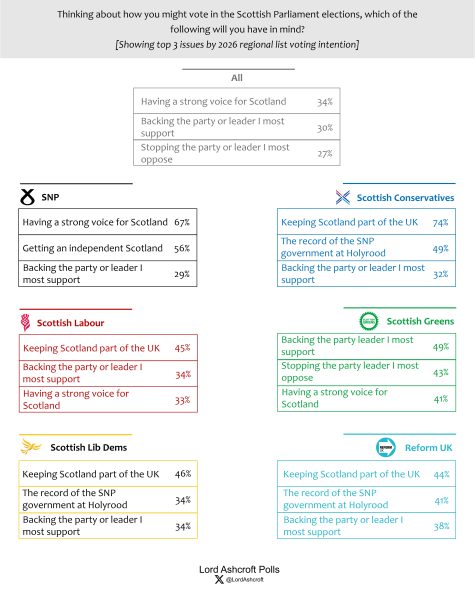

Asked what they would have in mind when deciding how to vote in the Holyrood elections, Scots were most likely to choose having a strong voice for Scotland, followed by backing the party they most support or stopping the party they most oppose. Only 26% overall mentioned the record of the SNP government, putting it in fourth place.
Again, however, there were sharp differences between political groups. Two thirds of those intending to vote SNP chose having a strong voice for Scotland, with just over half saying they would be using their vote to try and get an independent Scotland. For Reform, Lib Dem
and Conservative voters, the biggest motivating factor was keeping Scotland in the UK. For Greens, the top two places went to backing the party they most support and stopping the party they most oppose.
Independence
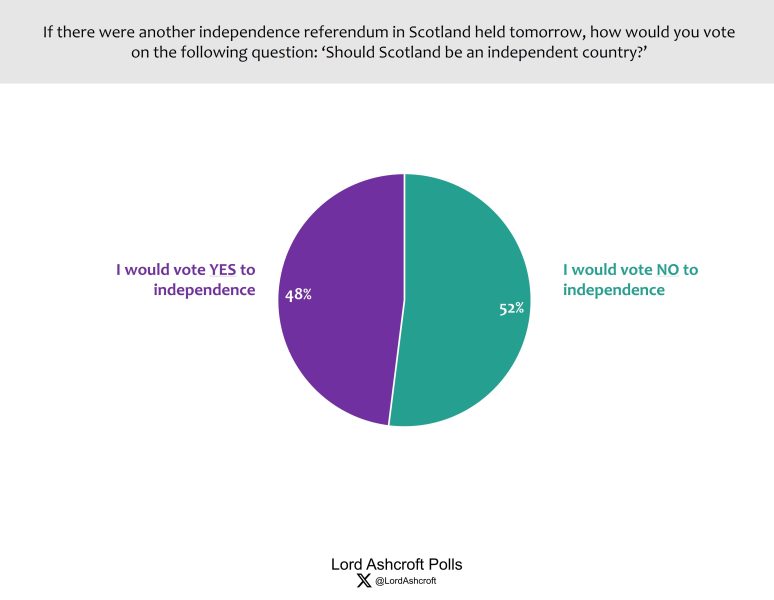

Asked how they would vote if an independence referendum were held tomorrow, respondents said they would vote No by a three-point margin, with 18 per cent saying they didn’t know or would not vote. Including only those giving a voting intention, this gives a result of Yes 48 per cent, No 52 per cent. (This compares to a 12-point margin for No in our previous survey in February 2023).
Among those currently intending to vote SNP in the regional list vote, 84 per cent said they would vote Yes to independence, while 7 per cent would vote No and 8 per cent said they didn’t know. Ninety-four per cent of those intending to vote for the Scottish Conservatives in the regional list vote said they would vote No, as did nearly three quarters of those intending to back Scottish Labour, six in ten of those backing the Scottish Lib Dems and nearly eight in ten of those intending to vote Reform. Those intending to vote Green said they would back independence by a 50-point margin, with 12 per cent saying they didn’t know or wouldn’t vote.


A plurality of Scots thought a referendum tomorrow would result in a No vote on independence, but the reverse was true if a referendum were to be held in five years’ time.
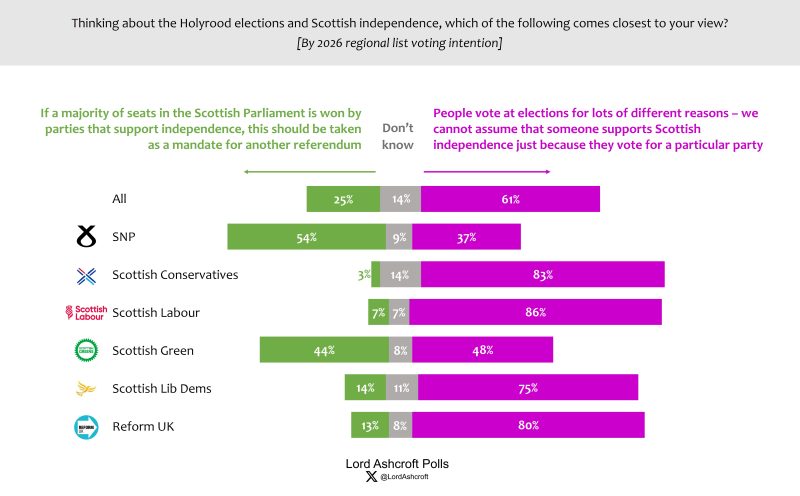

Only a quarter of Scots overall – including only just over half of likely SNP voters – said that pro-independence parties winning a majority of seats in the May election should be taken as a mandate for another independence referendum. More than six in ten agreed with the alternative proposition that someone cannot be assumed to support independence just because they support a particular party. Those intending to vote Green chose the second statement by a four-point margin.
Parties and leaders
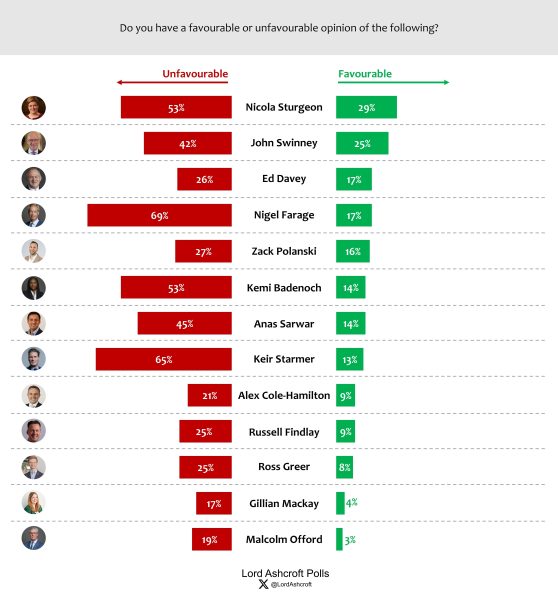

When we asked how favourable or otherwise people felt towards various politicians, Nicola Sturgeon emerged with the most positive score (but also one of the highest negatives). Nigel Farage had a higher favourable score than Keir Starmer, but their net scores (favourable minus unfavourable) were the same.
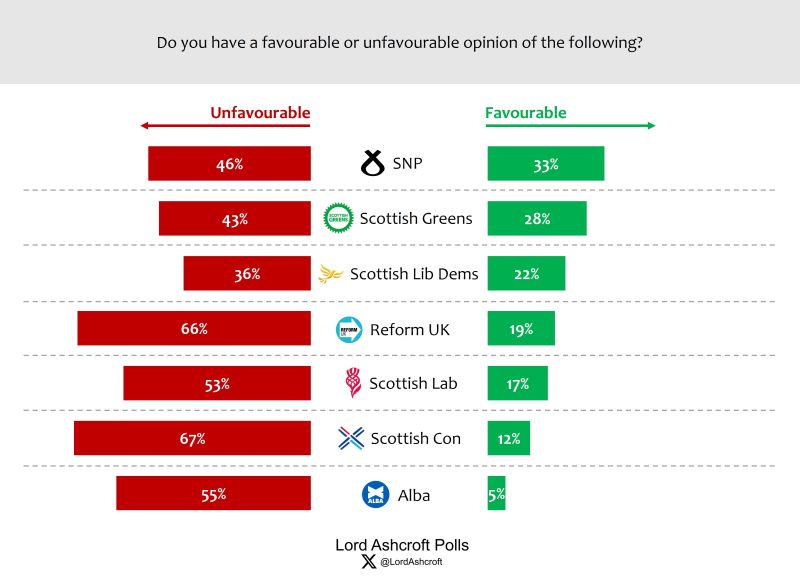

Comparing these favourability ratings with the figures above, we can see that Anas Sarwar, Zack Polanski, Ed Davey and Kemi Badenoch are more popular (or less unpopular) than their respective parties. While same is also true of Gillian Mackay, Alex Cole-Hamilton and Russell Findlay, this owes more to their relatively low recognition figures than to high favourability scores.
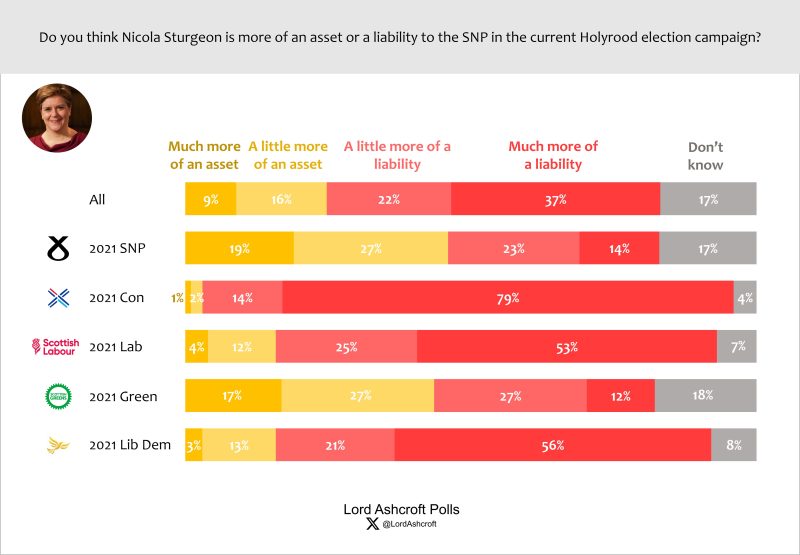

A majority of Scots said they saw Nicola Sturgeon as a liability rather than an asset to her party. Likely Green voters were also more likely to see her as a liability. However, SNP voters themselves were more likely to take the opposite view: those intending to back the party in the regional list vote this year saw her as an asset by 50 per cent to 33 per cent.
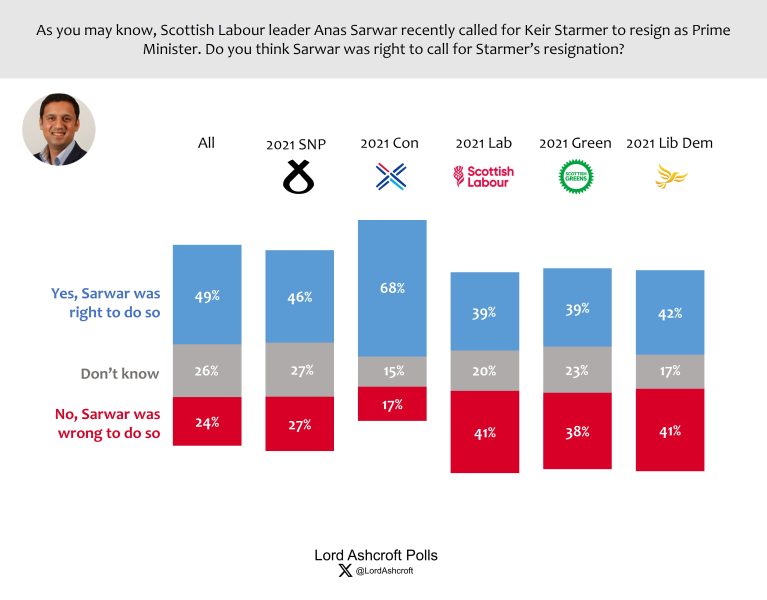

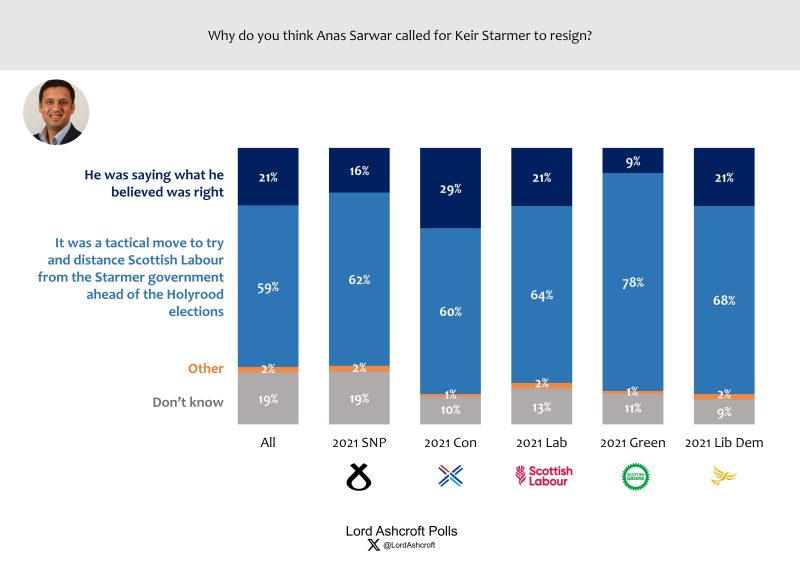
By a margin two-to-one margin, Scots thought Scottish Labour leader Anas Sarwar was right to call for Keir Starmer to resign as prime minister (indeed those intending to vote for Scottish Labour in the Holyrood elections were the only group to disagree). However, a majority of all parties’ voters thought Sarwar had made the call as a tactical move to distance Scottish Labour from the Starmer government, rather than that he was saying what he believed was right.

Attitude to Reform UK
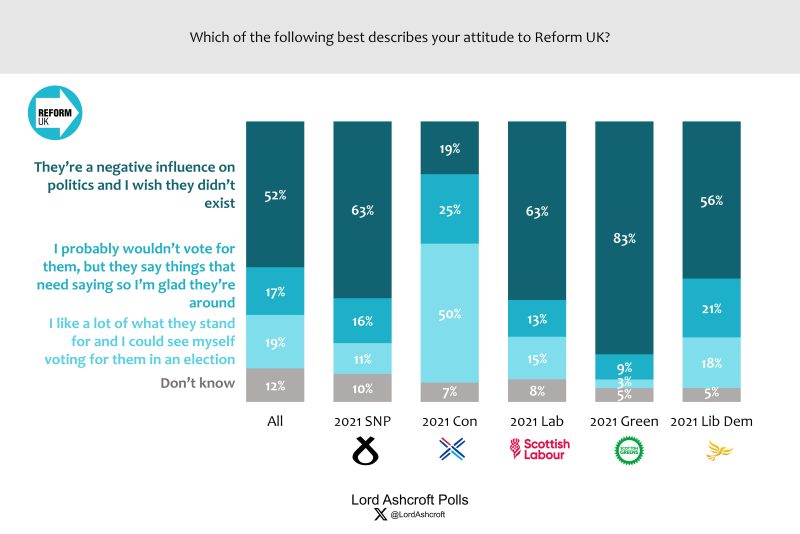

Just over half of Scots (including around three quarters of likely SNP and Labour voters) said they thought Reform UK were a negative influence on politics and they wished the party didn’t exist. A further 17 per cent, including one third of likely Conservative voters and more than one in five likely Lib Dems, say they probably wouldn’t vote Reform but they say things that need to be said so they’re glad the party is around. Just under one in five, including half of all 2021 Conservative voters, say they like a lot of what the party stands for and could see themselves voting for it in an election.
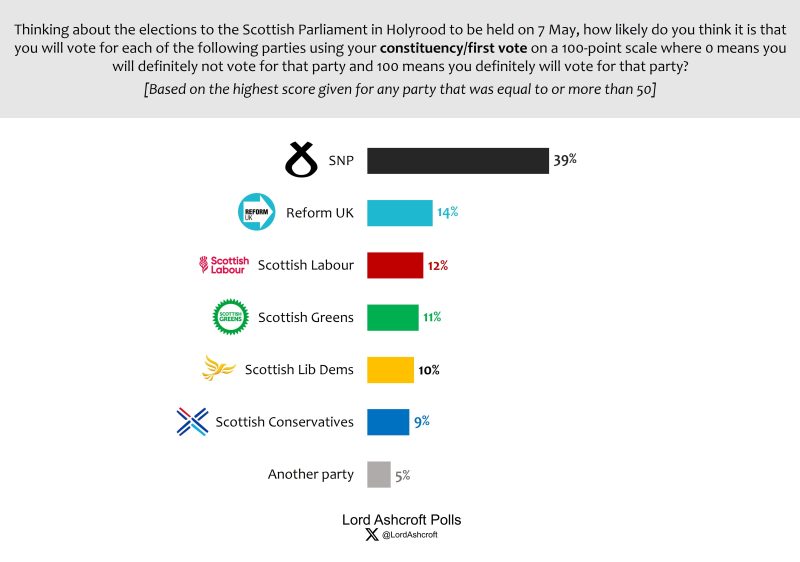

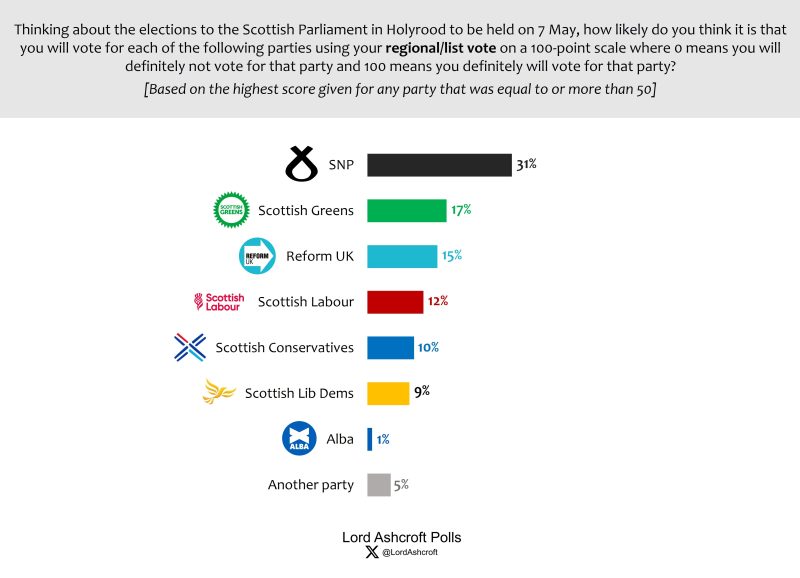
We asked people how likely they thought they were to vote for each party in the Scottish Parliament elections in May on a scale from 0 to 100 – where 0 means there is no chance, they will vote for that party and 100 means they will definitely vote for that party. Looking at those saying they are more likely than not to vote for one party (those whose likelihood of voting for one party was at least 50/100), this implies the following state of the parties in the constituency and regional list votes at the outset of the campaign:

Six segments
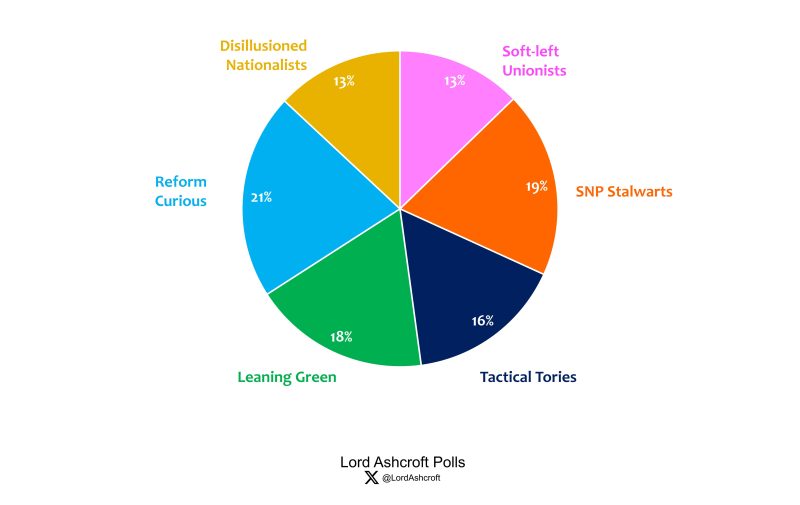

Our analysis identifies six similarly sized segments within the Scottish electorate.
- The SNP Stalwarts have given the party strong support at the last two general elections and are the most likely to vote SNP in May, although a significant minority will use their list vote for the Scottish Greens. Their vote in the Scottish Parliament elections tends to be about having a strong voice for Scotland and getting an independent Scotland. They think the SNP government is doing a good job and overwhelmingly prefer a SNP-Green coalition to any alternative. Economically they are very optimistic for their local area and for Scotland, but far less so for the UK. They support Scottish independence and are the only segment to agree that a majority of seats being won by pro-independence parties constitutes a mandate for a second referendum. They are evenly divided as to whether Scotland should keep using North Sea oil and gas reserves.
- The Lib/Lab Unionists are most likely to vote Labour or Lib Dem both in Holyrood and Westminster elections and have consistently done so in the past. They are most likely to identify education, the economy and the NHS as major issues. They tend to say the SNP government is doing a bad job and they want them replaced, although a significant proportion don’t know. They strongly oppose independence and expect that Scotland would reject it in a referendum held tomorrow, but are far less sure about a result in five years’ time. They have a strong preference for a coalition between Labour and the Liberal Democrats over an SNP-Green coalition; this preference persists but becomes much weaker if the Conservatives are added as a coalition partner. However, they prefer a SNP-Green coalition to any coalition involving Reform.
- Though the Open to Tories segment has the highest support for the Conservatives as things stand, their voting intention is currently spit between the Conservatives, Labour and Reform. They backed the Conservatives by a fair margin in 2019, but switched to Labour in 2024. These voters are most likely to care about defence, welfare the economy and immigration. They are the least likely of any segment to be concerned about the cost of living. In the Holyrood elections they are most likely to be motivated by keeping Scotland in the UK and SNP government’s record. About two-thirds of this segment disapprove of the SNP’s performance in government and want them replaced; there are consistent clear preferences for any coalition of unionist parties to a SNP-Green coalition.
- The Leaning Green segment are currently more likely to give their list vote to the Greens than the SNP and show the strongest Green support overall, despite having voted heavily for the SNP in the last two general elections. They are most likely to name poverty and inequality, drug addiction and climate change as the key issues, and say their Holyrood vote will be motivated by getting a strong voice for Scotland and Scottish independence, although not to the same extent as the SNP Stalwarts; they are also the most likely to want to stop the party they most oppose. They are most likely to think the SNP government is not doing a good job, but is better than the alternatives. They are the most likely to want to stop issuing North Sea oil and gas licences, and the most likely to be students or unemployed.
- The Reform Curious group had the strongest support for the Conservatives in 2019, but the Tory vote among this segment dropped 25 points in 2024 with Reform the primary beneficiaries. They show the strongest support for Reform in Holyrood and future Westminster elections. They are most likely to consider immigration and crime as important issues facing Scotland. Over 80 per cent of them say the SNP government is doing a bad job and want them replaced, and they are the most likely to expect the economy in their local area and the Scottish economy to perform badly over the next year.
- Having voted overwhelmingly for the SNP in 2019, the party’s vote plunged among the Disillusioned Nationalists in 2024 and they are now the most likely of any segment to say they will not vote. The few voters considering backing Alba are largely in this group. They say the cost of living is the most important issue by some margin, and tend to disagree that a pro-independence Holyrood majority would be a mandate for another referendum. They are unenthusiastic about the SNP government’s record and deeply pessimistic about the economy, both for themselves and the country.
Full report and data tables at LordAshcroftPolls.com
You must be logged in to post a comment Login