
Politics
Lorraine Beavers: ‘The silent killer the national cancer plan must confront’


As we await the release of the National Cancer Plan, Liver Cancer Awareness Month is a stark reminder of the urgent need to act on one of the UK’s fastest rising and less survivable cancers.
While the UK has made impressive progress in reducing deaths from several cancers, liver cancer stands apart. Each year, over 6,300 people die from liver cancer in the UK, and alarmingly, 49% of these deaths are preventable.
It has the fastest-growing mortality rate of any major cancer, with deaths increasing by 50% in the last decade. New data shows that deaths from liver cancer in England and Wales increased by 41% between 2013 and 2024 with the disease now accounting for a greater share of overall deaths than in previous years.
This rise is driven by obesity, alcohol harm, viral hepatitis, metabolic syndrome, and deepening health inequalities. But behind these causes lies a more fundamental failing; our system misses opportunities to detect patients early and fails to monitor those most at risk – often disproportionately affecting those in our most deprived communities.

MDU warns Chancellor clinical negligence system ‘not fit for purpose’

Northern Ireland RE curriculum is ‘indoctrination’ – Supreme Court
The National Cancer Plan offers an opportunity to reset and address the less survivable cancers and improve liver cancer services and care for all patients.
17 people die every day from liver cancer, while 17 more are newly diagnosed. This grim reality means the five-year survival rate for liver cancer is just 13% – among the lowest of any cancer in the UK. By contrast, comparable countries report markedly higher five-year survival rates: 23% in Australia, 22% in Canada and 43% in Japan.
Alarmingly, these figures are only set to worsen. Recent analysis from One Cancer Voice estimate there will be almost 120,000 new liver cancer cases by 2040. Liver cancer cases are set to double by 2050, with researchers of a Lancet Commission on Liver Cancer highlighting the growing impact of obesity – an estimated 11% of liver cancer cases could be linked to obesity by 2050, up from 5% today.
A key factor behind the stark survival rates is late diagnosis. Liver cancer is a silent killer – the symptoms are non-specific in the early stages (stages I and II) and are often attributed to other causes – resulting in only 19% of liver cancer cases in England being diagnosed early. Almost twice as many cases of liver cancer are diagnosed during an emergency in A&E (42%) as are diagnosed by a GP referral (24%), often when the disease has progressed beyond the point where effective medical intervention is possible. In contrast, 60% of primary liver cancer cases are detected at an early stage in Japan.
Yet, the majority of those diagnosed with liver cancer have known risk factors – pre-existing liver disease, overweight and obesity, metabolic syndrome, alcohol use and viral hepatitis. The opportunities for early detection are missed by a system that does not proactively find those at risk or keep them under surveillance. Notably, cirrhosis, advanced scarring of the liver, is present in as many as 90% of cases of HCC, yet the lack of a national cirrhosis registry means patients can be lost to care. These missed opportunities cost lives.
These missed opportunities do not fall evenly: lives are disproportionately lost in our most deprived communities. In all four nations of the UK, people in the most deprived communities have significantly higher rates of liver cancer than those in the least deprived. In England, men living in the most deprived areas face twice the rate of liver cancer compared with men in the least deprived areas. Surveillance and outreach into these communities is vital to reverse this unacceptable health gap.
As a less survivable and rare cancer, liver cancer may benefit from the Rare Cancers Bill. The bill, introduced by Dr Scott Arthur MP, is making progress with government backing. The bill seeks to incentivise research and investment into the treatment of rare cancers. Similar pieces of legislation in the US, spurred pharmaceutical companies to dramatically increase their research into rare diseases. Prior to the passage of the Orphan Drug Act, only 38 drugs were approved by the FDA for rare disease; by 2022, that number is 882.
Already, promising steps are being taken to improve liver surveillance. NHS England has doubled its deployment of mobile liver scanning teams throughout England, using non-invasive liver scans to offer over 100,000 on-the-spot scans for liver disease. Of those, almost 8,500 have been referred for further checks. Bringing diagnosis out of hospital and into those communities that need it most is a crucial step in reducing the health gaps. New minimum standards for liver cancer surveillance were also published by NHS England in 2024. These are steps in the right direction – proof that surveillance is possible and effective when prioritised.
Yet, the reality on the ground remains inconsistent. A British Liver Trust survey revealed a postcode lottery for liver disease surveillance. Only 20% of health bodies in England have full pathways for early liver disease detection, and most health bodies are still failing to proactively case-find those most at risk. Community Diagnostic Centres were designed to shift care closer to people’s homes and drive prevention, yet only 14 of 160 Community Diagnostic Centres had liver scanning capability as of February 2025.
This Liver Cancer Awareness Month, the British Liver Trust is calling for:
- Immediate action to improve early detection and surveillance of liver cancer.
- A National Cirrhosis Registry to track and monitor high-risk patients.
- Wider access to liver scans (transient elastography and ultrasound) and fibrosis testing in primary care and community settings, including Community Diagnostic Centres.
- Comprehensive early detection pathways for liver disease, to stop preventable cases before they start.
The National Cancer Plan is a generational opportunity to reverse years of neglect and deliver lasting change. It is an opportunity to address less survivable cancers – including liver cancer.
If the government is serious about saving lives, it must confront the reality of liver cancer with the ambition, urgency, and equity the crisis demands.
Politics.co.uk is the UK’s leading digital-only political website. Subscribe to our daily newsletter for all the latest news and analysis.


Katy Perry has treated her social media followers to fresh photos of herself enjoying the Coachella music festival with her new boyfriend, Justin Trudeau.
Last year, the Grammy-nominated singer and former world leader made headlines the world over when it was reported that they’d been pictured on a date while she was on a Canadian stop on her world tour.
Since then, Katy and the ex-Canadian prime minister have been sighted together on a number of occasions, and over the weekend, she proved things were still going strong between them with a carousel of pictures and videos taken at Coachella.
One clip showed the two watching the headlining set from another Canadian Justin – that’d be The Biebs, who performed at Coachella on Saturday night – while in another candid snap, the two were seen enjoying a drink and some noodles together.
Katy’s post also included more clips from Justin Bieber’s headlining set, as well as footage of herself sporting a t-shirt emblazoned with the message: “Please do not give me a rip off your vape no matter what I say.”
Take a look at Katy’s post for yourself here.

After months of speculation, the unexpected couple went Instagram official with their romance towards the end of last year, with Katy later sharing a picture of herself planting a kiss on her new beau while they were on holiday together in January.
The new couple were first rumoured to be dating in the summer of 2025, just weeks after Katy and her long-term partner Orlando confirmed they had parted ways after around a decade together.
Katy and Orlando insisted at the time that they would remain in one another’s lives, and shortly afterwards, they remained true to their word when they shared pictures of themselves on holiday together with their daughter Daisy, as well as Orlando’s two children Daisy and Flynn.
Meanwhile, before his new relationship, Trudeau had been single for around two and a half years, following the announcement in August 2023 that he and his wife of 18 years, Sophie Grégoire, had separated.
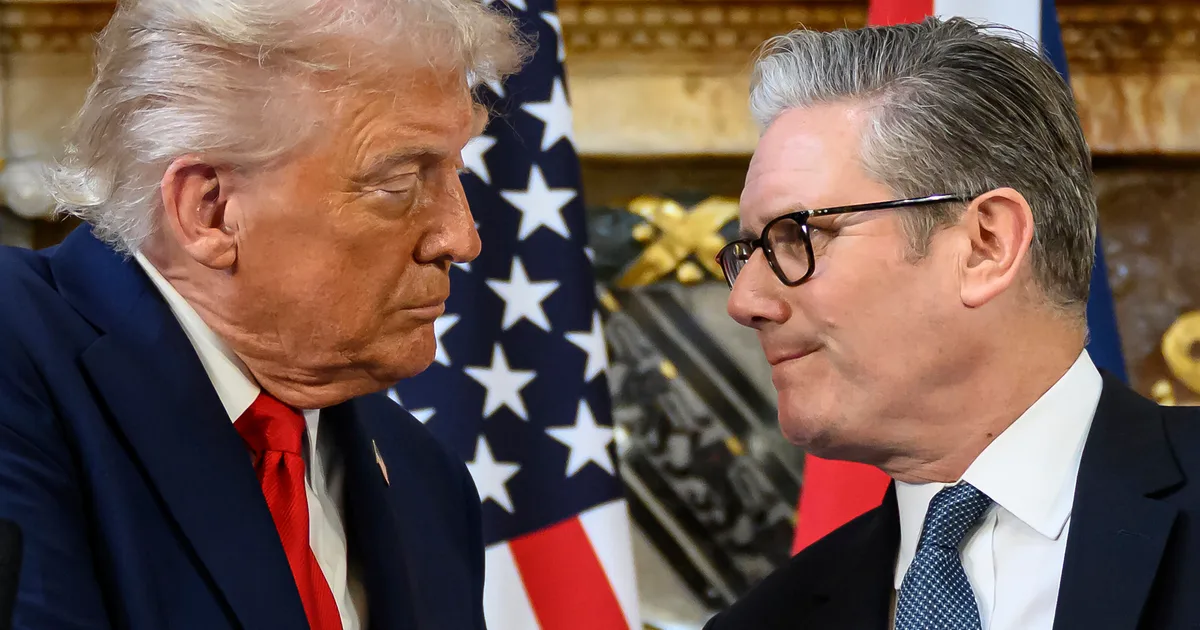
Keir Starmer has rejected Donald Trump’s plan to blockade the Strait of Hormuz and insisted the UK will not be “getting dragged in” to the Iran war.
The US president announced on Sunday that America and “other countries” will stop ships going in and out of the vital waterway.
The US military later clarified that while it will blockade of Iranian ports from 2pm on Monday UK time, it will “not impede” ships using the strait to get to or from other countries.
But regardless of the finer details of Trump’s plan, Starmer made clear that the UK will not be getting involved.
He told BBC Radio 5Live: “What we’ve been doing over the last few weeks – and this was part of what I was discussing with the Gulf states last week – is bringing countries together to keep the strait open, not shut.”
The PM added: “We’re not supporting the blockade and all of the marshalling diplomatically, politically and capability – we do have mine-sweeping capability, I won’t go into operational matters, but we do have that capability – that’s all focused, from our point of view, on getting the strait fully open.”
Starmer’s comments are further evidence of the breakdown in relations between Britain and America over the war.
Trump has repeatedly attacked the prime minister over his decision not to initially allow US jets to launch bombing missions from RAF bases.
Subscribe to Commons People, the podcast that makes politics easy. Every week, Kevin Schofield and Kate Nicholson unpack the week’s biggest stories to keep you informed. Join us for straightforward analysis of what’s going on at Westminster.
When talking about early 2000s style trends, you’d be remiss not to mention the reign of “jeans and a going-out top.”
This outfit staple allowed people to show off designer jeans while experimenting with a variety of tops from fast-fashion retailers. But a related trend brought this two-piece look to another level: dresses over jeans.
Between 2002 and 2005 in particular, celebrities paired an array of dresses with denim during public appearances. The dresses ranged from colourful halters to neutral minis to those classic strapless terrycloth numbers from Juicy Couture. In 2019, actor Jessica Alba poked fun at the look when she posted a Instagram roundup of photos of herself wearing it, writing in the caption, “In the early 2000s – Apparently, I loved to wear dresses w jeans … you’re welcome.”
Turns out, this type of outfit is more of a throwback than you might think. It goes far back in history and even has roots in the women’s rights movement.
The Appeal Of The Combo
As is often the case with style trends, the dress-over-jeans look wasn’t confined to red carpets. Non-celebrities embraced this pairing for their everyday lives in the early aughts as well.
“That was definitely one of my go-to looks when I was in high school. I can remember wearing sneakers and bootcut jeans with knee-length frilly dresses, which were often embellished with lace and glitter,” said Sara Idacavage, a fashion historian and researcher in the textiles, merchandising and interiors department at the University of Georgia.
“I think I was attracted to this style because it allowed me to be dressy, but not too dressy,” she added. “I loved wearing party dresses to school, but I don’t think it would have been seen as ‘appropriate’ without the jeans underneath. The dress-and-jean combo helped me look like I wasn’t trying too hard, which is actually why I think the look was popular with female celebrities at the time.”
Besides balancing between dressy and casual, the juxtaposition of super feminine dresses with denim pants also offered “a cheeky way of playing with gender norms,” Idacavage said, adding that the trend coincided nicely with the third-wave feminist movement and allowed women to channel a little rebellious spirit.
On a practical level, wearing a dress over jeans allowed for more freedom of movement since it erased fears of accidental flashing or Marilyn moments. It also allowed Disney stars such as Ashley Tisdale and Miley Cyrus give their outfits a more wholesome vibe at the time.
The History Of The Look
Today, we might chuckle at old photos of celebrities wearing dresses over pants — but back in the mid-19th century, this combo was downright scandalous.
“In 1850s America, women’s rights activists such as Amelia Jenks Bloomer and Elizabeth Cady Stanton horrified polite society with their controversial pairing of what at that time were two distinctively gendered garments,” said Cassidy Zachary, a fashion historian and co-creator of the podcast “Dressed: The History of Fashion.”
The dress reform movement, aka the rational dress movement, took off in the United States and parts of Europe during the Victorian era when women wore heavy dresses and restrictive corsets, which led to overheating, difficulty breathing, tripping down the stairs, crushed organs and other medical issues. The goal was to liberate women from attire that directly harmed their health and limited their freedom.
“These early suffragists intended their adoption of a calf-length dress worn over a pair of loose-fitting ‘Turkish trousers’ or ‘pantaloons’ to be a comfortable and practical alternative to the cumbersome floor-length skirts then in vogue,” Zachary said, adding that the controversial choice was perceived as a direct assault on the strict gender norms that divided women from men and regulated their lives.
“Dress-and-pant-wearing women became the subject of international ridicule, with innumerable satirical prints mocking a farcical world where gender roles were reversed: Women smoked cigars and proposed to men who stayed home, cooked, and took care of the children,” she continued. “It is amazing to consider how many social anxieties were embodied in this one garment.”
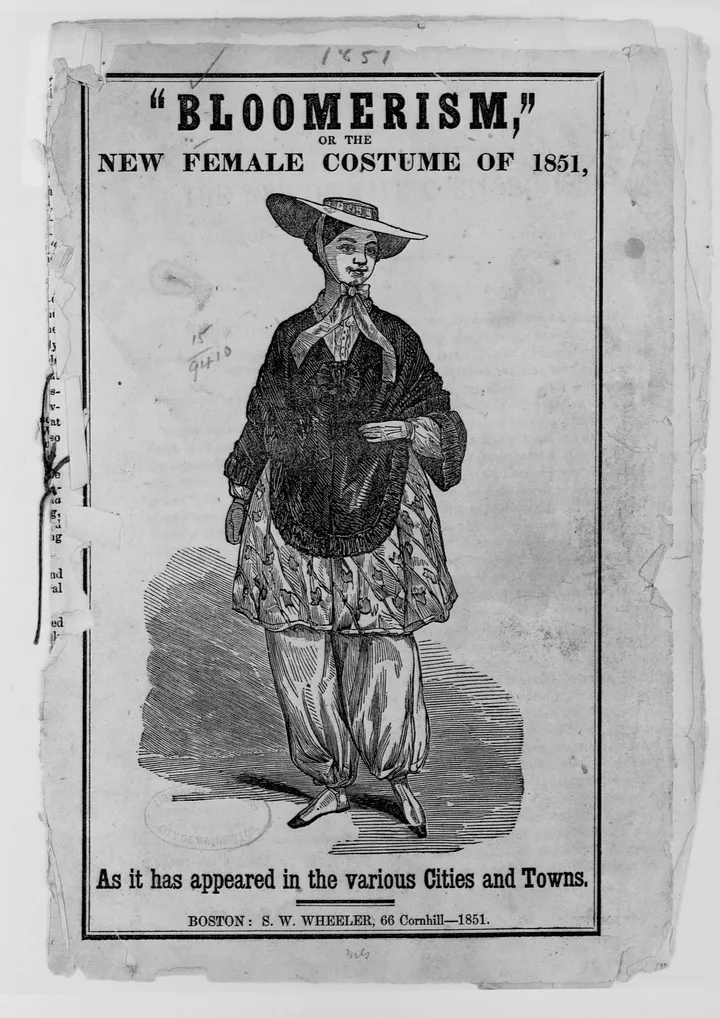
The ensemble of trousers gathered at the ankle under a loose dress was often referred to as a “bloomer” costume, named for the aforementioned activist, who popularised the look with her enthusiastic articles on its benefits in her newspaper, The Lily.

Library of Congress via Getty Images
“Bloomer costumes echoed the full silhouette that was popular in Western fashion at the time, but allowed for greater comfort and ease of movement by swapping layers of heavy petticoats for loose pants,” Idacavage said. “Aside from the obvious differences in materials and silhouettes, I think the bloomer costume is actually quite similar to the dress-over-jeans look of the early 2000s!”
Ultimately, the hoopla around this ensemble made activists like Bloomer concerned that their bid for comfortable attire was distracting from the bigger cause of women’s rights, so they eased away from the rational dress aspect of the movement.
While the dresses-with-pants trend was a notable moment in the West during the mid-19th century, women were actually wearing dresses and tunics over trousers long before that era and in many other parts of the world.
“As the term ‘Turkish trousers’ suggests, women in pants found precedent well beyond Euro-American society, including in nomadic horse cultures of Central Asia,” Zachary said. Similarly, Idacavage pointed to the salwar kameez in Central and South Asia.
Back in the West, American and European women wore trousers with dresses to costume parties for many years before suffragists adopted the combo for their everyday wardrobes.
“You can find fashion plates from the 1810s that depict women wearing full trousers called ‘pantalets’ or ‘pantaloons’ underneath calf-length dresses. The style wasn’t extremely popular or considered appropriate for daily dress, but it did exist,” Idacavage said.
The historian added that 19th-century childrenswear for both boys and girls often consisted of short dresses over pantalets as well. Additionally, American women often wore pant-and-skirt ensembles at swimming and water-cure establishments.
“Dresses over pants were also worn by women living in certain religious and utopian communities in the U.S. long before Amelia Bloomer popularized the look,” she continued. “It was also accepted as proper attire for women participating in sports throughout the 19th century, although wearing it outside of gymnasiums is a very different story!”
The Future Of Dresses Over Pants
As with the “going-out top” and other early 2000s style trends, the dresses-over-jeans look faded over time. But it seems this pairing may be making a comeback in the 2020s.
Lately, many runway shows and style influencers have sported long tunics and dresses over pants, including jeans. But these looks have an updated vibe with long shirt dresses unbuttoned at the bottom, monochrome combos, minis with volume, layered looks and more.

But Zachary believes the more pertinent conversation right now is less about the way women style their dresses with pants and more about how those who don’t identify as female might do the same.
“My question is this: With women flaunting their right to wear both garments by the 2000s, when will the same be said of her male or nongender-conforming peers?” Zachary said.
“It’s 2021, and while the pant has inarguably lost its gendered status, the same cannot be said of the skirt and dress, although we are seeing promising strides,” she added. “From actor Billie Porter’s crinoline tux gown at the 2019 Oscars to nongender-conforming artist and activist Alok Vaid-Menon’s #DeGenderFashion movement, I hope the next resurgence of the dress-pant trend will be one worn and enjoyed by all.”
The original version of this story was published on HuffPost at an earlier date.
Politics
Politics Home | Housing insecurity is not inevitable: here’s how social impact investment can help tackle it



Drew Ritchie, Investment Director
| Better Society Capital (BSC)
The UK’s housing crisis costs English councils £2.8bn annually, affecting 134,000 households. Social impact investment offers proven, cost-effective alternatives, with existing models saving £140m in taxpayer funds while keeping thousands out of temporary accommodation
Temporary accommodation (TA) is no longer a stopgap – it is the fastest growing housing tenure in the United Kingdom, with councils in England spending £2.8bn a year on TA.1 The cost to families is higher still, with more than 134,000 households, including circa 176,000 children,2 living without a stable home and the conditions needed for good health, steady work, or financial security.
New findings from our Better Society Index, a nationwide audit of housing insecurity, show that instability affects far more people than official figures reflect. More than one in four people (27 per cent) report that they or someone close to them has experienced housing insecurity in the past five years, rising to 41 per cent among young people. Public understanding of funding streams – and the limits of current resources – remains low.
Yet over the past decade, evidence has emerged that better, more cost-effective alternatives exist. Social impact investment brings in capital from outside the public purse, including from pension funds, trusts and foundations, and financial institutions, giving councils access to funding they would not otherwise have. Critically, it also funds the wraparound support that statutory budgets do not cover – mental health services, tenancy support, and the practical help that keeps people housed and out of crisis. This money is channelled into proven models led by housing associations and charities, expanding the supply of safe and stable homes.
These models are already working at scale. Homelessness property funds run by Resonance, Social and Sustainable Capital, and Bridges have kept more than 3,300 people out of TA, generating £140m in savings for taxpayers from reduced costs in healthcare, mental health services and the criminal justice system.3 Strong evidence also comes from the MHCLG backed Social Investment Pilot (SIP), delivered during Covid-19. The pilot combined a £25m government grant, matched by Better Society Capital, with £215m of additional investment, including £85m from Local Government Pension Schemes (LGPS).4 Independent evaluation by Manchester Metropolitan University showed improvements in tenancy sustainment, wellbeing and service efficiency, and substantial cost savings to taxpayers compared to private rented or TA provision.
A complementary model, social outcomes partnerships (SOPs), sees government and/or local authorities commission outcomes for people with complex needs before they reach crisis point. Charities or social enterprises can receive upfront working capital from socially motivated investors to deliver services supporting these individuals. Government outcomes payments are only made once independently verified results are achieved, meaning the financial risk sits with investors rather than the public purse. Successful programmes such as Greater Manchester Better Outcomes Partnership (GMBOP) and Kirklees Better Outcomes Partnership (KBOP) demonstrate that outcomes-based commissioning improves service quality and reduces long-term public costs; independent research shows every £1 spent generates £9 of public value.5 The £500m Better Futures Fund, announced by the Chancellor and due to launch in the coming months, creates the conditions to scale these approaches. MPs have a role to play in ensuring the Fund delivers for their constituents by championing local engagement and raising awareness.
Housing insecurity on this scale is not inevitable, with proven models increasing the supply of safe, stable homes and supporting people before instability becomes crisis. If government wants to reduce housing insecurity and spend public money more effectively, the path forward is to scale models already working and bring social impact investment into the mainstream of UK housing policy.
To find out more about BSC’s work on homelessness, please visit www.bettersocietycapital.com/our-approach/housing or reach out to [email protected].
Better Society Capital is a social impact investor, deploying capital through fund managers, social banks and intermediaries, and working with government and social sector organisations, to tackle the most pressing social challenges facing the UK.
References
1. Shelter; Bill for homeless accommodation soars by 25%, hitting £2.8 bn. 18 Sept 2025
2. MHCLG; Statutory homelessness in England: July to September 2025. 26 Feb 2026
3. Resonance; Better Society Capital & Alma Economics Report
4. Better Society Capital; Study finds Social Investment Pilot continues to increase support for people with experience of homelessness. 03 April 2025
5. Better Society Capital; New research shows how outcomes contracts can save the NHS. 11 June 2024
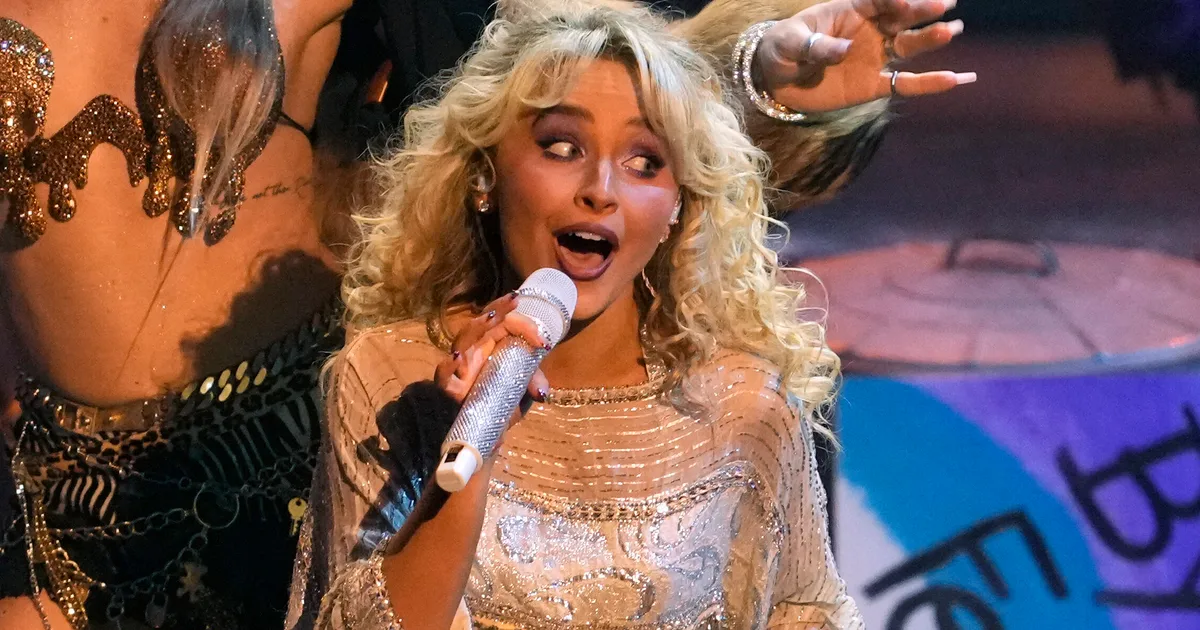
Sabrina Carpenter has apologised after insulting one fan who performed an Arabic vocal celebration during her Coachella set.
On Friday night, the Espresso singer delivered her first headlining performance at the Coachella music festival, where she whizzed through all of her biggest hits and was joined on stage by a number of surprise guests.
During a quieter moment of the set, Sabrina was seemingly taken aback when she heard someone in the crowd doing a zaghrouta, a vocal trill often heard at Arabic celebrations.
“I think I heard someone yodel,” she responded. “Is that what you’re doing? I don’t like it.”
When the fan in question shouted back that the gesture was part of their “culture”, the Grammy winner retorted: “That’s your culture? Yodelling? Is this Burning Man? What’s going on? This is weird.”
Footage of the incident was then circulated online, with one since-deleted clip racking up 30 million views on X alone.
Responding to one critic accusing her of being “insensitive and Islamophobic”, Sabrina wrote back on Saturday night: “My apologies, I didn’t see this person with my eyes and couldn’t hear clearly. My reaction was pure confusion, sarcasm and not ill intended.”
She then conceded that she “could have handled it better” now that she knows “what a Zaghrouta is”.
“I welcome all cheers and yodels from here on out,” Sabrina added.
Joining Sabrina as headliners at Coachella this year were Justin Bieber – who raised eyebrows with his own low-key set ending with him scrolling YouTube and singing along with some of his own hits on Saturday – and Karol G.
Sabrina’s set featured elaborate performances of hits including Espresso, Manchild and Taste, as well as on-stage appearances from Will Ferrell, Susan Sarandon and her former Disney Channel co-star Corey Fogelmanis.
Coachella will return for its second weekend of 2026 later this week.
Politics
People Who ‘Convinced’ Their Partners To Open Their Relationships Share How That Went For Them

For some couples, the most terrifying conversation isn’t “Where is this going?” but “What if we didn’t do this the way everyone else does?”
For people who suggest opening a relationship, the motivation is rarely casual curiosity. It often comes at moments of emotional reckoning. Typically it’s brought up when something feels unsustainable, unspoken or untrue in the relationship. And while non-monogamy is often framed as either getting to have “more sex” or a guaranteed disaster, the reality tends to be far more complex.
Unlike swinging, where sex with others is usually limited to parties and purely physical, or polyamory, where people pursue multiple committed relationships, open relationships fall somewhere in between — allowing sexual freedom while keeping a primary partnership intact.
Research shows open relationships aren’t as uncommon as you might think. About 1 in 5 adults has tried some form of non-monogamy, and surveys suggest younger adults are more open to it than older generations. While only a small percentage are currently in open relationships, growing acceptance and less stigma in media might explain why more people are willing to explore them.

Medioimages/Photodisc via Getty Images
Like most relationships, open relationships are not without its challenges — and rewards.
Below, relationship experts and coaches share what really happened when they suggested opening their relationships and what they learned along the way.
‘I thought non-monogamy might save my marriage.’
Clinical sex and relationship expert Courtney Boyer suggested opening her marriage after nearly two decades together.
“On our 17th wedding anniversary, I was the one who suggested opening our marriage,” she said. “I believed it was the only way to save our marriage.”
From the outside, her life appeared stable. “On paper and online, my marriage looked wonderful,” she explains. But internally, she felt “incredibly empty and unfulfilled,” carrying the emotional labor of her family while “slowly disappearing from my own life.”
At the time, an open relationship felt less like a lifestyle shift and more like survival. “I saw it as a lifeline,” Boyer said. “I wanted to feel wanted, desired and alive in my body again without blowing up my family.”
The decision itself wasn’t immediate. “It was a long, painful conversation that unfolded over six months,” she explains. What ultimately moved things forward wasn’t logic but the visible change her husband noticed in her: “Every time I talked about non-monogamy, I came back to myself in a way I hadn’t in years, and my husband could not deny the light he saw in my eyes when I did.”
Once the relationship opened, Boyer said, the hope that it would fix everything disappeared. “The fantasy that opening the relationship would fix what was broken fell apart quickly. Instead, everything percolated to the top: resentment, avoidance and emotional distance. Opening didn’t create new problems; it removed the buffers that had kept us from facing the old ones. We could no longer ignore the problems that had led us to where we were.”
She was surprised by the guilt that followed. “Being the one who wanted this, who was dating while my husband wasn’t, triggered so much shame. I also didn’t expect how hard it would be to ask for what I wanted or admit disappointment. Purity culture had taught me to be grateful for crumbs and call it love. My poor relationship with my body also emerged as I began dating and wondering if I was even desirable.”
Over time, their boundaries evolved. “Early on, we relied on distance that gave my husband a sense of safety, predictability and control. He wanted few details and to keep things separate (often referred to as parallel polyamory). Over time, I realised that silence wasn’t safety. Real boundaries required honesty, repair and the willingness to sit with discomfort instead of managing it away.”
“Every time I talked about non-monogamy, I came back to myself in a way I hadn’t in years, and my husband could not deny the light he saw in my eyes when I did.”
– Courtney Boyer, clinical sex & relationship expert
There were benefits too: “Well, our sex life exploded. The erotic energy I carried from being able to live authentically overflowed into all facets of my life. This allowed me to connect with my desire, my voice, without feeling shame. I stopped seeing myself only through the lens of being chosen or approved of. Even when it was painful, I felt more alive and more honest than I ever had inside monogamy.”
Opening the relationship also clarified her needs and values. “It showed me how deeply I had been conditioned to self-abandon in order to be loved. I learned that I need emotional presence, curiosity and accountability, not just longevity. I also learned that hoping someone will change is not the same as asking for what you need.”
Looking back, Boyer has no regrets, and said she would choose to do it again. “Yes. A million times, yes. Not because it was easy or because it led to a tidy outcome — but because it brought me back to myself. Opening our marriage cracked open the life I had been enduring and forced me to confront who I actually was. Whatever happens next, I’m no longer living inside a cage I mistook for safety. My husband has also completely transformed because he was finally forced to face his own fears. I’m so proud of the life we’ve created and the chapter of life we’re writing.”
’Opening our relationship showed me what was already broken.’
For Ally Iseman, an ICF-certified relationship coach and founder of Passport2Pleasure, the relationship she opened wasn’t a marriage — but it was deeply formative.
“I was two years into an exclusive monogamous relationship,” she said. “I brought it up.”
Her partner traveled often, and the idea of him connecting with others excited her. “What I thought was jealousy I now know to be compersion,” she said, describing joy derived from a partner’s pleasure. “I was wanting to further explore the erotic potential of those feelings in a secure relationship.”
But while the idea felt expansive to her, the conversations, she said, were lacking: “We had a few surface-level conversations that never went particularly well. We didn’t talk about enough specifics, and we both could have done a much better job trying to understand each other.”
When they finally acted on the agreement, the emotional fallout was immediate. “He had the opportunity to connect with someone else while on a work trip, with my full blessing and excitement. They ended up staying up all night talking. I had an opportunity later on while he was away on another trip. … My partner gave me what he called his ‘green light,’ and I had a wonderful time with my friend.”
When Iseman called to check in afterward, she was met with silence — and then anger. “When I called him after leaving my friend’s place, as we had discussed doing, I was overflowing, filled and bursting with love for my partner, but I was met with dead silence on the phone. And then all he said was, ‘I can’t believe you did it.’ He had some pretty serious anger-management issues already, so it was not a fun conversation, nor were the next few weeks.”

Sergio Mendoza Hochmann via Getty Images
Outside reflection helped clarify boundaries. “We sought counsel from the friends who had introduced us, a monogamous married couple. Their reflection was a HUGE catalyst for me, both enabling me to leave what I now know was an abusive relationship, in order to explore my own needs, desires, and sexual and relational identity. They said that even though they could never open up their own marriage in that way, that I was acting within the agreement we had made together. And because of that, they said my partner didn’t have the right to make me wrong for wanting to explore something we agreed to.”
The relationship ended a few weeks later. “That initial partnership ended a few weeks after opening up, and it was very much the right thing to do. It did not end because we opened up; we were not compatible, and there were unhealthy emotional patterns as well.”
Today, Iseman has continued exploring consensual non-monogamy. “I feel much more secure knowing what’s going on, even if it makes me feel uncomfortable or hurts. Knowing I’m in a dynamic with someone(s) who are committed to being with me through uncomfortable discussions gives me such a deep sense of security.”
She emphasises the importance of autonomy and choice and how “grounding” it can be to know her relationships are built on all parties choosing to be there, not “obligation.”
“If my partners are interested in being with someone else, they are welcome to be. They don’t need to leave me in order to do so,” she said. “The only reason they would ever have to leave is because either or both of us no longer want to be with each other. Our relationship has nothing to do with what we do or don’t do with others.”

President Donald Trump on Sunday night took a break from his new feud with Pope Leo XIV to apparently offer Christians an alternative: himself.
The president posted an image on Orthodox Easter depicting himself as Jesus Christ, or someone very much like Christ.
Trump in the image is decked out in white robes with a red sash as light emerges from his hands. One of those hands is on a man sick in bed, who in turn glows with an apparent healing light as a woman gazes at the scene with her hands locked in prayer.
There are also silhouettes of military figures in the sky above as well as eagles, fighter jets, fireworks, a giant flag, and more in the image. The post has some of the hallmarks of AI including distorted fingers, the incorrect number of stars on the U.S. flag and gibberish text on a man’s hat:

Trump and his team have a long history of posting over-the-top images of the president, with past pictures depicting him as Superman, on Mount Rushmore, and as the pope.
But showing himself as Christ or a Christ-like figure crossed a line for many.
“It’s more than blasphemy,” former Representative Marjorie Taylor Greene, a one-time Trump supporter who has since turned critic, wrote on X. “It’s an Antichrist spirit.”
Others across the political spectrum also slammed the president for posting the image:
Subscribe to Commons People, the podcast that makes politics easy. Every week, Kevin Schofield and Kate Nicholson unpack the week’s biggest stories to keep you informed. Join us for straightforward analysis of what’s going on at Westminster.
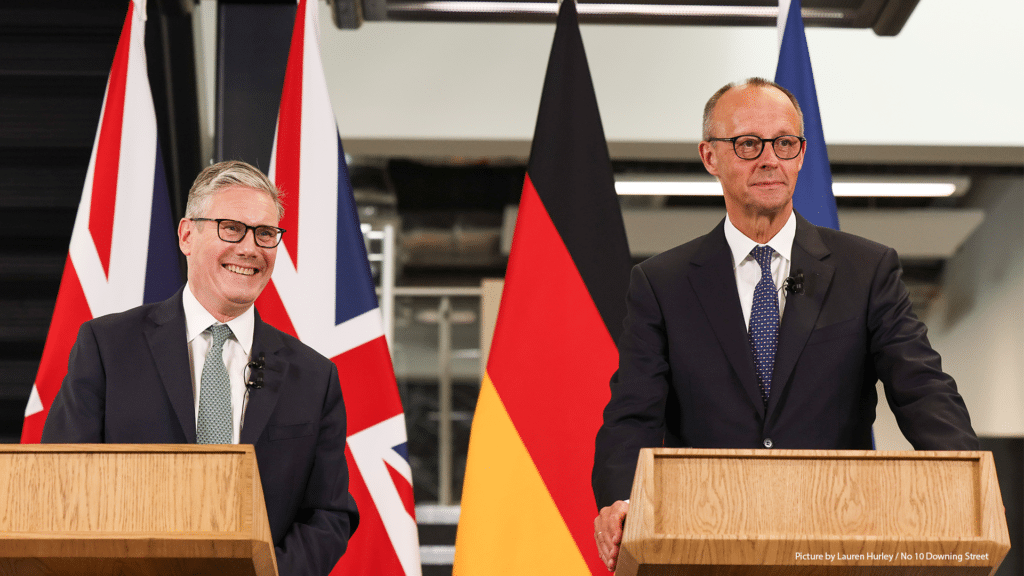
Carolyn Rowe, Ed Turner, Tobias Hofelich and Jannike Wachowiak look at the UK-German relationship since Brexit and consider how the two sides could work more closely together.
The UK’s relationship with Germany is multifaceted, complex and deep. The UK was one of the ‘occupying powers’ after the Second World War. The stationing of British troops in Germany until 2020 created lifelong bonds between people, contributed to cultural exchange, and shaped German institutions. Footballing rivalries are epic, with the hugely successful 2006 World Cup a game-changer in many Brits’ perception of Germany. Yet Britain and Germany did not always see eye-to-eye on matters such as European integration and Prime Minister Margaret Thatcher, fearful of the potential power of a united Germany, was initially sceptical about German reunification. Despite their differences, the two countries were often allies in the European Union, frequently in agreement on questions about trade openness and competitiveness, thus functioning as a counterweight to French and southern European interests.
This changed – dramatically – with Brexit. There was some acrimony towards Germany in the run-up, with British politicians naively expecting then Chancellor Angela Merkel to intervene to give them a better deal in the pre-referendum renegotiation of the terms of membership. But far more profound was German consternation at the UK’s decision, being compared variously (in the many interviews we have conducted for a research project on the UK-German relationship) to a messy relationship break-up, and an act of self-harm. Precisely because of strong German ties to and affinity with the UK, the distress at Brexit was felt by German decision-makers, many of whom had lived and, importantly, studied in Britain, all the more acutely. Throughout the ‘Brexit period’ (from the referendum in 2016 through, at least, to the signing of the Windsor Framework in 2023), the UK’s difficult relationship with the EU had a profoundly negative impact upon bilateral relations with Germany. There was a sense that ‘perfidious Albion’ was seeking to divide and conquer EU member states by looking for bilateral dialogue with them rather than working through the European Commission; there were worries that if the UK got ‘too good’ a Brexit deal, other countries might follow it out of the EU, and European integration, a cornerstone of post-war (West) Germany’s DNA, would be fatally undermined. There was also a strong sense that the UK’s proposed terms of its future relationship were unreasonable, often decried as Rosinenpicken, or ‘cherry picking’. There was fury when the UK failed to honour its commitments in the Withdrawal Agreement and even owned up to a ‘specific and limited’ breach of international law, while Boris Johnson – about as different a politician to Angela Merkel as it was possible to be – was hugely disliked and mistrusted.
Things started to improve with the election Rishi Sunak as Prime Minister, and the signing of the Windsor Framework. The German government, led by the social democratic SPD, welcomed the election of a new Labour government under Sir Keir Starmer in 2024. Labour and SPD politicians had quietly got to know each other in the years before the general election, laying the groundwork for closer bilateral cooperation with security and defence being a point of focus. Starmer’s visit to Berlin, just weeks after his election, in August 2024, kicked off work on a new bilateral treaty. There was a hiatus after the German government collapsed later that year, but the Kensington Treaty was finally agreed in July 2025, promising many new forms of intergovernmental co-operation as well as concrete ‘lighthouse projects’ such as co-operation on defence industrial co-operation, North Sea energy, and irregular migration, and enshrining deeper commitments on defence which had been set out in the Trinity House UK-Germany defence agreement of October 2024.
On its own, though, the Kensington Treaty will achieve little, without ongoing commitment, especially political commitment, in the two countries. It will not be sufficient just to talk at moments of pressing crisis, and consistent investment of time is needed. The various ministerial dialogues set up under the Kensington and Trinity House Treaties will help, however, ministers and officials will have to prioritise areas of engagement, and the ghost of Brexit will continue to lurk in the shadows. For instance, Germany rapidly backed off a bilateral agreement on youth mobility when the EU decided to get involved.
The UK has to tread a careful line, never asking Germany to ‘choose’ between the UK and the EU, but still using bilateral channels to influence the EU, such as securing a more accommodating stance on potential UK membership of the SAFE programme. Narrowly transactional behaviour by the UK in the sense of ‘we give you security, you help us on trade’ will fail. But there are links between different strands of the relationship, with fluid boundaries between different aspects of security such as questions of defence procurement and deployment, shared economic projects and labour mobility. The UK should use these links to create a narrative of mutually beneficial relations and real partnership.
The importance of bilateral trade diplomacy should also not be underestimated: precisely because of the greater complexity in trading relationships in the post-Brexit world, active trade diplomacy is more important than ever, and the Department for Business and Trade needs sufficient capacity to deliver it.
So, what is needed to unleash the potential of the UK-German relationship? Four things stand out. First, it must be understood in Britain that sound relations with the EU form the baseline for bilateral cooperation with Germany. Secondly, there needs to be consistency in political commitment, with full delivery on the Kensington Treaty. Thirdly, dialogue should not just be for ministers and senior officials, but also a wider cast of parliamentarians (recent visits to Berlin by select committees are an excellent start), and other public servants, for instance through secondments. And finally, civil society links are crucial: even though fewer UK schoolchildren are learning German, school and youth trips are more important than they were before Brexit, while sporting and cultural exchange is essential, especially where it reaches parts of society that would not normally be taking city breaks to Berlin or cruising down the Rhine. The commitments made in the Kensington Treaty are welcome. Now, these must be delivered on. In the post-Brexit world with a destabilised transatlantic relationship and war in Europe, strong UK-German relations are more important than ever before.
By Carolyn Rowe, Head of Department, Society & Politics at Aston University and Co-Director of the Aston Centre for Europe; Ed Turner, Reader in Politics at Aston University and Co-Director of the Aston Centre for Europe and acting chair of the International Association for the Study of German Politics; Tobias Hofelich, Research Associate, Aston University; and Jannike Wachowiak, Research Associate, UK in a Changing Europe.
This blog draws on a series of roundtables organised by the Aston Centre for Europe and UK in a Changing Europe in March 2026. The discussions were supported by funding from the German Academic Exchange Service (DAAD).
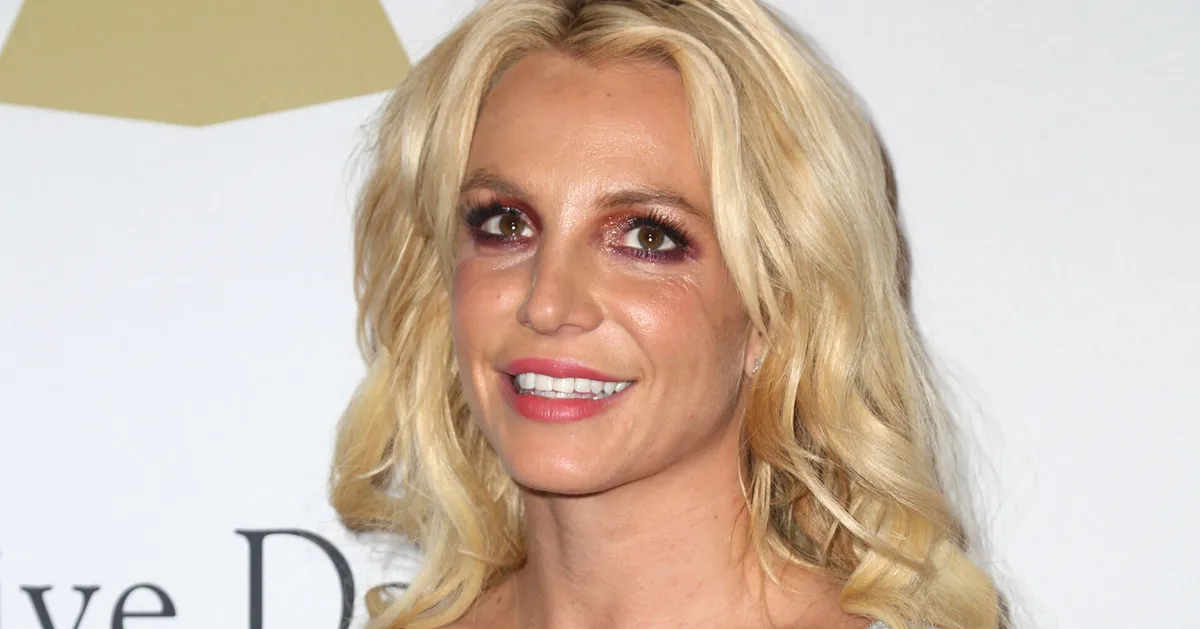
Britney Spears has voluntarily checked herself into rehab, her team has confirmed.
The Grammy-winning singer is currently awaiting a court appearance after being pulled over by the police while driving in California and eventually arrested last month.
On Sunday night, Britney’s representatives told Us Weekly that the Piece Of Me star has now entered herself into a treatment facility.
Following her arrest in March, a spokesperson for Britney told HuffPost UK: “This was an unfortunate incident that is completely inexcusable. Britney is going to take the right steps and comply with the law and hopefully this can be the first step in long overdue change that needs to occur in Britney’s life.
“Hopefully, she can get the help and support she needs during this difficult time. Her boys are going to be spending time with her. Her loved ones are going to come up with an overdue needed plan to set her up for success for well being.”
Since then, Britney has shared a number of Instagram posts depicting herself and her two sons, 19-year-old Jayden James and 20-year-old Sean Preston.
It’s not clear exactly when Britney entered the treatment facility in question, and her most recent Instagram post was uploaded on Saturday.
Britney has had a turbulent few years since being released from the conservatorship she’d been placed under 13 years earlier.
This legal arrangement finally came to an end in 2021, with Britney sharing much of her side of the story in her 2023 memoir The Woman In Me.
In her book, Britney spoke about one experience of being forced into a treatment facility “against my will” for two months, while still under the conservatorship co-run by her father Jamie Spears and her former business manager Lou Taylor, comparing the experience to “torture”.
She also wrote that it was during this rehab stint that she was shown footage of the “Free Britney” movement by a nurse at the facility, encouraging her to formally seek to end the legal arrangement.
Britney is due to appear in court on Monday 4 May concerning her recent arrest.

Soaring oil prices caused by the war in Iran are “going to hurt Donald Trump politically”, according to a BBC expert.
Jo Floto, the broadcaster’s Middle East bureau, said that explained why the US president has announced controversial plans to blockade Iranian ports.
Trump sparked confusion on Sunday when he said the US Navy would stop all ships going in and out of the Strait of Hormuz.
The US military later clarified that while it will blockade of Iranian ports from 2pm on Monday UK time, it will “not impede” ships using the strait to get to or from other countries.
Global oil prices once again rose in response to Trump’s announcement.
On Radio 4′s Today programme, Jo Floto said that was putting further pressure on American household budgets.
He said: “Despite Donald Trump’s knowledge of his own oil production – America is the biggest oil producer, doesn’t need this oil from the Gulf – but the prices are set globally and they’re affecting the pumps in America and that is going to hurt Donald Trump politically.”
Meanwhile, the UK government has confirmed it will not help America carry out its blockade.
A spokesperson said: “We continue to support freedom of navigation and the opening of the Strait of Hormuz, which is urgently needed to support the global economy and the cost of living back home.
“The Strait of Hormuz must not be subject to tolling. We are urgently working with France and other partners to put together a wide coalition to protect freedom of navigation.”
Subscribe to Commons People, the podcast that makes politics easy. Every week, Kevin Schofield and Kate Nicholson unpack the week’s biggest stories to keep you informed. Join us for straightforward analysis of what’s going on at Westminster.
Tata Chemicals, Tata Investment Corp shares rally up to 12% amid Tata Sons IPO buzz

Bitcoin Price Prediction: Arthur Hayes on AI, Oil Price, and War Against Crypto

Katy Perry And Justin Trudeau Enjoy Justin Bieber’s Coachella Set Together


-

 Politics3 days ago
US brings back mandatory military draft registration
-

 Fashion3 days ago
Weekend Open Thread: Veronica Beard
-
 Sports3 days ago
Man United discover Nico Schlotterbeck transfer fee as defender reaches Dortmund agreement
-

 Tech5 days ago
How Long Can You Drive With Expired Registration? What Florida Law Says
-

 Politics18 hours ago
World Cup exit makes Italy enter crisis mode
-

 Crypto World4 days ago
Canary Capital Files SEC Registration for PEPE ETF
-

 Fashion7 days ago
Massimo Dutti Offers Inspiration for Your Summer Mood Board
-

 Business2 days ago
Tesla Model Y Tops China Auto Sales in March 2026 With 39,827 Registrations, Beating Cheaper EVs and Gas Cars
-

 Fashion6 days ago
Let’s Discuss: DEI in 2026
-

 Crypto World5 days ago
Bitcoin recovers as US and Iran Agree a Ceasefire Deal
-

 Politics3 days ago
Malcolm In The Middle OG Turned Down ‘Buckets Of Money’ To Appear In Reboot
-
 NewsBeat10 hours ago
Pep Guardiola and Gary Neville agree over Arsenal title problem that benefits Man City
-

 Business3 days ago
OpenAI Halts Stargate UK Data Centre Project Over Energy Costs and Copyright Row
-

 Business2 days ago
Ireland Fuel Protests Enter Day 5 as Blockades Spark Shortages and Government Prepares Support Package
-

 Tech7 days ago
Haier is betting big that your next TV purchase will be one of these
-

 Tech7 days ago
Gamer Restores the Original PlayStation Portal From Two Decades Ago
-

 Tech7 days ago
Save $130 on the Samsung Galaxy Watch 8 Classic: rotating bezel, sleep coaching, and running coach for $369
-

 Politics3 days ago
LBC Presenter Mocks Trump Over Iran War Failures
-

 Crypto World2 days ago
Federal judge blocks Arizona from bringing criminal charges against Kalshi
-

 Tech7 days ago
Garmin Approach S50 review: a mid-range banger that shoots well below its handicap
You must be logged in to post a comment Login