
Tech
Instagram Users Can Now Edit Comments Within 15 Minutes


Earlier, fixing a comment on Instagram meant deleting it and starting over. Now, Instagram allows users to edit their comments within 15 minutes. This feature works only for comments posted from your own account.
It’s quite a straightforward process to understand and use. All one needs to do is click on the ‘Edit’ button under the comment made, modify the content appearing on the page, and then click on the blue check button. There’s sufficient time allowed for editing within fifteen minutes after posting the comment.
Why This Update Matters
Though the update may seem insignificant and straightforward, it holds great importance. It helps users make modifications without having to delete their comments. It also allows them to improve or update what they wrote. Since comments can appear in different places, like Stories, this feature makes them more flexible and useful.
Meta continues to update its apps with new features. After bringing message editing earlier, it has now added comment editing on Instagram. The company is also testing other updates to enhance the overall user experience and make the platform easier to use.
This feature might look minor, but it makes a real difference. By allowing users to edit comments, Instagram makes the overall experience easier and more convenient.


Age verification became mandatory for chat access on Roblox in January — and Friday morning Quartz reported it’s apparently impacted the company’s financials:
Roblox cut its full-year 2026 bookings forecast by roughly $900 million at the midpoint on Thursday, blaming stronger-than-expected headwinds from its mandatory age-verification rollout on an audience that skews heavily toward children and teenagers. Full-year 2026 bookings are now projected at $7.33 billion to $7.60 billion, a range that sits roughly $900 million below the prior guidance of $8.28 billion to $8.55 billion; analysts had expected $8.38 billion, according to Yahoo Finance. Roblox stock fell almost 22% in premarket trading….
Daily active users rose 35% year over year to 132 million, while hours engaged climbed 43% to 31 billion hours… Daily Active Users and hours engaged fell below forecasts of 143.8 million and 33.68 billion, respectively, according to Yahoo Finance… Users who have not completed age checks have faced restricted communication features, and the process has weighed on the platform’s ability to bring in new users. Russia’s blocking of the platform, which took effect in December 2025, added further drag on user growth, according to Yahoo Finance. As of the end of the first quarter, 51% of global daily active users had completed age verification, with 65% of U.S. users having done so, Roblox said….
The safety push has come with legal costs. Roblox accrued $57 million in the first quarter for settlements and settlement proposals with certain states over youth-related consumer protection and digital safety matters, with payments structured over multiple years, the company said.
Roblox acknowledged in a letter to shareholders that “our aggressive push to enhance safety lowers our expectations for topline growth in 2026.” But they argued that it also “makes our platform fundamentally better and amplifies the long-term growth potential of Roblox through more effective content targeting, tailored communication experiences, and improved community sentiment.”


Isaac Carlton decided one afternoon to tackle a project that most people would dismiss as impossible. He wanted to film the most famous moments from the Apollo moon landings without rockets, without a massive budget, and without stepping outside his own property. The result looks so close to the original NASA footage that viewers keep pausing to check whether they are watching history or something built from scratch in a garage.
Carlton began with a realistic goal: order a replica of the NASA spacesuit. When it arrived, he tried it on and was surprised to find that the fit worked perfectly for close-up photos. The moon’s surface came next. In his garage, he chopped out pieces of Styrofoam, sculpted them into craters and bumps, and then powdered everything with chinchilla bath powder to replicate the texture of lunar dust seen in old photographs. Black drapes obscured the walls, giving the scene a sense of infinite space.
Sale

LEGO Technic NASA Apollo Lunar Roving Vehicle LRV Building Set – Craft Kits for Adults, Ages…
- Build a realistic LEGO Technic lunar rover model – This LRV building kit for adults is packed with authentic details including seats, steering…
- NASA model for adults – Enjoy a mindful project assembling all the details of the rover and equipment including the battery pack, heating and…
- A build for NASA fans – Remember the Apollo 17 mission with a display that features the lunar roving vehicle alongside 3 detailed equipment…

Three different scenes made the final cut, beginning with a bird’s-eye view of the astronauts planting the American flag. Carlton came up with an idea for using stop-motion. He purchased some action figurines, bent thin wire into their limbs to control their positions, and stuffed paper towels into the crevices to make the joints appear smooth as silk under the camera. Each minuscule movement necessitated a new photo, dozens of them, until the flag would raise and wave as it had in 1969.

In contrast, the lunar rover sequence required motion rather than stillness. Carlton purchased a vintage mini rover on eBay and matched it with a remote-controlled buggy he discovered online. He then drove his buggy over the Styrofoam countryside while the camera rolled. Then he combined numerous passes and slowed the footage down to make it appear as if the rover was bouncing across the surface under low gravity. The end effect was eerily similar to the original footage.

The zero-gravity jump from Apollo 16 was likely the most physically difficult. Carlton attached a basic pulley system to the rafters in his garage. He bought an Amazon harness and then asked a couple of friends to pull the ropes for him. They filmed at a snail’s pace to make it appear as if he was floating higher when the ropes hauled him up, and then the editor worked his magic to remove all trace of the cables and mix the takes together so it looked smooth and seamless.

Editing required a significant amount of effort, arguably as much as filming. Carlton and his friend Levi spent hours perfecting the color, adding grain to make it look antique, and painting light scratches to make it look like it was shot sixty years ago. They digitally stretched each set’s boundaries, causing the draperies to disappear. Every wire, contemporary shadow, and telltale trace of a home project disappeared in the editing suite.
Tech
Rivian achieved a 50% lower cost in making the R2 EVs. Let’s hope the benefits pass on to buyers

Rivian may have figured out one of the hardest parts of building an affordable EV, as it has managed to reduce costs in producing one of its upcoming EVs. During the latest earnings call, the company said the upcoming R2 has achieved a cost reduction of more than 50% compared to the R1. With the R2 being made as the more accessible mass-market EV, this is a big deal.

How Rivian found ways to save up
According to InsideEVs, Rivian outlined several ways it brought costs down. The company reduced the R2’s wiring harness by 2.3 miles, cut the number of connectors by 60%, and reduced high-voltage cabling by 70% by consolidating multiple power conversion units into one. The company also simplified its new Maximus Drive unit, which has 41% fewer parts compared to the Enduro drive units used in R1 vehicles. Rivian mounted the inverter directly on the drive unit and used smarter cooling and packaging to cut parts and manufacturing complexity.
All of this sounds like boring manufacturing stuff, but it is making a real difference now. Fewer parts usually mean lower cost, easier assembly, fewer failure points, and better scaling.
The upcoming Rivian R2 is using a simpler mechanical setup, which reportedly helped achieve 70% cost savings on the front suspension by moving from a double-wishbone setup to MacPherson struts.

Meanwhile, large die castings also reduced the underbody part count by 90%, while rear door complexity was cut by 65%. CEO RJ Scaringe expects a reduction of more than 50% through design-for-manufacturing work and higher production volumes. He further added that this is how the company expects to ship the T2 profitably, while also keeping it at a more accessible price point without losing performance and utility.
So what about the buyers?
Rivian has positioned the R2 as a more affordable EV, with a target price around $45,000. But the T2 Performance is expected to kick things off at around $58,000 when deliveries begin. The expected price tag reveals that this isn’t an affordable car, though it is still more approachable than the R1S and R1T, which are positioned as premium models.
A $725bn hyperscaler capex ramp and a 20% HBM price rise have made the South Korean chipmaker the second-most valuable company on the KOSPI. The harder question is when supply catches demand.
There is a small joke in semiconductor circles about which part of an AI server is most expensive. The graphics processor used to be the obvious answer. For the past 18 months, increasingly, it has been the memory soldered next to it.
On Monday, the market priced that joke.
SK Hynix, the South Korean memory specialist that supplies the bulk of the world’s high-bandwidth memory for AI accelerators, climbed as much as 12 per cent in Seoul, with shares hitting roughly 1.4 million won, or about $970, in morning trading, according to Reuters.
The rally made SK Hynix the second-most valuable company on the KOSPI, behind only Samsung Electronics, and reflected, the wire said, foreign buying that followed strong earnings and reaffirmed AI infrastructure plans from US hyperscalers the previous week.
It is, by any measure, a remarkable run for a company most consumers have never heard of.
The trigger is straightforward. Big Tech’s combined 2026 capital expenditure is on track to land somewhere between $650bn and $725bn, depending on which analyst’s tally one trusts, an increase of roughly 77 per cent on 2025.
Microsoft has guided to as much as $190bn for the calendar year, with its chief financial officer publicly attributing about $25bn of that to rising memory-chip and component costs.
Meta, in its Q1 update, raised its own range to $125–145bn, citing similar pressures. Amazon’s Andy Jassy has committed roughly $200bn. Google has not been quieter. Practically all of this money flows, in one form or another, towards AI training and inference clusters; a meaningful share of it lands in the bill of materials for high-bandwidth memory, where SK Hynix dominates.
By late 2025, SK Hynix held an estimated 57 per cent of the global HBM market, according to figures cited by analysts at Counterpoint and others. That share is unusually concentrated for a commodity-adjacent business, and it is the structural reason the company’s earnings now look more like those of a software platform than a memory house.
SK Hynix’s first-quarter operating profit, reported on 23 April, was a record. Operating margins on its memory line, by some sell-side estimates, are running above 70 per cent.
Margins of that order do not last forever. They do, however, last as long as supply lags demand.
Why supply is not catching up
HBM is not ordinary DRAM. It is a stacked, 3D-packaged memory built to feed bandwidth-hungry GPUs, and producing it requires a specific set of advanced packaging steps that the industry, including Samsung and Micron, has been slower to scale than buyers would like.
According to TrendForce, both Samsung and SK Hynix have raised HBM3E prices by roughly 20 per cent for 2026, and supply is being booked years in advance by hyperscalers and accelerator vendors.
Samsung’s memory chief publicly warned earlier this year that significant memory shortages were likely to persist through 2027. The chairman of SK Group has gone further, telling investors he expects the wider chip-wafer constraint to last until 2030.
Whether or not those forecasts prove accurate, they explain why long-term supply agreements, in which a hyperscaler effectively reserves output years ahead, are becoming the norm. They also explain why Reuters reports SK Hynix and Samsung increasingly signing such deals with Microsoft and Google directly.
There are, in other words, two kinds of memory in 2026: the kind anyone can buy, and the kind your AI roadmap depends on. SK Hynix is in the second business.
There are, predictably, dissenters. The CAPE ratio on US equities now sits around 38, a level last seen at the height of the dot-com era, and TNW has noted the discomfort that comparison provokes, even as it argues that today’s leading AI-exposed companies are, unlike many in 2000, broadly profitable.
SK Hynix is squarely in that profitable cohort, but it is also unusually leveraged to a single product cycle. If hyperscaler capex moderates, or if competing accelerator architectures reduce HBM intensity per chip, the same operating leverage that has delivered record quarters could work in the opposite direction.
There is also the question of whether the AI build-out will keep producing the kind of returns that justify present capex levels. Meta has been simultaneously announcing record AI investment and cutting roughly 8,000 jobs as it restructures around the spending, a sequence that does not entirely fit the narrative of a healthy organic boom. Investors are, for now, willing to fund both ends of that equation. They have done so before in technology cycles, and they have changed their minds quickly.
The most useful way to read SK Hynix’s 12 per cent move is not as a forecast of where AI ends up, but as a real-time index of how confident the market currently is that AI training clusters will keep being built at this pace. Every dollar of hyperscaler capex announced becomes, eventually, an order book line at a memory supplier. SK Hynix sits in the chokepoint.
If the chokepoint loosens, through Samsung executing on HBM4 at scale, through Micron’s $25bn capacity push, or through architectural shifts that reduce HBM dependency, the dominant share gets shared and the multiples compress. None of those things has happened yet.
Until one does, the market’s read is that the second-largest company on the KOSPI is the one selling shovels to the AI gold rush, and it is not running out of buyers.
The harder, more interesting question is what the chart looks like a year from now. The answer will say less about SK Hynix than about whether the AI build-out has legs, and whether the people writing the cheques in Redmond, Menlo Park, and Seattle are still as certain as they were last week.
Tech
Meta contractor fires 1,100 AI trainers after they revealed Ray-Ban glasses recorded private and intimate footage


Meta has quietly ended its relationship with a vendor that helped train its generative AI systems using footage captured through Ray-Ban smart glasses. The contractor, Sama, subsequently announced the termination of 1,108 employees – some of whom alleged they were punished after coming forward about the sensitive nature of the…
Read Entire Article
Source link

A Chinese creator has built a walk-in PC that turns desktop cooling into a human-scale spectacle. The fish-tank-style tower has enough room for a person, a compact desk, and a gaming setup, making the creator look like one of the tiny figures builders sometimes place inside flashy cases.
The build comes from TechTuber Soda Baka, who shared the project on Bilibili. It scales up familiar PC modding cues, including wall-sized fan housings, a huge graphics card prop, chunky cooler parts, and plenty of RGB lighting.
The size gets attention first, but the sealed enclosure soon becomes a heat trap.
The giant parts are mostly props
Soda Baka’s build starts like a serious PC project, with sketching, modeling, and fabrication before the frame comes together. The finished tower looks like an extreme version of the glass-heavy desktop cases that put every component on display.

Most of the human-scale hardware is built for show. The oversized fans, GPU, RAM sticks, and liquid cooler pieces appear to be nonfunctional, while working PC gear gives the creator something to use once he sits down at the desk.
The absurdity is carefully staged. Its size sells the illusion without pretending this is a practical computer anyone should recreate at home.
Why the AC matters
The air conditioner becomes the key component once the sealed enclosure starts heating up. To mimic a PC’s thermal problem at room scale, the creator uses hot-coal sauna gear and water to push the interior above 100 degrees Fahrenheit, or 38 degrees Celsius.

With the huge fans and coolers serving as set dressing, the build relies on a 12kW AC unit with claimed 820 cubic meters per hour of air circulation. The joke only works because the AC does the job the fake cooling hardware can’t.
What to watch next
The build looks more like a promo stunt than a mod worth copying. It may also be tied to an air conditioner sponsorship, though it isn’t fully confirmed.
For actual PC builders, the useful lesson is narrower and more practical. Glass-heavy cases, dense layouts, and sealed spaces all need a real airflow plan before heat becomes the limiting factor. Start with intake, exhaust, and component clearance before chasing the look.

A Wall Street Journal opinion piece warns of “a troubling trend” in AI’s growth. “Rather than selling software, some AI companies are paying their partners to use it.”
It cites OpenAI’s $1.5 billion joint venture with private-equity firms, Anthropic’s $200 million contribution to a private-equity firm joint venture, and Google’s $750 million subsidization of Gemini’s adoption by consulting firms. “These agreements muddy the distinction between a company’s sound growth trajectory and artificial financial engineering.”
[T]he scale and structure of the recent AI deals go beyond standard incentive mechanisms… When a seller pays customers to buy its products, it is unclear if its revenue growth reflects vibrant demand or a willingness to accept subsidies.
Slashdot reader destinyland writes:
This warning comes from a prominent figure in the investing community. For six years Robert Pozen was chairman of America’s oldest mutual fund company, after five years at Fidelity. An advocate for corporate governance, he’s currently a lecturer at MIT’s business school (and the author of the book Remote Inc.: How to Thrive at Work…Wherever You Are). “As AI companies prepare initial public offerings, investors should scrutinize their numbers closely,” Pozner writes, warning about “time-limited financial support”.
“In evaluating AI sales figures, analysts should consider the distorted incentives that the recent financing deals create,” writes Pozner:
Private-equity firms, enticed by promised returns, might demand rapid rollouts of AI products, rather than ensuring their orderly and safe development. Portfolio companies of private-equity firms may embrace AI tools not because they are needed but because adoption is mandated by their owners. Consultants may favor one set of AI models based on the subsidy instead of the merits.
If guarantees and subsidies are major factors in the rapid adoption of AI tools, investors should be skeptical of AI companies’ revenue projections. Many of their customers enticed by consultants will stop paying full price when the financial incentives are gone. Many of the portfolio companies of private-equity firms could back away from selected AI tools once these joint ventures expire. The challenge with evaluating these AI financing deals is the lack of transparency. At present, AI vendors don’t separate revenue driven by subsidies or joint ventures from standard sales.
The lesson from the telecom debacle is that financial engineering can obscure, for years, the difference between real customer demand and demand driven by incentives. When AI companies begin to finance their own product distribution, guaranteeing returns to investors and subsidizing sales, it’s a signal for investors to dig deeper.
Investing in an AI company? Ask what percentage of enterprise revenue is coming from subsidized channels or joint ventures, Pozner suggests. And the renewal/retention rate for customers not supported by subsidies or joint ventures…
Most tech roles saw salary growth, but not all benefited equally
2025 marked a turning point for the tech industry. After several years of layoffs, cautious hiring, and uncertainty, the sector is showing signs of recovery across the region.
At the same time, companies are rethinking how they prioritise and value talent. Artificial intelligence (AI) is no longer just a talking point—it’s now embedded in hiring priorities, day-to-day workflows, and compensation, as highlighted in Nodeflair’s latest annual tech salary report.
This year’s data, released today (May 4), shows that engineers with AI skills are earning meaningfully more than their peers, with some seeing pay bumps of up to 25%. At the same time, senior engineers continue to pull ahead, as companies place greater value on judgment, architecture, autonomy, and the ability to work effectively with AI tools.
In effect, AI is reshaping the tech career ladder and rewarding stronger problem-solvers at every level. Here is a breakdown of the report and the overall compensation changes for tech roles in Singapore, detailed by role and seniority:
[Disclaimer: Salary data are derived from Nodeflair’s proprietary database of over 130,000 data points, including user submissions that are verified by documents (payslips and offer letters) as well as job advertisements from various job portals. While a majority of the entries are backed by a sizeable amount of data, Nodeflair has flagged out entries with less than 200 data points as potentially lacking accuracy.]
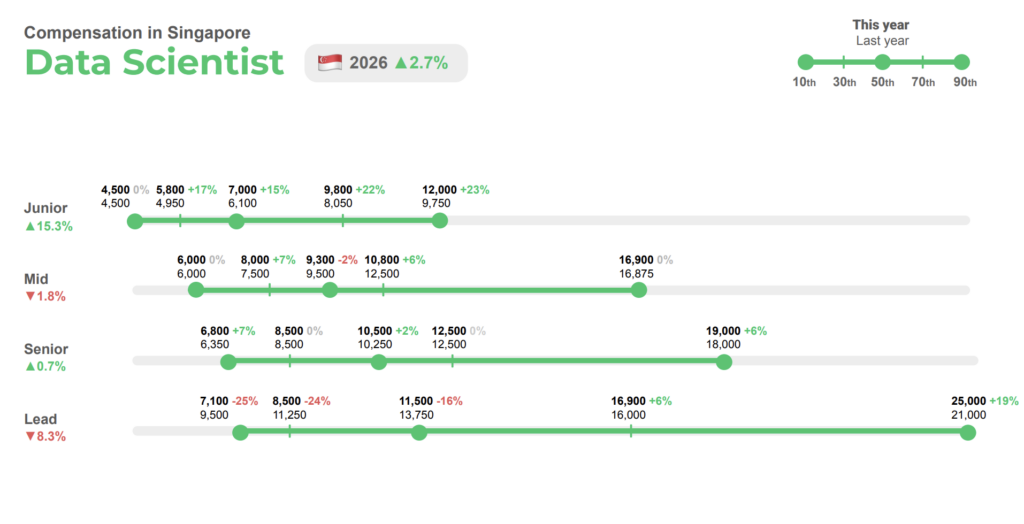
Data scientists are the highest-paid, earning up to S$25K per month
Based on salary data from NodeFlair’s proprietary database, lead data scientists are the highest-paid role. Despite an overall 8.3% decline, they still command a median monthly salary of S$25,000.

Meanwhile, software engineer managers earn up to S$20,100 per month, marking a 10.8% increase as compared to the previous year.

Senior solutions engineers earn a median monthly salary of S$18,500, followed closely by senior product managers at S$18,100. Other top roles include lead mobile engineers at S$16,900, lead data engineers at S$16,000, and platform (DevOps & SRE) leads at S$15,200.


Roles at S$15,000 and below include lead cybersecurity engineers, lead data analysts, systems & IT leads, and senior quality assurance engineers.


On average, senior roles saw the strongest salary growth, with pay rising 12.6%. Lead roles followed at 11.6%, while manager roles increased by 10.8%.
By contrast, mid-level and junior roles recorded more modest gains, with average salary increases of 1.7% and 5.3%, respectively.
AI skills pay off
Beyond providing salary data, NodeFlair’s report highlighted a widening pay gap between engineers with and without AI skills.
Its analysis of 50th percentile software engineers shows that AI-native talent is being paid a clear premium.

The data found that junior software engineers (zero to two years of experience) with AI skills saw a 25% pay bump at the median, earning S$6,000 per month compared to S$4,800 for those without AI skills.
Among mid-level engineers (two to five years of experience), those with AI skills earned 13% more at the 50th percentile—S$8,000 versus S$7,100 for their non-AI peers.
At the senior level (more than five years of experience), engineers with AI skills earned 18% more at the median, taking home S$10,000 compared with S$8,500 for those without.
AI fluency is no longer a nice-to-have—it’s now a salary advantage
Ethan Ang, Nodeflair founder
“With the rise of tools like Claude Code and a broader wave of agentic coding workflows, engineering teams are now rethinking how software gets built around AI, including placing greater value on engineers who are truly AI-native,” he added.
- Read more articles we’ve written on Singapore’s job trends here.
Featured Image Credit: Shadow_of_light/ depositphotos

Trust in online payments has never been as important as it is right now. For anyone who spends money across digital platforms, the tools we use to pay can shape the entire experience. Digital wallets stand out as more than a payment method, they’re a foundation for how fast, safe, and convenient every transaction can feel. Convenience might look like a buzzword, but for online shoppers, it’s the difference between an immediate purchase and a drawn-out checkout that breaks the flow.
Speed and flexibility are at the center of this shift. Today’s gamers, content subscribers, and e-commerce buyers have come to expect instant access, not just to their products, but to funds as well. Digital wallets answer the call, letting users transfer, store, and spend money in ways that traditional cards or slow bank payments can’t match. For those looking to stretch their value further, methods to buy Razer Gold online show how funding a wallet can help unlock exclusive game items, bonus points, or discounted content across many platforms.
Traditional payment routes come with friction. Waiting on transfers, dealing with surprise foreign transaction fees, and entering card information again for each new site can stretch a simple moment into a tedious process. Digital wallets cut this down to a few taps or clicks. They unify purchase histories, hold multiple payment options, and mask your actual card number, drastically reducing fraud risk. These perks are not only attractive, they’re quickly becoming essential for buyers who value both privacy and speed.

When looking for digital games, players often do a quick search only to find that platform stores like the PlayStation Store may have high prices or regional restrictions. Eneba gives those shopping for new titles or DLC a much wider range of game keys, often below standard store prices. Game keys are unique codes that can be redeemed for full games or content, buy a PlayStation code on Eneba, redeem it in your account, and the game appears in your library instantly. The catalog is vast, with instant code delivery, clear info about global versus region-locked content, and a support system in place. Gift cards for Xbox, PSN, and Steam are also available, turning top-ups into a hassle-free option. Crucially, Eneba verifies its merchants and maintains compliance checks so the buying experience is safe and reliable.
Digital wallets don’t just serve gamers, though. They unlock new ways to handle subscriptions, buy digital art, or access streaming services. Their real appeal is in how they make every transaction less of a process and more of a click. This shift in user expectation is subtle but profound, echoing through every part of digital commerce.
Security has become a hot topic. Payment fraud, identity theft, and data breaches drive demand for alternatives to typing out full card details. Digital wallets blend strong encryption with multi-factor authentication. These layers of protection help users manage risk without adding complexity to already busy lives. For those spending on unfamiliar sites, using a wallet adds an extra safeguard, keeping personal details out of harm’s way.
The integration of reward systems is another reason digital wallets have become staples for online buyers. Topping up with game-specific currency or third-party credits can give you cashback, bonus points, or early access offers. This builds loyalty without forcing users to stick to just one shop or ecosystem.
Digital wallets continue to grow by adapting to what users want next: more currencies, more integrations, and fewer barriers between platforms and regions. Their evolution keeps driving innovation, not just for gaming but for all forms of online spending.
Digital marketplaces like Eneba offering deals on all things digital have helped refine what buyers now expect from every online purchase: instant, secure, and tailored to their needs. As competition heats up, it’s clear that digital wallets are here to shape the future of online transactions.


The Dassault Mirage 2000-9 has served as the UAEAF’s interceptor for over two decades, filling a few gaps that the country’s prevailing jet, the F-16, cannot. But it’s on its way out, soon to be replaced with another, more capable model from the same manufacturer.
That replacement is the Rafale F4, the latest production standard of Dassault’s twin-jet fighter aircraft. The Emiratis have gone all in on it too, signing for a whopping 80 units back in December 2021. The contract was worth $18 billion, though that figure also included 12 Caracal helicopters — the French military version of the Airbus Super Puma. It was such a big win for the French that Macron himself reportedly flew over to seal the deal. In fact, it remains the largest international Rafale order ever placed. The first unit was unveiled at the company’s flight test center in January 2025, with deliveries scheduled for late 2026.
Ironically, the UAE had rebuffed an earlier French pitch for 60 Rafales in 2011. At the time, it had its sights on the Lockheed Martin F-35. But they had to circle back to the Rafales, though, when Washington itself stalled the F-35 deal, allegedly over concerns that the UAE was using Huawei 5G gear nationwide.
Whether that’s a loss for the UAE is debatable, though, because the F4 jets being delivered are the most up-to-date version of the Rafale family. They feature upgrades like improved fire protection and avoidance systems, enhanced frontal optronics, and more. Demand for the variant is high, which is why production is being pushed hard to keep up, with Dassault having completed its 300th Rafale fighter jet in October 2025.
Where the Mirages go next
So it’s in with the new and out with the old for the UAE, but what about these older jets? The UAEAF flies roughly 59 of them today, across two main types. 44 are fighter variants for actual combat, while the remaining 15 are two-seat trainers that bring new pilots up to speed. They can’t all simply be scrapped, especially since they remain airworthy. On top of that, Dassault has confirmed industrial support for the platform beyond 2035.
Initially, when the deal was signed in 2021, the plan was to hand over half the fleet to Morocco’s Royal Armed Forces. But getting that across the line has been a slog. The thing is, the original 1998 contract gave France veto power over any re-export of the jets, which it initially used to block the move altogether. Fortunately for Morocco, the veto was eventually lifted in early 2024, helped along by Macron’s formal recognition of Morocco’s sovereignty over Western Sahara that July. But then the next hurdle arrived in the form of the Iran war in February 2026. That’s when the UAE decided to hold onto its Mirages, at least until the Rafales were fully integrated.
How do the two compare?
The Mirage 2000 is one of the most agile jets today, so it’s certainly no slouch, especially with the 2000-9 variant upgrades. In fact, these upgrades are UAE-exclusive, developed specifically for the nation as a derivative of the older 2000-5. Its central computer is actually very similar in capability to the Rafale, too. Size-wise, it measures around 47 feet long with a wingspan just under 30 feet. Speed tops out at Mach 2.2, and the service ceiling sits at roughly 54,000 feet. Its arsenal includes MBDA’s Black Shahine cruise missile alongside Mica NG air-to-air missiles.
But the Rafale F4 plays in a different class. It’s a touch bigger overall, stretching about 50 feet long with a wider 36-foot wingspan. It also runs on two engines rather than the Mirage’s single turbofan, giving it more thrust and a useful bit of redundancy if one of them fails. Notably, the Rafale is slightly slower than its older sibling, topping out at Mach 1.8 with a service ceiling of around 50,000 feet. But it makes up for that with its arsenal, comprising Meteor long-range air-to-air missiles, the Hammer precision strike kit, and Scalp cruise missiles for deep targets. Stealth and survivability are a step up, too.

Clarity Act Update: Industry Leader Says Crypto Market Is ‘Fine’ Despite Deadlock

Woodland walks cut anxiety, study finds

Wall Street Breakfast Podcast: GameStop Adds eBay To Cart

Manchester United reach agreement with Casemiro over contract clause amid transfer speculation

US brings back mandatory military draft registration

Steven Gerrard disagrees with Gary Neville over ‘shock’ Chelsea and Arsenal claim | Football

Taking Surprise Delivery Of THAR ROXX | Value For Money Variant #mahindrathar #roxx #thar #tharrox

RIPPLE PRESIDENT IS DONE?!?! HUGE XRP BOMBSHELL ON STAGE…

CA Final May 2026 Financial Reporting Paper Review | How Was Today’s Exam ?
-

 Tech7 days ago
Register Renaming | Hackaday
-

 Politics7 days ago
Drax board avoid their own AGM, accused of greenwashing & environmental racism
-

 Fashion5 days ago
Kylie Jenner’s KHY Enters a New Era with ‘Born in LA’
-

 Tech7 days ago
Images of Samsung’s rumored smart glasses have leaked
-

 NewsBeat17 hours ago
Channel 5 – All Creatures Great and Small series 7 new post
-
 Tech3 days ago
Trump’s 25% EU auto tariff breaches Turnberry Agreement that also covers semiconductors and digital trade
-

 Business6 days ago
Most Commercial Energy Audits Miss the Real Losses
-

 Business7 days ago
(VIDEO) Charlize Theron Climbs Times Square Billboard to Promote New Netflix Thriller ‘Apex’
-

 Crypto World6 days ago
CFTC’s AI will review U.S. crypto registration applications, chairman tells CoinDesk
-
 Sports3 days ago
Paul Scholes issues Marcus Rashford reality check as agreement emerges over Man United star
-
 Entertainment7 days ago
Alicia Keys Calls Out Music Industry ‘Boys Club’
-

 Business5 days ago
Barclay Brothers Avoid Bankruptcy: HSBC Drops High Court Petitions After IVA Deal
-
 Business5 days ago
Tesla Officially Registers Elon Musk’s Stock: What Investors Need to Know
-

 Tech6 days ago
Get Ready for More Brain-Scanning Consumer Gadgets
-
 Crypto World6 days ago
Robinhood Phishing Scam Exploits Gmail Dot Feature to Bypass Security
-

 Entertainment7 days ago
Sister Wives: Janelle Posts New Scary Warning
-

 Crypto World6 days ago
Gmail Dot Trick Underpins Robinhood Phishing, Sending Real-Looking Emails
-

 Entertainment6 days ago
Michael Jackson’s Biopic Excluded Abuse Allegations For $25M
-

 Business3 days ago
Two Powerball Tickets Split $143 Million Jackpot in Indiana and Kansas
-

 Business6 days ago
Superdry co-founder accused of raping woman
You must be logged in to post a comment Login