
Politics
Our survey: Members convincingly back the new Conservative policy of banning under 16s from social media

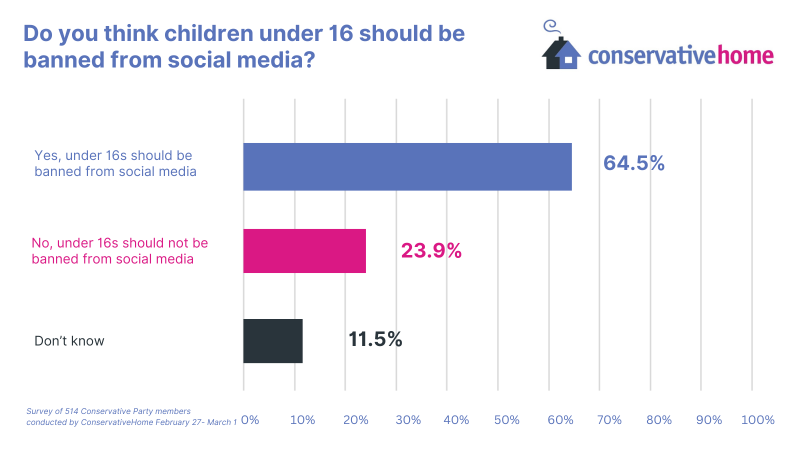
That 64.5 percent of our members survey are in favour of banning under 16’s from social media is quite a sea change. Societally it has ‘something of a journey.’
I have been on it.
Two of my children are over 16. The eldest in their twenties, the second late teens. And they loved and still love their screens.
I definitely allowed a smart phone too soon, and know that it’s my fault when I observe even today that they can spend way too much time just looking at their phones. When they were younger I was using Twitter extensively for work, so I was just as bad, and my example was not a good one. I mention my kids because there is a symbiosis of their generation with the whole phenomenon of social media.
Twitter (now X) and Facebook (Meta) – certainly not the prime choice of today’s younger generation – are now the ‘grandads of social media’ and they are still only 20 and 22 years old. Now there’s Tik-Tok, Instagram, and Snapchat, who if they were children under the ban the Conservatives are looking at for under 16’s would not be able to use themselves as they are way too young!
These companies grew up with my kids. And I was just as fascinated by it.
Early adopters of social media were constantly learning and finding new ways to use it. Experimenting with how different behaviours and styles could be created, which say the advent of the meme, the ‘sh*tpost’, ratioing, YOLO, ROFL and now a lexicon of user generated slang, methods and motivations that would making learning Hungarian seem easy.
However all the time the developers and owners, of these increasingly powerful behemoths were learning all about us. And we handed so much to them without giving it a second thought or every wondering what that might ultimately mean.
This is not a piece about Digital ID, but one of the biggest arguments levelled at the idea is that we already effectively have it. All packaged up in those ever more sophisticated slices of metal and plastic we seem not to be able to do without, we constantly spray out data we often have no idea we’ve tacitly agreed to give away.
Nine years ago I started working at the Office of the Children’s Commissioner for England under Anne Longfield, and then Dame Rachel de Souza. The single most common question we were asked by politicians, the media, teachers, just ordinary members of the public either officially or just privately was “do you think it’s ok for my kids to be spending so much time online, on their phones?”
The answer by the way is less about time and quantity, but light touch supervision and quality, but that’s never going to be and effective slogan. Besides we did not believe ‘it was ok’ but not everyone agreed. Age verification became a battle over adult privacy. Privacy primacy became a locked door to the investigation of grooming, abuse, county lines drug running, exploitation and bullying and a whole host of very dark stuff that had nasty, sometimes fatal real world consequences.
The companies always fielded their ‘heads of responsibility’ or some such with bountiful and seemingly sincere claims of taking child safety more seriously than anything else. It was transparently untrue. Yes, they did take it seriously but not whenever is clashed with exponential company growth and market share. Then for a variety of reasons having said they’d stop at nothing to make their social media worlds safer, they stopped and did nothing if it was really going to hurt the ‘bottom line’.
Yesterday the BBC made a good attempt to prove this. They had talked to whistleblowers inside the companies Meta and Tik-Tok who all told the same story: push the boundaries of acceptable content because ‘outrage drove engagement’.
One ‘engineer’ described orders from above to allow more borderline harmful content in users feeds:
“They sort of told us that it’s because the stock price is down”
Times have changed. My youngest child is 7. His mother doesn’t want him having more than quite strictly rationed screen time, no smart phone for some time, and – to show my age and how things sometimes go full circle – for us to emulate the iconic Jerry Lee Lewis-esque theme song to 80s children’s TV classic “Why don’t you?”
Yesterday the Government had Keir Starmer himself tweeting about the BBC story and how much he’s personally determined to tackle the problem.
The Conservative Party has changed. A past reticence about taking on the platforms than can sway voters opinions, a nervousness about how far any Online Safety legislation should go, seems to have been shelved in the face of public concern, and mounting solid evidence. Kemi Badenoch and shadow education secretary Laura Trott, have been determined that whatever the previous position may have been the party would now ban under 16s from using social media because of the damage it can cause.
There are still voices that say this is intolerable interference in freedom of choice, state interference in people’s privacy and I’m not going to argue they don’t have valid points, indeed some may make the case on ConservativeHome, but it seems many people have just moved on.
That includes Conservative Party Members.
Our February ConservativeHome survey produced convincing backing for the banning of under 16s from social media.
Now let’s be honest many of our members are not teens wanting to use social media, far from it, but they do care about freedom of choice and have less nanny-statism. But 64.5 percent of responders said the policy was the right one. Just 23.9 percent said no. That’s still nearly a quarter, but with don’t knows at just 11.5 percent it’s pretty decisive.
The key, as always is how you enforce it? However from work done some years ago across a range of child protection pilots in the online sphere, the harder you made it, the more socially acceptable it was not to be involved at all. The more you not only prevented it, the more young people got over their thirst for it in the first place. Not all, probably never all, but most.
It is why most schools in some form or another do actually ban the use of mobile phones in school hours, and have done so for some time, and why banning them altogether from schools makes sense.
The policy is a step change from what I saw outside the last government but looking in and worth pointing out to those who say change is beyond the party, a marked change from where they were before.
It would seem members are broadly happy with that, too.


Donald Trump could be pressured to de-escalate tensions in Iran either by military leaders or Republicans in Congress, according to a US national security analyst.
The president issued an expletive-laden rant at Iran over the weekend, threatening to bomb civilian infrastructure unless it opens the oil shipping lane – the Strait of Hormuz – before his self-imposed deadline tonight.
Ben Rhodes, who served as the deputy US national security adviser under Barack Obama, said Trump was operating outside of the usual checks and balances US presidents usually rely on.
He told BBC Radio 4′s Today programme: “It increasingly feels like at times, not all the times but at times, it is one man in one room making decisions or making threats and a government adjusting to that.
“We’re seeing a lack of expertise, a lack of thinking even two steps ahead, and I think that’s probably a sign they’re not following the normal process.”
“It’s kind of frightening really,” Rhodes added, pointing to the senior figures within the first Trump administration who stood up to the president.
Trump said: “This time, on the military side, with the selection of Pete Hegseth, he got the secretary [of defence] he wanted. Someone who principally would just follow Trump’s directive and be something of a spokesperson for them.
“Frankly, I think the checks are going to come from external sources.”
Rhodes suggested now it might all come down to Republicans in Congress who are “terrified about the political unpopularity of this war, from the markets and stock markets Trump pays attention to”.
He said he believes they will have more impact at “restraining Trump” than any process within the Pentagon or government.
Rhodes also claimed he hopes military leaders will pressure the president behind the scenes as Trump continues to threaten “absolute war crimes”.
“It’s a very important test really if the US military is willing to say no to Trump. He didn’t like it when they said no to him in the first term,” Rhodes said.
“There’s no way around the fact that we may be approaching that point because the war itself, I would argue, may be illegal but these things he’s threatening are clear war crimes.”
But the specialist warned Trump has set so many objectives for this war so will be pushing for a victory of some sorts.
“That is not something the Iranians are going to give him, right, because they control the strait,” Rhodes added.
He said they would most likely to have to resolve the war over negotiations with other countries around the table.
Subscribe to Commons People, the podcast that makes politics easy. Every week, Kevin Schofield and Kate Nicholson unpack the week’s biggest stories to keep you informed. Join us for straightforward analysis of what’s going on at Westminster.

The signs started appearing on telephone poles around town: simple black-and-white flyers of Drew Barrymore screaming with “Gay Screaming Society” in bold across the top, a date and location on the New Orleans lakefront.
“Look for the gay people,” the flyer instructed.
It wasn’t exactly difficult to find the hundreds of gays and theys who showed up to scream that day at Lake Pontchartrain. We chatted a bit and then a couple of people with megaphones prompted us to scream. And we did.
Two hundred queers, some in clown casual, some in their Sunday best, all screamed together at the sunset-dappled lake. We screamed and screamed and screamed. There was no why. We all knew why. Because, life. Because, Amerikkka and its current incarnations of bigotry. Because, everything.
I screamed so long and hard and loud that my throat was scratchy for days, but I felt amazing. It was as though the tight fist of my body had finally let go. I had to know more. I asked everyone who was “in charge.”
“It’s a movement,” someone told me. “No one knows who organises it,” someone else said. “It’s global,” someone else said.
No one knew who I could talk to about the mysterious Gay Screaming Society. The people with megaphones had melted into the larger body of queers, and for the life of me, I couldn’t remember anything about them. They were ageless, genderless gays. A total mystery.
“There was a mythology that sort of self-created,” says Lindsey Baker, a talent and promotions agent in New Orleans who co-organizes Gay Screaming. Baker doesn’t really remember who had the idea, and neither does her co-conspirator, Austin Davenport, a therapist in New Orleans. One of them saw an article about people screaming at the lakefront in Chicago and texted the other. “This,” they wrote, “but make it gay.”
“With the current state of affairs, we wanted to have an opportunity for people to gather and do something that they already do in their cars or into a pillow,” says Davenport. “We wanted to invite that similar release into a gathering.” Davenport and Baker weren’t trying to force people to have a specific kind of release, though. “There were tears,” they say, “ but I saw a lot of laughter too.”

Photo: Tracey Anne Duncan
Gay Screaming is kind of an anomaly, an experiment in queer community building for which the only intention is to be together, to feel our embodied togetherness with no pressure to be nice or look good, no anxiety about solving anything, spending money, or getting laid. That was intentional, Baker says. “It wasn’t a party situation. It wasn’t a work thing. It was just, like, we’re just doing this fuck-ass shit and it feels so good,” Baker says.
Gay Screaming is serving togetherness right on time. In 2025, 867 anti-LGBTQ+ bills were introduced, the most in US history, the vast majority targeting trans people. For context, there were just over 100 in 2020.
And among LGBTQ+ Americans ages 13-24, self-reported anxiety rose from 57% to 68%, depression from 48% to 54%, and suicidal ideation from 41% to 47% between 2023 and 2025, according to the Trevor Project. Add to that the fact that access to desired mental health care dropped from 80% to 60% among those in crisis in the same period and what you have is a queer mental health crisis. These facts, combined with the general collapse of democracy, are really good reasons to scream.
Davenport agrees. “The target on on trans and queer people right now is so palpable. The discourse is ugly and hateful towards queer and trans people,” they say, referring to legislative attacks on LGBTQ+ people and the surge of conservatism in the U.S. Baker adds that she wants to use her skills and resources to make something for queer people who need an outlet. “I have privileges,” she says, “And I want to help create space for people.”
Baker and Davenport wanted people to be able to tell they weren’t being invited to something that would put a target on their backs, they explain. “We had conversations about how we were going to organise this in a way that would not attract too much unwanted attention,” says Davenport. That’s why the flyers contain no names or social media handles or even a specific address. They posted them in public places where queer people are likely to be and trusted us to pass it on the way gays have always done, by word of mouth.
And it worked. No less than half a dozen people texted me pics of the flyer weeks before the event. It was on all our calendars. “I just wanted to attract the gays in a way that feels safe,” Baker laughs when I tell her about the mythos that built up around the event.
One of the most surprising things about this event is that it seems to offer something that gays of all ages need. I brought one of my queer elders with me to scream, and when I arrived, I saw people from every generation, including some teens or tweens holding hands with their own elders, who look like kids to me.
The tagline for Gay Screaming is, “Come for the scream and stay for the fellowship,” and that is the best way to sum up the complexity of the vibe. We came, we screamed, we laughed, we cried. Someone had a birthday party picnic in the grass. A few college students I know from a pandemic-era online dance party invited me to hang, but when I told them I needed a nap, everyone nodded. I have to be rested up for the next Gay Scream.
“You can just come and scream and fucking leave,” Baker says. “Some people do that, some people linger. Both are very cool.”
Help and support:

Iran has claimed Donald Trump’s threat to attack its civilian infrastructure “constitute war crimes”.
The president threatened to strike Iranian power plants and bridges in a foul-mouthed rant on Sunday if Tehran did not open the Strait of Hormuz.
Approximately one fifth of the world’s oil supply passes through the waterway, but Iran effectively blocked the shipping lane after the US and Israeli bombings against the country began at the end of February.
Subsequent economic pressure has seen the president grow increasingly irate.
He said on Saturday that “all hell would reign down” if Tehran did not re-open the strait within 48 hours, and on Sunday he listed all of the civilian targets the US would go after.
He said: “Tuesday will be Power Plant Day, and Bridge Day, all wrapped up in one, in Iran. There will be nothing like it!!! Open the Fuckin’ Strait, you crazy bastards, or you’ll be living in Hell – JUST WATCH! Praise be to Allah.”
Iran’s deputy foreign minister Kazem Gharibabadi claimed on Monday that Trump’s threats “constitute war crimes” and a “flagrant violation of Article 2(4) of the United Nations Charter”.
He added that Iran will deliver a “decisive, immediate and regret-inducing response to any aggression or imminent threat”.
An earlier statement from the spokesperson for Iran’s highest operational military command unit, Khatam al-Anbiya Central Headquarters, also warned: “If attacks on civilian targets are repeated, the next stages of offensive and retaliatory operations will be much more devastating and widespread.”
Tom Fletcher, the UN’s under-secretary general for humanitarian affairs told the BBC: “This stuff isn’t negotiable. You don’t hit civilian infrastructure. You don’t hit schools, you don’t hit energy sources, you don’t hit bridges. Those are war crimes. That is absolutely clear in international law.
“But somewhere along the way we seem to have thrown that all aside and we’ve chosen impunity, indifference, game show gambling over solidarity and humanity.”
Subscribe to Commons People, the podcast that makes politics easy. Every week, Kevin Schofield and Kate Nicholson unpack the week’s biggest stories to keep you informed. Join us for straightforward analysis of what’s going on at Westminster.

I write a lot about gardens for someone who (shhh) doesn’t actually have one.
While I grew up surrounded by luscious greenery, I’ve remained a member of the backyard-less minority since I moved to go to uni.
But that doesn’t mean I (or you) have to give up greenery for good. Here are the best plants that would rather sit pretty on your windowsill than struggle in some deeper soil:
1) Cacti and succulents (perfect for sunny windowsills)
The prickly plants are designed to last in the literal desert, so perhaps it’s no wonder they can handle the white ledge you put your picture frames on pretty well.
They don’t need much water, but they do thrive best in a sunny, bright room. Water infrequently and ensure the soil can drain.
2) Streptocarpus (ideal for shady windowsills)
If your room is giving more “shady cove” than “greenhouse”, the lower light needs of Streptocarpus will prove ideal. They produce pretty flowers across several months and will flourish on an east or west-facing windowsill.

3) Monstera obliqua (thrives on bathroom windowsills)
If you want a trailing, Swiss cheese-level-holey plant that won’t outgrow your little ledge any time soon, this is perfect.
Its massive leaves are light and lacy, but its maintenance is relatively simple: keep it in bright (but indirect) light, and make sure it’s in a humid environment. Your loo windowsill is perfect.

4) Pelargoniums (another sun lover)
Bright and sunny windowsills will look even more cheerful with pelargoniums trailing down them. They come in pinks, oranges, reds, and white, too. The RHS noted that “on a sunny windowsill or in a heated conservatory, these evergreen perennials and shrubs can flower virtually year round”.

5) Banana Dwarf Cavendish (for sunny windows)
Yes, that does say banana. And while you might think that makes its presence on your windowsill an inconvenience at best, and an impossibility at worst, this smaller version of the plant has actually been bred indoors since Victorian times.
Some small (and big) caveats, though. It’s not a beginner plant: it needs a lot of watering, a spacious pot, and relatively high temperatures. And while it will fit on your windowsill for a good few of its early years, it will eventually reach two metres tall.

6) Aloe vera (ideal for kitchen windowsills)
They grow upwards rather than outwards, making them great for the narrow ledge by your window. And, the RHS said, because their gel has traditionally been used to manage minor burns, they’re a great addition to the kitchen.
Water when the leaves turn reddish.

7) Ivy (loves shade)
The “tough” plant can take shade and even neglect in its stride. It’ll trail prettily off your windowsill and comes in a variety of different colours and patterns.

Politics
‘If Your Children Are Watching, Be Warned’: Here’s How Networks Covered Trump’s F-Word To Iran

Donald Trump’s deranged call for Iran to “Open the Fuckin’ Strait” on Sunday led some major news networks to do something that’d be otherwise stunning — cursing on live TV — if it were not to accurately depict the president’s wild online behaviour.
Nearly an hour after Trump’s unhinged Easter morning post where he threatened to attack Iran’s civilian infrastructure should the regime not open the Strait of Hormuz, CNN’s Jake Tapper emphasized the “extraordinary graphic” nature of Trump’s words.
“If your children are watching, be warned — the president did not use polite language,” advised the State of the Union host before reading Trump’s post in full, including his call for Iran to “Open the Fuckin’ Strait, you crazy bastards, or you’ll be living in Hell – JUST WATCH!”
He went on to note that destroying civilian power infrastructure is “generally considered to constitute a war crime under international law, though the president could argue that the infrastructure has dual use and also is utilized by Iran’s military.”
He proceeded to drop the word “fuckin’” several more times on his program.
His colleague, Manu Raju, avoided using the word altogether with an “f-bleep strait” workaround whereas the network’s Fareed Zakaria freely used the word.
Before Tapper’s program hit the air, MS NOW’s The Weekend host Eugene Daniels censored himself while initially reading the post before dropping the f-word minutes later, likely to stress the president’s unprecedented use of language in the public eye.
“That is a quote from the president so, yes, we are saying it on television,” Daniels stressed.
“Should’ve given parental warning,” added host Jacqueline Alemany of Daniels reading the post, which did not include such a warning on social media.
MS NOW’s Jonathan Capehart, Meet the Press host Kristen Welker and Fox News’ Trey Yingst steered clear of reading the word aloud while BBC News put a censorship bar over a screenshot of the post.
It’s worth noting that the Federal Communications Commission prohibits the airing of “profane content” on broadcast TV from 6 am to 10 pm, times when “there is a reasonable risk that children may be in the audience,” per its website.
That rule, however, doesn’t appear to apply to cable TV networks as they are “subscription services.”
It’s unclear how the FCC, which is currently headed by a Project 2025 contributor who has sought to use the agency to punish broadcasters deemed unfair to the president, could proceed with any wave of public complaints.
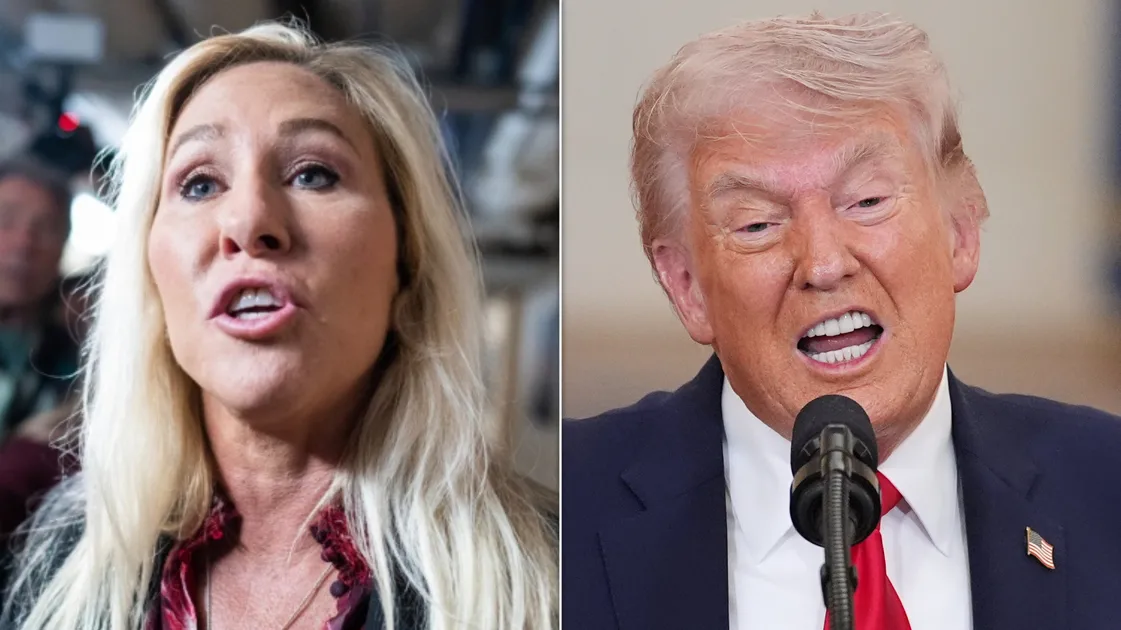
Former US representative Marjorie Taylor Greene blasted President Donald Trump for issuing more threats against Iran, in what she called an “evil” social media post on Easter Sunday.
“On Easter morning, this is what President Trump posted,” she began in an X post alongside a screenshot of Trump’s scathing Truth Social Post. “Everyone in his administration that claims to be a Christian needs to fall on their knees and beg forgiveness from God and stop worshipping the President and intervene in Trump’s madness.”
Greene, a once staunch Trump ally, said the president has “gone insane” and all of his supporters are “complicit.”
Noting that she’s “not defending Iran,” she continued, “But let’s be honest about all of this. The Strait is closed because the US and Israel started the unprovoked war against Iran based on the same nuclear lies they’ve been telling for decades, that any moment Iran would develop a nuclear weapon.”
The ousted MAGA outlier then accused Israel of having nuclear weapons.
“You know who has nuclear weapons? Israel. They are more than capable of defending themselves without the US having to fight their wars, kill innocent people and children, and pay for it. Trump threatening to bomb power plants and bridges hurts the Iranian people, the very people Trump claimed he was freeing.”
Greene went on to decry that on Easter “of all days” Christians should remember that “Jesus commanded us to love one another and forgive one another — even our enemies.”
Slamming Trump as a fake Christian, she stressed that “his words and actions should not be supported by Christians,” and Christians in the Trump administration “should be pursuing peace” and “urging the President to make peace.”
“Not escalating war that is hurting people,” she added. “This NOT what we promised the American people when they overwhelmingly voted in 2024, I know, I was there more than most. This is not making America great again, this is evil.”
MTG’s post came after Trump posted an expletive-laden message on Sunday telling Iran to open the Strait of Hormuz or “you’ll be living in Hell.”
“JUST WATCH! Praise be to Allah,” the president added in the post.
On Saturday, Trump made more threats against Iran on Truth Social while reminding the Middle Eastern country of the April 6 deadline he set for them to open the strait.
“Remember when I gave Iran ten days to MAKE A DEAL or OPEN UP THE HORMUZ STRAIT,” he wrote. “Time is running out — 48 hours before all Hell will reign down on them.”
Trump’s former campaign manager Bill Stepien defended the president’s Easter post while appearing Sunday on CNN’s State of the Union.
“This is the first war fought in this age of social media with this president. I think he does things very differently. I think he does things in his own way — different than Biden, different than Obama. And I think we were seeing this playing out this morning,” he said of Trump.
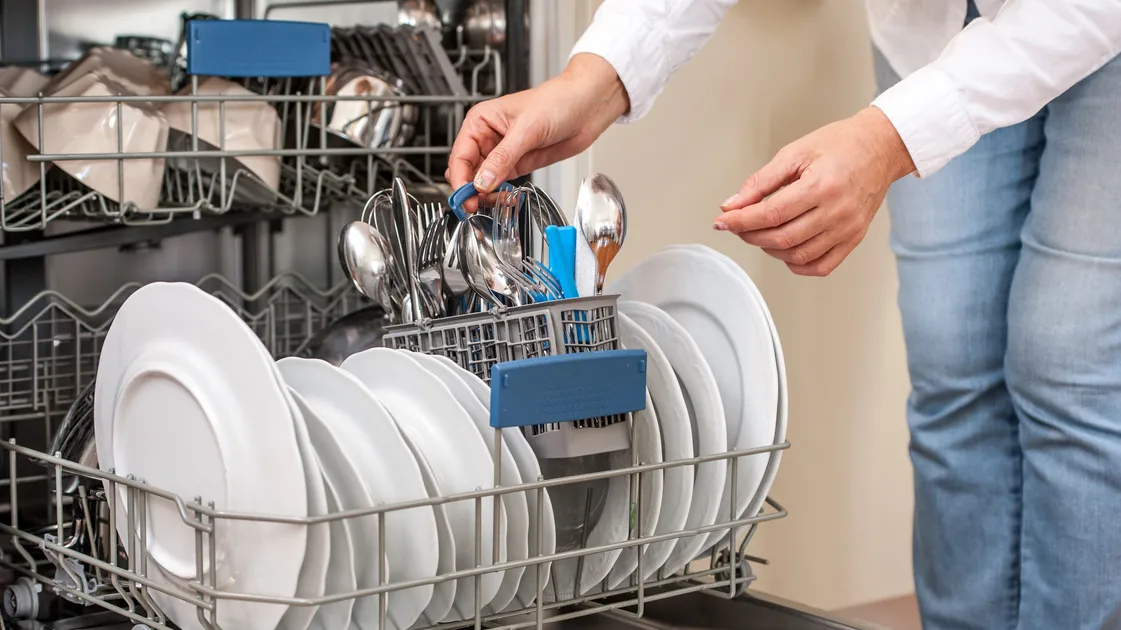
For many of us, loading the dishwasher isn’t just a household chore, it’s a minefield of opportunities to drive the people we love absolutely bonkers by where we choose to put our dirty bowls, how we insert our spoons, and how much gunk we leave on the lasagne pan.
“It really impacts people’s relationships,” Carolyn Forté, executive director of the Good Housekeeping Institute’s Home Care and Cleaning Lab, recently told Raj Punjabi and Noah Michelson, the hosts of HuffPost’s Am I Doing It Wrong? podcast, when she dropped by the studio.
“If you’re the type of person that wants to control the dishwasher and how it’s loaded, and your partner isn’t that fastidious, that can be a real bone of contention between couples or partners or whoever – even parents and kids,” she said. “People are very passionate about it.”
That’s why we asked her to share the dishwashing secrets she’s learned during her 40-plus years working in Good Housekeeping’s illustrious test labs – and she did not disappoint.
“The biggest thing to think about when you’re loading the dishwasher is if the water’s not gonna hit it, it’s not going to get clean,” Forté said. “So you just have to make sure that the water has access to everything in there. If you’ve got bowls on top of each other – not good.”
Using all of the adjustable components in our dishwashers means we can take advantage of the space and ensure everything is sitting snuggly and will be hit by the machine’s water jets.
“Use the racks. Most dishwashers today have flexible tines that bend up and down, or fold up and down, so you can put bowls down or you can put them up if you’ve got small bowls,” Forté explained.
“There are cup shelves that fold up or down to double tier, and [can give] you a double tier in the top rack. It’s all to expand and give you more flexibility when it comes to loading. Just think, ‘Is the water going to hit this?’ And if it is, then you’re good.”
The biggest mistake Forté sees people making is the way they’re loading their glasses.
“Glasses should go not over the tines in the top rack, but against them,” she advised. “So don’t put a glass over, let’s say, two tines. You feel like [putting it over the tines helps it] stand upright, but it could damage the glass, depending on how tight the fit is.”
Forté and most manufacturers recommend that our glasses rest against the tines not only so that they won’t break, but for another very smart reason.
“[If you load them against the tines, the glasses are] usually at an angle, so the water [automatically] runs off,” she said, which prevents those annoying water spots.
“Sometimes you have a cup that has a little base on it and you end up with puddling in there [if you haven’t loaded the glass correctly],” she said. “If it’s a shallow base, usually that’s not a problem, but sometimes it’s a pretty hefty base and you get a puddle of water. If you think that’s happening, make sure you unload the bottom rack first. That way when you pull the top rack out, the water doesn’t go down all over everything.”
Another supremely contentious dishwashing debate involves how to load cutlery.
“Years ago, you’d just have a basket in the bottom rack with all the different sections, and that’s really where most of the confusion came from – up? Down? Whatever,” Forté said.
“A lot of dishwashers today have that top tier, so that’s a flat rack that you can put your flatware in just one at a time and line them up. It’s not as important if you put your flatware up there – how you put it in – because they’re all just laying down, and they’re all going to get clean.”
However, if your machine has a basket in the bottom rack, as many of our dishwashers do, there is an optimal way to load your silverware according to the research Forté’s team has conducted.
“We recommend that you put the knives point or blade down,” she told us. “Spoons should alternate up and down, because you don’t want two spoons to nest. If two spoons nest each other, then one’s not gonna get any [water or cleanser].”
Forks should go into the basket with their tines up, but Forté emphasised that we should grab them by the handle when we unload our clean dishes because our hands usually aren’t sanitised, and we don’t want to dirty our freshly disinfected pieces.
You can also separate all of your forks, knives and spoons into groups in the basket. That way you can easily grab bunches of the same kind of silverware and save time when you’re placing them back in your cutlery drawer.
Forté had tons of other great tips, including what she would never put in the dishwasher, her foolproof secret for removing burnt-on food from pans, and much more, so listen to the full episode here or wherever you get your podcasts.
Have a question or need some help with something you’ve been doing wrong? Email us at AmIDoingItWrong@HuffPost.com, and we might investigate the topic in an upcoming episode.
It’s looking increasingly like Strictly Come Dancing will be a noticeably different show when it returns to our screens in the autumn.
Over the last few months, a number of the show’s resident professional dancers have parted ways with Strictly under a variety of circumstances, while it’s also been suggested that companion show It Takes Two could be getting something of an overhaul, too.
Then, of course, there’s the search for a new presenting team in the wake of Tess Daly and Claudia Winkleman’s exits at the end of last year.
Before her departure, Tess had been with Strictly since its inception in 2004, with Claudia joining on a permanent basis a decade later, taking over presenting duties from the late Sir Bruce Forsyth.
When the duo began hosting together, they made history as the first female presenting team to front a primetime show, and there’s no denying that Strictly viewers are going to miss their unique dynamic on those wintery Saturday nights.
But, with Tess and Claudia having now left the ballroom for good, fans are now looking to the future, and speculating over exactly who could be brought in to fill their shoes.
Rumours began circulating late last year, with The Sun publishing a list of names supposedly doing “chemistry tests” with the aim of landing the coveted Strictly role.
Since then, there’ve been a fair few developments, including one report claiming that BBC bosses could be looking to boost Strictly’s presenting team from two to three to shake things up even more.
As we wait for further news, here’s a quick round-up of everyone who’s been rumoured for the gig so far…
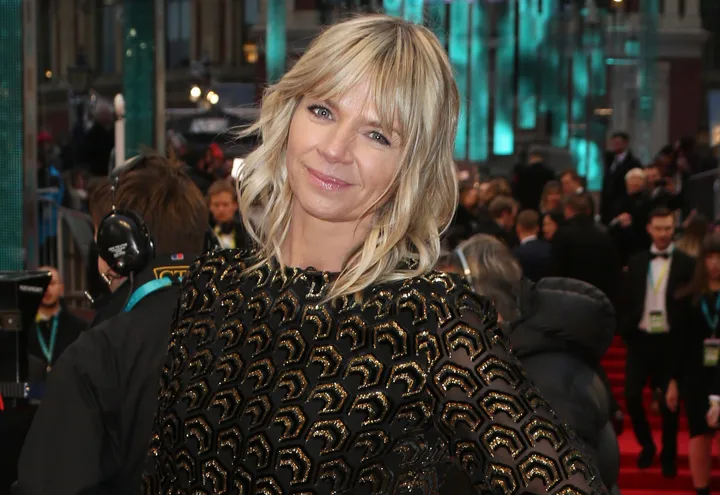
Zoe Ball

When we first heard that there were two vacant spots on the Strictly presenting line-up, our minds immediately went to Zoe Ball, who competed in the third series before going on to front companion show It Takes Two for 10 seasons.
She’s even guest hosted the main show, filling in for Claudia Winkleman back in 2014.
Zoe has also expressed interest in the job, with the rumour mill going into overdrive when she was included in The Sun’s supposed presenter shortlist, with the tabloid naming her the “frontrunner” for the gig as recently as February.
Emma Willis

The Sun’s piece naming Zoe Ball as a frontrunner claimed that the job search had become a “straight shoot-out” between her and another popular British presenter, Emma Willis.
Emma is best known for her work fronting a variety of reality shows over the years, including The Voice, The Circle and Big Brother.
More regularly, she’s also become a regular face on This Morning, and gained a more international audience when she began co-hosting the UK edition of Love Is Blind alongside her famous husband Matt Willis.
According to The Sun’s “source”, the BBC were hoping to pair either Zoe or Emma with a “more left-field person” with a “female stand-up comedian” being the preferred choice.
Mel Giedroyc

Ken McKay/ITV/Shutterstock
Just days after this, the Daily Mail published a piece saying that Mel Giedroyc was being “eyed” for a presenting role at the helm of Strictly.
It was claimed that Mel’s “gentle touch” and ability to “use humour to relieve [any] tension”, as displayed during her time in the Great British Bake Off tent, had made her a favourite for the job.
Mel can currently be seen in action in the latest season of Last One Laughing, and has recently competed on The Masked Singer and fronted the TV quiz show adaptation of Pictionary.
She also took part in the annual Strictly Christmas special back in 2021, where she was paired with Neil Jones.
Miranda Hart

Ken McKay/ITV/Shutterstock
Self-professed Strictly super-fan Miranda Hart was mentioned as a possible new host by The Sun in late March 2026.
According to the tabloid, Miranda was being considered for the role due to the fact that she and Claudia Winkleman share a similar sense of humour, with a source describing the rumoured signing as a “massive coup for the BBC”.
Angela Scanlon

Ken McKay/ITV/Shutterstock
Another former Strictly star rumoured to be on the BBC’s “golden ten” shortlist late last year, Angela Scanlon competed on the show in 2023, where she was paired up with now-reigning champion Carlos Gu.
The Irish presenter is best known for her work on shows like Robot Wars, Your Home Made Perfect and The One Show, and will next be seen trying her luck on The Celebrity Apprentice.
In March 2026, the Daily Mail said it was increasingly likely that Angela would bag one of the Strictly presenting jobs, following “meetings over the past few weeks with show bosses”.
Rylan Clark

A week after the Mail named Angela Scanlon as a top pick to take over as one of Strictly’s new hosts, the same publication claimed that she and Rylan Clark were a potential new duo.
They cited a “Strictly source” who suggested that bosses liked the idea of creating a new presenting pair rather than relying on an existing TV duo, and that Angela and Rylan would definitely fit the bill.
Meanwhile, The Sun claimed more recently that bosses were looking to add a male presenter into the mix, rather than trying to replicate Claudia and Tess’ dynamic, with Rylan one of three names mentioned as being in the frame.
Like Zoe Ball, Rylan previously fronted the spin-off show It Takes Two for four seasons between 2019 and 2022, and is a regular fixture on the BBC thanks to his Radio 2 show, his coverage of the Eurovision Song Contest and his travel series Rob And Rylan’s Grand Tour, which he co-presents with Rob Rinder (more on him in a sec).
Bradley Walsh

Even before he was included on The Sun’s list of the “golden ten” stars supposedly in consideration for the Strictly gig, Bradley Walsh was named in the press as a top pick to take over at the helm of the dance show.
Currently known for his work at the helm of The Chase, Gladiators and Blankety Blank, the tabloid reported in November that Bradley was being “lined up” by higher-ups at the BBC to take over from Tess and Claudia, as part of an apparent “revamp” for the show.
Last month, The Sun revived the speculation when they included him in their shortlist of three male stars reportedly in consideration to join Strictly’s new presenting team.
However, despite the persistent rumours, Bradley has repeatedly cast doubt on the suggestion that he’ll be taking over at the helm of Strictly.
Alex Jones

Ken McKay/ITV/Shutterstock
Last year, when Bradey’s name was mentioned in the press for the first time as a possible Strictly host, The One Show host Alex Jones was also suggested as a potential co-host.
Back in November 2025, The Sun cited “insiders” who claimed that Alex and Bradley were being “courted as the perfect partnership” to take over the show.
Later, Alex was also one of the 10 names listed to be on the rumoured shortlist, and while many other names have been mentioned in the months since, the tabloid insisted as recently as March that she was “still the favourite” in producers’ eyes.
Fleur East

Since competing on The X Factor in 2014, Fleur East has carved a new career for herself as a presenter, fronting Hits Radio’s breakfast show, as well as a recurring segment on Ant and Dec’s Saturday Night Takeaway.
Fleur has most notably fronted Strictly’s companion show It Takes Two since 2023, a year after competing on the main show, making it to the final alongside her professional partner Vito Coppola.
In March, The Sun mentioned that the Sax singer was still “in the mix”, indicating she could still land one of the coveted presenting slots.
Johannes Radebe

One of the most recent additions to the ever-growing list of rumoured hosts is Striclty pro Johannes Radebe.
Johannes has been a favourite of Strictly fans ever since he first joined as a professional dancer in 2018, and in March, The Sun named him as a wildcard third male star near the top of bosses’ wishlists, alongside Bradley Walsh and Rylan Clark.
If the South African performer did land the job, it wouldn’t be the first time a former Strictly pro moved to a different role within the show.
Current It Takes Two host Janette Manrara was previously a pro dancer on Strictly, as was resident judge Anton Du Beke.
Alan Carr

Tess and Claudia’s Strictly exits were announced in the middle of last year’s series of The Celebrity Traitors, meaning plenty of people’s minds immediately went to scene-stealer Alan Carr as a favourite for the hosting job.
Already a popular stand-up comic, Alan has plenty of TV experience to his name now, not just as host of his talk show Chatty Man, but also series like Picture Slam, Interior Design Masters and RuPaul’s Drag Race UK.
Unfortunately, he quickly poured water on the rumours, insisting the gig would be “too nerve-racking” for him.
That being said, he was still named in The Sun’s subsequent list of possible hosts, even if the man himself seems less keen on the suggestion.
Amanda Holden

David Fisher/Shutterstock
Also on that list was Amanda Holden, with whom Alan has now shared the screen on a number of occasions.
Like Alan, Amanda was mentioned on The Sun’s rumoured shortlist, but also dispelled the rumours, insisting that her commitments with Britain’s Got Talent would mean she wouldn’t be able to do Strictly.
“We are so flattered to be in that mix,” she told her Heart listeners. “[But] we both are not doing it.”
Holly Willoughby

Of course, it was always going to be inevitable that rumours about Holly Willoughby landing the gig would also start to circulate.
Former Dancing On Ice host Holly – who has been keeping something of a low profile since her This Morning exit in 2023 – was named as the bookies’ favourite for the hosting gig almost immediately, after which Daily Mail reporter Richard Eden wrote in his column that he’d heard from former BBC One controller Peter Fincham that a reliable source had told him that the job was Holly’s for the taking.
He alleged: “My hairdresser also cuts the hair of a well-known channel controller. What’s said in Harry’s the hairdresser stays in Harry’s. But he says with great confidence that Holly Willoughby will take over.”
Tabloid reports stretching as far back as 2023 even suggested that the BBC had been hoping to “lure” Holly over to them from ITV via a rumoured offer to present Strictly, two years before Tess and Claudia even announced they were departing.
More recently, Holly was included on the “golden ten” list published in The Sun.
Alison Hammond

Anthony Harvey/Shutterstock
Daytime legend Alison Hammond was also reported by The Sun to be one of the stars undergoing “chemistry tests” to try and land the co-presenting gig on Strictly Come Dancing.
Following this, she made an appearance on Loose Women where the Great British Bake Off presenter made no secret of her hopes to end up with the Strictly hosting job.
When she was still more of a beloved cult figure than a full-blown national treasure, Alison competed on Strictly back in 2014, where she was partnered with Aljaz Skorjanec.
Rob Rinder

David Fisher/Shutterstock
The Sun’s much-cited piece about the search for the new Strictly hosts mentioned that bosses were considering existing presenting teams, mentioning travelogue stars Rylan and Rob Rinder.
Rob – who first rose to fame as the host of Judge Rinder and now regularly co-presents ITV’s Good Morning Britain – was also reported to be taking “chemistry tests” with a variety of different potential co-hosts with the prospect of forming a new duo to front Strictly Come Dancing.
Oti Mabuse

Scott A Garfitt/Invision/AP
Oti Mabuse is undoubtedly one of the most popular Strictly pros in the show’s history, and since parting ways with the show, has become a regular fixture on screen, judging Dancing On Ice, fronting the dating show Romeo & Duet, briefly landing her own ITV daytime series and regular popping up on the Loose Women panel.
The same day Tess and Claudia’s departures were announced, Strictly staple Craig Revel Horwood (now the show’s longest-serving fixture) named Oti as his top pick to inherit the presenting job, alongside Alan Carr.
La Voix

We are going to continue manifesting this as long as we possibly can, alright? Give. Her. The. Job.
We hope you love the products we recommend! All of them were independently selected by our editors. Just so you know, HuffPost UK may collect a share of sales or other compensation from the links on this page if you decide to shop from them. Oh, and FYI — prices are accurate and items in stock as of time of publication.
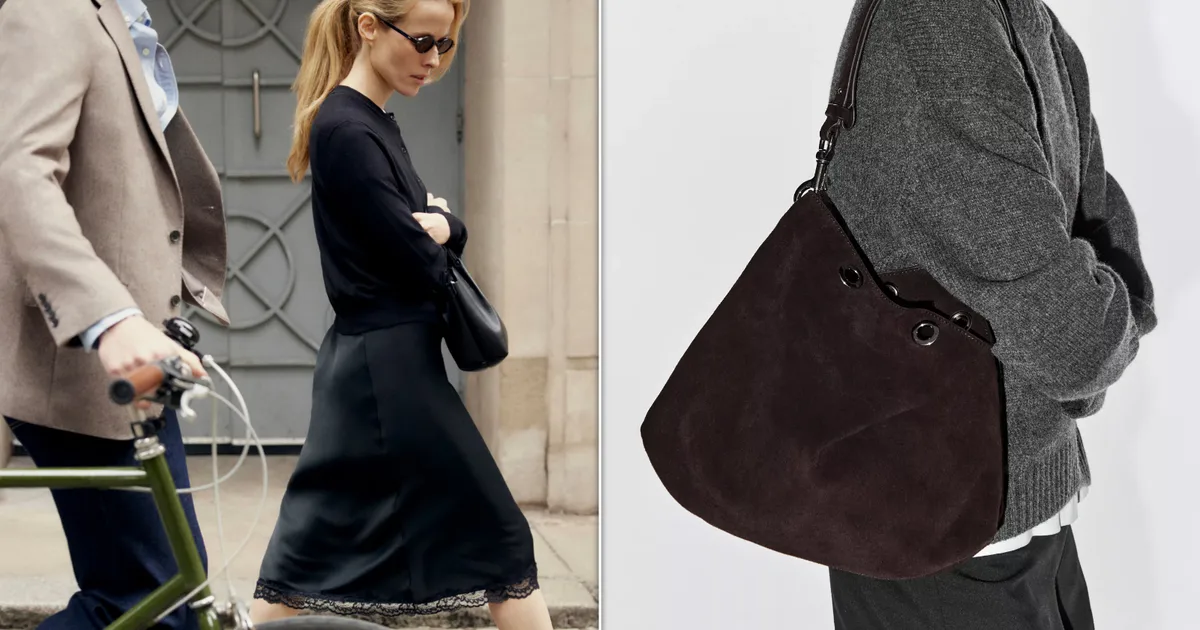
There’s just something about the 90s that we can’t shake. Maybe it’s our obsession with Carolyn Bessette Kennedy after bingeing Ryan Murphy’s Love Story that’s fuelling our desire to embrace minimalism.
Either way, we have to give it to the 90s: the penchant for sleek monochrome looks is a timeless one.
So much so that the style defined by the likes of Jennifer Anniston, Gwyneth Paltrow, and Sarah Michelle Gellar has never really left us – it seems like every year we declare the fateful decade is back in fashion.
But if you, like the rest of our Instagram feed, are feeling the urge to jump on the nostalgia train, here are the best 90s-inspired dresses, jeans, shoes, and shirts to shop now.
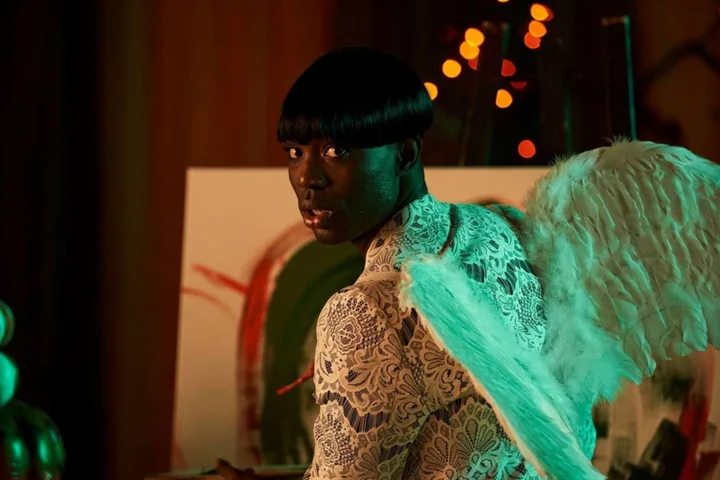
The new BBC drama Babies has been met with a wave of critical acclaim.
Directed by Stefan Golaszewski (the creator of hit shows like Him & Her and Marriage), the series has been described in early reviews as a “bittersweet” exploration of fertility struggles, weaving moments of humour throughout its more hard-to-watch sequences.
Babies primarily focusses on a couple in their 30s – played by Paapa Essiedu and Siobhán Cullen – who face repeated setbacks in their journey to become parents, with the show exploring how this affects their relationship and those around them.
It also features a cast of talented performers that you most likely recognise from a variety of film and TV projects.
Here’s a quick guide to where you’ve seen the stars before…
Paapa Essiedu

Paapa Essiedu first rose to prominence after appearing in Michela Coel’s I May Destroy You, which earned him an Emmy and Bafta nomination.
He also since appeared in in Gangs Of London, the Channel 5 miniseries Anne Boleyn and the Sky’s trippy sci-fi offering The Lazarus Project.
In 2023, he appeared as Gaap in the Demon 79 episode of Black Mirror, before starring opposite Keira Knightley in the crime drama Black Doves.
Most recently, he appeared in seasons two and three of The Capture as Isaac Tuner, an MP who is deepfaked on national television, and becomes embroiled in a news feed tampering conspiracy.
Later this year, he’s due to appear as Severus Snape in HBO’s new adaptation of the Harry Potter novels.
Siobhán Cullen

Irish actor Siobhán Cullen is probably best known for playing Caroline in ITV’s Irish comedy-drama The Dry, as well as her work in the 2024 Netflix comedy Bodkin.
Siobhán first found fame playing a supporting role in the BBC drama Paula, and appeared in two episodes of the divorce drama The Split.
Following this, she took the lead in the ITV crime drama The Long Call, and had a minor role in the Dalgliesh episode Shroud For A Nightingale.
Siobhán is currently filming the new Highlander movie, alongside Henry Cavill and Russell Crowe.
Charlotte Riley

Charlotte Riley has been on our screens for almost 20 years since making her debut in the BBC Three sitcom Grownups back in 2007.
She later made a splash when she appeared alongside her future husband Tom Hardy in ITV’s 2008 adaptation of Wuthering Heights, before going on to appear in three episodes of DCI Banks as the murdered Lucy Payne.
Following this, Charlotte starred in all eight episodes of Ken Follett’s adaptation World Without End and played Arabelle Strange in Jonathan Strange & Mr Norrell.
She has also appeared in seasons two and four of Peaky Blinders as the wealthy widow May Fitz Carleton, and starred in Danny Boyle’s John Paul Getty miniseries as lawyer Robina Lund.
On the big screen, you may recognise Charlotte from Edge Of Tomorrow, Swimming With Men or London Has Fallen.
More recently, Charlotte has had roles in Apple TV+’s comedy-drama Trying and in Amazon Prime’s thriller Malice.
You can next see her in Master Of The Universe alongside Nicholas Galitzine, where she’s set to play Queen Marlena Glenn.
Jack Bannon

Jack is most recognisable for playing Sam Thursday in Endeavour and taking the lead as Alfred in the recent Pennyworth TV show, based on the iconic DC Comics character.
His other TV credits include Medici, The Darkness and the recent Netflix medical drama Pulse.
In film, he played Alan Turing’s friend Christopher in the 2014 biopic The Imitation Game, appeared as a young tanker in Fury and starred as Felix in the 2016 British coming-of-age drama Kids In Love, alongside Cara Delevingne.
He is currently filming the upcoming Tomb Raider series alongside Sophie Turner, although his role has yet to be specified.
Nadine Marshall

Nadine Marshall, who plays Stephen’s mother, first captured viewers’ attention when she was cast as Sally in the sitcom The Smoking Room and has been a regular on our screens since the early 2000s.
Over her 25-year career, she has appeared in a variety of projects, from the sketch show Little Miss Jocelyn to the kids’ TV show Old Jack’s Boat alongside Bernard Cribbins and Robbie Coltrane, as well as the Channel 4 drama National Treasure.
In recent history, you might have seen Nadine as DS Shola O’Halloran in Sky drama Save Me, DSU Marianne Hamilton in Trigger Point or DI Sarah Torres in Silent Witness.
Gary Beadle

Gary appears in Babies as Stephen’s dad, but you’re most likely to know him for playing Paul Trueman in more than 300 episodes of EastEnders.
Although best recognised for the BBC soap, he has also appeared as Clem in Andor, Elyas Machera in Amazon Prime fantasy The Wheel Of Time and as Thick Rick in the Netflix spin-off The Gentleman.
Elizabeth Rider

Elizabeth Rider has been a television stalwart since the early 1980s.
As well as playing DCC Andrea Wise across five episodes of Line Of Duty, she has had minor roles in numerous TV shows, including Casualty, Heartbeat and Doctors.
Soap fans might also recognise for her playing Ashley Peacock’s biological mother in Coronation Street, or for her 10-episode EastEnders arc as nurse Jill Green.
Simona Brown

Simona Brown, who plays Bella in Babies, is best known for starring in the 2021 Netflix miniseries Behind Her Eyes.
She also had leading roles in the ITV series Him, the 2019 Florence Pugh BBC drama The Little Drummer Girl and the Channel 4 cyber thriller Kiss Me First.
Babies is currently available to stream in full on the BBC iPlayer, with episodes also airing weekly on Monday nights on BBC One.
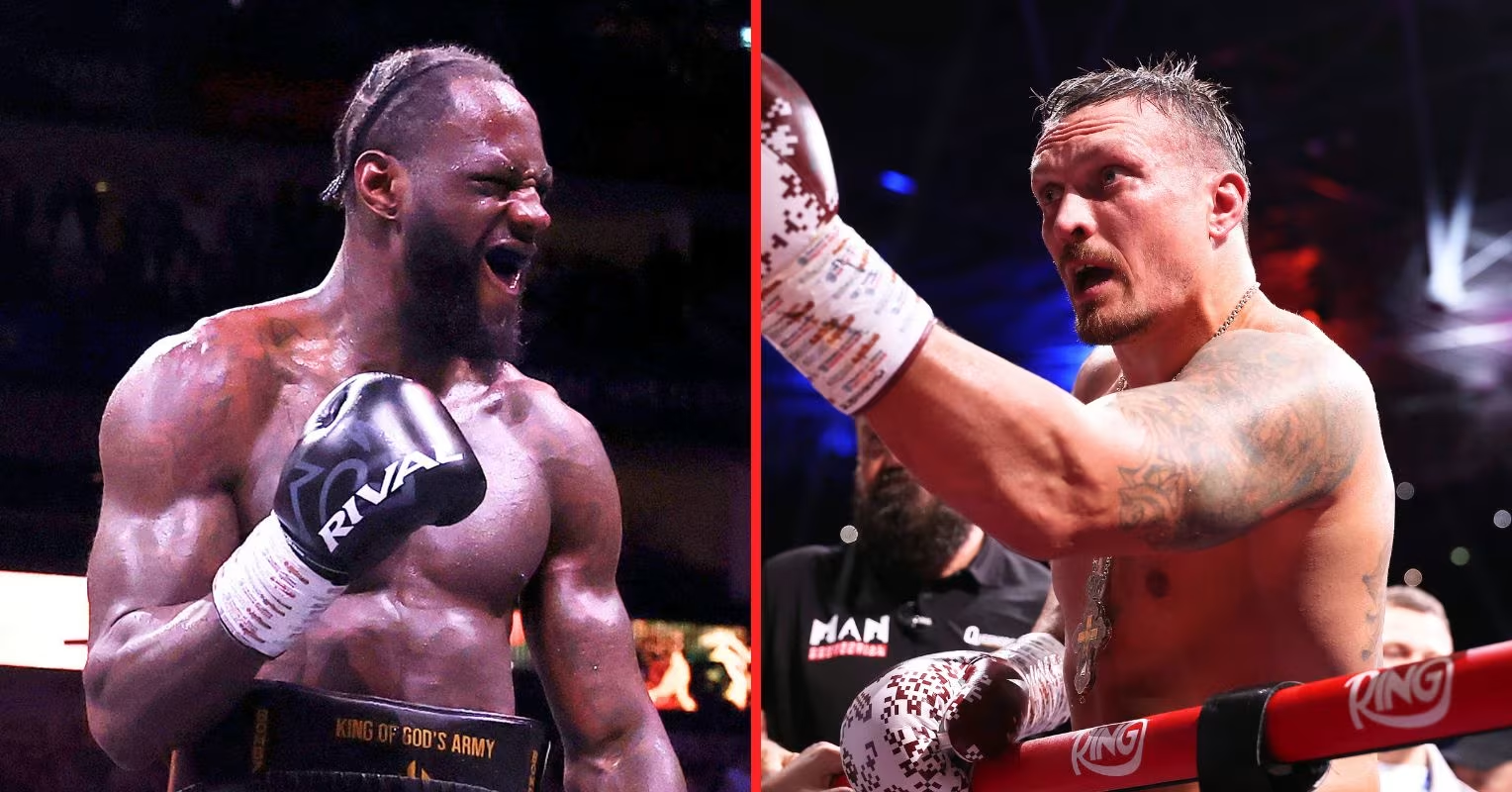
Derek Chisora sums up Deontay Wilder’s chances against Usyk after facing both

This is the ABB Robot Behind Japan’s First 3D-Printed Railway Station

Finance Tableau Sequence BOUL RALE BOUL + Conseil financier

Smart energy pays enters the US market, targeting scalable financial infrastructure

Why Israel is blocking foreign journalists from entering

Bitcoin: We’re Entering The Most Dangerous Phase
Finance Tableau Sequence BOUL RALE BOUL + Conseil financier

Govinda hurt his wife Sunita Ahuja now he is going through financial struggles #shortvideo

April 1 New Rules That Will Affect Your Money | India Financial Changes 2026
-

 NewsBeat4 days ago
Steven Gerrard disagrees with Gary Neville over ‘shock’ Chelsea and Arsenal claim | Football
-

 Business3 days ago
No Jackpot Winner and $194 Million Prize Rolls Over
-

 Fashion3 days ago
Weekend Open Thread: Spanx – Corporette.com
-
Entertainment7 days ago
Fans slam 'heartbreaking' Barbie Dream Fest convention debacle with 'cardboard cutout' experience
-

 Crypto World5 days ago
Gold Price Prediction: Worst Month in 17 Years fo Save Haven Rock
-

 Business11 hours ago
Three Gulf funds agree to back Paramount’s $81 billion takeover of Warner, WSJ reports
-
Crypto World6 days ago
Dems press CFTC, ethics board on prediction-market insider trades
-

 Sports2 days ago
India men’s 4x400m and mixed 4x100m relay teams register big progress | Other Sports News
-

 Business4 days ago
Login and Checkout Issues Spark Merchant Frustration
-

 Tech7 days ago
Apple will hide your email address from apps and websites, but not cops
-

 Tech6 days ago
EE TV is using AI to help you find something to watch
-

 Sports6 days ago
Tallest college basketball player ever, standing at 7-foot-9, entering transfer portal
-

 Politics7 days ago
Should Trump Be Scared Strait?
-
Tech6 days ago
Daily Deal: StackSkills Premium Annual Pass
-

 Tech6 days ago
Flipsnack and the shift toward motion-first business content with living visuals
-

 Fashion7 days ago
The Best Spring Trends of 2026
-

 Crypto World6 days ago
U.S. rule change may open trillions in 401(k) funds to crypto
-

 Sports7 days ago
Women’s hockey camp eyes fitness boost, tactics ahead of WC 2026 campaign | Other Sports News
-

 Politics7 days ago
BBC slammed for ignoring author of The Fraud
-

 Tech6 days ago
How to back up your iPhone & iPad to your Mac before something goes wrong
You must be logged in to post a comment Login