Politics
Politics Home Article | Women In Westminster: In Conversation With Dame Melanie Dawes


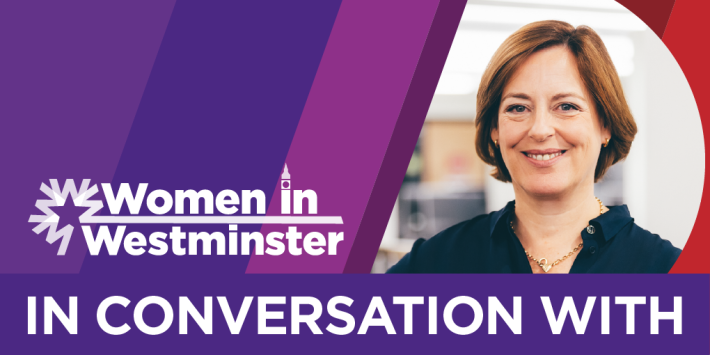


As Chief Executive of Ofcom, Dame Melanie Dawes is responsible for one of the most ambitious regulatory agendas in a generation. As part of our Women in Westminster series, we sat down with Dawes to discuss stepping into contested space, holding global tech companies to account, and being the public’s champion
Regulation is sometimes seen as an exercise that takes place quietly in the background, far away from the headlines. But that is not how Dame Melanie Dawes, Chief Executive of Ofcom, views it.
“Everything Ofcom does touches people’s lives in ways they really care about,” Dawes told Women in Westminster during our sit-down conversation. “What we do has that connection with people’s lives in a way that is quite special.”
From telecoms to television to social media, the sheer breadth of Ofcom’s remit means that Dawes occupies one of the most complex regulatory roles in the UK. Throughout our conversation, Dawes is clear that regulating the communications services that we all use and rely on each day is something that matters immensely to the UK public.
The former Permanent Secretary also finds herself in an increasingly visible role. Following the passing of the Online Safety Act, Dawes has been at the centre of some of the most contested public debates of our times, having to balance competing interests between safety and free speech, innovation and harm, and freedom and responsibility.
Dawes tells us that despite that complexity, Ofcom’s core job remains very clear. It is to act in the public interest with clarity and determination, even if that places the regulator squarely in conflict with some large and powerful organisations. That is, she promises, something that she and her staff will never shy away from.
“Everybody who works at Ofcom on online safety feels a huge sense of purpose,” she tells us. “We are doing it because our parliament has tasked us with this really important job, and we know that we have the public on our side and that they want to see results.”
The complexity of Ofcom’s regulatory role has grown in recent years as new technologies have challenged traditional models of how information is viewed and shared. Online safety, media standards, and the power of global technology platforms have shifted regulation into the foreground of public life.
Ofcom retains a very broad range of responsibilities, but Dawes acknowledges that the Online Safety Act “gets a lot of the oxygen” in current discussions.
“It’s not a system that any other country has set up,” Dawes says of the Act. “No one has regulated these companies in this way to try to achieve such an important increase in safety for the public.”
Dawes believes that the challenges in regulating large technology companies are cultural as much as they are technical, describing an industry “where there has been no regulation for 20-25 years.” It is also a sector where the entire culture has been built on moving fast and fixing problems later, if at all. In the wake of the Online Safety Act, Dawes tells us that this is something that must now change.
“The culture in Silicon Valley is not where we need it to be,” she says. “There isn’t a culture of safety testing, of testing things in advance before you launch them to the public. So, the scale of the challenge is huge.”
At the heart of the Online Safety Act, Dawes tells us, is a desire to hardwire safety into product design at an earlier stage. She urges platforms to “think like perpetrators”, anticipate abuse, and build protections in from the start.
“What we’re really trying to do here is to get the platforms to take a level of responsibility that they’ve not taken before,” she says. “They’ve got to stop just launching services on the public without having done a risk assessment. You don’t launch a toy on children without testing it properly. You don’t launch a new car. It should be the same for online services.”
Dawes acknowledges that both parents and children are “frankly really scared” at the moment. She also points out that online harms are not evenly distributed. Dawes highlights the gendered nature of online abuse, pointing to evidence that it is often women and girls who experience some of the worst problems online.
“We saw that it was women who were overwhelmingly targeted by that undressing functionality on Grok that was launched on Christmas Eve,” she reminds us. “In November last year, Ofcom launched its own guidance for tech platforms to better protect women and girls online”.
Ofcom opened an investigation into X early in the new year, making the UK the first country to do so. For Dawes, this demonstrates the willingness of the regulator to robustly intervene in high-profile cases.
Progress has also been tangible elsewhere. Dawes tells us that in less than a year of enforcement, 86 per cent of visitors to the top 100 porn sites are now covered by age checks. “Nobody really thought we were going to be able to do that a couple of years ago,” she adds.
Still, Dawes is careful not to oversell what regulation alone can achieve. The accountability for change, she insists, ultimately lies with industry. “They are the ones that run the services,” she says. Regulation can draw lines and create incentives, but it cannot replace platforms’ responsibility. Nor can it address every underlying cause of online harms.
“Behind every abusive post is a person,” she reflects. “And I think there’s something about the conversation that we have in our communities and our families and in schools about the way that we behave online in ways that we wouldn’t do if we were sitting face to face with somebody. That’s got to be about leadership everywhere across our society.”
However, despite the challenges, Dawes remains confident that regulation can make a real difference to safety.
“I am very optimistic, because we’ve shown that we can achieve change,” she says. “We’re very conscious of the expectations on us, and we’re constantly challenging ourselves about where we can move faster and move further.”
