Politics
Politics Home | Safely, securely, and responsibly managing the UK’s low-level radioactive waste


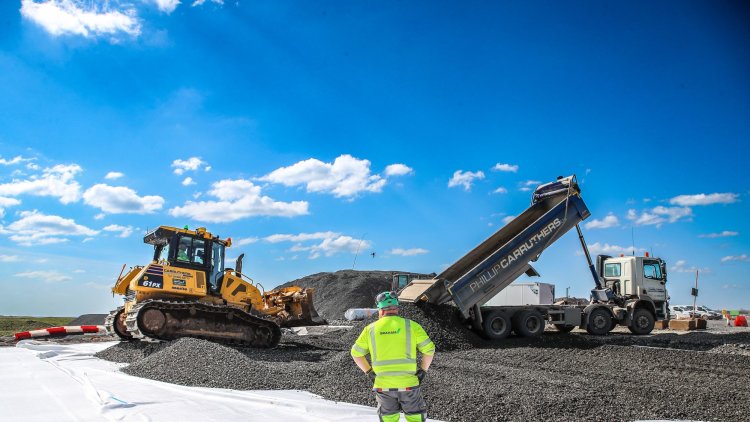
Unloading aggregate for the Southern Trench Interim Membrane project
If the UK is to deliver a new generation of nuclear power, strengthen energy security and support clean growth, it must also answer a fundamental question often asked in Parliament. How do we manage radioactive waste safely, securely and responsibly for the long term?
At Nuclear Waste Services (NWS), that question sits at the heart of everything we do. On the West Cumbrian coast, between the Lake District fells and the rugged west coast of Cumbria, the UK’s Low Level Waste Repository has been performing a nationally significant role for more than six decades.
Since 1959, it has supported the safe disposal of around one million cubic metres of low-level radioactive waste, protecting people, the environment and the future of the UK’s nuclear programme.
With Government recognising new nuclear as a cornerstone to help grow the economy with clean energy, the ability to manage radioactive waste safely now and in the future is key.
Making waste permanently safe, sooner
NWS is part of the Nuclear Decommissioning Authority (NDA) group whose mission is to decommission the UK’s nuclear sites safely, securely, and responsibly, taking care of the environment and the communities living and working near its sites. Our work provides the endpoint in the nuclear journey and is critical to the NDA’s mission.
Bringing together the UK’s expertise in radioactive waste management to drive our mission of making waste permanently safe, sooner, we’re tackling the legacy of decades of waste from civil and defence sector activities, while also preparing for the waste that will arise from new nuclear as part of the government’s ‘golden age of nuclear’.
Every decision our team makes is focused on the safe, secure, and permanent disposal of nuclear waste. And as a nuclear licensed site, our work at the Repository is underpinned by a comprehensive and robust Environmental Safety Case (ESC), which addresses environmental safety during operations and over timescales extending to thousands of years.


Long-term protection – capping the site
Disposing of low-level radioactive waste is a long-term mission, and we’re now carrying out important work on the final capping of the site which will eventually lead to the permanent closure of the legacy disposal trenches and vaults.
Capping is a key part of the disposal lifecycle and involves placing an engineered protective barrier over the trenches and vaults, where waste is already in its final disposal location and ready for permanent closure.
Comprising of layers of material, totalling up to 10m thick, this ‘cap’ will permanently protect the waste, people and the environment by layering natural aggregates, as well as engineered materials. Installed to the highest engineering standards, the multi-layered cap reflects our commitment to quality, durability and long-term environmental protection.
As part of our preparatory works for capping, we’re currently completing our Southern Trench Interim Membrane (STIM) project, which involves replacing the protective membrane (liner) over the southern part of our legacy waste disposal trenches that require a new, robust cover to withstand changing weather patterns.
A key component of the four-year STIM contract is collaboration with Nuclear Transport Solutions’ rail division, Direct Rail Services (part of the NDA group) with each train making the journey from Shap quarry to the Repository to deliver over 750 tonnes of aggregate to the Repository site – the equivalent of 36 HGVs. In total, more than 300,000 tonnes of aggregate will be delivered to the site between February 2025 and August 2026. As of 10 July 2026, 325 trains have transported over 285,000 tonnes of aggregate, and by using rail instead of road, we’ve avoided more than 15,000 HGV journeys. This reduces traffic and minimises disruption for the local community, which is important to us. This is an example of how the NDA group model is facilitating collaboration across operating companies to manage the UK nuclear legacy safely, securely and sustainably. We’re making great progress with this work which will see the interim liner remain in place for up to 100 years.
Rail deliveries are currently scheduled for completion in mid-August 2026. The STIM works are due to be completed in 2028 and the procurement process for the next phase of capping is now under way, which will provide comprehensive construction and design services over a 10-year framework.
Repository capping is one of our key projects and fulfils key requirements from our ESC and obligations under our site permit.


Diverting waste to protect capacity
The Repository site receives waste from a range of customers such as the nuclear industry, the Ministry of Defence, non-nuclear sectors such as educational, medical and research, where alternative treatment or disposal routes are not suitable.
NWS helps to drive sustainable waste management for the UK nuclear industry by applying the waste hierarchy – avoid, reduce, reuse, recycle and only dispose as a last resort.
By re-using or recycling where possible, we now divert 98% of waste away from disposal at the Repository site protecting constrained national capacity and improving efficiency.
Community and environment
We have a responsibility to be a ‘good neighbour’ and reduce the impact of operations on our Repository site community where possible. Any potential impacts are always a key consideration when planning our activities and operations.
Neighbouring a Site of Special Scientific Interest (SSSI) and a Special Area of Conservation (SAC), the Repository site is ecologically rich and sensitive. We host a range of species including roe deer, great-crested newts, badgers and pipistrelle bats.
Ecology on a site like ours is about both protection and improvement. It means surveying species, understanding how they use the land, and taking decisions that avoid unnecessary disturbance. It also means creating new opportunities for wildlife to thrive.
So, while nuclear waste management is about ensuring we meet our safety and legal obligations first and foremost, it’s also about working alongside our local community and caring for the environment.

You must be logged in to post a comment Login