
Politics
Reform councillor quits Farage’s party saying new welfare policy will have fatal consequences



Reform’s John Bell has resigned as parish councillor for Mabe in Cornwall and quit Farage’s far-right party. Explaining his decision, Bell stated that he “cannot in good conscience” support the recently announced ‘Making Welfare Work’ policy.
Joining resounding criticism of the harmful policy, Bell says that Reform’s changes to welfare and Personal Independence Payments (PIP) will “cost lives of people, especially those who have suicidal ideation”.
This resignation comes in the wake of Jason Arday’s apparent suicide – a death likely caused by the immense, undue pressure and demeaning rhetoric the mainstream media directed at him. That same media has spent years demonising and belittling people who rely on welfare support, particularly those receiving PIP.
As a result, this intervention from Bell underlines the real-world danger of punitive policy changes that risk leaving vulnerable people even more isolated.
Today I have resigned from Reform UK and also I have resigned as a Councillor. I cannot in good conscience support the Making Welfare Work policy. These changes will cost lives of people especially those who have suicidal ideation.
— John Bell


 (@johngbell0) August 17, 2026
Reform to cut £50bn from support for disabled people
Reform’s latest harmful policy announcement proposes replacing PIP entirely with a new system, ironically called a ‘Health Security Allowance’, while claiming it could save the welfare system a staggering £50bn.
But the reality is rather different. Reform would effectively shift the cost of PIP onto employers, who it says would need to take out insurance to cover the additional costs. It then proposes offsetting that hit through lower national insurance payments.
As our own Willem Moore and others have pointed out, this is unlikely to go down well with either PIP recipients or business owners. And for good reason. PIP helps many disabled people meet the additional costs of living with a disability and, crucially, can help make employment possible for those affected.
Businesses also benefit from disabled people being able to participate in the workforce. Yet Reform’s proposal would saddle employers with additional costs at the same time as many businesses already complain they are being squeezed by government.
If that £50bn bill really is being shifted onto businesses, you might expect a revolt. Especially when so many businesses and wealthy donors have backed Reform. On the face of it, the policy risks alienating both voters and the very business interests the party claims to champion.
DWP PIP claimants are being tricked into voting Reform
Some PIP claimants believed that Reform was only going after 'fraudsters'; now the party has made it clear they're going for everyonehttps://t.co/xAc61sMw7Shttps://t.co/xAc61sMw7S
— Canary (@TheCanaryUK) August 17, 2026
But there is a much darker possibility
If employers face far higher costs when hiring disabled workers, what happens when they start factoring those costs into recruitment decisions? The risk is that disabled applicants become even less attractive to employers, whether openly or through discriminatory hiring practices.
That creates a perfect storm: disabled people could lose vital financial support while simultaneously finding it harder to get and keep work.
And that is why the potential consequences of this policy go far beyond a row over welfare spending. Strip away the rhetoric about ‘saving’ £50bn and the long-term impact could be devastating. A policy that removes income, restricts access to work and pushes already vulnerable people further into isolation could, in the worst cases, cost lives.
As the now-former Reform councillor above points out, those already experiencing suicidal thoughts could be among those most at risk. For those with any degree of moral conscience or decency would do as Bell has done and walk away from the party. For those who don’t, well that speaks volumes.
Grossly, one Reform supporter refutes Bell’s assertion that this policy would increase the risk of suicide. Instead, they argue that this saving would mean those who are suicidal would receive greater support from the state.
Although, it is worth pointing out that he clearly hasn’t thought this through as that number would surely only increase due to this harmful policy pushing people out of employment whilst taking away vital support:
Suicidal ideation is something a vast number of people suffer from at some point in their lives. Reform UK's plan to cut benefits for people who abuse the welfare system would actually free up more funds for those who briefly suffer from suicidal tendencies.
John Bell has not… https://t.co/SWdlESuLyE
— Joe
 Reform UK (@Verbal_Vortex) August 18, 2026
Cut costs to increase costs elsewhere?
Reform voters don’t tend to apply much logic to why they support the ultra-wealthy Farage and his billionaire funded party/business, so it should hardly be a surprise that Reform would introduce a policy which would hurt its own voter base.
As our own Willem Moore reported:
It’s important to understand that some of the people with a negative opinion about benefit claimants are benefit claimants themselves. These people have bought into the lie that there are a handful of deserving claimants (themselves and their friends) and millions of undeserving. This phenomenon is why UK political parties can bash benefit claimants while still winning votes from them.
It really does seem that some Reform supporters desperately want to believe they’re somehow ‘different’ from other benefit claimants. Perhaps attacking the ‘others’ receiving state support gives them a way to distance themselves from people they see as beneath them – even when they’re relying on the very same system.
But if a future Reform government actually implements this policy, the consequences could hit the public finances from both sides.
After all, push disabled people out of work and you shrink the income tax base. At the same time, removing the support that helps people manage independently risks pushing more people towards the NHS and other public services.
That means higher costs for the state, less tax coming in and even more pressure on an NHS already struggling under the weight of privatisation.
The rich, of course, will get richer under Reform
And here’s the real kicker: instead of helping disabled people live independently and contribute to their communities, that money could end up lining the pockets of private providers and shareholders as our NHS is carved up and sold off.
This, we suspect, is exactly what Farage and his super rich backers are counting on. The question for taxpayers, is whether they want to get value for money or whether they want that to be vacuumed up by the richest in society.
Or, as Bell has pointed out, it could lead to a significant number of PIP recipients choosing to take their own lives, due to the duress this policy would inflict.
This is a Dickensian reality which no decent person should accept, let alone vote for.
Featured image via the Canary


A senior FIFA official warned he was prepared to lose his job over Gianni Infantino’s controversial World Cup plan. Weeks later, he has.
He knew the risk
FIFA has ended its working relationship with Chief Operating Officer Kevin Lamour, weeks after he publicly criticised Infantino over plans to sell a stake in the World Cup’s commercial rights to outside investors.
FIFA confirmed that Lamour’s contract ended on 17 August, thanking him for his two years with the organisation but declining to comment further.
Lamour had made clear that he knew his criticism could cost him his job.
Speaking to the Associated Press on 31 July, he said the proposal “should not go ahead” and that football’s leaders needed to “ask the right questions and make the right decisions”.
And if that means I lose my job, then so be it.
Within weeks, Lamour was gone.
The straw that broke Infantino
The dispute centred on a proposal to create a FIFA subsidiary valued at around $20bn, which would control the commercial rights to the federation’s major tournaments, including the World Cup.
Under the plan, up to 20% of the subsidiary could have been sold to outside investors.
The proposal triggered opposition both inside and outside FIFA, with critics questioning whether investors from outside football should have a stake in the commercial rights to its biggest tournaments.
Lamour was not the only senior figure to object. Hours before his comments, Carlos Cordero, a chief adviser to Infantino, resigned over the proposal, calling it “a bad deal for football”.
Infantino’s FIFA headache
FIFA subsequently backed away from the plan amid the growing backlash. But the controversy has continued to reverberate inside the organisation.
Lamour’s departure now adds another remarkable twist to a proposal that was supposed to be a major financial move for FIFA.
Lamour joined FIFA as Chief Operating Officer in 2024 after spending years at UEFA, where he had served as Deputy General Secretary.
His exit also raises an obvious question about how much room senior FIFA officials have to challenge Infantino when they disagree with his plans.
Lamour effectively predicted the consequences himself. He said he would accept losing his job if that was the price of speaking out.
Weeks later, FIFA confirmed that his time at the organisation was over.
Featured image via the Canary
By Alaa Shamali


Premier League clubs have already spent £2.14bn this summer, widening the financial gulf with Europe.
Premier League spending through the roof
Premier League clubs have continued their record-breaking spending this summer, splashing around £2.14bn so far and closing in on the record set in 2025.
According to BBC figures, clubs would need to spend roughly another £1bn to match last summer’s total. With more than two weeks still remaining before the transfer window closes, however, another record remains within reach.
The scale of the spending is striking. The league has already surpassed the totals for several entire transfer windows, including £1.98bn in 2024, £1.94bn in 2022, £1.32bn in 2020 and £1.13bn in 2021.
Only the summers of 2023 and 2025 have seen more spending, at around £2.36bn and a record figure respectively.
With clubs still strengthening their squads, the £2.36bn mark could soon be within touching distance.
The money stays in England
The spending boom isn’t limited to players arriving from abroad. Premier League clubs have also been throwing huge sums at each other, with almost £785m spent on domestic transfers so far.
That offers another indication of the league’s financial muscle—clubs have enough money not only to shop abroad but to pay extraordinary fees for players already competing in England.
Morgan Rogers’ move from Aston Villa to Chelsea leads the domestic spending list at £117m, followed by Elliot Anderson’s £116m transfer from Nottingham Forest to Manchester City.
Sandro Tonali’s move from Newcastle United to Tottenham Hotspur cost £100m, while Matheus Fernandes joined Tottenham from West Ham for £85m. Bruno Guimarães’ move from Newcastle to Arsenal completes the top five at £75m.
Europe is struggling to keep up
The figures underline just how wide the financial gap between the Premier League and Europe’s other major leagues has become.
BBC described the difference as “as clear as day”, with Premier League spending now approaching the combined total spent by clubs in the other four major European leagues.
The disparity reflects the enormous commercial and broadcast revenues flowing through English football, giving Premier League clubs the financial muscle to keep spending even as transfer fees continue to soar.
With the window entering its final stages, the question is no longer whether Premier League clubs can spend at extraordinary levels. It’s whether they can break yet another record — and widen the gap with the rest of Europe even further.
Featured image via the Canary
By Alaa Shamali
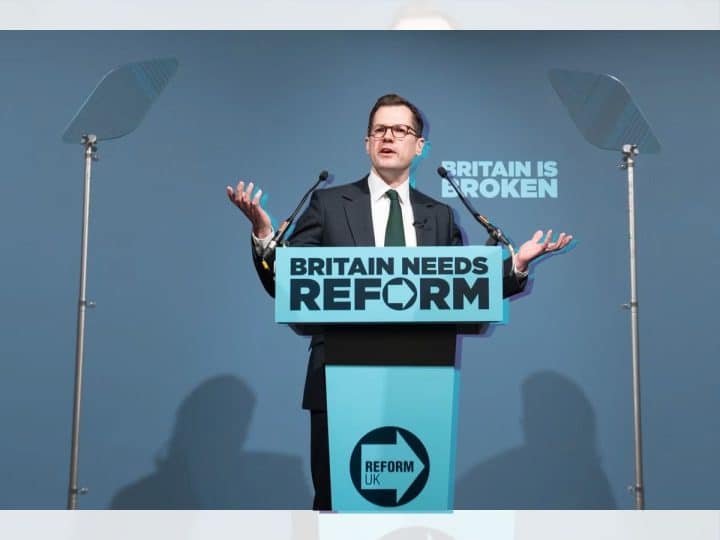

On Monday 17 August, Reform UK announced a suite of new policies designed to target and punish sick, disabled, and unemployed people. The party’s plan to target unemployed people is based on the idea that there’s a significant number of voters who are just ‘layabouts’. In reality, most of the people who don’t work can’t work, and the rest are facing a particularly tough market – as the latest job vacancies show:
all while every single major party says it’s going to cut benefits for people that “refuse to work” https://t.co/TsAZeBlXwb
— mike ☭

 (@__mike91) August 18, 2026
On the attack (and ignoring the job vacancies chaos)
Reform’s Making Welfare Work policy would completely abolish Personal Independence Payments (PIP). As we reported, this is an odd move for Reform to make, given that many Reform voters are PIP claimants. It’s one thing to pretend the system is full of ‘scroungers’ and to promise a crackdown; it’s quite another to directly target every PIP claimant in the country.
I canvassed a disabled voter in Crook recently who told me she was voting Reform because the first time she applied for PIP it was rejected. "I had to fight damn hard for my PIP" she told me, "but foreigners get it for nothing".
I hope people like her become better informed. https://t.co/l5emWDM0QD
— Sam Rushworth MP (@SamJRushworth) August 16, 2026
Predictably, Reform’s policy is likely to result in a massive increase in child poverty. PIP payments help sick and disabled people juggle part-time work with their ongoing health issues. Removing PIP might push some people into full-time work, but it will also force many into full-time unemployment.
The new policy will mandate that anyone who’s on Universal Credit for 12 months will have to complete 20 hours of community work a year. As the Standard reported:
Robert Jenrick, the party’s Treasury spokesperson, said the long-term unemployed would have to work 20 hours a week scrubbing high streets, carrying out minor repairs and “beautifying neglected places”.
The scheme would be run by local councils and those who do not accept work placements will have their funding cut.
This really betrays two things:
- It’s entirely possible to just create job vacancies – including jobs which benefit the local area.
- For whatever reason, some voters will only get behind such a move if there’s an element of punishment to it.
And all this is especially bad when you factor in the current unavailability of jobs.
There are now 2.5 unemployed people for every job opening in the UK. https://t.co/dAkoigaAgb pic.twitter.com/tKpis4jAmE
— Bull Theory (@BullTheoryio) August 18, 2026
 THIS IS INSANE
Job hunt
As the BBC reported, the number of job vacancies:
has fallen to its lowest level in more than five years as smaller businesses cut back on recruitment, official figures indicate.
Vacancy numbers fell over the May-to-July period to 707,000, according to the Office for National Statistics (ONS), which said small firms were citing labour and operating costs as reasons for scaling back hiring.
Energy costs have risen since the Iran war began, and companies have also said that increases in National Insurance and the minimum wage have made it more expensive to employ staff.

While it’s essential that the minimum wage rises to meet the cost of living, it can cause issues in a Cost-of-Living Crisis. The problem is that even with wages going up a bit, most people are still feeling the pinch. When that happens, people spend less; when people spend less, businesses attract fewer customers; when businesses attract fewer customers, they employ fewer people.
It’s a vicious circle, in other words. And it’s not one we’re going to get out of by punishing people who are out of work.
Reform says it will save £50bn a year by abolishing PIP. That’s £50bn which was being sent to PIP claimants who were in turn spending it on food, clothes, and essentials. Now ask yourself this: will pulling £50bn out of the economy be good for businesses who are already struggling, or will it be an absolute disaster?
Job seekers vs job vacancies
The BBC article carries the following interview with a job seeker:
Aaron Diangienda told BBC Newsbeat he has been looking for a role for more than a year.
“I’ve been trying my best, just making sure that I am finding the correct stuff to suit me and keeping on going with [the job hunt]”, he says.
Under Reform, Diangienda would have been put on the scheme to carry out labour for benefits – i.e. he’d be working for less than the minimum wage. Would that really help him find work?
Another job seeker said this:
For Jasmine Walker, it’s been a case of applying for jobs “literally anywhere and everywhere”.
The 24-year-old says she has been looking for marketing jobs since she graduated from university in July, and estimates she has applied for more than 300 roles so far.
“It’s a bit frustrating because you’re researching and practising how to make your CV and applications pristine, and yet you still can’t get anywhere with that,” says Walker.
Imagine if applying for 100+ jobs wasn’t enough, and suddenly you had to work 20 hours a week just to maintain your benefits – benefits which already failed to ensure any quality of life.
You can be mad about how things are, but you can’t pretend Reform’s plan will fix anything.
Farage wants 300k unemployed scrubbing the streets for free or starve. Call it community service. It’s the workhouse rebranded. Class war from the top. Always.
20 hours unpaid labour a week or lose your benefits. That’s Reform’s big idea. Taxpayers get paid. Claimants get… — Spirit Of Attlee (@SpiritOfAttlee) August 17, 2026
Costly
Another thing to note is that Reform’s plan is going to create whole new layers of bureaucracy and enforcement for local councils. Who’s going to pay for all this? Because the policy isn’t going to generate cash as far as we’ve been told. And this is supposed to be part of a plan to save money.
It’s almost like Reform hasn’t thought this one through.
Featured image via PA
By Willem Moore
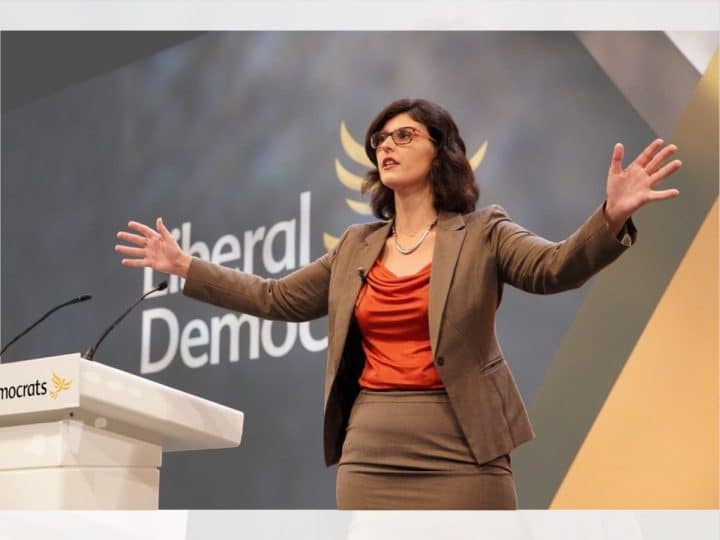

If there’s one thing pretty much everyone agrees with, it’s that British politicians haven’t been doing much long-term planning. A clear example of this is the following from Lib Dems MP Layla Moran:
It is hard to overstate the selfishness and short-sightedness of NIMBYism.
Here’s Lib Dem MP Layla Moran objecting to plans for a mega reservoir in her constituency in 2022.
Her constituency is now officially in drought because we lack enough places to store water. https://t.co/HiMXkIG4Le — James Hanson (@jhansonradio) August 18, 2026
NIMBYism = Lib Dems-ism
The acronym ‘NIMBY’ stands for ‘not in my backyard’. It’s a descriptor for people who want things to be built and developed, just so long as they’re not built and developed near them.
In Britain, NIMBYs have incredible power to prevent projects moving ahead during the planning process. On the one hand, having the ability to object to local mega projects is a good thing – especially when it comes to AI data centres. On the other hand, China has built “29,800 miles of high-speed train lines — about 70 per cent of the global total” – in the time it took us to half build HS1.
In the clip above, the Lib Dems Moran says:
Well, the main thing is that the water companies haven’t adequately, in my view, reassured and shown that this is absolutely necessary. You know, to put it into context, this is an enormous reservoir… 25 metres high, made of concrete. That’s three double-decker buses, one on top of the other. It’s pretty much the footprint of Abingdon itself. It’s enormous.
And there’s two things that they haven’t done. The first is proven that their population projections are correct. There are big discrepancies internationally, in what the ONS… say, and what they say they’re going to be. And we think that’s a big problem.
But the second is the environmental impact itself. We fully appreciate that we need to do something with our water supply. Absolutely. The question is, is this monstrous design the right thing? I don’t think they’ve made the case.
After the summer we’ve had, you’re no doubt salivating at the thought of that enormous reservoir. Although climate change has indeed accelerated, we knew that summers like this were coming in 2022 when Moran said the above. The Lib Dems have form too, with Nick Clegg having shot down carbon-free nuclear projects in 2010 because they wouldn’t come online until 2021:
Nick Clegg opposing nuclear energy investment in 2010, when interest rates were at record lows because it would simply take too long to materialise
pic.twitter.com/zxC26skevv https://t.co/iqbGl1EtXH
— camilo (@AscendedYield) June 26, 2025
Short termism
At this point, it really is up to us to punish politicians for this sort of short-term thinking. We need to renationalise key utilities; we need to improve and expand our national infrastructure, and we need to double down on renewables and nuclear. It’s going to take some time to make these things happen, but we’ll be kicking ourselves ten years from now if we don’t.
Featured image via Mark Pack
By Willem Moore
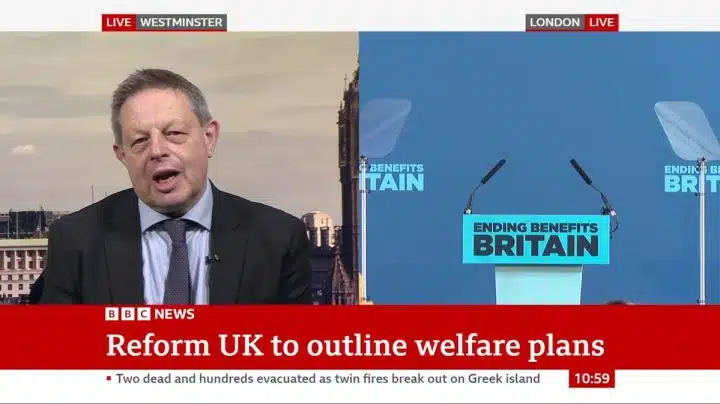

Hard-right, anti-migrant party Reform UK recently revealed its plans to “overhaul” Britain’s benefits system. As if anyone could be surprised, the plans were not exactly original: it’s neoliberal austerity, reheated. So far, not so shocking — although the actual plans understandably alarmed disability rights campaigners and affordability advocates alike. What should be more shocking is how the BBC handled the ordeal.
Just heard BBC news lead with Reform policy proposal. How is that editorial decision justified three years out from an election for a party that is a) not the official opposition b) has eight seats in parliament c) is no longer leading the polls? Free publicity as usual.
— Barry Malone (@malonebarry) August 16, 2026
Overly eager to air Reform’s latest press conference, the BBC displayed an empty podium for the better part of an hour. Meanwhile, pundits discussed — in hypotheticals — what might be announced any moment.
They then dedicated many minutes of airtime to both the live coverage and to further discussion after. Then, many of Reform’s supposedly costed assessments were reported as fact without much critical dissection.
Why on Earth would the BBC tweet about this story as if these supposed savings are a statement of fact, and not some wild ill thought out claim on behalf of Reform? The article itself isn’t particularly critical either https://t.co/M6Axn37oRn
— Razor Marone (@Streettough) August 16, 2026
Richard Sambrook, a former director of BBC News, has underscored the disgraceful coverage:
BBC’s coverage of Reform’s welfare plans is frankly bizarre. Headlines in Ten, leading on some radio networks. Reform are not even the official opposition and the plans have less credibility than Count Binface. Will BBC News do the same for Lib Dem and Greens policy two years out?
Any objective editorial assessment of Reform currently should surely focus on its corruption allegations. Namely, its party leadership is mired in money laundering investigations and the undeclared £5m “gift”. When discussing “fitness for government,” major public interest stories like that surely come first.
To quote one X user, Bruce McD:
Inchoate and inoperable policy announcements should be treated as the trifling diversion they [are].
Polanski slams BBC Reform-friendly hypocrisy after Newsnight ambush
BBC serves pro-Reform whoppers
Canary readers will be well aware that it’s not the first time the BBC has done party-political broadcasts ad hoc, not advertised as such, for Reform UK. Its Newsnight presenters recently ambushed Green Party leader Zack Polanski, loathed by Reform and its (especially Nazi) supporters, live on-air. As I wrote at the time:
Newsnight rightly drew sharp criticism after one of their journalists, Nicholas Watt interrupted the broadcast to read out live reactions to the show from Reform UK. Watt simply read out text messages from unnamed, inflammatory Reform figures. This took up over three minutes of the show’s 30-minute run-time.
During those three minutes, Polanski was filmed live on air, forced to sit and listen. Meanwhile, the BBC’s Watt proudly showed off to the nation that he gets DMs from Nigel Farage.
Innocent onlookers might be forgiven for thinking this kind of behaviour is more fitting to GB News than Reform. Though it hardly needed proving, media analysis by Alan Rusbridger exposed centi-millionaire funded GB News as essentially a propaganda outfit for the party. But this is the BBC — it’s different, no?
Although the BBC has historically always served as an extension of the British establishment, more is required to explain its pro-Reform stance. Unfortunately, the BBC’s editorial “turn” is actually quite easily explicable.
Reform’s man on the inside
It’s a man called John McAndrew. According to the BBC’s own website:
John McAndrew is Director of Programmes for BBC News, responsible for the quality, consistency and editorial direction of BBC television and radio news programmes, including Breakfast, the One, Six and Ten O’clock News bulletins, Newsnight, the Today programme, PM, Newsbeat, Radio 5 Live.
prior to that he was most recently the launch editor of The Andrew Neil Show at Channel 4. Before this he spent a year as Editorial Director and Director of News and Programmes at GB News
Gosh, it’s almost as if BBC’s Director of News is a former GB News editorial director…

Isn’t it.
Reform UK & Farage already have GB News to spew their propaganda. For a publicly funded broadcaster to assist them is completely unacceptable.#BBCNews #JohnMcAndrew pic.twitter.com/4iES6xScIx
— @mikiclemfandango.bsky.social (@MikiB007) August 17, 2026
Featured image via X / the Canary


So-called ‘Israel’s’ i24 News, which spread genocide-boosting fictions about beheaded babies post-7 October 2023, has released footage of a man attacking their ‘journalists’ in Belfast. Since then, dishonest media and politicians have sought to falsely conflate the anti-Zionist attack with antisemitism, offering zero evidence for the presence of the latter.
Yet this should have all been avoided by the British government imposing proper sanctions on the settler-colony, including barring entry for all ‘Israeli’ media outlets.
The attack occurred earlier in August, when an ‘Israeli’ cameraman and reporter were preying on people in Belfast’s cathedral quarter, an area packed with pubs and music venues. i24 News claims:
…i24NEWS reporter Jonathan Roe and photographer Nadav Abs were filming a documentary series examining the rise of antisemitism in Europe.
Their reporter Yonatan Raveh told the Jerusalem Post:
He came over to us and started asking questions. We put the camera on him, and then he gave us the middle finger and shouted: “f*** Israel.
We were not looking for any trouble; we were trying to be as peaceful as we can get, and we just walked away. But he started to follow us.
i24 News Footage reveals lies of ‘Israeli’ hacks
However, i24 News’ footage directly contradicts this account. The man does appear to make some sort of gesture to the apartheid entity’s propagandists, but then walks away. The next clip reveals that actual events are the exact reverse of Raveh’s account. The Zionists did not “just walk away”; instead they followed the man and began filming him close-up.
The man can be heard repeatedly asking his harassers to delete footage of him, and to stop recording him. When they refuse these reasonable requests, he becomes aggressive, and finally throws a pint glass towards them.
Many online have seen through the fiction dreamt up by the provocateurs masquerading as journalists. One commenter on Belfast Live’s coverage remarked:
They intimidated a drunken man. He warned them and they antagonised him again.
Another said “Not all heroes wear capes”. Taking a very different take were the Democratic Unionist Party (DUP), whose leader Gavin Robinson sought to deceitfully imply an antisemitic motive:
If this attack was motivated by antisemitism, it must be recognised and condemned unequivocally. There must be no place for antisemitism or any form of intimidation on our streets.
The available footage shows the man making no antisemitic remarks. If he said “fuck Israel”, then a) good for him, and b) criticising a genocidal settler-colony is not remotely the same as demeaning all Jewish people. As we tire of saying, to conflate the two things is itself to be antisemitic. Implying Jewish people are somehow inherently linked to the vile West Asian land theft project is a horrible slur upon them.
Massive sanctions on the Zionist entity now, including its propaganda outlets
i24 News themselves chose to also run with suggestions of antisemitism, with the help of another DUP figure – David McIlveen, who founded DUP Friends of Israel. The Zionist propaganda outfit doesn’t need to confect new fantasies, given it still has the grotesque beheaded babies lies up on its website, years after actual journalists debunked the story.
Such disgraceful organisations simply shouldn’t be allowed to operate in the north of Ireland, or anywhere else. Barring entry for them would protect ordinary people from harassment, and would form what ought to be a comprehensive range of sanctions against all ‘Israeli’ institutions, be they military, political, academic, sporting, cultural, media or anything else.
Devastating restrictions that prevent this deeply abnormal and criminal entity from operating like a normal state are the only way to curb its murderous and racist policies. External pressure is essential, given there is zero current prospect of any internal shift.
The Palestinian-led Boycott, Divestment and Sanctions (BDS) movement, in its guidelines for dealing with ‘Israeli’ academic and cultural institutions, says:
As a general overriding rule, Israeli cultural institutions, unless proven otherwise, are complicit in maintaining the Israeli occupation and denial of basic Palestinian rights, whether through their silence or actual involvement in justifying, whitewashing or otherwise deliberately diverting attention from Israel’s violations of international law and human rights.
All such institutions must be boycotted, divested from and sanctioned. Logically, this ought to extend to media outlets too.
We don’t condone attacks on journalists, or even ‘Israelis’ pretending to be journalists, needlessly provoking people in the street. Yet the island of Ireland should never serve as a platform for those who benefit from a genocidal settler-colony, and seek to produce fresh fictions to justify its intolerable ongoing existence.
Featured image via screengrab
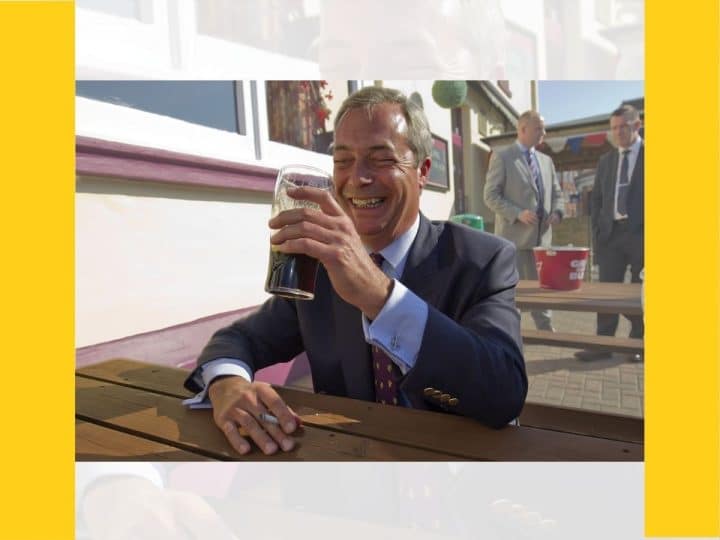

Nigel Farage is notorious for hardly ever showing up to Parliament. He’s also controversial for the £5m ‘gift’ which he received for unclear reasons. Despite this, he’s now decided Britain has a problematic ‘something for nothing’ culture:
Farage should be forced to prove a full 40 hour working week as MP for Clacton. https://t.co/LEkYV2L7SM
— Sam (@SamCKx) August 18, 2026
Absenteeism from Farage
As we’ve covered, Reform’s plan to make long-term unemployed people do free community service is just performative cruelty. It’s also not going to realise any of the benefits they claim to have in mind.
Farage, of course, is a particularly odd person to be calling out ‘something for nothing culture’. Since he was first elected as an MP in 2024:
- There have been 575 votes.
- Farage bothered to show up for 173.
- This means his attendance rate is 30%.
A 30% attendance rate is like if you only showed up to work 1.5 days a week. Sounds a lot like ‘something for nothing’ Britain to us.
Notoriously, Farage also decided he wouldn’t attend GP surgeries in his Clacton constituency. Farage claimed the Speaker’s Office advised him not to for safety reasons; the Speaker’s Office would later deny telling him such a thing. As Sky News reported in September 2024:
The MP had said he is not holding in-person surgeries in his constituency over fears the public will “flow through the door with knives in their pockets”.
Farage really does have a low opinion of Britons, doesn’t he? Clearly, he thinks we’re all violent layabouts, and yet he’s also notorious for swanning off to the US at every opportunity to hang out with Donald Trump – the world’s most notorious violent layabout. Trump is so lazy, in fact, that there’s a website dedicated to tracking his presidential golf trips. According to that site, Trump is nearly as workshy as Farage:
Donald Trump has golfed 125 days out of 577 days since returning to office (21.7% of the presidency spent golfing).
In terms of violence, Trump’s pointless war on Iran is set to make us all poorer, and that will of course lead to fewer jobs. Maybe Farage should be having a word with his mate instead of insulting the British public?
Pushback
Reform politicians are already facing significant pushback relating to the Making Welfare Work policy, which is set to abolish Personal Independence Payments (PIP):
You can see the exact moment that Reform politician Laila Cunningham realises that she's going to spend the next few years defending a policy that will hurt vulnerable people https://t.co/okm21FuK1L
— Larry the Cat (@Number10cat) August 17, 2026
Robert Jenrick and Jeremy Kyle resorted to telling lies to quiet down the critics. As Mukhtar reported:
A Reform supporter called in and said that his family would not vote for Reform because his wife is on PIP. She has been through hell trying to get it, and he isn’t willing to take the risk of her losing it under a Reform government.
Jeremy Kyle then interrupted him and falsely claimed that hundreds of thousands of people are fraudulently claiming PIP.
This is a lie. PIP has one of the lowest fraud rates among benefits, at around 0.2%.
This is the full clip and obviously Robert Jenrick also lies. https://t.co/iApvlJxgLC pic.twitter.com/PzFKEevRuo
— Mukhtar (@I_amMukhtar) August 18, 2026
Reform is also facing pushback from its own councillors:
BREAKING Reform councillor quits Reform saying that Reform’s new welfare policies will cost lives pic.twitter.com/5Wa9If4iaX
— Harry Eccles (@Heccles94) August 18, 2026
As we’ve reported in the past, many Reform councillors have complained that they lack independence. Apparently, they have to tow the party line, even if it’s bad for the local area. Several councillors have quit over this. And Reform’s Making Welfare Work policy could be another issue that forces Reform councillors to quit or defect.
Downhill
Reform has mostly targeted its wrath on migrants; now, it’s seeking to broaden the attacks to more clearly include sick, disabled, and unemployed people. As we’ve reported, this means Reform is attacking people who may have otherwise considered voting for them. And it’s unclear why they think this is a good idea.
Our current theory is that they haven’t thought it through. No doubt because workshy Farage couldn’t be bothered turning up to the planning sessions.
Featured image via Justin Tallis
By Willem Moore

Vilija Vėlyvytė argues that the UK-US medicines deal which will see the NHS pay more for new medicines is an unexpected cost of Brexit.
Earlier this year, the government published the terms of the UK–US medicines deal agreed late last year. The deal secures zero tariffs on UK pharmaceutical exports to the US for three years but commits the NHS to paying substantially higher prices for new medicines. This deal should be understood as one of Brexit’s hidden costs.
The UK’s principal commitment under the deal is to double the share of GDP spent on new medicines by 2036 – estimated to require around £14 billion in additional annual spending by then. In relation to this, the UK has also agreed to raise the net price paid by the NHS for newly launched medicines by 25%. In practice, this means that drugs previously judged too expensive for the benefits they offered might now be recommended for NHS use.
The deal is undoubtedly a win for the pharmaceutical industry, particularly large US drugmakers. The government says that is precisely the point: offering industry more favourable terms will make a wider range of innovative medicines available through the NHS and attract greater investment in life sciences. The promised payoff is better outcomes for patients.
But that is only one side of the bargain. As analysis by the Nuffield Trust and others suggests, higher spending on medicines will increase pressure on an already overstretched NHS, leaving less for other services – from GP appointments to operations for those on waiting lists. The government disputes this, yet it has refused to publish an impact assessment behind the deal.
Trade-offs could potentially be avoided if the higher medicines spending were matched by additional funding. But no such funding has been allocated: as things stand, the cost will be met from existing NHS budgets. A deal presented as a win for patients may therefore leave both patients and the NHS worse off.
Why, then, did the UK accept such a risky bargain?
The answer is that the UK was poorly positioned to refuse. Brexit is a large part of the reason why, as it dealt a serious blow to the country’s appeal as a medicines market and, more broadly, as a base for life sciences research, and in doing so weakened the UK’s ability to withstand US tariff pressure.
Brexit split what had been one regulatory system into two. Companies seeking to market medicines in both the EU and the UK must now secure separate approvals from the European Medicines Agency (EMA) and the UK’s Medicines and Healthcare products Regulatory Agency (MHRA). That extra step buys access to a UK market only a fraction of the size of the EU’s. Add to this UK-specific packaging and labelling rules, import requirements and customs formalities, and the commercial case for launching and supplying medicines in the UK weakens further.
The same calculus applies further upstream, to the development of new medicines. A company can use a single EU application to seek authorisation for a clinical trial across up to 30 European Economic Areas (EEA) countries, all under the same regulatory framework. Including UK sites means opening a second regulatory track, with a separate approval process and UK-specific regulatory requirements. This adds cost and can cause delay.
Predictably, the regulatory split has made the UK a less attractive destination for multinational trials. The number of industry clinical trials initiated in the UK fell sharply after 2017 and, despite a recent recovery, remained below its 2017 level in 2024. Patient recruitment has continued to fall. Each year, commercial trials bring billions of pounds of R&D spending into the country, generate income for the NHS, support tens of thousands of jobs, and help attract long-term investment in UK life sciences. Loss of trial activity therefore carries major economic costs and risks holding back growth in the life sciences sector.
In the post-Brexit years, the government’s strategy to restore the UK’s pull on the pharmaceutical industry was regulatory agility. Central to that strategy was reform of the MHRA: make it faster, more efficient, and more responsive to industry and innovation. New medicine authorisation routes were introduced, existing routes were modernised. The clinical trials framework underwent what was billed as the “biggest overhaul in trial regulation in 20 years.” The newly “sovereign” MHRA was meant to become a world-leading regulator, using greater agility to help turn the UK into a life-sciences “superpower”.
The reality has been more sobering. Brexit stripped the MHRA of EU-linked work and fee income, contributing to staff cuts and capacity pressures. Backlogs followed. The agency’s performance has since improved, aided by a £10m government funding boost, but the wider record remains mixed. New medicines are typically approved later in the UK than in the US and EU, while some of the recent gains in speed reflect the extent to which the MHRA relies, via the International Recognition Procedure, on decisions already taken by “trusted” overseas regulators.
The MHRA has thus not delivered on its promised agility. But even if it had, this would not have altered the fact that the size of the market to which the UK can offer access, and the scale of the opportunity it presents to the pharmaceutical industry, have both shrunk after Brexit. So too has the UK’s bargaining power.
That is the context in which the UK–US medicines deal should be understood. The UK faced US tariff threats alone, without the collective leverage of the EU, while still grappling with the regulatory and economic consequences of leaving the bloc. Moreover, major pharmaceutical companies warned that investment would move elsewhere unless the UK offered more favourable terms.
Brexit also exposed the UK to a form of pressure that EU membership had shielded it from. In the EU, trade policy is negotiated collectively while medicines prices are set at the member state level, so Washington cannot threaten an individual member state with tariffs to force concessions over what its health system pays for medicines. Outside the EU, that trade-off became possible.
The UK could, of course, have walked away from the deal. But walking away would have meant a further setback for an economy already under strain. Instead, it accepted terms that set the promise of new medicines against the NHS’s ability to meet other patient needs.
By Dr Vilija Vėlyvytė, Lecturer in EU Law, The Dickson Poon School of Law, King’s College London and co-editor of forthcoming book The UK Regulatory Framework Post-Brexit: ‘Law Unbound’.
Politics
Poll: Americans say the White House has shifted its deportation campaign. They’re still not buying it.


Republicans are struggling to reverse the damage President Donald Trump’s immigration agenda has done with voters.
With less than 90 days until the midterm election, the Trump administration has sought to keep Immigration and Customs Enforcement officials out of the headlines, pulling back on the high-profile, flashy raids in blue cities and minimizing public clashes with community members and protesters.
But new results from The POLITICO Poll show that half of Americans, including nearly a quarter of Trump’s 2024 voters, still say the president’s mass deportation campaign is too aggressive. That’s virtually unchanged from polling numbers in January and April, amid mounting political outrage over federal agents killing two U.S. citizens in Minneapolis.
Non-MAGA Trump voters are twice as likely as self-identified MAGA voters to say the president’s mass deportation campaign is too aggressive — 31 percent compared with 15 percent, according to the new poll, which was conducted Aug. 8 to Aug. 12.
The persistence of that negative voter sentiment underscores a vulnerability for Republicans heading into November, as the party grapples with its message and policy approach on an issue the GOP once dominated. Immigration was a reliable winner for Republicans, with the party rallying voters around border security and public safety. Now, they’re struggling not only to convince persuadable voters, but also hold together their own coalition as it splinters over deportations.
“Voters really did want border security, but they did not want to see abuelita taken away because she’s been here for 40 years but without documentation,” said Arizona-based GOP strategist Barrett Marson.
The poll, conducted by London-based polling firm Public First, found a notable share of Americans believe the administration has shifted how it is conducting deportations following the fatal shootings, but that has not been enough to reverse Americans’ views of the administration’s deportation strategy.
A 56 percent majority of Americans say there has been at least a small shift in the way the Trump administration has been conducting its deportation campaign. But a plurality of those respondents, 44 percent, say the shifts have made no difference in how much they trust the administration on immigration. Thirty percent say the shifts make them less willing to trust the administration on immigration.
Among the 71 percent of Trump voters who said they’ve observed at least a small shift from the administration, nearly half, 48 percent, say those shifts make “no difference” in how much they trust the administration on immigration. Nineteen percent said the shifts make them less likely to trust the administration, while 29 percent said they’d be more likely.
Whit Ayres, a Republican pollster in Washington, said that even with the lower-profile approach, the administration’s goal of increasing arrest and deportation numbers remains. That conflicts with what many voters broadly support: targeting immigrants in the country illegally who have committed crimes.
The lack of a change in voter sentiment is “not that surprising at all,” Ayres said. “It’s a lot easier just to go into an airport and find somebody who had overstayed a visa, had applied for an extension … and throw them into handcuffs and put them in a detention center. That’s the easy way to get the numbers up, and a great way to thoroughly antagonize public opinion.”
Another Republican strategist, granted anonymity to speak candidly about the landscape, said Trump “ran on border security, and he’s following through.”
“But the visuals of wins are unfortunately overshadowed by the visuals of chaos,” the strategist said. “There’s no question that the wall to wall coverage of the chaos that follows ICE makes voters squeamish.”
The White House pointed to polling from this spring that showed that 80 percent of Americans support deporting unauthorized immigrants who have committed crimes, as well as a Department of Homeland Security press release that highlighted arrests of immigrants who had been accused of sexual assault of a child, forcible sexual abuse and drug posession.
“Americans sent President Trump back to the White House with a clear mandate to deport criminal illegal aliens. Every single day the Trump Administration is delivering on his promise to the American people to remove murderers, pedophiles, rapists, and gang members from American communities,” said White House spokesperson Lauren Bis. “Americans are grateful to the President for removing these criminals from their neighborhoods and for Making America Safe Again.”
The GOP’s stronghold on immigration as a campaign issue eroded soon after the president’s return to the White House. Soon, robust enforcement efforts led to viral images of arrests inside courthouses, at airports and on neighborhood streets. The backlash brewed for months, and peaked this year amid the killings of Alex Pretti and Renée Good in Minnesota.
The White House moved quickly to contain the political fallout, sidelining then-Border Patrol commander Greg Bovino and deploying border czar Tom Homan to ease tensions. The administration has since sought to avoid controversy on immigration ahead of the midterms, emphasized criminal arrests and changed leadership at the Department of Homeland Security. Since Markwayne Mullin took the reins in March, he has reversed contentious policies, including a plan to turn massive warehouses into detention facilities.
Still, some Republicans are particularly worried that the hardline immigration stance was hurting the party with key voting blocs, such as young voters, moderate Republicans and Latino voters. The president won 46 percent of the Latino vote in 2024, the highest share of any GOP presidential candidate in modern history, but these voters have grown increasingly concerned with Trump’s deportations policy.
Democrats, meanwhile, are highlighting the Trump administration’s aggressive tactics on the trail, betting that more voters are repulsed than grateful for the increased presence of ICE and other federal agents in their communities. Minnesota Lt. Gov. Peggy Flanagan, who won the Democratic primary for Senate last week, used her victory speech to rail against her opponent, GOP nominee Michele Tafoya.
“Michele Tafoya was all in with Trump when ICE was terrorizing our neighbors,” she said.
Republicans, for their part, are fractured over the path forward, as immigration hawks battle with wary moderates who are pushing for a targeted focus on criminals.
Not only are non-MAGA voters more likely than MAGA voters to say Trump’s mass deportations campaign is too aggressive, there’s also a stark divide in how each faction supports the goals and implementation of his immigration agenda, The POLITICO Poll found. Nearly two-thirds of MAGA Trump voters — 64 percent — say they support both the goals and implementation of his deportations campaign, compared to just 35 percent of non-MAGA Trump voters.
The president’s MAGA supporters and immigration hardliners have argued that the administration is going soft on the president’s mass deportation vow, potentially turning off the far right base at a time when the party can’t risk a lull in turnout.
The split flared up last month when Mullin temporarily paused some ICE vehicle stops — a tactic the agency was using to increase arrest statistics — after two ICE-involved shootings during vehicle stops in Texas and Maine. While some Republicans welcomed Mullin’s response, the president’s MAGA supporters portrayed it as weak.
“We are being betrayed in real time,” conservative commentator Tomi Lahren said on X at the time. “If you want Trump voters to stay home in November, keep this up Markwayne and co.”
The president, after online pushback, reversed the DHS order.

Sellafield’s SIXEP Continuity Plant has reached an important milestone, with key equipment installed as the project reaches 75% completion.
The SIXEP Continuity Plant (SCP) has reached an important milestone. Teams have completed a series of major crane lifts on the Sellafield site.
The new plant, being built through the Programme and Project Partners (PPP), is now three-quarters complete. It’s on track to begin operations in 2029.
The main buildings are finished and protected from the weather. Work is now focused on fitting out the inside of the plant and installing specialist equipment.
Once complete, SCP will take over the work carried out by the current Site Ion Exchange Effluent Plant (SIXEP). It has been operating since 1985.
The plant plays an important role at Sellafield. It removes radioactive material from water used in site operations before the water is safely discharged to sea. Often described as the site’s “kidneys”, it helps keep this process running safely.
Recent lifts have seen 14 pump and valve modules moved into position. Each module weighs 16 tonnes. Teams have also installed a 55-tonne gantry crane. This spans 21 metres across the plant.
Steve Harnwell, PPP’s managing director, said:
“After years of design, engineering and manufacturing, I’m delighted to see the plant’s operational equipment arriving on site. Installing this equipment on a nuclear site is no mean feat. Our teams have had to thoroughly plan every detail.
Every major project we are delivering at Sellafield is a step towards safely managing and reducing the UK’s most hazardous nuclear materials.
We’re delivering stores for different types of nuclear material, processing plants, and analytical facilities. It’s infrastructure with purpose.
Our work is being delivered by so many organisations all working together. It stands as a powerful symbol of what UK infrastructure can achieve. Delivering with purpose, leading with expertise, and creating lasting value.”
As equipment continues to arrive and be installed, the plant is moving closer to operation.
The new plant will continue this work until at least 2060. It will support Sellafield’s mission to reduce risk and deliver the site’s long-term clean-up programme.
The progress also comes as PPP marks 7 years of delivery at Sellafield. Established in 2019, PPP brings together Sellafield Ltd, KBR, Amentum, Morgan Sindall Infrastructure, Altrad Babcock and a wide supply chain to deliver major infrastructure projects.

HomeHub, HomePad, or HomePod with Screen details revealed

#shorts #finance #ytshorts

Lewes train derailment: Rail track defect found in area where crash occurred





-

 Fashion5 days ago
Weekend Open Thread: Ann Taylor
-
 Sports6 days ago
This U.S. Amateur is a glimpse into golf’s future in more ways than you think
-
 NewsBeat4 days ago
Myanmar says over 300,000 Rohingya refugees verified for repatriation as exodus enters ninth year
-

 Tech5 days ago
11 Ways to Rank Your Videos
-

 Sports4 days ago
Birmingham 2026: Day 6 Timetable for Irish Athletes
-

 Politics4 days ago
SEQ Code: The Three Letter Boarding Pass Code That Could Give You The Worst Seat
-

 Sports7 days ago
DeQuan Jones in ‘high spirits’ after successful leg surgery
-

 Tech6 days ago
DeepSeek Harness launches as open source rival to Claude Code, alongside V4-Pro on API with higher prices
-
 Crypto World7 days ago
Perplexity AI Predicts an XRP Scenario Few Analysts Are Discussing
-

 Crypto World2 days ago
OCC Greenlights Trump Family Crypto Firm for Trust Charter
-
 Entertainment7 days ago
2026’s Most Ambitious Fantasy Movie Officially Scores Sequel Update
-
 Entertainment7 days ago
All 10 Hayao Miyazaki Fantasy Movies, Ranked
-
 Entertainment7 days ago
Travis Kelce Breaks Silence On ‘Crazy’ Taylor Swift Wedding
-
 Entertainment5 days ago
10 Netflix Shows That Quietly Became Modern Classics
-

 Fashion5 days ago
Weekly News Update, 8.14.26 – Corporette.com
-

 Tech1 day ago
Qwen3.8-27B runs frontier-class coding agents and reasoning locally, no cloud API required
-

 Fashion6 days ago
The Details Do the Dressing
-
 Entertainment4 days ago
Marvel Studios Reveals New X-Men Cast Including Adam Driver and Sadie Sink
-
 Business7 days ago
Nebius shares soar 22% as AI demand powers revenue beat
-

 Business7 days ago
July CPI inflation: Consumer price growth cooled but remained elevated
You must be logged in to post a comment Login