Politics
The Healing Power Of Screaming Into The Void

The signs started appearing on telephone poles around town: simple black-and-white flyers of Drew Barrymore screaming with “Gay Screaming Society” in bold across the top, a date and location on the New Orleans lakefront.
“Look for the gay people,” the flyer instructed.
It wasn’t exactly difficult to find the hundreds of gays and theys who showed up to scream that day at Lake Pontchartrain. We chatted a bit and then a couple of people with megaphones prompted us to scream. And we did.
Two hundred queers, some in clown casual, some in their Sunday best, all screamed together at the sunset-dappled lake. We screamed and screamed and screamed. There was no why. We all knew why. Because, life. Because, Amerikkka and its current incarnations of bigotry. Because, everything.
I screamed so long and hard and loud that my throat was scratchy for days, but I felt amazing. It was as though the tight fist of my body had finally let go. I had to know more. I asked everyone who was “in charge.”
“It’s a movement,” someone told me. “No one knows who organises it,” someone else said. “It’s global,” someone else said.
No one knew who I could talk to about the mysterious Gay Screaming Society. The people with megaphones had melted into the larger body of queers, and for the life of me, I couldn’t remember anything about them. They were ageless, genderless gays. A total mystery.
“There was a mythology that sort of self-created,” says Lindsey Baker, a talent and promotions agent in New Orleans who co-organizes Gay Screaming. Baker doesn’t really remember who had the idea, and neither does her co-conspirator, Austin Davenport, a therapist in New Orleans. One of them saw an article about people screaming at the lakefront in Chicago and texted the other. “This,” they wrote, “but make it gay.”
“With the current state of affairs, we wanted to have an opportunity for people to gather and do something that they already do in their cars or into a pillow,” says Davenport. “We wanted to invite that similar release into a gathering.” Davenport and Baker weren’t trying to force people to have a specific kind of release, though. “There were tears,” they say, “ but I saw a lot of laughter too.”

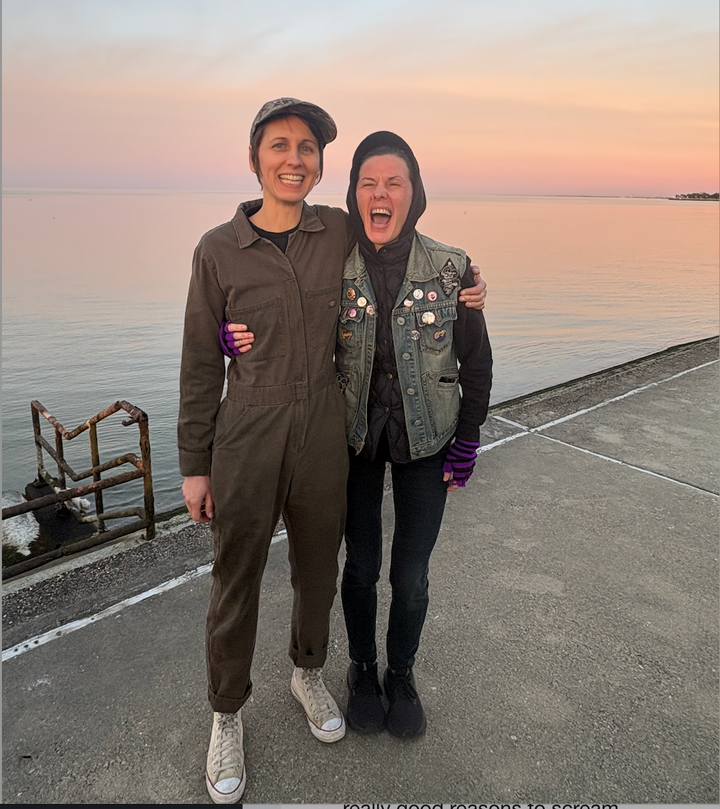
Photo: Tracey Anne Duncan
Gay Screaming is kind of an anomaly, an experiment in queer community building for which the only intention is to be together, to feel our embodied togetherness with no pressure to be nice or look good, no anxiety about solving anything, spending money, or getting laid. That was intentional, Baker says. “It wasn’t a party situation. It wasn’t a work thing. It was just, like, we’re just doing this fuck-ass shit and it feels so good,” Baker says.
Gay Screaming is serving togetherness right on time. In 2025, 867 anti-LGBTQ+ bills were introduced, the most in US history, the vast majority targeting trans people. For context, there were just over 100 in 2020.
And among LGBTQ+ Americans ages 13-24, self-reported anxiety rose from 57% to 68%, depression from 48% to 54%, and suicidal ideation from 41% to 47% between 2023 and 2025, according to the Trevor Project. Add to that the fact that access to desired mental health care dropped from 80% to 60% among those in crisis in the same period and what you have is a queer mental health crisis. These facts, combined with the general collapse of democracy, are really good reasons to scream.
Davenport agrees. “The target on on trans and queer people right now is so palpable. The discourse is ugly and hateful towards queer and trans people,” they say, referring to legislative attacks on LGBTQ+ people and the surge of conservatism in the U.S. Baker adds that she wants to use her skills and resources to make something for queer people who need an outlet. “I have privileges,” she says, “And I want to help create space for people.”
Baker and Davenport wanted people to be able to tell they weren’t being invited to something that would put a target on their backs, they explain. “We had conversations about how we were going to organise this in a way that would not attract too much unwanted attention,” says Davenport. That’s why the flyers contain no names or social media handles or even a specific address. They posted them in public places where queer people are likely to be and trusted us to pass it on the way gays have always done, by word of mouth.
And it worked. No less than half a dozen people texted me pics of the flyer weeks before the event. It was on all our calendars. “I just wanted to attract the gays in a way that feels safe,” Baker laughs when I tell her about the mythos that built up around the event.
One of the most surprising things about this event is that it seems to offer something that gays of all ages need. I brought one of my queer elders with me to scream, and when I arrived, I saw people from every generation, including some teens or tweens holding hands with their own elders, who look like kids to me.
The tagline for Gay Screaming is, “Come for the scream and stay for the fellowship,” and that is the best way to sum up the complexity of the vibe. We came, we screamed, we laughed, we cried. Someone had a birthday party picnic in the grass. A few college students I know from a pandemic-era online dance party invited me to hang, but when I told them I needed a nap, everyone nodded. I have to be rested up for the next Gay Scream.
“You can just come and scream and fucking leave,” Baker says. “Some people do that, some people linger. Both are very cool.”
You must be logged in to post a comment Login