
Politics
The House | An End To The Resident Doctors’ Dispute Could Cause New Problems For Government




11 min read
The long-running resident doctors’ dispute that has dogged successive governments may finally be nearing resolution. But, as Noah Vickers reports, there are formidable hurdles ahead before Wes Streeting can declare ‘mission accomplished’
Wes Streeting, less than a month into his new job as Health Secretary, declared that a strike that had “caused untold misery to patients and staff” was all but over.
He had, after all, just handed a 22.3 per cent pay rise to resident (formerly known as junior) doctors after 11 rounds of industrial action, in the weeks after Labour’s election victory in July 2024. Settling the strikes had been his “priority from day one”, he said, jubilant that the British Medical Association (BMA) had accepted the award.
Except that – as we now know – the huge settlement did not end the strikes. Within 11 months, the BMA was back on the picket line to Streeting’s extreme displeasure. To his critics, a hubristic Streeting has been taught a painful and expensive lesson in power dynamics. His allies insist that his approach is slowly working.
There are indeed signs that – despite winning a fresh mandate for yet more strikes – a new leadership at the BMA is looking for a way out. But the finishing line is still some way off and the obstacles forbidding. A deal to reduce competition for specialist posts from foreign graduates could cause problems elsewhere. And other health staff with pay claims of their own are watching like hawks.
First, tempers need to cool a little – on both sides – for any settlement. “We gave them a big pay increase because we recognised their value, and I think there was a feeling that we’d get them on our side. That clearly hasn’t happened,” says one Labour MP.
The BMA argues that resident doctors’ pay remains 20.8 per cent lower in real terms than it was in 2008, which they say is when their pay cuts began. Critics point out that they use the RPI rather than CPI measure of inflation to reach that percentage, and that most resident doctors had not even started their medical degrees in 2008.
The most recent round of strikes, held just before Christmas, saw tempers run high. Streeting accused resident doctors of taking a “self-indulgent, irresponsible and dangerous” decision by choosing to strike during a flu season, “at a risk of serious harm to patients”. Dr Jack Fletcher, chair of the BMA’s resident doctors committee (RDC), said politicians were “scaremongering” by suggesting that the number of flu cases was more severe than in reality.
Since the new year, however, the tone on both sides has become more conciliatory. Earlier this month, the BMA’s resident doctor membership voted by 93 per cent in favour of extending their mandate for strike action for another six months – but crucially, this was on a reduced turnout of only 53 per cent, suggesting that enthusiasm for the cause has ebbed somewhat.
“I don’t think the doctors have an appetite for years of rolling strikes, like they’ve had for the last three years,” says one Labour MP. “If you mandated all the doctors to vote, my guess is that the actual appetite for striking among all the doctors is not there. This is not the miners’ strike. The sort of people that get involved in BMA politics are a self-selecting group.”
For its part, the BMA claims it does not plan to use its new mandate.
“There is no intention to go on strike,” RDC deputy chair Dr Arjan Singh told the BBC’s Today programme. “[It is] a negotiating tool, but we’ve got no intention of actually using it. I would say that our relationship with government over the last few months has become increasingly positive.”
The BMA declined to make Fletcher, Singh or any of their RDC colleagues available for an interview with The House. MPs who have met Fletcher, however, say he is a “serious” and “co-operative” figure who “wants to see a solution”. They also point out he is a Labour member who “wants the government to work”.
One MP adds: “He has a committee who I think are not always on the same page as him, because they’re a little bit more militant.”
Before Fletcher was elected last year, the committee’s four previous co-chairs belonged to a hardline faction called DoctorsVote. It was this group which had pushed hardest for strike action and for “full pay restoration” to 2008 levels. DoctorsVote no longer holds any officer positions on the RDC committee, but full pay restoration “by 2027/28” remains BMA policy. Fletcher is said to regard this aim as “not realistic”.
The BMA says the dispute is not only about pay but also about addressing the “bottleneck” that resident doctors face when applying for specialty training posts. The ‘competition ratio’ for those jobs has got tighter over recent years, largely due to an increase in applications from international medical graduates (IMGs) – which leaves many UK-trained doctors unable to progress in their careers.
To address that issue, the government is passing emergency legislation – the Medical Training (Prioritisation) Bill – which will ensure UK-trained graduates are prioritised for foundation and speciality training posts. Streeting claims that for speciality posts, the bill “effectively reduces the competition for places from 4-1 to 2-1”.
The legislation was given its First Reading on 13 January, and the government aims for it to receive Royal Assent by 5 March. Passing the bill by that deadline should mean its effects are felt by this year’s round of applicants, whose jobs would start in August.
Yet there are concerns that the rushed-through bill could have damaging impacts on the government’s ambitions elsewhere in the health service.
Lucina Rolewicz, a fellow at the Nuffield Trust, warns that the NHS has “previously relied” on IMGs “to fill a big proportion of general practice training places, so if this bill deters them from applying for jobs that are less popular with UK graduates, it could torpedo efforts to expand general practice, especially in poorer areas”.
She tells The House: “Competition and interest in different specialities are not equal. This is especially the case in general practice and for core psychiatry training as well…
“The bill won’t stop internationally trained doctors from applying to those routes, but it could discourage them from putting applications forward in the first place.”
Stuart Hoddinott, associate director at the Institute for Government, points out: “Almost the entire increase in the GP trainee workforce, since 2019, has come through IMGs… They now make up more than 50 per cent of GP trainees. This is a very important route for general practice.”
More deprived areas, including many of the rural and coastal areas now turning to Reform UK, could be especially badly hit by any downturn in international applications, as UK-trained doctors disproportionately tend to apply for GP posts in urban areas close to the teaching hospitals where they studied.
When it comes to settling the dispute, however, there is a quiet optimism in Parliament that once the bill has been passed in March, a deal could potentially be reached with the BMA in the weeks that follow, without any further strikes having been called.
“That’s the intention of the Secretary of State,” says a Labour MP. “In the early spring, hopefully there’ll be a relatively harmonious deal, and they can move forward.”
But anyone watching the dispute agrees that the BMA is serious about needing to also see some form of improved pay offer – and one may be on the way.
“It sounds like there will be a pay-off of some sort which might be attractive,” says an MP, who adds: “What’s needed is a multi-year settlement which is just a little bit over inflation – that would solve the [pay] problem.
“I would give them a three-year rolling pay settlement, and I’d give it at a percentage or two above inflation for two years, and then a bit more in the third year. You’re not going to take it back to some mythical date of 2008, because it’s not affordable.”
But even a deal of that nature would risk further problems for Streeting, as other unions representing healthcare workers would take immediate notice of it.
“I don’t envy Wes Streeting in his job at the moment, because he’s got to balance all these things out,” says one backbencher. “He wants the doctors back. That might involve a more-than-inflationary pay increase, which then might bring all of the other professions into play.
“The main cost for the NHS is people. If you lose control of the pay aspect, then the costs will go up enormously.”
Unions representing NHS staff tell The House they are monitoring the resident doctors’ dispute and do not rule out balloting their own members for strike action if a generous deal is agreed.
“All NHS staff are deserving of above-inflation pay rises,” says Richard Munn, national officer for health at Unite, which represents almost 100,000 healthcare workers.
“Unlike resident doctors, the lower-paid NHS staff do not have the opportunity to progress to be consultants, GPs or surgeons as their careers develop.
“We hope that the government will see the unfairness of treating doctors more favourably than other NHS staff and will look to offer all staff above-inflation pay offers.”
A spokesman for the Society of Radiographers says their union is watching the resident doctors’ dispute “with interest”, adding that “balloting for strike action would depend on what follows for other NHS staff and how this is received by our members”.
The Royal College of Nursing, meanwhile, says it was “an insult” for the government to offer a 3.3 per cent pay uplift to their members and has pledged to “look at whether this is fair treatment compared to other professions and sectors”.
Hoddinott says: “The resident doctors are actually a relatively cheap staff group to pay. If you want to pay them a lot more money, you can actually do so relatively easily.
“An extra percentage point increase in their salary is worth roughly £51m, which sounds like a lot, but in NHS terms is not that much.
“More worrying is the contagion effect to other staff groups – if you get ‘Agenda for Change’ staff, which is all non-medical staff in the NHS, walking out.
“If you give them a percentage point increase that matches the resident doctors, that is suddenly something like £730m. That starts to get very expensive, very quickly.”
For Streeting, there will also be a personal incentive to resolving the dispute. The Health Secretary has been touted as a challenger to Keir Starmer’s leadership, and preventing further strikes – by reaching a deal which the public believes to be fair – will be a key test for him.
“It’s damaging for any secretary of state to have this hanging over their head,” says Hoddinott. “It gives the impression of dysfunction, and it does hurt your ability to demonstrate progress towards your ambitions.”
A DHSC spokesperson said: “Resident doctors have already had a 28.9 per cent pay rise over the last three years – we’ve gone as far as we can on pay this year.
“We’re working constructively with doctors on the long-standing issues they face in their careers and we’ve already made progress, including fast‑tracking legislation so UK medical graduates get priority for specialty training places. Our focus remains firmly on continuing this work and preventing strike action, which has already caused too much disruption for both patients and NHS staff.”
In a written statement, Fletcher told The House: “This is not a problem the government can wait out.
“From the very start of my engagement with government, I have made clear I am serious about getting to a deal. Strikes could have been avoided from the get-go if government had simply engaged with us on those terms.
“Sadly, we had to go through strike action before they would talk seriously. We hope that the talks we are now in will result in an offer that means there need be no further strikes.”
Regarding pay erosion since 2008, he added: “Our job is not 21 per cent less difficult, so it should not be paid 21 per cent less. The choice to cut this pay was a political on,e and the choice to restore it must be a political choice too.”

Parliament is in recess, and MPs are once again scattered across the country, back in their constituencies. In North West Essex, Kemi Badenoch will be pleased: once again, she tops ConservativeHome’s Shadow Cabinet League Table, with a net satisfaction rating of +82.1 (up 0.5 points).
It is the third Shadow Cabinet League Table in a row in which she has come first. The first time she reached pole position was shortly before Robert Jenrick’s defection to Reform UK. It underlines the marked shift from her earlier performances in ConservativeHome’s polling, when there were times that she was languishing on zero.
But it also reflects the way her personal polling has improved dramatically in recent months. Badenoch is now the most popular of all the party leaders. According to the think tank More in Common, the Tory leader’s net approval rating has risen to -9. That may not sound like much, but it puts her ahead of the pack. Sir Keir Starmer is on -42, while Nigel Farage and Zack Polanski are both on -16, with Ed Davey on -11.
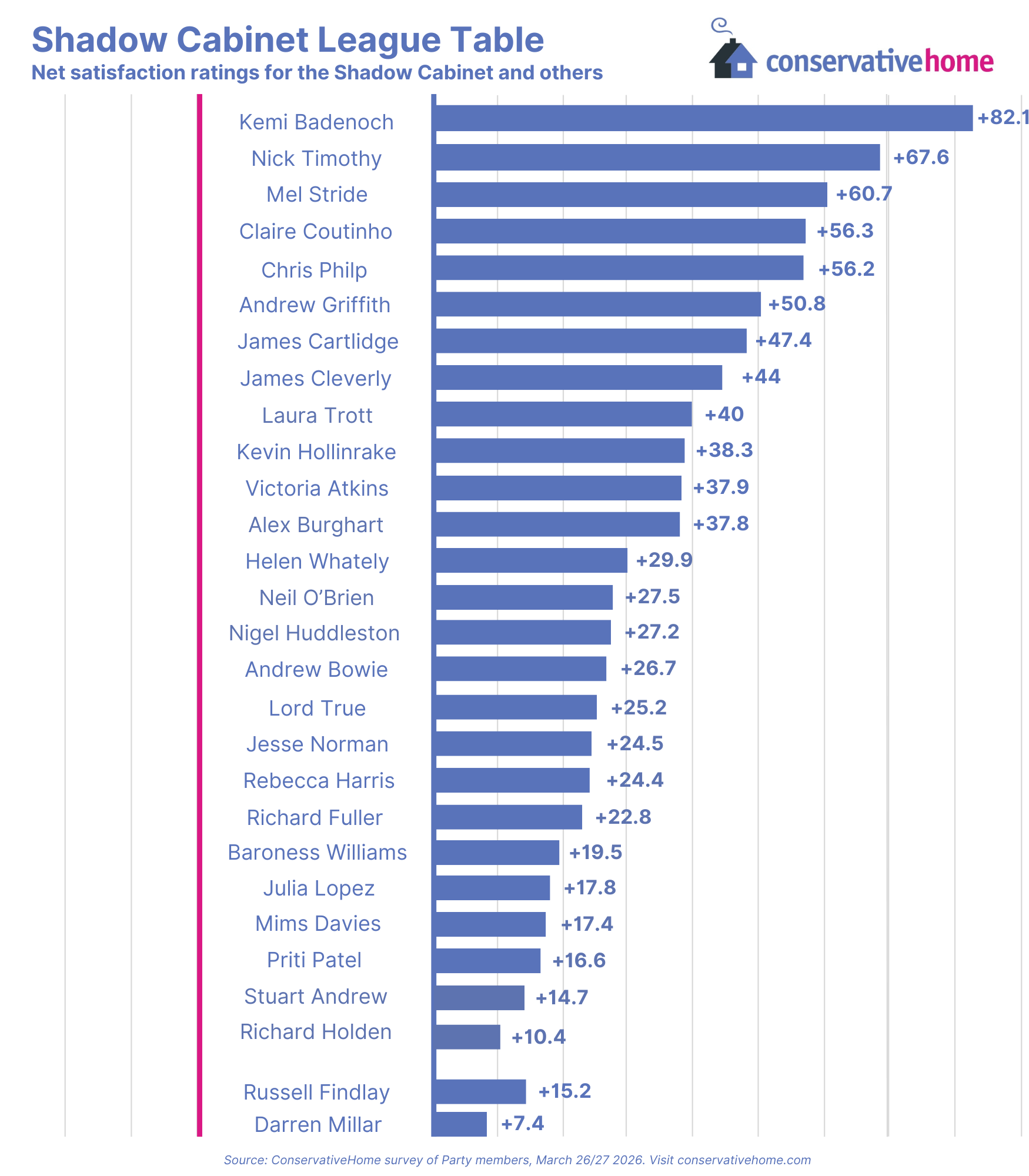
Behind Badenoch in ConservativeHome’s league table is shadow justice secretary Nick Timothy (+67.6), who retains second place since joining the shadow cabinet. He has recently been at the centre of controversy after describing a Ramadan prayer event in Trafalgar Square as “an act of domination” from an “Islamist playbook”.
The Tory leader rowed in behind him, but some fellow Conservative MPs – including some in the shadow cabinet and the whips’ office – have privately raised concerns about Timothy’s comments and his subsequent doubling down, which one senior Tory described as “extremely unhelpful”. But it has done nothing to dent his standing with Conservative members.
This Shadow Cabinet poll was conducted after Timothy’s remarks, and he still sits above all his shadow cabinet colleagues bar the Tory leader herself. In fact, he has increased his rating from +56.9 to +67.6.
The rest of the top five is unchanged from our last league table: shadow chancellor Mel Stride remains in third (+60.7), followed by shadow energy secretary Claire Coutinho (+56.3) and shadow home secretary Chris Philp (+56.2). Despite recent rumours – including in the Mail on Sunday – of a forthcoming reshuffle that would move Stride and Philp, both have held their positions since our last Conservative Home poll.
Another name that has surfaced in reports of a shadow cabinet refresh is shadow foreign secretary Priti Patel, who finds herself near the other end of the table, third from bottom on +16.6 — ahead only of shadow health secretary Stuart Andrew (+14.7) and shadow transport secretary Richard Holden (+10.4), who remains rooted to the foot.
Talk of a reshuffle seemed to lose some of its sheen as Parliament headed into recess. But I understand that, at senior levels within CCHQ, discussions are still ongoing about using a refresh as part of a broader plan to get the Conservative Party back on the front foot after the local elections.
And speaking of those elections: in the run-up to the Scottish and Welsh contests in May, things are not looking especially rosy for either Tory leader. In Scotland, Russell Findlay has slipped from +17 to +15.2 since our last survey. In Wales, Darren Millar is on +7.4, down only fractionally from +7.5. Still, the polls that matter are the ones coming next month.
The post Shadow Cabinet League Table: Badenoch extends her lead, Timothy holds second appeared first on Conservative Home.

I should have felt shocked when I read that one in eight parents now report that their child has a disability. That means that 12 per cent of British children – around 1.7million young people – are classified as suffering from a long-term illness, disability or impairment, according to figures just released by the Department for Work and Pensions (DWP).
These figures have almost doubled since 2015, when around seven per cent of parents reported that their child had a disability. This massive expansion in the number of children deemed to be disabled has been driven by a dramatic increase in the number of kids diagnosed with so-called behavioural issues, such as autism and ADHD. According to the DWP, ‘behavioural issues’ now account for two-thirds of childhood disabilities.
The reason I’m no longer surprised by the rise and rise of childhood disability is that I have been tracking this development for well over three decades. Back in 1996, I remember when UK government officials discovered that between 1985 and 1996, there had been a 40 per cent increase in the proportion of British people who consider themselves disabled. According to the survey, the increase was much higher among teenagers between the ages of 16 and 19. It seemed that the younger you were, the more likely it was that you would have a disability.
The authors of that survey concluded that the difference between the 1985 and 1996 figures ‘appears too large to be explained by a real increase in the prevalence of disability’. This is hardly a surprise. After all, there had been no war or outbreak of serious disease in this period that would have rendered swathes of the population infirm. That the authors couldn’t explain this epidemiologically extraordinary figure in the 1990s is entirely understandable. Thirty or 40 years ago, society had a far more limited view of who was considered disabled.
The explanation for this unexpected rise in the number of young disabled people does not lie in the field of epidemiology, but in the realm of a culture that invites people to classify themselves as infirm. It is important to stress that how people cope with negative experiences is strongly influenced by the cultural and historical factors that shape the way people make sense of them. Such cultural factors may increase or reduce the ability of the individual to cope with adverse circumstances.
In recent decades, the meaning of disability has undergone a dramatic semantic shift. This is part of a broader trend by which negative aspects of human experience and behaviour have become medicalised. In addition, an enormous disability lobby has emerged, which constantly demands that a variety of newly discovered disabilities be recognised with a formal diagnosis. The most important achievement of this lobby has been to alter public perceptions of the relationship between ability and disability. It has also succeeded in transforming what used to be characterised as children’s bad or problematic behaviour into medical issues.
Many of the ‘behavioural problems’ now designated to children have always been part of family life. Disobedience, aggression, disruptive and anti-social behaviour – now defined as ‘oppositional defiant disorder’ – have always posed a challenge to parents and schools. Yet these difficult patterns of behaviour are now often branded as psychological or medical issues. And so they become accepted, rather than something to be amended by adult guidance or firm discipline.
Clearly, parents are now actively courting disability diagnoses for their children. After all, the discovery of newly invented childhood disorders provides a welcome explanation for their children’s bad behaviour or poor performance in school: ‘She isn’t naughty, she is ill.’ It is also undeniable that the many welfare benefits now offered to parents with disabled children have also played a role. Nor can we ignore the role of teachers, some of whom are promoting the diagnosis of ADHD as an alternative to managing bad behaviour in the classroom through discipline and authority. A pupil’s failure to finish homework, inability to focus on class discussion and boredom in school are now blamed on some ‘condition’.
Unsurprisingly, over the past 30 or so years, children have internalised the disability narrative. Today’s young people readily communicate their problems in a psychological vocabulary. They describe their feelings in terms of stress, trauma and depression.
One of the gravest consequences of the disability culture is that many children no longer attend school at all. Last year, it was reported that the number of children missing more than 50 per cent of the school year in Oxfordshire had increased by more than five times in 10 years. This has been put down to ‘emotionally based school avoidance’, in which a child cannot attend school due to anxiety or stress. Half of UK secondary pupils avoided school due to anxiety at some point in the past year.
As a child, I can testify that my friends and I were more than happy to avoid going to school, and we had more than our share of anxiety. But we also knew that our parents and the rest of adult society had no sympathy for our predicament, and that not going to school was not an option. These days, adult society has become complicit in normalising truancy.
It is about time that society woke up to the fact that the current epidemic of childhood disability is not a medical problem. It is a cultural failure. Telling children that they are disabled, and unable to cope with the demands of life, is setting them up for a life of dependency and unfulfilled potential. Our children deserve better.
Frank Furedi is the executive director of the think-tank, MCC-Brussels.
 lead image
In the early hours of 25 March 2026, Israeli occupation forces (IOF) and police entered homes in Silwan, in occupied East Jerusalem, escorting settlers as Palestinian families were forced out of their properties in the Batn al-Hawa neighbourhood.
East Jerusalem — evicted after 10 year legal battles with settler organisation
16 Palestinian families, approximately 100 people, who had lived in the area for decades, were forcibly evicted from their homes. Their apartments were then emptied of their possessions. In many of these cases, illegal settlers from the settler organisation Ateret Cohanim moved into the properties immediately after the families were removed.
These evictions come after Israeli occupation courts upheld ownership claims based on pre-1948 Jewish property rights, which had been fought by Palestinian residents since 2016. Since 7 October, 2023, the Israeli occupation has forcibly displaced 28 Palestinian households from Batn al Hawa. Another 15 families are also expecting to be evicted from the neighbourhood imminently, by the same court order.
A law, known as the Legal and Administrative Matters Law of 1970, exclusively enables Jews to “reclaim” property in East Jerusalem. This is one of the many examples of the occupation’s discriminatory, apartheid policies. The many thousands of Palestinians who were forcibly displaced during the ethnic cleansing of the Nakba, in 1948, have not been allowed to return to their homes.
Since “Israel” occupied East Jerusalem, in 1967, it has expanded its presence and control over East Jerusalem, and attempted to alter the city’s religious identity, history, and demography- to Judaise Jerusalem. It has done this by exploiting its discriminatory laws and policies And through a combination of evictions, demolitions and restrictive planning policies, such as in Silwan, “Israel” is able to dispossess Palestinians of their land and property. .
Israeli occupation demolishing homes in al Bustan for biblical park tourist attraction
Several days after the Batn al Hawa evictions, on 30 March, the occupation’s police, military and bulldozers stormed the al-Bustan neighbourhood of Silwan, to demolish four Palestinian properties. No prior warning was given before the homes belonging to the Awad, Abu Shafaa, and Al-Ruwaidi families were destroyed. Retaining walls, gates and fences were also destroyed, roads bulldozed, and nearby infrastructure damaged,


The demolition of homes in the al Bustan neighbourhood, has been driven by the occupation’s plans to transform the area into public gardens, Torah-related projects, and settlers’ parking. He also highlighted that this neighborhood, located near the Al-Aqsa Mosque, is one of the most affected by Judaization and settlement initiatives.Demolitions accelerated in 2024 and 2025, and by February 2026, the occupation had demolished 35 homes and issued 17 additional demolition orders in al-Bustan. A total of 1500 Palestinians in the area have demolition orders on their homes, so further ethnic cleansing is expected any day.
The Israeli occupation’s interest in Silwan is due to its location, against the southern walls of the Old City and close to al Aqsa, which would allow the zionist regime to cement control over East Jerusalem. Archaeological tourism projects, settlement expansion, and court-backed property claims are all being used to forcibly displace Palestinians, and ethnically cleanse occupied Jerusalem of Palestinians.
Featured image via the author
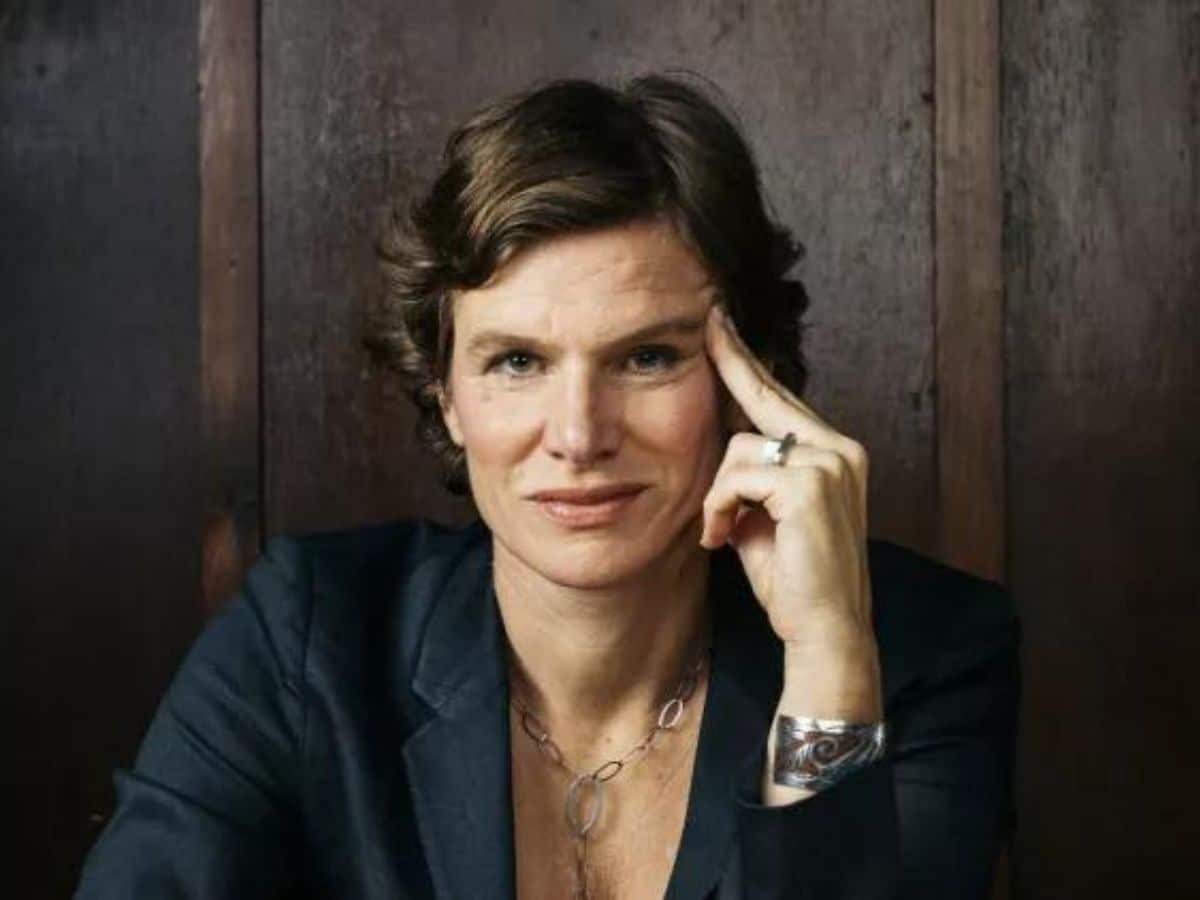
Mariana Mazzucato, professor at UCL, has shown how Labour should be less willing to simply hand out public money to corporations. Instead, she says that subsidies and grants should come with a guarantee of public benefit.
‘Conditionalities’ — types of public benefit
There are various possibilities for making the most out of public money when it comes to partnering with the private sector.
Mazzucato outlines them in four categories. The first, ‘access’, means requiring that the resulting products or services that the government puts money towards are affordable to the population. The second, ‘directionality’, means mandating that the company follows desirable goals such as green power. The third, ‘profit sharing’ means that the company returns some of the profits to the government. This could go further, with the government taking a stake in company. The fourth, ‘reinvestment’, means that some of the company’s profits are reinvested into socially desirable activities.
Of course, a government could use the mandate and popular support of a manifesto to at least take basic essentials into public ownership, to deliver common good without relying on corporations. But if large corporations still dominate some sectors, equitable partnerships could be the way forward.
Mazzucato — No nonsense approach
The government can already use legislation to ensure companies act in a certain way. Failing that, public-private partnerships can be useful.
Direct subsidies are not the only way the government hands out money to corporations.
22% of The Union of Shop, Distributive and Allied Workers receive universal credit (UC). That means the public purse is essentially subsidising the profits of companies like Tesco, which makes £6,150 of profit per employee.
This parliament, the government is providing £2.5bn to the steel industry. And that’s without taking a stake or profit-sharing with steel companies.
Although, the government has said that Tata Steel, which is receiving a £500m grant, will have to transition to Electric Arc Furnaces (EAFs) to address climate change or share its profits with the government. This is an example of a conditionality as Mazzucato outlines, but alone is quite the piecemeal approach to the neoliberal system.
Featured image via UCL

Today, Thursday 2 April, the Guardian ran an exclusive based on comments from the Prevent assistant commissioner, Laurence Taylor. He claimed that counter-terrorism scheme was being overwhelmed by a massive influx of referrals.
Trends indicate that Prevent will receive over 10,000 referrals in 2026. That represents a 33% increase compared to 2024. However, Taylor asserts that this doesn’t necessarily represent an uptick in the radical ideologies that Prevent was (nominally) set up to combat.
In fact, the majority of these referrals are apparently unrelated to extremist ideologies. Instead, they’re issued over concerns about people becoming interested in violence. As such, Taylor claims that Prevent’s time is being wasted, leaving it less able to deal with actual threats.
We at the Canary might phrase this another way. That is, the UK has invested so much in the very idea that (Muslim) terrorism is the greatest threat to our safety that we’ve actively started to damage the capacity to respond to non-terror threats.
‘Violence-fascinated individuals’
Back in July, interim independent Prevent reviewer David Anderson issued a report which responded, in part, to the scheme’s (mis)handling of the cases of Axel Rudakubana and Ali Harbi Ali.
The teenage Rudakubana murdered three young girls and wounded eight other people during his attack on a dance hall in Southport in 2022.
Ali was determined to have been motivated by Islamist ideology. However, Rudakubana displayed no clear motive, and was determined to have been driven by no fixed ideology. Anderson was appointed to:
identify remaining gaps or shortcomings that require further improvement and assure action to address them.
Released last July, the Anderson report stated that:
Several years before the attacks, both the perpetrators had been referred by their schools to Prevent … Prevent’s Channel programme for early interventions had the capacity to address concerns of the kind that were raised in these referrals. But in neither case did it do so.
In fact, Prevent declined to take on Rudakubana’s case three times. As such, Anderson recommended that Prevent’s remit be expanded radically to include non-terror threats. Alternatively, he also suggested that the government create a separate scheme to deal with non-ideological ‘violence-fascinated individuals’ (VFIs).
Prevent — ‘Overwhelmed with referrals’
Another report into the Southport attack is scheduled for release later this month. It’s expected to provide a damning indictment of local authorities, health services, and of course, Prevent itself.
After the attack, Prevent referrals started to rise dramatically. However, more than 50% of the individuals concerned had no clear ideological motivation. Assistant commissioner Taylor pinned this on the fact that there’s simply nowhere else to report these kinds of concerns.
However, he also claimed that this volume of non-terror referrals:
increases the risk of us not spotting somebody that is … because the system is overwhelmed with referrals.
He went on:
The challenge we have in the Prevent system is there is no triage that sits above it, so Prevent currently is the only bucket into which all of these referrals can sit.
We see people with material from Isis and neo-Nazis. We see people watching beheadings and school shootings. We see the gamification of that. So it’s people who are just absorbing horrible stuff that is creating concern for the people who refer them, but they’re not motivated by an ideology specifically, ie extreme rightwing or Islamist.
‘I wouldn’t like to say’
Taylor then rattled off increasing threat levels from states such as Iran and Russia, along with terror groups like Daesh. However, when faced with the question of whether Donald Trump and the American far-right was having a polarising effect, he suddenly became reticent to make a political statement.
Rather, per the Guardian, he characterised Trump as “one of several factors behind rising tensions”:
We’ve seen for a number of years an increasing polarisation, without doubt. You only need to look at the level of protest in London and the diversity of protest in London to see how many different views there are …. Whether you could directly attribute that to the US and Trump, I wouldn’t like to say.
I think there are many, many things at play here, of which that is but one.
If that isn’t the UK justice system’s attitude to ‘ideology’ in a nutshell, we don’t know what is. Is a fascist in the White House causing an uptick in radical ideology? Who’s to say? But look over there at the protesters!
Prevent, despite ostensibly being set up to target all extremist ideology, has disproportionately targeted Muslims from its outset. In fact, hundreds of babies and toddlers have been referred to the scheme, overwhelmingly due to “Islamist concerns”.
In 2022, the Shawcross review even had the nerve to call for a renewed focus on Islamic extremism, calling the definition of neo-Nazism has “expanded too widely”.
And now, we’re being told that non-ideological motivations are falling through the cracks precisely because of the state’s obsession with terrorist ideology? And, in fact, we have no real mechanisms in place for concerns of non-terrorist violence?
If the UK were any less Islamophobic, there’d be a lesson in all this. Pity, that.
Featured image via the Canary
Jeremy Corbyn-led Your Party won’t be fielding councillors in the upcoming local elections. They will, however, be backing various independents. Now, we’re learning such independents could include ex-Tory councillors:
‼️BREAKING | Your Party’s candidates for 2026 include three councillors who were Conservative members as recently as January 2026
Gaz Ali, Amo Hussain, Izzy Hussain all sat as Tories on Walsall Council until Jan ’26. Now backed by Corbyn.
(Leaflet edited to hide phone numbers) pic.twitter.com/azYoWufF0a
— Stats for Lefties 🍉🏳️⚧️ (@LeftieStats) April 2, 2026
“Endorsed by Jeremy Corbyn”
One thing to note is that the above flyer states “endorsed by Jeremy Corbyn” rather than ‘endorsed by Your Party‘. Corbyn is free to support whoever he likes, but as the party’s parliamentary leader, people will interpret his endorsement as the position of Your Party.
The endorsement was first highlighted by the Green Party’s Mish Rahman:
the candidates in my area are 3 deselected Tory cllrs, all cabinet portfolio holders part of the local Tory administration lol
They have moved wards as indys and are standing against me in the same ward. pic.twitter.com/b4Em7up7Ur— Mish Rahman (@mish_rahman) April 2, 2026
Rahman was a Labour NEC member between 2020 and 2024. When defecting to the Greens in January 2026, he said:
Politics must be about clarity and courage.
We are facing a convergence of crises: the rise of the far right, a cost of living emergency pushing working-class people to the brink and civil liberties eroded by successive governments. These are not abstract threats, they are lived realities for millions.
Today I have joined The Green Party because it is prepared to confront these challenges honestly: to defend democracy, stand up for social justice, and recognise that economic fairness and environmental responsibility are inseparable.
Earlier today (2 April), we reported on Your Party’s plans for the local elections:
As party structures continue to develop, Your Party will support around 250 candidates across England. The vast majority of these will be standing as Independents or for allied local community parties.
Your Party targets
Key targets for allied groups include:
- Tower Hamlets, run by Lutfur Rahman’s Aspire since 2022.
- Redbridge (see below).
- Newham, where the Newham Independents Party has recently won multiple by-elections.
- Bradford, where Labour’s support has been in massive decline.
Later in the day – and after the Mish Rahman tweet – New Statesman’s Ava-Santina posted that Walsall is in the mix too:
NEW: Your Party unveil their “get Labour out” local election strategy.
Full list of YP candidates coming later today
– Walsall
– Bradford
– Southport
– Oldham
– RedbridgeCorbyn: “These elections are the beginning of the fightback against austerity, privatisation and fear.
— Ava-Santina (@AvaSantina) April 2, 2026
This could be ex-Tories highlighted above, or it could be the ex-Labour independents who joined Your Party last year.
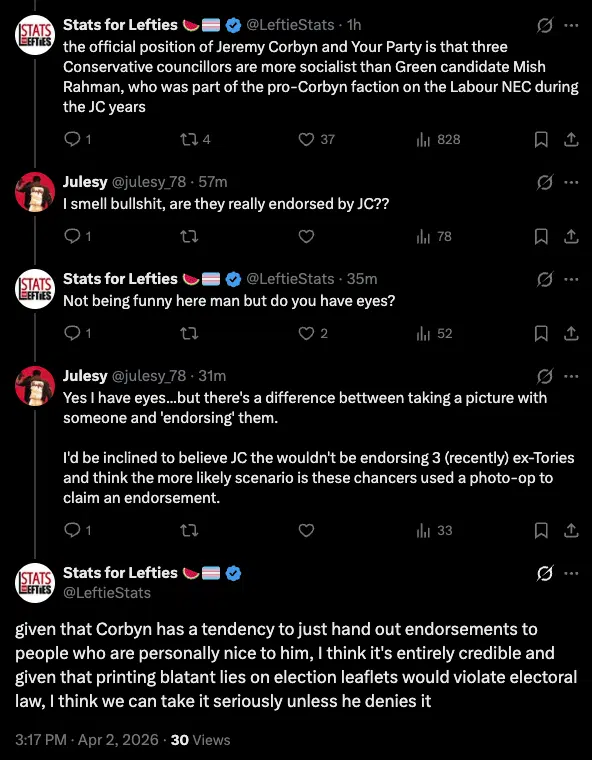
Stats for Lefties engaged in the following discussion on whether the endorsement is real (we’ve got to admit; we do keep rubbing our eyes and glancing back at it):

People outside Your Party have reacted as follows:

Independents
As reported by Birmingham Live, Gaz Ali and Amo Hussain were actually deselected by the Conservatives. In other words, if they didn’t go independent, they couldn’t have defended their council seats in the upcoming local elections.
In a statement on why the three men subsequently quit the Conservative Party, they said:
Our decision is driven by a number of factors. First and foremost is the treatment of several of our colleagues within the Aldridge and Brownhills Conservative Association. The exclusion of good, hard-working councillors, individuals who have given years of loyal service, has been deeply troubling.
In particular, the failure to approve respected councillors such as Keith Sears, who has dedicated over 50 years of service to Walsall and to the Conservative Party, is something we cannot overlook.
We are also increasingly concerned about the direction of the national Conservative Party. The tone and rhetoric emerging from parliamentary leadership appear divisive and risk marginalising communities.
We have always believed that politics should bring people together, and that the party should be inclusive and unifying. Regrettably, this is no longer a position we feel able to align ourselves with.
Ah yes – the Conservative Party – those great unifiers of modern Britain.
Who could forget how unified we felt when we suffered through the devastating austerity cuts of the 2010s – cuts which didn’t touch the rich even slightly.
It just doesn’t wash, does it?
Corbyn Endorsing Deselected Tories as “Independent Socialists” is no surprise, since we’ve already seen a near year of the “Social Conservative” shite from His Party.
Honestly, he should have just ran for London Mayor & Kept whatever respect he had left. He could have even won. https://t.co/VieTmnFXxi— Michael Walsh (@thatbloodyMikey) April 2, 2026
The big question is this: would the trio have quit if not for being deselected?
The answer is ‘we don’t know’.
Forgetting that, Corbyn and Your Party should have a policy of never endorsing anyone who’s ever had anything to do with the Tories.
And never in a million years did we think we’d need to explain that.
How did it come to this?
It’s not controversial to say Your Party has not turned out how many hoped it would.
Despite attracting 800,000 signups upons its announcement, the party would go on to secure a fraction of that number once it opened up to members. Since then, the party has failed to place in most polls, while the Green Party has captured much of Your Party’s initial enthusiasm.
There are good people in the party, and we know that many of them are struggling to process this latest development.
That’s quite enough for me, I think. What a massive disaster this has all been. Shame on those who squandered this opportunity to build a genuinely decent political alternative. https://t.co/G8Z6DHUCfj pic.twitter.com/eWWBi4ofpR
— chloe (@Dykeocletian) April 2, 2026
Solidarity with all those who just wanted Your Party to be a clear alternative to Labour and the Tories.
We contacted Your Party to confirm the endorsement, but had not heard back at the time of publication.
Featured image via X/Twitter

A UK airline has permanently cancelled a flight due to pressure from the energy crisis caused by the US attack on Iran. Skybus operated an internal flight between London and the Cornish town of Newquay. The firm’s cancellation could be the first of many as air travel is hit by increasing pressure.
The National reported on 2 April:
Skybus operates daily flights between London Gatwick and the seaside town of Newquay.
The service was due to end on May 31, however the airline has announced that it will be ending now – nearly two months earlier than planned.
Adding:
The airline’s managing director Jonathon Hinkles said it was due to various reasons including the increase in fuel costs.
Hinkles said:
At a time of great economic uncertainty and steps being taken to conserve energy worldwide, it is neither environmentally nor economically sound for us to continue flying with vastly reduced passenger numbers.
It does beg a question: who the hell flies from London to Cornwall?
UK — Widespread price hikes
But bigger providers say they are under pressure too. Ryanair CEO Michael O’Leary said:
We don’t expect any disruption until early May, but if the war continues, we do run the risk of supply disruptions in Europe in May and June and obviously we hope the war will finish sooner than that and that the risk to supply will be eliminated.
The UK has been hit in other ways too. UK Pm Keir Starmer has tried to allay fears, but Brits are feeling the impact:
Families with a 55-litre diesel car face paying more than £100 at the pump for the first time since December 2022.
LBC reported on 23 March:
The Prime Minister chaired the meeting on Monday afternoon, during which the Chancellor spoke about steps she will set out in a statement to Parliament tomorrow.
Ms Reeves, Governor of the Bank of England Andrew Bailey and Energy Secretary Ed Miliband gave updates on the situation and stressed that de-escalation and ending the Iran conflict was “the best thing we can do for the economy”, Downing Street said in a readout.
It is unclear when the war will end and on what terms.
US-Israel attacked Iran first on 28 February without provocation. Iran was offering unprecedented concessions in negotiations at the time. The Pentagon has since stated there was no imminent threat from Iran. And the UN’s atomic watchdog, the IAEA, has said there is no evidence Iran was developing a nuclear weapon.
The US has achieved none of its original war aims. Iran predictably closed the Straits of Hormuz, a vital oil channel, once attacked – creating a global energy crisis. Far from being defeated, Iran has said the war will continue until “the enemy’s inevitable and permanent humiliation, disgrace, regret, and surrender”. Trump came to power on an anti-war ‘America First’ ticket. He now faces worldwide humiliation.
Featured image via Aerospace Global News

Reform are having an absolute nightmare in the runup to the local elections. As we’ve reported, they’ve been losing candidates left and right. If you think this means the party’s vetting procedures aren’t up to snuff, don’t worry. According to Farage himself, the problem is many of the eager Reform members signing up are actually just liars.
Farage defends Reform’s vetting failures after ‘abhorrent’ incidentshttps://t.co/8uAu2Azx0V
— Reform Party UK Exposed 🇬🇧 (@reformexposed) April 1, 2026
Farage — Liars, liars
We’ve covered the many woes that Reform have had in the runup to the local elections, with key calamities including:
As reported by the Independent, Farage defended Reform UK’s vetting process by saying:
sometimes people lie
That’s true, Nigel, yes; this is what you’re supposed to uncover by vetting them.
The Independent also reported:
Reform UK’s home affairs spokesman, Zia Yusuf, also defended the process, stating that out of 8,000 candidates vetted, even a 99.9 per cent success rate means a handful of problematic individuals might still slip through.
If Reform had enjoyed a 99.9% success rate, they would have only had eight problem candidates. The truth is they’ve already had that many between Wales and Scotland alone, and we’re still a month out from the election:
Reform UK Wales only announced their candidate list 3 days ago and already 3 have quit or been suspended:
Andrew Barry
Corey Edwards
Patrick Benham-CrosswellIt’s 6 out of a friend of 73 in Scotland.#ReformShitshow
— Reform Party UK Exposed 🇬🇧 (@reformexposed) March 28, 2026
Reform UK Scotland have seen 5 of their 73 candidates suspended or stood down.
That’s nearly 7% of all of them. #ReformScotlandShitshow pic.twitter.com/0FWLJLxafH
— Reform Party UK Exposed 🇬🇧 (@reformexposed) March 27, 2026
All eyes on
When Yusuf was pressed on the number of candidates dropping out by the BBC’s Laura Kuenssberg, Yusuf said:
Yes, of course it’s reasonable to hold Reform to account.
But what consistently happens is the BBC pounces on every single Reform mishap and gives it vastly disproportionate coverage in your news cycles – and completely ignores the far most voluminous misdemeanours and frankly egregious things from other parties do.
This is the problem Reform have.
They want to be the biggest party in the country, but they don’t want the inevitable scrutiny that comes with it.
And as Kuenssberg pointed out:
proportionally, Reform has lost more candidates over this kind of thing happening than other political parties
Farage’s response to his party’s candidate crisis is to brand signups ‘liars’.
We can’t imagine that going down well with the Reform faithful, but we’ll see.
Featured image via Canva

French President Emmanuel Macron has bit back at Trump following his attempts to undermine NATO. Pointing to the US Presidents repeated attacks which he says has created “daily doubt about his commitment” to the North Atlantic alliance, Macron tells Trump to “be serious”.
Yesterday, the US President once again went to the media, making comments that appear designed to pressure the alliance into bending to his will.
However, it appears Macron is not for giving in — even going so far as to try to educate Trump on diplomacy:
We need to be serious, and if you want to be serious, you don’t go around saying the opposite of what you said the day before.
BREAKING 🚨: Macron is TROLLING Trump at epic level 🔥😂
🇫🇷Macron: “When we are serious, we do not say the opposite of what we said the day before. Perhaps we should not speak every day.”
Bro calmly telling Trump that he is a big clown. 😂 pic.twitter.com/Aupk0u3Sj8
— InfoGram (@_InfoGram_) April 2, 2026
‘Perhaps we should not speak every day’ says Macron
The US and Israel began its illegal war on Iran at the end of February, and with typical Western duplicity, the bombs began falling whilst Iranian officials were at the negotiating table. Consequently, the Middle East has descended into chaos with Iran using its inalienable right to self-defence by targetting US bases and interests in their neighbouring states.
Unsurprisingly, Iran has also used its proximity and access to the Strait of Hormuz to make this egregious violation of international law as expensive as possible for the West. A pretty strong strategic move, really.
Now the Western world is seeing consequences for its complicity in the US’ colonialist actions, Trump is changing his rhetoric daily in an attempt to seemingly save face.
The main challenge for Trump is to declare victory without being able to open the Strait of Hormuz: “Let France do it… Let the European countries do it… Let South Korea do it… Let Japan do it… This was not part of what I wanted to do” pic.twitter.com/0GCnqocxp9
— Glenn Diesen (@Glenn_Diesen) April 2, 2026
Thankfully, Macron is no longer being backwards about coming forwards and has confronted the President’s ridiculous political gameplaying.
In an interview whilst on a state visit in Seoul in South Korea, Macron stated:
I believe that organisations and alliances like Nato are defined by what is left unsaid – that is, the trust that underpins them, and that has often been the case, incidentally, with military and strategic matters.
If you cast doubt on your commitment every day, you erode its very substance.
We need to be serious, and if you want to be serious, you don’t go around saying the opposite of what you said the day before.
I think there is too much talk.
The French President then argued that the only way to reopen the Strait of Hormuz is through dialogue and diplomatic cooperation with Iran. Lambasting the tactic of US military might forcing it open as “unrealistic”, he says the risks are too great for navies involved and seeks peace rather than any involvement in the US/Israel war on Iran.
China: Illegal war and US-Israeli strikes responsible for fall out
China has today declared the war to be illegal and positioned the blame for the impact to global energy costs solely at the feet of the tyrants who started dropping bombs in the first place:
JUST IN: 🇨🇳 China says US-Israeli strikes against Iran is “illegal” and is what caused the Strait of Hormuz to close. pic.twitter.com/KEW2LhDQX9
— BRICS News (@BRICSinfo) April 2, 2026
A reminder that it is only complicit states who are being punished by Iran in the Strait of Hormuz, which is responsible for the transit of roughly a quarter of global oil trade:
BREAKING: Iran assures the Philippines that it will allow Philippine-bound and Philippine-flagged ships to pass through the Strait of Hormuz.
The Department of Foreign Affairs announced in a statement Thursday, April 2, that Foreign Affairs Secretary Theresa Lazaro spoke with… pic.twitter.com/NV7bX53uLw
— Philstar.com (@PhilstarNews) April 2, 2026
Like in previous aggressions, some have suggested the US’ main interest is to weaken China, who have long overshadowed the US in the size and health of its economy. Specifically, they depend on the Strait of Hormuz far more than Western countries.
Nevertheless, Iran has shown it values loyalty and a commitment to the rule of law over and above power plays and the instinct for collective punishment we so often see in the West.
Everyone keeps saying Iran ‘closed’ the Strait of Hormuz. They didn’t close it. They’re deciding who gets through.
China, India, now the Philippines 9 days after declaring an energy emergency. If you stayed out of the war, you get your oil. If you didn’t, good luck.
It’s a… https://t.co/zk1pOljP0K
— The Hormuz Letter (@HormuzLetter) April 2, 2026
Play by the rules or fuck off
It is undeniable that we currently live in a world order in which powerful white men seek to throw the rule book out the window, like in Iraq and other western invasions. Unlike in 2003 however, it appears world leaders are finally pushing back against sensationalist statements and war-baiting from politicians corrupted by billionaires and the military machine.
Spain has gone far further than most, banning use of its air space and its bases by the US military. Whilst France’s intervention is welcome, Macron could go a hell of a lot further and see a far greater impact.
After all, this moment offers a chance to prioritise the rule of law, as the world receives yet another reminder of why an international rules-based system exists in the first place.
Featured image via PBS

Jen Shah Reached out to Mary Cosby After Her Son’s Death

Three arrested after boy, 14, shot dead in Woolwich, London

Takeaways: Canada avoids second near-collapse to close round-robin at curling worlds


-

 NewsBeat7 days ago
The Story hosts event on Durham’s historic registers
-

 NewsBeat17 hours ago
Steven Gerrard disagrees with Gary Neville over ‘shock’ Chelsea and Arsenal claim | Football
-

 Sports7 days ago
Sweet Sixteen Game Thread: Tide vs Michigan
-
Entertainment4 days ago
Fans slam 'heartbreaking' Barbie Dream Fest convention debacle with 'cardboard cutout' experience
-

 Business12 hours ago
No Jackpot Winner and $194 Million Prize Rolls Over
-

 Crypto World2 days ago
Gold Price Prediction: Worst Month in 17 Years fo Save Haven Rock
-
 Entertainment6 days ago
Lana Del Rey Celebrates Her Husband’s 51st Birthday In New Post
-

 Tech4 days ago
The Pixel 10a doesn’t have a camera bump, and it’s great
-
Crypto World3 days ago
Dems press CFTC, ethics board on prediction-market insider trades
-

 Sports3 days ago
Tallest college basketball player ever, standing at 7-foot-9, entering transfer portal
-

 Tech3 days ago
EE TV is using AI to help you find something to watch
-

 Fashion5 days ago
Amazon Sundays: Soft Spring Layers
-

 Business1 day ago
Login and Checkout Issues Spark Merchant Frustration
-

 Tech4 days ago
Avatar Legends: The Fighting Game comes out in July and it looks pretty slick
-

 Tech3 days ago
How to back up your iPhone & iPad to your Mac before something goes wrong
-

 Fashion6 days ago
When Evening Dressing Gets Colorful for Spring
-

 Tech5 days ago
Elon Musk’s last co-founder reportedly leaves xAI
-

 Tech4 days ago
Apple will hide your email address from apps and websites, but not cops
-

 Crypto World4 days ago
U.S. rule change may open trillions in 401(k) funds to crypto
-

 Politics4 days ago
Should Trump Be Scared Strait?
You must be logged in to post a comment Login