Politics
The House Article | “Fascinating”: Lord Wallace reviews ‘The Lost Chapel of Westminster’


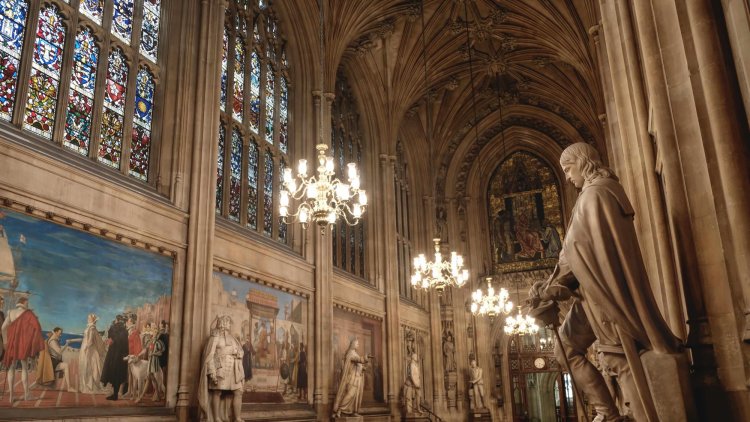
St Stephen’s Hall | Image by: Evan Dawson / Alamy


4 min read
A revealing look at how St Stephen’s Hall shaped the future Commons, this is also an all too familiar tale of restoration and renewal
MPs, peers, and others who walk through St Stephen’s Hall hurry past the statues of statesmen and the grandiose portrayals of Britain’s glorious past without stopping to consider how its narrow rectangular shape has set the pattern of Westminster politics.
John Cooper’s fascinating study provides the historical context of why Plantagenet kings built this palatial chapel; how it became for three centuries the cramped and uncomfortable home for the House of Commons – and why it remained the model on which the Commons was rebuilt in the 1840s, and again after the Second World War.
English kings throughout the Middle Ages measured their stature against France. Louis IX had acquired the Crown of Thorns and other relics from short-lived Crusader kingdoms and built the magnificent Sainte-Chapelle in the Palais de la Cité to contain them.
Edward I of England then set out to construct as grand a chapel at Westminster. Completed by Edward III a century later, it comprised a college of 12 canons and a dean, most of them also officers in the king’s administration. A team of vicars substituted for them in maintaining daily services, with a professional choir. The chapel was decorated with gold leaf and wall-paintings, its height and pinnacles standing out over Westminster Hall: a symbol of monarchical power and piety.
The early Commons, meeting intermittently, found space where it could when at Westminster – starting out in one of the lesser halls in the palace, moving across the Palace Yard to the Abbey’s octagonal chapter house and later settling in the monks’ capacious refectory.
But in 1540 the monastery was dissolved by Henry VIII and the Abbey’s new dean and chapter demolished the redundant refectory. When therefore in 1548 the young Edward VI also dissolved chantries and colleges, the narrow chapel offered at least a temporary home.
Precedent and continuity trump reform in Westminster politics
The 400 members of Edward VI’s House of Commons squeezed onto the benches set up where the choir stalls had been; what had been the nave became the lobby. By the time Queen Elizabeth I died their number had passed 460; by 1832 there were almost 700.
Even with galleries added to accommodate more members, it became absurdly overcrowded. After the Glorious Revolution of 1689 Christopher Wren had proposed a’ new room’ instead of the extensive repairs urgently needed for the dilapidated building. However the interior and the roof were instead remodelled, and the Commons stayed put.
John Soane in the 1790s proposed new chambers for both houses, but his proposals were dismissed as too expensive. Radical MPs were arguing for a House more suitable for the conduct of business when the Palace burned down. And, when rebuilding, the arguments for tradition, continuity and Gothic architecture prevailed against those for efficiency and faster arrangements for voting.
Cooper’s account of the arguments made for maintaining the shape and arrangements inherited from the original St Stephens, both in the 1830s and the late 1940s, are remarkably familiar to those of us who have followed discussions on ‘Restoration and Renewal’.


Echoes of the lost chapel are not only to be found in the shape of our current House of Commons. Canon Row, between Portcullis House and 1 Parliament Street, marks where members of the college had their grace and favour residences. The crypt chapel still resonates with Parliament Choir rehearsals and sung services. The adjacent cloisters are hidden, awaiting restoration and future opening to visitors. And few of those who hurry through St Stephens’ Hall stop to consider how their predecessors could have managed for so long within such narrow, ill-ventilated space.
Lord Wallace of Saltaire is a Liberal Democrat peer
The Lost Chapel of Westminster: How a Royal Chapel Became the House of Commons
By: John Cooper
Publisher: Apollo

You must be logged in to post a comment Login