
But for now, while the vulnerable brace for hunger, the elite brush off price caps as preposterous and call it common sense.
Featured image via Leon Neal / Getty Images



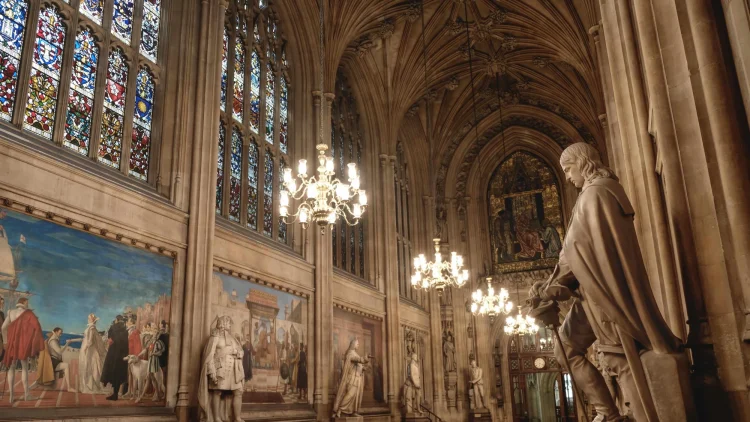
St Stephen’s Hall | Image by: Evan Dawson / Alamy

4 min read
A revealing look at how St Stephen’s Hall shaped the future Commons, this is also an all too familiar tale of restoration and renewal
MPs, peers, and others who walk through St Stephen’s Hall hurry past the statues of statesmen and the grandiose portrayals of Britain’s glorious past without stopping to consider how its narrow rectangular shape has set the pattern of Westminster politics.
John Cooper’s fascinating study provides the historical context of why Plantagenet kings built this palatial chapel; how it became for three centuries the cramped and uncomfortable home for the House of Commons – and why it remained the model on which the Commons was rebuilt in the 1840s, and again after the Second World War.
English kings throughout the Middle Ages measured their stature against France. Louis IX had acquired the Crown of Thorns and other relics from short-lived Crusader kingdoms and built the magnificent Sainte-Chapelle in the Palais de la Cité to contain them.
Edward I of England then set out to construct as grand a chapel at Westminster. Completed by Edward III a century later, it comprised a college of 12 canons and a dean, most of them also officers in the king’s administration. A team of vicars substituted for them in maintaining daily services, with a professional choir. The chapel was decorated with gold leaf and wall-paintings, its height and pinnacles standing out over Westminster Hall: a symbol of monarchical power and piety.
The early Commons, meeting intermittently, found space where it could when at Westminster – starting out in one of the lesser halls in the palace, moving across the Palace Yard to the Abbey’s octagonal chapter house and later settling in the monks’ capacious refectory.
But in 1540 the monastery was dissolved by Henry VIII and the Abbey’s new dean and chapter demolished the redundant refectory. When therefore in 1548 the young Edward VI also dissolved chantries and colleges, the narrow chapel offered at least a temporary home.
Precedent and continuity trump reform in Westminster politics
The 400 members of Edward VI’s House of Commons squeezed onto the benches set up where the choir stalls had been; what had been the nave became the lobby. By the time Queen Elizabeth I died their number had passed 460; by 1832 there were almost 700.
Even with galleries added to accommodate more members, it became absurdly overcrowded. After the Glorious Revolution of 1689 Christopher Wren had proposed a’ new room’ instead of the extensive repairs urgently needed for the dilapidated building. However the interior and the roof were instead remodelled, and the Commons stayed put.
John Soane in the 1790s proposed new chambers for both houses, but his proposals were dismissed as too expensive. Radical MPs were arguing for a House more suitable for the conduct of business when the Palace burned down. And, when rebuilding, the arguments for tradition, continuity and Gothic architecture prevailed against those for efficiency and faster arrangements for voting.
Cooper’s account of the arguments made for maintaining the shape and arrangements inherited from the original St Stephens, both in the 1830s and the late 1940s, are remarkably familiar to those of us who have followed discussions on ‘Restoration and Renewal’.
 Precedent and continuity trump reform in Westminster politics. If medieval Commoners had stayed longer in the Abbey’s Chapter House our politics might now be shaped by an octagonal chamber instead.
Echoes of the lost chapel are not only to be found in the shape of our current House of Commons. Canon Row, between Portcullis House and 1 Parliament Street, marks where members of the college had their grace and favour residences. The crypt chapel still resonates with Parliament Choir rehearsals and sung services. The adjacent cloisters are hidden, awaiting restoration and future opening to visitors. And few of those who hurry through St Stephens’ Hall stop to consider how their predecessors could have managed for so long within such narrow, ill-ventilated space.
Lord Wallace of Saltaire is a Liberal Democrat peer
The Lost Chapel of Westminster: How a Royal Chapel Became the House of Commons
By: John Cooper
Publisher: Apollo
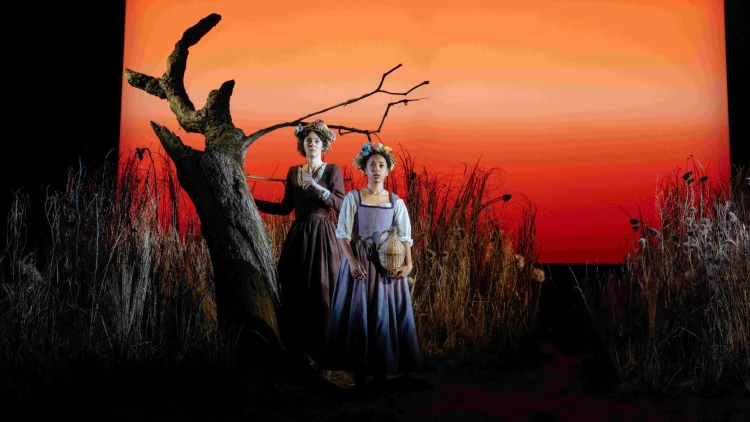

Tanya Reynolds as Mariella and Siena Kelly as Anna | Photo by Helen Murray

4 min read
Examining the ripple effect of the trial and execution of Anne Boleyn on the lives of everyday Tudor women, Ava Pickett’s play draws powerful parallels with modern day misogyny
A fresh and furious play, the performances of 1536’s central characters are absolutely brilliant. These three sparky young women of Essex are supported by a superb production which makes highly effective use of a black scrim. Yes. I had to look that up.

The early parts of 1536 present a wonderful portrayal of the kind of relationships which can exist between young women. On stage and screen we often see blokes joshing – yet not so often women, especially those with little education, wealth or ‘interesting lives’.
Before the plot unfolds, we witness loving and raucous teasing – a highly charged conduct, very rarely revealed to those outside the inner circle; the joy fairly radiates and is instantly appealing.
In the play’s programme we find a quote by Hilary Mantel: “History is not the past… it’s what is left in the sieve when the centuries have run through it.” And then the programme states this: “Women of the past were ground to such powder that history’s sieve catches nothing of them.”
In that sense 1536 is letting us hear something of the conversations that must have happened during the arrest, incarceration, show trial and execution of Henry VIII’s second wife Anne Boleyn. This is Mantel’s version of “fiction stepping in” which is not to say the conversations were ahistorical, only that they have to be inferred.
Powerful men can still have a catastrophic impact on women’s lives
Set against the backdrop of Boleyn’s arrest and execution in faraway London, 1536 is darkly comic in places, but elsewhere it resonates intensely with depressing aspects of life in the 21st century. Powerful men can still have a catastrophic impact on women’s lives, especially the lives of poor young women. But don’t get me started on Jeffrey Epstein.
Boleyn was arrested on 2 May 1536 and executed just 17 days later on 19 May with only a show trial in between.

Relying on two-day old news, at first the women find it hard to believe “the Queen” could be in any kind of serious peril. For the young women the story quickly moves on from gossip to something a great deal more serious: the nature of their lives and likely futures – and how closely they are tied to the men in their current or future existence.
The next bulletin from the capital reveals that while adultery is ordinarily a matter for the Church courts, in the case of a woman who apparently bewitched the King, and tricked him into marrying her, it becomes a capital offence for which the sentence is death.
The fact that everyone knew Henry pursued Anne for years and changed the law – and indeed the established Church – solely to make it possible for him to marry her counted for nothing.
 As further news of Boleyn’s alleged offences emerges the women realise the lurid details are having a ripple effect, feeding misogyny, and amplifying it in their everyday lives. Which brings us right back to the present day.
We have seen it often – a woman is monstered in social media and newspapers, her reputation and life trashed. Lies are created then embellished, believed particularly if she is a woman engaged in public life – or, as in this story, just a lively poor young woman with dreams and aspirations above her class and sex.
Find time to see this play – though with an age rating of 14+ (there are sex scenes but no nudity) it’s something to bear in mind when deciding who to take with you.
Baroness Thornton is a Labour peer
1536
Written by: Ava Pickett
Directed by: Lyndsey Turner
Venue: Ambassadors Theatre, London, WC2 – until 1 August
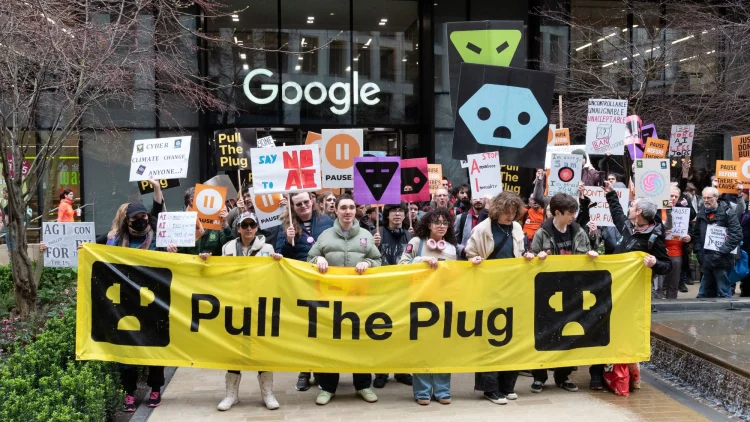

‘March Against The Machines’ protest outside Google’s London headquarters in February 2026 (Ron Fassbender/Alamy)
6 min read
Ruining childhoods, increasing energy and water costs and now, increasingly, destroying jobs – voters’ resentment against big tech is growing. Ben Gartside and Francis Elliott look across the Atlantic at the gathering storm and ask when it will hit the UK
The next US presidential election may be more than two years away, but the jostling to become the Democratic candidate is well under way, and Gavin Newsom’s success at turning Donald Trump’s social media game against him with mocking ALLCAPS tweets has put him at the front of the pack.
Critics have identified a potential problem with California’s governor, however – he is, they say, far too close to Silicon Valley’s leaders.
Given how far-reaching and fast-acting the changes wrought by AI are likely to be, some think the next US presidential race will be fought as the so-called techlash becomes significant.
Already, another senior Democrat has put himself at the head of the rebellion. Bernie Sanders, the Vermont senator, has lambasted Newsom for opposing new taxes and regulations on big tech.
Sanders is also benefiting from a growing voter backlash over the proliferation of data centres – the physical infrastructure that AI needs to power its tools – across the country.
The impact on rural areas in the US might even be a factor in the mid-terms, some commentators believe, weakening Republican support in some heartland areas the Democrats are looking to flip in their effort to seize control of Congress.
“A few months ago, when I proposed a moratorium on AI data centres, it was perceived as a radical, fringe and Luddite idea”, Sanders said recently. “Well, not any more.”
Twelve US states are now considering data centre moratoriums, with over 50 passed in towns, cities and counties locally.
In the UK the issue is, as yet, more muted, but there are already Cabinet tensions over how far the government should go to accommodate the energy-hungry centres.
So far the protests have been tiny – but government insiders can see what is happening in the US and worry the movement could spread.
Ministers – and data centre developers – are keen to emphasise the upsides, such as clean jobs in post-industrial areas. In a data centre, there is little risk of a life-changing injury – it is not physically punishing work, nor is it something that requires extensive training.
But providing sufficient energy is a challenge and the government was forced to acknowledge that it wrongly gave planning permission to a £1bn redevelopment of a landfill site in Buckinghamshire because they had not adequately assessed electricity demand stemming from the new data centre.
Foxglove, an activist legal firm also campaigning on data centres, believes the government has failed to account for a growth in data centres in its energy and emissions plans.
Tim Squirrell, head of strategy at Foxglove, tells The House: “The government doesn’t seem to have a clue what it’s doing about data centre emissions. There is no way that projected emissions can fit in the carbon budget without serious changes, but so far neither DSIT nor DESNZ seem willing to acknowledge there’s any trade-off between building hyperscale data centres and delivering on our net-zero commitments.”
Opposition to data centres in the UK may so far be low key, but there is a chance that it will grow and merge with other building concerns around tech – from social media use among children to the access to NHS data.
When I proposed a moratorium on AI data centres, it was perceived as a radical, fringe idea… Well, not any more
Elon Musk’s forays into UK politics – backing Tommy Robinson, for instance – have done little to improve public perception of US tech leaders. The dealings of Peter Thiel’s company, Palantir, with the UK state, including the NHS, are almost as controversial. The huge wealth and influence of a small group of Americans is only going to grow.
And then there is the spectre of AI-driven job losses as evidence mounts of a dramatic collapse of entry-level posts in some industries especially vulnerable to automation from the new technology.
Given the scale of the coming impact, some of the political discourse around AI can seem almost touchingly naive – touching that is, if it weren’t so important.
Speaking from an autonomous car juddering forward outside Parliament, Tech Secretary Liz Kendall recently admitted she didn’t use AI for work. “I use AI personally rather than at work, I’ve got to be honest. I’m much more likely to use it in my personal life,” she told Newsnight’s Matt Chorley, interviewing her from the front seat of a somewhat cramped saloon car.
Her predecessor, Peter Kyle, does use AI but found that his prompts were subject to Freedom of Information requests.
MPs like Mark Sewards who have experimented with AI to deliver constituency casework have found it to be a bruising experience. While the chatbot Sewards created was ultimately jettisoned in December due to the burden it placed on his staff, Sewards strikes an optimistic tone about balancing the benefits of progress and listening to the growing transatlantic tech backlash.
“A lot of the fear is based on very real observations of the power of tech to influence politics in a negative way; just look at what social media has done to us over the last 20 years,” he says.
“We’ve got to strike a balance between regulation and innovation. It’s one of the reasons I support innovating more with AI, while at the same time lifting the age of access to social media to 16.
“But the AI revolution is happening, whether we embrace it or not. So we should do everything we can to make it work in our favour.”
There is no doubt that AI can help with the business of politics itself. Ben Guerin, furious about tax rises against pubs, asked the AI agent Claude to workshop an idea he had: using Valuation Office Agency data, could a map of the upcoming business rate rises be built?
A lot of the fear is based on very real observations of the power of tech to influence politics in a negative way
Guerin is far from a political lightweight. Having worked under the tutelage of Lynton Crosby, he launched his own social media-savvy advertising agency in 2016, before becoming a close adviser to Boris Johnson’s 2019 general election campaign. He told the Telegraph that while AI can’t do the imaginative side of political campaigns, it can do just about everything else.
Upon launching, the site took off. Within 24 hours it had been viewed 100,000 times. Soon, tools to organise a crawl around the worst impacted pubs in your local area were added, and before long the government announced a U-turn on the changes.
Similarly, Lord Kempsell enabled AI to support his work campaigning against the Chagos deal including aiding his FOI requests, which revealed the FCDO ‘Chagossian contact group’ had never met after it was announced, and that the Prime Minister’s adviser Jonathan Powell had begun work on a deal before being formally appointed.
But while AI adoption may soon become essential for political campaigners, the irony is that those campaigns may increasingly be fought in the context of voter resentment at the disruption the technology will bring in its wake.


Dex Hunter-Torricke is advising Chancellor Rachel Reeves on how AI could transform the economy (ZUMA Press, Inc./Alamy)

11 min read
The scale and pace of AI-powered change continues to astonish – just look at the markets. Two former tech insiders have recently taken advisory roles to help shape, respectively, the responses of the Chancellor and Mayor of London. Zoe Crowther hears from Dex Hunter-Torricke and Baroness Lane-Fox
Think of a major American tech CEO and 40-year-old Dex Hunter-Torricke has probably worked for him.
He began his career at the UN, an experience he describes as “deeply frustrating”: “It was such a broken institution, so clearly at the mercy of events in the world, highly reactive, under-resourced… That’s what led me at the end of 2010 to think about making the move into tech.”
He was recruited as Eric Schmidt’s speechwriter at Google, before going on to work for Mark Zuckerberg at Facebook for more than four years. A brief stint with Elon Musk at SpaceX followed in 2016, though he “got out of there pretty quickly after the US presidential election” that brought Donald Trump to power.
He later served on Meta’s oversight board from 2020 to 2023, a period he describes as being “on the other side of the fence”. During the fallout from the Facebook Files – a series of investigations by the Wall Street Journal that exposed how Meta was aware of harms linked to its platforms, from teenage mental health to vaccine misinformation and incitement to violence – he says he was a vocal internal critic, pushing the company over its response.
More recently, he was head of global communications at Demis Hassabis’ Google DeepMind, before leaving the industry in autumn last year. He has since joined the HM Treasury Board as a non-executive director to advise Chancellor Rachel Reeves on how AI could transform the economy. In February, Hunter-Torricke founded the Center for Tomorrow, a global nonprofit research centre that he says will build research and practical solutions to the human and societal problems caused by the advancement of AI.
The former Silicon Valley comms pro tells The House that his worldview was shaped by his upbringing. His mother was a Malaysian nurse who moved to the UK to work for the NHS, and his father was a Burmese child refugee who also eventually settled in Britain.
His father experienced racism upon arriving in the UK, and Hunter-Torricke also experienced it growing up here. He became the first person in his family to go to university when he studied politics at UCL in London, and went on to do an MPhil in Russian and East European Studies at the University of Oxford.
“Life growing up was really tough,” Hunter-Torricke says. “We were outsiders… I was extremely motivated to understand how systems worked, and specifically why our society was ordered by systems which radically shaped your entire life before you’re even born.”
That focus on systems now informs his view of AI. Having worked at the heart of Silicon Valley, he believes many tech leaders “don’t understand or care deeply about many of the societal effects of the technologies that they are building”.
Hunter-Torricke is critical both of Westminster’s “performative criticism” of the tech industry and its level of deference to it.
Former technology secretary Peter Kyle argued in 2024 that governments should act with “humility” when dealing with large tech companies who are outspending the entire British state.
“We are having to apply a sense of statecraft to working with companies that we’ve in the past reserved for dealing with other states,” Kyle said.
Hunter-Torricke says this is the wrong approach, as “big tech is a small set of mostly US-based tech companies that have repeatedly demonstrated they do not have the interests of even large numbers of their users at heart”.
On AI sovereignty, he is sceptical of the UK going it alone: “The push for AI sovereignty is the right one, but right now… there’s no way we can simply develop an indigenous set of tech capabilities that would allow us to be essentially self-sufficient.”
Instead, he argues for co-operation between mid-sized nations to avoid becoming “digital vassals” of the US and China. The call for an alliance of ‘middle powers’ was made by Liz Kendall, the Tech Secretary, in a recent speech at think tank Rusi.
“We should be looking to pool our computing capabilities, to align our rules, to seek advantage and opportunities together,” Hunter-Torricke says, explaining that having a group of nations in alignment will give them leverage to “have a seat at the table to demand access to those technologies and to shape the future”.
He predicts the issue will only get more politicised in the years to come. “Simply put, the price that the United States and China will demand from us to continue having access to those technologies is likely to be unacceptable to most people in our country,” he says.
“We’re going to have to rewrite our trade rules. We’re going to have to hand over minerals.
We’re going to have to rewrite our societies to suit the interests of one or both of those superpowers in the world that is coming. This is going to become a major issue once the public wakes up to that fact.”
He is also wary of the deepening relationship between US tech firms and the US government, warning this could be a sign of an increasingly “new reality” in UK politics too.
One of his first goals for the Center for Tomorrow is to raise awareness of these risks with policymakers, among whom he says “understanding is wafer-thin”.
“The tech industry has massively distorted the discourse about how to manage technology, and made many leaders believe that most of the challenges are technical, which require technical solutions, when in fact, I strongly believe that these are societal problems which demand societal solutions.”
There are too many decision-makers who simply see the future as an incrementally different version of the past
You could be forgiven for being cynical about Hunter-Torricke’s own motivations. After all, until very recently, he was leading comms for some of the very companies he now warns about the dangers of. He says the decision to leave the industry was a “very personal one”, but that he had hit his limit for how much he was willing to work from within these “highly imperfect institutions”.
“I haven’t told friends and former colleagues to all go and quit big tech… We still ultimately need good people to go into those organisations and try to fix them from within.”
Hunter-Torricke has previously suggested that he would be interested in entering politics himself on a platform of challenging the tech industry – but tells The House he does not want to tie himself to any particular political party.
What does he want from Westminster now? “I would want leaders to take the future seriously.
“There are too many decision makers who simply see the future as an incrementally different version of the past. This is the arrival of a completely different chapter in human history… We can either choose to wake up to the disasters that are underway, or we can keep telling ourselves that we can muddle our way through these things with some tweaked version of our solutions from the past, and then we will fail.”
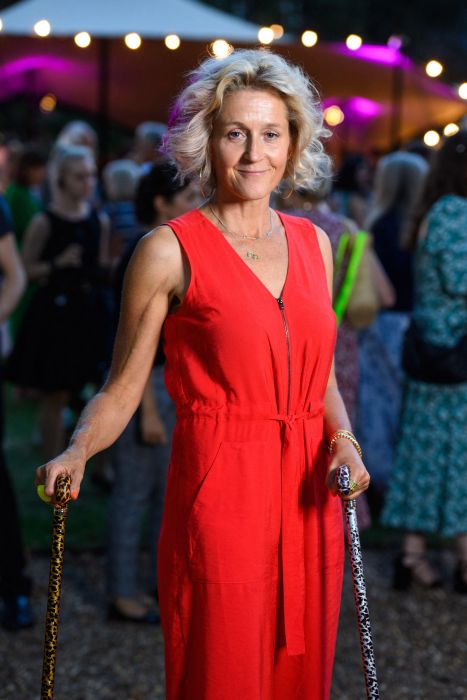
Martha Lane-Fox is a different kind of tech insider.
The 53-year-old co-founded Lastminute.com in 1998 and has since built a career spanning business, public service and digital policy. She became a crossbench peer in 2013, later serving as chancellor of the Open University and president of the British Chambers of Commerce. As the UK’s digital champion from 2009 to 2013, she helped establish the Government Digital Service.
Now, she has been appointed by London mayor Sadiq Khan to chair London’s new AI and jobs taskforce, which brings together government, businesses, unions and educators to assess how AI is reshaping work in the capital and what should be done in response.
Having spent years in civil society roles, Lane-Fox comes across as impatient for progress with little interest in endless deliberation. But she strikes a more measured tone than Hunter-Torricke when it comes to the potential economic and societal risks posed by AI.
“People tend to go to the, ‘Oh my god, it’s the jobs apocalypse’, and I don’t actually believe that’s the case,” she says. “I just don’t think we know yet. We don’t know enough.”
Announcing Lane-Fox as chair, Khan said he wanted an approach “rooted in realism”, by “being clear-eyed and pragmatic about the potential perils, while also being alert to the amazing possibilities”.
The taskforce will recommend action to use AI to boost productivity, create jobs in the capital, and support Londoners in acquiring skills for the future.
A new report published by City Hall found that more than a million Londoners, a fifth of the city’s workforce, are either ‘highly exposed’ or ‘significantly exposed’ to the impact of artificial intelligence, particularly in service industries such as consulting and tax management. At least 46 per cent of London’s workers are currently in roles where generative AI could automate a meaningful share of their tasks, compared to a UK average of 38 per cent.
Lane-Fox does not see this as a weakness, instead describing it as a city in an “interesting position”.
“Not only do we have an extremely vibrant AI sector, but we also have relatively high levels of digitisation, so a lot of people working in bits of the technology sector that have changed very quickly with the advent of new capacities over the last year or so.
“And we’ve got a very creative economy with different challenges around AI and digitisation. None of that means that London is in a weak position.”
It feels as though women are more at risk from being left behind than men are
Asked what politicians are getting wrong, she strikes a slightly more sympathetic tone than Hunter-Torricke, insisting that the Labour government is “trying to grasp the nettle”, but that it was difficult for them to engage in everyday politics while also keeping abreast of fast-paced technological changes.
She acknowledges reliance on big tech but resists sweeping criticism.
“I don’t agree with any blanket comment that a lot of big tech has nefarious purposes,” though some companies “have paid less attention to the consequences than they should have done”.
On sovereignty, she agrees the UK cannot go it alone, noting that Europe has only one major large language model company, Mistral AI, based in Paris, and that the UK is unlikely to catch up with US leaders.
“London’s doing an incredible job at building AI capacity, and that’s the first step… Building talent pools, building investment that creates an ecosystem that then allows other things to happen.”
One of Lane-Fox’s primary concerns is how AI might exacerbate existing inequalities, pointing to risks for women, young people and ethnic minorities.
“It’s obviously very painful to me, as someone who’s worked in technology for 30 years, that yet again, it feels as though women are potentially more at risk from being left behind than men are,” says Lane-Fox, the daughter of an Oxford academic and FT journalist.
“I see very mixed data on this subject, but it’s clear that women often do more administrative work, and that is work that is potentially shifting more quickly. It’s also clear that women don’t step into building their skills in the same way as men do.”
She adds that it will be important for the taskforce to also carefully consider how AI will impact people who have not yet worked at all.
The challenge, she argues, is not simply the number of jobs that will be available, but job quality, and the skills needed to fill them. “What will that job look like? That’s the more complex discussion.”
She believes London’s skills offering needs to be “very creative and future-facing”.
“We should be trying to design solutions for what we want London to look like in 2028 and beyond, not what we wanted it to look like a couple of years ago. And that’s what will give us the edge.
“City Hall has levers, specifically in terms of being able to do work at a very local borough level and help test and learn and develop programmes that could be scaled up across the city. That’s an immensely helpful thing that the mayor’s office can do.”
The crossbench peer tells The House that this taskforce “is not just words”: “The mayor has put aside a huge budget to try and do this stuff as well. So, this doesn’t come without clout… I specifically said I don’t want to do this if this is just a report, I want to do this because it’s going to be three to five actions that you can start with.”
She is eager for the taskforce to wrap things up within a few months, but also to “create some structures that can be helpful over time”.
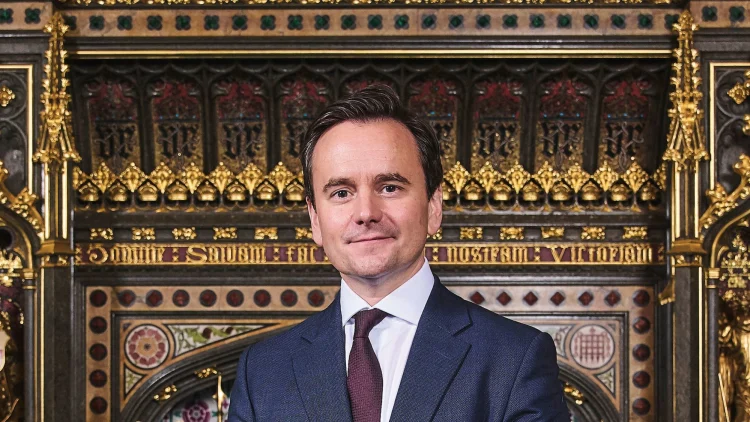

Photography by Roy J Baron

10 min read
The government’s cost of living champion, Lord Walker, tells Noah Vickers about defecting from the Tories to Labour, Keir Starmer’s future and why rejoining the single market would be ‘a terrible idea’
Across Britain, almost two years after Labour won a landslide election victory promising to fix the cost of living crisis, millions of families are still unable to keep their homes warm or to access essential dental treatment, while millions more are skipping meals as they struggle to afford food.
The government’s recently appointed ‘cost of living champion’ is not one of them and never has been.
Lord Walker, the multi-millionaire boss of Iceland supermarkets, freely admits that he has never personally struggled with living costs. But that doesn’t mean he’s the wrong man for the job, he insists.
“I make no secret of the fact that I’m very privileged in my background,” the 45-year-old peer tells The House.
“I’ve come from a very entrepreneurial family. Both my granddads, who I never met, died very young. They were both coal-miners who worked their fingers to the bone… I think because of that, mum and dad always knew what a hard day’s graft was, so I grew up with that work ethic.”
Richard Walker, as he was then, served as Iceland’s managing director from 2018 before taking over as executive chairman in 2023 from his father Malcolm, who co-founded the business in 1970. Working at Iceland brings with it an insight into the experiences of people from more humble starts in life, he says: “Given our business, we do see, feel and hear a lot of the issues on a daily basis that our customers are facing.”
Reporting directly to the Prime Minister, who he meets every few weeks, Walker says his job is to “bring some critical outside thinking” into government and to “stress-test some of the ideas already percolating within No 10” about how to reduce people’s daily costs.
He admits that, as a policy area, the cost of living is “an impossibly broad remit”. He is “zeroing in”, therefore, “on a few key territories where I think policy can be enhanced and improved, but also, to be frank, where I think I can make a quick impact and a difference”.
When The House sits down with Walker, he has just returned from a meeting with Kate Dearden, the consumer protection minister, to discuss the government’s work tackling “subscription traps”. From spring 2027, subscription services will be required to provide customers with reminders when their free trial is ending or when their annual contract is being automatically renewed.
But Walker is also working with the government to explore how sidecar savings, liquid savings accounts connected to a pension plan, and child trust funds could be used to provide a “buffer” for Britain’s lowest-income families. He is eager, too, to widen access to “responsible credit”, as he warns too many people are still being driven into the hands of loan sharks.
As part of his role, Walker has been given a private secretary in No 10 and plans to work with an existing Downing Street ‘sprint team’ solely focused on slashing living costs.
The team, he says, are bringing with them a “private sector mentality and trying to just get shit done – and not machinate and pontificate too much but actually make deliverable interventions at pace”.
Walker accepted the job – an unpaid post – on two conditions: “One – I’m not going to stick around and I’ll give it to the end of the year. Two – I am allowed the freedom to say what I think.”
Does that mean he’ll have finished his work by Christmas?
“We’ll see,” he replies. “What I didn’t want to do is be there forever, and write a very long, 100-page report that no one would read. I’m just interested in meaningful interventions and trying to make a difference. It is early days… but I think to try and put an end-stop date to it is important because it drives a sense of urgency and pace.”
Walker’s appointment to the role in February came less than a month after he took his seat in the Lords as a Labour peer – but his path to Parliament was not straightforward. Until the last election, he had only ever voted for the Conservatives, to whom he donated £10,000 in 2020.
In a letter to Rishi Sunak in 2023, he said it was his “most fervent wish” to become a Tory parliamentary candidate, having “given my all to earning that privilege”.
By that point, Walker says he had spent two years door-knocking and leafleting for the party in the hope of being selected for a constituency at the general election.
“I did feel I was being given the endless runaround by CCHQ [Conservative Campaign Headquarters],” he says. “This was a long, committed process. I was not so arrogant to think I could just parachute in and bag a seat.”
Walker says his candidacy was repeatedly deferred, as the party told him he was being too outspoken on issues like sewage in Britain’s seas. But he says he had also become disillusioned by the Tories’ ideological direction.
“I just did not like the aping Reform kind of way that the politics was going. I could see the writing on the wall, and I think I’ve been broadly vindicated in them becoming a bit of a tribute band and this existential crisis they’re now having.”
There was nothing opportunistic, he insists, about his decision to switch his support to Labour in early 2024, and he points out that he has “never donated a penny” to the party.
“I was very clear I’m done with chasing the unicorn of trying to be an MP and we never even discussed this place,” he says, referring to the Lords. He was “blown away”, therefore, by the call from Downing Street offering him the peerage late last year.
Endorsing the party is one thing, but taking the Labour whip in Parliament is clearly another. Having backed the Tories almost all his life, what exactly are his politics?
“I’m kind of a pragmatist, being a businessman. I’m obviously pro-market and pro-business,” he says, before adding: “I’ve always wanted to push an agenda that I suppose is centrist, but looks after those people who don’t have broad shoulders… I have, and continue to develop, quite a strong social conscience, which I think sits very well with a centre-left agenda.”
In a previous interview, Walker said described his father as “more a Farage fan”. How did Malcolm Walker react to seeing his son sworn in as a Labour peer?
“He was very proud,” Walker laughs, before admitting: “As the photos were being taken in the Robing Room afterwards, he did under his breath shout ‘Vote Reform!’”
Walker’s peerage may also have come as a surprise given how publicly lukewarm he had been about Labour’s first year in government.
I’m not going to give a running scoreline. I’ll give you a score at the end of year
In a February 2025 interview with the Financial Times, he warned that the decision to hike employers’ national insurance contributions had “added greatly to the cost of business” and he gave the government a measly score of six out of 10 for its performance thus far. Would he give it a higher score now?
“It haunts me, this question,” he exclaims. “I’m not going to give a running scoreline. I’ll give you a score at the end of year.”
Has the cost of living got better for people since Labour took office?
“I think it’s kind of some and some,” is his answer. While his opinion of the employer’s national insurance hike has not changed, he argues that the decision to increase the minimum wage to £12.71 per hour “is a good thing which will filter through”. He adds, however: “Clearly there have been some things that have been out of their control. I think the two biggest concerns are food and energy.
“At the moment, [with] food inflation, we’re OK, but clearly everyone is watching, praying and hoping that Hormuz will be reopened and things will be resolved. We’ll see what the next energy cap is, but hopefully we can get through the summer, and when heating usage goes up, we’re in a more stable environment.”
One major cost that hits households each month is council tax, charged according to what properties were worth in 1991. It has become an increasingly regressive system, with the Resolution Foundation finding that it now takes nearly five per cent of income from the poorest families but only one per cent from the richest. Shouldn’t the government reform it?
“I agree, and I’ve raised it with them. It isn’t a system which is up to date,” he says. “If there’s the political will and the room to manoeuvre, it should be looked at.”
Walker voted for Brexit in 2016 but has been disappointed by how it turned out: “I’m not quite sure we got to the sunny uplands that Lords Hannan and Gove promised us.”
While he has welcomed the government’s work building a closer relationship with the EU, he does not think it should go as far as taking the UK back into the single market, as London mayor Sir Sadiq Khan has pushed for. “It would be a terrible idea, politically, socially. There was enough of a row over Brexit.”
Is there an economic case for it? “Obviously there’s economic arguments, but we’ve been there and done that,” he replies. “We’ve had the vote, so we can’t go back there.”
He is less willing to pin his colours to the mast when asked whether the government should grant licences to drill the Jackdaw gas field and Rosebank oil field. Despite the question sitting at the centre of a policy debate over whether increased North Sea drilling could reduce energy bills – even if only slightly – the peer says he is “not an expert” on the issue, though he finds it “interesting”.
Walker is speaking to The House in the days ahead of Labour’s disastrous local election results and the subsequent turbulence at Downing Street, but even in advance of those elections, the opinion polls are clear that Keir Starmer is profoundly unpopular across the country. Does he have no sympathy with Labour MPs already calling on him to stand aside?
“No, none at all. I think that’s where they get too consumed in this place. The guy won an absolutely thumping majority, with a record number of seats. He was given a very clear mandate from the British people and it’s his duty to get on and deliver that.
“Opinion polls will bounce around – you’re right, of course, the current ones are pretty rough reading – but he is a man of integrity and of duty, and he wants to see it through, of course.”
While tackling the cost of living remains a top priority for the government, Walker is clear that the issue should be viewed not just in terms of the base cost of products, but in the full context of whether wages are keeping up with them.
“But actually, I think it goes beyond that,” he says, “towards a sense of life being a daily grind. By that, I mean people feeling that there’s an injustice to a system, or they’re getting caught out, or they can’t just catch a beat.
“I don’t think anyone is expecting the price of stuff to go down, long-term. In fact, I’d hope it doesn’t, because then we’d be in a Greek-style deflationary environment, it wouldn’t be a good thing.
“But I do think people should expect a government to work as hard as they can to make interventions where they can.”
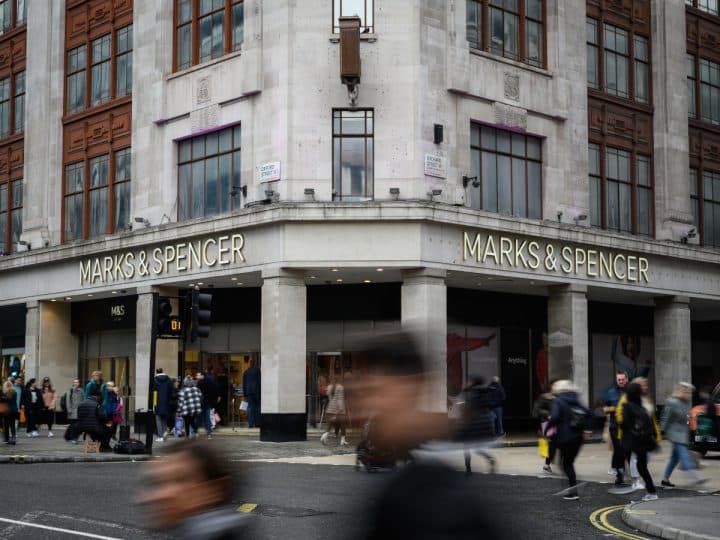

“Warflation” may send the cost-of-living crisis higher, but the UK’s CEOs and Lords are unbothered by it.
M&S chief executive Stuart Machin is calling reported discussions by the UK Treasury to cap the prices of essential goods – such as eggs, bread, and milk – “preposterous.”
The Treasury has reportedly been asking supermarkets to volunteer to slash prices on essential foods to protect the public from spiralling inflation caused by the Iran war. However, Treasury Secretary Dan Tomlinson told the BBC there were no plans to introduce a mandatory price cap on food by the Westminster government.
“It’s idiotic, it’s dangerous, and it will never work,” said the former Asda chairman, responding to reports that the government is urging supermarkets to limit food prices.
Marie Antoinette is said to have apparently jested as she was told of the starving masses: “Let them eat cake.” The phrase symbolises a wealthy, out-of-touch elite dismissing the suffering of ordinary people.
These CEOs and Lords are certainly exhibiting symptoms of that.
The Food and Agriculture Organisation has said that decisions today on fertilizer, imports, money, and crops will determine whether food prices spike by late this year or early 2027.
US and Israel’s war of choice, which has led to the closure of the Strait of Hormuz, could trigger a severe global food price crisis within six to 12 months unless governments act quickly.
FAO also warned the crisis could deepen with the onset of the El Nino weather phenomenon, which is expected to disrupt rainfall patterns across several regions.
But for now, while the vulnerable brace for hunger, the elite brush off price caps as preposterous and call it common sense.
Featured image via Leon Neal / Getty Images
By The Canary


We’ve all seen pheasants wandering around the countryside in that bumbling way, haven’t we? It’s endearing the way that they seem a little oblivious, a little bit not-quite-there as they bob through our fields. We treat these birds as a classic symbol of the British countryside, don’t we?
We assume they’ve always been here. But what if I told you nothing could be further from the truth? Pheasants are not a native bird. This is a carefully maintained illusion. And behind that illusion is one of the most disgusting and hidden networks of intensive factory farming in the UK. Behind glossy marketing campaigns of ‘traditional country sports’ lies a multi-million pound agribusiness.
And it poisons our wildlife, terrorises our roads, and inflicts cruelty on millions of sentient birds on a scale we have never heard of.
Every single year, this hidden cruelty behind the shooting industry results in the dumping of more than 60m birds into our countryside. We force millions of pheasants and red-legged partridges into the wild. That’s almost one for every man, woman and child in the UK.
It’s not just a few cute country estates doing this. It is a massive, ecological flood. In just the last century alone, the number of captive-bred birds being released into our countryside has exploded by over 600%. Just for rich knobs in tweed to mindlessly shoot them!
To feed this disgusting bloodlust, a network of approximately 300 industrial bird farms operates in Britain. And this is heavily supplemented by breeding farms from overseas. It’s in these farms where the ‘wild’ birds begin their lives and it’s a living hell. Rows of tiny, cramped wire cages hidden across acres of our countryside.
In these tiny cages, pheasants are stripped of every natural instinct they could ever possess. They’re traumatised, chronically bored and packed into tiny living conditions. Because of this, these adorable birds turn on each other. Fights break out as naturally territorial males and stressed as hell hens turn to feather-pecking and cannibalism. They literally tear each other to bits because they cannot escape from the claustrophobic conditions.
Of course, the people who farm these birds don’t ever question the cruelty of the cages as the cause. Instead, they rely on disgusting methods to protect profits. To stop birds from killing each other, they bolt plastic beak guards to their faces.
And the female birds get an even worse treatment. Due to repeat and aggressive mating that they can’t escape, they have protective ‘saddles’ strapped to their back. This conflict tears their skin right open. How is this animal care? They’re nothing but damage limitation designed to increase bird reproduction. Basically, they keep the birds alive long enough to harvest their eggs.
In recent undercover investigations by campaign group End Bird Shooting, investigators saw this first hand. They’ve documented cages that are three stories high. This leaves the birds at the bottom unable to escape a constant shower of shit falling on them.
These poor birds are finally boxed up and shipped off to shooting estates, and it’s a disaster. After living in a cage for so long, they have no survival skills. Incubator rearing deprives them of parent birds, ripping away their road sense and leaving them wide open to predators. And that includes humans.
We laugh as they bumble around the country. But this cluelessness is artificial. It’s the result of our neglect, and us putting them through so much early-life trauma.
It’s our incompetence and cruelty that leads to between 2.4m and 3.5m pheasants being killed on UK roads. Every. Single. Year. That’s about 7% of this artificial population. They’re the number-one roadkill victim in the UK. And this road chaos doesn’t just affect these poor birds.
Collisions with these heavy 1.5kg birds can be deadly for humans too. Pheasants can easily smash windscreens and buckle bumpers. When people naturally try to swerve to avoid them, it turns deadly. There’s around 65 collisions recorded with these birds every year. Around 6% of these result in serious death or injury. All so some rich dude with a gun can get his rocks off murdering an defenceless animal.
To make things worse, the birds are being shot with lead ammunition. A study led by the University of Cambridge revealed a shocking 99% of pheasants sold for meat contain toxic lead fragments. And it’s not just us who consumes it. It is also local scavengers and wildlife.
This destructive system operates in a regulatory dead zone. Because the shooting industry pretends to be a rural heritage, it slips through the cracks. It evades the strict oversight applied to every other form of intensive animal agriculture.
It’s a system that cannot be reformed. It has to be dismantled and now. We can no longer let rich people pay for the privilege of killing these stunning birds any longer. The dedicated team at End Bird Shooting is working tirelessly to expose this cruelty and they’re calling out for support.
These animals are counting on us to break the silence. Right now, millions of birds are stuck in this hell and it’s up to us to help to save them.
Featured image via Shutterstock
By Antifabot


There is an ongoing investigation by Ofcom into the GrokAI chatbot on X (Alamy)
5 min read
X has been accused of failing to honour commitments made to the UK communications regulator, after dozens of racist posts targeting ethnic minority public figures remained online for more than 48 hours after being reported.
On Friday, Ofcom announced that X – formerly known as Twitter – had agreed to strengthen its moderation of illegal hate and terrorist content under the Online Safety Act.
In a voluntary agreement, X promised to review and assess suspected illegal terrorist and hate content flagged through its dedicated UK illegal content reporting tool within an average of 24 hours of being reported, calculated over a three-month period. The platform also said it would review and assess at least 85 per cent of UK suspected illegal terrorist and hate content reported through the tool within a maximum of 48 hours.
Ofcom said it will monitor X’s performance “closely”, with the platform expected to submit performance data to Ofcom every quarter over a year.
However, the independent think tank and charity British Future said the platform had failed to moderate racist hate posts reported by the organisation on the platform since Friday.
The charity’s British South Asian Bridgers project reported 33 posts on Friday that used the racist slur ‘p**i’ as direct racially aggravated abuse to ethnic minorities in British public life – a prosecutable offence under UK hate crime laws and legal obligations under the Online Safety Act.
By Monday, all 33 of the reported posts were still visible on X despite the platform’s 48-hour moderation window having expired, with no indication that enforcement action had been taken. British Future told PoliticsHome that, within the sample it tested, the platform had so far recorded a “zero per cent success rate” in removing the reported racist content.
Among the examples highlighted was a post directed at Home Secretary Shabana Mahmood reading: “No one wants you scabby p**i c**ts, why are you surprised, rapey cockroaches”.
Other targets included former Scottish first minister Humza Yousaf, independent MP Zarah Sultana, Reform UK chairman Zia Yusuf, former Tory chancellor Sajid Javid, Greater Manchester Mayor Sadiq Khan, and journalist Sangita Myska.
The charity said 28 of the reports generated automated acknowledgements from X within around a minute, while five received no acknowledgement at all. It has shared its findings with Ofcom, ministers and MPs, and is urging the regulator Ofcom to intervene directly with the platform.
It reported a further two posts using the slur ‘n****r’ against Conservative leader Kemi Badenoch and Justice Secretary David Lammy on Sunday, both of which were also not taken down within 48 hours.
Labour MP and chair of the Women and Equalities Select Committee Sarah Owen told PoliticsHome that she wants the government and Ofcom to consider stronger sanctions against Musk’s platform in the UK.
“Ofcom has to get a grip of the dangerous and growing threat that online hate speech is posing to our democracy and our communities,” she said.
“We know that since Elon Musk took over Twitter and gutted the moderation teams, it has become a breeding ground for far-right messaging and incitement of hate and violence against ethnic and religious minorities. Musk himself has shamefully targeted our democracy and endorsed an ethnonationalist MP who wants to deport British citizens on the basis of their race.
“The government must consider stronger action against X. At the very least, this must include prioritising other platforms for government communications. If we don’t get this right, we send a message to foreign-owned tech giants that they can ignore our laws at will. If X do not rapidly comply with our laws, Ofcom must implement further sanctions.”
The voluntary commitments by X followed an investigation by Ofcom into whether the platform was doing enough to identify and remove illegal terror and hate content, after PoliticsHome revealed in November that a cross-party group of MPs and peers was calling for action against a surge in antisemitic posts and calls for violence against Jews on X. Ofcom said the commitments from X came after “intensive engagement” with the platform.
There is still an ongoing investigation by Ofcom into X under the Online Safety Act, after reports in January that the platform’s Grok AI chatbot account was being used to create and share sexualised images of adults and children.
An Ofcom spokesperson said: “We condemn racism in all its forms. Some of the online abuse people experience is illegal under UK law, such as some types of threatening or abusive behaviour and harassment targeting ethnic minorities.
“Under the Online Safety Act, social media companies must take appropriate steps to prevent their UK users from encountering illegal content. If a post is reported to a platform, it must decide whether the content breaks UK laws, and it can use our guidance when making these decisions.
“Ofcom’s job is to make sure sites and apps have appropriate measures in place to comply with their duties, rather than tell platforms which specific posts or accounts to take down.
“These commitments are a step forward, but there’s a lot more to do. We’ll be carrying out quarterly reviews of X’s performance, and we’ve shown we’ll take action if evidence suggests companies are not meeting their legal duties under the Act.”
Avaes Mohammad, Manager of the British South Asian Bridgers project at British Future, told PoliticsHome: “Many people will be shocked by the scale and intensity of racist abuse on X towards just about every Asian public figure, whatever subject they are talking about. This makes for a deeply unequal experience of public space with a chilling effect.
“Decades of hard work ensured that the p-word slur had become socially unacceptable in our society. But the failure to enforce the law online is now playing a significant role in a rising climate of racism.
“The platform’s new commitments to remove criminal content could make a real difference – if they are honoured. What is already clear is that this will only happen if there is real-time monitoring and scrutiny to ensure that X removes hateful content and keeps the perpetrators off the platform – rather than allowing them to carry on abusing people with impunity.”
The charity also raised concerns that X may be acting too narrowly, even when it does remove individual posts, by failing to suspend the accounts responsible.
PoliticsHome has contacted X for comment.


9 July 1943: American 82nd Airborne Division paratroopers en route for the invasion of Sicily | Image by: Pictorial Press / Alamy

4 min read
Gorgeously written and deeply moving, Duff Cooper’s tale of Second World War intrigue has a truly delicious denouement
I might not have been here to write about Operation Heartbreak – Duff Cooper’s only novel – if it hadn’t been for the events which are central to it: the meticulous planning for Operation Mincemeat.
Mincemeat – the subject of Ben Macintyre’s exceptional book, and of a film in 2021, and even a musical (currently showing at the Fortune Theatre in London’s West End) – was the most successful covert operation ever undertaken in the history of warfare. It deceived the Germans into believing the allies would launch the invasion of Europe through Greece. As a result, when the allies landed instead in Sicily in July 1943 – in a turning point in the war allowing the Mediterranean to be opened up – they met significantly less resistance than they might have done. Mincemeat saved thousands of lives. And my father’s may well have been among them as he was one of the first troops ashore.

The story of Mincemeat is well known. British intelligence dressed up the body of a tramp (Glyndwr Michael), placed personal items on him identifying him as Captain William Martin and ensured the body – carrying secret documents about allied plans for invasion in Greece – was washed up on the Spanish coast, where the authorities in Franco’s Spain predictably placed them in German hands. It worked like a dream.
It has been republished as a Penguin Classic, and rightly so. For classic it indeed is
What is less well known is that the first time this operation was actually written about was in an exquisite short novel by Duff Cooper – first lord of the Admiralty under Neville Chamberlain (a post from which he resigned over Munich), later becoming the first Viscount Norwich – after he heard a version of Mincemeat from Winston Churchill “in one of his expansive after-dinner moods” when Duff was ambassador to France in Paris in 1944.
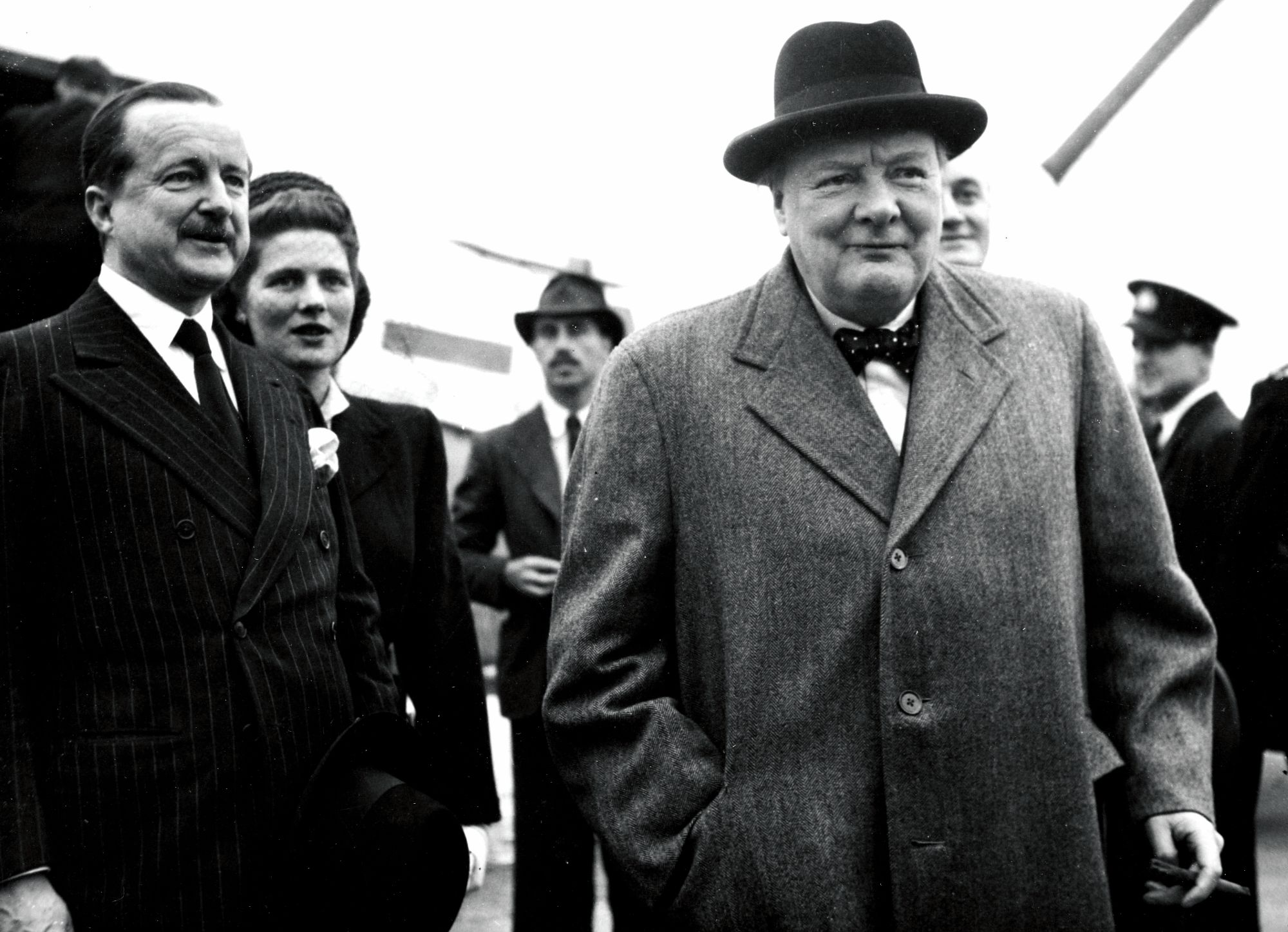
Published in 1950 – despite Cabinet Office efforts to stop its publication (not for intelligence reasons but in case it offended the Spanish) – it has been republished as a Penguin Classic, and rightly so. For classic it indeed is.
The hero of Operation Heartbreak is Captain Willie Maryngton, the tragedy of whose life was that he was desperate to fight for his country but was too young to take part in the Great War, and too old to fight in the rematch. An endearing character – “not too clever”, but with “good manners… and a happy smile which made him welcome wherever he went” – Willie was unlucky in love. After his first love, Daisy Summers, runs off with a married man, he turns his attention to Felicity Osborne who refuses to marry him “for reasons that are too difficult to explain” (though we eventually discover why).
 What happens to Maryngton – an army major by the end of the book – to make him so important to British intelligence? That would ruin the delicious denouement for you, dear reader, contained in perhaps one of the most exquisite surprise endings I have ever encountered.
This is a perfect novel – short, focused, gorgeously written and deeply moving – that you could get through in an evening, waiting for the Division Bell. I just wish my dad was around to read it, and raise a glass to Willie.
Lord Black of Brentwood is a Conservative peer
Operation Heartbreak
By: Duff Cooper
Publisher: Penguin Classics


With fundamental questions about consistency, fairness and consumer impact still unresolved, the Betting and Gaming Council’s chief executive, Grainne Hurst, argues the Gambling Commission must pause its Financial Risk Assessment proposals before causing serious, irreversible harm
On the day of the Gambling Commission’s Board meeting on Financial Risk Assessments (FRAs), there are still fundamental questions that remain unanswered.
Do these checks actually work?
What actions will they trigger?
And what will they mean for ordinary punters?
Until those questions are answered clearly, the Commission should not press ahead.
FRAs were meant to be “frictionless” and workable in practice. The pilot was supposed to test that. Instead, it exposed serious concerns about whether the system is reliable, proportionate or fair, and whether it will genuinely improve protections for consumers.
The biggest issue is what happens after a customer is flagged. The Gambling Commission has focused heavily on the idea that most checks will be technically “frictionless”, but punters care about outcomes, not process. If an assessment leads to intrusive follow-up questions, requests for personal financial documents and account restrictions, then the customer experience will be severely disrupted.
And there are real questions about whether the underlying data can even be trusted. The same customer can receive different outcomes depending on which credit reference agency is used. If operators cannot rely on the consistency of the data being returned, they will be forced to act cautiously. In practice, that means more customers facing restrictions and being asked to provide sensitive financial documents.
We already know how consumers feel about that. Recent YouGov polling found 65 per cent of bettors would be unwilling to provide documents such as bank statements or payslips in order to continue betting. Faced with intrusive or inconsistent checks, punters will not simply stop betting – many will be driven straight into the arms of the growing illegal gambling black market, which offers none of the protections or safeguards available in the regulated sector.
That should concern everyone. The illegal gambling black market is growing rapidly, doubling in size over the past two years. Any policy that risks driving ordinary punters away from regulated operators and towards illegal sites would be deeply counterproductive. It would harm consumers, damage the regulated industry and cost the taxpayer.
It would also have serious consequences for British horseracing, which relies heavily on regulated betting for funding. Racing’s finances already face significant pressure, and any further migration of customers away from the regulated market risks reducing Levy revenues, sponsorship and media rights income that support the sport, its jobs and its long-term future.
Concerns about these proposals are no longer limited to the regulated industry. Even former supporters are now calling for a pause and rethink, including Dr James Noyes, who recently resigned from the Gambling Act Review Evaluation Advisory Group in protest over the Government’s approach to Financial Risk Assessments implementation. Parliamentarians from across the political spectrum have also raised serious concerns, alongside former Gambling Minister Stuart Andrew MP, who oversaw the original White Paper reforms. Newspapers including The Sun and the Racing Post, alongside more recently The Guardian and The Telegraph, have repeatedly highlighted the risks around intrusive checks, the threat to horseracing and the growth of the black market.
Which is why recent comments from Tim Miller, the Gambling Commission’s Executive Director of Research and Policy, were so surprising. Speaking at the CMS conference last week, he said: “you can’t evaluate something until you have implemented it.”
But that is precisely what the pilot was supposed to do. Its purpose was to test whether these proposals worked before implementation. What we have seen instead are unresolved concerns around consistency, reliability and customer impact.
The Betting and Gaming Council supports proportionate, evidence-based regulation that protects the vulnerable while allowing the 22.5m adults in Britain who enjoy a bet each month to do so safely. But good regulation must also be workable in practice. At the moment, these proposals do not meet that test and should not proceed in their current form.
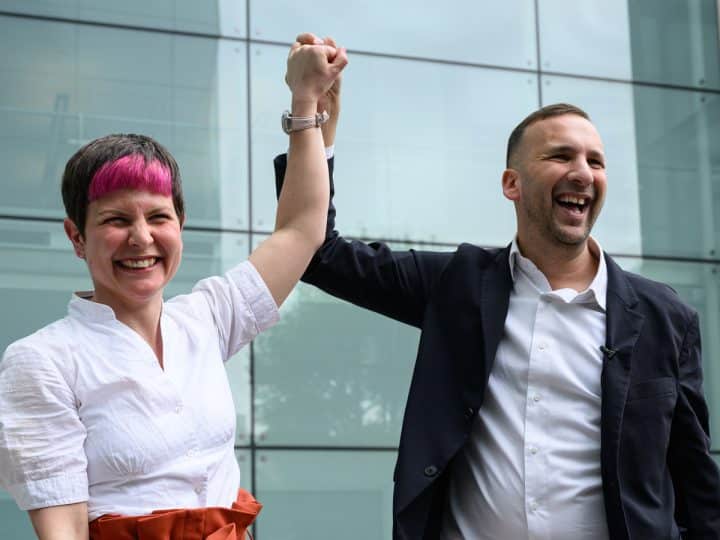

A new study shows that Labour lost nearly four times as many voters to the Green Party in the local elections as they did to Reform.
YouGov’s study of the 2026 local elections shows that just 46% of 2024 Labour voters who went to the polls remained loyal to the party, with more backing the Greens (22%) than Reform UK (6%) two weeks ago
The Conservatives retained 55% of their 2024 voters, with 33% switching to… pic.twitter.com/hK6CleMQrj
— YouGov (@YouGov) May 21, 2026
YouGov’s new study of the 2026 local elections shows that only 46% of Labour voters from 2024 who went to the polls remained loyal to the party. More previous voters backed the Green Party (22%) than voted for Reform (6%).
In comparison, the Conservatives retained 55% of their vote, with 33% switching to Reform.
YouGov found that Reform voters were most likely to use their vote in protest of the national government. Forty-six per cent of Reform voters said that the UK government’s performance was one of the main factors in their vote.
Whereas 40% of Labour and Lib Dem voters said they wanted to stop another party from winning.
Around 60% of people who voted Green said they did so because the party best represented their values. Around half of Labour voters said the same.
Clearly, Labour is losing more votes to the left than to the far-right.
Our data here is consistent with evidence from already-published analyses of the results.
Labour lost far more voters to parties on their left/in the centre than they did to the right on 7th May . Reform made their biggest gains from the Conservatives. https://t.co/DvVDcUiCrO
— Patrick English (@PME_Politics) May 21, 2026
Moreover, this is after Labour has abandoned practically all of its values in an attempt to appease far-right Reform voters. For a grand total of 6% of votes. Hilarious.
so here we have confirmation that Labour have abandoned every single one of their values and all the marginalised people they pledge to protect for a grand total of 6% of voters https://t.co/g9bmuuVek3
— Nat
FREE
(@loopzoooop) May 21, 2026
When people in Labour offices say things like ‘we’ve really got to win Reform voters back to Labour’, is there no-one with half a brain, a cynical pragmatist, there to say ‘you mean the almost invisible sliver on this graph? Yeah that probably can’t be our priority’ https://t.co/yhrwu8NPCU
— Daniel Gerke (@drgerke1) May 21, 2026
As social media users pointed out, we only really hear about Reform’s threat to Labour, not the Green threat.
Why? Obviously, Labour would rather demonise migrants, disabled people, and benefits claimants than stand up to the rich and powerful.
Labour lost nearly four times as many voters to the Greens as Reform.
Yet all you hear about is Reform’s threat to Labour.
Why? Because
a) the left aren’t treated as legitimate political actors
b) Labour’s masters prefer bashing migrants to challenging wealth and power https://t.co/TlEMr4DRZU
— Owen Jones (@owenjonesjourno) May 21, 2026
It also seems that Labour lost more voters to the Lib Dems than it did to Reform.
YouGov’s study of the 2026 local elections shows that just 46% of 2024 Labour voters who went to the polls remained loyal to the party, with more backing the Greens (22%) than Reform UK (6%) two weeks ago
The Conservatives retained 55% of their 2024 voters, with 33% switching to… pic.twitter.com/hK6CleMQrj
— YouGov (@YouGov) May 21, 2026
Starmer has practically bet his party on trying to beat Reform. In the process, he has created the perfect opportunity for the Green Party and a more progressive version of British oolitics. Importantly, the local elections showed us that many people want that alternative – and Labour have paved the way for their own demise.
Featured image via Leon Neal / Getty Images
By HG




BloFin War of Whales 2026 Grand Prix opens registration for $5M trading championship


Weekend Open Thread: Theory – Corporette.com


E-Estate Announces 1 Year Live: Washington DC Summit as Real Estate Tokenization Enters Its Next Phase


Tech Moves: Microsoft AI leader jumps to OpenAI; former AI2 exec joins Meta; and more


Google reimburses Register sources who were victims of API fraud


H&R Real Estate Investment Trust (HR.UN:CA) Q1 2026 Earnings Call Transcript


Napoleonic enters 2026 Doomben 10,000 field via Abounding withdrawal


BeInCrypto 100 Institutional Awards Nomination: KAST for Best Digital Assets Neobank and Best Digital Assets Fintech

Bitcoin Battles US Bond Nerves With BTC Price Dip Toward New May Lows


ICE and CME urge US regulators to curb Hyperliquid energy trading


Wall Street’s Boldest Gold Prediction Has Russians Rushing to Buy


On the Scene at Gucci’s Cruise Show in New York City: Mariah Carey, Kim Kardashian, Lindsay Lohan, Iman, and More!


DWP PIP Timms review continues to be an absolute farce


Trending Western Style Vests Perfect for Summer


IREN closes $3 billion convertible notes deal amid AI infrastructure expansion


David Letterman Returns to Late Show, Blasts Cancellation

Lido Finance Selects Chainlink CCIP as the Official Cross-Chain Infrastructure for wstETH Security


Amazon Sundays: Memorial Day Hosting


Creative Ideas for Custom T-Shirts


Watch: far-right flag-fanatics run over victim, attack locals – Setup By the Left wing for your entertainment


You must be logged in to post a comment Login