Politics
The House Article | Labour Faces Calls To Rethink Its 2030 Clean Power Mission


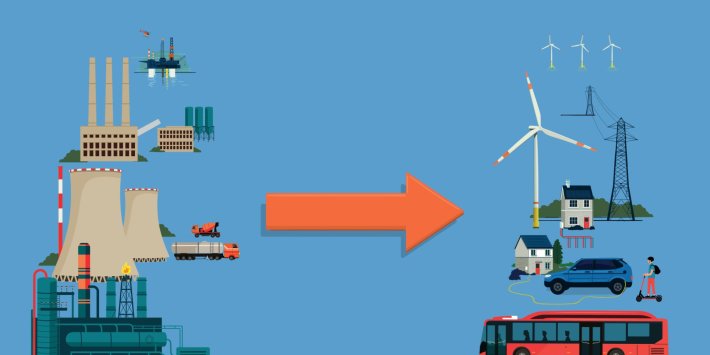
(Illustration by Tracy Worrall)


6 min read
Ministers remain committed to the 2030 target. But the voices calling for a rethink are getting louder – and some are coming from the government’s friends, reports Nadine Batchelor-Hunt
Donald Trump says they are for “losers”, Kemi Badenoch thinks they are destroying jobs and Nigel Farage says he will put the whole lot in the bin.
But not every critic of the government’s commitment to decarbonise the UK’s electricity supply – heavily reliant on wind farms – is on the right. Tony Blair, or at least the institute that bears his name, is among those calling for a rethink.
In October, the Tony Blair Institute (TBI) issued a report calling on the government to “reform” its 2030 green power target – arguing that when the target was established it was “right for its time but circumstances have changed”.
Speaking to The House, TBI senior policy adviser on climate and energy policy Tone Langengen, who authored the report, says the Clean Power 2030 target “will not be met” and that it would be “damaging to try to meet it”.
“What the voters will care about the most is lower energy bills, and that is basically the way that you maintain consent for net-zero,” says Langengen.
“And secondly, the real challenge for the UK is not the supply side… The problem is the demand side. It is the electrification challenge.”
The Warm Homes Plan was, she says, “an important step in the right direction, because it’s starting to focus on how you actually electrify homes. But I am afraid that having a mission towards clean power, you could risk doing the opposite of lowering bills.”
The analyst adds that it is “more important that the transition is done right” and “where you bring the public along with you” instead of prioritising meeting the target as rapidly as possible.
The government has already watered down some pledges on green power, over concerns about achievability and desirability from the sector. Ahead of the 2024 election, Labour said it was committed to the 2030 target to phase out the sale of new, combustible vehicles in the UK. But the government has already made significant concessions in this area – with its election pledge on sticking to the phasing out of the sale of new combustible vehicles by 2030 partially abandoned.
In April, Transport Secretary Heidi Alexander in a ministerial statement said: “In our manifesto, we promised to reimplement the phase-out of all new cars powered solely by internal combustion engines from 2030, restoring the certainty that has been sorely lacking. This response finalises that intention, confirming that from 2030 all new cars will need to be hybridised in some manner – or be zero emission. From 2035, all new cars and vans will be zero emission, and everything we do must now support manufacturers in reaching that end point.”
The UK is not alone in a shift on EVs, with the European Commission announcing a more substantial watering down of its electrical vehicles target than the UK. It declared in December that 90 per cent of new cars sold from 2035 would be required to be zero-emission – instead of 100 per cent.
Langengen is far from alone in her scepticism that the government will be able to meet its targets. Adam Berman, director of policy and advocacy at Energy UK, tells The House that while the clean power mission has “really focused minds within Whitehall” and “accelerated the pace” of the rollout of green infrastructure, it is unclear whether the 2030 target will be met – or should be met – from a practical perspective.
The 2030 target was always a political target – it wasn’t necessarily rooted in the engineering of the energy system
“We’ve got a hell of a lot further with the target than without the target, and it has meant they have removed blockages to planning and permitting,” Berman says.
“They have accelerated the pace of the rollout of generation infrastructure and network infrastructure. They have really put a lot of effort into moving faster than we ever would have otherwise – and so credit where credit is due there.
“I genuinely do think that there is a question as to what we do now; which is that the 2030 target was always a political target – it wasn’t necessarily rooted in the engineering of the energy system, or what was best for emissions. It was an eye-catching political target.”
Berman tells The House that “squeezing the last bit of gas out of the electricity system is probably less preferential than really focusing your energies on: how can you maximise the potential of a clean power we have now built?”.
“There is a moment now for the government to consider how can they pivot from really accelerating the ramp-up of clean power infrastructure – which they’ve done really well – to now prioritising thinking about how to actually use that infrastructure to decarbonise the rest of the economy and to bring bills down where they can,” says Berman.
Despite uncertainty about the achievability of the clean power target among stakeholders, a source close to Energy Secretary Ed Miliband tells The House the government remains committed to achieving clean power by 2030, pointing to decisions in planning and a recent successful renewable bidding auction as proof.
“We’re on track to clean power by 2030. We just had this massively successful offshore renewable auction last week where people expected us to get four or five gigawatts of power – we ended up getting eight,” they say.
“We’re massively going gangbusters on that, and at the same time something like two-thirds of all planning consents that have been made under this government have been made in Desnz [the Department for Energy Security and Net Zero].”
The source adds that while they accept the clean power by 2030 target is “very restricting”, the government is “confident” that it is on the right track to meet it.
“We feel that in the next year, you’ll begin to see projects being built because of planning decisions we’ve made and because of the procurements we’ve done that actually give us a really good chance of reaching the target,” they say.
“We’re really committed to it, we think that it’s the right thing to do, and we think we’re going to do it – and we’re feeling quite confident about it.”
A government spokesperson tells The House: “We are on track to deliver clean power by 2030, as shown by our recent record offshore wind auction, which secured enough clean energy to power the equivalent of over 12 million homes.
“Our clean power mission will protect household energy bills from volatile fossil fuel markets, drive clean energy investment and create thousands of jobs around the country.”
The more upbeat sentiment on reaching the targets is shared by Shaun Spiers, chief executive of Green Alliance, who tells The House it is important that the government remains committed to the 2030 clean power target.
“It seems to be pretty well on track, and the reason for going for it hasn’t changed: which was basically to drive energy security… lower costs in the long run, but also get us off the rollercoaster of dependence on fossil fuels,” says Spiers.
“With Donald Trump behaving so erratically, you really don’t want to be dependent on international gas prices – you don’t want to be dependent on imports of liquefied natural gas from the States. The quicker we can get to energy independence – clean power, energy independence – the better.”

You must be logged in to post a comment Login