
Politics
The House Article | Parliament needs better national security briefings



Screens showing shipping in the Middle East at the UK Maritime Trade Organisation in Portsmouth (PA Images/Alamy)

4 min read
Foreign and security policy are likely to play larger roles in the UK’s national politics for years to come.
The current Gulf war is only the latest sign of a deteriorating global multilateral order. Conflict persists in Ukraine and Sudan, while an unstable American hegemon seeks to enforce a new Monroe doctrine in Venezuela, Cuba and Greenland. These are symptoms of intensifying global power politics unrestrained by law or treaty.
Closer to home, Russia aims to divide Europe and test Nato’s commitment to the collective security of smaller nations. The UK is regarded by the Russian strategic elite as ‘enemy number one’, being one of the leading states in Europe with the will to damage its objectives, as in Ukraine. This long-term challenge from a hostile state in the UK’s neighbourhood will mean increasing attempts to damage and weaken its society through cyber-attacks, physical sabotage and information warfare.
In contrast to the broad foreign policy consensus in Parliament through much of the Cold War and decades since, parties are increasingly voicing divergent views. The Liberal Democrats press for an embrace of Europe, and the Conservatives tilt toward Canada, Australia and New Zealand (Canzuk). On defence too, troop deployments to Greenland, Ukraine and a new all-British nuclear deterrent have been advocated by the Liberal Democrats, and reform of Nato by the Greens.
While scrutiny and advocacy for alternatives are the constitutional duty of opposition parties in Parliament, weak domestic consensus can hobble execution of national security strategy.
Without broad parliamentary and public support, governments may struggle to adequately fund resource intensive priorities, deploy the armed forces, or maintain enduring alliances. Polarised political discourse is also ripe territory for exploitation by external actors to increase internal discord through information warfare campaigns.
A FTSE 100 executive is likely to have access to better intelligence and geopolitical analysis than most parliamentarians, courtesy of London’s thriving boutique private security firms.
National security briefings for parliamentarians on threats to the UK would allow for better scrutiny of preparedness, debate from an informed perspective and potentially greater consensus. Currently, only opposition leaders are briefed on ‘Privy Council terms’ on an ad-hoc basis and usually limited to specific incidents.
Select committees should function as the main vehicle for scrutiny of foreign and security policy, yet rely on government candour rather than access to information as of right. The Commons Defence Committee faced official barriers to assessing the UK’s defence readiness, while government continues to refuse requests from the Joint Committee on National Security Strategy to hear evidence from the National Security Adviser. Former defence secretary Sir Ben Wallace alleges excessive secrecy on the part of government, so it can “own the narrative of the threat” and contain political and public pressure on the Treasury for greater defence resources.
A FTSE 100 executive is likely to have access to better intelligence and geopolitical analysis than most parliamentarians
The US Congress halted the Trump administration’s plans to withdraw all American troops from Europe by 2027, whose members all have access to classified briefings by right of office.
In Estonia and Finland, as well as benefiting from published public threat assessments from intelligence agencies, nearly all legislators will have participated in a government national security course on threats and policies. In the Polish Sejm, members hand in phones before closed sessions of the whole chamber on Russian subversion activities, held at the request of government.
Parliament could receive better information in several ways. As in other Nato states, the Defence Committee should work at a ‘secret’ level, as it did in the Cold War. When the heads of MI5 and MI6 deliver public threat lectures, a closed version could be arranged for Parliament in Westminster Hall, alongside the chief of the defence staff. Members’ libraries could work with government to arrange access to ad-hoc briefings at other times. Without an ability to fairly scrutinise or build trust and knowledge, the national strategy and resourcing required for an era of increasing threats may falter.
Robin Potter is an academy associate at Chatham House



Arsenal arrive in Madrid with a clear line of sight, two matches stand between them and a first Champions League final since 2006.
Manager Mikel Arteta, and captain Martin Ødegaard, have framed the tie as an opportunity rather than a threat. They insist the squad is ready to take the next step after two seasons of steady progress.
This is a team built on a plan, recruitment, coaching and a style that has matured into genuine European competitiveness.
Arteta’s side have earned their place in the last four through a mixture of tactical discipline and moments of attacking quality. The narrative now is simple: convert potential into a result over two legs.
Arsenal face Atlético Madrid tonight
There are practical reasons for measured optimism. Arsenal is in back-to-back Champions League semi-finals, a sign of consistency at the highest level that the club lacked for years.
Arsenal has also shown defensive resilience in the knockout rounds, conceding just once across ties with Bayer Leverkusen and Sporting. That defensive backbone gives them a platform to play with confidence away from home.
But optimism must be balanced with realism. Arsenal’s form in recent weeks has been patchy. They have struggled for goals, managing only five in their last seven matches across all competitions.
That lack of cutting edge is the clearest vulnerability heading into a tie with Diego Simeone’s Atlético Madrid, a team built on organisation, experience and the ability to make big matches ugly for opponents.
Tactically, Arteta faces a familiar test: how to impose Arsenal’s possession-based game on a team that will happily cede the ball and strike on the counter.
The Gunners’ October meeting with Atlético was a 4-0 league phase win, which showed what they can do when they find rhythm and finish chances. But one result from the league phase does not erase the tactical discipline Atletico bring to European nights.
Gunners must be clinical and patient in equal measure
The psychological side matters as much as the tactical. Players and staff have spoken openly about the weight of expectation that comes with chasing major trophies. The pressure has shaped previous campaigns and will shape this one.
The difference now though is experience. Many of the squad have been through deep runs and know how to manage the noise.
The job for Arteta and his coaching team is to keep the focus narrow — one game, one step, one moment at a time — to reach another final.
Game management will be decisive. Arsenal’s recent reliance on defensive solidity suggests Arteta values control, but the manager has also been clear he wants to attack and decide ties rather than sit back.
That balance between protecting a lead and hunting a decisive goal will define the first leg at the Metropolitano.
Expect Arsenal to try to take the initiative early, but also to be ready for Atletico’s set-piece threat and counter-attacks.
We’ll be on the edge of our seats
For supporters, the stakes are both immediate and historic. A place in the final would be a landmark for a club that has rebuilt its identity and ambitions over several seasons. For the players, it is a chance to turn progress into legacy.
For the manager, it is a test of tactical flexibility and mental management. Win or lose, the way Arsenal approach this tie will tell us a lot about where the project stands.
Arsenal has the structure, the personnel and the belief to make history, but they must solve a recent scoring slump and navigate a tactically astute opponent. The first leg will be a measuring stick, not just of quality on the pitch but of temperament off it.
If Arteta’s team can marry discipline with the attacking intent they’ve shown at their best, they will give themselves a real chance to reach a final that has eluded the club for decades.
Featured image via Arsenal
By Faz Ali
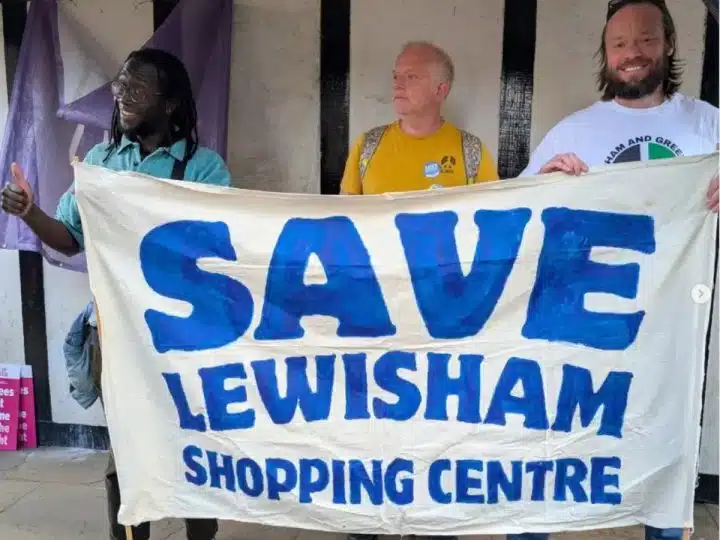

It’s just nine days until the local elections, where establishment parties are expecting a bit of a kicking at the ballot box. In their place, the country is seeing a huge rise in independents, Greens, and Your Party. These groups intend to turn the tide for local communities.
We spoke to Your Party candidate Daniel Ansell who is standing in Lewisham Central, alongside fellow YP Davis St Marthe. Ansell, Marthe, and Callum Carter – standing in Rushey Green. Together, they are working to rebuild trust in their local communities, which establishment parties have squandered.
View this post on Instagram
Ansell: “it’s a very different experience than what you see online”
We asked Ansell about how many are standing for YP, how it’s going and whether it’s been hard breaking through to local people:
People are weary, right? So, it’s hard.
We just started this in March. You’re not going to sway people’s opinions on politicians in just two months, because we’re not doing anything yet really. Like, maybe we’re talking a good game, but will we do it or are we just turning up for votes and then they won’t see us for four years?
There are three of us standing. It’s good. It’s interesting to see the difference in understanding or perspective between people that are very into politics, and the actual electorate we’re introducing ourselves to. We’re new, so we’re trying to just do an introduction because a lot of people haven’t heard of Your Party. Some people don’t even know Jeremy Corbyn’s left the Labour Party.
People have opinions on big things, but not everyone has an opinion of little things, which perhaps people that follow politics or are active in politics have a bit more of an opinion on and understand a lot more. So, dealing with elections and getting people out on the door, it’s a very different experience than what you see online.
He then pointed to the legacy of broken trust in politics as a result of establishment parties failing to deliver on their promises. In contrast, Ansell told us about how he is working to show his local community that he intends to act as opposed to making empty, lofty promises:
That’s how people see politicians: extractive, like wanting something from you, not wanting to give anything back. And that takes a while to change that opinion. You have to start doing stuff.
There was a lot of hope and excitement around this new party. So, I went to a meeting with a collective called Lewisham People’s Assembly and I just liked the energy of the room.
There were lots of people from different places. There were Green Party people, there were people from local campaign groups, peace groups. It was a really nice mix of different interests, but people wanted to work together. I got involved in that group last summer, and then we started the campaign to Save Lewisham Shopping Centre.
I gradually got more involved and then kind of helping to lead it. And there’s a guy called Faris Luke – he actually put in an article in the Tribune in November.

“The local Labour Party hate us, which is always a good sign.”
He [Faris] outlined what we’re doing, which he’s been leading. And yeah, I’m kind of taking a prominent supporting role in the campaign and it’s been going well.
The local Labour Party hate us, which is always a good sign. Yeah, they put up an attack piece in the Evening Standard against us, saying there were ‘shadowy, Green, and Corbyn agents coming from outside the borough to cause problems’.
Of course, Labour never draw attention to the shadowy people they work at the behest of – much to the disadvantage of our communities and wider society.
However, it appears that Starmer feels threatened by these local independents. Probably because they’re actually trying to change things for their communities, as Ansell underscored:
Yeah, they’ve been sending leaflets around saying we are conducting a misinformation campaign, because they know we’re making a difference. But it’s a zero-sum game, so if they are having to put energy into tackling us, then they can’t throw energy on their own campaign.
So, I got involved in that campaign, and with the local Your Party proto-branch bubbling along, there were conversations around, “shall we stand any candidates in the race?” And the natural place to try and stand candidates would be Lewisham Central, because that’s where there’s the issue of the shopping centre, but also the gateway redevelopment, which has seen a whole load of problems.
Novara actually did a piece on that, which went up this week to promote Liam Shrivastava’s mayoral campaign. So yeah, he kind of was outlining, I guess, in that, his opinion on it. So, we decided not to stand the mayoral candidate in our proto-branch because Liam, the Green candidate, has got a pretty strong campaign.
And ultimately, one of our goals is to get rid of Labour. And we’re not in a position to have a policy program in place to actually deliver, but on a personal level, I didn’t think we were at the point where we wanted to do that. I don’t think there’s a line that we don’t support the Greens. I think everyone has their own position on it… I think Liam’s the best to get rid of Labour at a mayoral level.
Labour and its “sham consultation” in Lewisham
Speaking about his active work alongside Faris Luke to demand better for Lewisham Central, Ansell told us:
Yeah, so we did a rally in March on Sunday. Yeah, Faris, the lead organiser, he spoke, I spoke, Liam Shrivastava spoke.
This is a big issue – it’s kind of housing and gentrification wrapped in one. It really is quite good at capturing people, because people care about housing, people care about their heritage.
Like, why get rid of a shopping center that’s functional and that people are fond of? There’s a lack of consideration about what people actually want.
They did this sham consultation, kind of shoehorned in – they put in some nice, shiny things, saying you’re going to get all these nice things, but didn’t mention the housing proposal at all. [They also] didn’t mention the fact that the things are actually for this whole new set of people they’re bringing in, into these expensive flats.
The housing has not been designed to benefit the community; it’s been designed to push out the community, and yeah, that’s something I’m not willing to accept.
View this post on Instagram
Ansell also works collaboratively and in respect with other independents across London, referring to Shake It Up, who have been working in solidarity across London:
I went on to a housing meeting they [Lambeth] had a few weeks ago. There’s this group called Shake It Up. They were there and Laura Graham was there and it was really good just to chat and meet different groups. I think one of the really heartwarming and brilliant things that’s coming out of this is getting a network of people doing the same things, against all odds, just trying to do something different rather than allowing this kind of negativity to get to them.
Ansell: “I’m not here to get power for myself – let’s get power for the community”
Refusing to let the perfect be the enemy of the good, Ansell explained why he chooses active work and optimism rather than factional bickering in YP:
It’s like, no – actually, I’m going to use this as a platform. It might not be a great platform yet, but it is a platform to actually do good work, and I’m going to use it.
And that’s kind of it. I think, for Your Party, despite its faults, it’s the best vehicle around right now if you want to promote the working class, want to promote socialism. I guess if you’re already in the Green Party, or you’ve already made a decision, then whatever – you’re attached to that project. But I wasn’t, so it was kind of easy for me to go this way.
I mean, I’m not here to get power. If I wanted power, I could have joined the Green Party, definitely. I could have got in, because they’re doing very well locally. They’ve got momentum. They’re quite organised. If I wanted to go that way, I could have done that.
But I’m not here to get power for myself – let’s get power for the community. It’s not always about sitting on the council to do that.
Whilst he has clearly been proactive in local campaigns, Ansell intends to go much further if elected on 7 May:
Yeah, we’ve not done enough yet. Presenting what I’m doing is important – talking about my involvement in this campaign to save the shopping centre. People are really interested in that. People are interested in the idea that everyone deserves affordable housing. It’s not a controversial thing – even people who have nice housing are ‘for’ everyone having affordable housing.
As a basic principle, people agree that everyone should be able to afford to live and not be in poverty. So that’s been a good way of introducing myself.
There’s this Vote Palestine campaign – that’s, again, another way of introducing who I am and where I stand and things like that. Also, pointing out – because a lot of people aren’t aware – that the council does have investments through their pension fund in Israeli companies that are complicit in the genocide. It’s important to point that out. I’m not here to do negative campaigning, but you need to tell people what’s happening, because a lot of the time they don’t understand.
Some of the housing associations could be doing better work, and people tell us the issues they’re having with the owners of the building – because you’ve got blocks of flats, and housing associations who are not doing the best work. You can see poverty a bit more now. In the town centre, you see people not in great shape, perhaps with mental health issues, just roaming the streets, probably needing a lot more support than they’re getting.
When people see that, they maybe feel less safe because of it – I think safety is a big one. Obviously, from a left-wing perspective, you have to think about how you want to talk about that, because that’s something the right wing quite often takes advantage of – people’s feelings of not being safe – and the left probably needs to do it a bit better.
I’m not always talking about that, but we think it’s about the community coming up with the solutions. Whether it’s down to security or development, the community should be leading these conversations, not being given some crumbs and told to be grateful.
View this post on Instagram
Unfortunately, the Green Party has decided to stand a full slate in Lewisham, which raises the risk of a split in the local progressive vote.
Nevertheless, Ansell refuses to be discouraged:
It’s a shame they decided to run a full slate. I think communication could be a bit better between us and them [the Greens], but… I wouldn’t say it’s antagonistic
They’re not actively campaigning in their seat. I’ve kind of accepted that’s just what they’re doing, which is fine. We are different parties. Perhaps, in a way, this settles the mind of, yeah, I made the right decision.

Ansell: People are “given some crumbs and told to be grateful”
Ansell also explained how he intends to change things for his local community:
I think you just need to be doing things, right? You know, you start a running club, you organise Zumba classes, you do stuff. And it’s not about taking over and controlling that. You just help people help themselves.
Community building is not telling people, you know, just… the top-down central kind of … “We’re going to do this for you, so what do you want?” [Instead, it’s:] “How can we help you do that”, you know?
Asked about whether Labour are a credible threat locally, Ansell told us:
People don’t like Labour – I don’t know, yeah, just to see what their vote is like. I think maybe there’s that thing previously of shy Tory voters – voting Tory, but not wanting to say. I think maybe that’s going to come back a little bit with the Labour Party. I mean, their vote is still out there, but quite often people are very angry towards the Labour Party.
You can start a conversation just by saying – I don’t want to focus on being negative – but, you know, the Labour Party have been letting us down, and people are nodding along. People feel that and are ready for a change, even lifelong Labour supporters – culturally Labour people – thinking, “well, maybe I need to change things, things aren’t going well here.”
So, I think it’s definitely an opportunity. It’s an opportunity for Reform as well, and that’s something we need to tackle. I think we’d probably be in a better place to tackle that than the Green Party. I think the kind of voter that might be looking at Reform – they may look at the Green Party as well – but I think maybe we’re better positioned as [we’re] more focused on the working class.
I mean, maybe I’m projecting a little bit there – my personal politics or who I am – but that’s the way I see it.
“People are confused now as well, and fatigued”
Refreshingly, it appears Reform votes are likely to swing towards these local independents. This is arguably due to their clear intention to fight a broken system on behalf of people who feel forgotten and neglected.
Speaking about how people no longer trust traditional party politicians, this independent intends to repair that broken trust with locals:
Yeah, when people look to see what’s around, right – there’s definitely, from talking to people on the doorstep, a kind of cohort who, when we introduce ourselves, are considering voting for us, whereas before they were looking to vote for Reform. There’s only one Reform candidate where we are, and it’s a two-seat ward, so it’s not – you know, we might even get their second vote or something.
It’s quite complicated. People’s politics are complicated. People are confused now as well, and fatigued, aren’t they?
I just – I mean, it’s much the same thing. You just pitch yourself in, because people want – there’s a lack of trust in politicians. You have to present yourself in a way that they can trust in.
In fact, adding to his credentials as a man of his community, Ansell already works with young people as an athletics coach. He coaches local kids twice a week, benefiting local families, and explains that getting involved in politics isn’t that dissimilar:
Well, I’m more competent than the councillors we have right now…
Locally, I’m involved in athletics and coach athletics twice a week. I’ve been doing that like 4-5 years. You get to know people, you get to know your community. And you become an important figure in that, especially helping people’s children. People respect you if you’re helping their children.
It’s interesting, you know, getting people’s numbers, and building your network, and you’re monitoring that all the time and all these groups. I’m not looking to step back from that. But doing that, I’ve got to know so many different families. Especially when you try and organise for a competition, you’re chatting to 30 different mums at a time, trying to get them to bring their kid along.
And it’s kind of similar to [local] politics, having all these conversations with people just trying to like build something organised, you know?
“Let’s try and do something” for Lewisham
Ansell is a signatory to the Vote Palestine pledge and is working to challenge oppression across British society. He intends to draw a line under the factional bickering that has long plagued YP. Instead, he prefers to move forward with positive action:
I’m coming from a perspective of doing stuff in the community.
Labour won every seat last time around and they’ve had four defections to the Greens. There are four Greens now [on the council]. Now, that might be hard to take down in one round, and obviously we are standing two candidates. Because we’re not in a position to do more. But we wanted to start something to be a positive team in the Your Party project, rather than people just starting on each other.
So, let’s try and do something, and it’s interesting for people to see another person turning out, you know, that actually wants to do the work.
We at the Canary recognise how people are sick of the political establishment. Therefore, we urge local people in Lewisham to vote for candidates who bring hope and humility.
After all, councillors who genuinely care about Lewisham are far more likely to fight for their communities.

The post ‘Starmer can stick his digital ID’ appeared first on spiked.


Tenerife is a lot more than just a holiday spot, especially for British travellers… You see, thanks to its privileged location and condition, sitting on the northwest coast of Africa, floating in the Atlantic Ocean, but still being part of Spain and Europe, the island offers a unique opportunity for a summer trip.
You get the best parts of Spain, but with better weather, stunning landscapes, and world-class attractions in a single place, while still having that familiar European comfort. This means that you can leave behind grey skies and enjoy one of the best summer holidays in Tenerife.
Whether you’re travelling as a couple, with friends, or as a family, Tenerife sure has something to offer you.
Loro Parque: A World Leader in Conservation and Animal Care
While most thing of beaches when hearing about Tenerife, what most people don’t know is that the island’s main attraction is Loro Parque. This is not just a park; it’s one of those places that leave an impression on you.
It’s educational and impressive.
The park is known as an Animal Embassy, which means that animals living there act as ambassador of their conspecifics in the wild, contributing to their protection. Loro Parque is deeply involved in protecting endangered species around the world, and you can easily see and feel that in the details you will spot on your visit.
Once there, you will notice how carefully each habitat was designed; it truly feels like the real thing. You will find anything from topical areas to forests, deserts, and specialised environments. All of that reflects a focus on animal welfare and respect for nature.
Siam Park: The Best Water Park in the World for 10 Years
After that title, Siam Park doesn’t need a huge introduction… a water park that has been named the best one in the world for 10 consecutive years by Tripadvisor. That’s HUGE! But don’t let that surprise you, the real thing will actually leave you speechless.
Yeah, you can expect consistent quality after a 10-year streak but It’s even better than that. The park is fully built in a stunning and accurate Thai theme, this give you a completely different feel from typical water parks.
By checking the design, the details, and all those things that make the thai vibe you will notice how polished everything is, to the point where you’re not just riding slides. You’re stepping into a carefully designed atmosphere.
There are high-speed rides as well as calm areas, rivers, the white sands of Siam Beach, the incredible waves breaking from the Wave Palace, and even great food!! And the best part is that it works just as well for couples as it does for families.
Mount Teide and Tenerife’s Dramatic Landscapes
While those two are part of what makes Tenerife great in recent years, what makes the island what it is to this day and has been leaving travelers speechless for ages is Mount Teide. Spain’s highest peak, and you can miss it; it can be seen from almost anywhere on the island.
Walking through Teide National Park is a unique experience; the landscapes completely change from coastal to volcanic, almost unreal terrain. It really looks like NASA’s Mars photos, like something from another planet.
You will see interesting rock formations, you have amazing trails to hike, as well as a ton of viewpoints to check, but I highly recommend that you take a cable car ride part of the way up. This not only makes the experience accessible, but it also offers some amazing views.
Once you’re up there, the views stretch across the island and beyond, giving you this sense of exploration and greatness.
Beaches, Food, and the Easy Island Lifestyle
But of course, there’s no summer holiday or visit to Tenerife without some beach, sun, and water activities… without forgetting about good food and some cultural immersion.
Because life in Tenerife is way different than life in mainland Europe, here everything is slower, fresher, and calmer. The island is home to a mix of golden and volcanic black sand beaches, each with its own thing. Some are lively and full of activity, while others are perfect for a slow afternoon.
When it comes to dining, there’s a flavour for every palate. The culinary scene presents a blend of classic Spanish dishes and distinct Canarian specialities. Options range from simple, authentic meals like papas arrugadas with mojo sauce and fresh seafood, to international favourites like burgers.
Conclusion
If you’re planning your next summer escape and want something that feels both familiar and exciting, Tenerife should be at the top of your list.
It offers the comfort of Spain, the beauty of an island in the Atlantic, and experiences that stay with you long after you return home.
From the visit to Loro Parque to Siam Park, it all fits together naturally. One day flows into the next, each experience building on the last.
So the real question is simple: why settle for an ordinary summer when you can have all of this in one place?
Image Source: Pexels, Atlantic Ambiance, under the Creative Commons license.


Hailey Baptiste pulled off one of the biggest upsets of the clay season, beating world number one, Aryna Sabalenka, in a wild tennis quarter-final at the Madrid Open.
The 24-year-old won 2-6, 6-2, 7-6 in a match that swung back and forth, and refused to end until the very last point.
Sabalenka started like a steamroller. She grabbed two breaks early and took the first set 6-2, hitting hard and moving the American around the court.
Surprisingly, Baptiste stayed in the game. She fought her way back in the second, breaking twice to level the match and force a decider.
The third set was a test of nerves for both players. Breaks were traded, momentum flipped and both players had chances.
Baptiste saved five match points while serving in the tenth game to stay alive, then later survived a sixth match point in the tie-break before closing out the win. The match lasted two hours and 32 minutes.
View this post on Instagram
WATCH: Hailey Baptiste’s winning moment
This is Baptiste’s biggest win to-date. It’s also her first victory over a top-five opponent and a career milestone that will stick with her. Baptiste showed grit, big hitting when it mattered, and a calm head in the pressure moments.
For Sabalenka, the loss is a shock and a reminder of how thin the margin is at the top. She’s a three-time Madrid champion and came in as the favourite, but the clay court draw in Madrid has been brutal for the top seeds this year. The tournament has already seen the top seven seeds exit early, and Sabalenka’s defeat only added to the chaos.
Baptiste’s path now leads to a semi-final against Mirra Andreeva, who beat Leylah Fernandez earlier in the day. That match will be another big test. Andreeva is a rising star with a fearless game, and Baptiste will need to keep the same fight and focus to go further.
Nerves of steel
What stood out was Baptiste’s refusal to panic. When Sabalenka piled on pressure, Baptiste answered with clean serves and aggressive returns. She mixed power with smart placement, forcing Sabalenka into longer rallies and taking advantage when the world number one missed.
The mental edge came down to a few points and Baptiste won them.
This result will ripple through the tour. A win like this boosts Baptiste’s confidence and ranking points. Her triumph also sends a message to the rest of the field that on any given day, the top spot can be challenged.
For Sabalenka, it’s a reset moment. She’ll go back to the drawing board, sharpen the serve and work on closing out tight matches. The loss stings, but it’s also a reminder that even champions must fight for every point.
An unforgettable game of tennis
Fans got drama, tension and a classic underdog story. Baptiste’s celebration at the net was simple and earned. She’s a young player who seized her moment on one of the sport’s biggest stages.
Madrid’s clay has a way of producing surprises, and this was one of the loudest.
In short, Baptiste kept fighting, saved six match points and stunned the world number one tennis player in a match that will be replayed in highlights for days.
It was a career-defining night for her and a tough exit for Sabalenka. Baptiste’s win is proof that in tennis, the scoreboard never lies and the next point is always the one that matters.
Featured image via Reuters/ Violeta Santos Moura
By Faz Ali


On 28 April, MPs voted on whether Keir Starmer should be probed for misleading Parliament. As we reported, this is something the PM seems to have done several times. Despite this, relatively few politicians voted in favour of Starmer facing the sort of transparency he promised to deliver in office.
Interestingly, Nigel Farage and Robert Jenrick were among those who didn’t even bother to vote:
This is why @reformparty_uk are such an unserious party.
Neither Nigel Farage or Robert Jenrick voted on this, that’s 25% of their parliamentary party simply couldn’t be bothered to vote. Decisions are made by people who turn up, Reform are not serious people. https://t.co/wRDGnowq28
— Mike Prendergast (@MikePrendUK) April 28, 2026
Part-timers
PM Keir Starmer stands accused of multiple instances of misleading Parliament. This is why his opponents tabled a vote to try and force a probe into his behaviour – a tactic Starmer himself once deployed against then-PM Boris Johnson
Starmer described the vote as a “stunt”:
Keir Starmer, "What my political opponents are doing tomorrow is a political stunt"
Cathy Newman, "It's a stunt you pulled in opposition against the last, Conservative, government"
Keir Starmer, "The reason they're doing it is because they don't believe what we're doing as a… pic.twitter.com/QXUdZJ86jZ — Farrukh (@implausibleblog) April 27, 2026
The vote has now gone ahead, with Labour MPs voting against Starmer facing scrutiny. One rebel MP who voted in favour of Starmer facing accountability said the following:
My speech in today's #PrivilegeDebate — Emma Lewell MP (@EmmaLewell) April 28, 2026
 https://t.co/B8cURwI3ur
Reform have sought to capitalise on this situation, with the full post from Zia Yusuf above reading:
Friendly note to Labour MPs ahead of the vote tomorrow to decide if Starmer should face an ethics probe:
If you vote against it, Reform will carpet bomb your constituency to ensure all your constituents know you voted to save the most unpopular PM of all time.
Vote wisely.
Some are upset by the term “carpet bomb”, but come on, in this context it’s abundantly clear Yusuf isn’t planning to literally bomb voters.
Zia Yusuf. This unelected evil little waffle goblin is unhinged. — Alethea Bernard (@Tush27J) April 28, 2026
Threatening to 'carpet bomb' an MPs constituency. Does he understand what carpet bomb means. He should be reported to the police. Idiot.#BBCBreakfast #r4today #Evil pic.twitter.com/quFGiY9zly
We all use words like ‘explosive’ and ‘nuked’ in day-to-day language, and pretending that’s not the case comes across as cynical.
To be less fair to Reform, however, you can’t talk this strongly about a vote and then just not bother voting:
Reform threatened to ‘carpet bomb’ the constituencies of Labour MPs who didn’t vote for Sir Keir Starmer to face an inquiry over the Mandelson affair.
How did their leader Farage vote? He didn’t.
— Simon Harris (@SimonHarrisMBD) April 28, 2026
And as Reform Party UK Exposed highlighted, Farage has said questionable things about Peter Mandelson himself:
Hi @Nigel_Farage, how did you vote?
You didn’t.@ZiaYusufUK – you going to “carpet bomb” Clacton? pic.twitter.com/zR6Bf25dK2
— Reform Party UK Exposed
 (@reformexposed) April 29, 2026
Excuses
Nigel Farage excused his absence as follows:
The vote in Parliament tonight was great theatre, but the three-line whip meant it would never be close.
I want Starmer out, which is why I spent the day campaigning for it.
If Reform crush Labour next week, he will be gone.
— Nigel Farage MP (@Nigel_Farage) April 28, 2026
Tory candidate George McBride said this in response:
A weak defence from a man who couldn’t be bothered to turn up.
The local elections will not see Starmer leave office.
If he actually wanted Starmer out, he would have rocked up to Parliament (for once) and voted to do so.
What an awful MP Farage is proving to be.
We hate to say it, but Farage might have a point.
The vote was never going to pass, because Labour MPs are spineless, self-serving worms with no direction or purpose. Given that, Farage was possibly correct to think it wasn’t worth losing a day of campaigning.
It’s certainly the case that his opponents are kicking up a fuss, but what do you think will get more attention today:
- The fact that Labour MPs overwhelmingly voted in favour of not probing Starmer – forever tying themselves to the Peter Mandelson scandal?
- Or the fact that Farage didn’t show up, even though it wouldn’t have mattered anyway?
This isn’t to say Farage doesn’t deserve criticism; this is literally an article giving him just that.
Farage’s absence is something people will highlight every time Reform try to challenge Labour’s handling of the Mandelson scandal – something which is happening already:
Your party leader didn’t even bother to turn up pic.twitter.com/Vb1RHMWzn8
— Imogen (@Imogenlemon02) April 28, 2026
While it’s fine for the public to make this point, it’s galling to see Labour MPs attempting the same thing:
(Setting aside the “carpet bomb” threat), I note that Nigel Farage and Robert Jenrick both missed the vote … that’s 25% of your MPs. Not that important to you then. https://t.co/Zq5D03xPxn
— Lucy Powell MP (@LucyMPowell) April 28, 2026
Lucy Powell – you literally voted against the transparency probe – you cannot be point scoring on this!
For reference, by the way, the following are the 15 Labour MPs who had the backbone to vote for transparency:
- Apsana Begum
- Richard Burgon
- Ian Bryne
- Mary Kelly Foy
- Imran Hussain
- Brian Leishman
- Emma Lewell
- Rebecca Long Bailey
- Andy McDonald
- John McDonnell
- Graham Morris
- Luke Myer
- Kate Osbourne
- Cat Smith
- Nadia Whittome
No show
Farage’s broader problem is he has a reputation for not showing up, and this is just another example of that. It may not be the worst example, but it’s certainly one people will remind him of in years to come.
Let’s hope by then everyone realises this guy is a part-timer, and that he has no intention to seriously lead this country.
Featured image via Parliament
By Willem Moore
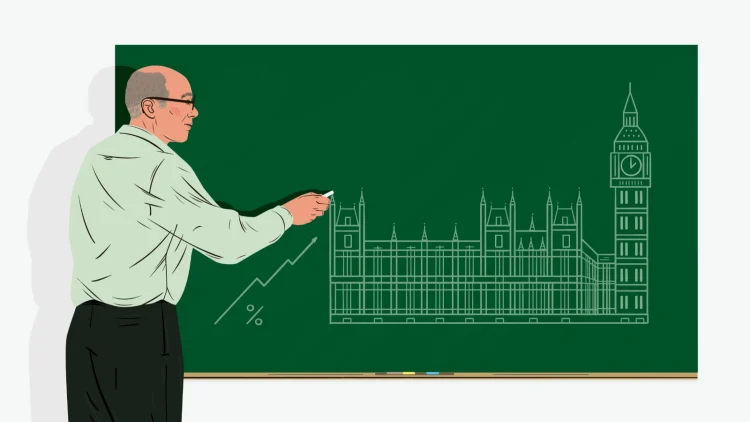

Illustration by Tracy Worrall
4 min read
Lessons in political science. This week: records
The story goes that in early 1945 Ronald McCallum was sat reading in the university library when he suddenly remembered he was supposed to be at a committee meeting to discuss future research projects. Having given it no thought, and with not a single idea ready to propose, he set off at pace and out of nowhere it came to him: a study into the forthcoming general election.
So began what is now the longest-running election series in the world. The latest volume, the 22nd in the series, was published recently.
McCallum’s story says a lot about how academic life has changed. He came up with the idea on the hoof and they just gave him the money. These days, I have about a dozen projects for which I can’t get funding and the process of applying makes Parliament’s renewal and restoration programme look snappy.
That first study on 1945 begins with the Duke of Wellington’s observation that you could no more describe a battle than you could describe a ballroom. “Still less,” McCallum, and his co-author Alison Readman, remarked “can you describe a general election”. They listed a series of ‘named’ elections: 1874, when the Liberals went down in a flood of gin and beer; the Midlothian election of 1880; the Khaki election of 1900; the Chinese Slavery election of 1906; the People’s Budget election of 1910, the ‘Hang the Kaiser’ election of 1918; and the 1924 Zinoviev letter election. They were sceptical that in reality these issues had ever been so dominant. In 1945, they pointed out, the key issue of the election was housing – yet no one referred to it then (or since) as the Housing election.
Since then, we have had fewer such ‘named’ elections. Even with the 1983 contest, which could easily be known as the Falklands election, there is plenty of evidence that the Falklands conflict was much less significant than people think. The 2005 election could have been labelled the Iraq election, given the extent to which national debate focused on the consequences of the 2003 war, but we know it was fairly low down voters’ priorities. The recent Brexit elections were about a lot more than Brexit.
Still, reading the latest volume (which is a cracker) it occurred to me that we could name 2024 the Roy Castle election – younger readers should ask their parents – because there were record-breakers everywhere. The Conservatives alone managed (i) their lowest vote share, off the back of (ii) the largest fall in vote share of any British party, resulting in (iii) the greatest loss of seats ever.
The 2005 election could have been labelled the Iraq election, given the extent to which national debate focused on the consequences of the 2003 war, but we know it was fairly low down voters’ priorities
There was (iv) the highest level of vote switching by electors for any contest for which we have data and (v) the most ever seats changing hands, along with (vi) the largest number of incumbents falling from first to third or fourth (all Conservatives). The record for (vii) the largest Conservative-to-Labour swing was broken in 47 separate seats; the largest was in Norfolk South West.
Labour benefited from (viii) the largest ever winner’s bonus – the gap between the vote and seat share of the winning party – winning a majority (ix) on a lower share of the vote than any other majority government. The combined vote share of the two largest parties (x) was lowest at any election since 1922, with MPs from other than those two parties (xi) at its highest since 1923.
Plus: (xii) the largest Lib Dem number of seats; the best Reform performance in (xiii) seats and (xiv) votes of any radical right party; the best Green performance in (xv) seats and (xvi) votes; more independent (xvii) votes and (xviii) seats than any election since 1945; and (xix) a record number of candidates: 2024 was the first election where every voter had at least five choices on the ballot paper. This is before we get onto the changes in the Commons – a record number of (xx) women, (xxi) graduates, (xxii) those from ethnic minorities, and so on.
And then you look at the current polling and think: what are the odds on some of these records surviving the next election?
Further reading: R Ford et al, The British General Election of 2024 (2026)

Stockport Green Party local candidate and GND Media podcast producer Andrew Glassford hosted a ‘Greens in Power’ event on 21 April 2026 to discuss local government strategy with Hugo Fearnley and Keir Milburn. This write-up highlights some of the many valuable insights from those conversations, ahead of the local elections on 7 May.
Conversations unfolding at a recent Stockport Green Party event offered revealing snapshots of an unprecedented political moment that’s damningly easy for the left to misread.
On the surface, it was about local government strategy: devolution deals, council budgets, and institutional reform. But it went deeper: growing recognition on the left that power in Britain is severely structurally constrained, and that any meaningful challenges to that constraint must begin locally.
Hugo Fearnley and Keir Milburn approached the issue from slightly different angles, but their diagnoses of our present converged neatly. Local government isn’t simply underperforming; it has been systematically reshaped over decades into a delivery mechanism for ideological austerity politics.
As Milburn put it, councils today inherit a “massive poison chalice”, tasked with maintaining services while operating with “around 20% less” spending power than in 2010. This all takes place within a system designed to dissipate responsibility downwards, whilst retaining power in central government.
This framing matters. It shifts debates away from managerial competence and towards political structure. The question is no longer why councils fail to deliver, but how they have been structurally set up to do so.
The system: designed to constrain
The UK’s model of governance remains highly centralised, even after successive waves of devolution.
Combined authorities – now covering roughly 60% of the UK population – sit uneasily above local councils, often with overlapping responsibilities and competing priorities. As Fearnley notes, this has created a “new layer” of regional government that is not fully integrated with the tier beneath it.
At the same time, the underlying inequalities between regions persist. Poorer health outcomes, lower wages, and weaker educational attainment continue to define large parts of northern England. The institutional architectures supposedly designed to address these disparities have, in practice, struggled to do so.
Part of the problem lies in the erosion of local capacity. Decades of (often wasteful) outsourcing and budget cuts have left councils, in Fearnley’s words, “bereft of … in-house skills” and increasingly risk-averse. This creates feedback loops: less capacity leads to more reliance on external actors, which further entrenches dependence and thereby limits innovation.
Milburn situates this within a broader political project. The rise of public-private partnerships and market mechanisms in public services, he argued, has not only shifted resources but reshaped behaviour. Councillors and officers are “trained … to see development from private capital’s perspective”, while citizens are encouraged to view each other as competitors, rather than obvious collaborators.
The cumulative effect is a form of “anti-democratic” conditioning, where collective problem-solving is replaced evermore by market logics.
Incremental changes within tight constraints
Despite these structural limits, the discussion highlighted areas where local authorities have been able to act, often by reframing existing priorities rather than securing new resources. One example from the North of Tyne Combined Authority illustrates this.
Faced with central government’s emphasis on job creation, Fearnley and colleagues under Jamie Driscoll’s mayorship argued for a partial reallocation of funds towards child poverty prevention. Their rationale was straightforward: “if the kids who are too hungry to learn today can’t access those jobs,” then job creation alone is clearly insufficient.
The resulting programme – offering welfare advice outside school gates – recovered over £1 million in unclaimed benefits within a year. In one case, a family received £13,000 in backdated support.
The broader context is striking: an estimated £1.33 billion in unclaimed benefits across the region. Often support is there, but it’s underutilised (contrary to tiresome sensationalism).
Similarly, changes to the adult education budget – focused on flexibility and accessibility – led to a 60% increase in enrolment, from 22,000 to 35,000 learners, without additional spending.
These examples were rightly framed as evidence of what can be achieved through “creative thinking” at the local level. However, they also underscored the limits of that approach. As Fearnley acknowledged, such interventions rely on genuine political will and remain inevitably constrained by the broader political system and context within which they operate.

Keir Milburn highlighted the Greens Organise faction’s emphasis on grassroots community mobilisation efforts in ‘re-commoning’ local political arenas – via Keir Milburn.
Limits to community capacity
One of the more instructive moments in the discussion came from a failed initiative: an attempt to establish a supply teacher cooperative to replace private agencies. The model was economically viable and politically aligned with broader authority-level goals of community wealth-building. But it did not materialise.
The reason was not lack of interest, but sheer lack of capacity. Teachers, already overstretched, were unable to take on the additional organisational burden.
This example highlights recurring tensions in left-wing approaches to localism. While community-led solutions are often presented as an alternative to market-based models, they can place significant demands on individuals already under pressure. Without institutional support, these initiatives risk remaining aspirational.
Milburn’s response is to argue for new forms of partnership that combine state support with community participation – what he terms “public-common partnerships.”

An abstract diagram of the Public Common Partnership organisational structure – via Keir Milburn.
Reframing ownership and control
Public-common partnerships were presented as structural alternatives to extractive and often wholly unproductive public-private partnerships.
Rather than relying on private capital to unlock investment, they seek to mobilise the “knowledge, resources and energy” of local communities, in collaboration with public institutions and workers.
The model centres on shared ownership and democratic control, particularly over how financial surpluses are used. In practice, this involves the creation of “common associations” – local bodies through which residents can participate meaningfully in decision-making that affects them and their families.
One case study discussed was the Latin Village market in Tottenham, where a long-running anti-gentrification campaign led to development of community-led plans for the site. The proposed structure included a three-way partnership between traders, a public authority, and a community body responsible for allocating surplus funds.
Financial modelling suggests that such an asset could generate £2.3 million within three years of redevelopment – funds that would be reinvested locally rather than extracted. Milburn spoke of parallels with Barcelona’s community-run Can Batalla.
Milburn’s argument is that this approach not only retains wealth within communities, which is vital, but also rebuilds genuine democratic engagement. By involving residents directly in decision-making, it seeks to reverse what he described as a 40-year process of “training people away from democratic sensibilities.”

Another case study discussed was the Wards Corner Community Benefit Society planned in Harringay where London’s Greens expect possible council control on 7 May – via Keir Milburn.
Next steps in power?
The broader political context is significant. The Green Party’s recent electoral gains have raised expectations about its potential role in local government especially. However, both speakers cautioned that electoral success alone is insufficient.
Milburn noted:
Winning an election is just the first stage.
The challenge lies in translating that hard-won mandate into structural changes within institutions that are de facto resistant to them – “the day after the revolution,” as Milburn paraphrased Lenin.
This includes navigating internal party dynamics for starters. As Fearnley pointed out, political parties are inherently coalitional, and increased support brings increased scrutiny. (Greens know this as well as anyone right now, as Britain’s right-wing press doubles down on its incessant smear campaign.)
The key, Fearnley suggested, is not complete ideological alignment. It’s instead a focus on asking:
What can we win together?
Both speakers implicitly recognised that local action must be linked to national change. The constraints facing councils – budget rules, centralised funding, regulatory frameworks, etc. – cannot be fully addressed at the local level.
Any attempt to “escape the trap” will therefore require broader political mobilisation.
Test time for the left
This discussion was not a fully formed blueprint, but it nevertheless offered overlapping strategies: incremental reform within existing structures, experimentation with new institutional models, and longer-term efforts to shift the slanted balance of power.
Whether these approaches can be scaled, of course, remains an open question.
The examples cited are often context-specific and dependent on particular conditions. Simultaneously, they offer counter-narratives to the idea that local government is inherently limited to managing decline. But the stakes couldn’t be higher.
With trust in political institutions at low levels – Fearnley cites figures suggesting only around 10% of people trust major parties to do what they promise voters – the ability to demonstrate tangible change at the local level could have profound wider implications.
In that sense, local government is not just a site of service delivery, but a potential arena for significant and necessary political renewal. The question is whether the current generation of councillors and activists can navigate the constraints they’ll necessarily inherit, whilst also building the capacity to transform them.
If they can, the implications will extend far beyond council chambers. If they cannot, the risk is that local government will continue to function as intended: a buffer between centralised power and local dissatisfaction, absorbing pressure without resolving it.
Dr. Keir Milburn is a writer, researcher, and consultant. He has a background as an academic in political economy and organisational theory. He authored the widely acclaimed book, Generation Left and is an internationally recognised expert on economic democracy, the commons and Public-Common Partnerships. His most recent book, Radical Abundance, was co-written with Kai Heron and Bertie Russel.
Hugo Fearnley is a Research Fellow at Northumbria University, investigating perspectives on social welfare policy and how it relates to health outcomes. This involves engagement with policymakers to explore differences in approaches in different geographic and cultural contexts. The project builds on previous work in policy as Mayor Jamie Driscoll’s Political Adviser in the North of Tyne Combined Authority.
Andrew Glassford is a freelance audio engineer and theatre worker, member of Red Co-op and a founder of the the Retrofit Get in Project, helping theatre workers affected by the covid-19 pandemic with reskilling into jobs retrofitting homes. He’s standing as a candidate on 7 May in Stockport’s Davenport & Cale Green ward.
Featured image via the Canary
Politics
The House | “An evocative tale of intrigue and manipulation”: Baroness Hayter reviews ‘In The Print’
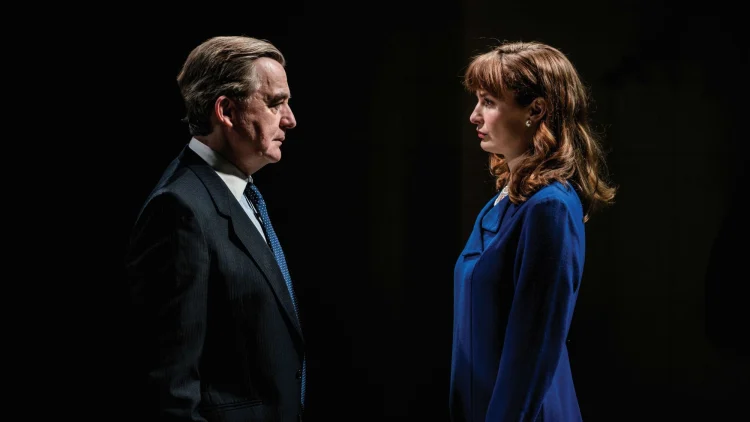

Alan Cox as Rupert Murdoch and Claudia Jolly as Brenda Dean | Image by: Charlie Flint Photography

4 min read
Tightly written and well-directed, Robert Khan and Tom Salinsky’s retelling of the 1986 Wapping dispute is a timely reflection on the human cost of technological change
Back in 1986, battles raged between police and print workers almost every night for 54 weeks at Rupert Murdoch’s new plant in Wapping, east London.
For those of us on the red benches, these events remain a vivid memory, while for most of those sitting on the green benches it is a bit of history brought to life on stage.
In The Print is a docudrama that focuses on two central characters in the dispute: the newspaper baron Rupert Murdoch, owner of four national titles, and Brenda Dean, the strong female leader of print trades union Sogat (which, several mergers later, became part of Unite).
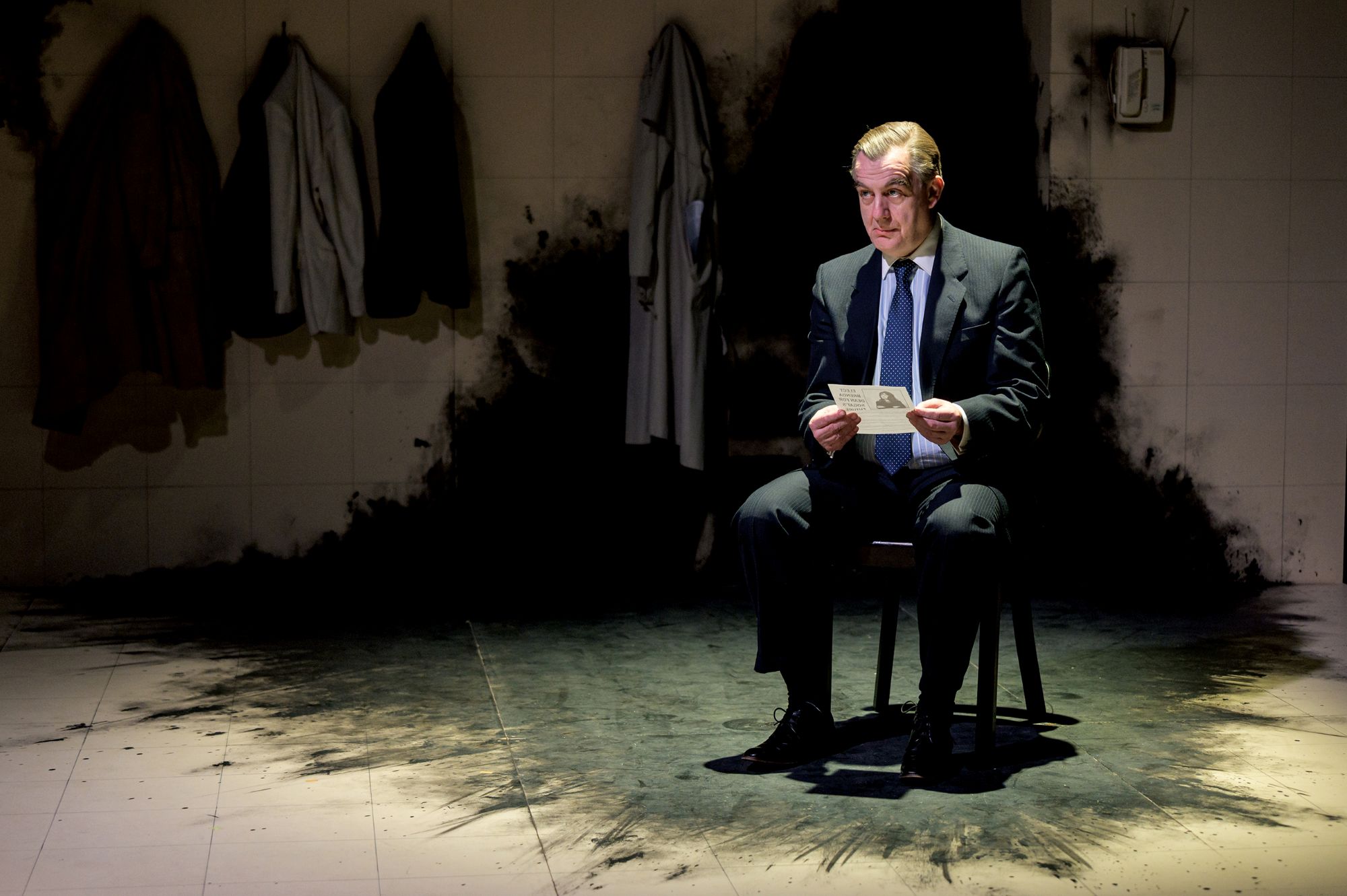
This play manages to transport the audience into the murky world of Fleet Street at a time when the print unions wielded enormous power. The briefest of stoppages could mean no papers delivered through the nation’s letterboxes in the morning, which explains both the bargaining power of the unions – and also their weakness.
When Murdoch comes along with computer-generated pages and the ability to send these over the wires to remote print and distribution centres, the balance of power is changed.
Dean faced a heartless, rich and determined Murdoch
Playwrights Robert Khan and Tom Salinsky detail a dark but human story; one of intrigue and manipulation. They recall the calculated disinformation Murdoch uses to build his Wapping empire, claiming his new print works was for the sole production of a new evening paper, the London Post. But a leaked blueprint for the works reveals to union bosses its true purpose… to print all four titles in the Murdoch stable, The Sun, News of the World, The Times and Sunday Times.
Brenda Dean – later our much-loved and missed colleague Baroness Dean of Thornton-le-Fylde – fights a focused, tightly organised attempt to save her members’ livelihoods and future. But she faces a heartless, rich and determined Murdoch.

In a calculated move, taking the unions by surprise, a ruthless Murdoch sacks the strikers immediately after the industrial action is called, saving himself some £40m in redundancy payments.
We witness clandestine negotiations between the two, where Dean (played by Claudia Jolly) secretly meets Murdoch, played by Alan Cox (who embodies some of the character of Logan Roy portrayed by his father, Brian Cox in the TV series Succession), with scenes playing out in Dean’s home and later in Murdoch’s Californian residence.
Dean tries to negotiate a settlement for the 6,000 striking members of the print unions – only a small number of whom were highly paid printers – hoping that some jobs would be saved, and for improved redundancy offers for the rest. But she is ultimately outmanoeuvred by Murdoch, who leaves her empty handed – and ends the era of print union power.
 The play is tightly written, well-directed and enlivened by a believable cast. I watched it in the company of at least one of the ‘refusenicks’ – journalists who declined the move to Wapping at the cost of their own jobs. Another companion recounted an earlier strike by Sun journalists which the print unions refused to support – perhaps heralding the reverse when printers sought solidarity.
For MPs from all parties new to the story, it portrays a lost time of strong working class bonds – when industry-based, expert union leaders had the power to tame dictatorial bosses. For older theatre-goers, it is a reminder of lost times and fights well-fought, and of the extraordinary role played by a pioneering female leader.
And for all of us, in the age of AI, an important reflection on both the inevitability and the human cost of technological change.
Baroness Hayter is a Labour peer
In The Print: Rupert Murdoch vs Brenda Dean in the Battle for Fleet Street
Written by: Robert Khan & Tom Salinsky
Directed by: Josh Roche
Venue: King’s Head Theatre, London, N1 – until 3 May
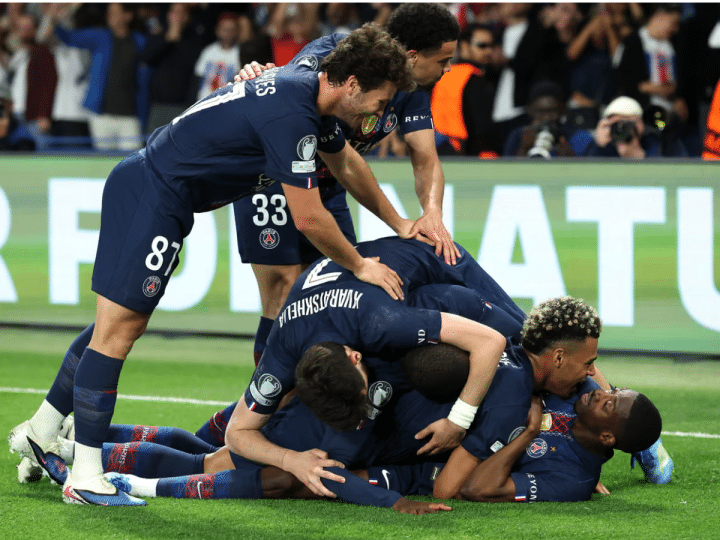

Paris Saint-Germain (PSG) edged Bayern Munich 5-4 in a first-leg Champions League semi-final that delivered everything the fixture promised, plus more.
An electric pace, finishing and a tactical chess match that rarely settled into a defensive contest. The scoreline tells the crazy story, nine goals, momentum swings and a slender advantage for the holders to take to Munich next week.
How the PSG vs Bayern Munich match unfolded
Bayern struck first when Harry Kane converted a penalty in the 17th minute, but PSG responded quickly.
Khvicha Kvaratskhelia levelled with a high-quality strike before João Neves headed the hosts in front from a corner.
Michael Olise pulled Bayern level again just before half-time, and Ousmane Dembélé restored PSG’s lead from the spot in stoppage time to make it 3-2 at the break.
The second half began in similar fashion, Kvaratskhelia and Dembélé scored within minutes to push PSG 5-2 ahead, only for Bayern to rally with headers from Dayot Upamecano and a Luis Díaz finish that reduced the deficit to 5-4.
What mattered?
Clinical finishing.
PSG scored with all five of their shots on target, an efficiency rarely seen at this level and a decisive factor in a game where both defences were stretched.
And big-game players really delivered.
In this game, Dembélé and Kvaratskhelia both scored twice, carrying PSG’s attacking threat through moments when Bayern looked set to dominate. Harry Kane’s penalty underlined Bayern’s threat, but the German side were repeatedly undone by quick transitions and individual moments of quality.
VAR and fine margins for PSG and Bayern
The match featured a contentious stoppage-time penalty for PSG after a VAR review. A later VAR check that allowed Díaz’s goal to stand after an initial offside flag was also overturned.
Those marginal decisions shaped the scoreboard and the tactical choices both managers will make ahead of the return leg.
Tactical takeaways
Luis Enrique set PSG up to attack and to invite moments of chaos. The plan worked because PSG’s forwards were sharper and more decisive in the final third.
Bayern, coached to press and probe, created chances but were vulnerable to quick counters and set-piece moments, the route by which Neves scored.
Both teams showed an appetite to win rather than to protect a result, which explains the open nature of the game and the high goal count.
Attack vs defence
Defensively, neither side can be absolved. There were positional lapses and moments of poor concentration, but the quality of the goals, long-range strikes, well-worked finishes and clinical headers, suggests this was as much about attacking excellence as defensive failure.
That context matters when assessing how the tie might play out in Munich. It has all the ingredients for another goal fest.
View this post on Instagram
What does this mean for the tie?
PSG take a one-goal lead to the Allianz Arena. In isolation that is not decisive.
Bayern showed they can score away from home and will be confident of overturning a single-goal deficit in front of their crowd. But PSG’s five goals in Paris give them a psychological edge and force Bayern to balance attack with caution in the return.
If Bayern score twice in Munich, the tie will be wide open. If PSG can nick an early goal, the pressure on Bayern increases significantly.
Players to watch in the return leg
- Ousmane Dembélé — He proves how decisive he is in the final third and how comfortable he is taking responsibility in big moments.
- Khvicha Kvaratskhelia — The timings of his two goals underline how dangerous he is in transition. When given space on the flank, he is able to change the dynamics of a game in an instant.
- Harry Kane — He is still Bayern’s focal point, as he has been for most of this season. Kane’s penalty and general ball movement will be central to Bayern’s plan to unsettle PSG. The fourth goal scored by Diaz was created by a killer pass from Kane.
The final verdict?
This was not a football match that will be remembered for defensive masterclasses, but it will be remembered for entertainment and for the way both teams committed to attack.
PSG leave Paris with a lead that is valuable but fragile. Bayern leave with belief that the tie is far from over.
The second leg promises to be tactical, intense and, given what we saw in Paris, likely to produce more goals. For neutral observers, that is exactly the kind of semi-final football the Champions League exists to provide.
An exciting potential awaits us in the second leg. If five goals are scored in the return leg, this tie would set a new record for the highest-scoring Champions League knockout tie in history.
Featured image via Getty Images/ Alexander Hassenstein
By Faz Ali

Armed police called to ‘man with knife’ on Spennymoor street

Opinion: Business may need to pick up the tab

Canada Proposes Crypto ATM Ban to Tackle Scams, Money Laundering

Manchester United reach agreement with Casemiro over contract clause amid transfer speculation

US brings back mandatory military draft registration

Steven Gerrard disagrees with Gary Neville over ‘shock’ Chelsea and Arsenal claim | Football

The Importance of Financial Education I Robert Kiyosaki

Mpokket se kaise loan le |M pocket money loan app se loan kaise le – Mpokket se loan kaise le – Loan

Revanthreddy Serious on govt officers | State financial ststus Down | Signal tv telugu
-

 Tech2 days ago
Register Renaming | Hackaday
-

 Fashion5 days ago
Weekend Open Thread – Corporette.com
-
 Crypto World4 days ago
Hyperliquid $HYPE Rally Builds Momentum as AI Sector Enters Prove-It Phase
-

 Politics7 days ago
Making troops accountable for war crimes threatens US alliance, ex-SAS colonel warns
-

 Politics7 days ago
Disabled people challenge government SEND proposals over segregation concerns
-

 Business5 days ago
Patterson-UTI Energy, Inc. (PTEN) Q1 2026 Earnings Call Transcript
-
 Sports3 days ago
IPL 2026: Ruturaj Gaikwad registers slowest fifty of the season, enters all-time unwanted list | Cricket News
-

 Politics2 days ago
Drax board avoid their own AGM, accused of greenwashing & environmental racism
-

 Politics7 days ago
Zack Polanski responds to home secretary’s taser threat
-

 Politics7 days ago
Starmer handler McSweeney to be dragged from shadows by Foreign Affairs Committee
-
Politics7 days ago
Wings Over Scotland | How To Get Away With Crimes
-

 Politics7 days ago
‘Iran is still a nuclear threat’
-

 NewsBeat3 days ago
LK Bennett closes all stores after entering administration
-
 Sports6 days ago
Tim Bradley names the current best in the world: “Better than Inoue and Usyk”
-

 Crypto World5 days ago
Michael Saylor says BTC winter is over. Market analyst disagrees, says bitcoin was in a pullback
-
 Entertainment4 days ago
Mariah Carey Slams Deposition Claims In Brother’s Lawsuit
-
Business6 days ago
Altimmune prices $225 million public offering at $3 per share
-
Entertainment6 days ago
Michael B. Jordan and Austin Butler's “Miami Vice” movie will bring the action back to the '80s
-
 NewsBeat5 days ago
Trump threatens to review UK’s claim to Falkland Islands and punish Nato allies over Iran war disagreement
-
Crypto World6 days ago
Is Algorand One of the Few Quantum-Resistant Blockchains? Here’s What the Data Shows
You must be logged in to post a comment Login