Politics
The House | The Hunt To Uncover The History Of A Mysterious Old Parliamentary Board Game


5 min read
After chancing upon an old parliamentary board game, Daniel Brittain persuaded two hereditary peers to join battle
There was something about it that wasn’t quite like the other chess boards piled in a corner as if hiding. It was the day after Boxing Day and I was idling in a favourite shop in the town of Corbridge, between Newcastle and Hexham. With little else to do, I investigated and so stumbled on an artefact at once trivial and timely. For instead of the regulation black and white squares, this board carried slogans such as One Man One Vote, Home Rule and Abolition of the Lords.
What was this? The front of the board proclaimed it to be House of Commons – The New Parliamentary Game. New it might once have been: the packaging suggested that it had not been new for at least a century.
Delight at unearthing this piece of parliamentary ephemera was tempered by the fact that were no playing pieces – and no rules. Further investigation was needed. I handed over my £3 and embarked on the quest.
The first point of inquiry after the Christmas recess was Patrick Vollmer, chief librarian of the Lords. Did this game exist in the parliamentary archives, a virgin copy kept in one of its vaults?
No, but he did pass on some leads to chase. A website for board game geeks gave the rules (extraordinarily complicated), and more surprisingly a link to the Bodleian Library, surely the repository of historic and valuable manuscripts? True, but also it turns out the home of 1,600 games and pastimes gifted this century. And there it was, on the Bodleian website, a photo of five of the eight required playing pieces, featuring pictures of prominent Liberal and Conservative MPs and peers from the game’s 1896 creation.
Jo Maddocks, the Bodleian’s curator of ephemera invited us (my wife Clare had by now joined the quest) up to Oxford to take a look, where we discovered that although the library has some of the playing pieces it doesn’t possess the rules or the board. We reunited them all for photos. Asquith, Campbell-Bannerman, Rosebery, Devonshire and Chamberlain re-emerged into the limelight. Turned out we were the first people to have requested a view.
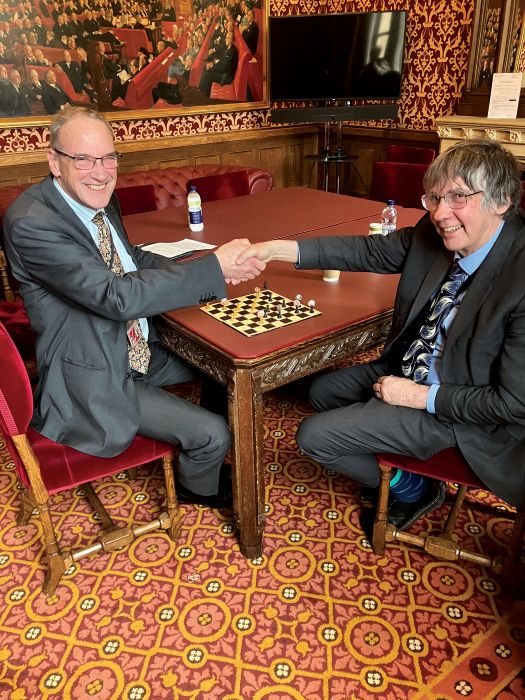

Back in Parliament, a plan was hatched to play the game, possibly for the first time in 100 years. Given that ‘Abolition of the Lords’ (in its all hereditary form) is one of the squares on the board, two hereditaries were my obvious target.
While Clare brilliantly copied the Bodleian pieces and made the required additional three, I went on the trail of game hereditary peers. Fortuitously, the Earl of Clancarty was enthusiastic, and he was about to meet up with the Earl of Lytton. A brace of earls, result!
A week later we gathered in one of the splendid rooms formerly part of the Lord Chancellor’s flat. For Lord Lytton, Parliament’s foremost expert on Planning and Building law, it was a special day (his last in the Lords), having decided a year ago to retire at 75. The minister, Baroness Taylor of Stevenage, had paid tribute to him. Opposite: Lord Clancarty a prominent champion of the arts and the creative industries. He’s just discovered that he is to be one of the few outgoing hereditaries to receive a life peerage. Both crossbenchers, Lord Clancarty gamely took the governing Tories’ side, Lord Lytton the opposition Liberals. Shaking hands, the game commenced.
Poor old backbench pawns move just one square at a time
Of course, the object of the game is for the government to pass acts on the subjects depicted on the board by landing a player on each of the two similarly named squares. The opposition’s job is to prevent that. According to the rules, the PM and what the board refers to as the Chief Opposition Spokesman can move in all directions across the board, while his cabinet and their shadows (a term formalised in the 1920s) rather fewer. Poor old backbench pawns move just one square at a time.
Let battle commence. First bill? Abolition of the Lords of course. Lord Lytton scored an early victory in saving the House; on the rematch Lord Clancarty got it abolished. Soon a whole radical manifesto was laid before them: licensing laws, payment of MPs, Home Rule, disestablishment and voting rights. It’s a fun game, perhaps the parliamentary shops should bring out a new edition?
Having reached an honourable draw, the two earls went their way. Lord Clancarty to a meeting, Lord Lytton heading off for a last stint in the Chamber, say his goodbyes and clear his desk after some 30 years. As the politician playing pieces were packed away, I noticed that all the measures on the board have been tackled since the game’s creation. All except one: Disestablishment of the Church of England. That thorny question has even managed to outlive the hereditaries in the House of Lords.

You must be logged in to post a comment Login