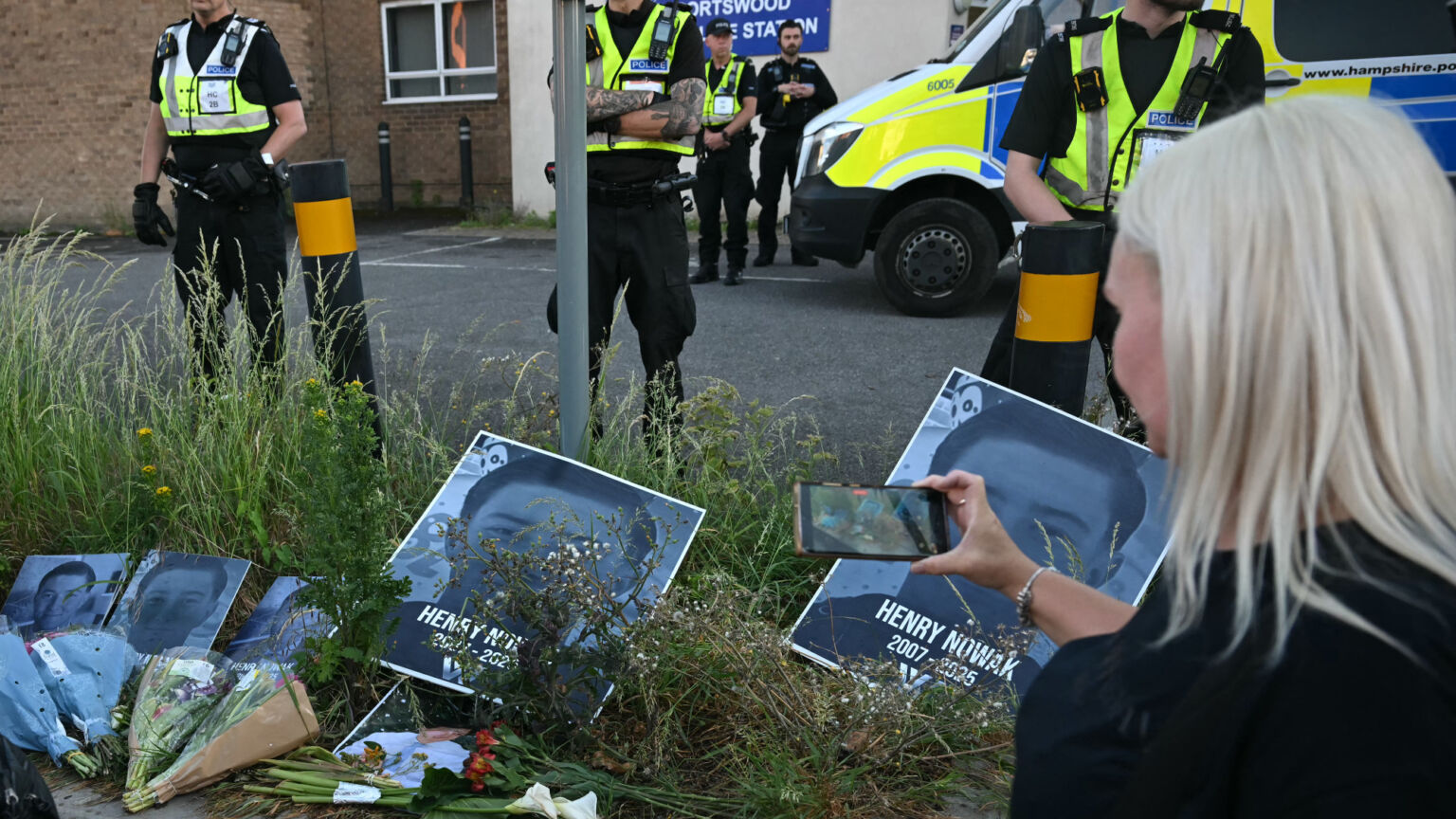
‘I don’t think you have, mate.’ These were the words of the unidentified policeman who disbelieved the dying Henry Nowak when the boy told him that he had been stabbed. Every innocent word when added to the others is vile, but for me the ‘mate’ stands out – there’s the whole stinking world of contemptuous DEI-fuelled murderous smugness in it.
Not since Sadiq Khan’s ‘Say Maaate To A Mate’ campaign of 2023 has this pleasant, everyday word sounded so atrociously inauthentic. You remember that one. If one young man says something sexist / sexy (shades of Spinal Tap’s poor bemused Nigel), then it’s the social responsibility of his ‘maaates’ to call him out on it. Along with this went untold public money spent on posters informing the innocent Tube-taker that cat-calling is an offence and that ‘Intrusive staring of a sexual nature is sexual harassment and will not be tolerated’. There were even sexy – sorry, old habits die hard – plain-clothes policewomen allegedly spotted in Redbridge, Surrey, hoping to ‘finger’ any louts daft enough to call them darlin’. And where has all this look-after-our-laydees palaver led us to? A judge letting three teenage gang-rapists go free last month, after telling them how well they had behaved – in court, if not towards the terrified girls, aged 14 and 15, whose lives they ruined.
But the ‘mate’ directed at Henry Nowak was a whole other level of wrong – sinister, not silly. We knew that the whole ruling regime was rotten. Even despite the endless policing of, arresting over and jailing for social-media posts, some of us free-speech maniacs had maintained a belief that the police force, being mostly of working-class origin, hadn’t really swallowed the excrement of wokeness. Now it appears that like a lot of hirelings of feudal lords, they’re even keener to carry out orders than their masters are to issue them. After all, what is the modern police force but muscle to protect the liberal establishment? Hence their frequent lack of anything approaching interest in solving crimes that happen to ordinary people.
Advertisement
Of course, some people join the police because they want to help people, and to see justice done. It’s important to say that a lot of us, including me, would never have the guts for this career. But increasingly one feels that the kind who wanted to wear scary uniforms and have the power to push others around are coming to the fore. This has always been the situation as regards sexual perverts, I’d guess. Met officer David Carrick committed 48 rapes over 17 years, while Wayne Couzens, killer of Sarah Everard, was affectionately known as ‘The Rapist’ by his Civil Nuclear Constabulary colleagues prior to being hired by the Met.
But these were old-fashioned monsters. With the new kind of callous functionary, wokeness (sorry, but there’s no better word) gives them the cloak of invisibility, whether it’s ‘protecting’ transvestites from feminists whose faces got in the way of their meaty fists or ‘protecting’ bogus victims of racism, like Vickrum Digwa, who played the race card to deflect from his murder of young Henry.
Advertisement
Once more that quote from Huxley’s Crome Yellow comes to mind, as it does with increasing frequency:
‘The surest way to work up a crusade in favour of some good cause is to promise people they will have a chance of maltreating someone. To be able to destroy with good conscience, to be able to behave badly and call your bad behaviour “righteous indignation” – this is the height of psychological luxury, the most delicious of moral treats.’
It’s funny to think of what those nutters who want to abolish the police – the ‘anti-carceral’ lot – must be feeling now. Quite confused, I’d wager. Are the police their friends now that they’ve adopted the crazed woke idea that being colourblind is wrong, and that the pure-hearted POC should always be believed over the inherently evil gammon? Or are the cops still lackeys of the ruling class? My own feelings about them change on a regular basis; personal experience generally good, high-profile cases jaw-droppingly generally awful. Like the old joke about prison food, they’re rubbish – and there’s not enough of them.
Advertisement
The police seem such an integral part of society that it’s strange to think that they’ve only existed for a relatively short time as we know them. In the 18th century, communities policed themselves with constables and night watchmen. No doubt the anti-carceral mob would consider this a desirable state of affairs, but it seems even more open to corruption than the current arrangement.
Who can forget the creepy alliance between the police and local mosques when ‘community leaders’ appeared to be calling the tune in Stoke-on-Trent in 2024, as a video emerged showing a police liaison officer telling a group of recently rioting young Muslims:
Advertisement
‘If there are any weapons or anything like that, then what I would do is discard them at the mosque. Don’t give anybody any reason to have any interaction with police. So if there are any weapons, get rid of them and we won’t have to arrest anyone.’
Letting ‘elders’ call the tune seems a sure way to mayhem – and imagine if white people tried it! ‘Okay boys, stand at ease – the Bowls Team have got the white youngsters calmed down. Nothing to see here!’
Then there was the time that a creepy West Midlands policeman insisted on opening and closing his address to offended Muslims with Arabic phrases. I do hope one of them takes the trouble to learn a few words of Hebrew next time the Jewish community are genuinely terrified. Probably not, though, the Jews being so well behaved. It’s the squeaky wheel that gets the oil. Or in this case, the oily copper.
Advertisement
Oh, for the old days before DEI, when cut-purses and grave-robbers roamed the land, and public executions were a regular weekend entertainment! Even by the start of the 19th century the population of London – one and a half million – were policed by 450 constables and 4,500 night watchmen. Then came the home secretary Robert Peel’s Metropolitan Police Act of 1829 and the police force as we know it was born. We’ve been through a few changes since then; the ones in popular culture are interesting. From the avuncular Dixon of Dock Green to the hard rotters of The Sweeney, we’ve somehow managed to keep believing that the British police are ‘the best in the world’ – an actual line from the Tom Robinson Band’s ‘Glad To Be Gay’ sung ironically, going on to detail how the British bobby is keen on ‘raiding our pubs for no reason at all / Lining the customers up by the wall / Picking out people, knocking them down / Resisting arrest as they’re kicked on the ground / Searching their houses, calling them queer.’
How much life has changed since the 1970s! Now, police dance gaily with barely-clothed fetish gimps at Pride parades, looking askance at any women who complain about children being present – and ‘queer’ is a compliment, one that many straight people adopt in an effort to appear cool. But of course this cleaving to queerness on the part of the police may well yet pose comical problems when it comes up against their slavish behaviour towards Islam, as detailed above and also seen both in the arresting of a man for being ‘openly Jewish’ and therefore potentially upsetting to a pro-Palestinian march, and in fabricating evidence against Maccabi Tel Aviv in order to ban their fans from Birmingham – the West Midlands police chief later blaming AI, of all the pathetic excuses.
And of course the terrible rapes of thousands of teenage children and girls by gangs of predominantly Pakistani Muslim men, which took place with the collusion of numerous police forces, some of whom ignored their horrific complaints and wrote them off as ‘slags’. White working-class girls are slags, white working-class boys are ‘mate’ – but they still count for nothing when the chance to get DEI brownie-points comes along. That Islam is the fastest growing religion in the world suggests that the fuzz are limbering up to serve their next masters as they see the power of the stale, pale kind receding. With such divided loyalties between the ‘queer community’ and Islamism, it would be amusing to see whose side they took now, should the incident from 2006 take place when Sir Iqbal Sacranie opined that homosexuality was a sin, and was promptly investigated by the cops.
Advertisement
What’s the worst crime that can be committed in the cause of DEI? The judge who let off the Traveller rapists of those teenagers was streets ahead when it came to who could win a prize for the most vile behaviour in the name of brotherly love. But those police officers who treated a dying young man like a lying nuisance in the name of being anti-racist are perhaps even worse – and calling him ‘mate’ as they did so was the chef’s kiss of utter and complete moral degradation on behalf of those who should have been helping him. Never mind, though – there’s bound to be something even worse a short way down the road, as the Danse Macabre of identity politics leads us towards something that looks very much like a civil war.
Julie Burchill is a spiked columnist. Follow her Substack, ‘Notes from the Naughty Step’, here.
We hope you love the products we recommend! All of them were independently selected by our editors. Just so you know, HuffPost UK may collect a share of sales or other compensation from the links on this page if you decide to shop from them. Oh, and FYI — prices are accurate and items in stock as of time of publication.
Shopping for a new baby can be overwhelming. There are so many products out there, most of them claiming that they are an absolute ‘essential’ for new parents.
But that can’t possibly be true; while we’re not one to knock buying products that make your life easier, we survived without app-controlled bottle warmers for years.
“With so many baby products available, it can be difficult to know where to begin,” says Hamish McPhillips, head of category management at Silver Cross.
Advertisement
To help you sort the fact of parenting essentials you need from the fiction, we’ve consulted him for a round-up of new baby essentials.
Newborn baby essentials checklist
Car seat
“Start with a car seat, as it’s the one item you’ll need from day one,” says McPhillips.
Advertisement
“If budget allows, opt for a rotating infant carrier with a lie-flat function. 360-degree rotating car seats are ideal for getting your baby in and out of the car hassle-free, while a lie-flat position offers greater comfort and support for newborns.”
Best car seats to shop
Celeb-approved travel cot
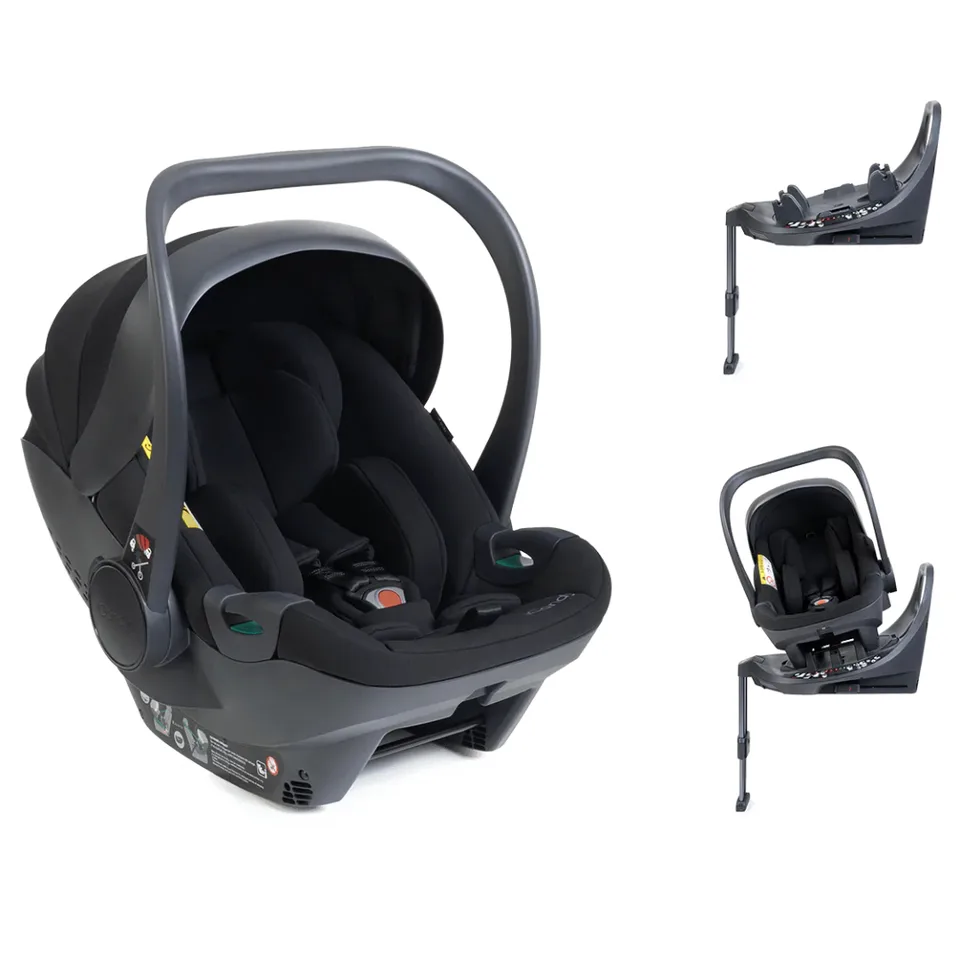
If you’re looking for a seat that you can bring them home from the hospital in, this one from iCandy has been safety tested to make it suitable for babies from birth.
Not only is the headrest fully adjustable, but the sides have added ventilation to ensure safety for newborns.
Advertisement
It also comes with a 360 base, meaning it makes getting your little one in and out of the car a breeze, and comes with a foldable support leg so you can easily store it when you’re not in transit.
Child fit: 40 to 87 cm/ 3 months to 12 years Weight limit: Up to 13kg Seat weight: 11kg with base Dimensions: 68 x 44 x 34kg Safety: i-Size (R129)
Most comfortable
Designed to keep your child safe and comfortable until they no longer need a car seat, the Maxi-Cosi Pearl can be used until they’re 12 years old.
The newborn inlay accessory means you can use it from birth, but when they’re four you can easily switch to booster mode, which features an adjustable headrest.
Advertisement
No matter their age, its 360 degree rotation allows you to quickly get them in and out of the car – because you don’t need another thing slowing you down when you’re trying to leave the house.
But that’s not the only feature that prioritises comfort: the seat is lined with ClimaFlow fabrics, which maintains optimal airflow throughout the seasons.
Of course, safety is key, so it also uses a G-CELL structure to spread impact and reduce injuries should you get into any accidents.
Child fit: 61 to 150cm/ 3 months to 12 years Weight limit: Up to 36kg Seat weight: 8.2kg Dimensions: Rearwards facing, 51-55 x 44 x 70-74cm. Forwards facing, 63-81 x 44 x 67-77cm Safety: R129/04
Advertisement
Most affordable car seat
As well as coming in at less than £100, this car seat takes an entire step out of your travelling routine as you can simply snap it into place in your pushchair – all without an adaptor.
Using a three-point harness, it makes sure your kid is both comfortable and safe. Joie has made it from machine-washable covers, which means you won’t have to worry about any unfortunate spillages, and it’s also included a sun canopy for extra protection when it’s bright outside.
Child fit: 40 to 75 cm/ up to 12 months Weight limit: Up to 13 kg Seat weight: 2.96 kg Dimensions: 56 x 39 x 68 cm Safety: ECE R129/03 and i-Size
Best for lying flat
This versatile car seat means your baby can get their snooze in no matter where they are, thanks to the fact it lies completely flat.
Advertisement
So you can get your child out of the car quicker than you can say ‘pebble’, the seat also comes with a SLIDETECH 2 base that slides the seat out 27cm and 90 degrees so you can reach them without having to strain. Not to mention that it also comes with a 360° FlexiSpin rotation system that lets you twist it with just one hand for extra easy access.
Pebble also comes with a large attached canopy, which uses UPF50+ protection to keep them protected from the sun, wind, and rain. Like the Pearl, the structure is designed to reduce impact and keep your baby secure with the three-point harness.
Child fit: 40-87cm, 0-24 months Weight limit: Up to 13 kg Seat weight: 3.9kg + 8.1kg base Dimensions: 63.2 x 43.2 x 75cm with base Safety: R129/04
Best convertible car seat
Forget about clicking your car seat into your pushchair, what if it actually was one, too? Well, if that’s your dream it’s your lucky day, because this one from Doona folds out into a stroller in seconds – ideal for when you’re on the go or don’t want to wake them from their slumber.
Advertisement
The seat itself comes with three recline positions, so they can lie down in any which situation (dreamy). Although it can only be used in recline position, it comes with an add-on accessory that helps protect against impact.
Child fit: 40-85 cm Weight limit: Up to 13 kg Seat weight: 8.3kg Dimensions: 72 × 44 × 46 cm as car seat, 89 x 44 x 101cm as stroller Safety: R129/04, EN1888, EN12790, TUV (EU)
Pushchair
“The second essential is your wheels,” says McPhillips. “Consider the type of lifestyle you have and how you’ll use your pushchair in your daily routine. Will you be walking around town every day, tackling country paths, or travelling frequently with your growing family?”
Advertisement
It’s also worth considering a pushchair that is compatible with car seats and other kind of travel.
“Many brands offer travel systems that pair with their car seats, which can be a great option for added convenience and value for money,” adds McPhillips.
“I would definitely recommend looking out for carrycots that are approved for overnight sleeping too, making naps on the go and overnight stays much easier.”
Best pushchairs to shop
Advertisement
Best for growing families
Whether you’re adding to your family, or planning on growing it in the future, this stroller from Momcozy will expand with you.
With 23 configurations to choose from, you can assemble it however you like to accommodate an only child, siblings or twins.
It comes with a bassinet, which can be used for a second child, or switched out for the seat for newborns. Plus, the bottom can be used as a wagon for older kids, so you’re not constantly having to herd children through busy streets.
Designed for strolling on any kind of terrain, it comes with a high-performing suspension system so they don’t feel bumps in the road. And, Momcozy has made sure it’s comfortable for parents too, as the handle bar adjusts to any height for optimum positioning as you push.
Advertisement
Despite promising big, it also folds extremely small, which makes it ideal for travel, too.
In the box: Bassinet, toddler seat, detachable canopy, bumper bar, front wheels, rear wheels, rain cover, travel bag Dimensions: 92 to 109.5 x90 x 49cm.
Best pushchair bundle
Don’t want to have to worry about different brands of pushchair and car seat connecting?
So you can cross multiple things off your list at once, iCandy has created this pushchair bundle, which comes with every accessory under the sun.
Advertisement
The pushchair is compatible with 14 different car seats, so you can move your baby out of the car while they’re snoozing, and it can also easily be converted into a double pushchair with the addition of the bassinet.
Also included are a raincover, screen, seat liner, changing bag, cup holder, seat liner, and all the clamps and converters you need – but if you don’t want all of that, there are plenty of other bundle potentials to choose from.
In the box: Raincover, screen, elevator Adaptors, car seat adaptors, footmuff and seat liner, changing bag, parasol, cup holder, clamp, and the iCandy Cocoon 360 Infant Car Seat and Base Dimensions: 77 × 61 × 96 cm
Best for on the go
If the idea of messing around with folding your pushchair for minutes on end every time you get in the car or on a plane doesn’t sound appealing to you, this stroller has you covered.
Advertisement
It has a one-hand fold, which will add hours back on to your life (or it’ll feel like it) while the suspension is designed specifically to respond to stops and starts around the city.
If that wasn’t enough for you, it’s also eco-friendly, as it’s made from bio based materials that reduce its carbon footprint by up to 21% – all while staying UPF protecting so your babe is sun safe.
In the box: Pushchair Dimensions: 106cm x 52cm x 104cm
Crib
Advertisement
“Bedside cribs are great option for the first few months, allowing your baby to sleep safely alongside you while making the night-time feeds much easier for you and your baby,” McPhillips says.
“When planning your nursery, it’s definitely worth investing in nursery furniture that grows with your child. Convertible cots that transform into toddler beds are always a good option, supporting your child from birth through to their early years while creating a consistent sleep environment.”
Best bedside and convertible cots to shop now
Best convertible bed
Honestly, tying to get rid of furniture is a nightmare – how are you supposed to buy a new bed when you can’t get rid of your old one?!
Advertisement
To eliminate that problem entirely, Stokke has come up with a bed that converts with your child as they grow. Starting as a bedside newborn crib, the mattress height adjusts as they get bigger, and is suitable all the way up to five years old.
Whether they’re sleeping next to you or in another room, the crib can be moved around thanks to the addition of swivel wheels, so you won’t have to rely on friends and family to relocate your little one.
Dimensions: 65 x 78 x 85cm minimum; 125 x 78 x 85cm maximum Age suitability: 0-5 years old.
Best travel cot
Some cots need to be strapped to your bed, which can get annoying when you’re trying to move the cot around the house with you so your baby can never be out of sight.
Advertisement
Not this one, though. As well as being freestanding, the sides drop down so you have quick and easy access to your baby (yep, even when you’re recovering from a C-section).
The side panels are made of mesh, so you can also keep a watchful eye on them as they sleep, and it even folds into a travel bag so you never have to be without it.
Dimensions: 98 x 61.5 x 72 to 82.5cm Age suitability: 0 to 6 months.
Nursing chair
Advertisement
“A comfortable nursing chair is another purchase many parents find themselves grateful for,” McPhillips says.
“You’ll spend countless hours feeding, soothing and settling your baby during those early months, so having a comfortable place to sit can make a real difference to everyday parenting life.”
Best nursing chairs to shop
Most stylish nursing chair
This stylish chair is designed to be as comfortable for the feeder as it is practical. As well as coming in a soft teddy texture, the chair sits atop a rocking base, for added soothing while your baby feeds.
Advertisement
The arms sit at the optimum height for feeding, so you might nod off to sleep with how comfy you are. You can even add a matching footstool if you like, but be warned: you’ll never want to leave.
Best budget alternative
If investing in a whole nursing chair sounds like a step too far for you, this pillow from Momcozy is a happy medium.
Made from 100% safe memory foam, it’s supportive of your baby while they’re feeding, and it’ll also stop any uncomfortable arm strain you have.
Plus, it expands with your baby, so you won’t have to worry about supporting extra weight as they grow.
Advertisement
High chair
“While we often think of highchairs as something for later, many modern designs can be used from birth with lie-flat newborn attachments and adapt as your child grows,” McPhillips explains. “Introducing your baby to family mealtimes from an early age can help encourage interaction, routine and social development.”
Best convertible high chair
Meal time is family time, so there’s no reason a high chair can’t be a seat for anyone. At least, if you ask Stokke it would say so, because it’s made this high chair than be converted from baby chair through to an adult one so it fits all the family.
The included newborn set means you can have your baby sit with you at the table from birth, and then switch out to the baby set as they grow. Remove the high chair layer and you’ll have a sturdy seat for a toddler, and it’s even the right depth and height to support a fully grown adult.
Advertisement
While this one comes in a natural beech finish, there are plenty of other colours to choose from, and you can add engraving so it becomes an heirloom you pass down through the generations. Sweet!
Best high chair bundle
Should you not be the type for shopping (can’t relate), this bundle kills two birds with one stone as you’ll get both a baby bouncer and high chair in one.
With a wipe-down seat, washable seat pads, and one-hand fold, getting your baby set up and for meal time takes mere seconds.
The height of the seat is completely adjustable, and the meal tray is removable, so it can adjust to your toddler’s needs at they grow.
Advertisement
Plus, the set comes with an anti-slip floor mat, so you can rest assured that they’re safe and sound whether they’re in the bouncer or in the chair.
Travel stroller
“Although not an immediate essential, it’s also worth planning ahead for a compact travel stroller if you expect to take holidays or weekend trips during your baby’s first year,” suggests McPhillips.
“Look for something lightweight, easy to fold and sturdy enough to cope with everyday adventures.”
Advertisement
What to consider when shopping for a new baby
As well as the size, weight, and age suitability – not to mention style – there are a few things to be mindful of when shopping as new parents.
Compatibility
If you’re shopping for a car seat, you’ll need to make sure you check whether it’s compatible with your car model, McPhillips explains.
Advertisement
“Your car seat is arguably the most important purchase you’ll make, so it’s essential to ensure it’s compatible with your car and installed correctly,” he says.
“Where possible, visit an independent nursery specialist and have the car seat fitted before you buy. Specialist retailers offer bespoke, tailored advice based on your family’s lifestyle, vehicle and daily routine.
“They can carry out car seat fitting demonstrations and check compatibility. It’s always a good idea to spend some time practicising fitting your car seat yourself ahead of time too to help you feel confident.”
Safety
Advertisement
Of course, car seat compatibility is important because it ensures your baby stays safe.
Safety should be the number one consideration across everything you buy, according to McPhillips.
“It’s also key to be aware of independent safety ratings, such as ADAC, which provide some of the most respected crash-test tests available and can help parents compare the safety performance of different car seats,” he explains.
“Look for trusted sleep brands with long-standing reputation for safety and quality, and products that have undergone rigorous testing for peace of mind.
Advertisement
“If you’re considering purchasing a carrycot for daytime naps or overnight sleeping, ensure it is approved for overnight sleep and has been specifically designed for this purpose. A firm, flat mattress, good airflow and breathable materials are all essential elements of a safe sleep environment for a newborn.”
In general, the fabric that comes into direct contact with your baby should be soft and breathable (like bamboo), McPhillips says. UPF 50+ protection can also be useful to protect your child from the sun.
Longevity
“Longevity is another key consideration when it comes to value for money,” McPhillips says. “Where you can, opt for car seats and nursery furniture that can be adjusted and converted as your baby grows.”
Advertisement
Test
“Most importantly, I always encourage expectant parents to take the opportunity to test products in person,” he adds.
“Fold and unfold the pushchair, practice fitting the car seat, and ask plenty of questions. While online research is useful, it can’t be compared to hands-on experience and expert guidance offered by a trusted independent nursery specialist.”
Mamas and Papas personal shopping
Advertisement
If you’re not sure where to begin, Mamas and Papas offers a free personal shopping experience.
With over 40 years of baby and child product expertise, its experts can offer guidance on what to buy in store, so you can ditch the registry and get a discount on your next shop.
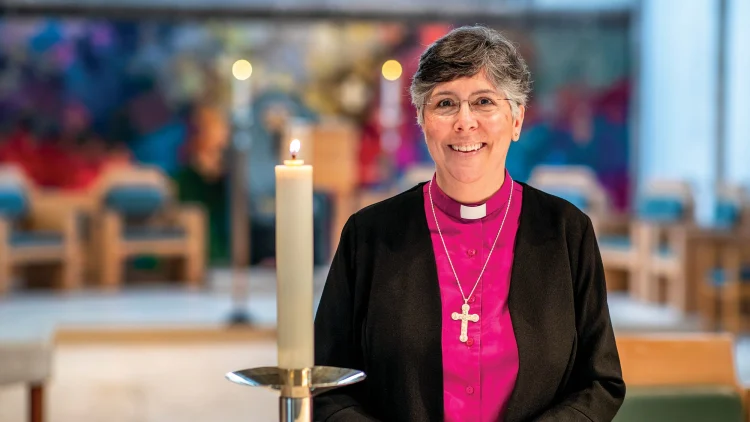
Guli Francis-Dehqani, the Bishop of Chelmsford, pays tribute to her parents’ remarkable bravery as Christians in Iran and how they found themselves, at last, no longer strangers but ‘fellow citizens with the saints’
Advertisement
I was born in Iran. My father was from a village called Taft, and had the opportunity, as a child, to be educated by British missionaries some 200 miles away in Isfahan. During term-time he would go away to school, and in the holidays would return to his Muslim family. Eventually at 18, he chose to be baptised as a Christian, but always retained a profound respect for Islam.
By the time I was born, he was bishop of the small Anglican church in Iran. He’d married my mother, the daughter of British missionaries, herself born and raised in Iran.
Then the revolution came. My father was very much in favour of change, and voted for the Islamic Republic on the proviso that it kept its promises of freedom and respect for all.
But very quickly our lives began to change.
The bishop’s house where we lived was ransacked, church institutions were confiscated or closed and financial assets frozen. My father was briefly imprisoned and then there was an attempt on his life. In the early hours of the morning in late October 1979, two gunmen broke into the house, clambered over the walls, and found their way to my parents’ bedroom. They were asleep in bed so they called him by his name and fired five bullets. Extraordinarily, they missed. My mother was shot. She threw herself over him…It was just instinctive for her to protect him. So she was injured, but he survived.
Advertisement
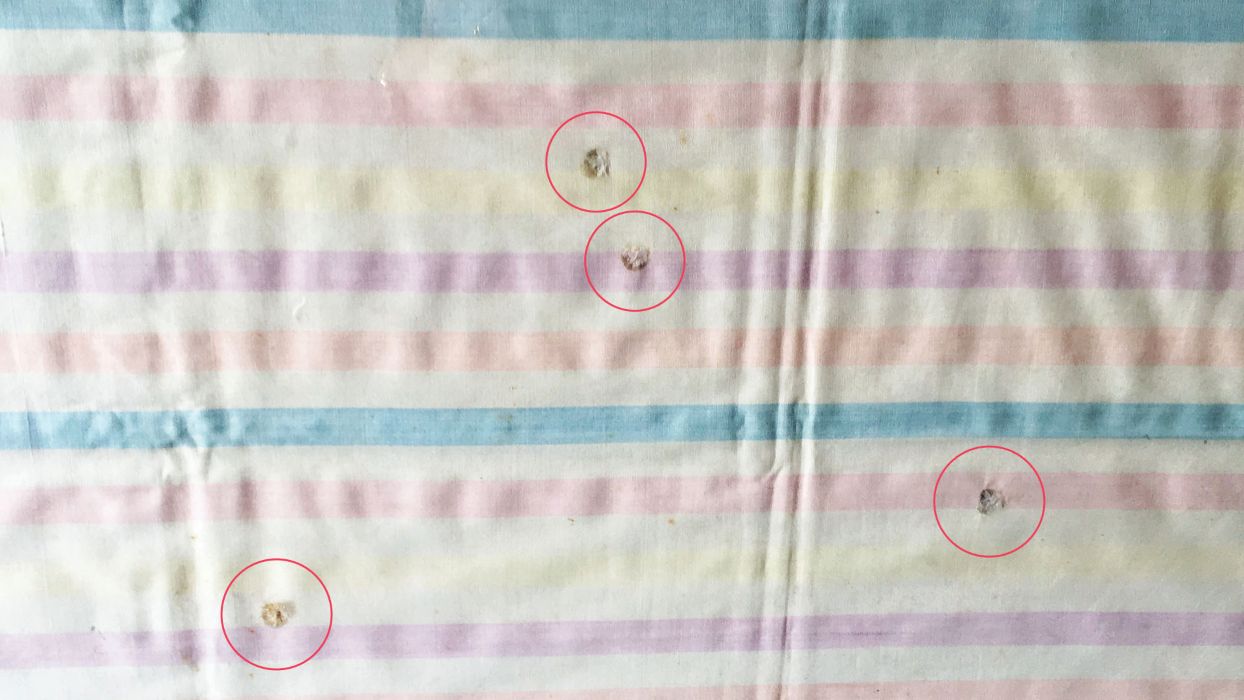
His pillowcase, with bullet holes in it, is an extraordinary thing. I don’t know why my mother brought it to the UK, but she did and I’ve now inherited it.
You can see what looks like a halo of bullet holes. You can see where my father’s head would have been and the bullet holes around it.
While my father was out of the country for meetings, the situation got a lot worse in Iran.
My father was advised not to return for the time being.
Advertisement
And then my brother was murdered. He was 24. No one was ever brought to justice. We’ve always understood that he was a scapegoat for our father, that really they had no interest in him. Possibly they thought my father would come back for the funeral; possibly it was an act of revenge. But at that point, the rest of us left to be with my father, after we’d buried my brother, assuming we’d be back home within a few months.
You can see where my father’s head would have been and the bullet holes around it
My father carried on as bishop in Iran in exile for about 10 years until his retirement. He very quickly realised he was going to have to practise what he’d preached for many years about reconciliation, about forgiveness, about all those things that trip off the tongue but when you have to live them are a different matter.
Advertisement
I, without realising it, observed how my parents chose to lean-in towards the way of forgiveness and looking for blessings rather than allowing themselves to become bitter. They were extraordinary. The pain never left. And yes, my father will have always had the feeling that if he’d gone back his son wouldn’t have been killed. But they never allowed the pain to become what defined them while they continued always in their calls for justice.
In our first year in England we were offered a vacant flat in Ridley Hall, a theological college in Cambridge.
I finished school and went to university and then went to work for BBC, and eventually I got married to a man from Northern Ireland. He was ordained a few years before me.
Now we are seeing Iran double down on those courageous people who came out onto the streets in December and January and again when President Donald Trump encouraged them to do so with the most recent war.
What we need is an effective resistance movement around which people can coalesce, which will eventually bring freedom.
Advertisement
Both my parents are buried in Winchester Cathedral and the words on my father’s grave are from St Paul’s letter to the Ephesians, “No longer stranger or sojourner but fellow citizen with the saints.” The verse speaks to his lifelong journey of wanting to find a place of belonging.
I recognise there are differences of opinion around whether bishops should be in the House of Lords.
My colleagues on the Lords Spiritual bench work incredibly hard, and I still find it extraordinary that somebody like me is in this House.
The Right Reverend Francis-Dehqani was interviewed by the Lord Speaker, Lord Forsyth of Drumlean, and is the latest guest on the Lord Speaker’s Corner Podcast, available wherever you get your podcasts
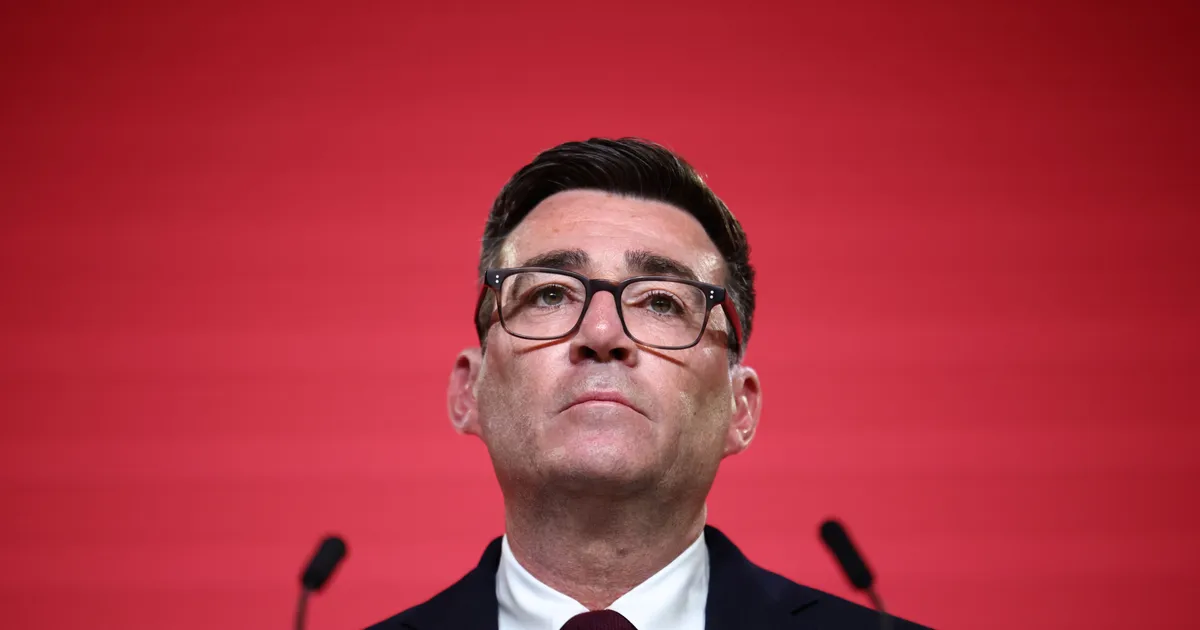
Andy Burnham will vow to give Britain “more breathing space” in his first speech outside 10 Downing Street as he takes office as prime minister.
The former mayor of Greater Manchester, who will become the seventh prime minister in just 10 years, is expected to call for honesty and reflection. Burnham’s address is set to focus on his priorities for restoring confidence in government.
The new prime minister will say that he is “acutely conscious” of being the seventh person to walk up Downing Street in the space of just 10 years, as part of a call for more stable and responsible politics.
Burnham will describe the moment as one of “reflection and resolution”, insisting Britain must be honest about the challenges.
Setting out his domestic priorities, Burnham will argue that political stability must deliver improvements in people’s lives.
Keir Starmer will give a final speech as prime minister at around 11:15am before his visit to the Buckingham Palace to formally tender his resignation. Burnham is then expected to address the nation outside No 10 before 1:00pm.
Starmer shared a three-minute video on social media over the weekend claiming he had left Britain in a better state than he found it. The outgoing prime minister pointed to achievements including his ongoing support for Ukraine, the Hillsborough Law, a social media ban for under-16s and action to save British Steel.
Starmer said: “I am so proud that we leave the country in a much better state than we found it two years ago, on the economy, on public services, on protection for children, on defence and security, and on our international reputation in particular.
Advertisement
“That’s the test for any prime minister: do you leave your country in a better place than you found it? And that test, and that answer, is a yes.”
Burnham was elected as Labour leader unopposed last week after a short contest confined to the parliamentary Labour Party (PLP) failed to produce a challenger. In the end, he secured a total 379 nominations out of a total 403 Labour MPs.
In his first speech as Labour leader, Burnham pledged to serve “people and places who have been waiting too long for politics to let them hope again.”
Addressing an audience of MPs, activists, trade union leaders and party grandees, Burnham further vowed to end Labour’s factional disputes, saying “we won’t beat Britain’s new right if we are consumed by infighting and pulling in different directions.” He referred to a “generation of politicians” who had failed to challenge “an economic model that simply doesn’t work well enough for ordinary people.”
Advertisement
Burnham declared: “Four decades of the neoliberalism that began in the 1980s have not been kind to the places that built our party, nor to the communities across the UK in rural and coastal areas. So we pledge today to them to be better.”
He added: “Political power was centralised and economic power was privatised. The country surrendered control of the essentials – housing, water, energy, transport – and left people exposed to higher costs…
“The right used the phrase ‘take back control’ – but they are the ones who gave it away in the first place.
“If we want an economy and a country that works for all people and places – which to me should always be at the very core of Labourism – then it requires a new path to the one we’ve been on for the last 40 years.”
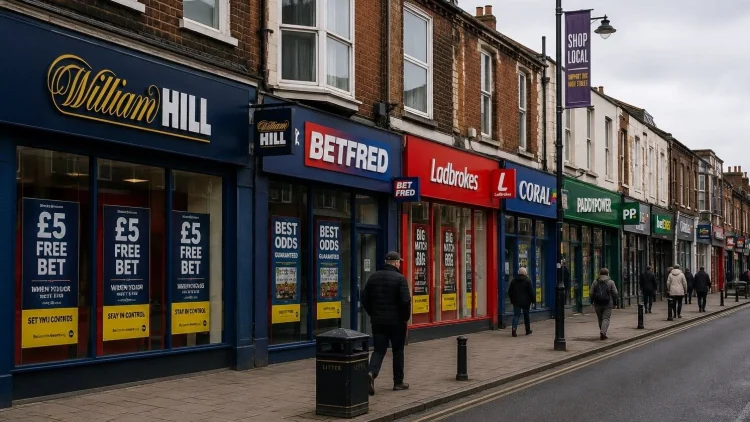
The Starmer administration thought that growing gambling was good economic policy. It is odds on that the Burnham team will not make the same mistake
The Labour Government has made economic growth its central mission, calling it “the only route to improving the prosperity of our country and the living standards of more people.” It has also launched a multi-billion pound Pride in Place strategy to create “safer, healthier neighbourhoods” by working with local communities. This commitment to localism has since been reinforced by the pledge of our new Prime Minister, Andy Burnham, for further devolution across the UK.
The gambling sector regularly claims that it benefits the economy. The Starmer administration often shared this narrative, for instance when gambling minister Baroness Twycross recently told the Lords Liaison Committee that the Government wanted to see the regulated sector grow. When Lord Filkin countered that there would no doubt be strong public support for tougher action on gambling advertising, the Baroness said: “I am not sure it is really my role to do just what the public thinks.” Public, take note.
Advertisement
However, Department for Culture, Media and Sport (DCMS) data shows gambling’s Gross Value Added (GVA) has fallen by 40 per cent in real terms since 2019, while the other sectors the department oversees have grown. Indeed, the evidence shows that the gambling sector adds relatively little to the economy, thereby limiting growth and productivity. This is particularly true for online gambling, with many sites offshore, which also imposes significant costs through gambling harm.
Venues with only gambling machines, commonly known as Adult Gaming Centres (AGCs), are spread unevenly across Britain and are concentrated in the most deprived areas. They often deceptively display the title “Casino” despite not holding casino licences.
Some AGCs and Bingo operations are in breach of the “80/20 rule”, whereby only 20 per cent of machines should be of the highest stakes category B machines, rather than the less dangerous category C and D ones. Some AGCs appear to inflate machine numbers by counting stacks of tablets (see below image) as gaming machines, allowing more Category B machines on site.
Advertisement
Campaigners argue tablets are being used in slot machines venues as a loophole to allow them to have more of the most harmful slot machines
The Gambling Commission’s new rules, which take effect on 29 July, require “non-compliant” gaming machines to be “removed from premises quickly”. Yet they were announced six months earlier, allowing venues to continue to make millions of pounds from the 80/20 loophole in the meantime.
By contrast, the Commission has dedicated a large amount of time, effort and money into prosecuting gamblers who bet on the 2024 general election date with alleged inside information, where the gain was just hundreds of pounds.
The Commission will seemingly come down hard on anyone who gets one over on the bookie, no matter how small the amount, but it is much less hard on the bookies themselves. In recent years the Commission has not removed a licence from a big gambling operator, despite repeated failures.
In the 1980s, Ladbrokes Casinos and Playboy Casinos did have their licences revoked after the Gaming Board was willing to invoke the spirit of the 1968 Act under the Home Office. The move from Home Office to DCMS, from the Board to the Commission, and the 2005 Gambling Act, have all contributed to the current incompetence and complacency of gambling oversight.
The Commission has this year been given £26 million by the Treasury to crack down on the illicit gambling market. This month the Gambling Reform APPG held a hearing dedicated to growing concerns around this illicit market. Multiple experts spoke but neither the Gambling Commission nor DCMS attended.
Advertisement
Representatives from both bodies did attend the Lords Liaison hearing into gambling advertising, where they repeatedly argued that restricting legal advertising would strengthen the illicit market. But there is strong evidence that widespread advertising normalises gambling, and therefore grows the whole market, including the illicit side. The logical response is to tackle all gambling advertising while blocking illicit sites.
The Whitehall and Westminster machine appears to have made a few late moves in favour of the gambling sector. The English Devolution and Community Empowerment Act 2026 includes “Gambling Impact Assessments” that give councils more powers to challenge gambling premises appearing in their communities. But a late amendment, by persons unknown, seriously weakens those powers.
A recent appointment by DCMS of the government’s first Music Champion was bestowed upon Michael Dugher, the former CEO and Chair of the gambling trade lobbying body. The odds of gambling friendly Parliamentarians being invited to concerts may have just shortened.
Also, the CMS committee made public a letter to the Commission on the controversial matter of Financial Risk Assessments. It uses the term “recreational bettors” rather than “gamblers” and seems inappropriately close to one that the bookies themselves would write.
Advertisement
This is all in stark contrast to the reality of gambling harm. This month, the coroner at the inquest of Gareth Evans, who took his own life after becoming addicted to gambling, determined that William Hill had failed to assess the risk and intervene. Extracts from the last letter Gareth wrote describe the anguish of living with extreme gambling harm, and in interviews his mother, father, and sister were so eloquent in telling their story. The family, supported by the charity Gambling with Lives, called for an end to gambling advertising. Each marketing message is an invasive trigger towards harm for many.
Andy Burnham has spoken passionately about the need to tackle gambling harm. Tackling Whitehall and Westminster will be part of that agenda.
Illy Andrews, Vice President – Defence International
| Amentum
Advertisement
What matters are the industrial capacities, skills, supply chains and trusted partnerships that give Britain the freedom to act independently
The UK Strategic Defence Review stressed the need to maintain sovereign capability, citing nuclear warheads, munitions factories and submarine production as critical areas. The focus on sovereign capability for national prosperity is essential, but manufacturing is only part of the national prosperity and resilience needed to deter the threats we face.
Advertisement
The Good Growth Foundation recently made an important contribution to this debate, arguing that defence investment must strengthen British businesses, support SMEs and deliver visible benefits for communities across the UK. But the reality of sovereignty is more complex than where a company is headquartered. The question is whether Britain retains the skills, industrial capacity, supply chain resilience and operational freedom required to act independently. That means buying British where it delivers the best capability, value and resilience. It also means working with trusted allies, at government and industry level, to access the best technology and innovation available.
Amentum’s UK scientists, technicians, programme managers and engineers are an essential part of the knowledge and skills base that underpins the defence enterprise, working at our offices and laboratories or on client sites critical to the UK’s nuclear deterrent. Our heritage in the UK defence sector stretches back more than 70 years, including involvement in every British nuclear submarine that has gone to sea and a key role in supporting procurement of facilities and equipment essential to the UK’s sovereign capability in all domains. To sustain our skilled workforce, we invest heavily in training graduates and apprentices. Our links with academia keep us at the forefront of technology.
Ukraine has shown that an adaptive, ingenious, homegrowndefence industry is critical to repelling an aggressor. The Strait of Hormuz has shown how conflict can disrupt long-distance supply chains. Sovereignty therefore depends not only on what Britain can build, but also on whether it can sustain, move and adapt capability under pressure.
Advertisement
That is why Amentum has formed the Torus Defence Supply Chain alliance with Accenture, GXO and Maersk: bringing together logistics scale, military expertise and defence-grade digital insights to strengthen supply chain resilience and sovereign operational capability.
In today’s interconnected world, sovereignty requires making the most of collaboration with allies. Amentum’s work on the UK’s hypersonics programme is reliant on two-way transfer of technology and intellectual property, requiring advanced systems engineering, propulsion integration, modelling and simulation, test design and operational understanding. It combines a UK delivery base with access to allied experience, reducing risk while keeping the programme focused on British sovereign requirements.
The UK participates in more US-led, military-related technology projects than any other country, while also seeking to do more with Nato allies. That should not be viewed as a compromise of sovereignty, it is one of its enablers.
As government develops its Defence Investment Plan, industry will look for a framework that aligns security with growth. With 6,000 people in the UK and a commitment to create 3,000 new highly skilled jobs by 2030, Amentum sees how defence investment can strengthen readiness while creating opportunity across the country.
Advertisement
Ultimately, sovereignty should be measured not simply by what is built in Britain, but by whether Britain has the skills, industrial capacity, resilient supply chains and trusted partnerships necessary to act independently when required. If we get that balance right, defence investment can strengthen our national security and prosperity while ensuring that we can overcome emerging challenges in a radically changing world.
Meet the Amentum team at Farnborough International Airshow 2026 from 20th – 24th July, Hall 3, Stand 3931.
When the BBC booked Wayne Rooney as part of their coverage of the 2026 World Cup final, they probably didn’t realise they were getting an impromptu showbiz correspondent, as well as a football pundit.
However, on Sunday night, the former England captain summed up what many viewers were thinking when it came to the tournament’s first ever halftime show performance.
During the live final, Fifa assembled a team of some of the biggest global musicians in the world to perform during halftime.
Things got off to a promising start with a classic hit from Madonna and a cameo from The Muppets, but in the end, many were left unimpressed with the way the rest of the show was put together.
Advertisement
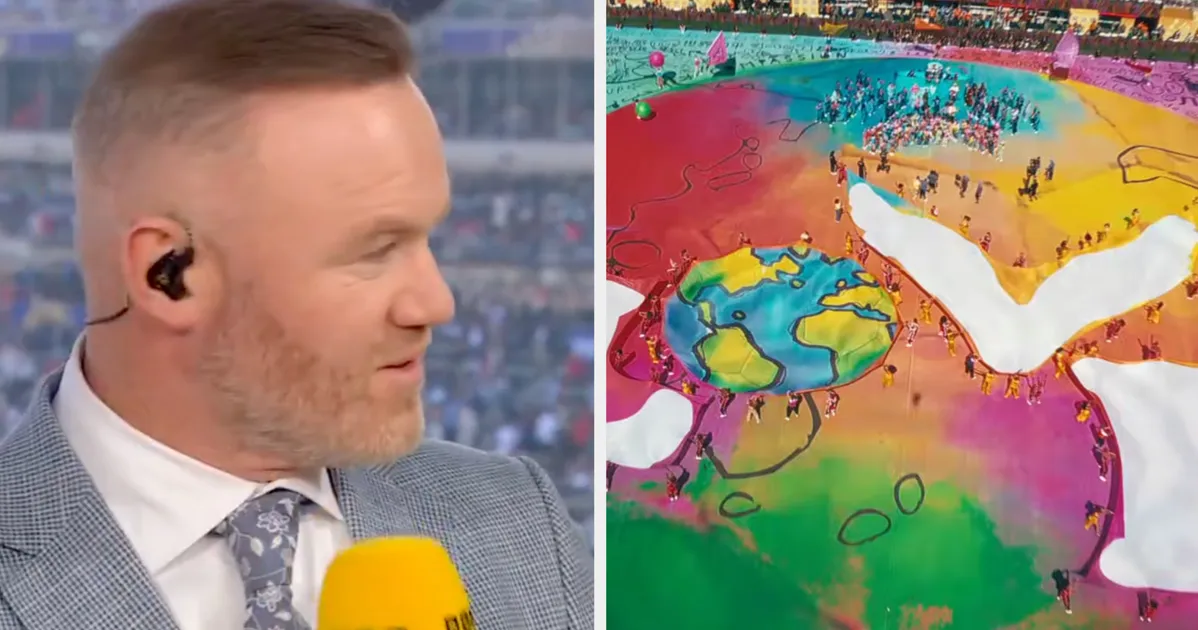
Among them was Rooney, who pulled no punches when asked for his take on the performance moments afterwards, live on the BBC.
Despite his fellow pundits’ positive reviews, Rooney said simply: “I thought the best part was when it finished. I like a lot of them artists, but I thought it was crap.”
“I did, honestly,” as his fellow presenters did little to hide their shock at his assessment.
Still, many viewers watching the BBC’s broadcast said that Rooney’s take on the show was definitely meme-worthy, and one of the stand-out moments of the night…
Advertisement
“What was your highlight of the half time show Wayne?”
It can’t just be us who suddenly wants a debrief from Wayne Rooney after every music awards show, right…?
The World Cup’s first ever Halftime Show also saw Ted Lasso himself introducing an acoustic ballad from Justin Bieber, Shakira bringing her World Cup anthem Dai Dai to life and a finale that included a children’s choir, a reunion between Sesame Street and The Muppets and co-organiser Chris Martin bringing back all of the performers onto the pitch (apart from Madonna, seemingly, who we’re guessing was already halfway home by that point).
After almost six weeks of ups and downs, this year’s World Cup came to an end over the weekend with a tense match that saw Spain triumphing over Argentina.
The 2026 World Cup final delivered plenty of stand-out moments – and we’re definitely not just talking about the football.
From unexpected celebrity appearances to a first-of-its-kind halftime show (which, it has to be said, received a bit of a lukewarm reception), the last night of the global football tournament gave us plenty of big moments from the world of entertainment that really got people talking.
Advertisement
Here are just 11 of those celeb moments from the 2026 World Cup final that you might have missed…
1. With the final taking place on US soil, things kicked off with a rendition of America’s National Anthem performed by the always–note-perfect EGOT recipient Jennifer Hudson
Jennifer Hudson performs a grand rendition of the United States National Anthem at the FIFA World Cup final 🇺🇸 pic.twitter.com/4AlAA3d1MM
— Jennifer Hudson Archive (@jhudaccess) July 19, 2026
3. Tom Cruise warms up the crowd before the game gets underway because… hey, why not?
Tom Cruise opened the FIFA World Cup final with an inspirational speech celebrating football’s power to unite people around the world.
4. The much-hyped star-studded Halftime Show started with a (mostly pre-recorded) performance of a Madonna classic – and the briefest of snippets of her latest hit – with some iconic football cameos in what turned out to be the scene-stealing moment of the whole 11-minute show
5. We’re always happy to see more of The Muppets on our screens, with The Electric Mayhem getting the fans going with this version of Seven Nation Army (don’t worry, there was an appearance from Kermit and Miss Piggy later on, too)
The Electric Mayhem made a brief appearance in the halftime show of the FIFA World Cup 2026 Final, performing the hit song “Seven Nation Army.”#Disneypic.twitter.com/WeHr7xufkL
We believe!🫶 The Muppets joined Chris Martin, Shakira, BTS and more to close out the first-ever FIFA World Cup Halftime show! pic.twitter.com/oNv75frRtn
6. BTS brought the Dynamite with a rendition of one of their signature songs
7. Ted Lasso himself introduced Justin Bieber, who used his segment of the show to deliver an acoustic ballad which doesn’t quite scream ‘football celebration’ to us but hey what do we know?
8. Shakira and Burna Boy then teamed up to bring their football anthem Dai Dai to life with some brilliant choreo
⚽️🏟️ Watch Shakira performing “Dai Dai” (feat. Burna Boy) during the FIFA World Cup halftime show in New Jersey! pic.twitter.com/Xb96b2twHk
10. There was plenty of celeb spotting to be done in the crowd, from Rihanna and A$AP Rocky to Sir David and Victoria Beckham, as well as Kylie Jenner and Timothée Chalamet
Advertisement
⭐️🎬 ¡Pasarela de estrellas en la gran final del Mundial!
🏆La final de la Copa del Mundo atrajo a algunas de las celebridades más conocidas del planeta para el duelo entre España y Argentina en las tribunas del MetLife Stadium.
What it sounded like when President Trump walked onto the field with FIFA head Gianni Infantino for the World Cup trophy presentation pic.twitter.com/qEIo327rcp
Andy Burnham is set to unveil plans to bring down energy bills to give people “more breathing room” in their everyday lives.
The incoming prime minister has held talks with Treasury officials on how tackling the cost of living will be his number one priority in office.
Raising the threshold at which workers start paying income tax, as well as capping bus fares at £2, are other measures Burnham is considering as he seeks to hit the ground running in No.10.
Burnham, who became Labour leader on Friday, will become the UK’s seventh PM since 2016 when he takes over from Keir Starmer on Monday.
Advertisement
Starmer will formally tender his resignation to the King at Buckingham Palace before making his final address from the steps of Downing Street.
After his own meeting with the monarch, Burnham will then travel to Downing Street himself, where he will tell the nation that he is “acutely conscious” of the political turmoil which has engulfed the UK in recent years.
Burnham will say that he is “acutely conscious” of being the sixth prime minister to walk up Downing Street in just 10 years, and pledging to introduce a more stable and responsible politics.
He will describe the moment as one of “reflection and resolution”, saying Britain must be honest about the challenges it faces while demonstrating that it can once again be recognised around the world for effective government.
Advertisement
Burnham will say that political stability must deliver “tangible improvements in people’s lives”, and call for national unity to improve the country.
The new PM will then disappear behind the famous No.10 black door to put the finishing touches to his new cabinet.
Home secretary Shabana Mahmood is tipped to beat Ed Miliband to the crucial role of chancellor.
Miliband could become foreign secretary, while there will also be cabinet returns for Louise Haigh, Angela Rayner and Wes Streeting.
Advertisement
Listen to Commons People, the podcast that makes politics easy. Every week, Kevin Schofield and Kate Nicholson unpack the week’s biggest stories to keep you informed. Join us for straightforward analysis of what’s going on at Westminster.
Andy Burnham is already on a collision course with Donald Trump even before he becomes prime minister.
The Labour leader will officially become the UK’s seventh PM since 2016 later today after Keir Starmer tenders his resignation to King Charles.
Burnham will pledge to give people “more breathing room” as he makes tackling the cost of living and bringing down energy bills his top priority.
He has hinted at giving the green light to more oil and gas extraction from the North Sea.
Advertisement
However, he will not break Labour’s election manifesto pledge blocking new exploration licences.
That would inevitably anger Trump, who yesterday insisted that Burnham would break with Starmer by “opening up” the North Sea.
In a post on his Truth Social account on Sunday, the US president said: “The People of Aberdeen, in Scotland, are dancing in the streets because the new Prime Minister, Andy Burnham, has stated that he will be opening up, all the way, the invaluable North Sea Oil!
““It is one of the Greatest Sources of quality Oil on Earth, has hundreds of years of Capacity left, with much not even found yet, and will make the United Kingdom, from a Poverty Stricken Disaster, to one of the Richest Countries anywhere in the World!
Advertisement
“Britain pays Norway Billions of Dollars a year to buy its Oil, which they get from a less valuable part of the North Sea — How ridiculous is that!”
Trump also claimed that Britain would move wind turbines near Aberdeen. “Word is that the UK is going to move the old and horrible looking windmills, which loom over and destroy the City of Aberdeen,” he said. “That will be a big day for the Country, and will be very much appreciated by everybody. Such great potential in the UK, but it all starts with OPENING NORTH SEA OIL.”
Starmer’s approach to the North Sea was one of the reasons why his relations with Trump collapsed during his time in office.
The US president was a regular critic of the outgoing PM’s refusal to allow new oil and gas fields in the North Sea to be explored as part of his government’s determination to achieve Net Zero by 2050.
Advertisement
Listen to Commons People, the podcast that makes politics easy. Every week, Kevin Schofield and Kate Nicholson unpack the week’s biggest stories to keep you informed. Join us for straightforward analysis of what’s going on at Westminster.
As singer Jennifer Hudson wrapped a stirring rendition of the US national anthem, the Jumbotron at New Jersey’s MetLife Stadium jumped to Trump, immediately inciting a blast of boos from the 82,500 other fans in attendance.
Verified by measurements shared with the presidential press pool, ambient crowd noise at the stadium clocked in around 78 decibels while jeers brought it to 84.
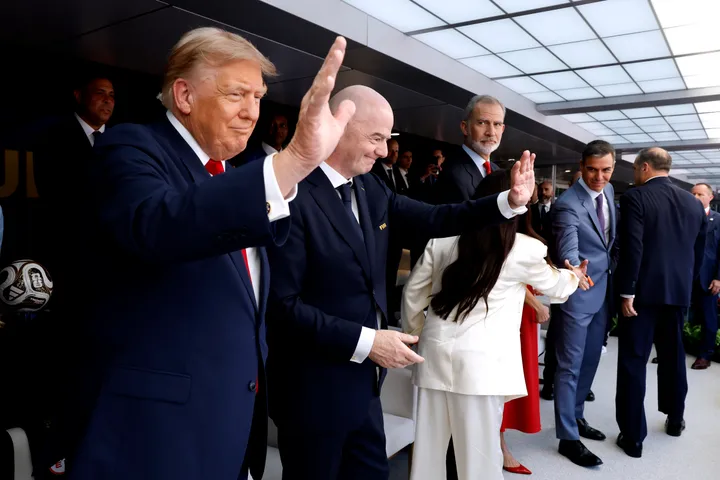
The US president was watching from a VIP suite along with his friend, FIFA President Gianni Infantino, first lady Melania Trump, and diplomatic rivals Prime Minister Mark Carney of Canada and Mexico’s President Claudia Sheinbaum.
Advertisement
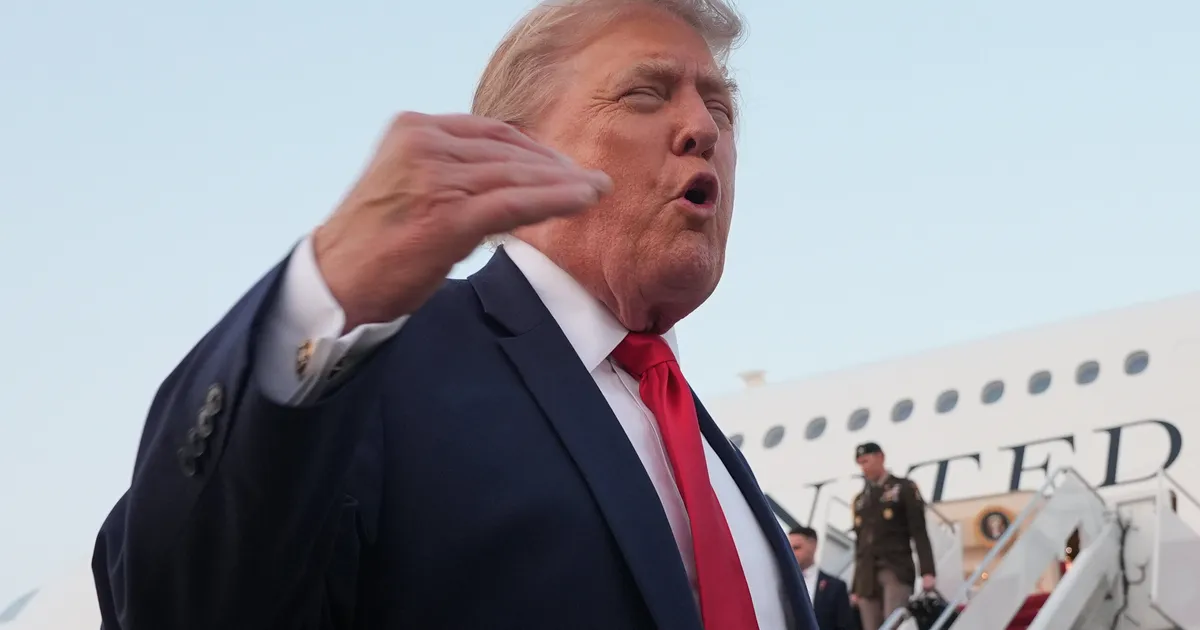
U.S. President Donald Trump waves at crowds with FIFA President Gianni Infantino during the FIFA World Cup 2026 Final on Sunday.
Eva Marie Uzcategui – FIFA via Getty Images
Trump, who was on hand to present the winning team with the World Cup trophy, did not pick a favourite ahead of the game but did remark that it’d be difficult for Spain to reckon with Argentine star Lionel Messi’s talents.
Though the 2026 World Cup has been a historic success, drawing a record-breaking 6.6 million fans across 16 stadiums throughout North America’s three largest nations, the impact of the US president’s politics could not be avoided.
Scandal emerged over decisions to deny a respected referee from Somalia entry, as well as the US sharply curtailing visas for the Iranian delegation and forcing the team to keep their home base in Tijuana, Mexico.
Nevertheless, Trump celebrated the World Cup as an American success during a reception for FIFA at his New York City Trump Tower on Friday.
Advertisement
“It turned out we were a soccer country, and I think it’s going to remain,” he said of the once soccer-sceptical US. “This has really brought the world together.”



























































You must be logged in to post a comment Login