
Politics
Trump’s war on Iran sends fertilizer prices soaring

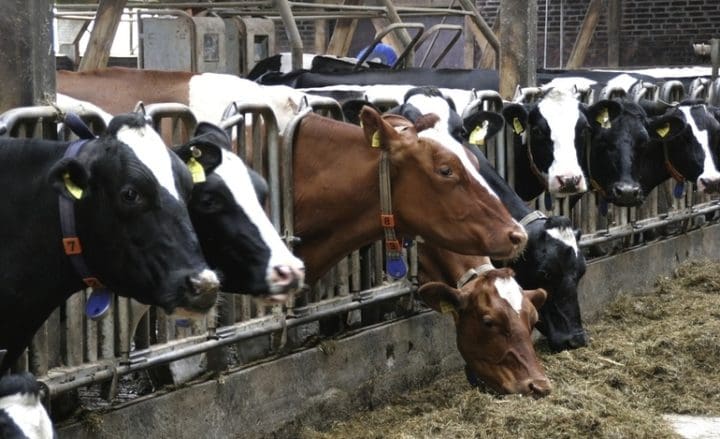

Fertilizer prices globally are rising since the war on Iran and “are poised to surge even higher,” potentially taking “months and months” to normalize even after the Strait of Hormuz reopens.
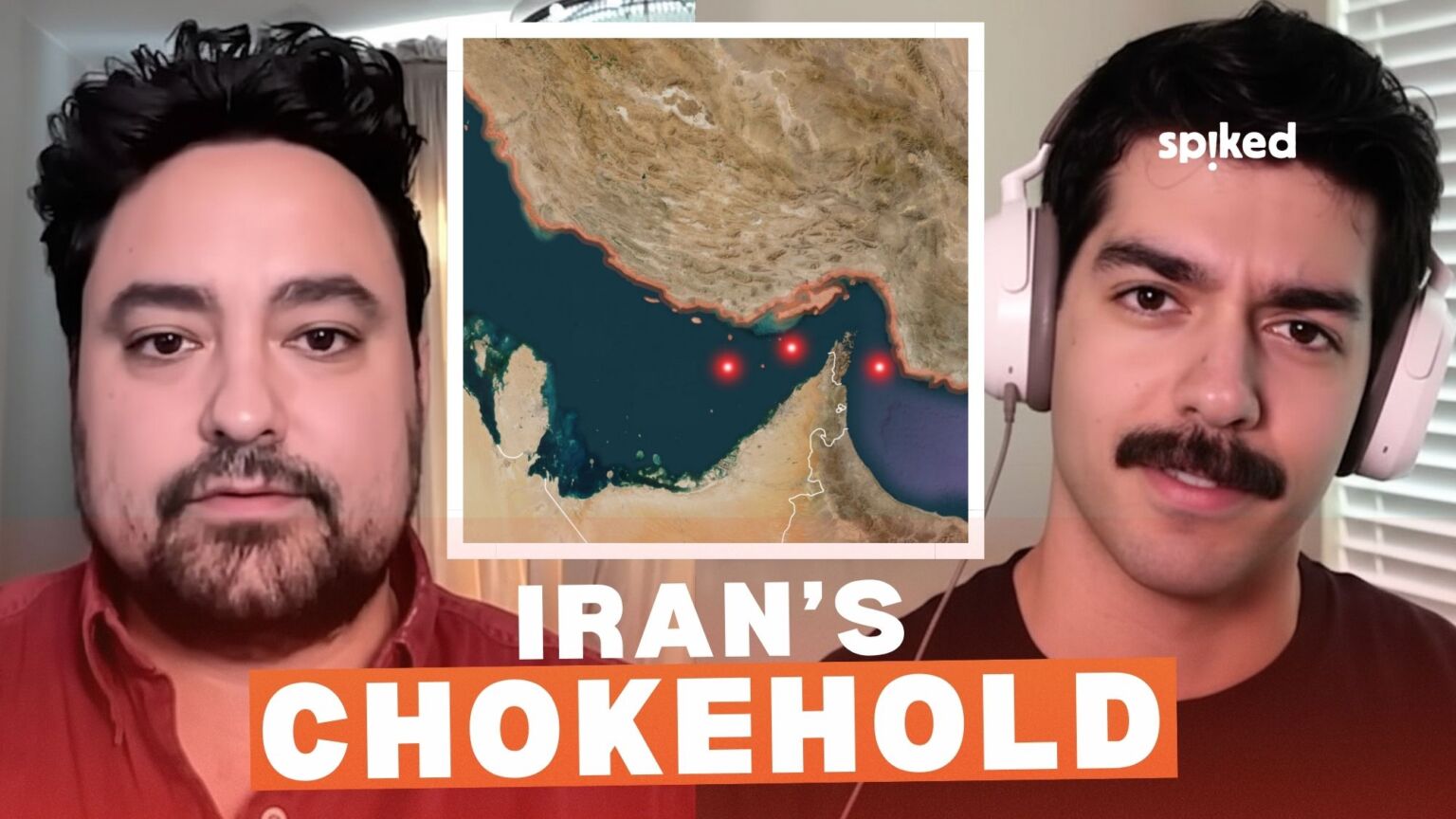
One third of global fertilizer trade – along with 35 per cent of crude oil and a fifth of liquified natural gas – passes through the Strait of Hormuz.
Many countries affected
India, the world’s top urea importer, is now paying $935 to $959 per ton, up nearly 90% from the $490 pre-war price, India’s Economic Times reported.
The UN said that planting season would end in May for most countries in Africa, making the loss of fertilizer at this time “significant and severe.” The disruption of the Strait of Hormuz could push 45 million more people into hunger and starvation, according to the UN’s World Food Program:
The planting season has already started, and in most countries in Africa it will end in May. So, if we don’t get some solution immediately, the crisis will be very significant and severe, particularly for the poorest countries and for the poorest citizens.
The UN said some of the most fertilizer-dependent countries were already highly vulnerable due to previous shocks, including Sudan, Somalia, Mozambique, Kenya, and Sri Lanka.
Advice to UK farmers
It is not just Asia and Africa. Even in the UK, advice is being given out to use fertilizer more efficiently. Farmers Guide reported that:
the most profitable strategy is usually about using nitrogen more efficiently, rather than applying more of it.
In the USA too, Responsible Statecraft noted that “Trump risks war backlash from the heartland: American farmers,” with fertilizer costs up.
The FT has reported similar findings, saying:
Across the US, farmers are reeling from a huge surge in the price of crop nutrients triggered by the Iran war — at a time when the economics of farming were already under pressure
This was an ill-thought-out war by Trump and his allies in Israel and the UK. The severe and dire consequences will hit their own voters, too.
By The Canary


The first report of the Southport Inquiry was published last week. It delivered a damning assessment of how knife-obsessed teenager Axel Rudakubana, despite being known to seemingly every authority under the Sun, was allowed to murder three children at a dance class in Southport in the summer of 2024.
The report makes for terrifying reading and has, unsurprisingly, garnered significant public interest. But it has overshadowed an ongoing and equally important inquiry, into an equally disturbed individual – namely, Nottingham triple-murderer, Valdo Calocane.
In the early hours of 13 June 2023, a then 32-year-old Calocane fatally stabbed Nottingham University students Barnaby Webber and Grace O’Malley-Kumar, both aged 19. Calocane then went on to kill 65-year-old Ian Coates, before stealing his van and driving it into three members of the public (all of whom, miraculously, survived).
There are many disturbing features of the Calocane case. The inquiry has shown how the former Nottingham University student avoided being taken off our streets because mental-health services were wary of the disproportionate detention rates of young black men who required sectioning. Just as egregiously, Calocane has not been charged with murder. Instead, he was allowed to plead guilty to manslaughter because of his mental-health conditions, and is currently serving an indefinite hospital order.
Disturbingly, the Rudakubana and Calocane cases are not aberrations. In June last year, the then 23-year-old Chukwuemeka Ahanonu flipped his car near Leicester Royal Infirmary and staggered from the wreck without any shoes on. He zeroed in on 56-year-old mother-of-two Nila Patel, who stood across the street. After racing towards her, he punched her with ‘full force’ to the ground and then stamped on her head. There was so much blood that a passing doctor told the court he assumed she had been stabbed. She died in hospital of brain injuries two days later, with her traumatised family at her bedside.
Ahanonu admitted manslaughter but denied murder, claiming diminished responsibility on the grounds he had been smoking cannabis. During the police interview, when asked why he was laughing, Ahanonu said, ‘I don’t remember even doing this’.
Finding him guilty of murder, the judge said the murderous assailant selected Patel for three reasons. ‘One was her gender, a woman – you would not have attacked a man. The second was her build and her height – 5’4” tall and of slight build.’ Spencer added he was ‘satisfied’ Patel’s race was the third factor.
But the most important feature of this case isn’t his motivation. It is that Ahanonu should never have been on the streets at all. During his murder trial, the jury was told that he had, until recently, been serving a two-year prison sentence for possession of a bladed article and breaching a suspended sentence order. Yet he had been released after less than a year. In other words, he was meant to be in jail when he murdered Patel.
A similar story of institutional neglect was heard at Sheffield Coroner’s Court in January. In August 2023, 32-year-old Emma Borowy – like Ahanonu, a habitual cannabis user – viciously stabbed 74-year-old Roger Leadbeater as he walked his dog in a park. Leadbeater suffered 124 injuries in the attack.
Borowy was severely mentally unwell. After her arrest, she told police that she had been ‘tricked’ by the devil into killing Leadbeater, an act she considered to be a ‘ritual sacrifice’. She was first sectioned in 2022 after she had killed two goats with a knife. The Sheffield inquest heard that she had subsequently absconded from her ward nine times. Despite this, Borowy was on ‘escorted leave’ when she murdered Leadbeater. The Greater Manchester Mental Health NHS Foundation issued an apology to the family, saying it ‘should have done more’. You think?
Do you notice a theme here? Neither Rudakubana, Calocane, Ahanonu nor Borowy were fit to be in society. Rudakubana was referred to the UK counter-extremism programme, Prevent, three times. Calocane, a man with a history of violence and paranoid delusions, was allowed to wander the streets unmedicated because he disliked needles. Ahanonu was supposed to be in prison when he murdered an innocent mother. Borowy was supposed to be in an institution when she murdered Leadbeater. How was any of this allowed to happen?
The British state is fraying. It is failing to see problems, let alone address them. Anyone with eyes can tell that our high streets have become blighted by barely cogent, violent characters who are ready to explode, often in a fog of cannabis smoke. We dip our heads, shuffle past, hoping not to fall into their line of fire.
The consequences of this institutional failure are profound. Indeed, it is hard to avoid the impression that there is a Valdo Calocane on every high street now – another time bomb waiting to go off. The failing British state is putting all of us on the front line.
Andy Jones is a journalist and broadcaster.
The post ‘One cheap drone can shut down the global economy’ appeared first on spiked.
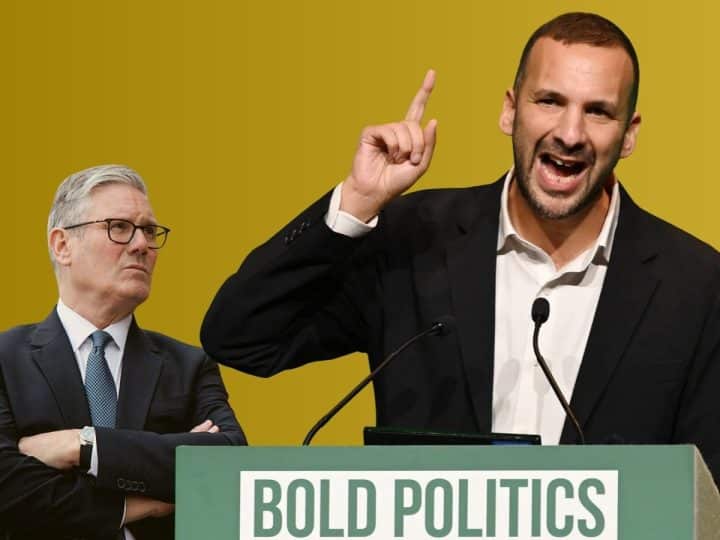

Green party leader Zack Polanski has demanded a public inquiry into the Starmer Labour party’s relationship with a firm founded by British intelligence agents.
OpenDemocracy has revealed that Keir Starmer’s top business adviser ran Hakluyt until he resigned as managing partner to work at Number 10, but still receives £112,000 a year from the firm as well as his government pay. Hakluyt, a “secretive corporate intelligence firm”, worked for free for Starmer’s party before it got into government, helping Starmer connect with corporate megadonors as his broken promises saw membership revenues collapse. But it seems there’s no such thing as a free lunch — and its revenues are now soaring.
But the Hakluyt connection goes further. Sacked civil servant Olly Robbins this week exposed the government’s trampling of security protocols to install disgraced Epstein-pal Peter Mandelson as UK ambassador to the US. But Robinson also left Hakluyt, at the beginning of 2025, to take up a top government job. Robinson became the Foreign Office’s most senior civil servant.
Zack Polanski — ‘Revolving door’
Zack Polanski said that companies’ “privileged access to political and regulatory insight” damages public trust and must be investigated — and that the Greens would end the “revolving door” if in government:
This is yet another revelation raising serious questions about Labour’s cosy relationship with big business. Bringing a senior figure from an elite corporate intelligence firm into the heart of government is deeply concerning.
When companies built on privileged access to political and regulatory insight appear to benefit from close ties to those in office, it undermines public trust.
The public deserve proper answers. Labour’s relationship with Hakluyt, before and after the election, should be investigated. The revolving door between big business and Westminster is still spinning – and it’s a system a Green government would work to dismantle.
A Downing Street spokesperson claimed that:
The Cabinet Office has a thorough process on declarations of interest for special advisers to ensure any conflicts of interest are properly managed and mitigated, including through recusals where appropriate.
Yes, no doubt about as thorough as its vetting procedures for disgraced cronies wanting to become ambassadors.
Polanski has been subjected to continually-escalating smears since the Greens overtook Labour as the main political option against the far-right ‘Reform UK’. His pledge to address big business’s undue influence in the corridors of power will only push the attacks in one direction.
Featured image via the Canary
By Skwawkbox
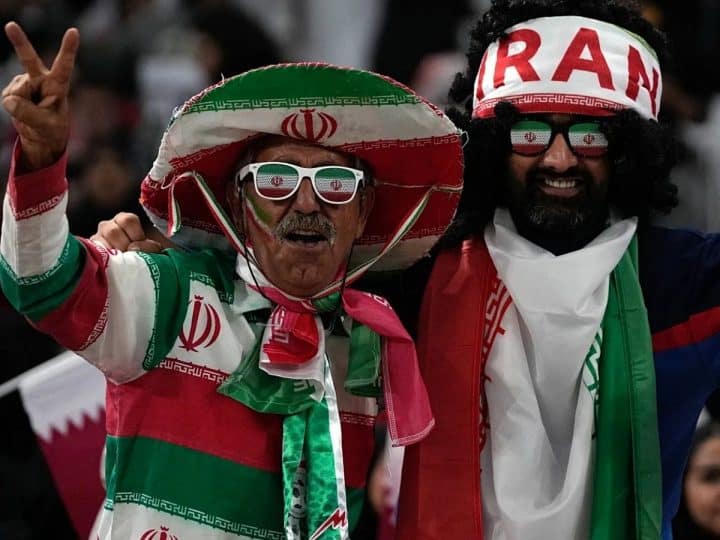

The proposal to replace Iran with Italy in the 2026 World Cup finals has sparked widespread controversy, following media reports linking the idea to military developments in the region since late February, against the backdrop of escalating tensions between the United States and Israel against Tehran.
According to the Financial Times, Paolo Zampoli, a close associate of US President Donald Trump, has put forward to FIFA the idea of granting Italy Iran’s place in the tournament — to be co-hosted by the United States, Canada and Mexico — should the Iranian team be unable to participate due to the security situation.
Zamboli explained, according to the same source, that he had discussed this proposal with Trump and FIFA President Gianni Infantino, expressing his desire to see the Azzurri at the World Cup and pointing out that Italy’s illustrious record of titles gives it the technical merit to participate.
In contrast, the BBC quoted sources within FIFA as confirming that there is no intention to consider this proposal, emphasising the federation’s commitment to Infantino’s recent statements in which he confirmed that Iran’s participation in the 2026 World Cup remains in place, and that there is no intention to replace them.
The suggestion of Italy as a potential replacement, despite its failure to qualify following a penalty shoot-out defeat to Bosnia and Herzegovina in the intercontinental play-offs, comes as the country is set to miss out on the World Cup for the third consecutive time, despite its high ranking among the non-qualifying teams.
Featured image via the Canary
By Alaa Shamali


In a football world increasingly shaped by corporate interests, Rayo Vallecano remain defiantly human.
A neighbourhood club that has built its identity on solidarity, resistance, and a fierce loyalty to the persecuted. Their story is not just about football; it is about Vallecas, the working‑class barrio of Madrid that shaped them, and the values their fans refuse to compromise.
Rayo Vallecano, a club built on struggle
Founded in 1924, Rayo Vallecano have always lived in the shadow of their glamorous neighbours Real Madrid and Atlético. Their stadium, the Estadio de Vallecas, sits tightly inside the streets of a district known for labour movements, anti‑fascist organising, and a deep sense of community. That identity has seeped into the club’s DNA.
Rayo’s budget has long been among the smallest in La Liga — just £5.5 million compared to Real Madrid’s £469 million, according to reporting from The Independent. Even in recent seasons, their financial reality has remained closer to a Segunda División struggler than a top‑flight mainstay. Yet the club’s fans, especially the famous ‘Bukaneros,’ have turned that scarcity into a badge of honour. Supporting Rayo is not about trophies; it is about belonging to a cause.
A fanbase that stands with the persecuted
Rayo’s supporters have long aligned themselves with people facing oppression, whether political, social, or economic. Their banners regularly reference anti-genocide, anti‑racism, anti‑fascism, LGBTQ+ rights, and solidarity with global struggles.
The fans wave the flag of Palestine at home games, they regularly produce tifo’s for the support of Palestine. The club even released a rainbow‑striped kit in support of “unsung heroes fighting homophobia,” as reported by CNN
This ethos is not performative, it is lived.
When Ukrainian striker Roman Zozulya, who had been linked to far‑right groups, was set to join the club in 2017, Rayo fans protested so fiercely that the transfer collapsed. Their stance was simple: Vallecas would not welcome anyone associated with extremist ideology. The message was clear, the persecuted are welcome; the persecutors are not.
The story that defined Rayo Vallecano, paying the rent of Doña Carmen
Nothing captures Rayo Vallecano’s soul more than the story of Carmen Martínez Ayuso, an 85‑year‑old woman who lived near the stadium. In 2014, she was evicted from the home she had lived in for 50 years after her son used it as collateral for a loan he could not repay. The images of her crying on the pavement shook Vallecas.
Rayo did not hesitate.
The club announced they would pay her rent and help her find a new home, a gesture that made headlines worldwide. Coach Paco Jémez said:
We won’t stand idly by, We are going to help this woman, not just me, but the coaching staff, the players, the club.
He added: “Within our ability, we will help this lady, so she doesn’t feel alone.”
For a club with one of the smallest budgets in Spain, the act was extraordinary. But for Vallecas, it was natural.
Carmen herself told Marca:
A thousand times thank you, God bless them. It’s a beautiful gesture, Viva el Rayo!
Her gratitude became part of the club’s folklore — a reminder that Rayo’s greatest victories often happen far from the pitch.
Football as a form of resistance
Rayo Vallecano’s identity is inseparable from Vallecas. The fans see themselves as defenders of the barrio’s values: solidarity, dignity, and resistance. Their tifos often show support for Palestine, they reference revolution, their chants echo social justice movements, and their presence at matches feels more like a political assembly than a sporting event.
Images of their supporters, drums emblazoned with skulls, banners reading “Por Nuestro Rayo Revolucionario” truly reflects a fan culture that refuses to be sanitised or commercialise
Rayo Vallecano — A club that punches above its weight
Despite their financial constraints, Rayo have repeatedly survived in La Liga, often playing bold, attacking football. Their recent resurgence under coaches like Andoni Iraola has earned admiration across Spain. But even when results dip, the fans’ commitment does not.
Because for Rayo Vallecano, success is not measured in league tables. It is measured in gestures like helping Doña Carmen, in standing with the oppressed, in refusing to compromise the values of Vallecas.
The beating heart of Vallecas
Rayo Vallecano are more than a football club. They are a symbol of a community that has always fought back, against poverty, against eviction, against discrimination, against indifference. Their fans support the persecuted because they know persecution. They defend dignity because they have had to defend their own.
In an era where football often feels detached from real life, Rayo Vallecano remain gloriously, defiantly human.
Featured image via the Canary
By Faz Ali
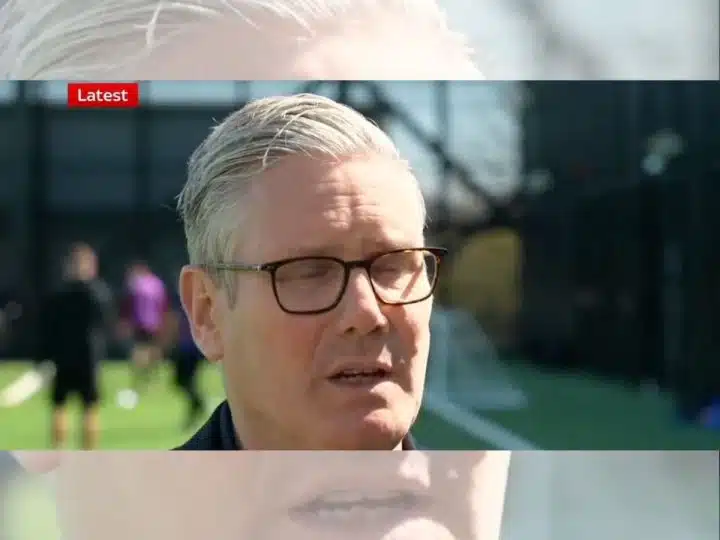

In a new interview, the slippery Keir Starmer avoided answering the question when asked if he has his Cabinet’s backing:
— Politics UK (@PolitlcsUK) April 23, 2026
 WATCH: Keir Starmer refuses to say if the Cabinet is behind him amid the Mandelson vetting scandal pic.twitter.com/MWMfmJnDGA
This would be a terrible look for any prime minister. It’s even worse for Starmer, because if he doesn’t have the backing of his Cabinet, he doesn’t have the backing of anyone:
Farage enjoys the highest approval figure (32%), whilst Keir Starmer has the lowest (19%). pic.twitter.com/hevSO4etMq
— Stats for Lefties
 POLL AVERAGE | Net approval of leaders:
 Polanski -8
 Davey -8
 Badenoch -14
 Farage -16
 Corbyn -36
 Starmer -44

 (@LeftieStats) April 3, 2026
Controversy
It’s clear why Starmer lost the backing of his Cabinet. At this point, the scandals are really stacking up:
So we're being asked to believe that Starmer announced the appointment of Mandelson before the security vetting had been completed and didn't then enquire about the vetting at any point subsequently, and according to Darren Jones this means due process was followed at all times pic.twitter.com/WckCGE8rbC
— Saul Staniforth (@SaulStaniforth) April 17, 2026
Just been told by a Minister that there is serious unease in Downing Street tonight that Starmer diverted from his briefing book and went too far in telling the House at PMQs no pressure had been put on any civil servants over Mandelson. “They know that wasn’t true” they said.
— (((Dan Hodges))) (@DPJHodges) April 22, 2026
In the video above, the interviewer asks:
Are you confident the Cabinet is fully behind you?
Starmer answers (and we use the word ‘answers’ loosely here):
The Cabinet is working really hard on a huge amount of issues and what we’re delivering at the moment.
The Cabinet is always working on a huge amount of issues, because they’re the government. If they weren’t working on a huge amount of issues, that would mean something had gone terribly, terribly wrong.
To be clear, the Cabinet being run off their feet is not an argument for the scandal-magnet Starmer to stay in position. The last thing ministers need is to be dealing with his neverending string of cock ups.
Starmer continued:
We’re preparing for the King’s speech and all the further measures that we’re going to need to take the country forward. And, of course, the issue we discuss at Cabinet a lot in recent weeks… is the war on two fronts, the ongoing war in Ukraine and the developing situation in Iran.
What we discuss at Cabinet is the international aspect of that, but also the domestic impact in relation to that and the measures that we need to take to ensure that we’re assessing the risks and making sure we’re protecting people in this country from those impacts.
Yet again, Starmer can’t decide if we’re involved in these wars or not.
He likes to brag that he didn’t allow Trump to drag us into the Iran fiasco when it suits him, but then he talks about facing a “war on two fronts” when he needs an excuse for not fixing problems at home.
Oh, and to be clear – we absolutely are involved in the war on Iran, no matter what the PM does / doesn’t claim.
End of the road for Starmer?
As we reported, it’s obvious why Starmer doesn’t want to say he has the backing of his Cabinet; it’s because he doesn’t:
— Politics UK (@PolitlcsUK) April 22, 2026
NEW: A Cabinet Minister says they have now lost confidence in Keir Starmer and expect the Cabinet to move against him
As one commenter noted:
“Keir Starmer refuses to say if the Cabinet is behind him amid the Mandelson vetting scandal”
Keir Starmer’s Cabinet right now: pic.twitter.com/IBEtzztMnb
— Monique Jolie #PardonAssange
☭ (@moniquejolie) April 23, 2026

We’d like to say Starmer doesn’t have long left, but never underestimate the ability of Labour ministers to dither and delay.
Featured image via X/Twitter
By Willem Moore

The BBC failed to name Israel as the perpetrator in 50% of reported Israeli attacks on civilians in Gaza.
Other British news outlets were not much better, with Sky News and the Guardian mentioning Israel in only 54% and 55% of cases, respectively. In comparison, the International outlet Al Jazeera named Israel as the attacker in 88% of its articles.
This means that Al Jazeera explicitly names the perpetrator at nearly double the BBC’s rate.
NewsCord analysed 11,295 articles across the BBC, the Guardian, Sky News and Al Jazeera. The aim was to quantify how Western media covered Israel’s genocide in Gaza.
Sanitising Palestinian deaths at the BBC
In 77% of cases, the BBC used the passive voice to report on Palestinians whom Israel murdered. Sky News did the same in 71% of articles.
Use of passive voice when reporting Palestinian casualties:
-BBC: 77%
-Sky: 71%
-Guardian: 67%
-Al Jazeera: 53%The BBC sanitises nearly 4 in 5 Palestinian deaths. pic.twitter.com/vfP1DHjPYD
— NewsCord (@newscord_org) April 23, 2026
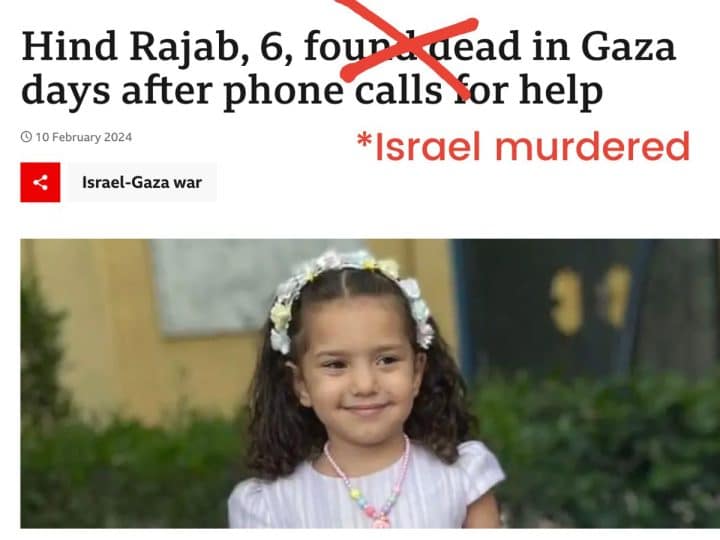
One of the most prominent examples is the reporting on the murder of six-year-old Hind Rajab.
The BBC’s headline read:
Hind Rajab, 6, found dead in Gaza days after phone calls for help
But Hind wasn’t just ‘found dead’. The Israeli Occupation Forces (IOF) murdered her, along with her family, in a “brutal act of genocide”. The IOF then fired 335 rounds at the car she was in, and killed the medics sent to save her life.
The BBC completely ignored Israel’s systematic and indiscriminate targeting of civilians in Gaza.
Israeli forces fired 335 rounds at a car, killing Hind Rajab, a 5-year-old Palestinian girl. They killed the medics sent to save her.
The BBC’s headline: “Hind Rajab, 6, found dead in Gaza.”
We analysed 11,295 article excerpts to see how systematic this sanitisation is. pic.twitter.com/1Q31v0YM9C
— NewsCord (@newscord_org) April 23, 2026
Similarly, when reporting on deaths in Palestine, the BBC used the phrase “according to Hamas-run health ministry” in 60% of articles, in comparison to only 1% by Al Jazeera and 17% in the Guardian.
Undermining Palestinian death tolls with “according to Hamas-run…”:
-BBC: 60%
-Sky: 36%
-Guardian: 17%
-Al Jazeera: 1% pic.twitter.com/ZpRcFZlz2V— NewsCord (@newscord_org) April 23, 2026
Importantly, though, the United Nations (UN) consider the figures accurate.
The BBC said that it told complainants it:
regularly reflects that these figures are considered credible by the UN.
However, NewsCord’s analysis showed that the BBC cited the UN’s credibility regarding Hamas figures exactly once. That is 0.6% of the time.
Of course, the BBC did not apply the same rule when it reported on Iranian or Hezbollah missiles killing Israelis. It simply reported deaths as facts.
Humanisation
Additionally, NewsCord analysed how often the four news sites humanised Palestinian hostages, versus Israeli hostages. It also noted that over 3,000 Palestinians are currently being held in Israeli prisons without charge.
The rate of humanisation included details such as names, family and context, and it found that the BBC only humanised 29% of Palestinian hostages, compared to 58% of Israeli hostages.
This means that the BBC is humanising Israeli hostages at nearly double the rate of Palestinian hostages.
Rate of humanisation when covering hostages (names, family, context):
-BBC: 58% Israeli / 29% Palestinian
-Guardian: 79% / 38%
-Sky: 65% / 31%
-Al Jazeera: 56% / 49%Over 3,000 Palestinians are held in Israeli prisons without charge. pic.twitter.com/99Ontv4t75
— NewsCord (@newscord_org) April 23, 2026
Shockingly, the BBC has never reported on various genocidal statements made by Israeli officials.
This included Yoav Gallant calling Palestinians ‘human animals’, Israel Katz stating that Gaza would not receive a drop of water or a single battery until they leave the world, and Bezalel Smotrich saying it was justified to starve two million Gazans.
Similarly, Benjamin Netanyahu referenced Amalek in relation to Gaza. This refers to a bible story in which God commands the total annihilation of Amalek, including all men, women, children, and livestock.
A pattern
The BBC’s bias against Palestine has been widely documented. As the Canary previously reported:
In a report titled BBC on Gaza–Israel: One Story, Double Standards published in June 2024, which critiqued the BBC’s coverage of the Gaza genocide between October 2023 and October 2024, the Centre for Media Monitoring (CfMM) accused the BBC of operating under a framework of ‘double standards’ when covering the Gaza genocide, of systemic bias against Palestinians, and of applying inconsistent editorial standards when covering Israeli and Palestinian experiences of war.
At one point, the BBC dropped a piece about UK and Palestinian kids sharing poetry for ‘impartiality’ reasons – which is absolute bullshit, even for the BBC.
Since 2023, the BBC has systematically attempted to erase the experiences of Palestinians by peddling Israel’s narrative. Anyone who has been paying attention has watched the BBC’s bias play out – but now the figures from NewsCord back up what we’ve all seen.
Is there any wonder Israel continues to get away with genocide and ethnic cleansing when huge media outlets, such as the BBC, continue to whitewash its war crimes?
Feature image via HG
By HG
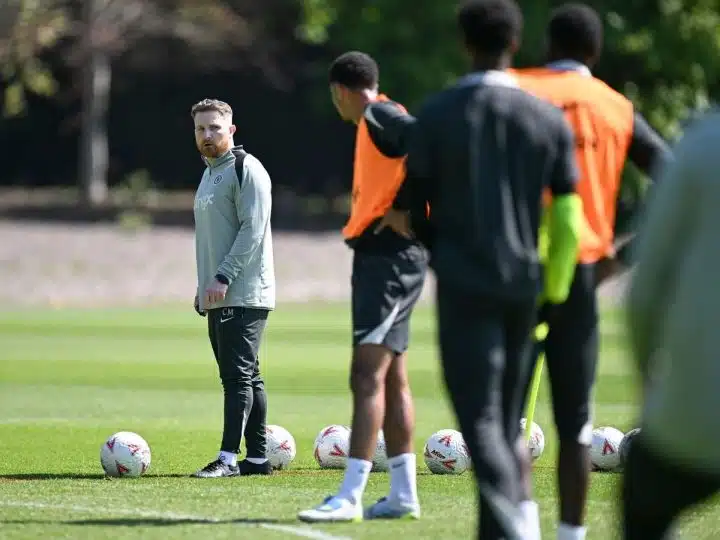

What happens next at Stamford Bridge feels less like a recruitment process and more like the next chapter in a long-running drama — one in which the cast keeps changing but the plot rarely does. Now the question becomes: when and how will Chelsea be pulled out of this quagmire?
The dismissal of Liam Rosenior after just four months — but more importantly just six days after co‑owner Behdad Eghbali publicly backed him — has left Chelsea exactly where they didn’t want to be, scrambling for stability, credibility and direction.
The manner of the Brighton defeat, the players’ visible loss of belief, and Rosenior’s own post‑match outburst made his exit inevitable. But the question now is who steps into a job that has become one of the most volatile in European football.
Chelsea — a club with no obvious plan
The general reporting consensus makes one thing clear, Chelsea are not rushing into a permanent appointment. There is currently, no number 1 candidate, and no appetite to repeat the mistakes of the past two years when managers were hired on long contracts only to be discarded months later.
The club’s leadership, a sprawling structure featuring multiple sporting directors, wants a manager with either Premier League experience or a proven record of success at a high level. That narrows the field, but not by much and with likelihood of no Champions League football next season, the job becomes a harder sell than it once was.
The names in the frame
Even with the current problems Chelsea are facing, certain level of names inevitably rise to the surface.
Andoni Iraola
Available this summer and admired for his work at Bournemouth, Iraola fits the profile: tactically modern, Premier League-proven, and capable of improving young players. But would he walk into a club where managers rarely last a season?
Oliver Glasner
Another coach with Premier League experience, Glasner has impressed at Crystal Palace. His organised, high‑pressing style would appeal to Chelsea’s hierarchy, but prising him away from a stable project may prove difficult.
Xabi Alonso
The most glamorous name on the market, but also the least likely. Alonso will have his pick of Europe’s elite jobs, and Chelsea’s current instability makes this a long shot. Given that there is also a phone call from Liverpool in the pipeline for Xabi.
Marco Silva
If Silva leaves Fulham, he becomes a compelling option: experienced, tactically flexible, and respected across the league. He also has a track record of improving teams without huge spending, something Chelsea may need as they navigate financial losses.
Cesc Fàbregas
The romantic choice. Currently coaching Como, Fàbregas would be a hugely popular appointment among fans. But Chelsea’s hierarchy is wary of appointing a manager without top‑level experience, and there is a belief he may one day be destined for Arsenal.
Beyond these names, Chelsea have previously spoken to Luis Enrique, Hansi Flick, Julian Nagelsmann, Thomas Frank and Roberto De Zerbi. Any could re‑enter the conversation, but the club insists it will not rush.
Chelsea’s structural question
Perhaps the biggest unknown is not the identity of the next manager, but the environment they will walk into. Chelsea’s five‑director sporting structure has been criticised for creating confusion, diluting accountability and undermining managers.
Any new manager will inherit a squad full of talent but short on experience, a fanbase exhausted by upheaval, and a club facing an £80m financial hit if they miss out on the Champions League. They will also have to navigate the futures of key players like Enzo Fernández, who could be sold if a nine‑figure offer arrives.
What the next manager must fix
Chelsea’s season has been a soap opera: the infamous huddle, the mole leaking team news, Cucurella’s barber becoming a storyline, Nicolas Jackson winning trophies at Bayern while his replacement struggled, and the club’s most in‑form centre‑back playing on loan at West Ham. Amid the chaos, one truth stands out: the next manager must restore belief, identity and discipline.
They must also bridge the gap between a young squad and the demands of elite competition. Chelsea plan to add more experienced players this summer — as a “tweak”, not a reset — but the manager will need to mould a coherent team from a group that has looked fractured and fragile.
The bottom line
Chelsea’s next manager will not just be a tactician. They will need to be a stabiliser, a communicator, and a unifier — someone capable of imposing clarity on a club that has lurched from one crisis to another.
The job remains one of the biggest in world football. But right now, it is also one of the most daunting. Whoever takes it on will define the next chapter of Chelsea’s modern era for better or worse.
Featured image via ChelseaFC
By Faz Ali
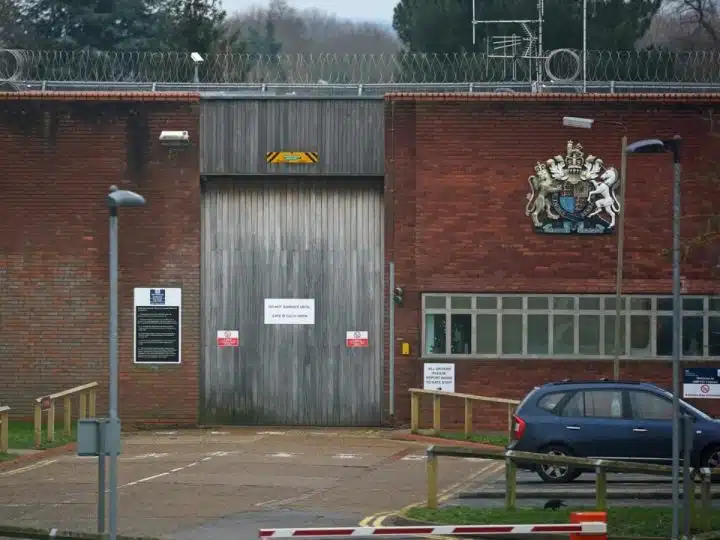

A teenage boy died in custody at Young Offenders’ Institute (YOI) Feltham in West London on 20 April. His girlfriend has told reporters after identifying his body that he had been “beaten to a pulp”. Feltham has been described at the most violent jail in the UK’s already dysfunctional prison system.
A death at Feltham Young Offenders Institute
The Canary was tipped off on 21 April. Feltham staff flatly refused to speak to us, but the Ministry of Justice confirmed the death that evening.
A Youth Custody Service spokesperson said:
We were saddened to hear of the death of a child from YOI Feltham, who died in hospital on Monday 20 April, and our thoughts are with their friends and family.
As with all deaths in custody, the Prisons and Probation Ombudsman will investigate. It would be inappropriate to comment further at this time.
Now more details of the death have emerged. The BBC reported on 22 April:
The London Ambulance Service (LAS) said it was called to the site just after 22:00 BST on Monday to reports of an “unwell child”. The boy was treated at the scene and taken to hospital “as a priority”, where he died.
The Met Police said it was notified of the death in the early hours of Tuesday by HMP Feltham staff. A Youth Custody Service spokesperson said the Prisons and Probation Ombudsman would investigate the death.
The Daily Mail reported that Scotland Yard detectives were treating the death as “unexpected”:
On Tuesday, April 21 at 12.05am, police were notified by staff at Feltham Prison and Young Offender Institute about the death of a boy who had been found unresponsive and later died in hospital.
The London Ambulance Service were called at around 9.30pm on Monday, April 20 and treated the boy, aged 16, before taking him to hospital. He sadly died at 11.43pm.
The Mail also said the individual’s girlfriend, who was not named, had identified his body. They quoted her at length:
His body had been beaten to a pulp, he was covered in scuff marks and bruises.
‘We had to look at him through a glass window, we weren’t allowed to say goodbye properly.
‘We are so confused. We don’t know how he died. He did have a heart condition but it is one that is very rare to die from.
He was a child
She continued:
His mother is completely broken. She was originally told he had died in the prison but then later that it was in hospital so we just don’t know what happened.
He had been in trouble, but he was 16, a child, and should have been protected. He had his whole life ahead of him and planned to go back to college but now he can’t.
It is a complete disgrace that this happened.
Before the story was picked up by legacy media, a source familiar with the matter told the Canary on 21 April:
He had a known heart condition and the other boys are saying he was calling for help (pressing cell alarm) for 45 minutes with no response.
The source said:
All the boys are heartbroken and they have no proper psychological support in there.
According to the BBC and Mail, and as confirmed by the MOJ to the Canary, a post mortem will be carried out in due course.
The MOJ also told us that in cases of this type involving a minor, names are not usually disclosed:
In terms of next steps, as with all deaths in custody the Prisons and Probation Ombudsman will carry out an independent investigation. It is sometimes the case that a name may be published later, for example by the PPO on their website and in their report, or through formal processes led by the coroner.
Adding:
The police and coroner will also oversee the post-mortem and any inquest, which is typically when further details may enter the public domain.
Feltham was described by HM Prisons Inspectorate in 2024 as:
the most violent prison in the country.
The report claimed conditions at the youth jail, which houses offenders aged between 16 and 18, had:
deteriorated significantly since its last inspection, and was characterised by rising self-harm and very high levels of violence.
No child should die in prison
Inquest is an organisation which supports bereaved families following deaths involving the state – including cases like the Grenfell Tower fire and the Hillsborough football disaster. Inquest’s director Deborah Coles told the Canary on 22 April:
No child should be dying in the care of the state, let alone a prison. Our thoughts are with his family and friends.
Coles described some of the shortcomings her organisation had seen:
Away from their families and support systems, locked in their cells for most of the day, with high rates of violence and self-harm, and prison guards now allowed to use PAVA spray, it is clear that imprisoning children will always be harmful and never be safe. This death is a urgent reminder of this.
Adding:
The government must divest money away from punishment and prisons and into community based support services to prevent further death and harm.”
The Canary will bring you more details as they emerge.
Featured image via the Canary
By Joe Glenton


Iran’s state news agency Tasnim has published a map of the undersea cables running through the Strait of Hormuz in an evident warning to the US, Israel, and their enablers of the consequences of continued aggression. Because of the West’s block on access to the site, it can only be accessed via VPN.
Iran is not having it
In a new article carrying a thinly-veiled threat of retaliatory pain, the Iran-based outlet writes:
The concentration of a large number of internet cables in a narrow passage has made the Strait of Hormuz a vulnerable point for the region’s digital economy.
The point wasn’t lost on observers:

Seven major cable systems pass through the Hormuz Strait, including AAE-1, FALCON, TGN-Gulf, ,SEA-ME-WE and Gulf Bridge International. As an example of the scale of disruption any damage to these cables could cause, countries that use AAE-1 include France, Italy, Greece, India, Pakistan, Oman, UAE, Qatar, Yemen, Djibouti, Saudi Arabia, Egypt, Hong Kong, Vietnam, Cambodia, Malaysia, Singapore, Thailand and Myanmar.
The ‘FALCON’ (FLAG Alcatel-Lucent Optical Network) cable system crosses several seas and oceans, including the Atlantic, but the Hormuz stretch connects Egypt, Oman, Bahrain, Saudi Arabia, Kuwait, India and other countries. Tasnim’s article specifically name-checked US enablers in the region – Qatar, Bahrain, UAE, Saudi Arabia and Kuwait.
Around 30% of global internet traffic passes through these cables, with the shallow depth and narrowness of the Strait leaving them clustered and vulnerable. Iran’s ability to flex on countries collaborating with the US-Israel axis is clearly not limited to oil.
Featured image via the Canary
By Skwawkbox

Suzie Bates: New Zealand great to retire from internationals after 2026 Women’s T20 World Cup

Microsoft is reportedly offering voluntary buyouts to up to 7 percent of its employees

If You Only Watch One Money Video, Make It This

Manchester United reach agreement with Casemiro over contract clause amid transfer speculation

US brings back mandatory military draft registration

Steven Gerrard disagrees with Gary Neville over ‘shock’ Chelsea and Arsenal claim | Football


-

 Sports6 days ago
NWFL Suspends Two Players Over Post-Match Clash in Ado-Ekiti
-

 Fashion6 days ago
Weekend Open Thread: Theodora Dress
-

 Politics6 days ago
Palestine barred from entering Canada for FIFA Congress
-
Entertainment4 days ago
NBA Analyst Charles Barkley Chimes in on Ice Spice McDonald’s Fiasco
-

 Tech5 days ago
Auto Enthusiast Scores Running Tesla Model 3 for Two Grand and Turns It Into Bare-Bones Go-Kart
-

 Business4 days ago
Powerball Result April 18, 2026: No Jackpot Winner in Powerball Draw: $75 Million Rolls Over
-

 Politics4 days ago
Zack Polanski demands ‘council homes not luxury flats for foreign investors’
-

 Crypto World6 days ago
Russia Pushes Bill to Criminalize Unregistered Crypto Services
-

 Politics3 days ago
Gary Stevenson delivers timely reminder to register to vote as deadline TODAY
-

 Business1 day ago
Rolls-Royce Voted UK’s Most Iconic Trade Mark as IPO Register Hits 150
-

 Politics1 day ago
Disabled people challenge government SEND proposals over segregation concerns
-

 Politics1 day ago
Making troops accountable for war crimes threatens US alliance, ex-SAS colonel warns
-
 Business7 days ago
Creo Medical agree sale of its manufacturing operation
-

 Crypto World6 days ago
Russia Introduces Bill To Criminalize Unregistered Crypto Services
-

 Politics1 day ago
Starmer handler McSweeney to be dragged from shadows by Foreign Affairs Committee
-

 Politics1 day ago
Zack Polanski responds to home secretary’s taser threat
-
Politics1 day ago
Wings Over Scotland | How To Get Away With Crimes
-
 Crypto World5 days ago
Kelp DAO rsETH Bridge Hack Drains $292M as DeFi Losses Top $600M in Two Weeks
-

 Politics24 hours ago
‘Iran is still a nuclear threat’
-

 Crypto World2 days ago
New York sues Coinbase, Gemini over prediction market offerings
You must be logged in to post a comment Login