
Politics
Water bills boycotter says ‘I’m taking this all the way’

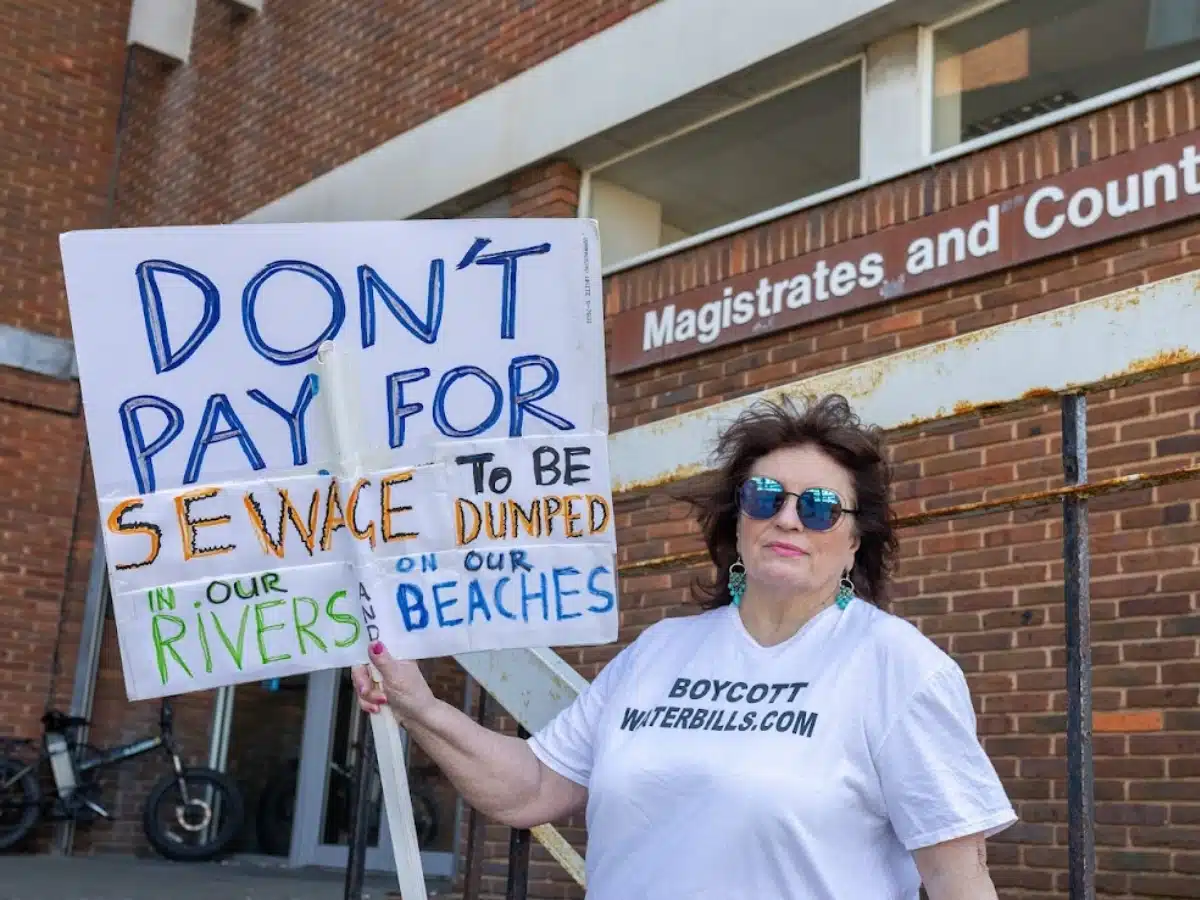
Campaigners for the boycott of water bills gathered in Margate on Thursday 19 March. They were protesting ahead of longtime boycotter Julie Wassmer’s court showdown against Southern Water.
Supporters came from all part of Kent including Whitstable, Broadstairs, Deal, Folkestone as well as from Sussex, London and Oxford. They were united in their condemnation at the dire state of the water industry.
Crime writer and environmental campaigner Wassmer has withheld payment for the wastewater part of her bill for over four years. She gave an impassioned speech arguing that the state of water is both a national and an international disgrace.
She said she intends to argue in court on 26 March that regulation has failed. She’ll claim there’s no accountability for poor service and this, in principle, contravenes Article 6 of the Human Rights Act:
It cannot be right that in a modern civic society consumers are forced to pay for services which are not being provided at all, or which seriously pollute our seas and waterways and damage our precious environment – while denying us a means of challenging this effectively through the legal system.
I’d like to see the back of every water company CEO in this country for whom, by the way, the average pay is £1.7m a year – while OUR bills have gone up 40% in real terms since privatisation and are set to increase far more.
The broken water industry
Johnbosco Nwogbo is lead campaigner at We Own It, an organisation that campaigns for public ownership of public services. He queried what it was that Southern Water wanted Julie to pay for:
Southern Water dumped sewage for about 304,000 hours in our rivers and seas in 2024. Is that what they’re asking Julie to pay for, so they can continue to dump sewage in our rivers and seas? They paid out £2.3 billion in dividends to their shareholders since the water company was privatized – it that what they’re asking Julie to pay for?
Nwogbo pointed out that when Southern Water went private in 1989 it had no debt, but it has since taken on £5.7bn of debt. This money clearly hasn’t been invested in infrastructure, but rather paid out in dividends to shareholders. He said:
Instead of people like Julie finding themselves in court defending themselves, Southern Water should find itself in court!
And he added that there is currently a proposal in front of the environment secretary to try to ‘save’ failing Thames Water from bankruptcy. This deal would allow the company to pollute illegally until 2040. He insisted the government should reject the deal and take Thames back into public ownership. Otherwise fellow water companies will simply follow suit in a race to the bottom:
Or rather, a race to the sewer!
Two Green Party councillors from Kent spoke at the event, Rob Yates and Andy Harvey.
Margate councillor Yates said he had personally investigated Southern Water by submitting Freedom of Information requests. These revealed the number of times the company had breached its permits by pouring untreated sewage into the seas. And the results formed part of a criminal case against Southern Water.
He added:
Privatisation without competition is exploitation. England and Wales are the only country in the world with a fully privatised water industry – now is the time to reverse Thatcherism.
Surge in boycott support
Katy Colley co-founded boycottwaterbills.com with Wassmer. She said that since the screening of Dirty Business, the Channel 4 three-part drama about the sewage scandal, the website had seen a surge in new signups.
She quoted submissions from a host of new boycotters from all over the country whose water companies included United Utilities, Southwest Water, Severn Trent, Thames Water and Southern Water.
These were people, she said, who had had enough of:
spiralling bills while water companies pour increasing amounts of sewage into our seas and waterways with impunity.
She insisted that for many, this was not a first step but a final resort:
because we see no other way to make a difference.
Like her, many had complained to their water company, to the Consumer Council for Water, to the Water Redress Scheme, Environment Agency and OFWAT.
At every stage we are told no, you cannot hold your company accountable for their failures. But if we’re consumers and we’re unhappy with a service we should be able to go elsewhere. We can’t because water is a natural monopoly.
We protested, we wrote letters, signed petitions. The government changed. But with water, nothing changed.
That’s why so many of us decided, that despite the potential risks, the difficulties, we’re going to use the power we have in our pockets. We’re going to withhold payment for the wastewater service part of our bill.
She says the boycott movement is now spreading rapidly with thousands accessing the site every week. Many are now cancelling their direct debits as a ‘first rung on the boycott ladder’.
She said:
Nobody is obliged to pay by direct debit, only on receipt of a bill twice a year, and direct debit is how water companies hold money on account, treating us like cash cows.
Olivia Cavanagh is from Hastings Boycotts Southern Water. She expressed her disgust at the recent bio bead spill from an Eastbourne sewage treatment plant across the Kent and Sussex coast. Ten tonnes of toxic beads were released into the sea, causing catastrophic damage to the coastline and environment. She asked:
Did Southern Water come out and say we’re sorry this has happened, we’re going to clean it up? No, volunteers and voluntary organisations came out. As usual it was left to the community and the people that care about the environment.
It’s clear that Southern Water, like all the water companies, don’t give a damn about the environment, the wildlife and the plant system.
The large and noisy protest drew dozens of encouraging honks from passing cars and trucks. Attendees said the energy and passion of the speakers was inspiring. One passerby said:
It’s encouraging to see ordinary people doing something and not just accepting this situation. With the sewage and the price increases here, you get the feeling that we are just being taken for mugs. I don’t think I would want to go to court myself, but I think I might cancel my direct debit. It’s better than nothing.
Wassmer’s case has its hearing at Canterbury County Court on Thursday 26 March at 10am.
Featured image via Andrew Hastings / Boycottwaterbills.com

Politics
Neurodivergent Job Interviews: Why AuDHD Talent Is Being Filtered Out Of The Hiring Market”
Since last July, Edward James Herath, a brand and strategic comms consultant, has taken part in more than 120 job interviews. The feedback is often the same: he’s “too direct,” “too honest,” “abrupt,” or “confrontational.”
Herath, 39, who is diagnosed with autism and ADHD (AuDHD), believes his literal and questioning demeanor is costing him jobs.
He finds interviews particularly difficult because of their “indirect, passive-aggressive, and theatrical communication style,” he tells HuffPost UK. He believes they measure how he performs under pressure rather than his ability to do the job, and his real self – someone who cares deeply about his relationships and career – doesn’t come across.
“There’s a strong emphasis on reading between the lines and softening language,” he says. For someone who values clarity, that’s a difficult tone to strike.
Hearth is by no means alone in this struggle. Research suggests neurodivergence is widely seen as a barrier to employment. A 2024 Zurich survey of 1,000 neurodivergent adults in the UK found more than half believed recruitment processes were designed to filter them out, while over a third said interviews had triggered panic. A 2025 UK survey also found that 40% of young people believe being neurodivergent was a hindrance in the hiring market.
The consequences are significant for employers, says Sharawn Tipton, Chief People Officer at Greenhouse. She says traditional hiring often favours similarity over talent, despite evidence that diverse teams perform better. Neurodivergence, she says, is “no different than height or personality.”
“When you think about neurodiversity, it’s really around understanding that the mind works differently for everyone,” she says. “Different ways of thinking and communicating are things that help companies innovate faster.”
Job interviews are a game, but the rules aren’t clear for everyone
Christal Castagnozzi, a psychologist with ADHD and autism who specialises in neurodivergence, says traditional interviews prioritise skills like eye contact and quick verbal responses. Executive functions like memory and processing speed are suddenly tested too.
“Neurodivergent folks will struggle in all of these areas, especially when we are put on the spot,” she says. “You’re literally being judged while standing in front of someone. That’s a neurodivergent person’s worst nightmare.”
For many, interviews become less about competence and more about navigating unwritten social rules, according to Elise Minkin, a neurodivergent career coach. She tells HuffPost UK that interviews can feel like “a game” where not everyone knows how to play.
“There’s this kind of secret code that a lot of neurodivergent people feel like they were never told,” she says.
Even common questions, such as why someone wants the job, can cause trouble.
“Obviously for a paycheque,” she says. That’s the true answer – and one which someone with neurodivergence would be inclined to say. “But of course it’s not what the interviewer wants to hear,” she added.
Office environments are not always comfortable spaces for neurodivergent people. Those with autism may struggle to concentrate under harsh fluorescent lighting. Flickering or humming lighting can also be distracting and even sometimes painful.
The location may also affect performance. Some candidates may communicate better over Zoom, where they can make notes, comfortably take more time to answer questions, or use a sensory fidget tool off-screen, which have been shown to help reduce anxiety and increase concentration for people with ADHD and autism.
Without flexibility, neurodivergent candidates “can’t always show up as their best self,” Minkin says.
Many neurodivergent candidates face the difficult decision over whether to disclose their condition up front. Tipton recommends those who want to do this to ask to be connected with anyone at the company who can offer support, such as an employee resource group (ERG).
“You can ask the company, what do you do?” she says. “Because interviewing is a two-way street, and you want to make sure you’re going to an environment where you’re going to thrive and the company is going to be able to support you.”
Those who don’t may result to masking, which is a term for suppressing natural behaviours to appear more socially typical.
“I’m not at all a fan of masking,” Austin says, citing its mental and physical toll. But she acknowledges the decision is personal.
Castagnozzi believes the responsibility should not fall on candidates at all, and adjustments should be built into hiring by default.
“This should just be a best practice,” she says. “Even someone that is not neurodivergent, or does not know that they are neurodivergent just yet, may benefit from accommodations, especially during a stressful time.”
Conversations are brewing on social media
Under the Equality Act 2010, employers in the UK must make reasonable adjustments for disabled applicants. Similar protections exist in the US and Canada.
But reasonable adjustments are often applied inconsistently or denied altogether. Many neurodivergent people are speaking publicly about their experiences, sharing frustrations and finding solidarity.
Darcie, who has autism and ADHD, shares her experiences with her 14,000 TikTok followers. She says that receiving interview questions 15 minutes in advance is a reasonable adjustment that helps her organise her thoughts.
In a TikTok posted in January, she described a recent interview where an employer initially agreed to provide the questions. But when she arrived, they backtracked, which undermined her confidence.
In the comments, viewers shared their own thoughts, with many agreeing that the way the company behaved was a “red flag.” Some urged Darcie to take the employer to court for discrimination, noting that reasonable adjustments are a legal requirement.
“This is really bad,” one said. “Definitely report this if you can.”
Viewers who also had ADHD and autism said they often made the same requests to potential employers, with mixed results.
“There really should be no excuse for employers not to do this when requested,” one viewer wrote. “For most jobs it shouldn’t be based on how quickly you can answer on the spot anyway.”
Some employers worry adjustments provide an unfair advantage. But Kristin Austin, VP of Culture and Community Health at Rewriting the Code, disagrees, arguing they actually improve fairness.
“If the goal is truly for people to show up at their best, why would you not give them those resources?” she says. “Are you evaluating my ability to think under pressure, or my ability to do the job?”
Software engineer Shea Belsky has experienced hiring from both sides. He says neurodivergent job-seeking experiences vary widely, making it difficult to generalise. Sometimes he has had a good experience, and sometimes he hasn’t. But meaningful change, he adds, must come from company culture, and that’s something he always strives to be a part of.
“It has to be baked into an organisation’s DNA,” he says. “We want people to feel like they can come and be their authentic selves.”
For Herath, and many others, the hope is to be assessed on their ability rather than arbitrary, performative skills. Until hiring models evolve more broadly, interviews may continue to filter out the very talent that can make a difference.

If you had to compare one living person to Jesus Christ, it would not be Donald Trump.
You might actually say Trump is the polar opposite of Christ – a sort of ‘anti-Christ’, if you will.
One person who disagrees, however, is the man himself:

Good lord
Jesus was famous for kicking the money lenders out of the temple. Donald Trump is famous for not paying back money he owes. These are not the same thing.
Lest we forget, Jesus said:
It is easier for a camel to go through the eye of a needle than for a rich man to enter the kingdom of God
To be fair to him, Trump might actually believe with this, because he said the following in October 2025:
I don’t think there’s anything going to get me in heaven. I think I’m not maybe heaven-bound. I’m not sure I’m going to be able to make heaven.
The benefit of knowing your eternal soul is damned is that you don’t have to worry about being a good person. This frees Trump to commit clearly sinful acts like waging war and depicting himself as the Christ.
While the warmongering president may made his peace with evil, however, many of his supporters have not:
Truth Social is revolting on Trump, BIGLY! I have never seen it this bad! It goes on and on! pic.twitter.com/cjOT74KihT
— Knoxie (@KnoxieLuv) April 13, 2026
Among those criticising Trump is former loyalist Marjorie Taylor Greene, who said:
It’s more than blasphemy.
It’s an Antichrist spirit.
Commentator Harry Sisson, meanwhile, suggested that Trump appears to be healing an old friend of his:
Trump is now posting AI images of himself as Jesus Christ healing, what appears to be, a young Jeffrey Epstein. pic.twitter.com/zG2OQKbP9s
— Harry Sisson (@harryjsisson) April 13, 2026
Another thing people are noting is that the image Trump shared seems to be more demonic than the original:
Turns out the original photo was posted by @NickAdamsinUSA but someone in the Trump camp decided it would be wise to alter it to add a demon and repost. 👀
Credit to: @mend_alyn for the find! pic.twitter.com/oMQExSN2Qq
— Based Millennial Mommy 🇺🇸 (@MaRy_JaNe1209) April 13, 2026
Did Team Trump alter the image?
Or did the demon simply manifest as a result of the image’s proximity to Trump?
Trump VS the Pope
As many have pointed out, Trump’s latest deadly sin came after he tangoed with the current Pope. In recent weeks, Pope Leo has been putting out fire like the following:
War divides; hope unites. Arrogance tramples upon others; love lifts up. Idolatry blinds us; the living God enlightens. All it takes is a little faith, a mere “crumb” of faith, in order to face this dramatic hour in history together — as humanity and alongside humanity. #Peace
‘Idolatry’, by the way, is when a person worships things like money, fame, or hotel chains over God.
Hard to guess who he might be referring to there.
He doesn’t believe in building libraries or museums, only hotels.
That should be his epitaph, signed off by him.
A rare non-lie from Trump. https://t.co/4aqxsoGMTL
— Mehdi Hasan (@mehdirhasan) March 31, 2026
Hundreds of millions of people throughout the world are immersed in extreme poverty. Yet, disproportionate wealth remains in the hands of a few. It is an unjust scenario, in the face of which we cannot fail to question ourselves and commit to change things. There is no lack of resources at the root of disparities, but the need to address solvable problems related to a more equitable distribution of wealth, to be achieved with moral sense and honesty.
According to convicted criminal Donald, the Pope has been critical of Western wars because he “likes crime”:
He’s attacking the Pope.
He. Is. Attacking. The. Pope. https://t.co/DbveAIyBhw— Jo (@JoJoFromJerz) April 13, 2026
And, the president also said all of the following, which you’re free to read if you have a spare ten minutes and don’t respect your own time:
This will end well.
Some genius in Trumpland decided, “Hey, the best thing we can do now is to go to war with the Holy Father.” pic.twitter.com/zYG3IuNivB
— Rick Wilson (@TheRickWilson) April 13, 2026
Of course, Trump has form when it comes to attacking Popes/the concept of basic human decency:
I just remembered Trump posted this after Francis died. pic.twitter.com/FLcGziYs0a
— Jeet Heer (@HeerJeet) April 13, 2026
Pope Leo has now responded, saying:
I don’t think that the message of the Gospel is meant to be abused in the way that some people are doing.
I will continue to speak out loudly against war, looking to promote peace, promoting dialogue and multilateral relationships among the states to look for just solutions to problems.
This sicko really loves crime, doesn’t he?
The Pope isn’t the only religious figure who’s been critical of the American president’s blatant wickedness either:
Trump’s post comes after @60Minutes aired interview with three American cardinals https://t.co/xVGHSeG8eD
— David Shepardson (@davidshepardson) April 13, 2026
End times
As one commenter noted, it does feel like we’re living through the end times:
The Book of Revelation really made all this sound like it was going to be more poetic and less stupid. https://t.co/wZenwg0aos
— one dozen rats at a keyboard (@PanasonicDX4500) April 13, 2026
This isn’t for nothing.
The US evangelicals who support Trump and Israel do so because they think they’re going to usher in the end of the world. This is why they support endless hostilities and expansionism in the Middle East.
As we reported on 21 February:
Many American evangelicals support Israel, but not because they like Israelis. In actuality, they think the creation of Israel is a signifier that the end times are approaching, and that Israel will trigger the Rapture.
If you’re unfamiliar with the term, the ‘Rapture’ is the time when God calls his faithful back to heaven. Said ‘faithful’ will not include the Jewish men and women who live in Israel, even if they do play an instrumental role in jump starting the Armageddon.
We’re not facing down the end of the world because it was foretold; we’re facing it down because wealthy freaks believe it was foretold.
Trump may not be the literal anti-Christ, but that isn’t stopping his donors from positioning him to perform the same function.
Featured image via Donald Trump

Israel is having a petulant hissy fit about Spain. Again. The occupation regime has cried that a Spanish village’s decision to use an effigy of genocidal war criminal Benjamin Netanyahu in its traditional Easter ceremony is – you’ve guessed it – antisemitic.
The Israeli government – never one to shy away from displays of arrogance – has “summoned” a Spanish embassy official for a “reprimand”. The issue? The small Málaga town of El Burgo used an effigy of Benjamin Netanyahu for its traditional “burning of Judas” festival.
All too typically, the Israeli government ranted on X that the decision of one pueblo in an autonomous region of Andalusia was the fault of Spanish PM Pedro Sánchez – because he has criticised Israel’s genocide in Gaza, said mean things about Israeli war criminals and dared to say Spain will not support Israel’s illegal war on Iran:
The appalling antisemitic hatred on display here is a direct result of @sanchezcastejon government’s systemic incitement.
And even now, the Spanish government remains silent.
The Spanish chargé d’affaires was summoned for a reprimand. pic.twitter.com/2Bguhs7Ce8— Israel Foreign Ministry (@IsraelMFA) April 11, 2026
Israel having another tantrum
Sánchez’s government was having none of such nonsense. In a public statement, it said that it rejected the “insidious accusation” and pointed out the measures it has taken to protect and support Spain’s tens of thousands of Sephardi Jews.
On Easter Sunday, 5 April, El Burgo’s townspeople burned a 7m-tall effigy of Netanyahu, filled with around 14kg of gunpowder. Many would say that this is the least Netanyahu deserves after Israel’s slaughter of hundreds of thousands of innocent Palestinians, his and Donald Trump’s illegal war on Iran and his attacks on Lebanon, Syria and the occupied West Bank.
Every year, the town selects someone they consider to represent evil as the template for the effigy of Judas. The town’s council said this year’s choice was an expression of the people’s rejection of war and genocide. Last year, Netanyahu’s poodle Donald Trump was selected.
Unsurprisingly, Spain is right, Israel is wrong. Rejecting and opposing evil is not antisemitic. In 2015, the Sussex town of Lewes selected then-PM David Cameron to burn as Guy Fawkes on the UK’s ‘Bonfire night’, a festival with deeply anti-Catholic origins. Of course, suggesting that rejecting evil is antisemitic is, itself, antisemitic. That’s hardly surprising either, considering the deeply antisemitic nature of Zionism and its propaganda.
Featured image via YouTube screenshot/Al Jazeera

Iran are mocking Donald Trump’s claim he is planning to impose a blockade on ships leaving or entering the Strait of Hormuz if Iran doesn’t give up its own control of who can pass along its coastline. Trump made the threat after his ‘three stooges’ team of amateur negotiators failed to bluster Iran’s diplomats into accepting the US’s demands for capitulation in talks in Pakistan.
The Iranian embassy in Thailand, for example, referred to Iran’s total victory in the online propaganda war and its hugely viral ‘Lego’ style videos. The embassy’s X account said Trump’s plan is “so comical we don’t even have a meme for it”:
The new move from trump against our country is so comical that we don’t even have a meme for it.
— Iran Embassy in Thailand ☫ (@IranInThailand) April 12, 2026
Iran’s embassy in Zimbabwe chipped in with a reminder who’s really in charge of Trump’s administration:
True peace requires confronting the shadows governing the White House. pic.twitter.com/tf5nd9kTUW
— Iran Embassy in Zimbabwe (@IRANinZIMBABWE) April 12, 2026
China and Russia have free access to the Strait because they have supported Iran rather than those waging criminal war against it. Trump may well be ridiculous enough to think he can get away with attacking their ships trying to go about their lawful business – but he would soon get an education in reality.
Toxic clown says what?
Featured image via X


1910: Emmeline Pankhurst (left) listens as Margaret Bondfield (right) makes a speech | Image by: Mirrorpix / Alamy

3 min read
Nan Sloane has produced a fascinating biography of an extraordinary working-class woman
There are two Labour women who have shaped my political life – and indeed the lives of many of my colleagues – more than any others: Margaret Bondfield and Nan Sloane. Bringing them together in Nan’s new biography of Bondfield feels like a Labour Party version of Avengers Assemble.
Most of us know Nan as the driving force behind the Jo Cox Women in Leadership Programme. She has guided more women toward the green benches than I could possibly count. That she has used her formidable skills to shine a light on the pioneers who came before us, ensuring the stories of Labour women aren’t just remembered but heard, is a testament to her.
Margaret Bondfield’s list of ‘firsts’ is remarkable, but her life before Westminster was arguably even more radical. She was a powerhouse in the trade union movement, famously going undercover to expose the shocking conditions women faced on and beyond the shop floor.
She rose through the ranks of the predecessor to today’s Usdaw, rising to the senior leadership team, becoming the first woman delegate to the TUC Conference and eventually the first woman to chair the TUC.
Her parliamentary career was a series of broken glass ceilings – the first woman to speak from the despatch box, the first female Cabinet minister, and the first female privy counsellor.
Her parliamentary career was a series of broken glass ceilings
Yet this book isn’t just a dry tally of milestones but rather a testimony to the grit it took to get there. My favourite story in the book captures this perfectly, where Bondfield joined the shopworkers’ union after spotting an advert for it in the newspaper her chips were wrapped in during a lunch break.
It’s such a brilliantly ordinary moment, but it sparked a life of extraordinary public service.
Nan expertly shows how Bondfield’s politics were rooted in the precariousness of working-class life. Growing up with the very real fear of the workhouse, she understood how quickly a life could be upended by low wages or uncertain employment. That sense of insecurity stayed with her throughout her career. Her politics were never academic – they were grounded in the material realities of working families and, specifically, working women.
 She was a fearless risk-taker, though she doesn’t always fit a neat “feminist” mould. She wasn’t a suffragette; she believed that extending the franchise to all – including the working class and not just middle-class property owners – was the only way to truly serve the interests of working-class women. Certainly she made mistakes and took positions that don’t always hold up a century later, but her impact is undeniable.
I do wonder what she would make of today’s landscape – particularly our New Deal for Working People. To see us finally delivering on the issues she was campaigning for a 100 years ago shows that while times change, the fault lines remain the same.
It’s been a century since Margaret Bondfield first represented my constituency. As her successor, and as a proud member of both the shopworkers’ union and the Co-op Party, I feel a deep responsibility. Our movement is the most important vehicle for change we have, and I’m going to work every single day to make sure I live up to the standard she set.
Emma Foody is Labour ( Co-op) MP for Cramlington and Killingworth
Margaret Bondfield: The Life and Times of Britain’s First Female Cabinet Minister
By: Nan Sloane
Publisher: Bloomsbury Academic

On Sunday 12 April, we reported that Wes Streeting is once again gearing up for a leadership challenge. Should Streeting become PM, he would have two key opponents: Nigel Farage and Zack Polanski. If you’re wondering how well Streeting would do against the latter, please see the below:
— Zack Polanski (@ZackPolanski) April 12, 2026
Polanski and titnotherapy
When Zack Polanski became the Green Party leader, the Labour Party immediately launched what they believed would be a devastating line of attack. According to them, Polanski had once tried to hypnotise women into have larger breasts. As Ed Sykes reported for us in September 2025, Polanski:
clarified that he never believed he could enlarge breasts with hypnotherapy, that he never charged people to try and do it, that the Sun misrepresented him, and that he had apologised a day later. He even got a few laughs by saying “lots of men got in touch with me asking if I could help with other body parts”.
Since Labour launched this attack, Polanski has more than quadrupled his party’s membership; he’s also pulled ahead of Labour in the polls.
How have Labour responded to this new reality?
As you can see above, by repeating the same smear which has had zero impact on Polanski’s standing:
Does streeting just genuinely not realize that whenever he goes after Zack he loses in devastating fashion? https://t.co/EoryrHcSHn
— James (@TaxingChimp) April 12, 2026
When Jeremy Corbyn was the Labour leader, there was a popular meme which told the following story:
Tony Blair: You should be more right-wing.
Jeremy Corbyn: You should be in prison.
Tony Blair: *HANGS HEAD IN SHAME*
We’re seeing something similar with Streeting.
He knows he has to take the fight to the Greens, but his record in office means he’s fighting with both arms tied behind his back and a handgun in his mouth.
Clearly, being connected to Peter Mandelson is much, much worse than anything Polanski has ever done. Mandelson literally referred to himself as the Prince of Darkness and as a practitioner of the ‘Dark Arts’, which is a big step up from hypnotherapy, no?
It doesn’t end with Mandelson, either. Streeting is up to his eyeballs in donations from private health vultures, as James Wright reported for the Canary on 1 April 2025:
Health secretary Wes Streeting accepted over £50,000 from a company with links to private healthcare recruitment on 3 February. Not long after on 18 February, Streeting announced he was abolishing NHS England and cutting 9,000 public jobs. This raises the question of whether the private sector would replace the public sector job cuts, with the Labour Party already increasing private provision of NHS services under Keir Starmer.
Oh, and there’s also this:
You armed a genocide and trained the army who committed it. No amount of spin and distraction can wash all that blood away. https://t.co/IcNxuq24Ak
— Ross Greer (@Ross_Greer) April 12, 2026
Red hands or Green fingers
Keir Starmer’s Labour operation is one of the most hated governments we’ve ever had, and Streeting is a key cog in that machine.
He’s delusional if he thinks there’s some clever attack line which will make voters forget who he is or what he’s done. He’s not delusional to think he could replace Starmer, however, as Streeting is precisely the sort of slug who does well in the Labour Party.
This is why they’re about to get wiped out in the local elections.
Starmer encouraged activists to leave Labour, now they’re drafting MPs to make up for lack of door knockers — who could have seen it coming?
Via @willem_moore_uk https://t.co/0Qd5wHTgTd
— Canary (@TheCanaryUK) April 12, 2026
Featured image via Barold

Katy Perry has treated her social media followers to fresh photos of herself enjoying the Coachella music festival with her new boyfriend, Justin Trudeau.
Last year, the Grammy-nominated singer and former world leader made headlines the world over when it was reported that they’d been pictured on a date while she was on a Canadian stop on her world tour.
Since then, Katy and the ex-Canadian prime minister have been sighted together on a number of occasions, and over the weekend, she proved things were still going strong between them with a carousel of pictures and videos taken at Coachella.
One clip showed the two watching the headlining set from another Canadian Justin – that’d be The Biebs, who performed at Coachella on Saturday night – while in another candid snap, the two were seen enjoying a drink and some noodles together.
Katy’s post also included more clips from Justin Bieber’s headlining set, as well as footage of herself sporting a t-shirt emblazoned with the message: “Please do not give me a rip off your vape no matter what I say.”
Take a look at Katy’s post for yourself here.

After months of speculation, the unexpected couple went Instagram official with their romance towards the end of last year, with Katy later sharing a picture of herself planting a kiss on her new beau while they were on holiday together in January.
The new couple were first rumoured to be dating in the summer of 2025, just weeks after Katy and her long-term partner Orlando confirmed they had parted ways after around a decade together.
Katy and Orlando insisted at the time that they would remain in one another’s lives, and shortly afterwards, they remained true to their word when they shared pictures of themselves on holiday together with their daughter Daisy, as well as Orlando’s two children Daisy and Flynn.
Meanwhile, before his new relationship, Trudeau had been single for around two and a half years, following the announcement in August 2023 that he and his wife of 18 years, Sophie Grégoire, had separated.

Keir Starmer has rejected Donald Trump’s plan to blockade the Strait of Hormuz and insisted the UK will not be “getting dragged in” to the Iran war.
The US president announced on Sunday that America and “other countries” will stop ships going in and out of the vital waterway.
The US military later clarified that while it will blockade of Iranian ports from 2pm on Monday UK time, it will “not impede” ships using the strait to get to or from other countries.
But regardless of the finer details of Trump’s plan, Starmer made clear that the UK will not be getting involved.
He told BBC Radio 5Live: “What we’ve been doing over the last few weeks – and this was part of what I was discussing with the Gulf states last week – is bringing countries together to keep the strait open, not shut.”
The PM added: “We’re not supporting the blockade and all of the marshalling diplomatically, politically and capability – we do have mine-sweeping capability, I won’t go into operational matters, but we do have that capability – that’s all focused, from our point of view, on getting the strait fully open.”
Starmer’s comments are further evidence of the breakdown in relations between Britain and America over the war.
Trump has repeatedly attacked the prime minister over his decision not to initially allow US jets to launch bombing missions from RAF bases.
Subscribe to Commons People, the podcast that makes politics easy. Every week, Kevin Schofield and Kate Nicholson unpack the week’s biggest stories to keep you informed. Join us for straightforward analysis of what’s going on at Westminster.
When talking about early 2000s style trends, you’d be remiss not to mention the reign of “jeans and a going-out top.”
This outfit staple allowed people to show off designer jeans while experimenting with a variety of tops from fast-fashion retailers. But a related trend brought this two-piece look to another level: dresses over jeans.
Between 2002 and 2005 in particular, celebrities paired an array of dresses with denim during public appearances. The dresses ranged from colourful halters to neutral minis to those classic strapless terrycloth numbers from Juicy Couture. In 2019, actor Jessica Alba poked fun at the look when she posted a Instagram roundup of photos of herself wearing it, writing in the caption, “In the early 2000s – Apparently, I loved to wear dresses w jeans … you’re welcome.”
Turns out, this type of outfit is more of a throwback than you might think. It goes far back in history and even has roots in the women’s rights movement.
The Appeal Of The Combo
As is often the case with style trends, the dress-over-jeans look wasn’t confined to red carpets. Non-celebrities embraced this pairing for their everyday lives in the early aughts as well.
“That was definitely one of my go-to looks when I was in high school. I can remember wearing sneakers and bootcut jeans with knee-length frilly dresses, which were often embellished with lace and glitter,” said Sara Idacavage, a fashion historian and researcher in the textiles, merchandising and interiors department at the University of Georgia.
“I think I was attracted to this style because it allowed me to be dressy, but not too dressy,” she added. “I loved wearing party dresses to school, but I don’t think it would have been seen as ‘appropriate’ without the jeans underneath. The dress-and-jean combo helped me look like I wasn’t trying too hard, which is actually why I think the look was popular with female celebrities at the time.”
Besides balancing between dressy and casual, the juxtaposition of super feminine dresses with denim pants also offered “a cheeky way of playing with gender norms,” Idacavage said, adding that the trend coincided nicely with the third-wave feminist movement and allowed women to channel a little rebellious spirit.
On a practical level, wearing a dress over jeans allowed for more freedom of movement since it erased fears of accidental flashing or Marilyn moments. It also allowed Disney stars such as Ashley Tisdale and Miley Cyrus give their outfits a more wholesome vibe at the time.
The History Of The Look
Today, we might chuckle at old photos of celebrities wearing dresses over pants — but back in the mid-19th century, this combo was downright scandalous.
“In 1850s America, women’s rights activists such as Amelia Jenks Bloomer and Elizabeth Cady Stanton horrified polite society with their controversial pairing of what at that time were two distinctively gendered garments,” said Cassidy Zachary, a fashion historian and co-creator of the podcast “Dressed: The History of Fashion.”
The dress reform movement, aka the rational dress movement, took off in the United States and parts of Europe during the Victorian era when women wore heavy dresses and restrictive corsets, which led to overheating, difficulty breathing, tripping down the stairs, crushed organs and other medical issues. The goal was to liberate women from attire that directly harmed their health and limited their freedom.
“These early suffragists intended their adoption of a calf-length dress worn over a pair of loose-fitting ‘Turkish trousers’ or ‘pantaloons’ to be a comfortable and practical alternative to the cumbersome floor-length skirts then in vogue,” Zachary said, adding that the controversial choice was perceived as a direct assault on the strict gender norms that divided women from men and regulated their lives.
“Dress-and-pant-wearing women became the subject of international ridicule, with innumerable satirical prints mocking a farcical world where gender roles were reversed: Women smoked cigars and proposed to men who stayed home, cooked, and took care of the children,” she continued. “It is amazing to consider how many social anxieties were embodied in this one garment.”
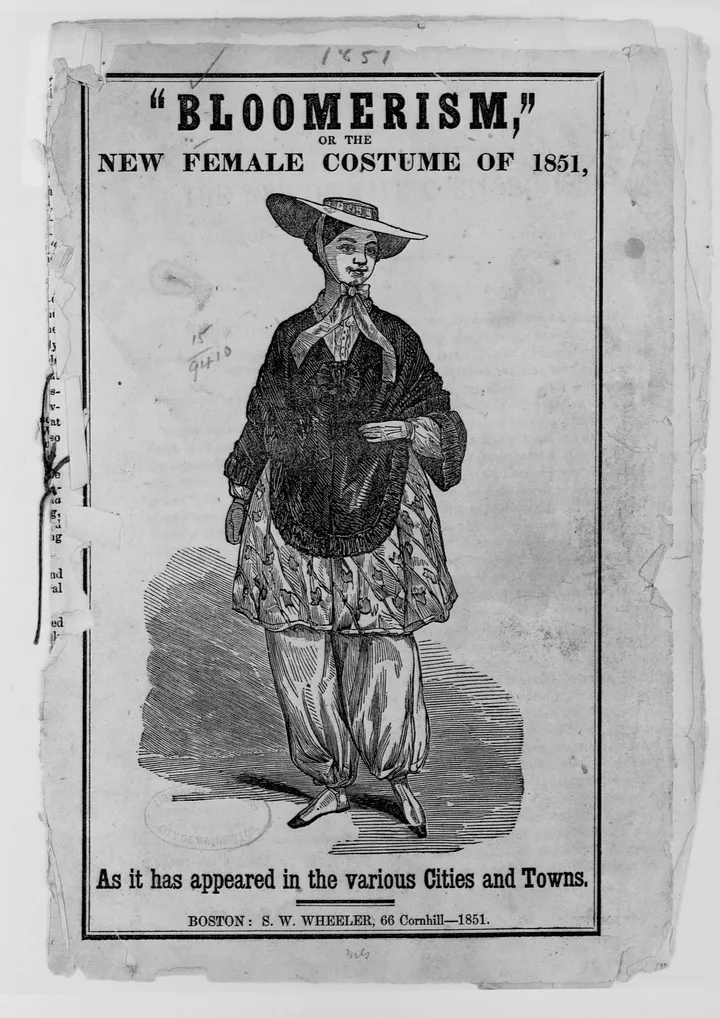
The ensemble of trousers gathered at the ankle under a loose dress was often referred to as a “bloomer” costume, named for the aforementioned activist, who popularised the look with her enthusiastic articles on its benefits in her newspaper, The Lily.

Library of Congress via Getty Images
“Bloomer costumes echoed the full silhouette that was popular in Western fashion at the time, but allowed for greater comfort and ease of movement by swapping layers of heavy petticoats for loose pants,” Idacavage said. “Aside from the obvious differences in materials and silhouettes, I think the bloomer costume is actually quite similar to the dress-over-jeans look of the early 2000s!”
Ultimately, the hoopla around this ensemble made activists like Bloomer concerned that their bid for comfortable attire was distracting from the bigger cause of women’s rights, so they eased away from the rational dress aspect of the movement.
While the dresses-with-pants trend was a notable moment in the West during the mid-19th century, women were actually wearing dresses and tunics over trousers long before that era and in many other parts of the world.
“As the term ‘Turkish trousers’ suggests, women in pants found precedent well beyond Euro-American society, including in nomadic horse cultures of Central Asia,” Zachary said. Similarly, Idacavage pointed to the salwar kameez in Central and South Asia.
Back in the West, American and European women wore trousers with dresses to costume parties for many years before suffragists adopted the combo for their everyday wardrobes.
“You can find fashion plates from the 1810s that depict women wearing full trousers called ‘pantalets’ or ‘pantaloons’ underneath calf-length dresses. The style wasn’t extremely popular or considered appropriate for daily dress, but it did exist,” Idacavage said.
The historian added that 19th-century childrenswear for both boys and girls often consisted of short dresses over pantalets as well. Additionally, American women often wore pant-and-skirt ensembles at swimming and water-cure establishments.
“Dresses over pants were also worn by women living in certain religious and utopian communities in the U.S. long before Amelia Bloomer popularized the look,” she continued. “It was also accepted as proper attire for women participating in sports throughout the 19th century, although wearing it outside of gymnasiums is a very different story!”
The Future Of Dresses Over Pants
As with the “going-out top” and other early 2000s style trends, the dresses-over-jeans look faded over time. But it seems this pairing may be making a comeback in the 2020s.
Lately, many runway shows and style influencers have sported long tunics and dresses over pants, including jeans. But these looks have an updated vibe with long shirt dresses unbuttoned at the bottom, monochrome combos, minis with volume, layered looks and more.

But Zachary believes the more pertinent conversation right now is less about the way women style their dresses with pants and more about how those who don’t identify as female might do the same.
“My question is this: With women flaunting their right to wear both garments by the 2000s, when will the same be said of her male or nongender-conforming peers?” Zachary said.
“It’s 2021, and while the pant has inarguably lost its gendered status, the same cannot be said of the skirt and dress, although we are seeing promising strides,” she added. “From actor Billie Porter’s crinoline tux gown at the 2019 Oscars to nongender-conforming artist and activist Alok Vaid-Menon’s #DeGenderFashion movement, I hope the next resurgence of the dress-pant trend will be one worn and enjoyed by all.”
The original version of this story was published on HuffPost at an earlier date.
Politics
Politics Home | Housing insecurity is not inevitable: here’s how social impact investment can help tackle it



Drew Ritchie, Investment Director
| Better Society Capital (BSC)
The UK’s housing crisis costs English councils £2.8bn annually, affecting 134,000 households. Social impact investment offers proven, cost-effective alternatives, with existing models saving £140m in taxpayer funds while keeping thousands out of temporary accommodation
Temporary accommodation (TA) is no longer a stopgap – it is the fastest growing housing tenure in the United Kingdom, with councils in England spending £2.8bn a year on TA.1 The cost to families is higher still, with more than 134,000 households, including circa 176,000 children,2 living without a stable home and the conditions needed for good health, steady work, or financial security.
New findings from our Better Society Index, a nationwide audit of housing insecurity, show that instability affects far more people than official figures reflect. More than one in four people (27 per cent) report that they or someone close to them has experienced housing insecurity in the past five years, rising to 41 per cent among young people. Public understanding of funding streams – and the limits of current resources – remains low.
Yet over the past decade, evidence has emerged that better, more cost-effective alternatives exist. Social impact investment brings in capital from outside the public purse, including from pension funds, trusts and foundations, and financial institutions, giving councils access to funding they would not otherwise have. Critically, it also funds the wraparound support that statutory budgets do not cover – mental health services, tenancy support, and the practical help that keeps people housed and out of crisis. This money is channelled into proven models led by housing associations and charities, expanding the supply of safe and stable homes.
These models are already working at scale. Homelessness property funds run by Resonance, Social and Sustainable Capital, and Bridges have kept more than 3,300 people out of TA, generating £140m in savings for taxpayers from reduced costs in healthcare, mental health services and the criminal justice system.3 Strong evidence also comes from the MHCLG backed Social Investment Pilot (SIP), delivered during Covid-19. The pilot combined a £25m government grant, matched by Better Society Capital, with £215m of additional investment, including £85m from Local Government Pension Schemes (LGPS).4 Independent evaluation by Manchester Metropolitan University showed improvements in tenancy sustainment, wellbeing and service efficiency, and substantial cost savings to taxpayers compared to private rented or TA provision.
A complementary model, social outcomes partnerships (SOPs), sees government and/or local authorities commission outcomes for people with complex needs before they reach crisis point. Charities or social enterprises can receive upfront working capital from socially motivated investors to deliver services supporting these individuals. Government outcomes payments are only made once independently verified results are achieved, meaning the financial risk sits with investors rather than the public purse. Successful programmes such as Greater Manchester Better Outcomes Partnership (GMBOP) and Kirklees Better Outcomes Partnership (KBOP) demonstrate that outcomes-based commissioning improves service quality and reduces long-term public costs; independent research shows every £1 spent generates £9 of public value.5 The £500m Better Futures Fund, announced by the Chancellor and due to launch in the coming months, creates the conditions to scale these approaches. MPs have a role to play in ensuring the Fund delivers for their constituents by championing local engagement and raising awareness.
Housing insecurity on this scale is not inevitable, with proven models increasing the supply of safe, stable homes and supporting people before instability becomes crisis. If government wants to reduce housing insecurity and spend public money more effectively, the path forward is to scale models already working and bring social impact investment into the mainstream of UK housing policy.
To find out more about BSC’s work on homelessness, please visit www.bettersocietycapital.com/our-approach/housing or reach out to [email protected].
Better Society Capital is a social impact investor, deploying capital through fund managers, social banks and intermediaries, and working with government and social sector organisations, to tackle the most pressing social challenges facing the UK.
References
1. Shelter; Bill for homeless accommodation soars by 25%, hitting £2.8 bn. 18 Sept 2025
2. MHCLG; Statutory homelessness in England: July to September 2025. 26 Feb 2026
3. Resonance; Better Society Capital & Alma Economics Report
4. Better Society Capital; Study finds Social Investment Pilot continues to increase support for people with experience of homelessness. 03 April 2025
5. Better Society Capital; New research shows how outcomes contracts can save the NHS. 11 June 2024

10 Opening Scenes That Are Almost Perfect

Bajaj Housing Finance at IPO Price! Worth investing?

Sealioning: Meaning And What to Do If It Happens


-

 Politics3 days ago
US brings back mandatory military draft registration
-

 Fashion3 days ago
Weekend Open Thread: Veronica Beard
-
 Sports3 days ago
Man United discover Nico Schlotterbeck transfer fee as defender reaches Dortmund agreement
-

 Tech6 days ago
How Long Can You Drive With Expired Registration? What Florida Law Says
-

 Politics19 hours ago
World Cup exit makes Italy enter crisis mode
-

 Crypto World4 days ago
Canary Capital Files SEC Registration for PEPE ETF
-

 Fashion7 days ago
Massimo Dutti Offers Inspiration for Your Summer Mood Board
-

 Business3 days ago
Tesla Model Y Tops China Auto Sales in March 2026 With 39,827 Registrations, Beating Cheaper EVs and Gas Cars
-

 Politics3 days ago
Malcolm In The Middle OG Turned Down ‘Buckets Of Money’ To Appear In Reboot
-

 Fashion6 days ago
Let’s Discuss: DEI in 2026
-

 Crypto World5 days ago
Bitcoin recovers as US and Iran Agree a Ceasefire Deal
-
 NewsBeat12 hours ago
Pep Guardiola and Gary Neville agree over Arsenal title problem that benefits Man City
-

 Business3 days ago
OpenAI Halts Stargate UK Data Centre Project Over Energy Costs and Copyright Row
-

 Business2 days ago
Ireland Fuel Protests Enter Day 5 as Blockades Spark Shortages and Government Prepares Support Package
-

 Politics3 days ago
LBC Presenter Mocks Trump Over Iran War Failures
-

 Crypto World2 days ago
Federal judge blocks Arizona from bringing criminal charges against Kalshi
-

 Tech3 days ago
A version of Windows 10 released a decade ago is now eligible for additional security patches
-
 NewsBeat1 day ago
JD Vance announces ‘no agreement’ with Iran over nuclear weapons fear
-
Sports2 days ago
1st-Round WR Enters Vikings Mock Draft Orbit
-
 Entertainment4 days ago
Alfred Hitchcock’s 10 Most Suspenseful Masterpieces, Ranked
You must be logged in to post a comment Login