Politics
What Is An ‘Alpine Divorce’?

We really wish we didn’t have to talk about “alpine divorces”.
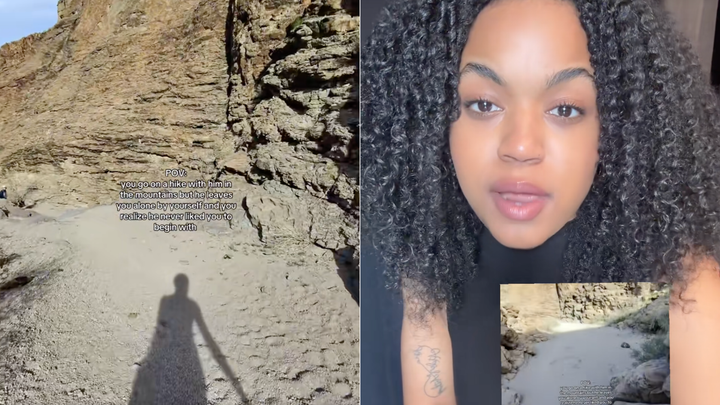
Over the past week, the unusual term has been trending on social media, particularly on Threads. The conversation stems from a TikTok video posted last month by a woman who said she was left alone on a hike after a man who invited her along abandoned her.
We reached out to the woman to verify the claims in the video, which has over 21.8 million views, but did not receive a response before publication. But in a new follow-up video, she said it all went down during a recent hike with a date in the North McCullough Wilderness area of southern Nevada. According to her, her date rushed ahead to beat other hikers to the summit and left her behind to catch up on the trail.
“He said he wanted to run and I remembered thinking, ‘Why are we chasing strangers to the top of the mountain?’” she said in the clip. (Good point!)
In the comments on the original video, women broadened the conversation, saying that having a partner leave you on a hike or any other outdoor outing was a surprisingly common experience. Some claimed that there were whole online support groups filled with women who’ve been abandoned mid-hike by men – an “alpine divorce”, they labelled it.

The eerie-sounding phrase comes from the title of an 1893 short story by Scottish-Canadian writer Robert Barr, about a man who plots to kill his wife while they are traveling in the Swiss Alps.
As women discussed the topic and shared tales of alpine divorce and breakups, they were met with some disbelief in the replies, mostly from men. “Things that never happened for 500,” one guy replied to a Threads post.
Obviously, he’s not a true crime follower. If you pay attention to such stories in the news, you know that things like this – attempted murder through remote abandonment, essentially – sadly happen all the time.
Just last month, an Austrian climber was found guilty of gross negligent manslaughter after his girlfriend – who was said to be “light-years behind him in terms of her climbing abilities” – froze to death on Austria’s highest mountain in 2025.
And then of course there’s Gabby Petito, who died by strangulation in late August 2021 in the Spread Creek Dispersed Camping Area of the Bridger-Teton National Forest in Wyoming. Her remains were found there a month later, with the coroner determining the death was a homicide, perpetrated by her boyfriend Brian Laundrie.
Given the preponderance of actual alpine breakups, is it any wonder why women choose the bear over a man?

Igor Suka via Getty Images
We talked to women who’ve experienced ‘alpine divorces.’
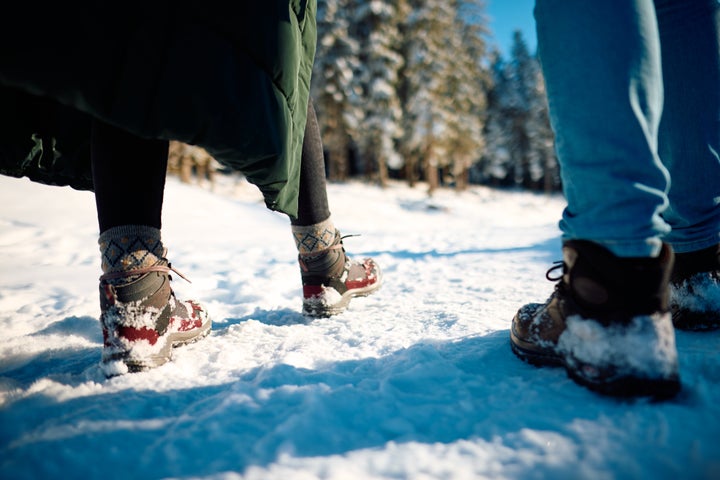
Carol, a 51-year-old from Central Texas, was among the women who shared a story about being left behind, in her case by an ex-boyfriend in college on a slope in Lake Tahoe in 1993.
“My roommate and her friend went off to some of the lower slopes, but my boyfriend dragged me to the very tip-top so he could show off his mad skills,” said Carol, who asked to use her first name only to protect her privacy. (Said ex is now a convicted felon, for an unrelated crime.)
They skied one short bowl run down the back side of the mountain, before Carol got lightheaded from the altitude. (It didn’t help that both were suffering from a hangover.)
“He didn’t want to hassle with getting me back down,” she said. “It would harsh his vibe – he was there to tear up some snow – and I was too winded to find the way down and too disoriented to ski to one of the short lifts to the top where I could get the gondola back down.”
Her boyfriend’s solution? Dig her an “emergency” hole – “think like a seat, not a cave” – and put Carol in it so he skied for the rest of the day.
“I stayed there until a good skier Samaritan came by, got me out of the hole, took me to the gondola, and deposited me at the ski patrol, where I proceeded to faint from dehydration,” she said. They patched me up and took me back to our condo, where I fell asleep. Said boyfriend did not return until late in the evening.”
At 19, she admits she didn’t “understand what an absolute dick move that was,” and the pair didn’t break up for a few more months of other equally awful episodes, she said.
“But now, reading these stories, I immediately see myself in a hole on the back side of a mountain at 19 years old,” Carol said.
Wiser now, she says she’s learned to leave at the very first sign of disrespect or crossed boundaries, to trust her gut, and to take responsibility for her own skill level and safety.
“That starts with being able to detect disrespect and know what our boundaries even are,” she said.
Photographer, Basak Gurbuz Derman via Getty Images
Amelia Ehrens, a British Columbia woman and experienced hiker, said her ex left her behind for 10 days at Kearsarge Pass in the Sierra Nevada while they were hiking the Pacific Crest Trail.
As she explained to HuffPost, when you’re hiking almost every single day for five or six months, it’s not entirely uncommon for hiking partners or groups to split up for the day, or multiple days sometimes.
“That said, on the most dangerous sections of the trail – at high altitude or in snow with sketchy river crossings – you never leave anyone behind if it’s not explicitly agreed upon,” she said.
When she saw “alpine divorce” trending on Threads, she felt terrible knowing she wasn’t alone in being left on a trail.
“Unfortunately, I’m not shocked, though,” she said. “As amazing and wonderful as many hikers are, and the hiking community is in general, it’s definitely a sport that has a lot of ego in it.”
People with an ego sometimes make choices that endanger others, either consciously or not, she told HuffPost.
“There’s immense power in being able to abandon someone in a dangerous or terrifying environment, and for certain types of abusive people, that’s very enticing,” she added.
As her experience in the Sierras reminded her, no relationship is ever worth staying in if you don’t have, at the absolute bare minimum, physical or emotional safety.
Here are some tips for staying safe on hikes with anyone
Human to human, no matter how upset or frustrated you are, it’s never acceptable to leave someone on the trail, said Amanda Neiman, the operations director in North America for Wildland Trekking, an Intrepid Travel company.
To be safe, it’s wise to prepare for any hike as if you’re going alone – even when you’re not, Neiman told HuffPost.
“Plans change. Weather shifts. People leave,” she said. “Confidence comes from knowing you can handle it.”
Start with actual supplies. Don’t rely on your hike partner to pack everything in their backpack: bring snacks, water, a map, even if it’s a screenshot of the map at the trailhead. (Read more about the 10 essentials for hiking here.)
Be sure to pack a basic first aid kit that includes a light – don’t just rely on the flashlight on your phone, which could run out of battery.
“Look at the weather ahead of time to know the appropriate clothing for the hike,” Neiman said. “I personally always hike with a rain shell even if there is no rain in the forecast.”
Evgeny Vasenev via Getty Images
Maybe don’t go on a hike as an early date, either. “Get to know their character first,” said Heather Balogh Rochfort, freelance adventure journalist and host of TrailblazeHER, a YouTube channel for outdoor women.
“Do they care about their goals over people?” she said. “How do they handle your existing disagreements [when you’re] not on an arduous nature walk?”
Like Neiman, Balogh Rochfort’s first tip is to build confidence so you don’t actually need anyone else to get out safely.
“I really believe women should spend more time outside on their own, even if it means starting really small with a tiny, one-mile hike or something,” she said. “Something that lets you prove to yourself, ‘I can do this.’”
When you know deep down inside that you are fully capable of handling a situation, the dynamic completely changes, Balogh Rochfort said.
“You’re not dependent. It’s a powerful shift to go from ‘please don’t leave me’ to, ‘If you leave, I’ll be mad but totally fine.’”
And if someone does ditch you in the end? “Screw them,” she said. “Eat your snacks. Drink your water. And get yourself out with the knowledge that you’ll never let them waste your time again.”