
Politics
Wings Over Scotland | Governing For Beginners

My first ever real experience of politics was playing Dictator.

Originally written by Don Priestley for the Sinclair ZX81 in 1982, it was a simple text-based game which subsequently came to other formats including the Commodore 64, BBC Micro, Elan Enterprise and the ZX Spectrum, which is where I encountered it.
(Its legacy very much lives on in modern games like Reigns, incidentally.)
It installs you as the new despotic ruler of a banana republic called Ritimba, located “somewhere vaguely equatorial” – it could most reasonably be interpreted as either Central/South America or Africa – which is home to various interest groups, including rebel guerrillas who may or may not be linked to the neighbouring country of Leftoto.
You start off with the country in pretty good shape after your coup, with almost uniform support across the board.

Your objective is to rule and survive for as long as possible without being assassinated or killed in a revolution, by balancing the demands of conflicting groups like peasants and landowners, with the assistance (or not) of the military and the secret police.
But rather than explain the entire plot, let’s see a game play out.
And if you play Dictator for a while, you quickly work out the best strategy, which is summed up by this frame in Garth Ennis’ brilliant and highly popular comic book (and subsequently a TV series) Preacher, depicting a resignation letter to unlikely disfigured pop star Arseface from his manager, Lt. Col Gene Sergeant.
(Don’t say we’re not bringing you culture today.)

To save you deciphering all that ornate handwritten text, the end reads:
“I shall leave you with some words of wisdom that my dear old Pappy left for me: Fuck ’em for all they’re worth and run like hell, Gene.”
The game of Dictator in the above video is an unusually successful one, with the unseen player managing to hold on in office for an impressive 18 months, scoring a total of 91 points.

But that’s not the best way to play Dictator. The actual optimal strategy is this:
(1) On your first turn, go to the “IMPROVE YOUR CHANCES” menu and dump half the contents of Ritimba’s treasury into your personal Swiss bank account. (You don’t get to select the amount, it’s always half.)

(2) On your second turn, buy the escape helicopter for $120,000.
(3) And that’s basically that. From then on, just try to survive as best you can, grab as much short-term cash as possible (including aid from the Russians and Americans) until one or other group revolts, at which point you take no chances and scarper in your chopper.
You won’t stay in office anywhere near as long that way, but you’ll score a lot better, as demonstrated by my short and eventful reign here.

Because what Dictator depicts is that Ritimba, in common with almost every country on Earth today, can’t actually afford to run itself.

No matter how well-intentioned you set out, the numbers just kill you. The population are fickle, remembering only the last thing you did for them. You can give the peasants a national health service, free education and union rights, but introduce conscription to please the army and they’ll forget all that and your popularity will plunge.


Here, for example, by refusing to spend $120,000 on an irrigation system, we’ve upset the Landowners AND the Peasants, who are now in an unlikely revolutionary alliance against us (signified by the “A” – no one group can ever revolt by itself).


(Of course, it’s the plebs who have to put their lives on the line.)

But all that 120 grand would have done was buy you another month, maybe two. It’s a really bad return for such a large outlay. Much better to pick on the foreigners.


That lets you stick more cash into your Swiss bank account, until the inevitable day arrives (on this occasion just five months into your rule).


Now, you might get lucky and crush the revolt, at which point it’s wise to exact a bloody revenge to ensure the revolutionaries are too weak to try again.

[sound of machine guns]

But you shouldn’t take that risk at all.

As soon as things get hairy, you should haul ass out of there and live out the rest of your life in feather-bedded luxury (maybe with a lovely consultancy gig in business or the third sector or even writing novels). That’s where you get the big points.
And readers, while Dictator is a very rudimentary game in coding terms and came out more than 40 years ago, it actually painted a pretty accurate picture in 1982 and nothing much has changed since. Countries still run at a loss, and you can never please everyone. It’s a fundamentally impossible job, you have to sacrifice every principle very early on, the public are ungrateful bastards even if you try to be nice, and if you try to crush them they’ll eventually shoot you.
That’s why every governing party gives in to corruption the moment it achieves power (or even earlier), and why you should never expect anything else from them. All you can do to keep them even slightly honest is stay alert, take matters into your own hands and keep reminding them who they’re supposed to work for.

That takes time, effort and money, and is also why they try to take away your freedoms any chance they get, on any old excuse.


And why they want to shut down anywhere you might gather and talk about it.


That’s an impulse that spans the political spectrum, but Labour has been especially prone to it, this century in particular.
Because the interests of politicians and the people are almost always in direct conflict, and they’re bothering to conceal it less and less. (Our theory is that the rot really started in 2009 with the expenses scandal, when they collectively realised how much they could get away with by just brazening things out, but that’s another article.)
The obvious (and rational) outcome of that is that people turn to a “screw the lot of you” entity, whether that be a political party or something more sinister. The electorate is getting angrier and angrier, and the more contempt they see parties holding them in the worse it gets.


The mainstream parties in both Scotland and the UK may well already be beyond the point of salvation. But if their voters and members can’t persuade them to see sense soon, they may all find themselves wishing they’d bought escape helicopters on their first day in office, and deciding that the only way out is to kill you instead.

So be careful who you vote for, readers, and try to have a better reason than that they’re “your” team. They’re not, and it isn’t a game.



Keir Starmer is allowing the US to use UK military bases to bomb Iran. This is an explicit deviation from his line that they should be used only for “defensive purposes”.
Specifically, Starmer has said that UK bases can be used to
strike Iranian sites targeting Strait of Hormuz
His previous comments meant that the US could only use UK bases for actions that would stop Iran from firing missiles that put British interests or lives at risk.
However, despite this, we have still repeatedly seen photos and videos on social media showing large bombs being loaded into US warplanes, on UK soil.
So Starmer may only be publicly changing his mind now, but it appears that US forces were already doing it.
The BBC have decided to report on a thing that’s been happening for two weeks https://t.co/YSA1cmiBvC
— Nate Bear (@NateB_Panic) March 20, 2026
Starmer — war criminal
Human rights groups are warning that the UK allowing the US to use its military bases could violate international law.
Yasmine Ahmed, Human Rights Watch UK director, has demanded “urgent clarification” from the government to ensure that US military strikes conducted from its bases are “compliant with international humanitarian law”.
But how can any strikes in a war that started due to Israel and the US’s unprovoked attacks possibly be “compliant with international law”?
There have been more international law violations in the last three weeks than even Ai Neyanyahu has fingers to count.
International law only works if everyone abides by it.
Starmer is proving over and over that he is a war criminal.
I truly hope Starmer will one day be tried and jailed for his complicity in countless war crimes. https://t.co/84FRFoV6sq
— Red Collective (@RedCollectiveUK) March 20, 2026
You’d have thought a former prosecutor might have reflected on the lessons from the illegal Iraq war.
This war isn’t about nukes, it’s about power. Trump‑Netanyahu’s moves against Iran ignore international law. Global energy suffers, ordinary people pay, while big powers play dangerous games. #EndTheWar #USIsraelExposed #IranWar https://t.co/FFHR9UWQZT
— Lenin Ravi (@leninravi) March 20, 2026
Especially when neither parliament nor the British public have voted on the country going to war.
Britain should block the US from using our bases
British people want no part in this illegal war! https://t.co/F7Sz4XsfL3
— Manchester Green Party 🐝 (@McrGreenParty) March 21, 2026
Consequences
Like usual, British households will pay the price for the government’s inability to engage their brains and face the consequences of their actions.
Keir Starmer is taking Britain into an illegal war AGAINST the wishes of the majority of British people
And putting us in danger
Starmer is a disgrace https://t.co/MxBEGqhoqr
— Stop The Bollocks with Mirabel (@MirabelTweets1) March 20, 2026
No discussion.
No vote.
No accountability.Call it what it is: escalating participation in an illegal war of aggression. https://t.co/sX0OCcnnMo
— Jonathan Bartley (@jon_bartley) March 20, 2026
Just as Starmer has participated in Israel’s genocide in Gaza, he is now also participating in murdering innocent Iranians.
We can count on Starmer playing the victim when Iran bombs UK bases.
Watch them spin it like they’ve done nothing wrong when Iran bombs UK bases https://t.co/ObjSybLpg1
— Leah Dionne (@leahdionne__) March 20, 2026
Iran warned him that anyone assisting Israel and the US’s illegal and unprovoked attacks would be fair game.
Similarly, it warned the world that it would retaliate for strikes on oil and natural gas facilities. It even issued evacuation orders, which is far more than the US or Israel did when they blew up Iran’s South Pars gas field.
Yet still, Starmer blames Iran and “condemns in the strongest terms“. Meanwhile, he allows the US and Israel to blow up Iran’s facilities.
So much for standing up to Trump. Starmer is a pussy. And he couldn’t be further up Trump and Netanyahu’s arses if he tried.
This is a universally un-fucking-popular war here. It’s a public easy win to simply not involve us in another war in the middle-east.
Instead, we are prioritising licking the boot of a foreign leader who is quite candid about doing this illegal war for his own oil gains. https://t.co/F2TlWMRZ4l
— Ryan T. Brown 🎮🩷 on holiday! 🌞 (@Toadsanime) March 20, 2026
Starmer is nothing but a Temu Tony Blair. But we have to ask why Labour love war so much? Supposedly, the party of the working class, yet more concerned with blowing up black and brown people in the Middle East than making sure British people can afford their energy bills. All while lying about their involvement.
Starmer’s blind allegiance to the US and Israel is dangerous and will make the UK a direct target for retaliatory attacks. But he can’t say no one warned him.
Feature image via HG

A pack of hounds from the Heythrop Hunt rampaged through a private garden and killed a fox on Wednesday 11 March 2026. Blood stains remained on a resident’s lawn in Condicote after approximately 30 hounds chased the terrified animal through the village.
Footage taken by Three Counties Hunt Saboteurs shows the pack running wild on driveways and through gardens in the scenic village. Hounds appear with blood on their coats whilst drinking from plant pots and buckets.
The hunt staff allegedly entered the property without permission to remove the poor creature’s body. Joint masters Ollie Dale and Vanessa Chanter were filmed attempting to remove a camerawoman from the garden. The hunt broke the garden fence during the altercation.
Another member of the hunt, Josh Tierney, was seen with bloodstains on his trousers after removing the body of the poor fox away from the crime scene. Whilst the homeowner allowed activists to film the site, the hunt forcibly escorted them out once the owner went inside.
Systematically wreaking havoc in the countryside
This incident is just part of a wider pattern of hunting-induced havoc across the UK. The League Against Cruel Sports recorded 1,117 reports of hunt havoc during the 2024/25 season. These reports include (PAGE 5):
- 319 incidents of trespass on private property.
- 423 incidents of out of control or lost hounds.
- 367 reports of road havoc caused by the hunt.
Rowan Hughes, a spokesperson for the Hunt Saboteurs Association said this shows why hunting needs a total ban. Hughes stated that hunts have no respect for private property and ‘shout trespass’ only when they are being exposed.

Broken fences, trashed properties, ruined lawns and injured animals are one side of the hunt that these ruthless riders are desperate to hide. The law is catching up with them, and public hostility toward the hunt has never been higher. At this critical moment, we must call them to account for every small infraction.
A history of the Heythrop Hunt controversy
The Heythrop Hunt are no strangers to controversy or press attention. In February 2026, Channel 4 News released footage of the hunt dumping dead chickens in woodlands. Activists claim this “feeding station” was used to lure foxes into areas so they can be hunted in the future. In the 24/25 season, monitors recorded 332 cases ((PAGE 8)) of hunt trespass nationally. So it isn’t just when these wankers are actively hunting, it’s also to lay the dirty groundwork to draw in their innocent prey.
The HSA reported that covert cameras captured the terrierman of the Heythrop Hunt. He was recorded dumping black bin-bags full of dead chickens between June and August 2025.

By October, the same cameras picked up the hunt pursuing the very foxes they had drawn in. This premeditated approach contradicts the claim that the hunts are simply following a pre-laid ‘trail. Unless these fucking dickheads are actively laying trails through peoples’ gardens, we can see the obvious lie.
Heythrop Hunt — Closing the trail hunting loopholes
Gloucestershire Police received a report of the kill but, as per usual, officers did not attend the scene. Police have not charged any members of the hunt at this stage.
In January 2025, this same hunt apologised after hounds ran through an industrial estate. The chairman previously told Bourton Parish Council that such incidents were “isolated”. But how can that be the case when once again we are seeing private property being used as the hunt’s personal playground?

Three Counties Hunt Sabs filmed this new footage after the Labour Party announced the plans to ban trail hunting. This reform was part of the Animal Welfare Strategy for England announcement on Monday 22 December 2025. A spokesperson for Three Counties Hunt Sabs noted that the kill happened whilst vixens are pregnant. And this is happening within half a mile of where staff dumped the chicken corpses.
The spokesperson urged the government to close the loopholes in the Hunting Act 2004. And urgently. This latest incident in Condicote suggests that trail hunting remains a smokescreen and is nothing but a thin veil to hide the hunt’s illegal activity.
The human cost of hunt trespass
The owner of the garden in Condicote was visibly shocked by the ruthless intrusion. He gave the hunt sabs permission to film the evidence before re-entering his property. Yet once the owner was out of sight, the hunt members used force against the activists. Despite them having no permission to be on the private land.
This lack of respect for residents is a common theme in rural communities. The League Against Cruel Sports reported that 76% of the public support strengthening the ban. Yet the current legislation allows hunts to claim they are following a scent trail. However, in a case like this when a fox is killed in a garden, that excuse becomes impossible to justify.
We reached out to Simon Russell, chair of the HSA who said:
“The current Hunting Act 2004 has so many holes, you could drive a van through it. Although Hunt Sabs have achieved more hunting convictions than any other organisation, the 99% of times we see illegal hunting, there is no chance of a conviction. The government needs to do a lot more than just ban trail hunting, which seems to be its only focus.”
So as the Labour Party moves towards a total ban, incidents like this should be increasing public pressure. The sight of blood-stained trousers and dead foxes in gardens is a stark reminder of the reality of a government and a police force that don’t give a fuck.
Featured Image via The Three Counties Hunt Sabs

Byline Times has linked the components used in the Tomahawk missiles which hit a girls’ school in Mibab, to two defence companies with a strong presence in the UK.
The US missiles murdered around 165 school girls on February 28 in a double-tap attack. The second missile killed sheltering survivors, two first responders, and the parent of a murdered child.
Tomahawk cruise missile
Byline Times has revealed that analysis by Action on Armed Violence, combined with US Government procurement data, strongly suggests that the British defence industry — namely BAE Systems and Raytheon — produced parts for the Tomahawk missiles used in these attacks.
At first, there was speculation about the origins of the missile used in the attack and who was responsible. However:
independent analysis of video, satellite imagery and debris has consistently identified the munition as a Tomahawk cruise missile, a system used by the United States and its allies in this conflict, and no credible source has contested the origin of the recovered fragments.
One of the recovered components is marked “SDL ANTENNA”. This is:
part of the satellite data link system that allows the missile to receive mid-flight guidance updates.
The markings on the part identify its manufacturer as Ball Aerospace & Technologies Corp. This is a US-based contractor. However, BAE Systems, a UK corporation, owns Ball Aerospace, having acquired it in February 2024.
The weapon fragment contains the code 13993, issued by the US Commercial and Government Entity. This code makes it clear that the company owned by British BAE Systems manufactured the missile’s satellite communications antenna.
Of course, detailed information on current subsystems is partly classified. However, there is no evidence of any recent changes to the UK’s supply of core components, such as those used in these strikes.
Byline Times added:
Since acquiring Ball Aerospace in 2024, BAE Systems has retained its capabilities in Radio frequency (RF) and phased-array (multiple antennas) technologies, making it likely that similar components remain in production under UK ownership.
It is often hard to attribute weapons components to a single strike, as Byline Times has done in this case. However, UK-linked components are a consistent feature of the Tomahawk system.
Additionally, the recovered fragment contains a contract number: N00019-14-C-0075.
According to Byline Times, US Naval Air Systems Command records show that Raytheon won this contract in 2014 to produce Tomahawk Block IV missiles, with “subsequent modifications expanding the order”.
This means that we can directly link the recovered component to that production programme.
The UK’s wider role
Byline Times has also seen wider procurement data that points to “continuity” in the UK’s role in the Tomahawk programme.
Around 4% of the production of the US Tactical Tomahawk programme is based in the UK — at Raytheon UK’s Glenrothes facility in Scotland. It manufactures “electronic and guidance components” for missiles.
According to Byline Times:
Raytheon UK received more than $15 million for its contribution to this production lot according to public financial records (contract N00019-14-C-0075). UK parliamentary records have also previously confirmed that components produced at the Glenrothes site are exported to the United States for integration into Tomahawk missiles, indicating a sustained role in the programme.
An unclassified US Selective Acquisition Report (SAR) also shows that the UK plays an official role in the Tactical Tomahawk programme.
It states:
The FY 2014 procurement includes 196 surface and subsurface launched AURs, 20 torpedo tube launched AURs as part of the United Kingdom Foreign Military Sales case, and 15 surface AURs (FY 2013 funded through Buy-to-Budget).
The UK government doesn’t usually disclose which British-made components are included in weapons used by allied forces, or how these systems are deployed. However, the US does provide detailed procurement data. This means we can trace which company produced specific components.
UK complicity in war crimes
Even before this latest revelation, the UK was already complicit in Israel and the US’s war crimes.
Previously, Keir Starmer claimed the UK was “playing no role” in the illegal attacks on Iran. Then he stated the UK was only taking part in “regional defensive operations”. Now, Starmer is allowing the US to load massive bombs into planes to bomb Iran.
And to make matters worse, it now turns out that the US and Israel are using weapons with British-made parts to blow up little school girls.
You’d have thought a former prosecutor might have had a hard red line when it comes to war crimes. But apparently not. Starmer has even more blood on his hands.
Feature image via HG

I have always prided myself on having a sixth sense for deception, an ability to spot the lie buried in the casual comment or the discrepancy in a story that exposed what someone is working to hide. I figured that’s what made me a great thriller writer.
In 16 books published over 25 years, I’d been constructing elaborate plots where people led double lives and hid horrible truths with both blatant lies and simple misdirection.
My protagonists were always law enforcement – inspectors and detectives, a medical examiner – sharp-eyed women trained to see through shiny veneers to notice the small inconsistencies that eventually cracked the case.
And yet, for two and a half years, I missed the most obvious plot twist of my life: my husband was having an affair with his massage therapist.
The irony isn’t lost on me. Somedays, the irony is suffocating.
It was a Friday afternoon in December 2022 when I found out. Our kids were home from college for the holidays, and our family was preparing to head to Mexico to join my sister and her family for a week of sun, sand and margaritas.
I discovered his affair not through any brilliant investigative work nor the careful attention to detail I so prided myself on. Instead, the discovery came from a charge on a credit card statement – a session with a couples counsellor we hadn’t seen in almost a decade – that caused an uncomfortable pit in my stomach.
I sometimes wonder whether the appearance of that pit meant that suspicion had been planted before then – whether there was a part of me, deep and buried, that sensed the rot beneath the carefully maintained façade.
When I reached out to my husband, his phone was turned off. For more than two hours, the pit grew as he remained unreachable and our adult children began to sense something was wrong. When his phone finally came back online, I confronted him with the charge and asked what was going on.
“I’m almost home. Let’s talk then,” he responded. So casual. So calm.
When he arrived, he asked if we could talk without the kids.
“What’s going on?” I demanded when we were alone. “I’m not in love with you anymore,” he said in the same tone you might mention the oil light has come on in the car.
“Who are you in love with?” I asked.
Love was energy; it didn’t just dissipate into the ether. It went somewhere else.
“There’s no one else,” he told me.

Courtesy of Danielle Girard
He acted normal for the next 24 hours. In weak imitation, the kids and I tried to act normal, too, to prepare for our trip and the small Christmas celebration we planned before leaving.
The following morning, Christmas Eve, we were set to depart for our vacation when I woke at 4am with the memory of something my husband said when our friends divorced: “A man never leaves his marriage unless there’s someone waiting for him.”
I roused him at 4:04am and asked again, “Who are you in love with?” When he didn’t answer, I started to guess. I got it in two. On the first guess, he protested loudly. On the second, he went silent.
“How long?” I asked. If I’d written the scene, I like to think I’d have been more creative, but creativity evaporated in the panic of that moment.
I shouldn’t have been surprised that he lied again. It took more than three weeks to get him to admit that the relationship had been going on for almost two and a half years. Three years later, there are details that never quite squared and lies that were never ironed out.
As a thriller writer, I’ve spent countless days imagining the worst things people can do to each other. I’ve sat in coffee shops and on airplanes and at my desk and invented murders, betrayals, psychological torture.
I’ve been inside the heads of liars and manipulators and people who destroy others without remorse. That experience made me believe I understood human darkness with a clarity others lack. But understanding it for the benefit of a story and living through it are entirely different things.

Courtesy of Danielle Girard
For days after I found out, I moved through my life like a stranger. Every object felt suspicious, every memory potentially false. Had he been thinking about her when we were in Nashville for my birthday the month before? Was he texting her from our bed when I was in the kitchen and setting up the coffee machine for the next day? How many times had he said “I love you” while mentally planning his next Friday massage appointment?
“Really? Your massage therapist?” I asked once, during one of those miserable circular conversations where nothing gets resolved and everything gets worse. “A 50-year-old man and his massage therapist. It’s so cliché.”
The comment clearly stung, as if I’d insulted his creativity rather than his fidelity.
“We were friends first. She listened to me,” he said.
“I listen to you,” I said like a petulant child.
“You’re in your office, working, or you’ve got your nose in a book for the podcast.”
He wasn’t entirely wrong.
Once our kids had left for college, I’d shifted my focus to my writing and working harder than ever as my career took off. I’d stopped working on the marriage. My shiny new toy was the book; his worked out the kinks in his neck, ones put there by 30 years with me.
That December, I was neck-deep in a manuscript about a detective investigating a pregnant surrogate who goes missing. It was a book I’d been so excited about six months earlier, one I’d been confident was my darkest, most psychologically complex book yet.
After I learned my husband’s secret, I couldn’t write a word.
Every time I sat down at my desk, I’d cry or stare at the blank page, wondering why I bothered. What did these pretend murders matter? What did my clever plot twists signify when I’d missed the biggest one in my own life?
Beyond the logistical fears about my own future was another terrifying realisation: I no longer wanted to write the detective book. Overnight, I’d lost interest in stories about detectives solving crimes, justice being served through shootouts and the court system, about the bad guys getting caught and punished. Suddenly, those seemed too neat, too fake, like fairy tales and not the Grimm’s variety.
Real betrayal, I learned, doesn’t get solved in 300 pages. Real deception doesn’t wrap up with a satisfying twist where everything makes sense and the protagonist emerges stronger and wiser. Real betrayal sits there, ugly and unresolved, in the middle of your life while people take sides and you fill the garage with items you once cherished and no longer want to see.
I started thinking about the kinds of stories that had never interested me – messy ones where the protagonist doesn’t figure everything out and there are no clear villains, just people making terrible choices for complicated reasons. Stories set in the ugly places I’d never wanted to go until now.
When I found my way back to the page, I rewrote the surrogate story, cutting the point of view from the detective, and placing the biological mom at its centre with her best friend from high school as the surrogate who vanishes four days before the baby is due.
In this new version, the story focuses on these women who were friends in high school and the complications of their long, intense friendship.
Though there is a big moral question at the centre of the book, as well as a fun, juicy plot, it was the interactions between the characters themselves that allowed me to explore the messy reality of life that I was living through while writing.
My divorce was finalised at the end of 2023, a few months after I got a new agent, six months before my agent sold that book, Pinky Swear, at auction for release earlier this year. It was the hardest book I’ve ever written and the best.

Courtesy of Danielle Girard
The one I’m writing now is trickier, more complicated. It’s about a woman who discovers her husband’s long affair with a massage therapist.
My husband was married to a thriller writer for almost 30 years. This can’t come as a surprise to him. Still, this is not a memoir. There’s a murder, for starters. But there are echoes from my own experience in the details, like the secrets that begin small and seem harmless … until they’re not.
While the main character is not me, the protagonist is walking in my own, uncomfortable shoes, trying to construct a narrative to make sense of chaos, and working to find a path forward when the narrative crumbles.
Every time I drive downtown, I scan the cars, the street, the store or restaurant for my ex-husband and his girlfriend. I still haven’t seen them together, though I know that they are. I wonder what I’ll feel when I do – a fresh wallop of despair? Closure? I have run the scenario a hundred times, and I still don’t know.
What I do know is that the writing I’m doing now feels like what I should be doing. Not because detective fiction isn’t important or valuable, but because I’d been using it as a way to imagine I could manage the outcome and somehow avoid the terrible things that happen to people who I imagined weren’t as studious or as prepared.
For months, I’d been plotting elaborate lies and deceit in that first draft of Pinky Swear while missing the simple, stupid truth: that the person sleeping next to me was a stranger. That I was so good at inventing characters for mysteries, I’d forgotten to be curious about the one I’d married.
I see now what those books were really about: control. The illusion that if you’re smart enough, observant enough, careful enough, you can see the betrayal coming. You can solve the crime. You can write your way to safety.
But you can’t. Life isn’t a thriller, and there’s no genius detective who’s going to figure it all out – no satisfying final chapter where all the pieces fit. At least, not in my life. Instead, there are just little clues I recognised far too late about the person I thought I knew becoming someone I never knew at all.
The book I’m working on now – the one about the woman who discovers her husband’s two-and-a-half-year affair with his massage therapist – will be called Happy Ending.
It won’t be neat or easy, but it might be happy. I hope it will be.
Danielle Girard is the USA Today bestselling and award-winning author of several novels, including the Annabelle Schwartzman series and Pinky Swear. She is also the creator and host of the Killer Women Podcast, where she interviews the women who write today’s best crime fiction. A graduate of Cornell University, Danielle received her MFA in creative writing at Queens University of Charlotte, North Carolina. When she’s not traveling, Danielle lives in the mountains of Montana.
Do you have a compelling personal story you’d like to see published on HuffPost? Find out what we’re looking for here and send us a pitch at pitch@huffpost.com.

When was the last time you asked your partner something more meaningful than “How was your day?” or “What’s for dinner?”.
It’s easy to think you know everything about the person you’re with. But people evolve over time, and relationships thrive on curiosity.
Asking the right questions can help you better understand your partner and deepen the emotional intimacy between you.
“The ‘right’ questions deepen emotional connection and shared meaning,” licensed marriage and family therapist Tara Gogolinski told HuffPost.
“They focus on each other’s inner worlds, not trivia facts or sameness. Couples who understand each other’s emotions, needs, and desires are more resilient, more satisfied, and better able to navigate conflict.”

Westend61 via Getty Images
Dr. Annie Hsueh, a licensed clinical psychologist and couples therapist, said asking thoughtful questions also helps partners develop a “love map” of one another’s inner world – a concept popularised by relationship researcher Dr. John Gottman in The Seven Principles for Making Marriage Work.
Couples who maintain detailed love maps are better able to navigate stress, conflict and life transitions, such as having a child or coping with illness.
“Getting to know your partner intimately isn’t a one-off process; it takes consistency,” Hsueh said.
Regular check-ins – whether daily or weekly – while asking the right questions can help couples stay curious about one another and deepen their understanding over time.
The most important questions to ask your partner
According to Gogolinski, healthy couples don’t need to know everything about each other. But there are key questions that, if partners know the answers to them, are strong indicators of a healthy relationship.
“These questions get at the heart of three important concepts: being in tune with each other’s feelings and noticing when something is off (emotional attunement); feeling safe, supported and confident in the relationship (secure connection) and listening, responding, and showing your partner that what they say truly matters (responsive communication),” she said.
Some core questions include:
- What helps you feel most loved or valued?
- What fears or insecurities tend to trigger you?
- How do you prefer to receive comfort when you’re overwhelmed?
To navigate recurring conflicts, Gogolinski recommended knowing your partner’s stress patterns:
- What situations or topics cause you the most stress?
- How do you typically cope: withdrawal, problem-solving, humour?
- What cues indicate you’re feeling overwhelmed or shutting down?
- How can I best support you during stress?
Understanding each other’s emotional world also extends to long-term dreams, values, and personal history:
- What are your long-term goals?
- What excites you the most?
- Who influenced you most growing up?
- What experiences shaped who you are today?
Gogolinski said, “Asking these questions helps you understand your partner on a deeper level and allows you to support them meaningfully.”

bymuratdeniz via Getty Images
Questions that can deepen your connection
One simple way couples can stay emotionally connected is by asking questions that go beyond surface-level updates, Hsueh said.
“When you ask not just what has been on your partner’s mind, but also what has been on their heart, it allows them to reflect more deeply on the things that matter most,” she said. “Stay curious and let the conversation flow. It can deepen your bond.”
Hsueh suggests starting with a daily debrief at the end of the day, which can open the door to more meaningful conversations.
Daily check-in questions might include:
- What was the toughest part of your day today?
- How are you feeling about it now?
- How can I best support you?
- What was the best part of your day today?
- What’s something unique that happened today?
Beyond day-to-day updates, Hsueh recommended regularly checking in about different aspects of your partner’s inner world – including their stress, dreams, emotions, personal history and relationships.
Deeper check-in questions could include…
Stress and concerns
- What’s been weighing on you lately?
- Is there something difficult you’re dealing with that you wish I understood better?
- What concerns have been on your mind recently?
Hopes and dreams
- Where do you see yourself in five years?
- What excites you the most right now?
- Is there something new you’d like to try or learn?
- How can I support you in achieving your goals?
Emotional world
- What moments have brought you joy lately?
- When do you feel happiest?
- What’s something that has been upsetting recently?
Personal history
- Who influenced you most growing up?
- What childhood memories stand out to you the most?
- What experiences shaped who you are today?
Relationships
- How are you feeling about your friendships lately?
- How are things with your family?
- When do you feel most supported by the people around you?
“These types of questions allow you to get to know your partner on a deeper level,” Hsueh said. “They can also help you understand how best to support them, and even make exploring different parts of your lives together more fun.”
How to ask these questions effectively
If asking these types of questions are new to both you and your partner, both Gogolinski and Hsueh recommend the following to make it feel more seamless and natural:
- Soft startups: Begin with curiosity, not accusation.
- Scheduled rituals of connection: Regular check-ins and shared routines keep communication consistent. Pick a time of day or a specific day of the week, and stick with it.
- Turn-taking: Let one partner speak while the other listens fully.
- Normalise differences: Accept that you don’t have to share all preferences to have a strong bond.
- Create emotional safety: Private, distraction-free conversations build trust.
As important as it is to ask the right questions at the right time, both Hsueh and Gogolinski emphasise the importance of honing your listening skills.

“Work on being a good listener,” Hsueh said. “Respond to your partner with curiosity and openness. Listening and staying engaged can help your partner feel safe sharing their thoughts and feelings. The more you create safety around vulnerability, the more you’ll be able to open up to one another – and the closer you’ll become.”
Gogolinski agrees that the intention behind listening matters just as much as the questions themselves.
“It’s important to listen with the intention of understanding, rather than simply preparing your response,” Gogolinski said.
“Validate what you hear your partner saying – for example, ‘Thank you for sharing that,’ or ‘I can see why you’d feel that way.’ Staying curious helps keep the conversation open and prevents defensiveness, assumptions or mind-reading.”
“Try to listen for the emotion being expressed, not just the surface-level content,” she continued. “When we reflect our partner’s emotions back to them, it helps them feel truly understood.”

The post Why is Bob Vylan posing with the ayatollah? appeared first on spiked.

The Starmer government has announced that the UK navy will bail out the Epstein axis’s floundering, illegal war on Iran. A statement on the official UK government website declares that because of its “deep concern about the escalating conflict”, the UK will help escalate the conflict by collaborating with the US.
The UK navy will assist the US in trying to keep open the Strait of Hormuz, along with France, Germany, Italy, the Netherlands, Japan and Canada. The UK is therefore, entirely unsurprisingly, siding with the aggressors to prevent a sovereign state defending itself in accordance with international law.
But, Starmer being Starmer, the hypocrisy has to be ladled on. The statement also:
condemn[s] in the strongest terms recent attacks by Iran on unarmed commercial vessels in the Gulf, attacks on civilian infrastructure including oil and gas installations, and the de facto closure of the Strait of Hormuz by Iranian forces.
We express our deep concern about the escalating conflict. We call on Iran to cease immediately its threats, laying of mines, drone and missile attacks and other attempts to block the Strait to commercial shipping… Freedom of navigation is a fundamental principle of international law, including under the United Nations Convention on the Law of the Sea.
The effects of Iran’s actions will be felt by people in all parts of the world, especially the most vulnerable.
Oddly, no mention is made on the page of the US’s gleefully murderous sinking of an unarmed Iranian ship in international waters, or Israel’s wanton attack on Iran’s major gas field designed to ‘escalate the conflict’ and prevent any negotiations to end the war. Or of both those countries launching their illegal war of aggression in the first place, which forced Iran to take all the measures it can to — entirely legally — defend itself.
Since Starmer is taking the side of the aggressor, those are presumably ok. Yet he and his drones continue to insist ‘we’ are not really taking an active part.
Featured image via the Canary
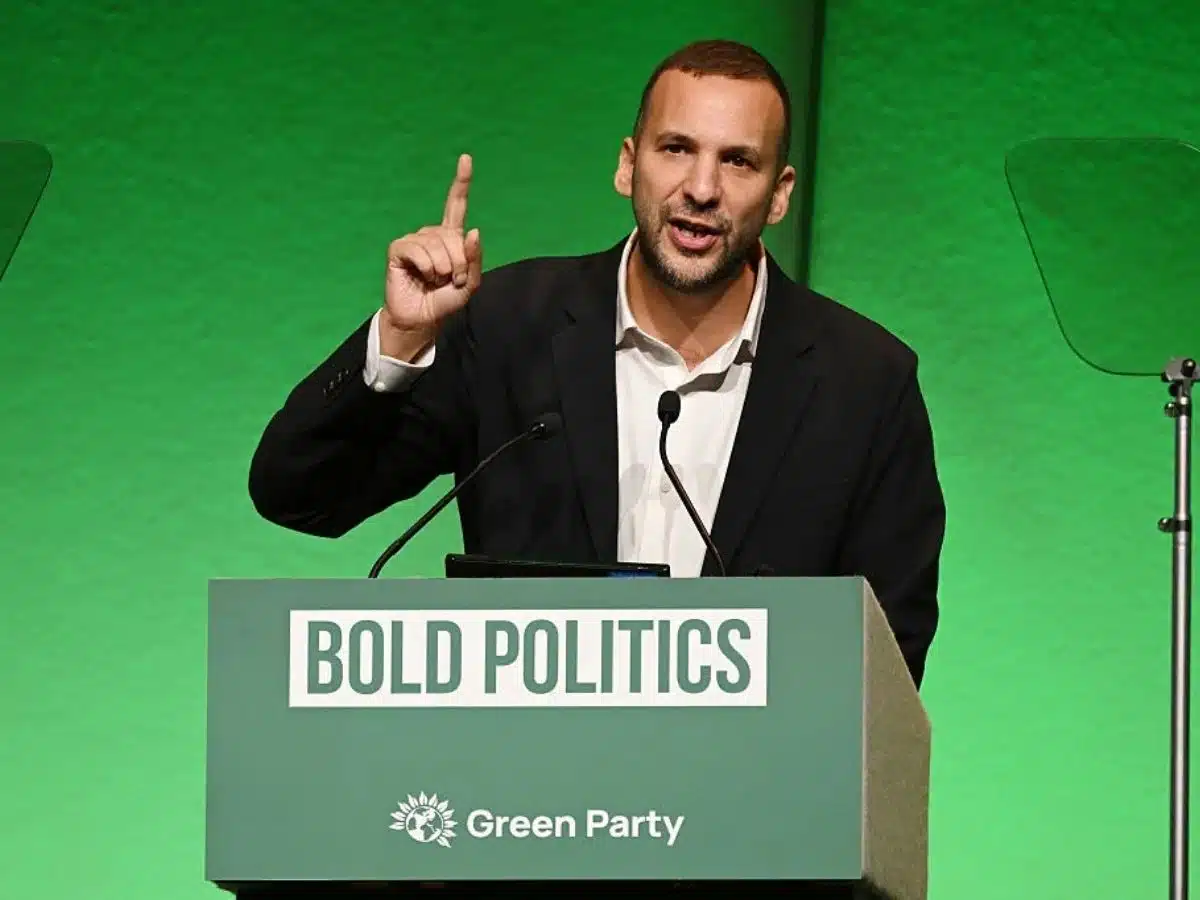
Green party leader Zack Polanski delivered his first economic speech to the New Economics Foundation on 19 March. Polanski’s diagnosis of the issues with the UK were privatisation, deregulation and the excesses of the rentier class. His solutions included nationalisation of water, rent controls and wealth taxes.
Zack Polanski — End ‘rip off Britain’
He began by highlighting the ‘extreme economic inequality’ in the UK:
We live in Rip Off Britain. Sky high bills, stagnating wages – extreme inequality. It can’t go on like this. But we have a plan to change it.
He then spoke of how green energy not only addresses the climate crisis, but also delivers cheaper bills and shields the UK from volatile international oil markets:
Spain… has doubled its wind and solar capacities since 2019, taking it from having some of the highest energy bills in Europe to some of the lowest. Other countries have been able to learn the lessons from previous crises and prepare – why is our response so weak when disaster strikes? The answer, put simply, is that we live in rip-off Britain: an economy built to reward the few off the work of the many. A country where people work so hard and try to do the right thing but still struggle to afford the basics, and people find themselves constantly cutting back.
Polanski stopped short of offering a publicly owned Green New Deal in his speech, simply saying that we should speed up the transition to renewables. Currently the market is moving towards renewables, but it isn’t happening fast enough to avert the risk of climate catastrophe. It’s worth noting that the esssential of energy was once in public ownership and would deliver even cheaper running costs.
That said, he did state the problem:
A bonfire sale of our water, our energy, our railways – and so many other fundamental services – meant UK Public Wealth went from the Highest in the G7 to the Lowest… over… two decades.
End Right to Buy
Polanski began with an analysis of Right to Buy, but then concluded that it should be replaced with state landlordism:
Over two million houses have now been sold under right to buy since it was introduced. In the first place, those houses went to people who had worked hard and saved up to own the home they lived in and loved – but now they’re increasingly owned by private landlords, property developers and investment firms who treat those homes – and their tenants – as cash cows.
So we need to end right to buy completely.
Instead, why not replace the social homes that are bought up and make provisions against them being used for private rent?
Billionaire Britain
Polanski continued:
In 1990, when I was going through primary school, and there were 15 billionaires in the UK. By last year, that number had risen to 154. And let’s look at how those people are making their money: today, more than 1 in 4 billionaires draw some or all of their wealth from property and inheritance.
Unearned wealth is a huge issue because it undermines the economy. Inheritance tax should be progressive rather than flat.
Zack Polanski on public investment
The Green leader then spoke of an issue with government planning:
UK fiscal forecasting currently relies on rigid fiscal multiplier assumptions that constrain effective government policy. By assuming that spending multipliers expire after 5 years, the current model is prioritising short-term fiscal targets over the longer-term economic and social gains that targeted government spending could achieve. Right now we can’t plan major infrastructure projects. We can’t invest properly in a healthy, educated population. Right now, we can’t build our future.
To be sure, Polanski’s speech was an inspiring and accurate diagnosis of the issues with Britain.
Featured image via the Canary

I regularly drink from stray glasses of water I see scattered around my house that were poured the day before. I think I’m being efficient and resourceful, but am I being safe?
Experts say there is actually a tipping point at which it is better for your health to dump that glass of water and start afresh.
Kristen Smith, a dietitian and spokeswoman for the Academy of Nutrition and Dietetics, said that she personally follows a 12-hour rule for a glass of water. After 12 hours, Smith will pour it out and drink a new glass. However, she said you can drink a day-old glass of water “as long as it hasn’t been exposed to contaminants or left uncovered”.
Microbiologist Jason Tetro, aka The Germ Guy, also said 12 hours was the limit for drinking leftover water in glasses.
To him, the potential bacterial problems wouldn’t come from air contaminants but from the tap. One study found that bacterial cell concentrations in drinking water increase overnight. Infrequently used drinking water taps can also harbour high levels of bacteria.
“For those first 12 hours, there’s not going to be enough food for the bacteria numbers to rise,” Tetro said. “After those 12 hours, there will be food for the bacteria to multiply.”
In other words, if you drink water from the night before, you’re likely fine. But if the water has been sitting for a whole day, it’s better to get a new glass of water, even if you used a water filter, Tetro said, or you risk suffering from gastrointestinal issues.
Day-old water “becomes a growing environment for opportunistic pathogens,” Tetro said. “And so what you want to do is just get a new glass of water.”
Sharing water with someone else speeds up the timeline of when you should tip it away.
“Once a person drinks directly from a bottle or glass, bacteria from their mouth can transfer to the remaining liquid and begin to multiply,” Smith said. “So for that reason, after you put your mouth on a bottle, it’s best to finish it in one go and dispose of it rather than saving it for later, especially if you’re sharing a cup or bottle with someone else.”
You can buy yourself more time by using bottled water, which is designed to avoid bacterial growth for longer than a day, Tetro said.
Of course, if you are parched, it’s better to stay hydrated than worry about how stale your water is.
If “the only option you have is that water bottle that’s been sitting around for a day, it’s definitely better to drink than to stay dehydrated,” Smith said.

As Muslims around the world are celebrating Eid al Fitr, with family gatherings and the sharing of food, the Israeli occupation continues to detain thousands of Palestinian prisoners in their jails. Since the beginning of the genocide in Gaza, these political prisoners have continued to be banned from any communication and visits with their families.
Hundreds of Palestinian prisoners have not communicated with their families for decades
The Palestinian Prisoner’s Society says that hundreds of Palestinian prisoners have been prevented from seeing their families for decades by the Israeli occupation — some for as long as 40 years.
Since October 2023, these policies of isolation have expanded exponentially, and have further intensified since the US and “Israel” began their attacks on Iran. Lawyers have long been the only window to the outside world for Palestinian prisoners, but the occupation has now also suspended all lawyer visits for detainees. It has also extended the state of emergency in prisons, until May. This means that any measures imposed on prisoners since the beginning of the genocide in Gaza will remain in place, under the pretext of “security”.
Escalating Abuse and Conditions During Ramadan 2026
The Palestinian Centre for the Defense of Prisoners (PCDP) says this Ramadan 2026 marked:
one of the harshest periods for Palestinian detainees in Israeli prisons in more than four decades.
Not only were prisoners having to cope with the usual medical neglect, starvation and torture, but they were also facing unprecedented conditions during Ramadan, imposed on them by the occupation. “Israel” ensured there was a lack of regular pre-dawn meals, while also significantly delaying the breaking of the fast. According to the PCDP, the occupation’s intentional neglect of Palestinian prisoners during this time has worsened the suffering of fasting detainees and negatively impacting their health.
In a clear violation of religious freedom, some prison sections have also limited Palestinian prisoners on bringing in copies of the Quran, and banned group prayers on group prayers. “Israel” has also carried out various raids against Palestinian prisoners this Ramadan. In February, the fascist National Security Minister Ben-Gvir, gave orders for detainees in Ofer Prison near Ramallah to be violently assaulted. This resulted in stun grenades being fired at prisoners, who were also violently attacked.
More than one in three Palestinian prisoners are held with no trial or charge
As of early March 2023, according to the Palestinian Prisoner’s Society, there are more than 9500 Palestinian prisoners in Israeli prisons. The majority are being held without charge or trial, including women and children. More than 100 have been killed by the systematic repression and torture practiced against them by the Israeli occupation. 88 of these martyrs have been identified.
As of 20 March, 79 Palestinian women are locked up in the occupation’s prisons, and 350 children. More than 3440 are held under administrative detention, without charge or trial. Almost 1250 from Gaza, known as “unlawful combatants,” are currently being held without trial or charge.
With international attention waning, the Israeli occupation has increased abuses against Palestinian detainees. Measures are also being adopted that could pave the way for legalising executions. These developments deepen the vulnerability of prisoners, and make urgent independent oversight and accountability more necessary than ever.
Featured image via the Canary

Campaign support money grows along with profile of state attorneys general

Sprout Social: Improving Fundamentals Pushing Stock Into Deep Value Zone; Reiterating Buy

TRON DAO Takes Center Stage at DC Blockchain Summit 2026 as Diamond Sponsor


-

 Tech6 days ago
Your Legally Registered ‘Motorcycle’ Might Not Count Under Proposed US Law
-

 Politics22 hours ago
Jenni Murray, Long-Serving Woman’s Hour Presenter, Dies Aged 75
-

 Fashion23 hours ago
Weekend Open Thread: Adidas – Corporette.com
-
 Tech4 days ago
Are Split Spacebars the Next Big Gaming Keyboard Trend?
-

 Business6 days ago
Search for Savannah Guthrie’s Mother Enters Seventh Week with No Arrests
-

 News Videos3 days ago
RBA board divided on rate cut, unusually buoyant share market | Finance Report | ABC NEWS
-
Crypto World7 days ago
Coinbase and Bybit in Investment Talks: Could Bybit Finally Enter the US Crypto Market?
-
 Crypto World17 hours ago
NIO (NIO) Stock Plunges 6.5% as Shelf Registration Sparks Dilution Worries
-

 Business5 days ago
Australian shares drop as Iran war enters third week
-

 Crypto World5 days ago
Crypto Lender BlockFills Enters Chapter 11 with Up to $500M in Liabilities
-

 Politics3 days ago
The House | The new register to protect children from their abusers shows Parliament at its best
-

 Fashion5 days ago
25 Celebrities with Curly Hair That Are Naturally Beautiful
-

 Tech1 day ago
inKONBINI Lets You Spend Summer Days Behind the Register
-

 Crypto World3 days ago
Canada’s FINTRAC revokes registrations of 23 crypto MSBs in AML crackdown
-
 Politics4 days ago
Real-time pollution monitoring calls after boy nearly dies
-

 Crypto World7 days ago
Crypto Losses Drop 87% in February, But Hackers Are Now Targeting People, Not Code
-
 NewsBeat3 days ago
Residents in North Lanarkshire reminded to register to vote in Scottish Parliament Election
-

 Business5 days ago
Meta planning major layoffs as AI spending and automation reshape workforce
-

 News Videos3 days ago
PARLIAMENT OF MALAWI – PAC MEETING WITH REGISTRAR OF FINANCIAL ON AMARYLLIS HOTEL – INQUIRY LIVE
-

 Politics6 days ago
9 Stylish Leather Jackets Perfect For Spring 2026
You must be logged in to post a comment Login