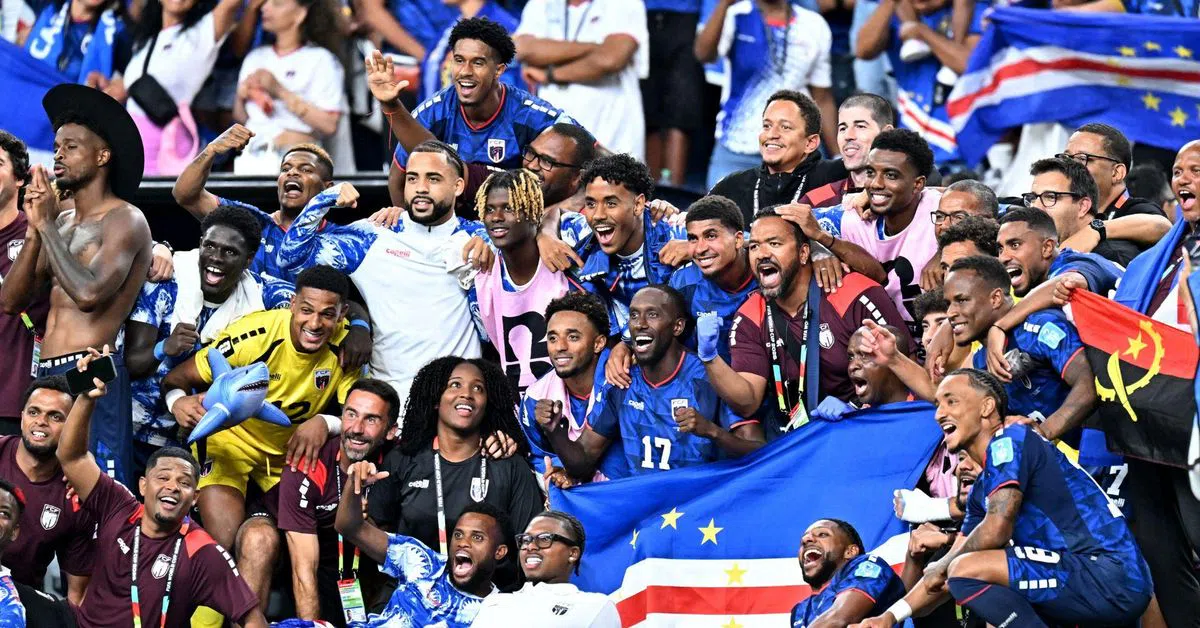
Cape Verde did not win a match in Group H. They did not score freely, overwhelm opponents or turn the World Cup into a tactical exhibition. Yet, when the final whistle went against Saudi Arabia, the island nation had done something far bigger than victory.
They had survived.
A 0-0 draw against Saudi Arabia on Friday completed one of the most improbable group-stage runs of the 2026 Fifa World Cup. Cape Verde finished second in Group H with three draws from three matches, behind Spain, and became the smallest nation ever to reach the knockout stage of a men’s World Cup.
For a country of around 525,000 people, spread across 10 islands off the west coast of Africa, it was a moment that stretched far beyond football. Cape Verde, a Portuguese colony until 1975, were already one of the smallest nations to qualify for the tournament. Now, on debut, they are in the Round of 32.
Their reward is as daunting as it is glamorous: Lionel Messi’s Argentina in Miami on July 3.
A $63 million side in a billion-dollar world
The scale of Cape Verde’s achievement becomes sharper when viewed against the financial map of world football.
According to Transfermarkt squad values used in the comparison, Cape Verde’s squad is valued at $63.2 million. Argentina’s squad, their next opponent, is valued at $936.7 million. France, the most valuable squad in the tournament, stands at $1.76 billion.
That means Argentina’s squad is nearly 15 times more valuable than Cape Verde’s. France’s squad is almost 28 times bigger in value.
But the World Cup has always allowed room for stories that cannot be priced on a spreadsheet. Cape Verde’s campaign is one of them.
Top 10 Transfermarkt squad values for the 2026 FIFA World Cup compared to Cape Verde |
Rank |
Country |
Squad value |
1 |
France |
$1.76 billion |
2 |
England |
$1.58 billion |
3 |
Spain |
$1.42 billion |
4 |
Portugal |
$1.17 billion |
5 |
Germany |
$1.10 billion |
6 |
Brazil |
$1.08 billion |
7 |
Argentina |
$936.7 million |
8 |
Netherlands |
$874.9 million |
9 |
Norway |
$684.3 million |
10 |
Belgium |
$635.1 million |
|
Cape Verde |
$63.2 million |
Transfermarkt squad values converted to US dollars |
The contrast is brutal. But so is the beauty of Football World Cup. Cape Verde did not arrive as a commercial force. They arrived as a team, and then refused to leave.
Cape Verde coach Pedro Brito celebrates after the match as Cape Verde qualify for the knockout stages of the World Cup.Photo: Reuters
How Cape Verde qualified for Round of 32
Cape Verde’s route was not built on fortune alone.
They reached the World Cup by winning their African qualification group, finishing ahead of Cameroon, a regular name in World Cup history. They did not come through the back door of intercontinental playoffs. They earned their place.
Once at the tournament, they did not play like tourists either. They held Spain, the European champions, to a 0-0 draw. They came from behind to draw 2-2 against Uruguay. Then, with qualification on the line, they held Saudi Arabia 0-0.
It was not always pretty. Against Saudi Arabia, Laros Duarte and Garry Rodrigues had chances to win it for Cape Verde, but neither side produced the quality to turn the game decisively. Saudi Arabia offered little in attack, while Cape Verde’s promising moves often lost sharpness near the penalty area.
Still, the point was enough. In a group that included Spain and Uruguay, Cape Verde finished second.
Fifa World Cup 2026 Group H points table |
Team |
Pts |
Status |
Spain |
7 |
Qualified as Group H winners |
Cape Verde |
3 |
Qualified as runners-up |
Uruguay |
2 |
Eliminated |
Saudi Arabia |
2 |
Eliminated |
Spain top Group H, Uruguay crash out
While Cape Verde were making history, Spain were doing what elite sides are expected to do. Their 1-0 win over Uruguay secured top spot in Group H with seven points and sent the two-time world champions home without a win.
Alex Baena scored in the 42nd minute after Uruguay goalkeeper Fernando Muslera failed to properly deal with his shot from inside the area. It was another costly error in a difficult tournament for the 40-year-old, who was taken off at half-time by Marcelo Bielsa.
Uruguay, ranked 19th by Fifa, became the highest-ranked team to be eliminated from the tournament so far. For a side with their history and pedigree, three winless group games represented a painful exit.
Spain, meanwhile, will face the runner-up from Group J in Inglewood, California, on July 2. Cape Verde will head to Miami for Argentina.
The Messi test awaits
Cape Verde’s story has already made World Cup history. Argentina, however, represent a different level of examination.
Messi’s side are expected to finish top of Group J and will enter the Round of 32 as heavy favourites. Argentina’s squad value, experience and recent World Cup pedigree all dwarf Cape Verde’s. The defending champions are chasing another deep run, and the draw appears to have given them a manageable opening knockout fixture.
If Argentina beat Cape Verde, they could face either Australia or Belgium in the Round of 16, depending on the final bracket. A potential quarterfinal meeting with Portugal remains possible if both Argentina and Portugal top their groups and then win their first two knockout matches.
That would bring Messi and Cristiano Ronaldo together at a World Cup for the first time. Given Messi is 39 and Ronaldo is 41, it could also be the last chance for football’s most defining rivalry to appear on this stage.
But that is the grander theatre. For Cape Verde, the immediate reality is simpler: they have 90 minutes against the champions, and the world will be watching.
Cape Verde’s Vozinha celebrates after the match as they qualify for the knockout stages of the World Cup. Photo Reuters
Vozinha becomes unlikely face of a miracle
No Cape Verde story at this World Cup is complete without Vozinha.
The goalkeeper has become one of the tournament’s most unlikely cult figures. His rise has been part performance, part personality and part the kind of emotional thread that World Cups produce better than any other sporting event.
Fans have carried placards of his face. One young supporter held a sign reading, “In Vozinha we trust”. Others painted his name across their torsos. His mother was in the stands again after visa issues had reportedly forced her to miss Cape Verde’s 0-0 draw against Spain.
The scale of attention is extraordinary for a player who turned professional only at 26, played last season in the Portuguese second tier, and nearly retired from international football after being dropped from the squad during an unsuccessful Africa Cup of Nations qualifying campaign.
Whatever happens against Argentina, Vozinha and Cape Verde will remember the summer of 2026.
More than an expanded-format story
It would be easy to reduce Cape Verde’s run to a product of the expanded 48-team format. That would be unfair.
Yes, the 2026 World Cup gives more nations access and keeps more teams alive through the third-place route. But Cape Verde did not need the third-place safety net. They finished second in their group.
They qualified directly from African competition. They avoided defeat against three World Cup opponents. They held Spain, fought back against Uruguay, and did enough against Saudi Arabia when the pressure was at its heaviest.
The expansion has given smaller football nations a bigger platform. Cape Verde have used it to make a case for themselves.
Cape Verde fans with plastic horns in Praia. Photo: Reuters
Argentina next, but Cape Verde already belong
The match against Argentina may prove too steep. Messi, even at 39, remains the tournament’s biggest gravitational force. Argentina are deeper, richer and more battle-hardened. Cape Verde’s $63.2 million squad now faces a side valued at nearly $1 billion.
But Cape Verde have already changed the terms of their tournament.
They arrived as debutants. They leave the group stage as history-makers. They did not need a win, a superstar forward or a billion-dollar squad to reach the knockouts. They needed discipline, belief, resilience and just enough nerve to keep drawing when the World Cup demanded they fall.
Now they go to Miami, where the smallest nation ever to reach the men’s World Cup knockouts will stand opposite Messi’s Argentina.
On paper, it should be no contest. But Cape Verde’s World Cup has already proved that paper can be a poor witness to football’s most improbable stories.















































You must be logged in to post a comment Login