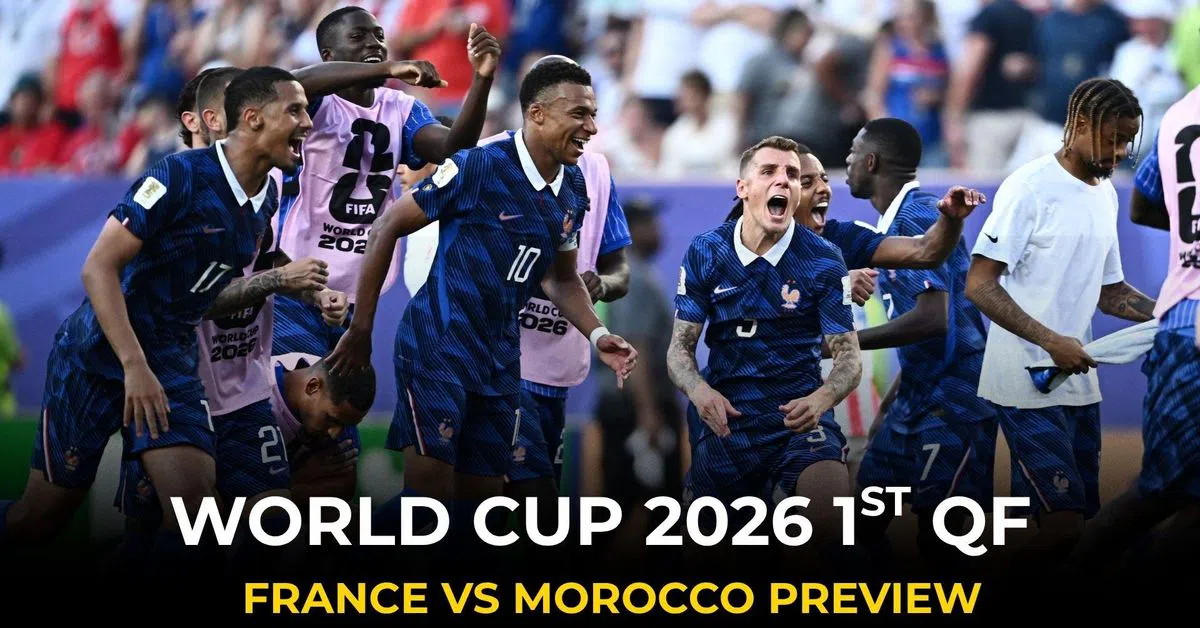
The Fifa World Cup 2026 quarterfinals begin with a fixture that carries the weight of form, history and unfinished business. France arrive as title favourites, the most balanced side left in the tournament and a team whose attack has made even difficult matches appear manageable. Morocco arrive as African champions, World Cup semifinalists from four years ago, and no longer a romantic surprise but a contender with enough structure, speed and belief to trouble anyone.
At Gillette Stadium in Foxboro, France and Morocco meet again, four years after their semifinal in Qatar. France won that match 2-0 on their way to a final defeat against Argentina. Morocco left that tournament as the first African and Arab nation to reach a World Cup semifinal. Now the Atlas Lions are trying to become the first African side to reach back-to-back World Cup semifinals.
The challenge is severe. France have won five matches out of five, scored 14 goals, conceded only two, and are yet to fall behind. Kylian Mbappe has seven goals in five games, one behind Lionel Messi and level with Erling Haaland in the Golden Boot race. Around him, Ousmane Dembele, Michael Olise and Bradley Barcola give Didier Deschamps arguably the most dangerous attacking unit in the competition.
But Morocco are not built to be dazzled. They are built to resist, wait and strike.
Match details |
Match |
Venue |
Local date and time |
India date and time |
What is at stake |
France vs Morocco |
Gillette Stadium, Foxboro |
July 9, 4 pm ET / 9 pm BST |
July 10, 1:30 am IST |
Winner faces Spain or Belgium in the semifinal |
The road to the quarterfinals
France have taken the direct route. They topped Group I with wins over Senegal, Iraq and Norway, then beat Sweden 3-0 in the Round of 32 and Paraguay 1-0 in the Round of 16. The Paraguay game was not fluent, but it may prove useful. France had to withstand provocation, physical pressure and a messy contest. They did not lose control.
Morocco’s path has been more dramatic. They opened with a 1-1 draw against Brazil, beat Scotland 1-0, and then defeated Haiti 4-2 to finish second in Group C. In the Round of 32, they needed a stoppage-time equaliser from Issa Diop before beating the Netherlands 3-2 on penalties. They then knocked out co-hosts Canada 3-0 in Houston, scoring all three goals in the second half.
Team |
Group stage |
Round of 32 |
Round of 16 |
Goals for |
Goals against |
France |
Beat Senegal 3-1, Iraq 3-0, Norway 4-1 |
Beat Sweden 3-0 |
Beat Paraguay 1-0 |
14 |
2 |
Morocco |
Drew Brazil 1-1, beat Scotland 1-0, Haiti 4-2 |
Beat Netherlands on penalties after 1-1 draw |
Beat Canada 3-0 |
9 |
4 |
France: More fluent, but still pragmatic
France under Deschamps have often been associated with tournament pragmatism. This edition has looked different. They have attacked earlier, pressed with more variety and used the pace of Mbappe, Dembele and Barcola to make transitions lethal. Olise has been central to that shift, with five assists and a tournament-high 11 through balls. Three of those assists have led to Mbappe goals.
That combination is Morocco’s biggest problem. France can draw teams forward, sit briefly in a 4-4-2 block and then explode into space. They have scored from fast breaks against Senegal, Norway and Sweden. Their front four give them different ways to punish risk: Mbappe’s runs in behind, Dembele’s directness, Barcola’s speed and Olise’s passing angles.
France’s Desire Doue, Kylian Mbappe and teammates
The win over Paraguay, however, added another layer. France were not sparkling, but they were controlled. Assistant coach Guy Stephan said the match provided answers about how the players respond “in the face of that kind of adversity”. That matters in a quarterfinal where Morocco will try to frustrate, slow and counter.
France also have small concerns. Aurelien Tchouameni is doubtful with an adductor injury. Marcus Thuram has returned to training after a calf issue and is expected to be available. Olise, Barcola and Manu Kone are one yellow card away from missing a potential semifinal.
Morocco: From surprise package to contender
Morocco’s 2022 run changed global perception. Their 2025 Africa Cup of Nations title confirmed that it was not a one-tournament miracle. Under Mohamed Ouahbi, who took charge in March, Morocco have become more layered than the side that shocked Spain and Portugal in Qatar.
They can still defend deep and suffer without the ball, but this version carries more attacking rhythm. Brahim Diaz is their chief creator, often starting from the right and drifting inside to allow Achraf Hakimi to surge forward. Azzedine Ounahi provides movement between lines, while Bilal El Khannouss brings pace from wide areas.
Morocco’s Achraf Hakimi celebrates after Fifa World Cup 2026 match. Photo: Reuters
The major blow is the absence of Ismael Saibari. The 25-year-old, who had scored in all three group games and struck the winning penalty against the Netherlands, has been ruled out with a hamstring injury suffered against Canada. He had been used as a false nine and was Morocco’s most important goal threat. Soufiane Rahimi, who came on for him and scored against Canada, is the likely replacement.
Ouahbi has insisted Morocco are no longer a surprise.
“We’re no longer a surprise today, and that’s a great source of pride,” he said.
Against France, that confidence will be tested by the tournament’s most complete squad.
Where the match could be won: Fast breaks
This quarterfinal may be decided by counter-attacks. Morocco and France are the top two teams at this World Cup for fast-break shots, according to Opta. Morocco lead with 10 such attempts, while France have nine. Both have scored three goals from those situations.
That makes the match tactically fascinating. Both teams are dangerous when they win the ball in their own half and attack quickly. Both also need to be careful about where they lose possession.
Rank |
Team |
Fast-break shots |
Fast-break goals |
1 |
Morocco |
10 |
3 |
2 |
France |
9 |
3 |
3 |
Brazil |
9 |
2 |
4 |
Argentina |
7 |
3 |
5 |
England |
5 |
0 |
6 |
Canada |
5 |
0 |
7 |
Sweden |
4 |
2 |
8 |
Cabo Verde |
4 |
0 |
9 |
South Africa |
4 |
1 |
10 |
Croatia |
3 |
0 |
Source: Opta |
Morocco’s Chemsdine Talbi in action. Photo: Reuters
Morocco scored from such a sequence against Brazil. El Khannouss blocked Lucas Paqueta’s pass, Noussair Mazraoui split midfield with a forward ball, Diaz released Saibari, and Morocco were ahead after only two passes.
France operate similarly but with greater individual speed. If Morocco’s full-backs push high, Mbappe and Barcola will look to attack the space behind them. If France lose the ball in midfield, Hakimi, Diaz and Ounahi can spring forward quickly. The first pass after a regain may matter as much as the final shot.
Mbappe vs Morocco’s right-sided strength
The main question is obvious: can Morocco stop Mbappe?
He has seven goals in five games and is chasing history. He could become the first player to win the World Cup Golden Boot more than once. But Morocco’s defensive organisation is not easily pulled apart. Hakimi is one of the best right-backs in the world, Mazraoui offers security on the other side, and Morocco’s midfield works hard to close central spaces.
France’s Kylian Mbappe, Mike Maignan, Lucas Digne and William Saliba line up with young mascots during the national anthems before the match. Photo: Reuters
Still, Mbappe does not need much. France do not require long spells of control to hurt opponents. Olise’s through balls and Barcola’s speed mean Morocco must constantly manage depth. If their back line drops too deep, France can circulate and cross. If they push too high, Mbappe can decide the match in one run.
Mbappe also enters the game after a difficult few days off the pitch. Following France’s win over Paraguay, he responded to abuse from a Paraguayan senator, describing the comments as “despicable” and “racist”. Now the France captain must return his focus to the field, where his influence has been decisive.
Diaz, Hakimi and Morocco’s route to an upset
If Morocco are to win, Diaz and Hakimi are likely to be central. Diaz has four assists in the tournament and has become Morocco’s most important creative player. He operates like a No 10 from the right, drifting inside and creating lanes for Hakimi outside him.
Morocco’s Brahim Diaz and teammates celebrate after the match. Photo: Reuters
Hakimi’s duel with Lucas Digne could be one of the game’s most important battles. France have refreshed their left side in the knockouts, with Digne replacing Theo Hernandez to add a crossing threat. But that side can also be attacked. Hakimi’s long sprints from deep and Diaz’s passing could test France’s defensive balance.
Ounahi is another key figure. His ability to carry the ball and escape pressure gives Morocco a way to turn defence into attack. Without Saibari, Morocco will need others to make runs beyond France’s midfield. Rahimi gives them a more traditional forward profile, but the team’s attacking rhythm will change.
Head-to-head and history
France dominate the head-to-head record, with four wins and two draws from six meetings. The most important meeting came in the 2022 World Cup semifinal, when France beat Morocco 2-0 in Qatar.
But the relationship between the two countries gives this fixture an added dimension. France occupied Morocco between 1907 and 1956, and more than a million Moroccans now live in France. That history does not define the football, but it shapes the emotional context. For Morocco, beating France would not only mean reaching another World Cup semifinal. It would also mark one of the most significant results in African football history.
Meetings |
France wins |
Morocco wins |
Draws |
Last World Cup meeting |
6 |
4 |
0 |
2 |
France beat Morocco 2-0 in the 2022 semifinal |
Team news
Team news |
|
|
Team |
Key availability updates |
Suspension risk |
France |
Aurelien Tchouameni doubtful with an adductor injury; Marcus Thuram back in training after calf issue |
Michael Olise, Bradley Barcola and Manu Kone are one booking away from a ban |
Morocco |
Ismael Saibari ruled out with hamstring injury; Soufiane Rahimi likely to replace him |
No major suspension concern mentioned |
Predicted starting playing 11 |
France |
Morocco |
Maignan |
Bounou |
Kounde |
Hakimi |
Upamecano |
Diop |
Saliba |
Riad |
Digne |
Mazraoui |
Kone |
El Aynaoui |
Rabiot |
Bouaddi |
Dembele |
Diaz |
Olise |
Ounahi |
Barcola |
El Khannouss |
Mbappe |
Rahimi |
Likely formations: France 4-2-3-1; Morocco 4-2-3-1 |
Referee focus
Fifa has appointed an all-Argentinian officiating team for the match, with Facundo Tello as referee. The decision has drawn attention in France because Argentina beat France in the 2022 World Cup final. This is the first time at the 2026 World Cup that the entire officiating team is from the same country.
Tello has taken charge of two matches at this tournament: South Africa’s 1-0 win over South Korea and Canada’s 1-1 draw with Bosnia & Herzegovina. Across those games, he issued seven yellow cards and awarded no penalties.
Referee |
Country |
Matches officiated at World Cup 2026 |
Yellow cards |
Penalties awarded |
Facundo Tello |
Argentina |
2 |
7 |
0 |
What experts expect
Predictions largely favour France, though most expect Morocco to make the game uncomfortable. The range of forecasts underlines the same theme: Morocco have enough organisation and transition threat to trouble France, but Les Bleus’ attacking depth gives them the stronger case.
Prediction trend |
Common scoreline range |
Main reasoning |
France win |
2-0, 2-1, 3-1 |
Superior attacking depth, Mbappe’s form, stronger bench |
Morocco upset route |
Narrow win or penalties |
Defensive discipline, fast breaks, penalty strength |
Key concern for France |
Wide areas and counters |
Hakimi and Diaz can attack space behind Digne |
Key concern for Morocco |
Saibari’s absence |
Loss of main goal threat and false-nine profile |
One thing to know about France
Deschamps has refreshed France’s left side in the knockouts. During the group stage, Theo Hernandez offered a more defensive profile at left-back, while Desire Doue played ahead of him. In the knockouts, Digne has added a crossing option from deep, giving France a different way to attack packed defences.
That matters against Morocco, who can defend compactly and force opponents wide. France now have more than one way to break teams down: through Mbappe’s runs, Olise’s passing, Dembele’s dribbling, Barcola’s speed and Digne’s delivery.
France coach Didier Deschamps. Photo: Reuters
One thing to know about Morocco
Morocco are the first African nation to reach the quarterfinals of two World Cups. But this team is not simply a repeat of the 2022 version. Under Walid Regragui in Qatar, Morocco often played with very low possession, including 27 per cent against Spain and 23 per cent against Portugal.
Ouahbi’s Morocco can still defend deep, but they are more flexible with the ball and have a broader attacking base. Morocco also benefit from a golden generation. There were 51 Moroccan players in Europe’s top-five leagues last season, the 12th-most of any nation. That depth explains why they no longer look like outsiders.
Morocco coach Mohamed Ouahbi with players during training. Photo: Reuters
Prediction
Morocco will make France work. Their counter-attacking threat is real, their full-backs are elite, and their collective confidence has grown from a 34-match unbeaten run and an AFCON title. But Saibari’s absence is a major loss, and France’s attacking depth may eventually tell.
France do not need to dominate every minute to win. They only need the right moment: an Olise pass, a Barcola run, a Dembele dribble, or Mbappe in space.
Prediction: France 2 Morocco 1
Who will the winner face?
The winner will face Spain or Belgium in the semifinal at AT&T Stadium in Arlington, Texas, on July 14. That match will kick off at 3 pm ET, which is 12:30 am IST on July 15.
Potential semifinal |
Venue |
Local date and time |
India date and time |
Winner of France vs Morocco vs Winner of Spain vs Belgium |
AT&T Stadium, Arlington |
July 14, 3 pm ET |
July 15, 12:30 am IST |








 "fifa world cup 2026, argentina")












































You must be logged in to post a comment Login