Of course we did. This is Super Bowl week. Pats and Hawks! Bad Bunny! Commercials! Quit hogging the dip! But the thing is, though, every week feels like a super week in pro football. Regular season! NFL draft! Signings! Every week seems meaningful.
Even when it’s tough to watch.
This season, Dave Berri’s Detroit Lions were predicted to contend. But players got hurt. And the Motor City faithful suffered. Please trust that the analysis that follows was spoken in a pained tone.
Advertisement
“I think in one game — against the Vikings — their starting center came off the practice squad,” Berri said. “And you’re like, ‘Well, I don’t think you’re going to win this game.’ I think they could have just said, ‘Well, probably not.’ I don’t know that you can block the Vikings defensive line with a practice squad center. And then he left the team three days later, so there you go.
“And then they were telling me, Jared Goff, you didn’t play a very good game. ‘Well, I only had one second to throw the ball. I mean, he is the center. He is pretty close to the other team. So I don’t know what you wanted me to do about that.’ So, yeah, it was just, games like that, I don’t know what you want us to do. I wish coaches could just say that. It’s like, they’re different players. Those aren’t the players I want playing. There’s a reason why they were on the practice squad.”
Poor Berri, right? And yes, you’re still on a golf site.
Berri’s other job is in sports economics. He teaches it. He’s written books and articles about it. He’s established himself as one of the country’s authorities on the subject. A couple years ago, I talked with him, and I felt it was right to do so again, considering all of the news around golf and money — and football. We talked about the PGA Tour and its new CEO, Brian Rolapp — who came from the NFL. We talked about YouTube — which now broadcasts NFL games. We talked about LIV Golf and Saudi Arabia — where the NFL is hosting an event in March. We talked about Bryson DeChambeau — who’s in the midst of contract talks not unlike a quarterback or defensive end.
Advertisement
We also wondered whether pro golf could become appointment viewing — in the way that it is for the NFL.
Regardless of how the play is.
(Editor’s note: The interview has been lightly condensed.)
Brian Rolapp in August at the Tour Championship.
Getty Images
Advertisement
I. THE PGA TOUR — AND ITS NEW CEO
Last June, the PGA Tour named Brian Rolapp as its CEO. Who’s Rolapp? An NFL man, he’d been thought of as a potential successor to NFL commissioner Roger Goodell (and he still might be). But now Rolapp is in golf, and over the past few months, he’s created a “Future Competition Committee” aimed at examining the Tour’s competitive model and developed a pathway for Brooks Koepka to return to the Tour after a four-season stint with LIV Golf.
Last year, the PGA Tour hired the second-in-command of the NFL as the PGA Tour’s first-ever CEO. What can pro golf take from the NFL model? What should it ignore?
I’m going to argue pretty much nothing. This is a totally different sport. The difficulty is, going from the NFL to the PGA Tour, is that football is a very, very good television sport. I don’t know if golf has quite the same television appeal. I think there’s a ceiling to how many people are going to tune in to watch golf. And I don’t know how you change that. Despite the amount of coverage it gets, it’s never been one of the major sports. It gets a lot of attention because it does appeal to executives, right? The people who make decisions love golf. But I don’t know that it’s the kind of sport that you’re going to get — the Super Bowl is going to have 150 million people tune in to watch this, right? I don’t know how you’re going to get that for golf. People are aware of who Tiger Woods is and stuff like that, but the number of people who tune into this is somewhat small, and I don’t know how he’s going to change that. It’s been around a long time. People are aware of it. I just don’t see what specifically you can do that’s going to dramatically change the model. Introduce defense?
One of Rolapp’s pillars is scarcity. This year, there are fewer players who have received full-time playing privileges, and there are rumors that, starting next year, there will be fewer tournaments. The thought is the PGA Tour right now runs essentially from January all the way through Thanksgiving, where there is really no offseason, whereas Major League Baseball has an offseason, NFL does, NBA does — to where you then miss it. Like where opening day in baseball is an event. Like week one of the NFL is an event. Is less play better or worse for the product?
Advertisement
I think there’s an argument to be made that if you make it more scarce, then people are going to value more what they do get to see and that’s not a ridiculous argument. That’s OK. Is that going to dramatically change anything? I don’t think that’s going to happen. It’s a small change that could theoretically help. I think the counter argument is there’s a value in having it on all the time. If you look at the NFL, the NFL was scarce. It was very scarce. It used to be, if you want to watch an NFL football game, it was on Sunday. And then they moved it to Monday night, right? And that was a big change. And then they didn’t really do much after that for a long time. And now they have it so that there’s NFL games on Thursdays and Fridays and Saturdays and Sundays and Mondays. Has that made the NFL worse? I don’t know. I don’t think that’s true. And they do the same with college football. I mean, college football is on almost every night now. And so I don’t know that that’s made it worse. It is the case that if you have a lot of events, then your ratings for each one will likely be lower because people are not going to commit themselves to seven days a week watching something. But I think your overall viewership would probably be higher because you have more events you’re selling and the amount of attention people are paying to you might be higher. So I can see what he’s saying. I think that could help. I don’t know that that dramatically changes anything.
As you said, Sunday’s a big thing, Monday night’s a big thing, Thursday night’s become a must-watch event. What could the PGA Tour try to do to duplicate that?
Yeah, that’s a tough one. One issue that you have with the PGA Tour, and it’s the same problem that afflicts cricket, is that you don’t have an event that lasts three hours and decides the winner. It’s a four-day event. And that requires some level of commitment on the part of the viewer. And you could say, well, just tune in the last day. But there’s stuff that went on before that. The solution they came up with in cricket was the T20 approach where you change the game so it’s a three-hour event. And that seems to have worked. So one option is create events where instead of it’s a four-day tournament, go, OK, we’re going to do a three-hour.
Grant Horvat last March at the Players Championship.
Getty Images
Advertisement
II. YOUTUBE — AND WHY IT’S SUCH A PHENOMENON
YouTube’s popularity has exploded, especially so in golf. Good Good. Bob Does Sports. Grant Horvat. The Bryan Bros. And many more. This past summer, there was also an International Invitational, hosted by Bob Does Sports and Barstool Sports, which attracted hundreds of thousands of views.
To me, YouTube golf has become as popular as it is because it’s fast, it’s digestible.
The advantage of YouTube is this — I’m going to give you a totally different way of thinking about this. So if you look at the rise of K-pop and how that happened, K-pop takes off internationally when YouTube becomes a thing. And the reason why YouTube is crucial to the story is because prior to YouTube, the only way you could get your music on the radio or on MTV was if a decision-maker decided to put it there. And the problem is the decision-maker has their own tastes. And their own preferences. And so they’re going to put on what they like. And we have this idea that network executives know what the audience wants. We have countless examples of network executives having no idea what the audience wants, and they’re totally shocked when they put something on there. When you do YouTube, though, YouTube is a different model. Now the viewer gets to decide. You decide what you want to listen to. And suddenly K-pop becomes this huge thing because everyone individually chooses what they want. And so when you create a product for YouTube, you’re allowing the audience to decide what they want themselves, rather than the network executive saying, ‘I have so much time at ABC or ESPN or whatever, and I’m going to dedicate this amount to that.’ And that can completely transform what you’re doing. You have to be responsive to what the YouTube audience wants, right? You have to pay attention to that because they’re choosing it themselves. They’re not letting the network do it for them.
Is there anything pro golf can take from YouTube?
Advertisement
I don’t know. I think the advantage is you’re letting the viewers pick what they want, so if you give them a menu of things, you’re going to find faster what they like and what they don’t like better than what an executive could do. Because executives again are making decisions based on their personal preferences and they are absolutely convinced that they know the answer, they know what people want, but history says they don’t. How to convert that to a sports model is challenging, though. Because, again, they have to be live. I do think there’s some value if the PGA Tour could come up with events that really were in a shorter time frame. We’re going to have you play 18 holes. Or even just do nine holes. See what happens. Nine-hole pressure. I wonder if you could create a golf course — here’s an idea: Create a golf course where things are like par-6 or par-7. So make it so it’s longer, right? And do like nine of them. I mean, you can think about making events so it’s like, I’m going to highlight this particular aspect of golf. Maybe you create a course that makes the putting more difficult. Maybe you make the course that makes hitting the drives more difficult. Things like that. You could create a whole tour where you’re saying these events are going to focus on these skills, but these events will focus on these other skills.
There’s just all sorts of things you could do, but you have to create it so that the event is shorter in time period, because longer time periods, you’re really just appealing to your major fans. You’re not not appealing to the average fan. You got to bring the casual fan into the thing. That’s why the NFL works so well. Casual fans can watch it. You don’t have to know a whole lot about the intricacies of football to watch football. You can see what’s going on. They’re at the 30-yard line. I can see it. They ran a play. They got four yards. They just said it, I saw it, there you go. You don’t need to know, well, do you see how they got the four yards? Do you see the left tackle pulled on it? I don’t give a crap. You got to create events that bring in casual fans. You can’t focus on the hardcore fans. This is where the NHL went wrong. So many years ago in the NHL, they did this thing with the purple puck where you could see where the puck was. And the hardcore fans got pissed off with that. ‘I can see where the puck is.’ Yeah, most people can’t. Most people don’t know where it is. And so that really helps. ‘Yeah, I don’t like it.’ So they got rid of it. You know what, this isn’t for you. You’re going to watch regardless. I don’t need to make you happy. Hockey also suffers from a problem in that you do have to watch. It isn’t like football or baseball where it can be on in the background and you can look at the score every once in a while and go, ‘Oh, I got an idea what’s going on.’
If you look at the hockey television ratings, they are persistently very low. It does really well in person. They sell out the arenas very consistently, but the ratings on television are terrible. And they’ve always been terrible because they construct the broadcast to appeal to the hardcore hockey fan and they don’t do it to appeal to the casual hockey fan, and if you’re going to build up a sport, it’s always the casual fan that matters. That’s what baseball’s been trying to do. They had a problem with pitchers just sort of milling around on the mound and not doing anything. And people were like, It’s kind of boring watching him take 45 seconds to throw the damn pitch. Put in a pitch clock.
I think that shot clock is one of the best sports ‘inventions’ since maybe the three-point line.
Advertisement
It makes the game much faster, and it gets them focused on what they’re doing. And you’re like, OK, that’s good, I like that. That’s the kind of thing that you want to do. The whole notion that the crowd has to be quiet when golfers are playing? Every other athlete has to hear noise. You can yell if you want. I think that might make it more interesting. Let ’em yell, let ’em see what happens.
Yasir Al-Rumayyan and Jon Rahm in August at LIV Golf’s team championship.
Getty Images
III. LIV GOLF — AND HOW LONG THE SAUDIS WILL BACK IT
This week, LIV Golf started its fifth season, and there are questions on its future, as there are with any new sports league. The central one, though, is this: Will its primary backer, the Saudi Arabia Public Investment Fund, continue to support the circuit?
The last time we talked, the PGA Tour had taken money from a sports ownership group and that came after a preliminary deal between the Tour and the Saudi PIF. That is currently still being negotiated and might not see the light of day. At one point last year, Donald Trump met with the Saudi PIF governor, but nothing has happened. So the question I have is, what are the benefits and detractions to looking into Saudi investment in American sports?
Advertisement
The Saudis are looking for things to invest in because the oil industry is not eternal. At some point, that’s going to be a problem for them. And there’s a huge attraction for rich people being involved in sports. And if you can’t play sports, I guess the next best thing is to buy the sports. So that’s why they’re doing it. The problem is, the Saudis tried to create a brand-new golf league by itself, which I think I told you wasn’t going to work, and it doesn’t seem like it’s working. You just can’t do that. There’s no tradition. You can’t just take people and stick them in a tournament that looks the same as every other tournament and say, well, now they’re going to compete over here doing this. It’s like, I don’t know what it is they’re fighting for. The Masters means something because there’s a history to it. But creating another league is probably not going to work If it’s the same product, which I think it was, right? Four-day tournaments, right?
Yeah, see, that’s the same thing. You’re doing exactly the same product. If they wanted to do something, what they should have done is what we were just talking about a moment ago. You know, create a bunch of contests that are totally different. But if you just do exactly the same thing, but there’s no tradition, well, I don’t think you’re going to have any audience then. It’s not the players by themselves. There’s the history that matters. What the past players did matters. If there’s no history, then it matters less. And the audience doesn’t have an idea why it’s significant. Why does this matter? And so that was the problem the Saudis have. So I understand what they were trying to do. But it was unlikely that was going to be terrifically successful. And you can see now the top stars moving back to the PGA Tour because well, money’s nice, but at the end of the day, you are a professional athlete. You do want to compete against the best, and you want people to pay attention to you.
Last year, it was reported that LIV Golf was losing money at a clip of nine figures a year, though recently the CEO of LIV Golf said that the league could turn a profit in five to 10 years. My question is, how long does Saudi Arabia stick with LIV? Do they believe in it no matter what, or do they eventually pull the plug?
Advertisement
I don’t know. They have an immense amount of money. The amount of money that they’re spending on this is quite small, relative to what money they have. So therefore, they could do it indefinitely if they want, if that’s what they like. It’s really up to their preferences. I don’t believe, and I said this to you before, I don’t think they’re doing it to make a profit. They already have money. They’re not trying to make money. They do want an audience. I think they want people to pay attention to them. And if that doesn’t happen, then I don’t think they want to keep doing that. That CEO telling you — how exactly are you planning on making a profit in 10 years? What do you think is going to happen? This is where an academic would be like, I don’t see how that’s possible. Where are you getting that from? What is your analytical tool that tells you that that’s going to happen? That just doesn’t seem very likely from where you’re starting. How are you going to get an audience? If you don’t have an audience now and your stars are leaving you, why do you think you’re going to have an audience 10 years from now? Are the stars going to come back? You didn’t have much of an audience with the stars. You’ll have less of an audience without the stars. But how long will they do it? As long as they want to do it. They have the money. I think what matters to them more than anything is, is anyone paying attention?
Bryson DeChambeau on Thursday at LIV Golf’s Riyadh event.
Getty Images
IV. BRYSON DECHAMBEAU — AND HIS CONTRACT
In 2022, Bryson DeChambeau was among the players who signed deals to leave the PGA Tour and join LIV Golf, and that contract is expiring at the end of the year. DeChambeau figures to have significant leverage in the negotiations, which begs the question: How much will he ask for from LIV, should he want to return?
When LIV formed in 2022, many of its stars signed contracts that are now expiring, including Bryson DeChambeau. And in that time, Jon Rahm signed for what’s been reported as a nine figure deal. And Brooks Koepka and Patrick Reed left to return to the PGA Tour. And LIV continues to try to gain a foothold. And DeChambeau won a U.S. Open and developed a significant YouTube presence. Given all of that, how much money could DeChambeau demand?
Advertisement
Oh, I don’t know. I have no idea. I mean, it’s obviously a lot more than [Rahm’s]. Again, the problem is, if you’re thinking about this in terms of a business like a Taco Bell, and you’re thinking about revenues and costs and how much revenue this person brings in and what they’re worth to me, the answer would be they wouldn’t pay him much of anything because there’s not really much revenue being generated. But that’s clearly not what they’re doing. I mean, they’re trying to build something here. They can’t afford to lose more stars. And they also have this incredibly large sum of money that they can throw at this. And so when that’s the case, how much money can you command?
Could he ask for a billion dollars?
I would. I would ask for $2 billion. I would just throw it out there. ‘$2 billion. What do you got? $2 billion. You got $2 billion?’ I mean, they have $2 billion. And let’s see if they counter.
Has there ever been an athlete who has had that much leverage?
Advertisement
No, in the sense because you’re dealing with — what is the amount of money they have to invest in this? What do the Saudis have?
OK, so you have $1 trillion. OK, now think about that. So you think about a typical owner of a sports team. Typical owner of a sports team might have $10 billion. You have $1 trillion. And you’re desperate. I’d demand $2 billion. I’d demand $3 billion. That’s $3 billion. ‘You have $1 trillion, give me $3 billion.’ ‘You know, I’m not doing it.’ ‘Well, then I’m not playing.’ So, you know, I would demand just the most ridiculous sum of money possible because none of the revenue or cost issues make any difference. You’re doing this because you want to gain an entry into the space. And without a star, it won’t happen. So your decision is, how much are you going to pay me to make this happen for you? And if the answer is, you’re not willing to, well, then I don’t do it. Then you try it on your own. Good luck with that. It also depends on how much he wants to do it. I mean, how much do you want to actually continue participating in this? I would just throw out some ridiculous money.
Jeeno Thitikul last week at the LPGA’s Tournament of Champions.
Getty Images
Advertisement
V. THE LPGA — AND A WNBA MOMENT
Popularity in women’s sports has skyrocketed, especially so in the WNBA. Can the LPGA, under new commissioner Craig Kessler, capture that attention, or even surpass it?
You’ve written extensively on the WNBA. And my question is, how can the LPGA duplicate that type of success?
The WNBA success came about — and I think is what happened — is that we had Covid and the women’s basketball in college and men’s basketball in college both went to bubbles. And Sedona Prince does the video and says, look, the bubbles aren’t equal. They built a giant weight room for the men. They didn’t build anything for the women. They gave them a tower of dumbbell racks. And as a result of that, the NCAA investigates itself, and there is a legal team that looks at them and they issue a report and there’s a whole bunch of media coverage and then suddenly, within months, there is a change in how women’s college basketball gets covered. Suddenly, for the first time in history, the network puts a regular-season game on the networks. That had never happened before. Suddenly they’re telling the women, you can call your tournament March Madness, just like the men’s. Suddenly, the entire tournament for the women is on television. That was not the case before that. Or at least, it wasn’t the case for much of its history. So suddenly, college basketball becomes accessible and had not been accessible before. And not surprisingly, within a year or so of that happening, one of the players becomes a massive star. Caitlin Clark becomes a huge star. And the way they report this is, oh, we discovered Caitlin Clark and now we started covering this. No, I can see in the data that you started covering it first and then Caitlin Clark became the star. That is exactly how it always goes. It’s always the coverage first and the star second. It’s not the star first and then the coverage. Then Caitlin Clark moved to the WNBA, and the networks go, you know what, we should be covering that. There’s a lot of interest in this. And then the WNBA gets a whole bunch more coverage. And people are like, in 2024, it’s Caitlin Clark. Well, then in 2025, Caitlin Clark gets hurt. But they kept the coverage the same and the ratings go up even higher. And you’re like, it was never Caitlin Clark. It was just the coverage changed.
So how can the LPGA duplicate that? Well, you somehow have to change the coverage. And how do you change the coverage? Well, that’s the real problem that they have. How do you change the coverage? How do you get it so that you get the same kind of consistent, I’m-on-television-all-the-time coverage. Think about the way the media covers the final of the major tournaments on the men’s side and how they cover the ones on the women’s side. The volume of stories is going to be a lot higher on the men’s side. If you don’t have the same kind of media attention, if you’re just reporting the winner, if you’re not doing the coverage consistently as it goes along, it’s going to limit your fan appeal. But I do think if we go back to the whole diversity issue, given the fact the LPGA is more diverse, there’s a bigger audience potentially there if you could get them to pay attention to it. I think that makes a difference. So I think there’s a lot of stories that you could tell on the women’s side. But you have to want to do that.
Advertisement
When there was more media coverage of the WNBA, they told the Caitlin Clark story, they told other players’ stories. Is there a way that the LPGA can market its players to get to that level?
Absolutely. And the advantage of golf is the same advantage tennis has. The athletes are individuals and therefore the audience relates to them very rapidly. See, that’s the problem in team sports. Team sports, at the end of the day, you’re asking somebody to form an emotional attachment to something that’s entirely fictitious. There is no such thing as an Indiana Fever. That doesn’t exist. There’s no such thing as a Boston Celtic. Those things don’t exist. But when you’re doing tennis or golf or boxing, that’s a person. And if you can simply get the audience to connect to the person, where either they like the person or they don’t like the person — I’m rooting for them or I’m rooting against them — either way, you’re paying attention. So the way to do it is to find a way to get it so the audience has some kind of emotional attachment to that person. Tell the person’s story. Was there some sort of struggle that led them to become a golfer? Are there issues here that we should know about? Are there rivalries that we should know about? And that’s what happens in tennis, right? Tennis is you get to know the personalities of the players and it allows you to connect with who you’re watching. And that’s the key, right? That’s the key.
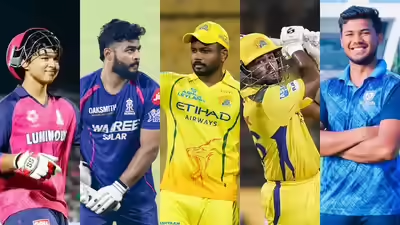
An emotional subplot will headline Monday’s IPL clash as Sanju Samson faces Rajasthan Royals for the first time after leading them for over a decade. Now with Chennai Super Kings, Samson — RR’s former captain and all-time leading run-scorer — returns in top form following a stellar T20 World Cup campaign, where he struck three successive half-centuries.Go Beyond The Boundary with our YouTube channel. SUBSCRIBE NOW!His move, part of a high-profile swap that saw Ravindra Jadeja rejoin Rajasthan, adds further intrigue. With MS Dhoni sidelined due to injury, Samson will share leadership duties with Ruturaj Gaikwad at the top.CSK appear in transition, bolstered by emerging talents and a varied bowling attack. Meanwhile, Rajasthan begin a new era under Riyan Parag, with Yashasvi Jaiswal leading the batting alongside Shimron Hetmyer.While RR boast explosive batting options, concerns linger over their bowling consistency. Both sides, coming off underwhelming 2025 campaigns, will view this clash as a chance to reset and rebuild momentum.
Top 5 players to watch in RR vs CSK clash
Vaibhav Sooryavanshi (15 years old)The Rajasthan Royals opener enters his second IPL season carrying significant expectations after a sensational debut year. At just 14, he scripted history by becoming the youngest centurion in men’s T20 cricket, hammering 101 off 38 balls against Gujarat Titans in IPL 2025. His century came off just 35 deliveries, making it the second-fastest in IPL history. Across seven matches, he piled up 252 runs at a staggering strike rate of 206.55, underlining his fearless approach at the top. Against Chennai Super Kings last season, he scored a brisk 57 off 33 balls, including four sixes and four fours. His explosive powerplay batting makes him a key figure for RR once again.Riyan Parag (24 years old)Riyan Parag begins his first full season as Rajasthan Royals captain following Sanju Samson’s exit, taking charge at his home ground. One of the youngest captains in IPL history, Parag has steadily grown into a central figure for the franchise since his debut in 2019. In IPL 2025, he led the side in eight matches and scored 393 runs, emerging as RR’s second-highest run-getter with a strike rate of 166.52. His breakthrough came in 2024 when he amassed 573 runs in 16 matches at an average of 52.09. Overall, Parag has 1566 runs from 84 games at a strike rate of 141.84. Against CSK, he has scored 122 runs in eight matches, with a highest score of 47.Sanju Samson (31 years old)Sanju Samson will be in the spotlight as he turns out in Chennai Super Kings colours for the first time after being the face of Rajasthan Royals for over a decade. Having played 11 seasons with RR, he remains their all-time leading run-scorer with over 4000 runs. Overall, Samson has accumulated 4704 runs in 177 IPL matches at an average of 30.94 and a strike rate of 139.04, including three centuries and 26 fifties. He comes into the season in excellent touch after a Player-of-the-Tournament performance in the T20 World Cup 2026. His first outing against RR adds emotional weight, making him one of the biggest attractions in this contest.Kartik Sharma (19 years old)Kartik Sharma is a young wicketkeeper-batter, known for his power-hitting abilities. He became the joint-most expensive uncapped Indian player in IPL auction history when Chennai Super Kings signed him for Rs 14.2 crore. After being part of CSK’s wider squad in IPL 2025, he has now broken into the main squad for the 2026 season. If included in the playing XI, Sharma could make his debut, bringing with him the reputation of an aggressive young finisher.Ayush Mhatre (18 years old)Ayush Mhatre, another exciting young talent, enters his second IPL season after making a strong impression in 2025. He scored 240 runs in seven matches at an average of 34.28 and a remarkable strike rate of 188.97, including a high score of 94. Initially unsold at the IPL 2025 auction, Mhatre earned a mid-season call-up to Chennai Super Kings due to an injury to Ruturaj Gaikwad and made an immediate impact. Against Rajasthan Royals, he struck 43 off 20 at a strike rate of 215, showcasing his aggressive batting style.
One of the endgame activities, Pure Fiction, has received a new cycle in Honkai Star Rail 4.1. With that, players now get fresh challenges with brand-new enemy lineups. Since the activity is quite tough to beat, players are compelled to build top-of-the-line teams to get all the rewards it offers.
This article lists the best teams for the Honkai Star Rail 4.1 Pure Fiction.
Note: Some aspects of this article are subjective and reflect the author’s opinions.
Exploring the best teams for Honkai Star Rail 4.1 Pure Fiction, Virtual Made Manifest
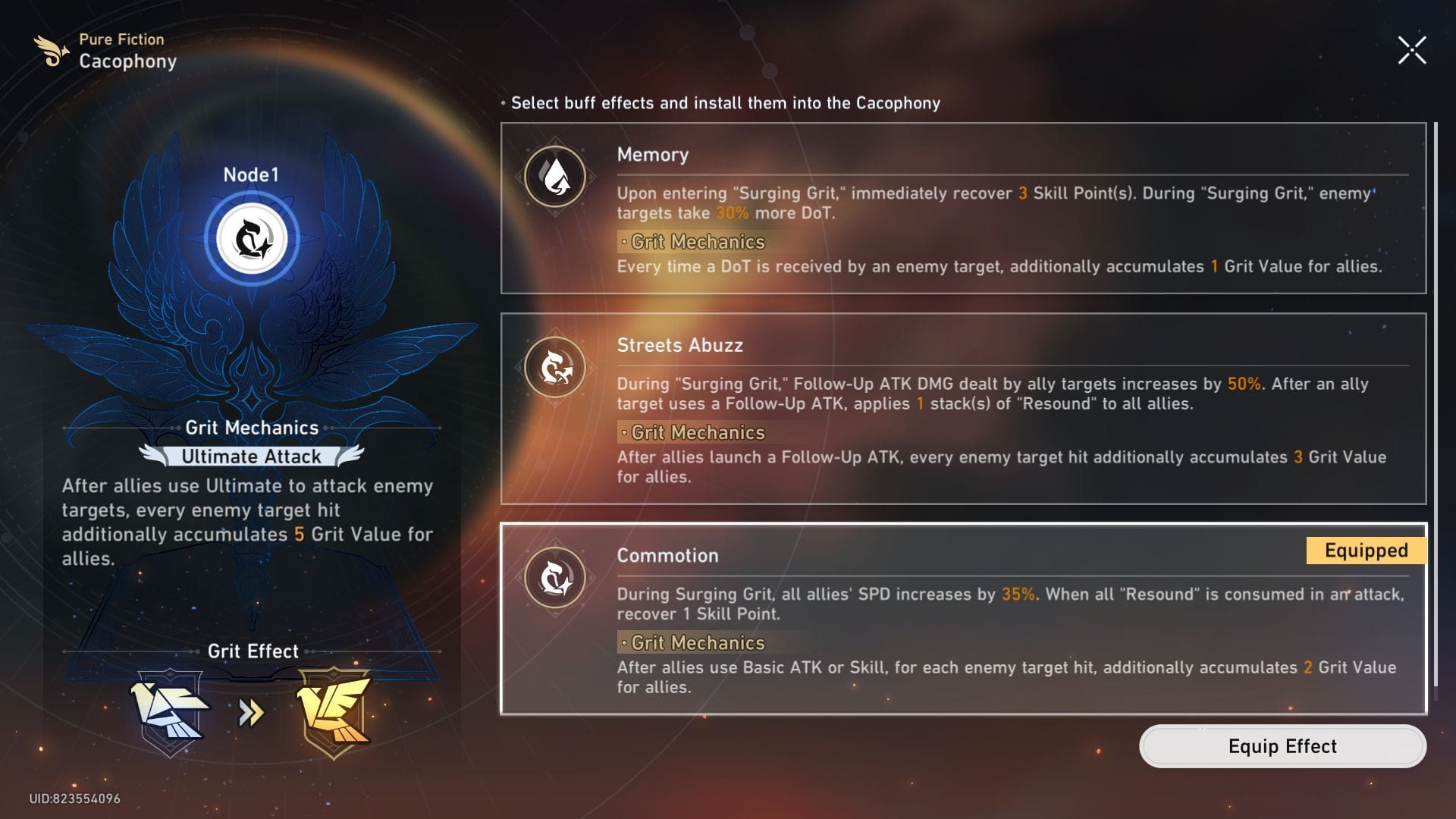
All HSR 4.1 Pure Fiction Node buffs (Image via HoYoverse)
Let’s take a look at all the buffs you can use in Honkai Star Rail 4.1’s Pure Fiction:
Advertisement
Memory: When Surging Grit gets triggered, it regenerates 3 Skill Points and all enemies take 30% more damage from DoTs.
Streets Abuzz: While Surging Grit is active, all allies deal 50% extra Follow-Up ATK damage. When an allied character unleashes a FUA, the entire team gains a Resound stack.
Commotion: During Surging Grit, all allies’ SPD gets boosted by 35%. When an allied unit consumes Resound, a Skill Point will be replenished.
Node 1
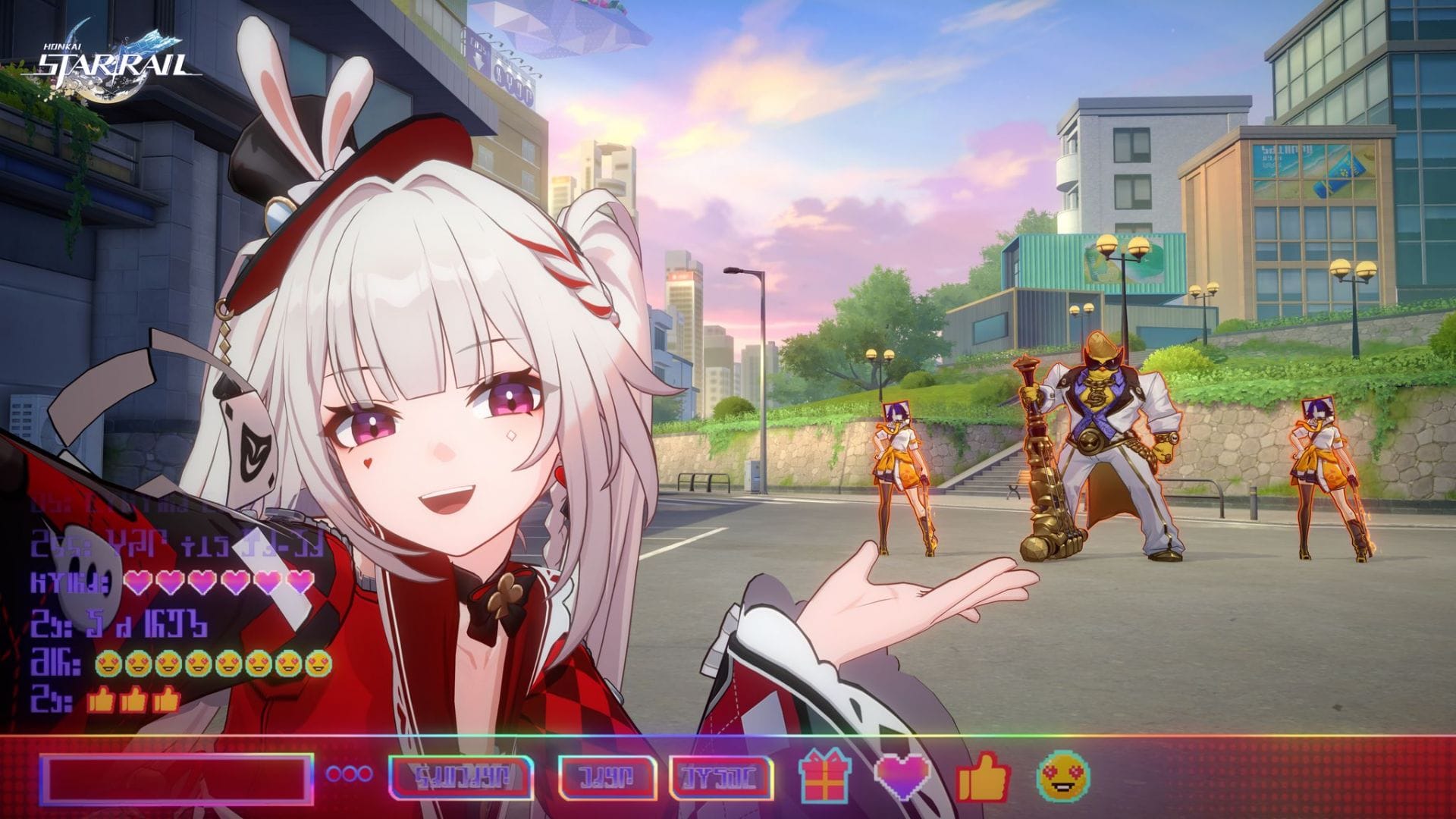
Sparxie (Image via HoYoverse)
While the enemy lineup in every stage of the Honkai Star Rail 4.1 Pure Fiction is different, they somewhat share the same weakness types. However, the first three stages aren’t that challenging compared to the last one. The first Node of Stage 4 features Argenti, the Knight of Beauty. Here are some teams you can use to clear the first Node:
Sparxie, Yao Guang, Sparkle, and Dan Heng Permansor Terrae
The Herta, Anaxa, Tribbie, and Dan Heng PT
Phainon, Cerydra, Sunday, Dan Heng Permansor Terrae
Since Argenti is weak to the Fire and Physical Elements, we have recommended the Sparxie Elation and Phainon hypercarry compositions. Both teams are exceptionally powerful and are capable of dealing damage to multiple enemies simultaneously.
On the other hand, The Herta team can be used in this Node as Anaxa can place weakness types on the enemies. Hence, you can easily use this composition in both nodes. Since there is not much difference in these teams, you can just use the Commotion buff.
Node 2
Ashveil (Image via HoYoverse)
As for Honkai Star Rail 4.1 Pure Fiction’s Node 2, you will fight Sam, alongside some others. The Stellaron Hunter is weak to Quantum, Lightning, and Imaginary Elements. The following section lists some teams that can help you clear Virtual Made Manifest:
Kafka, Black Swan, Hysilens, and Huohuo
Ashveil, Sunday, Tribbie, and Dan Heng Permansor Terrae
Archer, Sparkle, Yao Guang, and Dan Heng PT
The Kafka DoT team is quite strong in this particular cycle, as the Memory buff can boost the entire team’s damage output by a substantial amount. Since Kafka wields the Lightning Element, she can easily deal toughness as well as DoT damage to Sam.
Moving over to the Archer and Ashveil teams, both work differently because of their unique playstyle. However, their damage output is exceptionally high, and they specialize in defeating one enemy at a time. Like the Kafka team, these two also deal consistent damage throughout the fight.
For more articles related to this turn-based gacha title from HoYoverse, Honkai Star Rail, check out the following section:
Advertisement
Why did you not like this content?
Advertisement
Was this article helpful?
Thank You for feedback
Are you stuck on today’s Wordle? Our Wordle Solver will help you find the answer.
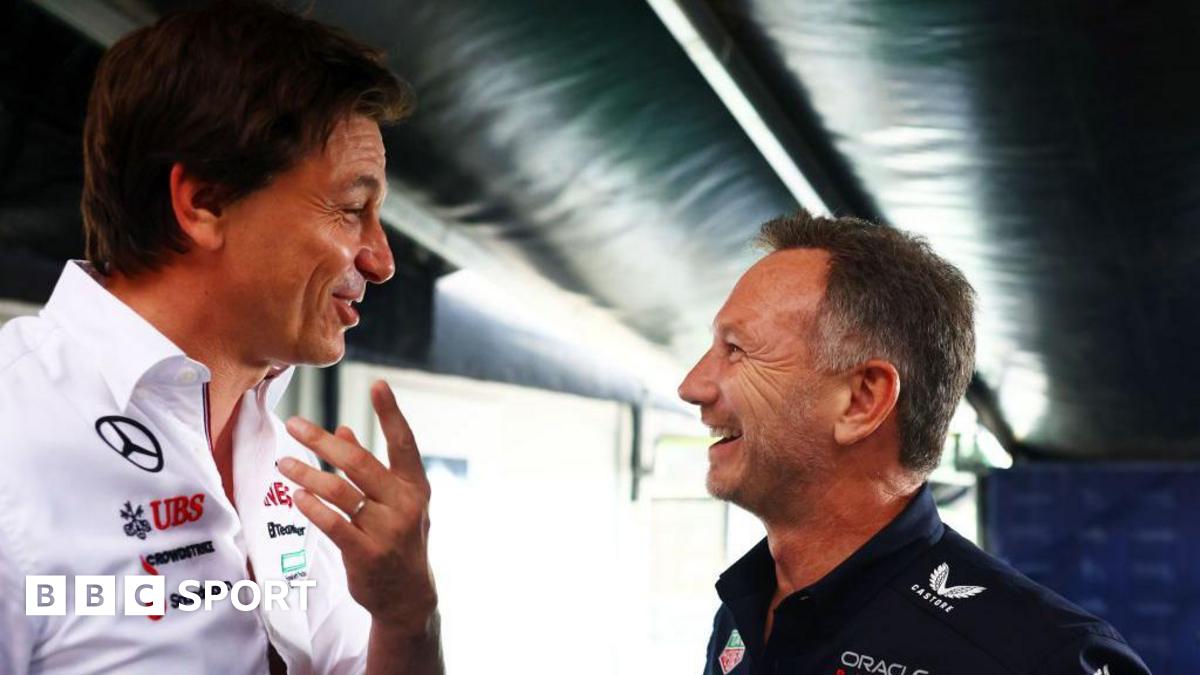
Wolff and Mercedes are also looking at buying private investment firm Otro Capital’s 24% shares in Alpine.
Wolff said there is “no connection” with Horner in regards that investment and it would be “quite sad” if that was a consideration.
Advertisement
“I am in two minds about it [Horner returning to F1]. The sport is missing personalities. And his personality was clearly very controversial and that is good for the sport,” Wolff said.
“I said to [Ferrari team principal] Fred Vasseur that it needs the good, the bad, and the ugly. And it is now only the good and the ugly left. The bad is gone.
“Would I consider that he could ever be an ally or someone that shares objectives? I don’t think so.
“But even when I had the biggest frustration, and anger with him, you need to remind yourself that even your worst enemy has a best friend, so there must be some goodness.
Advertisement
“If there wasn’t that competitive rivalry over so many years, and if there was more water down the river, I am sure I could have had hung with him over dinner and a had a laugh.”
Red Bull’s Max Verstappen won four consecutive drivers’ titles from 2021 to 2024, ending Mercedes’ dominance with Lewis Hamilton, who was controversially denied five straight titles.
Horner, who has said he has “unfinished business” in F1, was last year overlooked to take over at Aston Martin.
“Over those years it was just too intense, too fierce, and things happened which even today I cannot comprehend why he has done them,” Wolff said.
Advertisement
“I don’t know if he is finding his way back, and in which function. I certainly don’t wish him bad. And we need to give each other credit. There are not many team principals who have done what he has done.”
Minnesota Vikings running back Zavier Scott (36) carries the ball during second-half action against the Cincinnati Bengals, with the play unfolding on Sep 21, 2025 at U.S. Bank Stadium in Minneapolis, as Scott pushes upfield through traffic while contributing to the offense in a regular season home matchup. Mandatory Credit: Brad Rempel-Imagn Images.
The Minnesota Vikings will add at least nine new players from the 2026 NFL Draft, barring trades, a significant jump from the number last year, when the purple team had just five picks entering the event. And because nine newcomers are on the way, some existing players may be demoted sooner rather than later.
Several Vikings could lose ground when the rookie class arrives.
Here’s a look at the players hoping to avoid demotions, listed in alphabetical order.
Advertisement
Current Minnesota Players Facing the Most Draft Pressure
Job security is at risk.
Minnesota Vikings guard Blake Brandel (64) goes through his pregame routine, Nov. 10, 2024, at EverBank Stadium in Jacksonville, Florida, before facing the Jaguars as the versatile lineman prepares for another role along the offensive front amid injuries and lineup shifts during the season. Mandatory Credit: Morgan Tencza-Imagn Images.
Blake Brandel | C
Ryan Kelly retired a few weeks ago, and the Vikings signed zero center replacements in free agency. For now, the starting job appears to belong to Brandel, though third-year center Michael Jurgens might contest that this summer.
But if the Vikings draft one of these men in the draft’s first four rounds, Brandel could be back to his do-everything OL role:
Advertisement
Connor Lew (Auburn)
Sam Hecht (Kansas State)
Jake Slaughter (Florida)
Logan Jones (Iowa)
Parker Brailsford (Alabama)
It’s worth noting that Brandel improved each week last season at center in relief of Kelly.
Tai Felton | WR
Felton played 46 offensive snaps as a rookie, used primarily as a special teamer, which is fine, but most onlookers thought a 3rd-Round wideout would be used on offense. No cigar.
The Vikings didn’t re-sign Jalen Nailor, as the speedster vamoosed for Las Vegas, his hometown, to be the Raiders’ WR1 or WR2. That leaves Felton in a league of his own at WR3. There is no other wide receiver on the depth chart to even remotely compete for the WR3 job.
Still, if Minnesota drafts one of these men, Felton could be on notice, at least as far as the WR3 job is concerned:
Like Nailor leaving for the Raiders, Ingram-Dawkins’s DT teammates, Jonathan Allen and Javon Hargrave, found new homes with the Cincinnati Bengals and Green Bay Packers, respectively.
But just like Felton, if the Vikings draft one of these defensive tackles next month, Ingram-Dawkins may remain a reserve commodity:
Peter Woods (Clemson)
Kayden McDonald (Ohio State)
Caleb Banks (Florida)
Lee Hunter (Texas Tech)
Christen Miller (Georgia)
Domonique Orange (Iowa State)
Gracen Halton (Oklahoma)
Darrell Jackson Jr. (Florida State)
Dontay Corleone (Cincinnati)
Zane Durant (Penn State)
Zxavian Harris (Mississippi)
DeMonte Capehart (Clemson)
Chris McClellan (Missouri)
Kaleb Proctor (Southeastern Louisiana)
Tim Keenan III (Alabama)
Ingram-Dawkins saw defensive action on roughly 250 snaps as a rookie, a worthwhile amount for a late-round rookie.
Zavier Scott | RB
Advertisement
Scott probably has the shakiest job security on the list. By trade, he’s a practice squader who was promoted to the active roster last year. That may not last long.
Minnesota Vikings running back Zavier Scott (36) carries the ball during the second quarter, Aug. 16, 2025, at U.S. Bank Stadium in Minneapolis, Minnesota, against the New England Patriots as he looks for running room while contributing in a preseason matchup for the Vikings offense. Mandatory Credit: Brad Rempel-Imagn Images.
Minnesota has 31-year-old Aaron Jones back for another run, and Jordan Mason is tentatively expected to fill the RB1 job. Most fans agree that Kevin O’Connell’s team needs an early-round running back from the draft for the first time since the Dalvin Cook and Alexander Mattison days. All signs point to Minnesota acquiescing to the fans’ request.
If you see the Vikings draft one of these tailbacks, that could be the end of the road for Scott on the 53-man roster:
Jeremiyah Love (Notre Dame)
Jadarian Price (Notre Dame)
Mike Washington Jr. (Arkansas)
Jonah Coleman (Washington)
Emmett Johnson (Nebraska)
Nick Singleton (Penn State)
Demond Claiborne (Wake Forest)
Kaytron Allen (Penn State)
Kaelon Black (Indiana)
Seth McGowan (Kentucky)
The Vikings have formally met with Washington Jr. and Johnson via pre-draft visit.
Jay Ward | S
If Harrison Smith retires — he probably would’ve announced that by now, so most assume Smith will be back for Year No. 15 — Ward’s job security will rocket to the heavens. Ward was surprisingly effective in 2025, even snatching Theo Jackson’s starting job in December.
Advertisement
Tennessee Titans wide receiver Racey McMath (13) is brought down by Minnesota Vikings defenders Jay Ward (20) and Kalon Barnes (27), Aug. 19, 2023, at U.S. Bank Stadium in Minneapolis, Minnesota, as multiple defenders converge to stop the play during a preseason matchup between the teams. Mandatory Credit: Andrew Nelles-Imagn Images.
But like all the men on this list, Ward must dodge the draft selection of one of these safeties:
Thieneman is a massive draft darling for the Vikings at the moment. After you close this article, type into Google “NFL mock draft,” and we’re willing to bet that article connects Thieneman to Minnesota with the 18th pick.
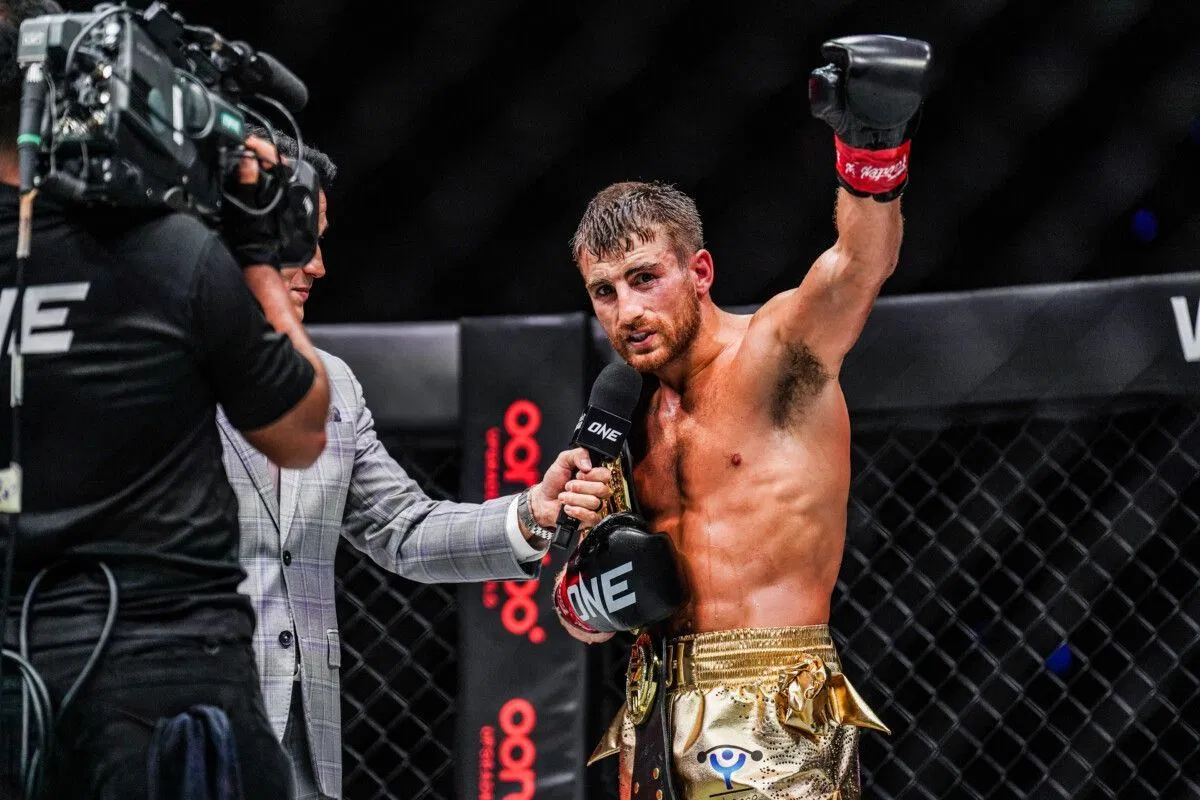
Reigning and undisputed ONE bantamweight kickboxing world champion and former Muay Thai king, ‘The General’ Jonathan Haggerty of the United Kingdom, is known for his powerful teep kick, which he has worked on for his entire life.
But that kick didn’t come about naturally. It was painstakingly developed over the years through repetition and practice.
Get the latest updates on One Championship Rankings at Sportskeeda and more
‘The General’ said:
“My teeps were just part of my game from a very young age. I was building that technique from the very beginning. I was quite tall for my weight category growing up through the ranks in the UK, and using the teep was quite effective. So I just continued building it brick by brick. Why stop if it’s working, you know? I just kept building what works, really.”
‘The General’ Jonathan Haggerty is set to defend his ONE bantamweight kickboxing world championship against Japanese star Yuki Yoza at ONE SAMURAI 1, which will take place live at the Ariake Arena in Tokyo, Japan, on Wednesday, April 29.
Advertisement
Fans in the United States and Canada can visit ONE Championship’s official website for more information on how to watch the event live from their location.
Jonathan Haggerty admits that ‘getting in that ring is very scary’: “I fight better with fear”
‘The General’ Jonathan Haggerty will be the first to admit that climbing into the ONE Championship ring is one of the most harrowing ordeals a fighter can experience. But because of that fear, he says he can fight at his best.
“When I think of fear, I think of my body shaking, adrenaline, and like scared. To overcome it, just block it out. I just block it out. As I said, getting in that ring is very scary. It’s a lot of fear. And getting past that. I need fear to fight. I fight better with fear.”
Stay tuned to Sportskeeda MMA for all the latest news and updates surrounding Jonathan Haggerty’s next fight.
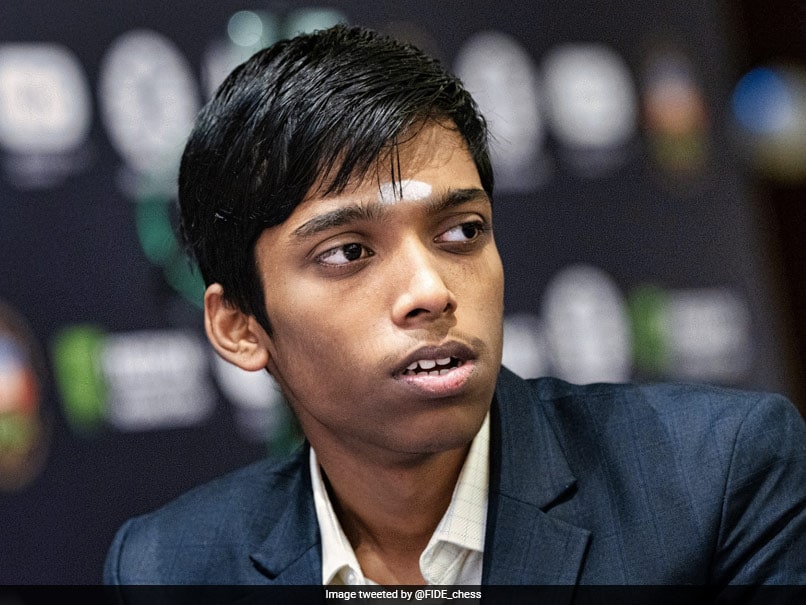
Indian Grandmaster R Praggnanandhaa kicked off his campaign at the prestigious Candidates Tournament by breaking through the defenses of Dutchman Anish Giri to secure a full point and now shares the lead after the first round with American GM Fabiano Caruana and Uzbekistan’s Javokhir Sindarov in Paphos. In an eventful first round, World Cup champion Sindarov showcased his excellent tactical skill to turn the tables on Russia’s Andrey Esipenko, while pre-event favourite Caruana stunned fellow American Hikaru Nakamura. The other game of the eight-player double round-robin tournament between Germany’s Matthias Bluebaum and China’s Wei Yi ended in a stalemate with both players sharing a point.
In the women’s section being held simultaneously, Indian Grandmaster and Women’s World Cup champion Divya Deshmukh drew with Ukraine’s Anna Muzychuk, a last-minute replacement for Koneru Humpy, while R. Vaishali survived some anxious moments before sharing the point with Kazakhstan’s Bibisara Assaubayeva.
It was, in fact, a day of stalemates in the womens’ section as Russia’s Aleksandra Goryachkina drew with compatriot Kateryna Lagno and the all-Chinese clash between Zhu Jiner and Tan Zhongyi also ended in a shared point.
Advertisement
Praggnanandhaa had been struggling in recent months leading up to the Candidates but has now bounced back in style, and Giri, one of the most consistent and solid players on the circuit, was simply no match for him on Saturday.
It was a battle of nerves as the Indian began with the Grand Prix Aatack to challenge Giri’s Sicilian Defense with the black pieces, and whether the opening achieved its intended effect is debatable, but it certainly gave Praggnanandhaa a valuable lead on the clock.
Giri is not used to surprises and while he was resourceful enough in the early middle game and equalised, Praggnanandhaa won a pawn in the ensuing rook-and-minor-pieces endgame.
Giri, running low on time, blundered in a lost rook-and-pawns endgame with a pawn less. The rest was easy for Praggnanandhaa.
Advertisement
But perhaps the most impressive game was played by Caruana who used his white pieces to perfection.
Nakamura was close to levelling the game as the middle game arrived, but the American, who is currently more active as a streamer than as a player, found himself in an opposite-coloured bishops middle game where his bishop was restricted to a passive role.
Caruana sealed the game with precise calculation in the endgame.
The Candidates is being contested in both the Open and Women’s sections to determine the challengers for the next World Championship matches against reigning champions D Gukesh and Ju Wenjun of China.
Women: Aleksandra Goryachkina (Rus) drew with Kateryna Lagno (Rus); R Vaishali (Ind) drew with Bibisara Assaubayeva (Kaz); Divya Deshmukh (Ind) drew with Anna Muzychuk (Ukr); Jiner Zhu (Chn) drew with Zhongyi Tan (Chn).
(Except for the headline, this story has not been edited by NDTV staff and is published from a syndicated feed.)
As Arizona prepares to play in its fifth all-time Final Four on Saturday, we’ve compiled a list of all such appearances by schools in the West.
The region boasts 19 Final Four teams, 12 of which have made two or more appearances, led by UCLA with 19, Arizona with five, and Utah and UNLV each with four.
But before we get to the list, for those who may be interested, a little history.
Advertisement
The NCAA recognizes Final Four appearances since the first tournament in 1939, even though only eight teams participated in the tournament from 1939 to 1950.
Between 1939 and 1950, there were only eight teams in the tournament, so half of the teams can claim a Final Four appearance.
However, since 1985, all have been required to play at least three games to make the Final Four.
Here is the list of participating schools from the region.
Advertisement
All-Time Final Four Appearances by Schools in the West
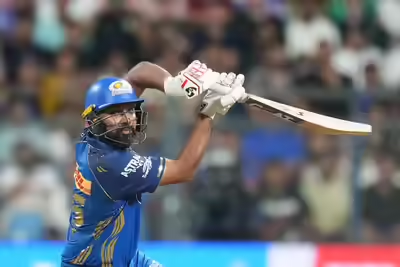
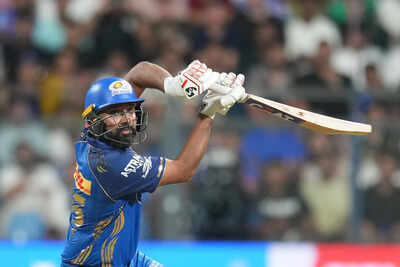
NEW DELHI: Former India captain Anil Kumble believes a resurgent Rohit Sharma could spell trouble for the rest of the IPL, after the Mumbai Indians opener announced his return in style with a match-winning knock against Kolkata Knight Riders.Rohit smashed a scintillating 78 off just 38 balls to power MI to a six-wicket win in their season opener at the Wankhede Stadium, ending their long-standing jinx of losing the first match of an IPL campaign.Go Beyond The Boundary with our YouTube channel. SUBSCRIBE NOW!Kumble was particularly struck by the authority and ease with which Rohit dominated quality bowling, calling it a sign of a dangerous new phase in his career.“Rohit Sharma seems to have arrived in his 2.0 avatar, and his innings showed he is ready to dominate again. The way he hit the ball all around the ground reminded me of his prime,” Kumble said on Star Sports.The former India coach highlighted how Rohit made light work of a potent spin attack featuring Sunil Narine and Varun Chakravarthy, along with pacer Blessing Muzarabani.“It is not easy to hit sixes against bowlers like Varun Chakravarthy, Sunil Narine and Blessing Muzarabani, but he made it look easy. He has worked a lot on his fitness… when you come back after a short break, it takes time to find rhythm,” Kumble noted.“This was a fantastic innings… the six-hitting looked easy, and even though the boundaries were small, those shots were going into the stands. This knock shows that Rohit means business and this version of him will worry all IPL teams,” he added.KKR’s spin strategy under scrutinyWhile praising Rohit, Kumble also pointed out tactical lapses from Kolkata Knight Riders, particularly their under-utilisation of key spinners.“KKR are relying too much on Sunil Narine and Varun Chakravarthy, and Narine did not even complete his quota, which was surprising. The disappointing part was that Ajinkya Rahane did not bring him on in the Powerplay,” he said.According to Kumble, the delay in introducing Narine proved costly as Mumbai’s openers had already taken control.“By the time Narine came on, the damage was already done… they need to use their resources better. When you have two world-class spinners, you need to use them well,” he added.
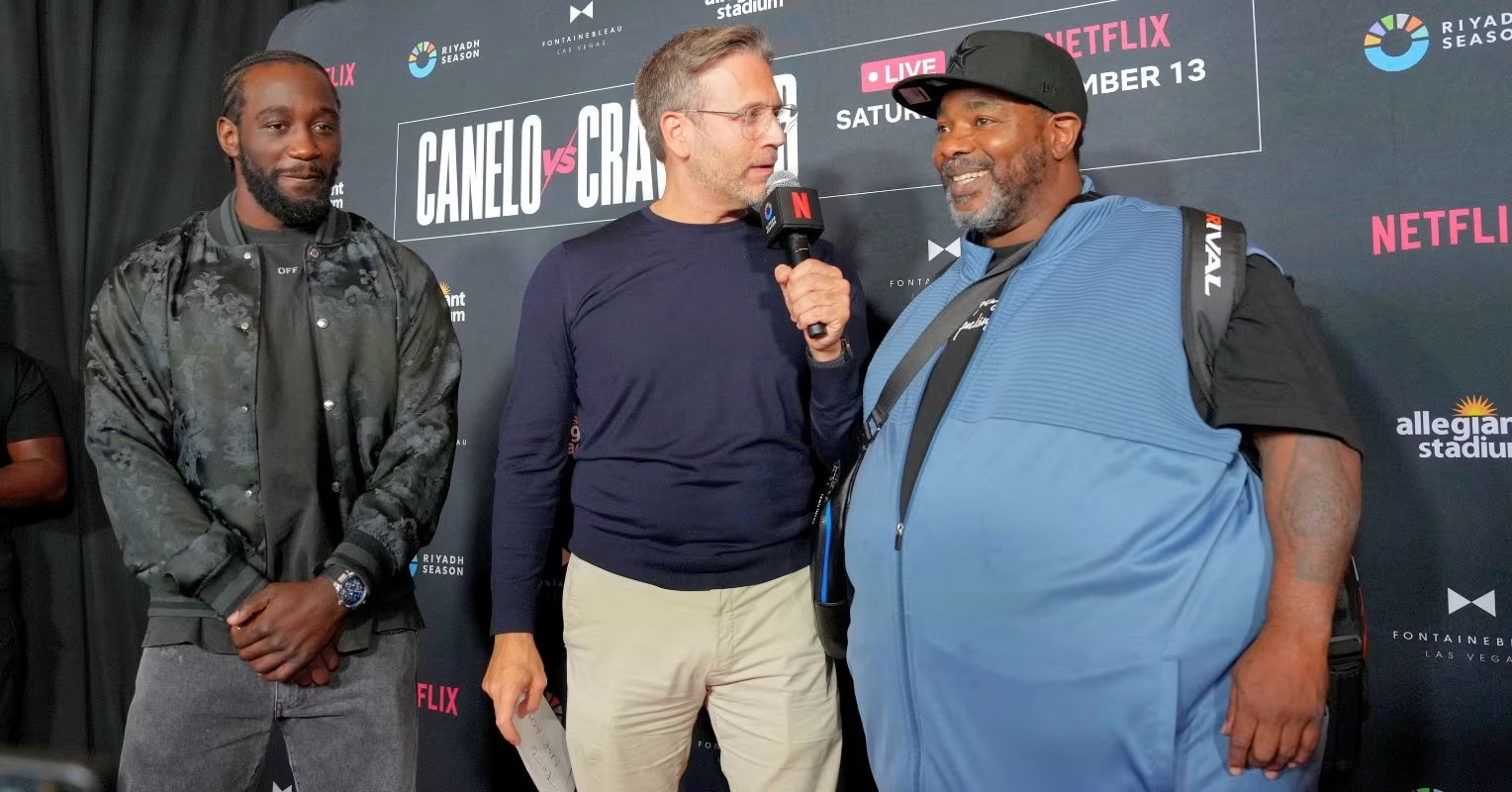
Terence Crawford‘s long-term trainer Brian ‘BoMac’ McIntyre believes there is one man that all other fighters would be wise to avoid sharing the ring with.
For many years Crawford was a fighter who appeared to be avoided himself, before finally landing the big fight he craved when he took on Errol Spence in an undisputed welterweight title showdown in July 2023.
Crawford dominated that bout and claimed a ninth round stoppage win, and that was seen as the biggest win of his career until he stepped up to 168lbs and dethroned Canelo Alvarez to become undisputed super-middleweight champion in September.
Crawford’s well-respected coach BoMac appears to found someone who possesses the skills to do just that, as he told Fight Hub TV that other fighters should avoid Shakur Stevenson due to the skill level of the unbeaten star.
“Shakur has got a great boxing mind. That’s just it. Once he put his mind to it he gets the job done. You probably want to stay away from that kid man.”
BoMac also heaped praise on Stevenson for the performance he produced in his recent victory over Teofimo Lopez to become WBO super-lightweight champion.
“He looked so smooth, calm and relaxed. It was a boxing lesson. The future young guys in the amateurs just turning pro, watch that, it was beautiful.”
That win saw Stevenson become a four-weight world champion, and at just 28-years-old, it certainly appears he can go on to achieve plenty more within the sport.
The Minnesota Vikings set sail on the 2026 NFL Draft in 25 days, so let’s take a look at the past to size up the best selections in franchise history. Next week, we’ll profile the naughty list: the worst selections by Minnesota since 1961.
Ranking the Franchise Picks That Delivered the Biggest Payoff
The criteria are simple: the Vikings players who put the biggest thumbprint on the team.
Advertisement
Ranking the Franchise Picks That Delivered the Biggest Payoff
Minnesota Vikings wide receiver Justin Jefferson (18) celebrates after converting a first down in the opening quarter, Oct. 30, 2022, at U.S. Bank Stadium in Minneapolis, Minnesota, against the Arizona Cardinals as he signals to the crowd and energizes the offense during an early-game scoring drive. Mandatory Credit: Brad Rempel-USA TODAY Sports.
8. Justin Jefferson | WR
Total Years as a Starter in NFL: 6 Drafted: Round 1 (2020) 1st-Team All-Pro: 2 Pro Bowls: 4
Here’s the stat to know about Jefferson:
Most Receiving Yards thru First 6 Seasons of Career:
Advertisement
Justin Jefferson (8,480) Randy Moss (8,375) Torry Holt (8,156) Jerry Rice (7,866) Calvin Johnson (7,836) Julio Jones (7,610) DeAndre Hopkins (7,437) CeeDee Lamb (7,416) Mike Evans (7,260) A.J. Green (7,135) Antonio Brown (7,093) Marvin Harrison (7,078) Larry Fitzgerald (7,067) A.J. Brown (7,026) Sterling Sharpe (7,015)
Not bad.
7. Adrian Peterson | RB
Total Years as a Starter in NFL: 15 Drafted: Round 1 (2007) 1st-Team All-Pro: 4 Pro Bowls: 7
Peterson’s off-the-field antics have turned wacky as of late, but before that, he was the best running back of his era in the NFL. In fact, no one has quite replicated him stylistically since he left the sport in 2021. Derrick Henry came close, but he’s just not quite as fast.
Advertisement
The only player with more rushing yards and rushing touchdowns in NFL history than Peterson is Emmitt Smith, who was an obvious Hall of Famer.
Peterson will be up for Hall of Fame Consideration soon; he better get in right away without any voter shenanigans.
6. Chris Doleman | DE
Total Years as a Starter in NFL: 15 Drafted: Round 1 (1985) 1st-Team All-Pro: 3 Pro Bowls: 8
Doleman spent 10 years in Minnesota, appearing in 154 games and logging 96.5 sacks along the way. He navigated the rough stretch of mid-1980s Vikings football and helped get the Dennis Green era off the ground in style.
Advertisement
He ranks seventh all-time in sacks on the “unofficial” leaderboard and fifth on the official version. He would’ve ranked No. 5 on this list, but No. 5 fundamentally changed how the sport is played.
5. Randy Moss | WR
Total Years as a Starter in NFL:12 Drafted: Round 1 (1998) 1st-Team All-Pro: 4 Pro Bowls: 6
Moss is widely known for revolutionizing the passing game in both the NFL and during his exciting 7.5 seasons with the Minnesota Vikings.
Jerry Rice is the only wide receiver in NFL history with more receiving yards and receiving touchdowns than Moss.
Advertisement
4. Randall McDaniel | G
Total Years as a Starter in NFL:14 1st-Team All-Pro:7 Drafted: Round 1 (1988) Pro Bowls: 12
Though offensive guards rarely receive top billing, McDaniel’s accomplishments warrant consideration, as his resume speaks for itself.
Former Minnesota Vikings guard Randall McDaniel delivers his induction speech during the Pro Football Hall of Fame ceremony, Aug. 8, 2009, at Fawcett Stadium in Canton, Ohio, as he addresses the crowd and reflects on his career during enshrinement into the sport’s most prestigious honor. Mandatory Credit: Matthew Emmons-USA TODAY Sports.
From 1988 to 1999, McDaniel anchored Minnesota’s offensive line with remarkable consistency and versatility. After his departure to Tampa Bay, the Buccaneers won the Super Bowl the following season.
¯\_(ツ)_/¯
3. Carl Eller | DE
Total Years as a Starter in NFL:15 Drafted: Round 1 (1964) 1st-Team All-Pro:5 Pro Bowls: 6
Advertisement
Eller was a cornerstone of the Purple People Eaters and a Hall of Famer. Before joining the Vikings, Page starred at the University of Minnesota, further enhancing his already impressive credentials.
He ranks 19th all-time in sacks on the unofficial leaderboard, which includes numbers from before 1982, when official sack tracking began.
2. Alan Page | DT
Total Years as a Starter in NFL:15 Drafted: Round 1 (1967) All-Pro:5 Pro Bowls: 9
Page’s 148.5 sacks rank eighth all-time, a remarkable achievement for a defensive tackle. While the choice between him and Eller for this spot was extremely close, Page’s statistics give him a slight edge, earning him the No. 2 spot.
Advertisement
He also served on the Minnesota Supreme Court from 1993 to 2015.
1. Fran Tarkenton | QB
Total Years as a Starter in NFL:18 Drafted: Round 3 (1961) All-Pro: 1 Pro Bowls: 9
Tarkenton’s No. 1 spot stems from three key factors: his position as quarterback, the most impactful on the field; his unexpected arrival to the Vikings as a 3rd-Round pick 65 years ago; and his remarkable longevity with the team.
Minnesota Vikings quarterback Fran Tarkenton (10) lines up at the line of scrimmage alongside guard Ed White (62) and tackle Grady Alderman (67), date and location unknown, as the offense prepares for the snap during a classic era moment captured in this archival file photo. Mandatory Credit: Malcolm Emmons-USA TODAY Sports.
Tarkenton’s career spanned roughly the length of Harrison Smith’s current tenure, plus another rookie contract — all while playing quarterback. Imagine Smith playing until 2029; that’s Tarkenton’s career.
Upon his retirement in 1978, he held the league’s top records in major passing categories, marking the end of an era closely tied to Minnesota’s Super Bowl aspirations.


;)
;)
;)
;)
;)













































You must be logged in to post a comment Login