Tech & AI
5 Of The Best Fighter Jets Flown By The US Navy

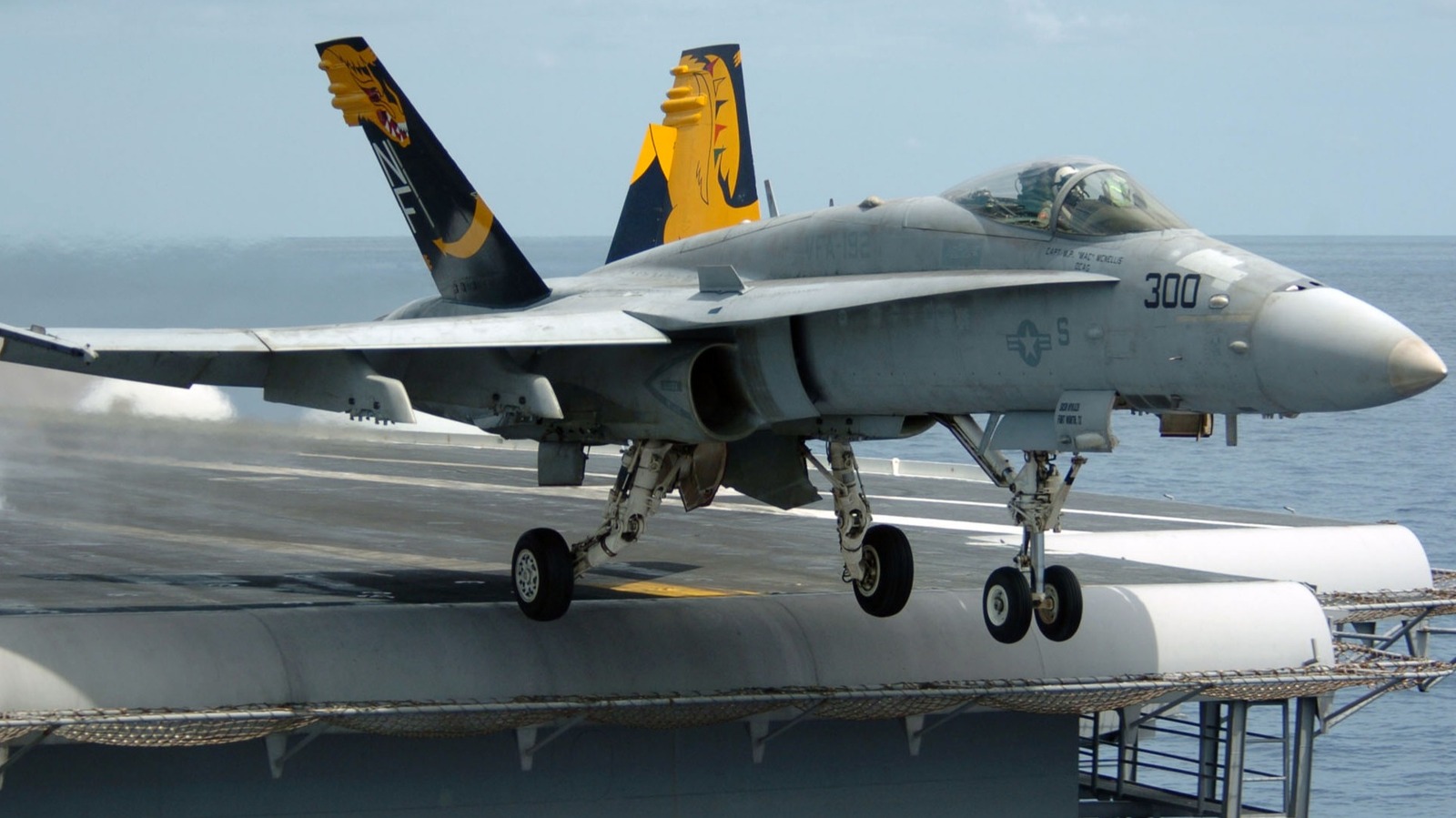

While the United States Navy (USN) is known for its ships, it also boasts a massive air force. The Navy’s air wings include all manner of aircraft, from small helicopters and transport planes to fighters and attack aircraft, all centered around the USN’s 11 aircraft carriers. The USN entered aviation in 1911, when Lt. Theodore Gordon “Spuds” Ellyson became Naval Aviator No. 1.
Thousands of brave men and women followed, flying Navy aircraft in and out of combat. Over the years, the USN has flown many different fighter jets, beginning in 1949 with the Grumman F9F Panther. Since then, more fighters, fighter-bombers, and attack aircraft have taken to the skies, and like any military vehicle, some were simply better than others. Whether it was their design, overall capabilities, lethality in dogfights, or the pilots themselves, the Navy has flown several fighter jets considered better than the rest.
Modern fighter jets aren’t often classified as such, as they’re typically multirole aircraft that don’t engage in dogfights. That said, the consensus is that these aircraft can take the fight to the enemy on the ground, at sea, or in the air. Each of these USN jets has proven its worth in various combat operations over the years, and they are among the Navy’s best fighter jets.
McDonnell Douglas F-4 Phantom II
The USN began flying the McDonnell Douglas F-4 Phantom II in 1961 as the branch’s newest two-seat, twin-engine interceptor and fighter-bomber. Naval aviators quickly recognized the F-4 Phantom II as an excellent fighter. Two General Electric J-79-GE-15 engines powered the aircraft, providing a combined 34,000 lbs. of thrust. This gave the F-4 Phantom II a top speed of Mach 1.82 (1,400 mph). It had a service ceiling of 59,600 feet, which was high for the period, and it could carry a variety of ordnance into battle.
The USN flew around 1,200 F-4 Phantom IIs during its service life, and the aircraft saw heavy use during the Vietnam War. For air-to-ground operations, the aircraft carried twice what a World War II-era B-17 Flying Fortress could carry. Its typical loadout consisted of four AIM-7E Sparrow air-to-air missiles, four AIM-9B Sidewinder air-to-air missiles, and eight 750-lb. Mk. 117 bombs. It could also carry two external fuel tanks and an ALQ-87 electronic countermeasure pod.
During its service, F-4 Phantom II pilots achieved 150 air-to-air kills while losing 42. This gives the F-4 Phantom II a kill ratio of 3.6:1, which is quite high. It was particularly deadly against MiG-17s during the Vietnam War, and every American ace from the conflict achieved their five kills while flying F-4 Phantom IIs. The USN retired the F-4 Phantom II in 1992 after 31 years of operation.
LTV A-7 Corsair II
The USN replaced the Douglas A-4 Skyhawk with the LTV A-7 Corsair II in 1967 as its newest light attack aircraft, so it wasn’t a traditional fighter. Regardless, the A-7 Corsair II was an exceptional aircraft that featured an unusual design that earned it the moniker SLUF, or Short, Little, Ugly Fella.’ It was short and stubby, with a large single jet intake beneath the nose and a single engine. It was powered by an Allison TF41-A-2 engine that produced 14,250 lbs. of thrust, giving it a top speed of Mach 0.9 (693 mph).
The versatile turbofan aircraft dominated during the Vietnam War. It carried an M61A1 Vulcan 20mm rotary cannon and could carry up to 15,000 lbs. of additional ordnance. The USN used them during Operation Linebacker bombing raids on Hanoi and other notable targets in the region. It was also used to aerially mine North Vietnamese ports in 1972, so the A-7 Corsair II was versatile.
After the Vietnam War, the USN continued operating the A-7 Corsair II, packing them onto aircraft carriers, where they continued operations in the 1980s. They flew in support of combat operations in Grenada, Libya, Lebanon, and Panama. They continued flying in support of Operation Desert Storm, striking Baghdad, Iraq, during the opening days of the air war. In 1991, after 24 years, the USN finally retired its remaining A-7 Corsair IIs.
Grumman F-14 Tomcat
Among iconic USN fighter jets, the Grumman F-14 Tomcat is one of the most recognizable. Maverick (Tom Cruise) flew it in “Top Gun” and its sequel, “Top Gun: Maverick.” It’s one of the most advanced 4th-generation fighter jets the USN ever flew. The USN began flying the F-14 in 1974 as its premier carrier-capable supersonic, twin-engine, two-seat all-weather fighter. It featured a variable-sweep wing that could move forward or backward, depending on the pilot’s needs, and it outmaneuvered contemporary MiG fighters.
The F-14 served the USN primarily as a fleet-defense interceptor and air-superiority fighter, but it also performed numerous roles and carried a variety of ordnance. The USN retired the F-14 in 2006, replacing it with the technologically superior F/A-18 Hornet, but it served as one of the Navy’s most iconic aircraft for 32 years. Beyond starring in “Top Gun,” F-14s achieved five confirmed air-to-air kills with zero losses, giving them a 5:0 kill ratio that demonstrates their exceptional capabilities.
The F-14 Tomcat reached a top speed of Mach 2.34 (1,795 mph) with its two Pratt & Whitney TF-30 turbofans and afterburning, which produced a combined 40,000 lbs. of thrust. It could carry six AIM-54 Phoenix missiles or six AIM-7 Sparrow missiles and four AIM-9 Sidewinder missiles alongside its 20mm Vulcan cannon. Unfortunately, most F-14s were destroyed to prevent Iran from acquiring their parts after the Iranian Revolution in 1979.
Boeing F/A-18 Super Hornet
In 1984, the F/A-18 Hornet replaced the F-4 Phantom II and the A-7 Corsair II. Initially a 4th-generation fighter, the F/A-18 Hornet has undergone several upgrades and modernization enhancements, and the current F/A-18E/F Super Hornet is the USN’s primary multirole fighter and a 4.5th-generation aircraft. While the USN has several fighters at its disposal, the F/A-18 Super Hornet forms the backbone of its air wings.
The current variant began operating in 1999, and it’s one of the best fighters the Navy has ever flown. It replaced the F-14 Tomcat, and while that aircraft was exceptional, the F/A-18 Super Hornet outperforms it in every way, except top speed. It uses two F414-GE-400 turbofan engines that provide a combined 44,000 lbs. of thrust, giving the F/A-18 Super Hornet a top speed of Mach 1.8+ (1,381 mph). It has a ceiling of 50,000+ feet and a combat range of 1,467 miles.
In terms of armament, F/A-18 Super Hornets can carry a variety of munitions across over 400 loadouts, including air-to-air missiles, anti-ship missiles, bombs, mines, and rockets. It’s a highly capable fighter, and the new F/A-18 Block III Super Hornet is the Navy’s next-level fighter. While the USN is working to produce a 6th-generation replacement, currently dubbed the F/A-XX, the F/A-18 Super Hornet will remain operational throughout the 2030s.
Lockheed Martin F-35C Lightning II
The U.S.’ second 5th-generation fighter, the Lockheed Martin F-35 Lightning II, was designed with three variants. The USAF uses the F-35A, the USMC uses the F-35 B, which can take off and land vertically (VTOL), and the USN uses the F-35C. The Navy’s F-35 has a different configuration with foldable wings, which helps store it in aircraft carrier hangars without taking up too much space. The USN began flying them in 2019 and continues to expand their roles as more enter the inventory.
The F-35C was designed and built specifically for USN carrier operations, featuring enhanced stealth, a wide range of ordnance, and the ability to operate in contested environments worldwide. The aircraft has a top speed of Mach 1.5 (1,151 mph) and can pull up to 7.5G. The F-35C can carry 18,000 lbs. of mixed ordnance. It’s powered by a single Pratt & Whitney F135-PW-100 engine that produces 40,000 lbs. of thrust.
While the F-35C has been operating for the USN for several years, it only achieved operational testing aboard a Ford-class aircraft carrier in October 2026. It successfully completed an EMALS launch and cable-assisted recovery aboard the USS John F. Kennedy (CVN-79), marking a major milestone for future carrier operations. The F-35C represents several enhancements to USN fighter capabilities and is the branch’s most technologically advanced aircraft to date.
How we chose these five USN fighter jets
Selecting the best fighter jets the Navy has flown is subjective, but we aimed for objectivity, so we considered several factors. For example, the F-4 Phantom II is one of the most iconic aircraft the USN has flown, but the U.S. Air Force (USAF) and U.S. Marine Corps also flew it. One reason it’s iconic to the Navy is that the USN Blue Angels flew it, and it remains the only aircraft flown by that demonstration team, as well as the USAF Thunderbirds.
It represents Navy aviation and was an amazing fighter with an exceptional record. The same goes for the F-14 Tomcat, which quickly became one of the Navy’s most beloved fighters, thanks to “Top Gun” and its popularity. While it’s not as well known today, the LTV A-7 Corsair II was an exceptional USN fighter that flew during the Vietnam War, and it too became iconic in USN operations, appearing on carrier decks for many years after the conflict ended.
While the F-35C is one of three variants of the 5th-generation fighter, its carrier-specific configuration and the aircraft’s exceptional capabilities make it a preeminent Navy fighter. That said, the F/A-18 Super Hornet is arguably the most important of the USN’s jets, as it’s the service’s backbone of all aerial operations, and will remain so for years to come.
You must be logged in to post a comment Login