This article is crossposted from IEEE Spectrum’s careers newsletter. Sign up now to get insider tips, expert advice, and practical strategies, written in partnership with tech career development company Parsity and delivered to your inbox for free!
If you’re an engineer, you may feel like your skills aren’t commanding the premium they once did. Many engineers have faced layoffs or restructuring. But even for those of us who still have jobs, something corrosive is happening. You may have heard some version of this:
“ChatGPT answered that in five seconds. Why can’t you?”
Or, “I made this app in a weekend. Why is our team taking so long?”
Advertisement
I worked on a team where leadership said things like this directly to engineers. This was in 2024 and 2025, when the AI craze was in full swing and Claude and ChatGPTadoption was rising.
Demo-Driven Development
Generative AI (and the marketing behind it) gives people the illusion that the work is simpler than it is. A working demo hides complexity, and once someone has a website that works, they may decide they no longer need engineers, or start to distrust the ones they do have.
Some CEOs want to believe they can replace an engineering team with a few sexy prompts. Many companies also want them to believe this.
That website works great in the demo—under specific conditions and without users with thumbs for fingers. Then it has to plug into a system with millions of lines of old code, satisfy legal requirements, meet accessibility standards, and be delivered in a complex deployment process.
Advertisement
Thinking that writing code was the only bottleneck for deploying new software is like the Titanic seeing the tip of the iceberg and assuming there was nothing underneath it.
What you can do about it
Engineers have a unique position in the AI space, because you have the capacity to understand how these models work much better than the average person. Use this to your advantage.
Learn how AI models work. If you can’t already explain that LLMs are probabilistic, what tokens are, or why training data matters, spend a weekend fixing that. You don’t need to become a full-blown AI researcher. A few fundamentals will put you ahead of most people making the AI decisions.
Teach upward. Turn that knowledge into teaching moments for the people who lead you. Explain the limits of these tools, and why a demo and a production system are different animals. It keeps people from truly believing that a notebook full of prompts can replace an engineering team.
Advertisement
Consider the criticism of today’s processes. Some of what we do has been treated as ceremony for too long. Be willing to say, “you know what, maybe you’re right, this process is too slow for the speed we can work at now.” Conceding that earns you the credibility to defend the steps that matter.
I still believe that speed at the cost of everything else is harmful—but that’s a topic for another time.
Find your voice. Engineers at the forefront of AI adoption need to push back and explain why we do things the way we do. Nobody else in the room is going to do it for us.
Don’t chase (too many) shiny objects
Your goal, in my opinion, is to save your organization from buying into the hype so much that they chase the wrong thing. Our job, before and after AI, is building safe and useful products for human beings, and engineers are still best suited for that.
Advertisement
—Brian
The need to educate engineering students about ethics and social responsibility is widely recognized, but today’s curricula often miss the mark. Three professors propose a new approach: adding ethics training directly to core technical coursework.
Looking for a career in quantum computing hardware? An IBM spin-off called Anderon could receive up to $1 billion in funding from the U.S. CHIPS and Science Act for its quantum foundry, established earlier this year. Could Anderon do for quantum hardware what TSMC did for conventional chips?
When Gurmeet Saran joined Anthropic’s technical staff in 2025, he entered a role focused on a key question: How do you know whether you can trust a chatbot like Claude? Learn more about Saran’s path and his work at the AI company.
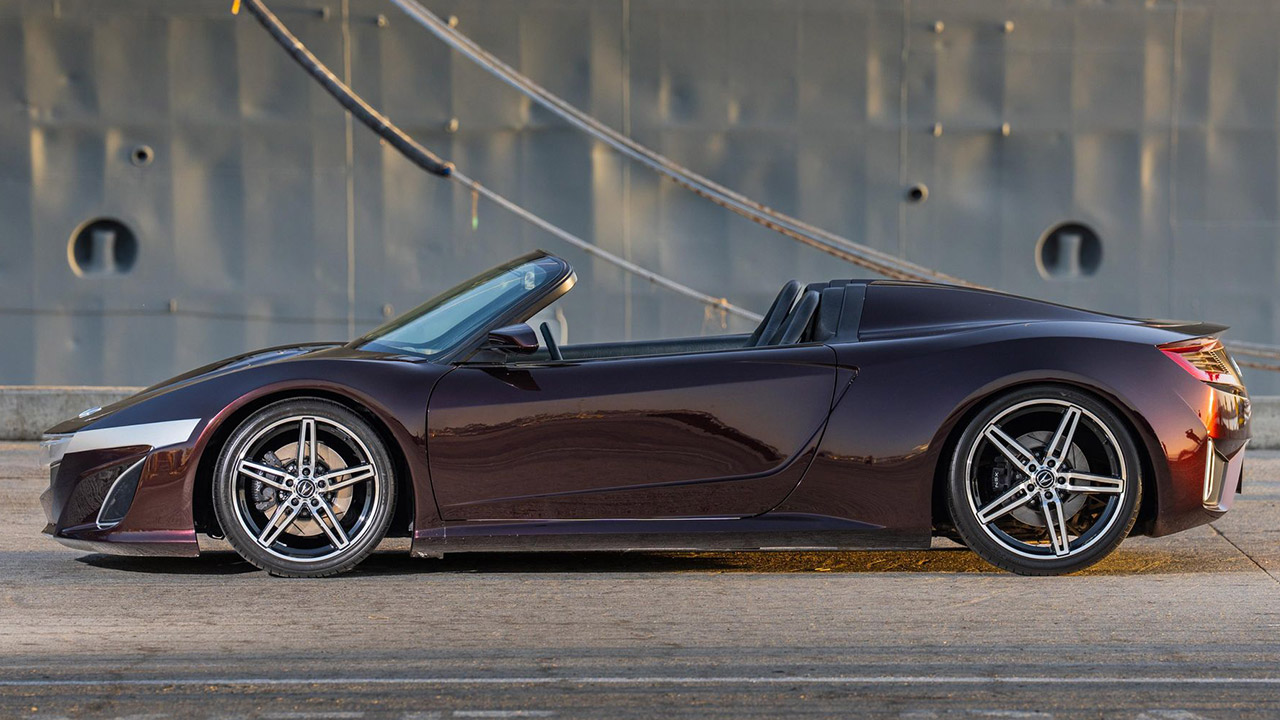
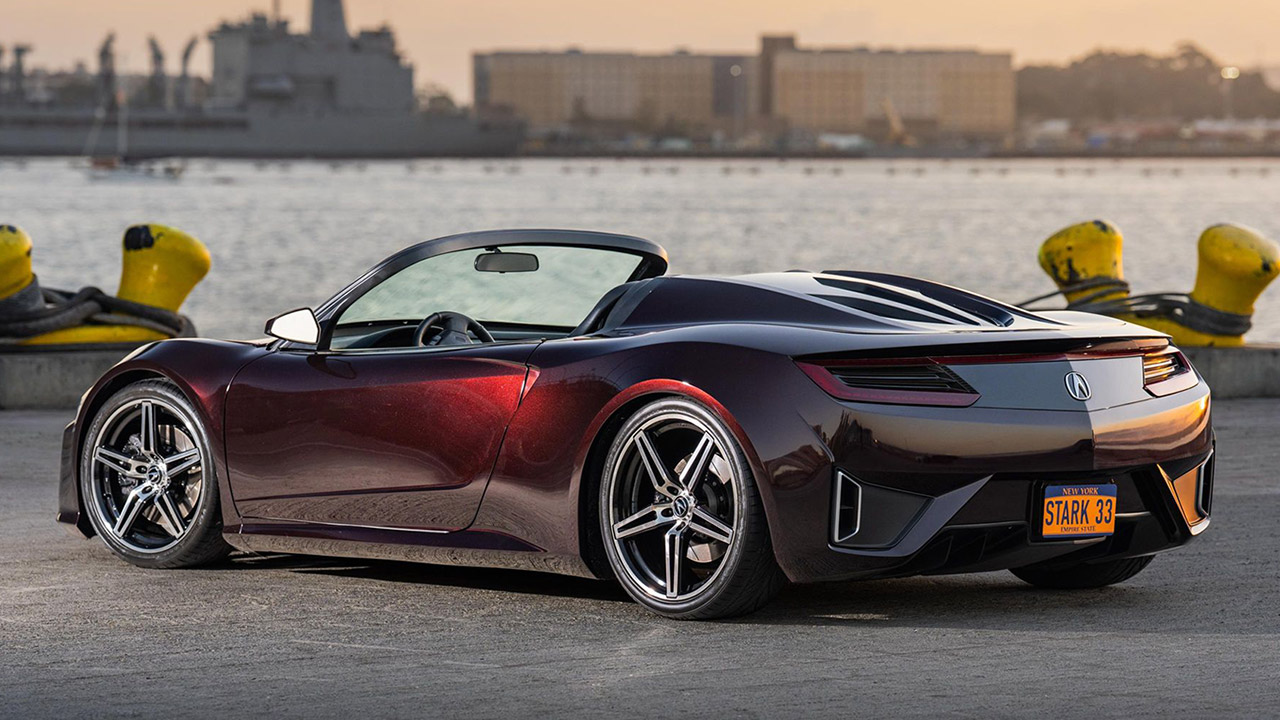
Robert Downey Jr. drove away from the final scene of 2012’s The Avengers in a low, open roadster finished in a deep red close to Iron Man’s armor, wearing a New York plate that read STARK 33. That exact car now sits on Cars & Bids with no reserve, and every dollar of the winning bid goes to a charity chosen with the buyer. American Honda will also cover the platform’s buyer’s fee once the sale closes on October 31.
The Acura Los Angeles design office, then led by Dave Marek, took the second-generation NSX concept from the Detroit auto show and ran with it, practically putting those design cues into the car it was developing. Trans FX in Oxnard, California, then created a resin and fiberglass bodyshell over a first-generation chassis, beginning with a relatively worn 1991 NSX with 252,000 kilometers. Marek subsequently revealed that he chose this car for a film set because they needed something that would start every time the cameras rolled, and nothing was better suited to that aim than the original NSX.
SUPER HERO TOY BUILDING SET – Unleash large-scale Super Hero action with the LEGO Marvel Epic Battle: Avengers: Doomsday (76348) building toy for…
6 AVENGERS MINIFIGURES – Launch into epic Super Hero adventures with minifigures of Doctor Doom, Magneto, Thor, Nightcrawler, Mystique and Mister…
INSPIRE CREATIVE PLAY – Recreate the exciting showdown from the Marvel Studios Avengers: Doomsday movie with a buildable, fully articulated Sentinel…
The suspension was lowered by two inches, and aftermarket sport seats were added. For good measure, the wheels were staggered, with 18 inches up front and 20 inches in the back. The power still comes from the factory 3.0-liter DOHC VTEC V6 engine, which produces roughly 270hp and 210lb-ft of torque when new, and it is still mated to a five-speed manual transmission that sends power to the rear wheels.
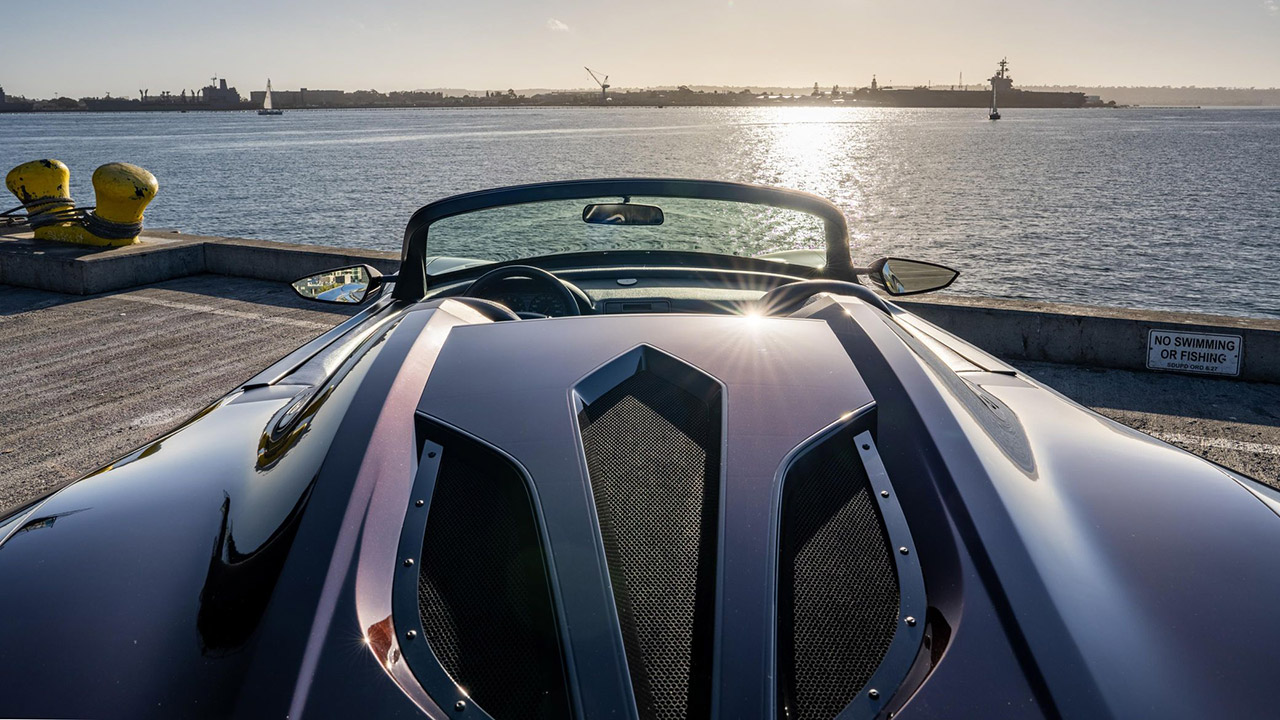
The finished car has no hardtop or side windows, leaving the cockpit totally exposed to the elements. They also left the screen-used plate and some unique LED taillights in place. After all of the filming, Acura decided to keep the car, bringing it out of storage for public viewing in 2025 at Monterey Car Week and then again at Sundance.
A certificate of authenticity, a signed photo of the creative director with the car, one key, and two key fobs travel with it.Ownership comes with hard limits. The listing calls the car a non-registerable manufacturer prototype that carries no usable VIN for street purposes. It sells on a bill of sale, cannot be titled or driven on public roads, and remains subject to an Acura usage agreement.
In terms of the car’s condition, let’s just say that it’s been well-loved and used for the last dozen years or so. There are micro-scratches on the bumpers, A pillars, and doors, paint cracks on the C pillars, scuffs on the interior trim, and a bent armrest. Plus, the exact mileage on this car is practically a mystery, as it was only test driven in brief bursts of about 20mph while they were creating it.
So it’s worth emphasizing that whoever wins this auction will most likely see it as a nicely kept film prop rather than a daily driver. Which is interesting given that Acura essentially chose this high-mileage donor car because it knew it only needed it to be dependable enough to complete the task on camera.
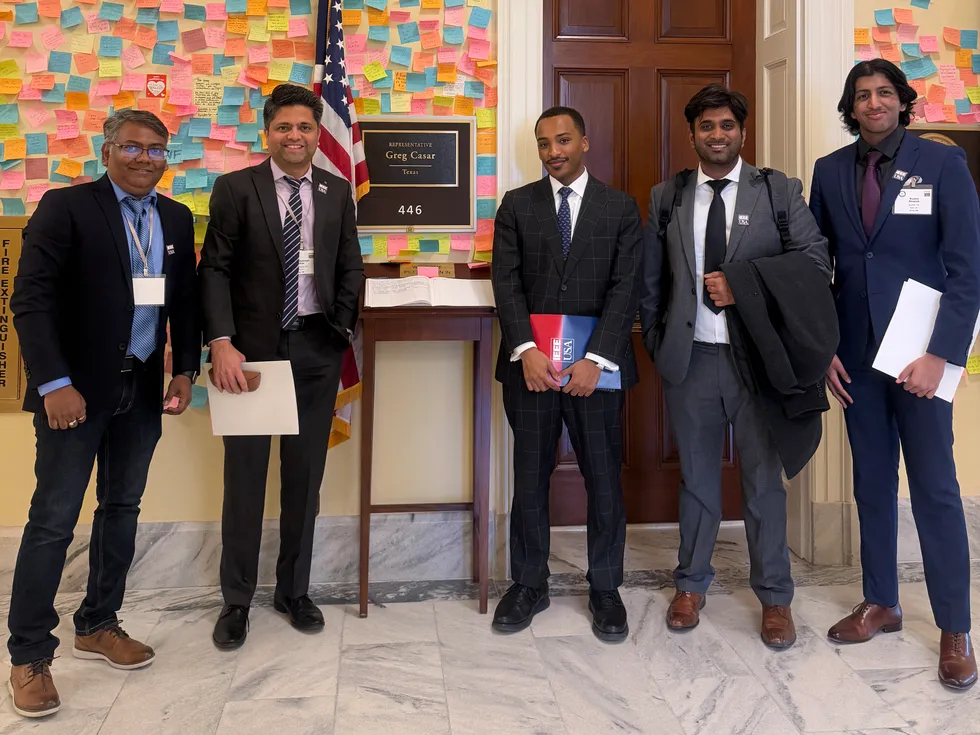
When San Antonio–based software engineer Nikhil Jathar first went to Washington, D.C., to advocate for federal support for technology education and research funding, he was in awe of the opportunity. It was spring of 2025, not long after Jathar settled in the United States from India, when he got an invitation to join the annual Congressional Visits Day organized by IEEE-USA.
“My first reaction was, ‘Wow, I get to visit Congress,’ ” says Jathar, CTO of AvanSaber, a business software company he cofounded in 2014. At the time, he did not have a specific lobbying position on behalf of the company. But he was intrigued by the invitation—which goes out to all U.S. IEEE members—and as he read more about congressional visits, his motivation deepened. He realized: “I need to try this. I want to see where it goes.”
Congressional staffers say they welcome the knowledge and perspective that engineers like Jathar and other visitors from beyond Washington, D.C., provide. It’s also important for those visitors to be clear on what they are advocating for. One staffer for the House Committee on Science, Space, and Technology, who agreed to speak anonymously due to the office’s media policy, says, “Ideas for new policies come from multiple places. It could begin at the [legislator] or staff level, an ask from a constituent, or needs from industry. It’s up to us to figure out what would do the most good,” the staffer said. “For instance, if you leave it to the lobbyists, they’re understandably going to do what’s in their clients’ interests.”
For engineers in the United States, speaking with elected representatives is an effective way to shape key policies, but it takes some preparation and the right approach, as Jathar learned over the course of two visits.
Advertisement
Mapping Your Way Into Washington
Congress’s job is to act on behalf of the people, and it has rules for how people can lobby it. It distinguishes between broader advocacy—conversations between constituents and U.S. representatives—and professional lobbying, which involves paid professionals and is governed by the Lobbying Disclosure Act. Many professionalgroups like IEEE also organize congressional visits for their members. Those visits can be subject to lobbying rules, so the organizers told Jathar that: “You are representing the organization, not your own views.” He would need to stick to the talking points IEEE-USA had prepared for all its participants, regardless of their specialty, to promote across several congressional offices.
On Jathar’s first visit, those organizational talking points included advocating for funding smart grids, authorizing Department of Energy research, and investing in STEM education. That represents one of the trade-offs of access in Washington. IEEE-USA’s priorities didn’t all overlap directly with Jathar’s work, but they were broad enablers of science and technology and, he says, “STEM education funding is close to my heart.”
Anyone can approach their representatives in Washington with their personal priorities, Jathar notes, but given how pressed for time congressional staff are, they are more likely to prioritize a meeting that represents the views of as many of their constituents as possible. “I could have gone outside the IEEE structure,” Jathar says, but congressional staff “are more likely to listen if you are part of a much bigger organization.”
For Jathar’s first congressional visit, organizers assigned him to call on the offices of several representatives from both political parties based on where he lives: Representatives Greg Casar (D-Texas), Lloyd Doggett (D-Texas), and Barry Moore (R-Ala.). “Meeting a staffer or a senior member from their office is good. They tend to relate to these issues more than a representative, because a representative has 10 different high-level things they have to worry about whereas the staffer can be more focused on the policy details,” Jathar says.
Advertisement
A typical visit like this may last anywhere from 15 minutes to an hour, so Jathar kept his talking points simple and short. “First and foremost you’re gonna get a very small window,” he says, “Make sure you’ve got everything ready to present in bullet points and not a lot of jargon. You can always bring that out later if they ask more questions.” Simple visual aids, in the form of one-page handouts, may be helpful for communicating numeric or technical information, too.
“If you leave it to the lobbyists, they’re understandably going to do what’s in their clients’ interests.”–Staffer for the House Committee on Science, Space, and Technology
The House Science Committee staffer agrees: “I prefer meetings where people know what they want and know what we’re doing in Congress.” In addition to having a clear request, the staffer says engineers and other advocates should keep track of where Congress is in its cycle: Is it appropriations season, and when is the next budget being set? How far along is a given piece of legislation in the process, and what is realistic to change at that point?
During Jathar’s 2025 visit to one Capitol Hill office, he learned firsthand the importance of preparation. For one of the three representatives he visited, staff politely pointed out that the legislator they worked for was not on the committee with jurisdiction over the IEEE-USA talking point they were discussing. “They explained that there are only certain things [the legislator] can do on that issue and that there are other people we need to talk to, to achieve more,” Jathar recalls.
Advertisement
Shortcuts to Influence
Earlier this year, Jathar decided to go back to Capitol Hill with his newfound knowledge, again within the framework of an IEEE-USA visit. This time he was able to provide something else legislative staff want from engineers: authoritative technical knowledge.
“When I introduced myself as a software developer to one staffer, his first question was, ‘Do you think AI will replace coders?’ ” Jathar says. The conversation went back and forth, with the staffer asking Jathar and his other engineering companions questions. Jathar went on to explain that his company developed an open-source business-management software it calls ERPClaw, designed to be used with AI agents such as OpenClaw. That led naturally to discussing the role of open source in AI, which plays a role in one of IEEE-USA’s proposals for democratizing AI. This time Jathar was able to align his organization’s advocacy with his expertise and the staffer’s areas of interest.
It’s too soon to know what legislative impact that advocacy might have, but it’s the sort of informed, relevant proposal that legislative staff seek out. “The people who build trust have more cachet with congressional staff because they’ve asked for something that’s reasonably thought out,” the House Science Committee staffer says. In turn, congressional staffers can advocate better within their offices for policies brought to them by people they trust.
And talking about the issues you care the most about can deepen that trust. The House Science Committee staffer once visited Congress as an advocate before switching to the other side of the table. On that visit, as on Jathar’s, the professional society organizing the visit provided a pitch. “I was making a pitch that was given to me without a lot of personal buy-in,” the staffer says. Instead, “you should feel emotionally connected to any issue you’re advocating for.”
Advertisement
Jathar’s support for the open-source movement is like that. Open source gives smaller companies a foundation they can adapt and build upon, while allowing other developers to extend that work. “We can progress a lot faster,” Jathar says. “I’m not doing it only because it’s good for my business, but because I feel it’s good for any technological advancement.”
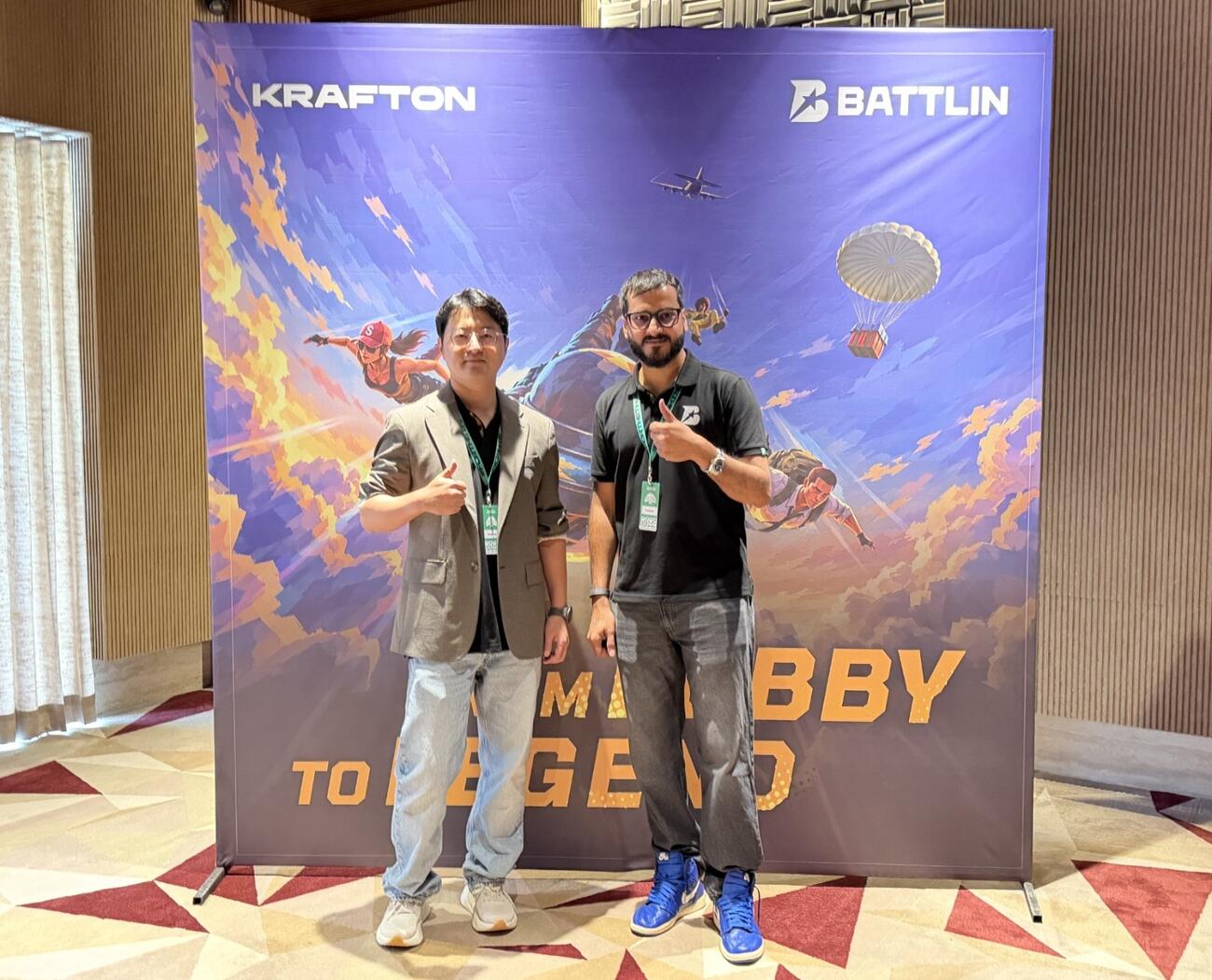
KRAFTON has launched Battlin, a new tournament platform for India’s gaming sector. The platform integrates every aspect of tournament participation, from discovery to hosting and rewards. It will initially focus on BGMI, helping players find and join tournaments more easily.
BGMI has plenty of competitive players, but finding and managing tournaments can still be difficult. Participants rely on group chats for room IDs and even on third-party apps to register for these events. Moreover, they even have to provide proof of completion through screenshots. This is where KRAFTON’s Battlin platform comes in handy. The platform lets you find, join, and track tournament results all in one place. It also displays reward conditions and disbursement timelines before registration.
The Battlin’ app gives tournament organizers features that let them control the whole process. They can set up the tournament, register participants, schedule matches, organize rooms, notify participants, track results, and provide rewards. Automated brackets, rooms, and notifications reduce the effort required to run competitions. The platform also manages reward disbursement, so organizers don’t have to pay participants. This helps make the process clearer for players. Battlin is open to individuals, content creators, colleges, gaming cafés, and gaming organizations that want to host tournaments. They can use the same infrastructure as official competitions to organize events and build audiences.
Battlin Open Season 1: Registration, Dates, and Prize Pool
Registration for Battlin’ Open Season 1 has now opened on KRAFTON’s new Battlin platform. Participants can register on Battlin until November 1, 2026. The tournament has 5,000 seats. The tournament will start on November 2, 2026, with two tracks. The winning team of Track 1 will win a BGIS slot and a cash prize worth Rs 5,00,000. The prize money for Track 2 will be Rs 15,00,000.
Advertisement
Track 2 Finale is scheduled for November 29, 2026. This event will be the first in the Battlin Open series to produce a winner. All the results of the tournament will be tracked via the platform where the rewards are going to be issued. KRAFTON states that Battlin tournaments will depend on players’ skills and performance. The platform offers no betting or staking features. Through accessible tournaments and transparent reward processes, Battlin’ aims to support grassroots competitive gaming in India.
Lately Trump has been complaining about the numerous polls all showing that he’s historically unpopular due to stuff like covering up for a pedophile and launching a disastrous war that’s driving up the cost of living for everybody. Most polls show Trump’s likely to sink Republicans in the midterms.
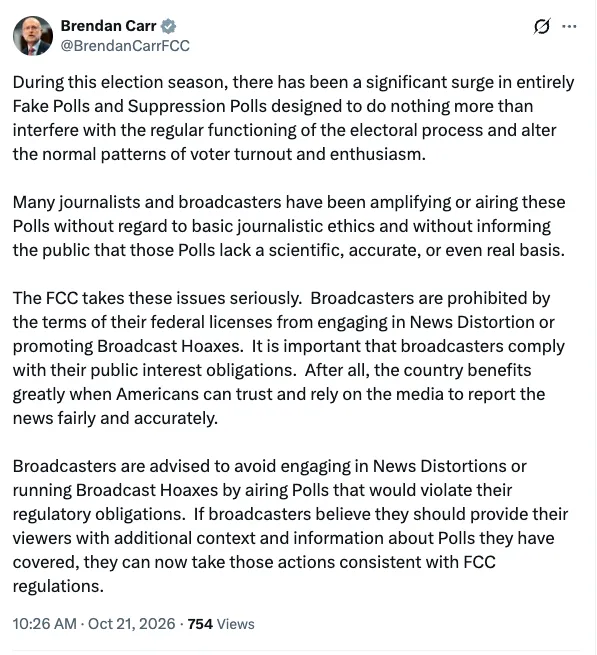
So like a dutiful little yipping chihuahua, Carr took to Elon Musk’s right wing propaganda website on Wednesday to once again hurl threats at journalists for the “crime” of…covering polling that clearly shows the U.S. President is historically unpopular:
If you can’t read it, it starts with Carr making the false claim that there’s a bunch of fake polls circulating that journalists are unethically repeating en masse. This is silly fascist code for the fact that Republican internal polling data indicates Trump’s fading health and political power are going to be an albatross around their necks this midterm voting season:
“During this election season, there has been a significant surge in entirely Fake Polls and Suppression Polls designed to do nothing more than interfere with the regular functioning of the electoral process and alter the normal patterns of voter turnout and enthusiasm.
Many journalists and broadcasters have been amplifying or airing these Polls without regard to basic journalistic ethics and without informing the public that those Polls lack a scientific, accurate, or even real basis.”
Advertisement
Carr continues by once again threatening to harass media companies for discussing polls the thin-skinned president and his pasty sycophants don’t like. He also, once again, falsely claims that he has the authority to act (read: censor media companies) under the FCC’s dated “broadcast news distortion” rule:
The FCC takes these issues seriously. Broadcasters are prohibited by the terms of their federal licenses from engaging in News Distortion or promoting Broadcast Hoaxes. It is important that broadcasters comply with their public interest obligations. After all, the country benefits greatly when Americans can trust and rely on the media to report the news fairly and accurately.
Broadcasters are advised to avoid engaging in News Distortions or running Broadcast Hoaxes by airing Polls that would violate their regulatory obligations. If broadcasters believe they should provide their viewers with additional context and information about Polls they have covered, they can now take those actions consistent with FCC regulations.”
This is Carr pretending to be important. He really likes when people are afraid of him and when the press talks about him. But as with his threats against ABC, this is an obvious violation of the First Amendment, an abuse of his office, and a giant turd of a legal case should he pursue it.
It’s worth noting (and it’s not something most press coverage discusses) that one benefit of Carr’s endless censorship saber rattling is that it obscures how much damage he’s doing on issues like media consolidation and consumer protection, stuff the corporate press couldn’t care less about.
Advertisement
The FCC’s broadcast news distortion rule, created in 1949, gives the agency the power to punish media companies for clear ethical violations involving an intentional, misleading distortion of “a significant event and not merely a minor or incidental aspect of the news report.”
Ideally, this would be something like a media company taking a large bribe from a company or public official to kill a story. The FCC had only actually used the rule eight times between 1969 and 2019, and few of those actions actually resulted in serious, substantive punishment. It most certainly doesn’t apply to a right wing politician trying to censor news the President doesn’t like.
A bipartisan array of former FCC officials recently pointed out that the rule should probably be eliminated altogether, as it inherently risks violating First Amendment principles, chills journalistic speech, and as Carr demonstrates is easily abused by radical extremists.
In a statement, Anna Gomez, the FCC’s only Democratic Commissioner (because Republicans simply refuse to approve any others), reiterated that Carr’s threats are empty:
Advertisement
“Pollsters who intentionally mislead the public should answer for it, but broadcasters who report publicly available polling data should never be punished when a poll is wrong. FCC rules on news distortion or hoaxes do not apply to a station that reports this data in good faith.”
These Carr threats worked initially because companies were afraid of the President — or at least really liked tax cuts and deregulation, and didn’t want to be subject to costly legal harassment. But as Trump’s political power wanes those threats will continue to hold less and less weight, and corporations (as we’ve seen with both ABC and the BBC) will start showing more and more backbone.
You’d like to think Carr will be held accountable for his historic abuses of FCC authority and trampling of the First Amendment, but his most likely fate remains a high six figure gig at some telecom industry think tank where he comfortably spends the rest of his days finding creative ways to reduce competition for the large companies (AT&T, Comcast, Securus) he’s very clearly captured by.
Disclaimer: Unless otherwise stated, any opinions expressed below belong solely to the author.
According to quarterly results published by Blackbox Research, anxiety over jobs has jumped up to the highest level since the company started polling Singaporeans in 2023, with 21% of respondents considering it an important issue right now (up from a low of 13% in July last year).
It’s not a surprise, as even the Ministry of Manpower acknowledged recently that slowdown in hiring is affecting both fresh graduates as well as older, retrenched workers looking for a new job. Both are seeing extended waiting times and fewer opportunities available — in no small part due to widespread adoption of Artificial Intelligence.
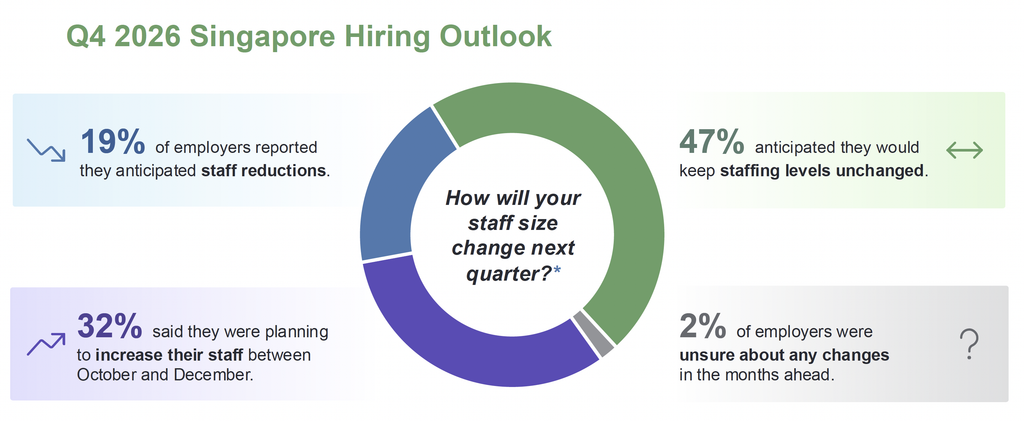
32%, or very nearly 1 in 3 employers, are planning to increase their headcounts between October and December. Nevertheless, 19% anticipated employment cuts, which leaves us with a Net Employment Outlook (NEO) of +13%. Compared to Q4 2025’s NEO of +20%, it’s a significant drop this year.
Yet, that is positive, but not overly so: it is the lowest reading since the pandemic and well below the 29% global average.
Image Credit: ManpowerGroup Singapore / Q4 Employment Outlook SurveyImage Credit: ManpowerGroup Singapore / Q4 Employment Outlook Survey
Of course, your personal prospects are going to depend on your profession and your expectations of the company you would like to work for.
The list is topped by Trade & Logistics at 22%, which is understandable given the global demand for tech products made in and shipped out of Singapore. However, the hiring prospects for that industry decreased slightly, by 4 percentage points.
Meanwhile, compared to 2025, the most improved profession is the good, old Singaporean staple: Finance & Insurance at 20%.
Advertisement
Net Employment Outlook by Industry
Some industries may have been omitted due to a small number of responses./ Image Credit: ManpowerGroup Singapore / Q4 Employment Outlook Survey
The second sector on the rise is Construction, which, however, is unlikely to be a target for most Singaporeans, as the number of jobs which would be attractive to locals there is relatively small.
Unfortunately, nearly all other industries have recorded steep drops compared to last year. Information as a whole fell by a whopping 18 percentage points.
One small exception is the “Tech & IT Services” specialty sector, which MPG carved out from across Manufacturing, Information and Professional Services, to summarise the hiring situation for technical staff across multiple industries.
However, by including manufacturing in the mix, I suspect the picture may be a bit more optimistic than it really is, given the fact that AI boom has boosted employment in local factories, but AI adoption in software-related activities has likely badly dampened hiring for developers.
Advertisement
This might be the reason why Information as a whole dropped by a whopping 18 percentage points compared to last year.
Some confirmation of this uneven situation within the broader IT sector is found in the official MOM data, which reports a large number of vacancies, but also shrinking employment in parts of the industry. Seemingly contradictory trends can be true in tech if there is a mismatch between the skills required and the skills possessed by potential candidates (and employees made redundant).
All in all, the employment situation in Singapore is getting tougher, although jobs remain available and unemployment continues to hover around 3% for residents. It’s the entry or re-entry into employment that have seen the biggest change, with more candidates having to wait several months more than usual to secure a job.
Read other articles we’ve written on Singapore’s job landscape here.
EA’s COO David Tinson and chief studios officer Cam Weber explained that they have taken a deeper look at the organisation, resulting in project cuts and job loss.
Video game company Electronic Arts (EA) has announced plans to cut 3pc of its global staff, around 400 people, alongside plans to shut down BioWare, which is the platform’s development studio responsible for popular games such as Dragon Age and Mass Effect.
The next Mass Effect game is among the projects being discontinued for now, as it was in early development at BioWare. Reportedly, around 50 of the roughly 400 people being let go at EA are from the BioWare division.
Popular life-simulation franchise The Sims will also be impacted. ‘Project Lotus’ is being put on hold, with priority being reassigned to another Sims related development, ‘Project Evergreen’.
Advertisement
EA said it has two major upcoming launches that are pulling focus, a new game based on Marvel’s Iron Man and the next game in the Star Wars Jedi franchise.
Over the past several months, EA has had to take a closer look at its business operations and what the future might hold.
In a jointly published statement, which was shared with EA’s workforce, EA chief operating officer David Tinson and chief studios officer Cam Weber, said “As we focus on these larger opportunities, we’ve had a small team at BioWare working on early-development for Mass Effect.
“We’ve made the decision not to move forward with this development, which means we’re closing the studio and our Edmonton workspace. BioWare is a legendary studio that helped define the role-playing genre and we do not take this decision lightly.
Advertisement
“We’ve challenged assumptions, confronted hard realities, imagined new possibilities and made deliberate choices in order to deliver exceptional experiences for our players and to drive sustained growth.”
In 2025, EA was acquired by the Kingdom of Saudi Arabia’s Public Investment Fund (PIF), Silver Lake and Affinity Partners, a private equity firm founded by Jared Kushner, in a deal valued at $55bn.
Don’t miss out on the knowledge you need to succeed. Sign up for the Daily Brief, Silicon Republic’s digest of need-to-know sci-tech news.
Tesla said Wednesday it will start selling its Cybercab to customers by the end of the year, even as federal regulators investigate whether the vehicle meets vehicle safety standards. The gold-hued, autonomous two-seater lacks a steering wheel and other traditional controls.
During the company’s third-quarter earnings call, Lars Moravy, vice president of engineering at Tesla, said the Cybercabs produced today are all destined for the company’s own robotaxi fleet. As that fleet grows, the company will “mainly deliver fully designed autonomous vehicles to our customers,” he said, noting that it will start small. The company will scale as it learns about delivery, ownership, and fleet management of autonomous vehicles, Moravy added.
Tesla first floated the idea of selling the autonomous vehicle to third parties last month around its Cybercab event in Austin and even posted a form for people interested in buying robotaxis. But it wasn’t clear if Tesla would follow through, or how.
Tesla CEO Elon Musk has talked for years about building a massive fleet of low-cost robotaxis, but until recently, those plans centered on turning privately owned Tesla vehicles into self-driving taxis with a software update.
Advertisement
That plan has yet to materialize, and Musk’s comments on the call show how his views have shifted.
Today, Tesla owners can subscribe to Full Self-Driving (Supervised), an advanced driver-assistance system that automates many driving tasks but still requires the driver to take control. The company continues to push out software updates to the system to improve its capabilities, but a human driver is still required to remain engaged and ready to take over — even though many videos show drivers testing the limits of that rule.
Musk said Wednesday that an unsupervised version of FSD, the fully self-driving version, would be rolled out to customers sometime in the second quarter of next year, yet another delay for Tesla owners, many of whom bought or subscribed to the software years ago.
If both timelines hold, it would mean third-party fleet customers would be able to buy the autonomous Cybercab and potentially operate it as a robotaxi service before Tesla owners would get access to the same autonomous capability in their own cars.
Advertisement
Musk said the Cybercab is meant to be a ride-hailing vehicle, not a car people own. “Cybercab is primarily going to be something that is offered as like transport as a service, whereas our other cars would be more, you know, the cars that you’d want to own, like the 3 and the Y and whatnot, and the Roadster, obviously,” Musk said Wednesday on the call. “But, you know, the vast majority of the Cybercab stuff will be essentially Tesla-owned and transported as a service.”
There is at least one obstacle that could throw off Tesla’s Cybercab fleet plans. The National Highway Traffic Safety Administration (NHTSA), the federal auto safety regulator, announced last month that it had opened an investigation into the Cybercab, just hours after the vehicles began operating on public streets in Austin.
Federal Motor Vehicle Safety Standards (FMVSS) require manual controls like brake pedals, as well as other features such as rearview and side mirrors. Automakers traditionally self-certify whether their vehicles comply with FMVSS rules, and Tesla did the same.
Current regulations don’t accommodate vehicles without manual controls, though the Department of Transportation recently proposed removing those requirements for vehicles that are designed to be autonomously driven. In the meantime, NHTSA said it would investigate the Cybercab to “examine the process and technical data on which Tesla relied when certifying the Cybercab and related issues.”
Advertisement
The outcome of that investigation could affect whether Tesla, or anyone else, can legally operate the Cybercab.
When you purchase through links in our articles, we may earn a small commission. This doesn’t affect our editorial independence.
The Acer Swift Air 14 (2026) is a light, stylish and well-built laptop that punches above its price. The 120Hz screen is excellent, with accurate colours, the keyboard and trackpad are a pleasure to use, and the battery comfortably lasts a couple of working days. Its 8GB of RAM and modest SSD hold it back, though against rivals with more of both.
Lightweight, stylish looks
Solid IPS screen
Excellent battery life
Some flex on the keyboard deck
8GB of RAM is a shame
Squirrel Widget
Advertisement
Key Features
Review Price:
£749.99
Advertisement
Intel Wildcat Lake processor inside
The Swift Air 14 (2026) features one of Intel’s new efficient Wildcat Lake chips inside for zippy, but more modest, performance.
Advertisement
14-inch 1920×1200 IPS 120Hz screen
It also comes with a serviceable IPS panel, complete with a 120Hz refresh rate for zippier on-screen action.
Advertisement
Weighs just 1.19kg
This Acer laptop is also especially light for a compact laptop, tipping the scales at a fair bit less than key rivals.
Introduction
It seems every Windows laptop manufacturer has a different way of competing with Apple’s MacBook Neo – for Acer and the new Swift Air 14 (2026), it’s lightness and style.
Advertisement
At its more modest £749.99/$699.99 price point, it exceeds a lot of the competition both in finishing and in low mass, while maintaining parity in terms of features, too. The Intel Core 5 320 processor inside is fine, while we’ve got 8GB of RAM and a 512GB SSD to boot – an unfortunate sign of the times, it seems. Nonetheless, it’s paired with a serviceable 14-inch 1920×1200 120Hz IPS screen and a capacious 70Whr battery for good measure.
To see whether the Swift Air 14 (2026) can come out on top against some rather stiff competition as one of the best laptops we’ve tested, I’ve been putting it through its paces for the last couple of weeks.
Advertisement
Advertisement
Design and Keyboard
Stylish aluminium frame
A little bit of flex
Solid ports, snappy keyboard and a larger trackpad
Far too often, more wallet-friendly laptops tend to skimp on their construction and the fit and finish on offer, and that isn’t the case necessarily with the Swift Air 14 (2026). It’s made of an aluminium chassis to give it some strong durability, plus Acer has taken a leaf out of Apple’s book and is offering this laptop in an enticing array of colours – the purple my sample comes in is particularly fetching.
This Acer laptop tips the scales at 1.19kg, making it quite light for a smaller laptop, and against a lot of the competition. With that 14-inch form factor in mind, it means this Acer laptop is immensely portable and you’ll barely notice it slipped into a bag.
Image Credit (Trusted Reviews)
Ports wise, things are a little more pared back. The left side houses two Thunderbolt 4-capable USB-C ports, while on the right you’ll find a USB-A port and a 3.5mm headphone jack. There’s no HDMI here, so if you regularly hook up to external displays, you’ll be relying on those USB-C ports, or using an affordable dongle.
Advertisement
There is one tell this is a cheaper, laptop, though. Open up the lid and push down on the keyboard tray, and you will find a bit of flex under finger. Nonetheless, the key action is tactile and crisp, and it’s a pleasing one to use for productivity tasks. The white underglow is rather bright for after-dark working, too.
Image Credit (Trusted Reviews)
For a more compact laptop, the Swift Air 14 (2026)’s trackpad is of a more generous size, and has a pleasant, dampened feel under the finger to make it rather lovely to use.
Display and Sound
Zippy 120Hz IPS panel
Excellent colour accuracy
Surprisingly decent speaker system
A lot of these more affordable laptops tend to skimp on one area more than others, which is usually its display. However, I’d wager thxtse Swift Air 14 (2026)’s screen is one of its strongest assets. A 1920×1200 IPS panel is nothing remarkable on paper, but the 120Hz refresh rate gives everyday navigation and scrolling a zippiness that rivals stuck at 60Hz simply can’t match.
In a general sense, this panel performs as you’d hope a decent IPS option to, with reasonably deep blacks (0.15 at 50% brightness, rising to 0.35 at peak) and solid contrast (a 1430:1 peak contrast ratio). I measured 365.3 nits of peak SDR brightness, which makes this fine for indoor use and workable outdoors, although not as bright as the best panels I’ve tested.
Advertisement
Advertisement
Image Credit (Trusted Reviews)
Colour accuracy is where this panel really impresses for the money. My colourimeter measured 99% coverage of the mainstream sRGB gamut, alongside 81% DCI-P3 and 77% Adobe RGB, which means you could even use this screen for more colour-sensitive tasks at a push. That’s a clear step up from the washed-out panels you’ll find on a lot of budget rivals. A white point of around 7500K is a touch cool, but nothing that bothered me in day-to-day use.
The Swift Air 14 (2026)’s quad-speaker array is actually a surprise highlight, providing full-bodied audio with strong volume and a decent amount of bass, too.
Performance
New Wildcat Lake chip inside
Decent single-core performance
Average RAM and SSD combo
It’s inside where things become quite interesting with the Swift Air 14 (2026), although not for the reason you may expect. This laptop features an Intel Core Ultra 5 320 chip inside, which is one of the brand’s newer Wildcat Lake processors designed for more affordable laptops.
The key difference is the lack of ‘Ultra’ in the product title, although Intel has essentially cut down a Panther Lake chip in a lot of ways to get to these more value-oriented chips. Everything from the core count to the integrated graphics has been cut down to make these chips more efficient and suitable for lower-cost laptops.
Advertisement
Advertisement
Image Credit (Trusted Reviews)
The Core Ultra 5 320 I have here features six cores and six threads, with the core count split between two Performance cores and four Low Power Efficiency cores, and a boost clock of up to 4.6GHz. The slightly brisker boost clock is what makes this a slightly higher end part than the Core Ultra 5 315 inside Samsung’s rival.
Where it counts for a laptop like this is with single-core performance, and in both Geekbench 6 and Cinebench R23, the Swift Air 14 (2026) manages to keep up with higher-end Panther Lake parts. There is around a 15-20% gulf in single-threaded tasks, but the laptop still feels zippy for day-to-day tasks in my experience.
Image Credit (Trusted Reviews)
Given this chip only has six cores, it’s in the multi-threaded department, and this laptop falls down a smidgen. It’s fine for more basic tasks, although if you want to step up to much more intensive workloads, then stepping up to a beefier chip will yield much stronger performance.
The same also goes for the Swift Air 14 (2026)’s 3D performance. Intel has cut down the integrated graphics against the beefier iGPUs found in some of the top-end Panther Lake chips to provide similar results to Qualcomm’s first-gen Snapdragon X chips, meaning performance is fine at best.
Advertisement
Image Credit (Trusted Reviews)
Where this laptop is cut down against some Windows-based rivals is that it only comes with 8GB of RAM, rather than 12GB or even 16GB. For more basic tasks, it’s fine, but you may hit a wall when it comes to more intensive multi-tasking or any other beefier tasks. You can spec this laptop with up to 12GB of RAM, and a higher-end Core Ultra 7 355 processor if you need more oomph, though.
To this end, the 512GB SSD is reasonable in capacity, although not earth-shattering there or when it comes to speed. It’s fine for a mid-spec PCIe 4.0 option, with tested reads and writes of 4606.98 MB/s and 2589.96 MB/s, respectively.
Advertisement
Software
Windows 11 installed
Lots of Acer-specific apps
Not enough AI horsepower to be a Copilot+ PC
The Swift Air 14 (2026) comes running proper Windows 11, although it comes with some unnecessary apps or shortcuts, such as a taskbar one for Booking.com, oddly.
There are more Acer-specific apps than anything else, such as Acer Jumpstart, which provides a link to the brand’s website, and AcerSense, which gives you access to check your system’s vitals and change settings around, such as power modes and such.
Advertisement
Image Credit (Trusted Reviews)
That said, there isn’t enough AI horsepower inside the Swift Air 14 (2026) for it to be classified as a Copilot+ PC, so you miss out on Microsoft’s own AI features, such as the generative stuff in Photos and Paint, and the clever Windows Studio webcam effects.
Battery Life
Lasted for 18 hours 15 minutes in the battery test
Capable of lasting for two working days
The Swift Air 14 (2026) comes kitted out with a capacious 70Whr cell, which, combined with the anticipated efficiency from the Wildcat Lake chip inside this laptop, meant I had high hopes for its longevity.
In running a PCMark 10 video loop test at the requisite 150 nits of brightness, the Swift Air 14 lasted 18 hours and 15 minutes, meaning you’ll comfortably get through a couple of working days before needing to recharge. What’s more, it’s only a few hours off some of the top performers I’ve tested.
Acer bundles a beefy 100W brick with the Swift Air 14 (2026), which you think would be quite brisk in getting go-juice back into the cell, although it wasn’t as speedy as I was anticipating. It took 53 minutes to get it back to 50%, while a full charge took close to two hours.
Advertisement
Advertisement
Squirrel Widget
Should you buy it?
You want a light, stylish laptop with a great screen
Advertisement
The Swift Air 14 combines a featherweight build with a sharp and accurate 120Hz panel.
Advertisement
You want to multi-task heavily
With just 8GB of RAM and a mid-range SSD, this base model will struggle if you push it, so you may want to look above its pay grade at beefier choices.
Advertisement
Final Thoughts
The Acer Swift Air 14 (2026) is a light, stylish and well-built laptop that punches above its price. The 120Hz screen is excellent, with accurate colours; the keyboard and trackpad are a pleasure to use, and the battery comfortably lasts a couple of working days. Its 8GB of RAM and modest SSD hold it back, though against rivals with more of both.
The Samsung Galaxy Book6 is the more capable machine on paper, with 16GB of RAM, a faster SSD and slightly longer battery life. It costs a fair bit more, though, and its washed-out 60Hz screen is far weaker than the Acer’s. Likewise, the Asus Zenbook 14 (2026) is slightly more powerful and stylish, although the Arm chip inside is a little long in the tooth at the price. If you’d rather stick with a conventional x86 Windows laptop, the Swift Air 14 is the safer choice.
The Apple MacBook Neo is the other obvious alternative, and its A18 Pro chip is surprisingly brisk for the money. It’s a tempting option for anyone happy to switch to macOS, but the Swift Air 14 is the one to get if you want to stay on Windows and keep a USB-A port for older accessories.
Ultimately, if you want something light that looks and feels more expensive than it is, the Swift Air 14 delivers. For more options, check out our list of the best laptops we’ve tested.
Advertisement
How We Test
This Acer laptop has been put through a series of uniform checks designed to gauge key factors, including build quality, performance, screen quality and battery life. These include formal synthetic benchmarks and scripted tests, plus a series of real-world checks, such as how well it runs popular apps.
FAQs
How much does the Acer Swift Air 14 (2026) weigh?
The Acer Swift Air 14 (2026) weighs 1.19kg, making it light for a 14-inch laptop.
Advertisement
Test Data
Acer Swift Air 14 (2026)
Cinebench R23 multi core
6959
Cinebench R23 single core
1761
Geekbench 6 single core
2446
Geekbench 6 multi core
7591
3DMark Time Spy
1732
CrystalDiskMark Read speed
4606.98 MB/s
CrystalDiskMark Write Speed
2589.96 MB/s
Brightness (SDR)
365.3 nits
Black level
0.15 nits
Contrast ratio
1430:1
White Visual Colour Temperature
7500 K
sRGB
100 %
Adobe RGB
77 %
DCI-P3
81 %
PCMark Battery (office)
18.25 hrs
Battery discharge after 60 minutes of online Netflix playback
Meze Audio has never been particularly interested in making headphones that blend into the furniture, and its $2,000 POET open-back planar magnetic headphones are no exception. We’ve covered the Romanian manufacturer’s ambitious design extensively, including our original POET introduction and in-depth review, which explored its impressive craftsmanship, distinctive sonic character, and exceptionally comfortable fit.
The standard POET’s elaborate copper-colored grilles and industrial styling have a somewhat polarizing aesthetic in the Head-Fi community. Some listeners appreciate the craftsmanship and bold appearance, while others would prefer something a little less conspicuous on their heads.
Meze, however, has decided that subtlety is overrated, introducing the POET Jazz Special Edition, a collection of just 11 individually hand-painted headphones that takes the original design into entirely new artistic territory.
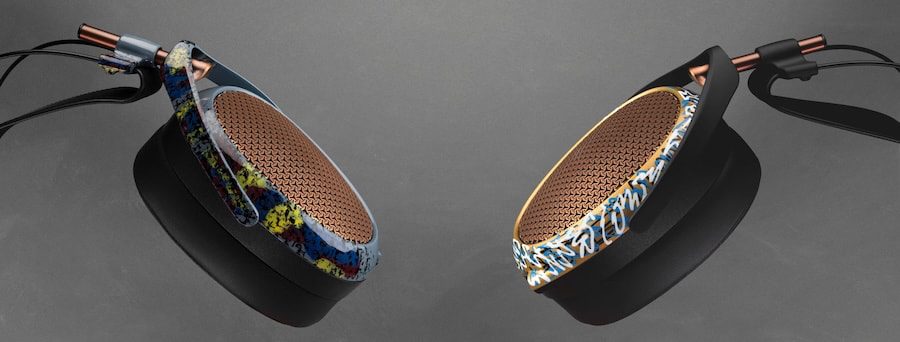
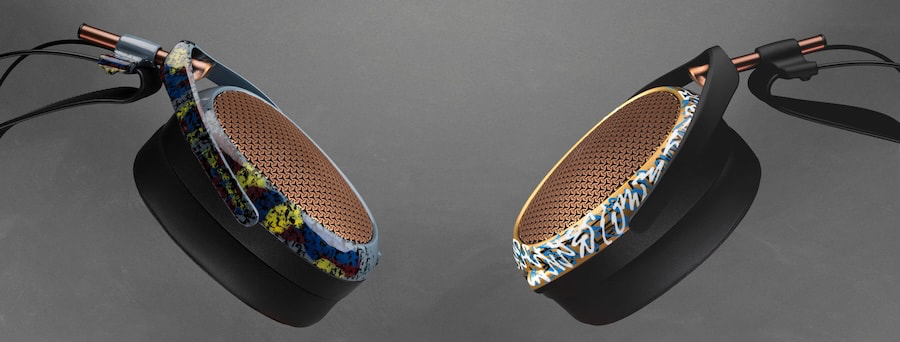
Meze Audio POET Jazz Special Edition Headphones – Swing State (left), Bepop Static (right)
The Engineering Behind the Art
The Meze Audio POET combines Rinaro Isodynamic Hybrid Array technology, premium materials, and an ergonomic design. The standard version features a steel grille, magnesium chassis, and soft suede-leather headrest, creating a visually striking headphone engineered for durability, comfort, and acoustic performance.
Advertisement
Comfort and Longevity: The POET’s flexible titanium-alloy headband distributes weight evenly, providing a secure and comfortable fit for extended listening sessions. Its relatively lightweight construction and magnetic ear pads further improve usability, while the replaceable pads make routine maintenance and long-term ownership considerably more convenient.
Rinaro and Parus: The POET incorporates a new MZ6 planar magnetic driver featuring Rinaro’s Isodynamic Hybrid Array technology. Each driver is hand-assembled and tested at Rinaro’s facility in Lviv, Ukraine. The Hybrid Magnet Array is engineered to produce a powerful, uniform magnetic field across the Parus diaphragm, which weighs just 0.06 grams despite its substantial active surface area. According to Meze, this combination delivers exceptionally low distortion (less than 0.05%) and highly resolving sound, capturing subtle musical details from deep sub-bass to the upper treble.
Fully Serviceable: Beyond its acoustic engineering, the POET emphasizes long-term serviceability, with components designed to be disassembled and replaced when necessary. From the magnetic ear pads to the mechanical elements of the chassis, Meze has prioritized maintainability rather than treating the headphones as a disposable product.
The combination of durable construction, premium materials, and replaceable components makes the POET an appealing option for listeners who value long-term ownership. A premium hand-braided copper cable completes the package, reinforcing Meze’s emphasis on craftsmanship and visual design without sacrificing practical functionality.
Advertisement
Meze Audio POET Jazz Edition – Brass and Smoke
Meze Audio POET Jazz Edition: Eleven Headphones, Eleven Works of Art
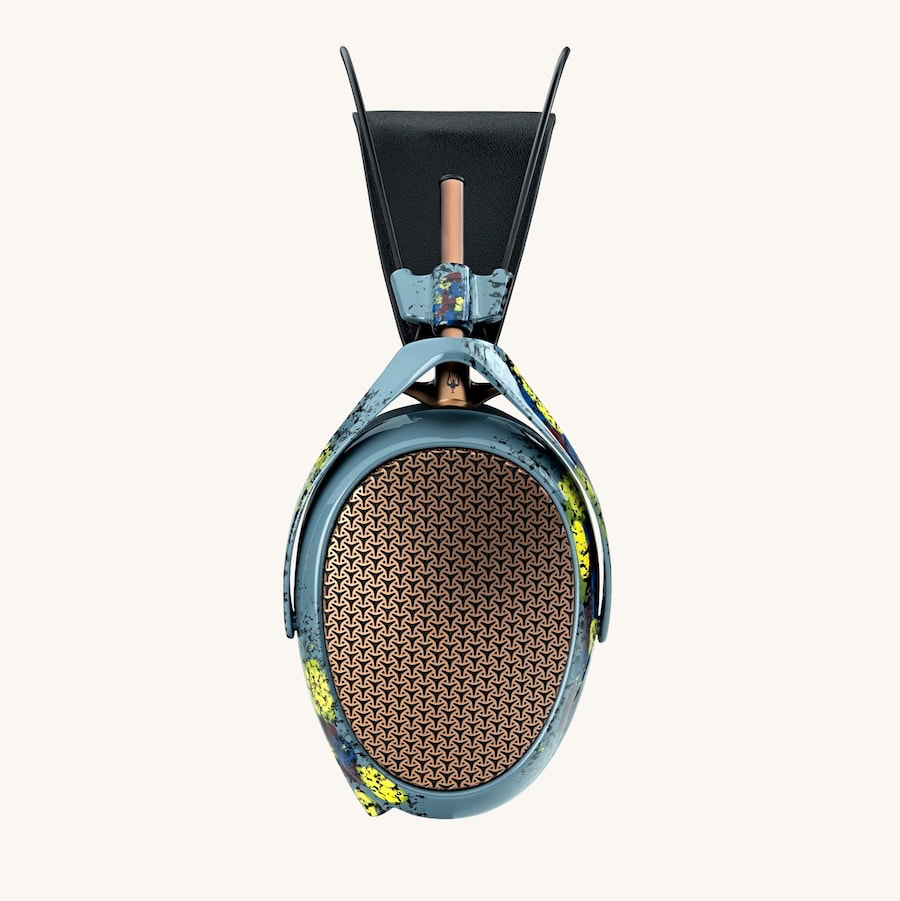
Meze Audio has taken its acclaimed POET planar magnetic headphones in a decidedly more artistic direction with the POET Jazz Special Edition, a collection of just eleven individually hand-painted pairs inspired by the emotions, rhythms, and improvisational character of jazz. Each pair features a unique finish, with the artwork applied to the earcups, brackets, and adjustment sliders rather than the entire headphone.
These are not eleven different headphone models with unique acoustic tunings. Every Jazz Edition retains the same drivers, engineering, and technical specifications as the standard $2,000 POET, with the distinction coming entirely from the hand-painted artwork. At $2,399 per pair, buyers are paying a $399 premium for the exclusivity and craftsmanship, not some mysterious improvement in soundstage brought about by a few extra brushstrokes.
The Eleven POET Jazz Special Edition Designs
Each variation represents a different aspect of jazz performance and expression, with only one pair produced in each finish.
Advertisement. Scroll to continue reading.
Encore: Celebrates the spontaneous return to the stage for one final performance.
Blue Note: A moody, melancholic design inspired by jazz’s ability to communicate unresolved emotions.
Swing State: Flowing, fragmented patterns representing the natural movement and rhythm of swing.
Bebop Static: An energetic, high-contrast interpretation of bebop’s intensity, precision, and controlled chaos.
Midnight Session: Inspired by intimate late-night performances when musicians communicate almost instinctively.
First Take: Captures the spontaneity, uncertainty, and excitement of musicians beginning a performance.
Brass and Smoke: Evokes the warmth, atmosphere, and intimacy of a crowded jazz club.
Free Form: An improvisational design celebrating creative freedom without predetermined structure.
Low End: A more restrained interpretation of the double bass and rhythmic foundation that holds a performance together.
Offbeat: Uses unexpected contrasts and visual accents to reflect jazz’s unconventional rhythmic patterns.
Afterglow: Represents the lingering emotional impression of a performance after the final note fades.
Each variation has its own listing, allowing buyers to select the specific artwork they want rather than ordering a generic Jazz Edition and receiving a random finish.
The exclusivity is genuine. Meze is producing only one pair of each design, with no plans to reproduce, replicate, or reissue the artwork once it sells. At the time of writing, five of the eleven variations were already listed as sold out, leaving collectors with a rather narrow window to secure their preferred design.
Limited and special-edition audio products have become increasingly common, but Meze Audio has taken a more interesting approach with its POET Jazz Special Edition. Rather than offering one exclusive finish with a numbered production run, the Romanian manufacturer has created eleven individually hand-painted variations, each inspired by a different mood, rhythm, or expression of jazz. With only one pair of each design being produced, these are genuinely one-of-a-kind headphones rather than another cosmetic refresh with a collectible badge.
At $2,399 per pair, the Jazz Editions command a $399 premium over the standard POET while retaining identical acoustic engineering and performance specifications. Buyers are paying for the artwork, craftsmanship, and exclusivity, not an improvement in sound quality. That makes them particularly appealing to collectors and Meze enthusiasts who appreciate functional audio equipment as art.
Whether these unique creations eventually command a premium on eBay remains to be seen, although I wouldn’t underestimate the enthusiasm of headphone collectors with more disposable income than restraint. Meze deserves credit for creating something genuinely exclusive without pretending a new paint job improves the sound. Eleven pairs, eleven personalities, and not a single extra decibel of audiophile marketing nonsense.
Price & Availability
Each variation of the Meze Audio Jazz Edition POET is only available for $2,399 at Meze Audio.
The internet’s mad scramble on Wednesday to patch a pair of critical vulnerabilities in PHP, a widely used web scripting language, was already too late to stop every attack, newly released details reveal.
Wednesday’s release of fixes for two critical vulnerabilities in PHP caused administrators and security staff to race to identify and patch vulnerable websites and apps, while attackers inevitably reverse engineered the fixes to learn how to exploit the flaws. Some governments and other groups even proactively took key websites down in anticipation of the release, so they wouldn’t be targeted before they could apply the patches.
But in addition to detecting such active exploitation on Wednesday, research published Wednesday evening by Amazon Web Services indicates that at least one actor had started attempting to exploit the bugs—known collectively as PHP2Shell—on October 17, four days before Wednesday’s public revelations.
AWS analysts spotted the October 17 exploitation on Wednesday while looking back at activity on one of their so-called honeypots, or intentionally vulnerable web servers or other digital lures that help researchers study attack methods and trends. The attempt came from an IP address that AWS says is linked to a “commercial anonymization network,” in other words a proxy network or VPN.
Advertisement
“While the vulnerability was under embargo, the targeting of a honeypot from an anonymized IP address suggests the activity was conducted by a threat actor, though it remains unclear how the actor acquired exploit information prior to disclosure,” CJ Moses, AWS’s chief information security officer, wrote in the research post.
Proof-of-concept exploits for PHP2Shell began emerging publicly on Wednesday, with some seeming to appear hours before the public disclosure at 10 am ET. In the hours leading up to the disclosure, AWS researchers say their honeypots were hit with multiple exploitation attempts anonymized using various providers and seemingly with various attack goals, likely indicating multiple different actors. “Technical analysis is ongoing, and it’s unclear if any of these attempts would have succeeded in real-world systems,” Moses wrote. He added that “PHP2Shell is now being broadly exploited in the wild.”
The PHP Foundation did not immediately respond to WIRED’s request for comment.
Though it is unclear how the exploitation on October 17 happened or where it came from, AWS emphasizes that the findings underscore how coordinated vulnerability disclosure must evolve and speed up, given global access to AI tools that can accelerate vulnerability analysis and allow less technically proficient actors to quickly develop new exploits.
Advertisement
“The time from patch to working exploit is shrinking for structural reasons,” Moses wrote. “In the past, most exploitation we observed came after a public proof of concept was released. A small number of capable actors built exploits, and everyone else waited for them. That dependency is weakening. AI-assisted analysis makes it cheaper to turn a patch diff or advisory into a working exploit. As a result, more actors can act within hours or even minutes once technical details of a vulnerability are disclosed.”


























































You must be logged in to post a comment Login