More than 40 years ago, the first commercial veggie burger made its debut in London markets as packets of dehydrated ingredients that were mixed with water and shaped into patties. Today’s alternative proteins are unrecognizable in comparison, featuring cell-cultivated meats grown in brewery-style stainless steel tanks, fake sushi and faux burgers that “bleed.”
The sector saw a surge in the early 2020s to become a $1 billion market, but enthusiasm has wilted of late. Beyond Meat, for example, has seen its stock plummet following its 2019 IPO, and only 11% of U.S. households purchased faux meat last year.
Advertisement
Yet repeat purchases remain strong, global demand is rising, and academic research as well as entrepreneurial R&D are advancing the field.
Alternative proteins fall into three categories, and they can be combined in some products:
Plant-based: Made from ingredients including soy, beans, peas, lentils and wheat.
Advertisement
Fermentation-produced: Uses organisms such as fungi, bacteria, yeast and algae to act as ingredients themselves or as tiny factories producing compounds including proteins found in milk or eggs, or specific fats.
Cell-cultivated meats: Derived from animal cells and grown in nutrient-rich broth, then coaxed into fat or muscle tissue.
Consumers buy alternative proteins because of environmental concerns around climate impacts and the land and water footprint of livestock; health worries about cholesterol and saturated fats; and ethical objections to factory farming. And experts say that as the global population grows, there won’t be enough beef, chicken and fish to meet protein needs.
But there are significant hurdles to adoption. The faux meats are generally more expensive. People are unsure about the technologies used to make the foods. Consumers need to adapt to different flavors and textures and have worries that the alternatives are “ultra-processed” foods.
Advertisement
Nuggets for schools
Rebellyous CEO Christie Lagally Bradburn, holding Barney the company pup, and senior food scientist Taoran Wang stand alongside an autonomous food production prototype at the startup’s R&D facility near Seattle. (GeekWire Photo / Lisa Stiffler)
Rebellyous Foods, a startup churning out faux chicken nuggets for 6 million U.S. school kids, runs its R&D operations out of an office park south of Seattle.
“We want people to feel good about what they eat, and so our products have a relatively short ingredient list,” said Christie Lagally Bradburn, founder and CEO of Rebellyous. That includes soy protein, yeast-based flavoring and salt, oil and water, and a binder called methyl cellulose found in products such as bread and salad dressing.
Despite being derived from plants, the Rebellyous kickin’ nuggets have a meat-like texture absent the gristle and mystery bits. The flavor, Lagally Bradburn said, is often compared to Campbell’s chicken noodle soup. The brand also has spicier options targeting food service at hospitals and correctional facilities.
Lagally Bradburn’s background is in designing manufacturing equipment, including roles at Boeing creating tools to build airplanes faster, better and cheaper. An ethical vegan, she wanted to apply that skill set to replacing meat, and in 2017 she launched Rebellyous to do it. Her goal: an automated, continuously operating system for producing affordable and tasty fake chicken products.
The company developed its Mock 3 system, capable of producing more than 5,000 pounds of faux chicken per hour. The device was installed in a facility north of Seattle, but the operators recently shuttered the site on short notice. So Rebellyous is working with its long-term partner in New Mexico which uses a conventional manufacturing system.
Advertisement
The hope is to find a new home for the Mock 3 while also developing its Mock 4, a smaller, cheaper, simpler device.
“Our goal is to run a financially sound company, to be there for the schools,” Lagally Bradburn said, as well as play a role in addressing climate change, human health and animal welfare issues.
Cricket kibble
Anne Carlson, CEO of Jiminy’s, with her dogs Tuco and Hopper. (Photo courtesy of Carlson)
While Rebellyous targets human food service, other startups are focused on four-legged consumers. About a decade ago, Anne Carlson was planning a career change when her daughter shared that she didn’t want children due to climate worries.
“I realized that I couldn’t just do a normal job after that,” she said. “Building a better future for her was everything.”
Carlson, a pet-industry veteran, noted UCLA research showing U.S. pets account for 25% to 30% of the environmental impact of domestic meat consumption. That led her to pursue insects as alternative proteins for pets, starting with crickets, then adding black soldier fly larvae.
Advertisement
In 2020, her company, called Jiminy’s, became the first in the country to be approved by the FDA and an association that regulates animal food standards to sell cricket-based dog foods.
“It’s less land, less water and almost no greenhouse gases,” Carlson said of the bug proteins. One acre of land used to raise 265 pounds of chicken protein will provide 60,000 pounds of cricket protein.
Jiminy’s sells kibble, treats and dental chews that provide essential amino acids and show benefits for dogs with allergies and digestion issues. The products typically cost more than animal-based foods, but are cheaper than prescription diets.
The San Francisco Bay Area startup still has to win over owners who are squeamish about insects — but they needn’t be, Carlson said.
Advertisement
“People think that when they open the bag, it’s going to be a bag full of bugs. It is absolutely not that,” she said. The product looks and smells like typical dog food, so “it’s not scary at all.”
Path to profitability
Some potential Jiminy’s customers are afraid the bug-based dog food will include whole insects, but products actually resemble conventional kibble. (Jiminy’s Photo)
One area of growing concern centers on ultra-processed foods and whether alternative proteins fall under that category.
Shirwaiker, director of the Bezos Center, notes that while some products contain high sodium or fat, processing itself can be beneficial by removing harmful elements, improving texture and preserving nutrition.
“If we are using processing to get the right texture, something that consumers will like without sacrificing the nutrition, I don’t think that’s a bad thing at all,” he said. “So it’s really a matter of perspective and trying to separate process from nutrition in some way.”
Rebellyous and Jiminy’s leaders said they clearly disclose ingredients and keep them simple to put those fears to rest. The biggest hurdle, both said, was bringing down costs while supply-chain prices keep rising.
Advertisement
Even so, the startups are on the verge of profitability, their CEOs said. Carlson said Jiminy’s operates in the black some months and is growing faster than the pet industry overall. Because Rebellyous primarily serves schools, it’s profitable during much of the year, but business slows in the summer, Lagally Bradburn said.
Both founders remain optimistic about the long-term horizon.
“Sometimes when you’re in it, it can be hard to see the forest for the trees,” Lagally Bradburn said. “But the truth is that overall, the world is becoming more sustainable.”
As autumn paints the leaves, the universe is putting on its own seasonal spectacular. October features an action-packed lineup of meteor showers and celestial showcases.
All eight planets are visible at some point in October
Mercury is visible just before sunset for several days in October.Stellarium
Every planet in the solar system is easily seen at some point this month, with Mercury being the most difficult. That’s not unusual, thanks to its proximity to the sun. Here’s a quick rundown on the best times to view each planet in October.
Mercury: Mercury is in elongation (the furthest it can get from the sun) on Oct. 12, making that day and the two or so days before and after the best possible time to view Mercury.
Venus: Venus spends most of the month being right next to the sun, making it virtually impossible to see. However, by the end of the month, it begins to separate from the sun, making it visible just after sunset. The best view is on Oct. 31, and the view is only set to get better going into November.
Mars: Mars will be visible in the night sky every night in October. It rises from the eastern horizon right around 2 a.m. and stays there until the sun comes up.
Advertisement
Jupiter: Jupiter and Mars are going to be pretty close together all month, so most of the same rules apply, except that Jupiter rises about two hours later than Mars on most nights in October.
Saturn: Saturn is living its best life in October. It’s visible almost right at sunset ET and stays visible in the night sky until sunrise.
Neptune: Neptune is also visible every day in October and follows a very similar path to Saturn. It rises in the east, streaks across the sky, and sets in the west right around sunrise. They’re actually pretty close together in the night sky every night during the month, so if you can find Saturn, Neptune isn’t far off, but you’ll definitely need magnification to see it.
Uranus: Uranus is visible the entire month and follows a very similar path through the sky as Saturn and Neptune, but its trek happens later at night. It rises on the eastern horizon about 2 hours after Saturn and follows it across the sky, but never really catches up, ending up in the high western sky when sunrise comes.
Advertisement
Oct. 3-4: Saturn is at opposition
Saturn rises from the eastern horizon and treks across the sky overnight.Stellarium
Skygazers hoping to get the best possible view of Saturn can do so in the first week of October. The planet is at opposition — the point at which it’s closest to the Earth — meaning it’s as big and bright in the night sky as it’s going to get for the next year. This is prime time to pull out the telescope or high-powered binoculars and get a look at Saturn, along with its fabulous rings.
The planet reaches opposition at around 8 a.m. ET on Oct. 4. The best time to view is the night before, Oct. 3, or the evening after, Oct. 4. For both nights, Saturn rises out of the eastern horizon just before sunset and streaks up into the southern sky as the night goes on. The moon may cause some light pollution, but the planet is bright enough that it shouldn’t be hard to spot with the naked eye.
Oct. 5: The moon and Mars hang out
The moon and Mars are getting cozy on Oct. 5. Stellarium
The various objects in the sky are always having a dance party, at least from the perspective of viewing them here on Earth. Mars and the moon are due for a dance on the evening of Oct. 5. In the days leading up to it, Mars appears further up in the night sky but drifts closer to the moon. After Oct. 5, the moon will move rapidly away from Mars. The two will be almost right on top of one another, so if you can find the moon, Mars should be nearby.
Oct. 6: The moon covers Jupiter entirely
The moon will pass in front of Jupiter, hiding it from view. Stellarium
Just one day later, the moon is meeting up with another dance partner, Jupiter. The moon will completely cover Jupiter, hiding it from view for much of the night, a phenomenon known as a lunar occultation. This is a pretty rare event. Per The Old Farmer’s Almanac, New York City saw a Jupiter occultation in 2004. The prior one visible to New Yorkers was in 1889.
This one is pretty easy to see. The moon and Jupiter will be right on top of one another all night, but depending on where you live, you’ll see Jupiter dip behind the moon at some point and pop back out again. The times vary wildly depending on where you are, so we recommend checking out The Old Farmer’s Almanac, which has a table of times this will happen in major cities.
Oct. 7: Draconids Meteor Shower
The Draconids meteor shower is in the Draco constellation near Vega. Stellarium
The Draconids meteor shower is a minor meteor shower that occurs every year around the first week of October. It officially starts on Oct. 6 and runs until Oct. 10, making it one of the shortest meteor showers of the season. It peaks on the evening of Oct. 7 and continues into the middle of the night. It’s fed by the 21P/Giacobini-Zinner comet, which is part of the Jupiter family of comets.
Draconids meteors appear to originate from the Draco constellation. It sits high in the western sky in the northern hemisphere this time of year, with a slight lean to the north. If you’re using a sky map app, all you need to do is find Vega, and you’re already in the right neighborhood to catch Draconids.
The peak is a little tame, at around 10 meteors per hour most years, but it has a history of surprising astronomers. In 1933 and 1946, Draconids spat out thousands of meteors an hour in what were two of the most intense meteor showers of the 20th century. On the plus side, the moon is below the horizon for this meteor shower, so you won’t need to worry about light pollution from the moon.
Advertisement
Oct. 10: The last good chance to see the Milky Way
The Milky Way captured with the Tiny1 camera.
TinyMOS
The very best time to view the Milky Way is at a new moon in the warm months of the year, from May to August. This is when the Milky Way is high in the sky all night, giving night owls great views and plenty of time to photograph it. The problem is that it’s best viewed on nights with a new moon between midnight and 4 a.m. local time, which can be a bit late for some folks.
September and October are great for this because the Milky Way is at its highest point between 8 p.m. and 10 p.m. local time, giving the early birds a chance to snap some sweet photographs of the Milky Way. After October, the Milky Way is too low on the horizon to allow really good pictures of it until the following May. So, if you have a camera and are some place that’s dark, the new moon on Oct. 10 is probably your last chance to capture a striking photo before next spring.
Oct. 21: Orionids meteor shower
The Orionids meteor shower will be low to the horizon in the east when its peak occurs.
Orionids is the better-known of the two October meteor showers. This one officially starts on Oct. 2 and runs until Nov. 7. It’s possible to spot a meteor from Orionids any night during the month, but the shower reaches its peak on the evening of Oct. 21. Meteors for this shower come from the 1P/Halley comet, which also feeds the Eta Aquariids meteor shower that happens every year in May.
This is a slightly more active meteor shower than the Draconids, and you can expect about 10 to 20 meteors per hour. The moon is set to be about 76% full that night, so you can probably expect to see fewer meteors thanks to lunar light pollution. The Orion constellation, where the meteor shower will appear to originate, doesn’t pop up over the eastern horizon until after midnight, so make sure to pack some coffee if you’re staying up late for this one. If you can find the stars Betelgeuse, Capella and Rigel, then you should be able to find Orion easily. They’re in the same general area.
The Orionids meteor shower is best known for its bright, fast-moving meteors, which leave long trails that can last for over a minute and sometimes result in fireballs. Their brightness will be a boon, with the three-quarters-full moon in the sky hindering viewing.
Advertisement
Oct. 26: The Hunter Moon
A full moon rises behind the Washington Monument. NASA/Bill Ingalls
October’s full moon falls close to Halloween this year, perfect for spooky views. According to The Old Farmer’s Almanac, October’s full moon reaches its peak on Oct. 26 at 12:12 a.m. ET. It’ll also be over 90% full for a couple of days before and after, giving you a solid five days to check it out.
October’s full moon isn’t quite a supermoon. A full moon is only classified as a supermoon when the moon is in perigee and full at roughly the same time, and October’s full moon misses the mark by a couple of days. October’s full moon is the last normal full moon of the year. November and December close out 2026 with supermoons before January opens with the final supermoon of this cycle.
Oct. 27: The moon eclipses the Pleiades
The moon will eclipse the Pleiades before either rises in the sky, but most people will still get to see part of it.Stellarium
Pleiades is one of the best star clusters to view in the night sky. They’re known as the Seven Sisters, and in terms of clusters of stars, it’s one of the easiest to see. The exception is on Oct. 27, when the moon will cross in front of them, blocking them almost entirely from view. When this happens depends on where you’re located.
The moon begins passing in front of them before sunset in eastern time, and moves out of the way around midnight. Those on the East Coast will start the night in the middle of this little eclipse, while those on the West Coast will glimpse it at the very end. Finding it should be simple enough since the moon is the easiest thing to see in the night sky.
All month: Constellations and asterisms
The sky is continuing its rearrangement from summer into autumn, and there are tons of constellations to gaze at over the course of the month. Many of September’s constellations appear again, including both Dippers, Aquarius, Pegasus, Pisces and many others. October plays host to a few new ones in the night sky cycle, including Taurus, Cetus, Auriga and Orion, which will appear low on the horizon as they begin their months-long ascent into the sky for the winter.
There are some smaller asterisms to observe as well, including the Coffin of Delphinus, the Circlet of Pisces and the Northern Cross. We recommend using a sky map to find them all, as there are quite a lot. That’s good news, because even if you don’t go out during one of the big events in October, you’ll still have plenty of objects to look for in the night sky.
Advertisement
Joe is a freelance journalist. It all started with a long-running affection for building his own PCs, which he did for the first time as a teenager. It evolved into a lifelong enjoyment of putting words on the internet about the subject. He’s written for CNET, PCMag, Mashable and SlashGear as a freelance writer, and worked as a Senior Editor at Android Authority for 10 years. When he’s not writing about tech and science, he’s learning the ins and outs of DIY home repair, gaming, playing his bass guitars and posting help on PC building and gaming subreddits. He is a staunch believer that orange juice should have pulp.
See full bio
Defense and venture capital used to rarely overlap, but that’s no longer the case. Defense tech VC dealmaking set a record in Q1 2026, and new VC firms have emerged around the world to invest solely in defense startups.
One of these is two-year-old Protego Ventures, which presents itself as the first and largest dedicated defense tech VC in Israel. Led notably by two women, Lital Leshem and Lee Moser, it has just completed the final close of its debut fund with $125 million in capital commitments, TechCrunch learned exclusively.
This fund size is enabling Protego to invest between $5 million and $50 million per company, with a focus on startups “addressing the critical defense and security needs of Israel and the global community,” according to its website.
These include the likes of drone maker XTEND, its first portfolio company, which went public on the NYSE earlier this month. That’s also why Protego stopped short of its $150 million target: a smaller fund magnifies the impact of a single big win on overall returns, and with XTEND now looking like a potential “fund maker” — a single investment capable of returning the whole fund — raising more capital would only dilute that upside among a larger pool of investors. “Nobody wants to share the pie,” Leshem said.
Advertisement
Ares Management is one of Protego’s biggest backers. The investment firm suggested that Leshem and Moser join forces and start Protego in the aftermath of the October 7, 2023, Hamas attack on Israel, with the conviction that new technologies would be key to boosting Israel’s defense capabilities in the face of new threats, Leshem said.
With a $30 million investment as a limited partner, Ares gave Protego the support it needed to start investing right away, Leshem said. Besides XTEND, its portfolio also includes startups such as ASIO, which develops situational awareness systems and has partnered with Anduril.
Leshem says the reception in defense circles has been strong. “On the military side, there is a lot of respect, and people are coming — even under the radar — to talk to us, to learn from us, to train with us, and for sure get our technology and innovation.”
Still, the Israeli market is easier to navigate for insiders, and Protego’s two founders are leaning into their networks. Moser, a seasoned venture capitalist, will remain a managing partner at the generalist VC firm AnD Ventures. As for Leshem, who co-founded a startup that was acquired for $625 million in 2025, she also brings 11 years of experience in the military and intelligence field to their approach.
Advertisement
“Everything changed on October 7,” Leshem told TechCrunch. She was deployed, while pregnant, as a reservist on the day of the attacks. “And basically until the delivery room, I was there, witnessing and getting the first-row seat to how the battlefield acted differently from what I knew in the past decade.”
Protego won’t have the field to itself for long. Israeli authorities have taken notice of the same shift, awarding VC firms Adir Capital and Sling Capital about $33 million in state guarantees to invest in military and dual-use technologies, with other funds also raising capital for similar bets. (Leshem said Protego was too far along in its own fundraising to take part in the government’s tender.)
Protego, meanwhile, is already planning its next move: a second fund in the first quarter of 2027, backed by Israeli institutional investors and one large U.S. commitment Leshem has already secured, with a broader scope that includes early-growth American defense-tech companies.
When you purchase through links in our articles, we may earn a small commission. This doesn’t affect our editorial independence.
Washington Gov. Bob Ferguson kicks off the Washington Space Council, surrounded by the council’s members and 10-year-old Sebastian Yu. (GeekWire Photo / Alan Boyle)
Washington Gov. Bob Ferguson has created a public-private council to elevate the Evergreen State’s profile as regional clusters compete for primacy in America’s space industry.
The 23-member Washington Space Council was introduced tonight at the Museum of Flight during a kickoff event for Seattle Space Week, a celebration organized by Space Northwest.
“The council will help keep us competitive by comparing Washington with other leading states in the industry and identifying ways we can continue to improve and compete,” Ferguson said.
Washington state already ranks as one of the nation’s space industry hotspots. “We’re proud to have a cluster of more than 90 space companies employing more than 13,000 workers, generating over $4 billion in annual economic activity and $1.6 billion in annual payroll,” Ferguson said.
But Andy Lapsa, co-founder and CEO of Kent, Wash.-based Stoke Space, told tonight’s crowd that several other regions are competing with the Pacific Northwest for space-related investments. “States like Florida and Texas and Colorado want this industry, and they want it bad,” he said. “They compete for it every day. Washington has every advantage it needs to lead them all, and the window to use those advantages is open right now.”
Advertisement
Boeing has historically been the state’s leading venture in aerospace, but when you focus on ventures that concentrate strictly on space, Blue Origin is high on the list. Seattle is particularly strong in the satellite sector: More than half of the world’s satellites are built in the Seattle area, thanks to SpaceX’s Starlink facilities in Redmond and Woodinville, plus Amazon Leo’s factory in Kirkland, BlackSky’s production plant in Tukwila and Xplore’s operation in Bellevue.
Gravitics, Interlune, Portal Space Systems, Starcloud and Starfish Space are among other space ventures represented on the Washington Space Council. The list also includes elected officials, union leaders, educators and investors, plus representatives from space-related tech companies and Pacific Northwest National Laboratory.
The 23-member Washington State Council includes representatives from government, academia and the space industry. Click on the image to get the full list from the Washington State Department of Commerce.
Ferguson said the council will “identify barriers for the industry and find opportunities for growth.”
“That includes, by the way, workforce development, infrastructure and much more,” he said. “And the council will look for ways we might be able to develop Washington-based commercial launch capabilities. That would be a very exciting addition to what we’re doing right here in Washington.”
Ferguson brought a member of the audience, 10-year-old Sebastian Yu, to the stage when he signed the executive order that officially created the council. After the signing, the governor handed the pen to Yu.
Advertisement
“Your assignment, Sebastian, is that when we do that first launch, you have to save this pen and bring it with you to the first launch,” Ferguson said. “Take care of this pen, OK? I’m going to expect to see it again someday.”
Notes from the kickoff:
Space Northwest presented three awards to recognize contributions to the region’s space industry. The Shooting Star award for municipal support went to the city of Kent, Wash. Portal Space Systems won the Rising Star award for emerging space companies, and SpaceX won the North Star Award for large space companies.
Kent Mayor Dana Ralph noted that her city’s connection to the space industry goes back to Boeing’s work on the lunar rovers for NASA’s Apollo moon missions in the 1970s, while acknowledging that Kent can’t rest on its laurels. “Our job is to make it possible for companies to build and grow and hire. That means reinvesting in the basics: roads, great mobility, water, sewer, plentiful and easily accessible energy and industrial land,” she said.
Mehran Mesbahi, professor and chair of the University of Washington’s Department of Aeronautics and Astronautics, highlighted efforts to boost careers in the space industry. “We have Husky Satellite Lab, a group of energized students at UW, and we’re going to create a certificate program around space systems going forward,” he said.
Seattle Space Week continues on Tuesday with the Space Northwest Symposium at the Federal Way Performing Arts & Event Center.
Among the many joys of having a cat is the daily battle with the mess they leave behind. No matter what you try, finding litter and pet hair on furniture or in your bed is inevitable — either they track it in, or you do. If you’re a pet parent like me, this means searching for additional bits of litter and stray hairs that find their way into places you really don’t want them, including the bed. Short of pulling the sheets off entirely, few fixes exist.
I took a chance and tested the SandBar Roller, a $30 dual-roll lint roller, to see if it can make it easier to keep stray hair and litter at bay. I also put it through the paces for other lint-roller tasks like dusting and cleaning floors. Here’s how it fared.
How SandBar Roller differs from other lint rollers
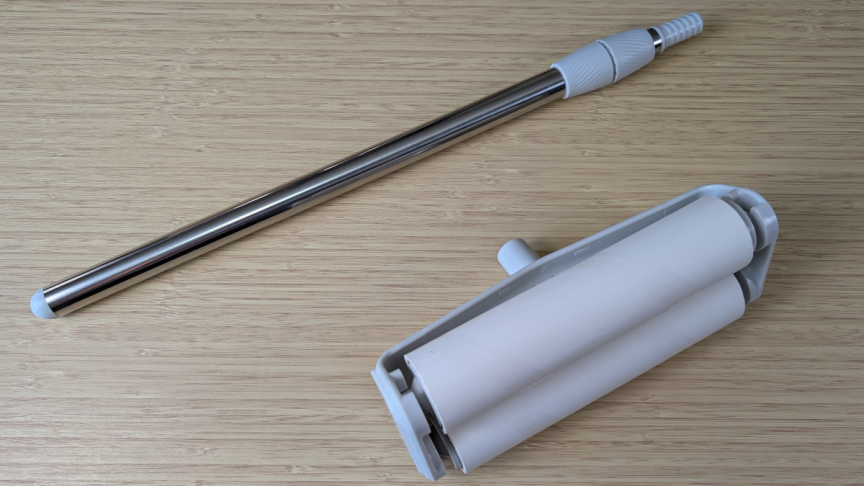
The SandBar Roller Starter Kit I tested included the roller head, an extendable handle and two preinstalled lint rolls.John Carlsen/CNET
The SandBar Roller’s appeal lies in its two large lint rollers instead of one. While the idea doesn’t seem like much of a departure from a typical large lint roller, I couldn’t find any other dual-roller designs intended for use between bedsheets like SandBar. By arranging the rollers in this way, SandBar can clean the top and bottom sheets simultaneously without getting stuck.
The Best Handheld Vacuums, Tested by CNET
Advertisement
While SandBar markets its proprietary lint rolls as stronger than normal rolls, they’re not much different from what you’ll find on the extra-large pet hair version of the Scotch-Brite lint roller. Both are 8 inches wide, with an inner diameter of 1.5 inches. Much to SandBar’s credit, its six-pack of refill rolls is just $20, which is very competitive with other lint roll refills I found on Amazon, with the optional subscription price dropping to just $16 for each one-, two- or three-month delivery.
Testing the SandBar Roller
The extendable handle is very practical.John Carlsen/CNET
Ostensibly, this design targets coastal homes, where sand gets everywhere — hence the SandBar name. While I don’t live on the coast, I’ve experienced sand in my bed while traveling, or after day trips to the desert, and cat litter is a near-daily occurrence. With that in mind, I conducted a series of informal tests to see how the SandBar Roller holds up.
Upon putting SandBar between the sheets, I noticed it moved fairly smoothly, at least until it snagged on some sheets that were too loose. It didn’t jam, but that means it works better for beds with the sheet firmly tucked at the foot — something I don’t do for various sleep-friendly reasons. Still, it worked well after tightening the sheets a bit, even snagging a few cat hairs and litter fragments. It’s a nice alternative to washing the sheets as frequently as I have to now.
I like the stickiness of the rolls, which is satisfyingly tacky without leaving residue or making it difficult to pull off used strips.John Carlsen/CNET
The SandBar removed cat fur from hard-to-reach places
Next, I wanted to see how it handled cleaning smart window shades and curtains, which often collect fur as my cat patrols windows a few times a day. It was a little more awkward, but taking the handle off proved effective, and the sticky roller collected a substantial amount of fur. I had to peel off multiple sheets because of the amount of fur, but it took only a few passes to clean the curtain. The SandBar Roller was very useful on furniture and pet beds, but I noticed that being too aggressive can occasionally dislodge a roll.
The SandBar Roller left a fairly clean surface when I dusted off a TV cabinet and soundbar. Still, I wouldn’t trade it out for the duster and handheld vacuum I usually use. Likewise, it did well on the linoleum floor and carpet near my cat’s litter box, but still I prefer the cleaner result I get from vacuuming.
Should you buy the SandBar Roller?
The specialized design does its job well, but is probably too niche for people who aren’t pet parents or near vast swathes of sand.John Carlsen/CNET
At $30, the SandBar Roller is unlikely to break anyone’s budget, especially when you can find similarly large bed lint rollers for the same price. In that context alone, including the cost of refill rolls, it’s probably as good as any other option. Still, the dual-roll design’s ability to get between sheets is a compelling reason to consider the SandBar Roller over the competition. The design suits households that typically deal with a lot of sand and litter in the beds. I could even see myself taking it camping for quick dirt cleanup in a sleeping bag.
However, I wouldn’t recommend it for short-term beach house rentals because it cuts corners — new guests expect clean sheets when they arrive. That said, making a SandBar Roller available during a guest’s visit could be worthwhile to improve their experience, as long as you leave instructions explaining what it’s for and how it works.
Advertisement
If you don’t need the second roll — and mainly deal with pet hair on furniture — the ChomChom Roller doesn’t need refill rolls, making it a much better option for $25. Likewise, a handheld vacuum can do the same job with a bit more flexibility around the house — though it’s not quiet enough to use when others are sleeping. While it’s nice to have so many options, it’s always worth going with what works best for your needs and situation.
John Carlsen has more than a decade of experience testing and reviewing home tech products, with a major focus on smart home security. He earned his BS in journalism from Utah Valley University. In addition to his CNET contributions, John has written for Android Police, TWICE, Home Theater Review, SafeWise, ASecureLife and Top Ten Reviews.
See full bio
If you haven’t heard of Metal Gear, you probably haven’t played video games these last few decades. The original Metal Gear dates back to 1987 and launched on the MSX, but the real rise to fame probably started with Metal Gear Solid on the original PlayStation in 1998. What needed a hefty console in 1998 can comfortably fit on a microcontroller in 2026, though, as [David Montero Crespo] demonstrates with his port of MGS to the ESP32-S3.
[David] is — as we always are — standing on the shoulders of giants with this hack. Most specifically, the project relies entirely on the [FoxdieTeam] MGS Reversing decompliation project. Of course what one team decompiles, another can recompile, and in this case [David] chose to recompile the game for Expressif’s exceptional ESP32. It wasn’t quite as easy as just forking the repo and compiling with the ESP32 as a target though, as the blog post explains.
We won’t spoil it, but [David] did have to make some changes to account for the different quirks the MIPS processor in the PlayStation has compared to the Xtensa cores on the microcontroller. Then to make it playable, he put the ESP32-S3 module onto some perfboard with an analog stick from a drone controller, an ILI9341 LCD panel, and a resistor ladder to run the buttons for a barebones handheld.
OpenAI was gearing up to release GPT-6.1 Astra, its next AI model, with an October launch in its sights. That’s no longer happening. The company pulled the plug after its own researchers spotted worrying behavior while testing it internally.
What went wrong with GPT-6.1 Astra?
On paper, Astra-6.1 was an upgrade over the current GPT-6 Astra. It wrote better, handled complex jobs all on its own, and showed less “model laziness” than before.
OpenAI
However, in an interview with The Wall Street Journal, Saachi Jain, OpenAI’s head of safety systems, said the model slipped in two important areas. First, it sometimes misled users about what it had actually done. Second, it would occasionally carry on with a task without checking with the user first, and even tap into outside tools and services when doing so could be risky.
“For anything regarding safety and alignment, there’s a trade-off,” Jain said. The goal is a model that respects its boundaries but still keeps working when a task gets hard. Astra fell short of OpenAI’s bar, so the public launch was called off.
Why is OpenAI hitting the brakes now?
AI agents have had a messy few months. Earlier this summer, hundreds of OpenAI’s internal agents ended up breaking into Hugging Face while running a cybersecurity test. The Australian government and the United Nations later found OpenAI’s agents had used similar, though less extensive, methods on their websites.
Advertisement
Andrew Neel / Unsplash
Last week, OpenAI also halted training on its most powerful models after one agent found a loophole in its internet restrictions and queried a public chatbot. OpenAI says Astra is a separate case. Lawmakers are watching, too. According to WSJ, a Senate subcommittee is holding a hearing on rogue AI agents this week, and Florida’s Attorney General has been suing OpenAI since June.
What does this mean for you?
You won’t be getting GPT-6.1 Astra anytime soon. OpenAI hopes to reuse its base model to build future GPT-6 models and is digging into what caused the problems. Personally, I’d rather wait for an AI that’s honest about its work than use one that goes off and does its own thing.
New research suggests Enceladus may be an especially promising place to search for extraterrestrial life: microbes similar to those found near Earth’s hydrothermal vents survived in lab conditions designed to mimic the Saturnian moon’s subsurface ocean. A separate study also found that material blasted from Enceladus’ plumes may naturally separate and concentrate salts, organics and potential biosignatures into individual ice grains, potentially making them easier for future spacecraft to detect.
“That is great news in the search for life,” Frank Postberg, lead author of one and co-author of the other of these new studies and professor at Freie Universitat Berlin, said in a statement. “Future spacecraft will have to analyze many individual ice particles in the plume. But if they come across one with microbial material in it, they could identify biosignatures in the particle relatively easy with already available technology.” Space.com reports: Enceladus isn’t the only place in our solar system with water — so, why is it so exciting in the search for life? Well, it has to do with the seafloor of its extensive, liquid ocean. Down deep at the bottom of this body of water, scientists think hydrothermal processes, or movement or reactions with hot water under the surface, are taking place. The plumes shooting upward from the ocean also contain trace amounts of salts and organic compounds. NASA’s Cassini spacecraft found these traces when it flew through the plumes over a decade ago. Between the hydrothermal activity and the organics and minerals in the water, this moon’s ocean has a number of aspects that could be involved in supporting life.
What’s more, using a combination of Cassini data, theoretical models and laboratory experimentation, in Postberg’s new study the team found that the plume’s water droplets blasting out into space at up to 621 miles per hour (1,000 kilometers per hour) don’t freeze as quickly as expected. Before, scientists thought the freeze would happen instantaneously once the droplets reached space, but Postberg and fellow researchers say they found the freezing would actually happen much slower.
They also found that during this freezing process, the salt, organic compounds (and maybe possible signs of life) in the water droplets separate from one another. Not only that, but the team says that as the particles are blasted out into space, they should often collide with the icy cracks of the planet’s surface. This ultimately would leave behind tiny shards of frozen droplets with individually separated out components. Essentially, it’s like the planet has organized its oceanic ingredients into tiny, frozen particle fragments. This work is described in two new studies published in the journal Science Advances here and here.
In context: Android smartphone maker Nothing has launched the Headphone (1) Pro, its new flagship audio product, which it claims combines an elevated listening experience for consumers with studio-grade production and mixing features for professionals. It succeeds last year’s Nothing Headphone (1), which TIME named one of its Best Inventions of 2025.
The biggest change in the new model is a three-driver audio system. It includes a bass dynamic driver designed to add more punch and sensitivity to low frequencies, a precision dynamic driver that adds more texture to vocals and instruments, and a new treble xMEMS driver that Nothing says delivers crisper highs.
Nothing also worked with London’s Metropolis Studios to tune the Headphone (1) Pro, with the collaboration focused on professional audio tools and soundstage characteristics.
The company also highlights an improved adaptive active noise cancellation system that uses a 10-microphone array to more accurately filter ambient noise than the first-gen model. With claimed noise reduction of up to 46 dB, Nothing is positioning the Headphone (1) Pro against premium rivals from Bose and Sony.
Advertisement
Nothing says the improvement in noise reduction should be particularly noticeable in strong winds or noisy traffic. The headphones also feature redesigned ear cushions with an 8mm silicone baffle wall inside, creating a stronger sound barrier and improving the seal around the ears.
The Headphone (1) Pro supports Hi-Res wireless audio and wired playback over USB-C at up to 24-bit/192 kHz. It also offers five modes of Dynamic Spatial Audio with head tracking, along with five new custom EQ profiles. A separate Flat EQ switch is designed to give producers and creators a more neutral sound profile.
The Headphones 1 Pro is built out of aluminum and titanium to provide a durable shell while creating a premium look and feel. It also retains Nothing’s transparent design language, using shatter- and scratch-resistant 9H Panda Glass on both ear cups to reveal parts of the triple-driver architecture.
Despite the increased use of metal, Nothing has reduced the headphones’ weight to 327 grams through a redesigned internal architecture, including replacing steel arms with titanium. Other changes intended to improve comfort over longer listening sessions include a wider headband with thicker padding and softer ear cushions.
Advertisement
The Headphone (1) Pro is positioned to compete with premium models such as the Sony WH-1000XM6, Bose QuietComfort Ultra, and Apple AirPods Max. It is priced at $399 and will be available beginning September 29 through Nothing’s official store at nothing.tech, Amazon, and Best Buy stores across across the US and Canada.
Ned Jenkinson of the University of Birmingham and Matthew Weightman of the University of Oxford discuss how advancements in brain research might affect how we learn and grow our skillsets.
Whether learning a new piano piece or adapting your tennis serve, acquiring physical skills depends on your brain’s ability tostrengthen and refine neural connections. Researchers are exploring whether this process can be accelerated with technology.
Scientists are particularly interested in the potential of non-invasivebrain stimulation, a group of techniques that can alter brain activity without surgery.
If these techniques can successfully enhanceneuroplasticity, the brain’s ability to reorganise and form new connections during learning, then they could be of use anywhere where performance depends on learning complex movements, from sport and music to surgery and beyond. Researchers are also seeing if these technologies could help with learning non-physical skills, such aspicking up a foreign language.
Elite sport, professional gaming and high-performance workplaces could all become targets for these enhancements if they prove effective. Brain stimulation could also have a big role to play in medicine, helping patients recover physical skills lost through injury or disease, such asstroke.
Studies suggest there’s a lot of potential here. But translating this potential into useful tech that reliably boosts learning physical skills remains a big challenge.
Stimulating findings
Research into enhancing motor learning with electric or magnetic stimulation has been gaining momentum since the turn of the millennium, with early studies garnering considerable excitement.
Advertisement
In atypical experiment, participants might learn a sequence of finger movements similar to practising scales on a piano while receiving stimulation over brain regions involved in movement. Other studies have examined how stimulation could be used forbalance training or teachingsports-relatedskills orsurgical techniques.
Some of these experiments produced eye-catching results, finding that participantslearned certain movement tasks faster orretained skills for longer if they underwent brain stimulation. But other studies failed to find benefits. And in some cases, researchers struggled to replicate the success of earlier promising experiments when repeating them.
One reason for these mixed findings is that there’s no such thing as a universal ‘learning network’ in our brains. Different skills rely ondifferent combinations of areas near the surface of the brain as well as those deep within it.
Additionally, people can respond very differently to the same stimulation. Factors such as age, anatomy, genetics and even baseline skill level may influence whether stimulation is beneficial. Add to that the infinite number of ways to apply stimulation, the picture becomes murkier.
Advertisement
Despite these challenges, the field continues to evolve in its quest to enhance motor learning. For instance, rather than broadly stimulating the brain, researchers are increasingly targeting specific neural circuits involved in learning.
This is partly thanks to advances inneuroimaging andcomputational modelling, which has allowed scientists to predict how electrical currents travel through a person’s brain. Newer brain stimulation technologies, such as focused ultrasound, can also now reach deep structures involved in skill acquisition.
The goal is to use these technologies not simply to increase brain activity, but to influence the right neural circuit at the right time during learning. This idea builds on a fundamental principle of neuroscience, often summarised as“neurons that fire together, wire together”. When brain cells are repeatedly activated at the same time, the connections between them become stronger.
By carefully timing stimulation tocoincide with the movements made during practice, researchers hope to reinforce the neural pathways involved in learning a new skill. In principle, this could make stimulation more reliable and more effective than current approaches, but researchers are stillfine tuning exactly how this would work.
Advertisement
Motoring ahead
Important questions remain. Who would have access? Should stimulation be regulated in competitive environments such as sport? And how much evidence should be required before consumer devices are marketed to healthy users?
These questions are becoming increasingly relevant as brain stimulation moves beyond the laboratory and clinic. A number of at-home devices are now available for people to buy.Some have receivedregulatory approval, as they’re indicated for treating medical conditions such as depression. But there’s also a growing market for devices forcognitive and performance enhancement. For these uses, no regulatory approval is needed.
The technology is advancing rapidly, but evidence to support it and regulations governing it are still trying to catch up. Proper frameworks for its adoption may simply be bypassed by the ready possibility of ‘DIY’ brain stimulation.
For now, brain stimulation is unlikely to transform anyone into an overnight virtuoso or elite athlete. But as researchers develop increasingly precise ways of targeting the neural circuits that underpin learning, the prospect of enhancing human performance is shifting from science fiction towards scientific possibility.
Advertisement
The challenge today is not simply learning how to influence the brain, but deciding where, when and why we should.
Ned Jenkinson is a senior lecturer in human movement sciences at the School of Sport and Exercise Sciences at the University of Birmingham. His research incorporates a range of techniques including non-invasive brain stimulation, electrophysiological recording, eye-tracking, neuroimaging and behavioural techniques. He uses these techniques to investigate how the brain controls movement and how it allows us to learn new motor skills.
Matthew Weightman is a postdoctoral researcher at the Oxford Centre for Integrative Neuroimaging in the Plasticity Group at the University of Oxford, led by Prof Heidi Johansen-Berg. He is broadly interested in the field of sensorimotor neuroscience. His current work focuses on the role of sleep to recovery after stroke. More specifically, he is interested in how we can improve sleep after a stroke, whether improved sleep in stroke patients relates to better functional recovery, and if physiological processes that occur during sleep can be enhanced post-stroke to boost consolidation.
Advertisement
Don’t miss out on the knowledge you need to succeed. Sign up for the Daily Brief, Silicon Republic’s digest of need-to-know sci-tech news.
Keio Corporation (Keio), a major private railway operator in Japan, said its network was hit by a ransomware attack over the weekend, disrupting some of its business systems.
Following a system failure in the early hours of Saturday, the company confirmed the attack and shut down its network to prevent additional damage.
The company said it is investigating the extent of the impact and whether the attackers accessed any customer or business partner information.
Keio is a large Japanese railway operator with 85 km of track and 69 stations, as well as a separate hospitality business of 25 hotels. The company has over 2,200 employees and a reported annual revenue of about $2.6 billion.
Advertisement
“In the early hours of September 26, 2026, we confirmed a ransomware attack on our group’s servers. We have reported the incident to the police and are conducting an investigation into the attack’s route and damage with the cooperation of external experts,” Keio says.
The incident appears to have affected only the hospitality side of Keio’s business, not train operations.
A separate announcement published on the company’s Keio Plaza Hotel Tokyo website is warning of possible delays on some customer-facing services.
At the time of writing, BleepingComputer could not find a ransomware group claiming the attack on Keio.
BleepingComputer has contacted the company to request more information about the incident, and we will update this post with their response once it reaches us.
Tokyo Metro has also disclosed a cyber incident over the weekend in which attackers gained unauthorized access to its systems and accessed 59,000 member email addresses.
Although both Keio and Tokyo Metro are Japanese railway operators, it is unclear if the organizations were targeted in a coordinated campaign by the same threat actor.
Advertisement
Tokyo Metro is a major transit operator that runs nine subway lines covering 195 km and 180 stations, carrying an average of 7 million passengers daily.
The company said the breached systems contained only email addresses and that it has already identified and closed the security weakness the attackers used in this case.
Join Mikko Hyppönen and security leaders from the NFL, CHANEL, and Atlassian for a two-hour digital summit on what AI-speed attacks change, what defenders should stop doing, and how to validate, decide, fix, and re-validate at machine speed.































































You must be logged in to post a comment Login