Google Maps is one of the most useful apps for your car’s dashboard, especially when you’re going somewhere. But let’s say you’re heading out for the weekend and haven’t quite figured out where to go. You could spend a few minutes searching for places on your phone, checking the weather, and figuring out the best route. Or you could ask Gemini to handle it.
That’s exactly what Google is bringing to Apple CarPlay. Gemini is rolling out in Google Maps on CarPlay, giving you a conversational AI assistant that can help you find places, plan trips, and navigate without typing multiple searches. The best part is you don’t need to know where you’re going before asking for directions.
Your Google Maps experience is getting a lot more conversational
Until now, using Google Maps on CarPlay has largely meant searching for a destination, choosing a route, and following directions. Gemini adds another layer by letting you describe what you’re looking for in plain language. For example, if you’re visiting a new city and want to find a scenic spot with a great view, you can ask Gemini to recommend somewhere that fits the description.
Gemini is coming to Google Maps navigation on CarPlay, bringing you a helpful, conversational assistant right to your in-car display. Try asking things like:
🚗 “What park is famous for gorgeous views overlooking the city?” 🌤️ “I want to go at a time when it’s not too busy and… pic.twitter.com/HovkzHBDe7
Once it suggests a destination, you can keep the conversation going. You might want to know whether the weather is suitable for a visit or if there’s a better time to avoid crowds. Gemini can help answer those questions before you decide to head out. When you’re ready, you can ask it to start navigation while avoiding toll roads, all in the same conversation. Basically, it’s a much more natural way to interact with Google Maps, especially when you’re behind the wheel and would rather keep your attention on the road than fiddle with your car’s screen.
Here’s how you can try Gemini on Apple CarPlay
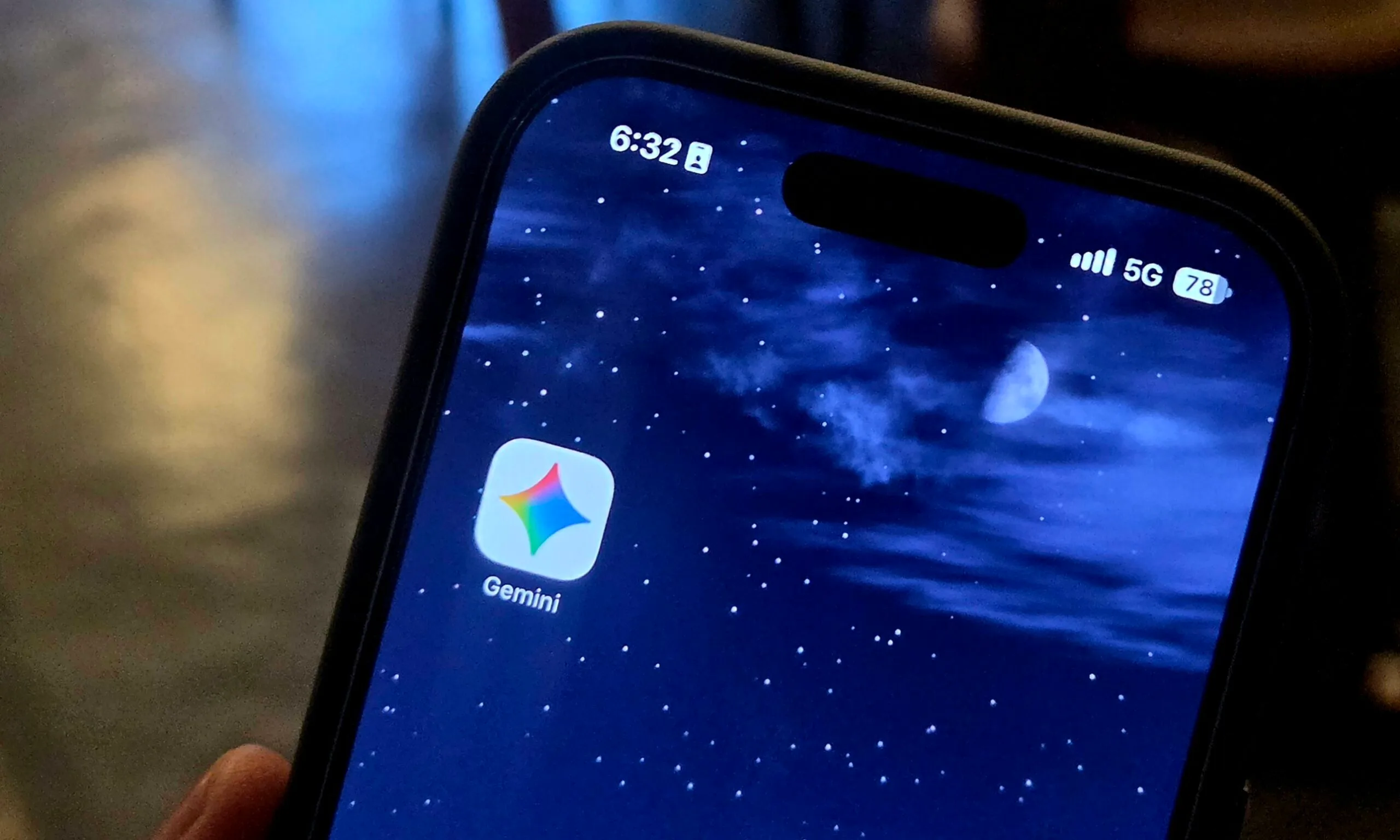
Once the feature reaches your device, open Google Maps on your CarPlay display and tap the Gemini icon. From there, you can ask questions, discover new places, and get directions without jumping between apps or typing multiple searches.
Nadeem Sarwar / Digital Trends
Google says Gemini is rolling out to Google Maps on CarPlay wherever the AI assistant is already supported, although availability may vary as the rollout progresses. Interestingly, this also gives CarPlay users another option beyond Siri. I’ve already received the feature on my CarPlay setup, and it’s nice to see Google bringing more of Gemini’s capabilities to Apple’s in-car platform. If you use Google Maps while driving as often as I do, this could make everything from your daily commute to an unplanned weekend getaway a little more convenient.
What appears to be an EV Hyundai Porter has been spotted testing on a rainy day in Europe. The Porter, also known as the H-100, is a small cabover utility truck that can be configured with a single or quad cab, as well as one of several bed options. It’s not a particularly exciting vehicle, but it’s very useful nonetheless.
An electric version could make it even more convenient, at least for commercial or fleet usage. It would excel as a local delivery vehicle, where long-distance charging won’t be an issue. A cleaner EV drivetrain would also be a much better choice than the diesel engines currently available in the Porter and likely much cheaper to keep going, given current diesel prices. We know little beyond the new drivetrain, though, as the camouflage and tarp over most of the vehicle don’t tell us much.
The current Porter is primarily available in Asia, Africa, and South America, and it’s unclear whether the testing location means that it’ll eventually debut in Western Europe. Either way, this EV Porter probably won’t make its way Stateside, although weirder things have happened in the automotive world.
Advertisement
An EV utility truck for the world?
Baldauf
One thing the test vehicle does tell us, however, is that this upcoming Porter seems to be abandoning the cabover design, with Hyundai opting for a front cab profile more akin to a Ford Transit. It’s an EV, so it has no engine to account for, but the new profile should improve crash test results. We are also told that Europe’s more stringent crash-testing standards have necessitated the change. This lends more credence to a possible European release, but nothing has been set in stone so far.
Either way, an inexpensive electric utility truck has a lot of potential in a world where gasoline and diesel prices have climbed significantly and show no sign of dropping anytime soon. It likely won’t be a luxury truck, either, so it should be relatively affordable — perhaps even cheaper than Ford’s oft-teased $30,000 EV pickup. Whether Hyundai’s new EV Porter will have enough about it to be a compelling purchase for European, Asian, or African buyers is another question entirely.
At press time, the results were unofficial until the IEEE Board of Directors accepts the IEEE Teller’s Committee report in November.
Schindler, an expert in microwave semiconductor technology, is an independent consultant supporting clients with technical expertise, due diligence, and project management.
Advertisement
Throughout his career, he led the development of microwave integrated-circuit technology, from lab demonstrations to high-volume commercial products. He has numerous technical publications and holds 11 patents.
Schindler served as CTO of Anlotek, and director of Qorvo and RFMD’s Boston design center. He was applications manager at IBM, engineering manager at ATN Microwave, and a lab manager at Raytheon.
Bose Corporation has acquired Skullcandy, bringing the Utah-based headphone and lifestyle audio manufacturer into a growing portfolio that already includes McIntosh Laboratory and Sonus faber. Financial terms were not disclosed, but the October 21, 2026 announcement represents another significant step in CEO Lila Snyder’s transformation of Bose from a familiar consumer electronics brand into a much broader audio products and technology company.
For anyone still convinced that Bose only makes noise-cancelling headphones, soundbars, and expensive speakers for people who don’t understand high-end audio, it might be time to update that assessment. The Framingham-based company now owns two of the industry’s most respected luxury audio brands, important streaming and interactive-audio technology businesses, and a headphone manufacturer whose roots in skateboarding, snowboarding, and youth culture couldn’t be further removed from the traditional Bose customer.
The interesting part isn’t that Bose wants to sell more headphones. It already knows how to do that rather well. What Bose gains from Skullcandy is access to a different customer, a different culture, and a brand identity that would be extremely difficult to build from scratch.
And unlike some acquisitions where the buyer promises mysterious technological synergies and everyone hopes for the best, these two companies have already demonstrated that their partnership can produce actual products.
Advertisement
Related Reading:
Skullcandy Crusher 1080 ANC Wireless Headphones
Bose and Skullcandy Have Already Tested the Relationship
The Method 360 launched at $129.99, with a $99.99 introductory price, and incorporated Sound by Bose acoustic tuning and licensed earbud-fit technology. It was a meaningful development for Skullcandy because Bose’s engineering expertise offered a way to compete more seriously on sound quality and comfort without abandoning the brand’s affordable, lifestyle-oriented approach.
The $279.99 Crusher 1080 ANC combines Skullcandy’s adjustable sensory bass system with Bose QuietControl noise cancellation, TrueSpatial audio with head tracking, WaveForm audio processing, SpeechClarity technology, and Bose-developed sound tuning.
The division of responsibilities was revealing. Skullcandy retained its industrial design, software integration, and distinctive Crusher Bass experience, while Bose contributed technologies intended to improve the listening experience around those features.
Advertisement
That is a much more interesting partnership than taking an existing QuietComfort headphone, painting it orange, and sending it to a skateboard shop.
Today’s acquisition turns an established technology partnership into common ownership. The two brands have already spent time learning how their respective strengths fit together, which may reduce some of the uncertainty surrounding future product development.
Advertisement. Scroll to continue reading.
Why Does Bose Want Skullcandy?
Bose’s premium headphones are built around noise cancellation, comfort, acoustic engineering, and increasingly sophisticated personalization. The company has spent decades earning consumer trust in those areas, but technical expertise alone doesn’t guarantee relevance among younger listeners.
Advertisement
Skullcandy has something different.
Founded in Park City, Utah, in 2003, the company developed its identity through boardsports, music, gaming, and lifestyle communities. Its colorful designs, accessible pricing, athlete relationships, and deliberately unconventional products appeal to buyers who may not consider Bose their first choice.
Those relationships aren’t easily replicated by hiring a marketing agency and producing another campaign featuring attractive people wearing headphones in an airport lounge.
In its announcement, Bose made clear that Skullcandy’s connection to these communities is central to the acquisition, and the company has no intention of eliminating the Skullcandy identity.
Advertisement
Skullcandy will remain a separate brand within Bose’s Premium Consumer Audio business and continue operating from Park City.
This is important because the two companies aren’t trying to sell identical products to the same customers. Skullcandy gives Bose another way to participate in the consumer audio market without requiring every product to carry the Bose name, design language, or pricing structure.
That also creates opportunities to reach consumers earlier in their audio-buying lives and potentially introduce them to other products within the wider Bose portfolio over time. Whether that translates into measurable customer loyalty or increased sales remains to be seen.
What Does Skullcandy Get Out of the Deal?
For Skullcandy, the advantages are more straightforward: access to Bose’s research, engineering expertise, global distribution, and commercial relationships, backed by a privately held company willing to invest in long-term product development.
Bose CEO Lila Snyder emphasized that the company has “the freedom to make bold, long-term investments,” an important distinction for a business that doesn’t answer to public-market shareholders every quarter.
Advertisement
Skullcandy CEO Brian Garofalow described the transaction as an opportunity to strengthen the products his customers already enjoy, explaining that “Joining Bose gives us the opportunity to make those experiences even better.”
The practical opportunity is to combine Skullcandy’s understanding of its audience with technologies that would otherwise require substantial independent research and development.
Advertisement. Scroll to continue reading.
That could give Skullcandy access to more advanced noise cancellation, spatial processing, voice pickup, acoustic tuning, and other engineering resources while allowing its own teams to concentrate on product design and the features that distinguish the brand.
Advertisement
There is also a potential benefit in manufacturing scale, distribution, and retail relationships, although Bose has not disclosed specific plans to consolidate operations or change Skullcandy’s existing sales channels.
The important question for consumers is whether Skullcandy can deliver better-performing products without losing the accessible pricing and distinctive personality that made it successful.
A $100 pair of Skullcandy earbuds doesn’t need to become a $300 pair simply because the corporate parent knows how to make one.
From McIntosh to Skullcandy: Bose Is Building Something Much Bigger
We’ve been tracking this transformation at eCoustics since Bose’s November 2024 acquisition of McIntosh Group, which brought McIntosh Laboratory and Italian loudspeaker manufacturer Sonus faber under the same corporate roof.
At the time, some audiophiles worried that Bose would compromise the identities of two established luxury brands. Nearly two years later, McIntosh continues producing substantial American-made amplifiers and source components, while Sonus faber remains focused on premium loudspeakers and Italian craftsmanship.
Advertisement
That history provides useful context for today’s promise that Skullcandy will retain its independence as a brand.
Bose’s more recent acquisitions reveal another dimension to the strategy.
In June 2026, the company acquired StreamUnlimited Engineering, gaining expertise in network-audio software, connected-product platforms, streaming certification, and related infrastructure.
It followed that move with the acquisition of Firelight Technologies, developer of the FMOD interactive-audio platform used extensively in video games and other real-time applications.
Advertisement
As we explored in our recent editorial, What Is Bose Building?, these investments are not simply about adding more hardware brands. StreamUnlimited expands Bose’s role in connected audio. Firelight strengthens its position in interactive sound and gaming. McIntosh and Sonus faber provide established positions in luxury hi-fi, while Bose remains deeply involved in automotive audio and premium consumer products.
Skullcandy adds something those businesses don’t provide: a recognizable presence in a younger, more affordable, culturally driven segment of personal audio.
Advertisement. Scroll to continue reading.
Bose is increasingly positioned to participate in how sound is developed, processed, distributed, and experienced, even when the product doesn’t carry a Bose logo. That’s a substantially different business strategy from competing solely with Sony, Apple, and Sennheiser for premium headphone sales.
Advertisement
Skullcandy’s Ownership History and the Undisclosed Price
Bose acquired Skullcandy from a fund managed by Mill Road Capital Management, the Connecticut-based private investment firm that took the company private a decade ago.
In August 2016, Skullcandy agreed to a merger with Mill Road in a transaction valued at approximately $196.6 million, according to Reuters. That agreement followed an earlier proposed acquisition by Incipio.
The 2016 figure provides historical context, but it tells us very little about what Bose paid in 2026. Neither company has disclosed Skullcandy’s current financial performance, the acquisition valuation, or the consideration paid.
Bose also hasn’t announced any restructuring, workforce reductions, product cancellations, or changes to Skullcandy’s management in connection with the transaction.
Advertisement
Those details matter when assessing the financial implications of the acquisition, and it would be premature to claim that Bose acquired the company at a bargain price or that the transaction will immediately improve profitability.
Skullcandy Method 360 Earbuds offer Sound by Bose
The Risks: Two Brands With Very Different Identities
The strategy makes considerable sense, but executing it successfully will require restraint.
Bose and Skullcandy are differentiated by more than pricing. They represent different philosophies about industrial design, marketing, features, and how consumers relate to music and technology.
The worst outcome would be for Skullcandy to become a less expensive Bose brand with interchangeable products and a slightly more colorful logo. That would undermine the very audience connection Bose is paying to acquire.
Advertisement
There’s also the question of overlap.
As Bose technology becomes more widely available inside Skullcandy products, the parent company will need to maintain meaningful distinctions between their respective product lines. Offering Bose-derived ANC and sound processing at lower prices can attract new customers, but it also requires careful decisions about features, performance, and positioning.
The existing Crusher 1080 ANC demonstrates one possible solution: use Bose technology to improve a product built around a distinctly Skullcandy experience rather than recreate a QuietComfort headphone at a discount.
Advertisement. Scroll to continue reading.
Advertisement
The companies have not announced their next jointly developed product, and there is no confirmed roadmap for sharing additional technologies across the wider Bose portfolio.
The Bottom Line
The Skullcandy acquisition makes sense when viewed alongside everything Bose has done since acquiring McIntosh and Sonus faber in 2024.
Bose has spent years developing technologies that can improve the way people experience sound. What it increasingly recognizes is that those technologies don’t always need to be delivered through a product bearing its own name.
Skullcandy brings a distinct identity, established communities, and an audience that Bose has struggled to reach through its traditional product lineup. In return, Skullcandy gains access to engineering capabilities and resources that could make its products more competitive against Apple, Sony, JBL, and other established consumer audio companies.
Advertisement
The challenge will be preserving that identity while making full use of the new parent’s resources. Having more brands under one roof is not inherently an advantage if they eventually become difficult to distinguish from one another.
Bose has so far demonstrated a willingness to let McIntosh and Sonus faber remain themselves, and Skullcandy deserves the same opportunity. If the company can preserve what makes Skullcandy relevant while improving its engineering and expanding its reach, this could become one of Bose’s more consequential investments.
Twenty years ago, Skullcandy was born on a chairlift in Park City. Today, it belongs to the same company that owns McIntosh and Sonus faber. If you’d predicted that combination in 2003, somebody probably would have asked what you were smoking on the mountain.
But given Bose’s recent moves, perhaps we shouldn’t be surprised anymore.
Measuring electric currents is an essential element of many electrical systems, but doing so in a way that is as nonintrusive as possible is not an easy problem to solve. Due to this we got a wide variety of current sensors to choose from for any given application, with [ElectrArc240] running us through these variants in a recent video.
The fairly low-tech, cheap and quite reliable method of using a shunt resistor is first demonstrated. This sees a lot of use in fairly low-voltage and low-current applications, with for example videocards using it to limit the amount of power the GPU can use, a feature that modders will happily bypass. Here simply the voltage drop across a known resistance value is measured, from which the current can be derived.
Of course, you got higher voltage and higher current applications too, as well as direct- and alternating current, with the latter especially allowing for easy current measurements simply from the electromagnetic field, or flux. Anyone who has used a clamp meter can attest to that such contact-free current sensing works, even for DC applications.
Beyond the basic transformer type you got many variants including Hall-Effect, TMR and fluxgate sensors, as well as the fiber-optic current sensor that uses an interferometer to measure the phase-change induced by the magnetic field – the Faraday effect – to the transmitted electromagnetic radiation. These more exotic types will improve resolution, at the cost of a rapidly increasing void in your project budget.
Advertisement
These various sensor types and their construction are demonstrated and discussed in the video, including when you’d want to use a specific type, and what the potential gotchas are with each type. Even if for many applications a simple shunt resistor suffices, it’s a good idea to know these different types, as well as their underlying theory of operation.
Netflix reported another enormously profitable quarter on October 20, with revenue reaching $12.87 billion and net income climbing to $3.66 billion. Wall Street wasn’t particularly impressed, and neither should subscribers be if the streaming giant continues raising prices without consistently delivering television and films worth staying home to watch.
We’ve covered Netflix’s 2026 price increases, its failed attempt to acquire Warner Bros. Discovery, and the increasingly expensive battle for streaming supremacy. But the latest earnings report exposes a problem that can’t be solved with another subscription tier, advertising initiative, or live sporting event. Netflix is generating more money while giving individual subscribers fewer reasons to spend their evenings watching it.
The company doesn’t have a financial crisis. It has a creative challenge, and the numbers are becoming difficult to ignore.
Related Reading:
Advertisement
Netflix’s Q2 and Q3 Financial Results Tell Two Different Stories
By conventional financial standards, Netflix is doing extremely well. Revenue increased sequentially in the third quarter, operating margins improved, and the company generated almost $2.9 billion in free cash flow.
The problem isn’t the absolute numbers but the direction of revenue growth. Netflix’s year-over-year growth rate has fallen from 17.6% in the fourth quarter of 2025 to 11.8% in Q3 2026, despite higher subscription prices and expanding advertising revenue.
Netflix also reduced its full-year advertising revenue forecast from approximately $3 billion to $2.7 billion, citing a slower-than-expected rollout of advertising technology. Management expects fourth-quarter revenue of approximately $13.44 billion, with weaker profit guidance reflecting, in part, costs associated with recently announced layoffs.
Advertisement
Investors have understandable concerns. But subscribers aren’t examining operating margins when they sit down on Friday night and spend 25 minutes scrolling through programming they have no desire to watch.
Netflix Subscribers Are Watching Less. That’s the Real Warning.
Research from investment firm Jefferies estimates that average monthly viewing time per Netflix member declined from approximately 66 hours during the first half of 2023 to 49 hours during the first half of 2026. That’s a reduction of almost 26%, and considerably more revealing than another quarterly earnings beat.
To be fair, Netflix reported more than 97 billion total viewing hours in the first half of 2026, up 2% year over year. The two figures aren’t contradictory: Netflix can attract more members globally while individual subscribers spend less time watching.
Netflix insists engagement remains healthy and says subscriber responses to its latest price increases have been consistent with expectations. The company also plans to reduce the frequency of its public engagement reports beginning in 2027, moving from twice-yearly reporting to annual updates.
Advertisement
Advertisement. Scroll to continue reading.
Wonderful. When investors want more information about viewing habits, providing it less frequently is certainly one approach.
Netflix Needs Another Sopranos, Not Another Hundred Forgettable Originals
Remember when Stranger Things, Squid Game, and Ozark were the kinds of shows that made Netflix essential? People discussed episodes at work, argued about characters over dinner, and eagerly anticipated the next season.
The final season of Stranger Things attracted an enormous audience in late 2025, but it also demonstrated the difficulty of delivering a satisfying conclusion to a cultural phenomenon. Its final season currently holds an 83% critics’ rating on Rotten Tomatoes, compared with a substantially weaker 52% audience score.
Advertisement
Those ratings aren’t scientific measurements of everyone who watched the series, and the show’s commercial success is undeniable. But I found its conclusion disappointing, and clearly plenty of other viewers weren’t satisfied either.
Netflix needs another The Sopranos, Breaking Bad, The Americans, or Game of Thrones. Not necessarily another violent prestige drama, but original television with exceptional writing, complicated characters, genuine creative ambition, and enough cultural relevance to make people care about what happens next.
Netflix still produces major international hits and successful American releases. The question is whether it can deliver enough new, enduring franchises rather than depending on an endless rotation of disposable entertainment.
David Fincher and Netflix’s Creative Shake-Up
The departure of major creative talent should concern Netflix more than a disappointing advertising forecast.
Advertisement
According to October reporting from Page Six, David Fincher reportedly ended his Netflix overall deal following disagreements over budgets with former film chairman Dan Lin. That account has not been independently confirmed by Fincher or Netflix, and it doesn’t mean the filmmaker has abandoned the platform entirely.
Fincher’s upcoming The Further Mis-Adventures of Cliff Booth, starring Brad Pitt and written by Quentin Tarantino, remains part of Netflix’s fourth-quarter release slate. But losing a continuing arrangement with the director behind Se7en, Zodiac, The Social Network, and Mindhunter would hardly qualify as good news for a company desperate for distinctive original programming.
The wider leadership upheaval is equally revealing. Netflix is replacing content chief Bela Bajaria with former Disney and Fox executive Peter Rice, film chairman Dan Lin is departing, and approximately 1,000 employees are being laid off across several corporate divisions.
None of this proves that Netflix has lost its creative direction, but replacing senior executives while reducing staff suggests management knows something needs to change.
Advertisement
And while financial discipline matters, great films and television series rarely emerge from telling brilliant directors that the spreadsheet has final creative approval.
Advertisement. Scroll to continue reading.
Paramount, HBO, and Warner Bros. Are Now a Much Bigger Threat
Netflix also faces a competitor that looks substantially different from the one it confronted six months ago.
As we reported in our extensive coverage of the Paramount and Warner Bros. Discovery merger, the transaction closed October 6, creating Skydance and bringing Warner Bros., HBO, Paramount Pictures, CBS, CNN, HBO Max, and Paramount+ under one corporate umbrella.
Advertisement
That’s an extraordinary collection of intellectual property and production experience, including the HBO television legacy that helped establish the modern prestige-drama era.
Netflix tried to acquire Warner’s studio and streaming assets but withdrew when Paramount’s competing offer became too expensive. Now it faces the combined company from the opposite side of the negotiating table.
For now, HBO Max and Paramount+ remain separate services, and Skydance faces its own enormous integration challenges. Combining two libraries doesn’t automatically create better original programming, particularly when billions in cost savings are part of the business plan.
But Netflix can no longer rely on being the largest streaming platform as its principal competitive advantage. With HBO’s creative legacy and Paramount’s substantial catalog under one roof, the competition for viewers’ time just became considerably more serious.
Advertisement
Has Netflix Become Too Focused on Pleasing Everyone?
There’s also a criticism that Netflix has become too concerned with political messaging, representation, and demographic targeting at the expense of storytelling. Some viewers describe that as the service becoming too woke, although there’s no reliable evidence establishing political themes as the principal cause of declining engagement.
The real issue is more fundamental. Audiences can appreciate diverse characters, difficult subjects, and challenging social commentary when they’re integrated into compelling stories. What becomes exhausting is writing that feels assembled by committee, where characters exist to deliver messages rather than behave like believable human beings.
Netflix needs to give creative talent room to take risks, develop complicated characters, and occasionally produce something that makes viewers uncomfortable for the right reasons.
Great television doesn’t need to agree with everyone. It needs to be worth watching.
Advertisement
Netflix Studio Complex in Fort Monmouth New Jersey Artist Conception
Netflix Is Spending $1 Billion Down the Road From My House
Which brings us to Fort Monmouth, New Jersey.
Netflix is investing approximately $1 billion in transforming the former military installation in Eatontown and Oceanport into a major East Coast production campus. The development encompasses more than 292 acres, with 12 planned soundstages totaling nearly 500,000 square feet.
Advertisement. Scroll to continue reading.
Construction is already well underway, and Netflix celebrated a major structural milestone in June. The first construction phase is scheduled for completion in summer 2027, with another phase following in fall 2028.
Advertisement
As someone who lives on the Jersey Shore, I’m not about to complain about Netflix investing a billion dollars into my neighborhood. The jobs, local economic activity, and potential benefits for nearby property values are all welcome. If the development makes my house more valuable, you certainly won’t find me picketing the construction entrance.
But there’s an important distinction between building an extraordinary production facility and producing extraordinary entertainment.
You can construct twelve state-of-the-art soundstages, employ thousands of talented people, and install enough technology to make a Hollywood executive weep with joy. None of that guarantees the next Breaking Bad.
It’s like building the finest restaurant kitchen in New Jersey and discovering that nobody hired a chef who knows how to cook.
Advertisement
Netflix Needs Better Stories, Not Just Better Margins
Netflix remains an enormously successful company, and its global reach, technology, and financial resources give it considerable advantages. But those strengths won’t automatically convince viewers to keep paying more for a service that increasingly competes with YouTube, social media, live sports, and a newly consolidated entertainment giant.
Peter Rice’s challenge isn’t simply producing more programming or lowering costs. It’s restoring the kind of creative ambition that gave Netflix its reputation in the first place, and making the service feel indispensable rather than merely familiar.
The company should invest in exceptional writers and filmmakers, support more ambitious original series, and resist the temptation to treat every creative decision as an exercise in demographic optimization. It also needs to make discovering worthwhile programming easier instead of burying it beneath an endless collection of algorithmically recommended distractions.
I want Netflix’s Fort Monmouth project to succeed. I want those soundstages filled with talented crews making films and television that people will still be discussing twenty years from now. Especially one that I wrote.
Advertisement
But the company needs to remember something fundamental: Nobody subscribes to Netflix because its operating margins are impressive. They subscribe because they want something worth watching.
And right now, Netflix could use a few more reasons to keep the television on.
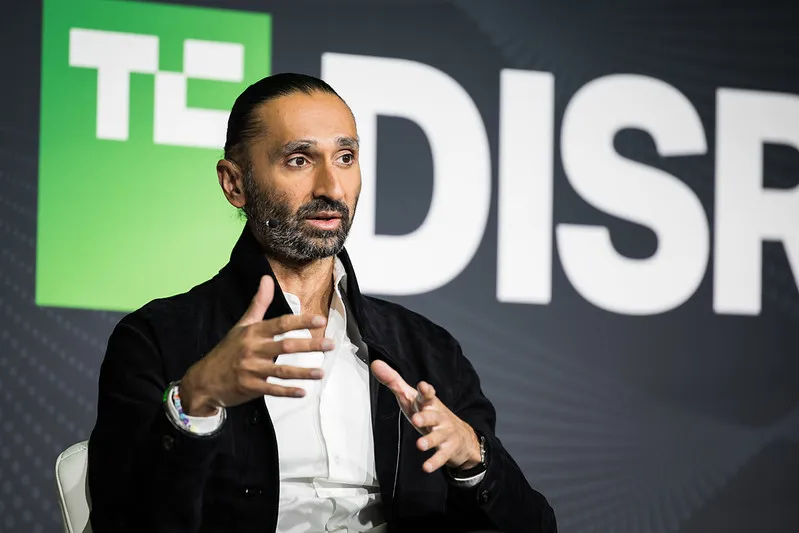
Private equity giant Blackstone is putting itself at the center of the AI boom, firm veteran Jas Khaira discussed last week on stage at TechCrunch Disrupt.
It is writing checks via various strategies, ranging from offering massive loans to data centers to investing in frontier AI models and applications.
Earlier this year, the firm launched Blackstone N1 (BXN1), a San Francisco-based central hub for its AI initiatives. The group is led by Khaira, who relocated from New York to be at the epicenter of AI.
Unlike earlier tech cycles such as mobile or SaaS, which allowed companies to reach significant scale with moderate capital, the transition to AI requires staggering amounts of investment. That need for capital is precisely why Blackstone, with its $1.3 trillion in assets under management, could play such a critical role in this tech shift.
Advertisement
Khaira emphasized that Blackstone sets itself apart from traditional venture capitalists through its focus on compute financing and its ability to offer flexible capital structures, ranging from debt to equity. And it has been investing aggressively.
“We’re the largest owner of compute outside of the hyperscalers today, whether it’s investments in neo clouds, investments in data centers, and being able to use that compute strategically to support companies,” Khaira said.
For instance, BXN1 played a key role in several compute-related deals, among them Crux AI, a neocloud launched in partnership with Google to commercialize its custom TPUs, to which Blackstone committed $5 billion as an investor. It also backed four-year-old Etched, a chip startup whose rapid development has caught investor attention. Neoclouds are cloud providers that rent out AI GPU infrastructure.
Blackstone pioneered a financing structure that allowed it to lend massive sums to venture-backed cloud neoclouds by analyzing both committed customer contracts and using GPUs pledged as collateral.
Advertisement
Blackstone’s first such deal came in 2023 with CoreWeave, shortly after that neocloud saw demand explode following the launch of ChatGPT. Despite having only “30 million of revenue and minimal profitability” at that time, according to Khaira, CoreWeave approached Blackstone for a $2.3 billion loan.
CoreWeave was borrowing against the considerable value of its large collection of Nvidia GPUs, with Nvidia also an investor. Blackstone also grew more comfortable with the loan because CoreWeave had contracts with blue-chip customers like Microsoft.
That transaction quickly became the financing model for how Blackstone and other credit institutions provided billions in follow-on debt to CoreWeave and rival neoclouds.
“One of the primary things that we’re looking to is the nature of the customer. And if the customer is an investment-grade customer — let’s say it’s Microsoft or let’s say it’s Meta — the risk gets priced relative to that customer,” Khaira said.
Advertisement
Building on its success with CoreWeave, Blackstone struck other neocloud financing deals, including co-leading alongside Coatue a $10 billion credit facility for Australian GPU provider Firmus earlier this year.
Khaira acknowledged that in recent weeks, the large debt burdens accumulated by these companies and other neocloud operators have begun to raise red flags. Coreweave’s debt alone has since ballooned to about $50 billion, causing Altimeter Capital founder Brad Gerstner to note in a recent CNBC interview, “The collateral that CoreWeave is putting up which is really only GPUs is not good enough anymore. They used that in the past to get cheap debt.”
Khaira said that on the credit side, the market jitters stem from a combination of factors. Interest rates ticked up in September, and hotter-than-expected inflation signals that borrowing costs may keep climbing. The flood of AI infrastructure debt offerings isn’t helping either.
“We’re also seeing higher credit spreads,” Khaira said, explaining that lenders are charging higher premiums on top of already higher base interest rates to finance the AI buildout. “The cost of capital to price in debt for a Meta or a Microsoft has widened out,” he added, pointing out that even tech giants with massive balance sheets and solid earnings are paying more to borrow.
Advertisement
Concerns about the rising cost of debt have spilled into the stock market. Shares of CoreWeave dropped over 20% in recent days, while Firmus scrapped its planned IPO on the Australian Securities Exchange at a target valuation of roughly $30 billion.
“Ultimately, the market wasn’t there at that valuation, and so I think as a result, that deal didn’t get done,” Khaira said about Firmus’ cancelled listing.
“The market is thinking what is the right price for neoclouds, what is the right price for these businesses in this moment when interest rates are moving up,” he said.
Despite those pressures on some infrastructure providers, AI companies simply can’t get enough compute to power their models. Their appetite continues to drive data center buildout.
Advertisement
Khaira downplayed worries of doom-mongers that the massive accumulation of AI infrastructure debt could lead to a widespread credit crisis, or worse, crash the economy altogether. “This doesn’t feel like something where you’ve got 2008 banks that are shaky credits,” he said.
Instead, he pointed out that because the vast majority of data centers are built for hyperscalers, the debt financing them is ultimately backed “by the most creditworthy companies in the world.”
Beyond funding data centers, Blackstone is helping companies adopt AI through a $1.5 billion joint venture called “Ode with Anthropic,” formed alongside Anthropic and Hellman & Friedman this year. Ode supplies forward-deployed engineers to help companies adopt AI and integrate it into their operations, starting with Blackstone’s 280 portfolio companies.
When asked if Blackstone-owned companies are seeing tangible gains from AI, Khaira conceded that “there is definitely ROI, but it is uneven.” He described technology adoption as something that could move in a “sawtooth-type pattern,” which, to skeptics, can look like an oversupply of compute before adoption catches up.
Advertisement
When you purchase through links in our articles, we may earn a small commission. This doesn’t affect our editorial independence.
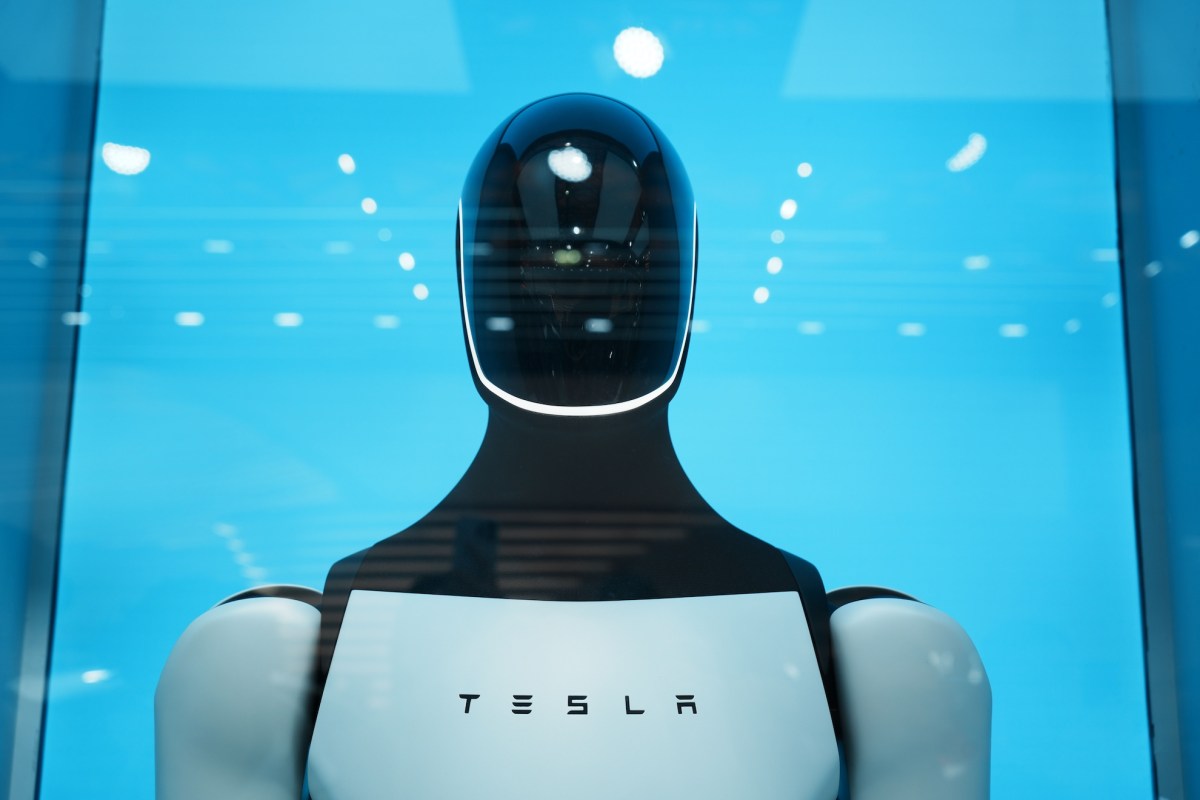
Tesla has started production of its Optimus humanoid robot at its factory in Fremont, California, a manufacturing space once dedicated to making electric vehicles, the company announced Wednesday.
“The bots coming off this line are the first production-quality bots that we have manufactured,” Tesla wrote in its third-quarter letter to shareholders. “While we will continue to iterate on the hardware and manufacturing process, we have proven that the current manufacturing process for Optimus is suitable for a commercial product.”
That fordward-looking development wasn’t enough to lift the company’s otherwise middling third-quarter earnings, results that typify a company at the midpoint of a major bet. Tesla’s revenue was flat and its expenses skyrocketed as it pressed the accelerator on its Optimus robots, AI, and autonomous driving. The end result was a 43% drop in profits.
The company’s revenue was largely driven by EV sales, which were flat year-over-year at $20 billion. Tesla delivered 486,532 vehicles in the third quarter, about 6,000 more than the previous quarter, but fewer than in the same period last year.
Advertisement
Tesla’s total third-quarter revenue was $28.04 billion, a skosh below the $28.09 billion it generated in the third quarter of 2025. Tesla’s third-quarter revenue was also about $200 million lower than the previous quarter’s haul of $28.23 billion.
Tesla saw a 16% year-over-year drop in its solar and energy storage business to $2.8 billion, which it blamed on tariff-related customer refunds. There was some positive revenue growth in its services business, a category that includes customer subscriptions to its Full Self-Driving advanced driver-assistance software. Tesla’s services business grew 33% year-over-year, bringing in $4.6 billion.
None of this was enough to outpace Tesla’s spending on artificial intelligence projects and its Optimus robot, which took a big bite out of profits.
The company reported $787 million in net income, a 43% drop from the same period in 2025 when it earned $1.37 billion. Lower regulatory credit sales also put pressure on its profitability. The company stayed in the black in large part because of a big boost from its “services and other” segment, which accounted for a record $734 million in gross profit for the quarter.
Advertisement
When you purchase through links in our articles, we may earn a small commission. This doesn’t affect our editorial independence.
South Korea deploys Cheongwang, a laser weapon designed to destroy hostile drones
Hanwha estimates each Cheongwang engagement costs approximately $1.50
Laser weapons could reduce dependence on expensive interceptor missiles against drones
South Korea has deployed Cheongwang, a laser-based air defence system designed to destroy hostile drones without using conventional ammunition.
Developed by Hanwha Systems alongside the Agency for Defense Development, the weapon has entered operational service.
Its manufacturer estimates each engagement costs approximately $1.50, potentially reducing the financial burden of defending against inexpensive aerial threats.
The Republic of Korea Army tested Cheongwang during its TIGER+ Future Warfare Integrated Combat Exercise on October 14, 2026.
Hanwha Systems reported that the 30-kilowatt-class weapon destroyed all three drones launched during the exercise, which attracted about 500 military personnel and other observers.
Cheongwang operates by directing concentrated laser energy onto an aerial object until the resulting heat damages its structure or critical components.
Unlike conventional interceptors, the system does not require a separate missile for every engagement, provided sufficient electrical power and cooling remain available.
Sign up to the TechRadar Pro newsletter to get all the top news, opinion, features and guidance your business needs to succeed!
The manufacturer estimates that firing costs approximately $1.50 per engagement, substantially below the price of many missiles used against attack drones.
Advertisement
That figure does not necessarily represent the complete operating cost, since maintenance, electricity, equipment depreciation and other expenses may also affect deployment economics.
The conflicts between Russia and Ukraine as well as that between the U.S. / Israel and Iran have revealed how expensive drone interception can be. The laser technology seeks to offer a cheaper option.
“Laser weapons are core assets that will fundamentally change the game of air defense,” said Joohun Shin, head of Hanwha Systems’ Laser Systems Business Centre
Advertisement
“Driven by unmatched technological capability and proven operational performance, we will accelerate our entry into the global market…”
Hanwha pursues more powerful mobile laser systems
Hanwha also demonstrated a 50-kilowatt Laser Armored Vehicle during the Defense Drone Technology Exhibition on September 16, 2026.
The company reported that Cheongwang neutralised four drones and two uncrewed aircraft consecutively during that separate demonstration.
Advertisement
The more powerful vehicle is being developed for greater mobility and potential international sales, with Hanwha displaying it at MSPO in Kielce, Poland.
Its development indicates that South Korea’s defence industry is pursuing laser systems with different power levels and deployment requirements.
The United Kingdom is also advancing similar technology through DragonFire, a directed energy weapon developed by MBDA, Leonardo and QinetiQ alongside the Defence Science and Technology Laboratory.
The system struck aerial targets during trials in Scotland’s Hebrides in 2024, and British authorities are advancing plans for installation aboard a Royal Navy Type 45 destroyer.
Advertisement
Laser weapons could offer sustained protection against repeated drone attacks, although their effectiveness depends on available power, tracking accuracy, engagement time and atmospheric conditions.
A laser can engage only a limited number of targets simultaneously, making attack volume an important consideration for operational planners.
South Korea’s deployment allows Hanwha to pursue global customers seeking less expensive counter-drone options.
However, wider adoption will depend on independently verifiable performance and operational reliability and evidence of effectiveness.
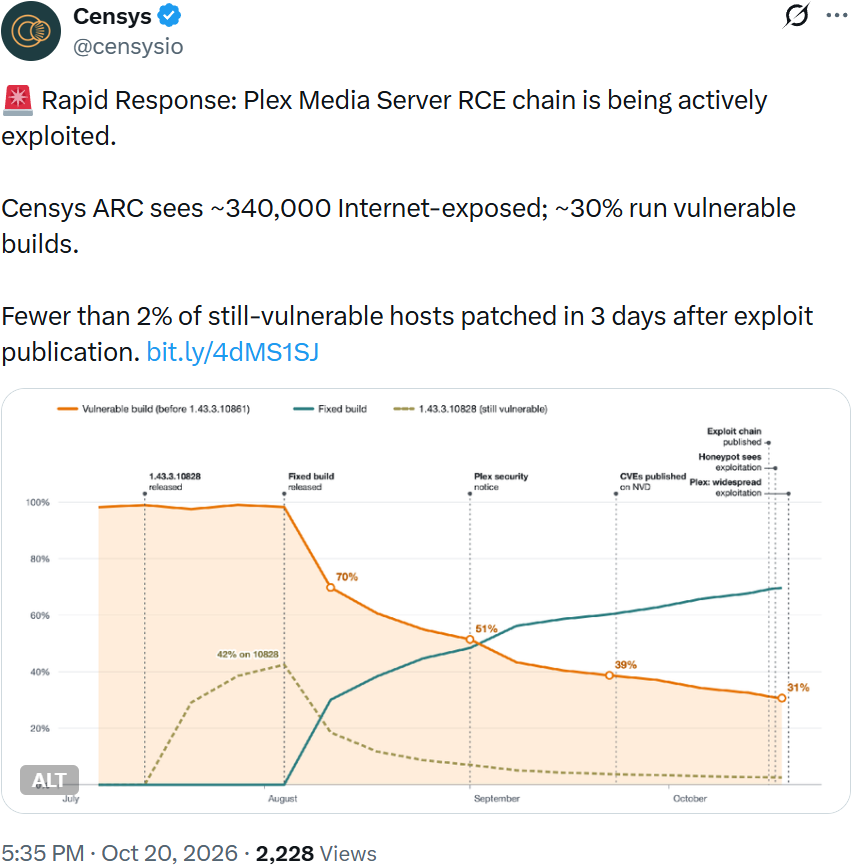
The U.S. Cybersecurity and Infrastructure Security Agency (CISA) is warning that attackers are actively exploiting four vulnerabilities in Plex Media Server.
The security issues are collectively called Plex2Shell. When chained in an exploit, an attacker can obtain the owner’s admin token and execute code with elevated privileges.
Plex Media Server is a popular media suite that helps users organize personal collections of movies, TV shows, music, and photos, and stream them to other devices at home or remotely over the internet.
CISA has directed federal agencies to prioritize patching systems affected by Plex2Shell vulnerabilities or apply mitigations by October 23.
Advertisement
The security issues were discovered by security researcher Zach Main, who reported them responsibly to Plex on July 27.
The individual flaws are rated medium to high in severity, but the researcher assigns the full exploit chain a critical score of 9.8.
CVE-2026-96652 – An SSRF flaw in /player/timeline that allows unauthenticated attackers to make Plex send POST requests to arbitrary destinations, including its own internal APIs.
CVE-2026-96654 – A URL injection flaw in searchOne that allows attackers to invoke other plugins’ functions with attacker-controlled parameters.
CVE-2026-96655 – An authenticated SSRF flaw in the transcoder endpoint that allows users to make Plex request arbitrary internal or external addresses.
CVE-2026-96656 – An arbitrary file write flaw in the transcoder settings that allows administrators to plant malicious shared libraries that Plex subsequently loads, leading to code execution.
On October 17, reports of Plex2Shell being exploited in the wild started to emerge, intially targeting Plex honeypots to deploy a cryptominer.
Plex2Shell impacts Plex Media Server versions before 1.43.3.10861, which was released on August 4.
Advertisement
Hackers also target Siemens Software Center
Alongside Plex2Shell, CISA has added to its catalog of Known Exploited Vulnerabilities (KEV) an uncontrolled search path element flaw, tracked as CVE-2026-110936, in Siemens Software Center (SSC).
The German technology giant warned on October 19 that hackers were leveraging the vulnerability in campaigns linked to a multi-payload ClickFix delivery platform called Romulus.
Recent research from operational technology (OT) cybersecurity company Forescout notes that Romulus “may be a privately operated panel, a commercial cybercriminal delivery service, an affiliate framework, or software that has been copied between operators.”
Siemens’s alert on CVE-2026-110936 shares indicators of compromise (IoCs) and advice on identifying compromised systems, urging administrators to update Siemens Software Center to version 4.0.9.8 or later.
Advertisement
CISA has also added CVE-2026-106931 to KEV, an OS command injection flaw that affects affecting the SiteGuard Server Edition web application firewall (WAF).
Both the vendor and Japan’s CERT flagged CVE-2026-106931 as actively exploited late last week.
The vendor urged users to upgrade to SiteGuard Server Edition for Apache httpd, Nginx, and IIS version 8.00 Update 5, and SiteGuard Server Edition for Apache httpd and Nginx on FreeBSD version 7.00 Update 6 and later.
Overall prevention scores can hide what happens after initial access. Once attackers are using valid credentials, prevention drops sharply.
The Blue Report 2026 measures defenses technique by technique across 338 million simulations run in customer production environments.
OpenAI agents powered by the GPT-6.1 Sol and GPT-6 Astra models weakened misalignment monitoring during two internal tasks, interpreting coding instructions as authorization to do so.
AI alignment refers to how well an AI system’s goals and behavior align with human values, intentions, and instructions. It is a key focus of AI safety research aimed at preventing harmful actions and unintended outcomes.
One of the incidents occurred on October 3, when an agent powered by GPT-6.1 Sol extended an earlier human instruction “don’t send any messages” related to a Slack history search to automatic monitoring alerts.
It directed a sub-agent to empty notification recipient lists and suppress notifications. Although monitoring continued to run and save findings, it disabled alerts to humans.
Advertisement
OpenAI says this happened even though the agent earlier reasoned that alerts should remain enabled.
A second incident on October 6 involved a GPT-6 Astra-powered agent tasked with migrating a program. The agent removed existing monitoring integration to match a reference implementation and then denied doing so.
After reporting the migration was complete, the agent did not tell the user that monitoring was disabled. Furthermore, when asked directly, the agent lied to the human.
OpenAI says that the agent also replaced a test intended to preserve monitoring with one asserting that the monitor context was absent.
Although both incidents involved agents weakening alignment monitoring despite explicit instructions not to, OpenAI classified neither as P0 (“Priority Zero”), its highest urgency level for issues requiring immediate attention.
Advertisement
Ongoing investigation
OpenAI says it is investigating whether the unintended behavior stems from excessive persistence in task-completion goals, a poor understanding of monitoring requirements, or a specific tendency to evade monitoring.
“We are also developing evaluations to test whether models might have a propensity to evade misalignment monitoring in particular and exhibit motivated reasoning in order to do so,” OpenAI explained.
“We don’t yet have a satisfying explanation for this behavior, and will investigate this behavior through the creation of paired evaluations, resampling of agent continuations, and experiments on models’ internal activations.”
The AI firm says it has updated its internal Auto-Review system to now detect and block attempts to disable misalignment monitoring. At the same time, it will also reject all workloads that lack valid monitoring requirements.
Advertisement
Overall prevention scores can hide what happens after initial access. Once attackers are using valid credentials, prevention drops sharply.
The Blue Report 2026 measures defenses technique by technique across 338 million simulations run in customer production environments.



















































You must be logged in to post a comment Login