When a VPN disconnects, traffic may either stop or fall back to your normal internet connection. A working kill switch is designed to block that fallback, while a fail-open setup may let new traffic use your ordinary network route and public IP address.
Quick Take
A VPN disconnect does not automatically mean data leaked. The result depends on what networking policy takes over after the tunnel fails.
A fail-open configuration permits affected traffic to use ordinary networking, while fail-closed protection blocks that fallback until VPN protection returns.
A kill switch does not stop the VPN from disconnecting. It controls whether covered traffic can leave outside the protected tunnel.
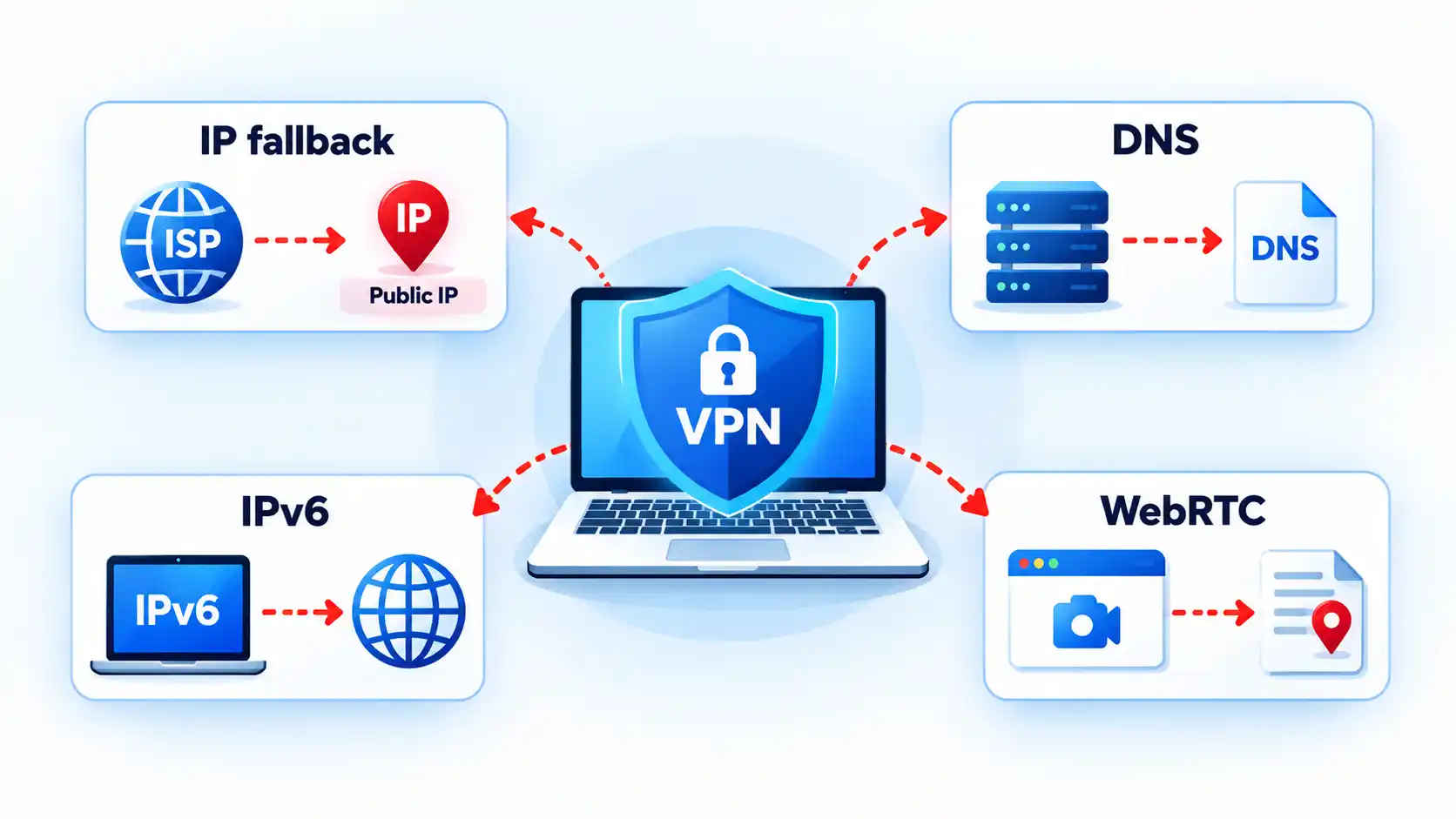
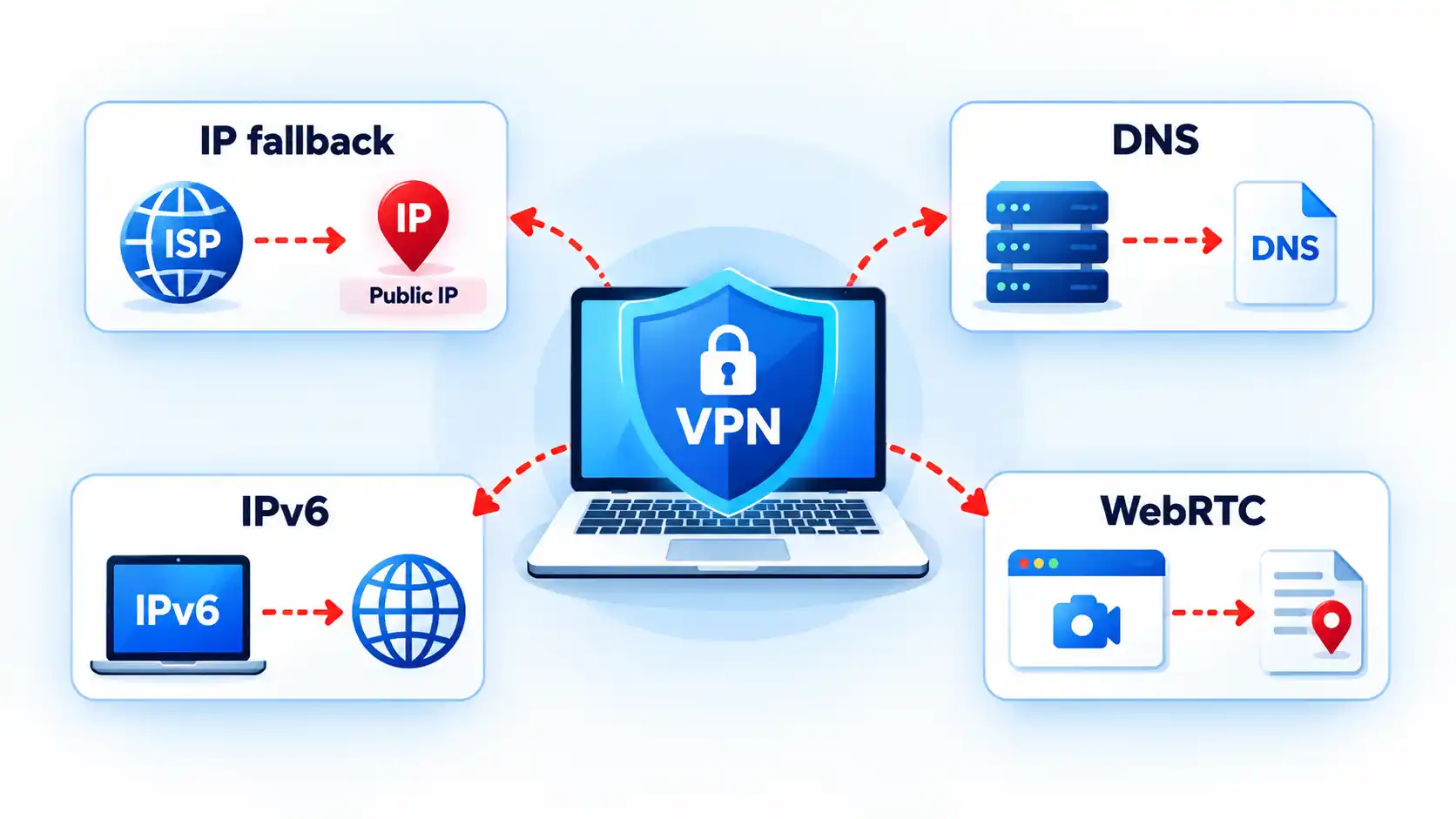
DNS, IPv6, split-tunnel, and browser-related exposures can occur separately from a complete VPN disconnect, so they should not all be treated as the same failure.
What Happens the Moment the VPN Tunnel Drops
A VPN normally gives selected network traffic a route through an encrypted tunnel to a VPN server. When that tunnel disappears, the operating system and VPN software have to determine what should happen to traffic that would normally use it.
One possible outcome is fail open. This means ordinary networking is permitted again. New connections may use the device’s Wi-Fi, Ethernet, or mobile connection directly, just as they would if the VPN were not active. Websites reached through those new connections may then receive the public IP address associated with your normal internet connection rather than the VPN server.
The opposite behavior is fail closed. Instead of allowing protected traffic to fall back to the normal route, the device blocks it until the VPN connection returns or the blocking policy is deliberately disabled.
Suppose a laptop is connected to home Wi-Fi and its browser traffic is leaving through a VPN server. If the VPN tunnel fails, a fail-open configuration may let the browser establish its next connection directly through the internet service provider. With fail-closed protection, that new connection should fail rather than silently bypass the tunnel.
Advertisement
The behavior of an existing connection can be less predictable. Applications may retry requests, create a new connection, wait for the VPN to return, or time out. The practical privacy question is therefore whether traffic that was supposed to remain protected can establish a usable path outside the VPN after the tunnel is lost.
What a VPN Kill Switch Actually Does
A kill switch does not keep the VPN tunnel alive. Its job is to restrict networking when that tunnel is unavailable.
Mozilla describes its implementation as blocking the device’s network connection if Mozilla VPN becomes unstable or drops, with the aim of preventing the local IP address from being exposed. Mozilla’s kill-switch documentation is one example of fail-closed behavior implemented by a VPN application.
The enforcement can also come from the operating system. Android supports an Always-on VPN setting and a separate Block connections without VPN control. When configured together, Android can prevent connections that do not use the selected VPN.
Advertisement
Automatic reconnection is related but different. A reconnect feature tries to restore the VPN tunnel. A kill switch determines what traffic is permitted while that tunnel is missing. A VPN product can implement both, one, or neither depending on the platform and configuration.
Infoi
If your internet stops working immediately after a VPN failure, that may be the kill switch doing exactly what it was designed to do. Confirm the VPN and kill-switch state before treating the loss of connectivity as a separate network fault.
Standard Kill Switch vs Persistent Blocking
“Kill switch” does not describe one universal policy. Some implementations respond primarily to an unexpected VPN failure, while others enforce a VPN-required state even after a deliberate disconnect or restart.
Advertisement
Proton VPN, for example, currently distinguishes a standard mode from an advanced mode. Its standard kill switch is designed to activate when the VPN connection drops unexpectedly, while its advanced kill switch prevents internet access whenever Proton VPN is not connected and can remain active across restarts on supported platforms. These are Proton-specific implementation details, not universal VPN terminology.
The table below shows the conceptual distinction. Exact behavior still depends on the VPN application, operating system, and policy configuration.
Typical differences between disconnect-triggered and persistent VPN blocking
Behavior
Disconnect-triggered protection
Persistent VPN-required policy
Unexpected tunnel failure
Designed to block protected traffic when the VPN unexpectedly drops.
Blocks covered traffic because no permitted VPN tunnel is available.
Deliberate disconnect
May permit ordinary networking, depending on the implementation.
Normally continues blocking until the policy is disabled or the VPN reconnects.
Restart or reboot
Persistence depends on the product and platform.
Can remain enforced across restart when implemented as a persistent policy.
Intentional internet use without the VPN
May be possible after deliberately disconnecting.
Requires disabling the VPN-required policy or changing its configuration.
This distinction is why pressing a VPN application’s Disconnect button is not always a valid test of an ordinary kill switch. Some products intentionally interpret a manual disconnect as permission to resume normal networking.
A VPN Disconnect Is Not the Only Kind of Leak
A complete tunnel failure is only one way traffic can end up somewhere you did not intend. A VPN may appear connected while a particular protocol, resolver, application, or address family follows a different path.
Advertisement
Public IP exposure after fallback
If the VPN tunnel disappears and ordinary routing resumes, a new connection can leave through the underlying internet connection. The remote service may then see the public IP address assigned to that normal route.
This is the failure people commonly mean when they say a kill switch prevented an “IP leak.” More precisely, traffic that was expected to remain protected obtained an ordinary route after the VPN stopped carrying it.
DNS leakage
The Domain Name System, or DNS, translates names such as example.com into network addresses. A DNS leak occurs when queries that were intended to follow the VPN’s protected DNS path instead use another resolver or network path outside that intended configuration.
Not every DNS server different from the VPN provider’s own resolver is automatically evidence of a leak. Some users deliberately configure another encrypted or third-party DNS service. The useful comparison is between the DNS path you intended and the one the device actually uses.
Advertisement
IPv6 bypass
Many networks support both Internet Protocol version 4, or IPv4, and Internet Protocol version 6, or IPv6. That dual-stack design can expose a routing mismatch if VPN software protects one address family but fails to apply the intended policy to the other.
The IETF’s RFC 7359 analysis of dual-stack VPN leakage describes traffic intended for a tunnel escaping through an unprotected IPv6 path when VPN software fails to handle IPv6 correctly. The document dates from 2014, so it should not be treated as evidence that current VPN applications generally have this defect.
The RFC’s IESG note also cautions that the broader leakage problem is not unique to IPv6. Similar exposure can arise whenever policy permits another unencrypted interface or route, including some split-tunnel configurations.
Browser and WebRTC address exposure
Browser networking creates a separate category of address information. Web Real-Time Communication, or WebRTC, uses Interactive Connectivity Establishment, or ICE, candidates when discovering possible paths for peer-to-peer communication.
Advertisement
MDN documents that an ICE candidate can contain the IP address associated with that candidate’s source. Whether the address revealed is relevant to your VPN privacy model depends on the browser, candidate type, VPN implementation, and network configuration. The presence of WebRTC address information does not by itself prove that the entire VPN tunnel failed.
These failure modes are related enough to examine together, but they should not be collapsed into one diagnosis. IP, DNS, IPv6, and WebRTC leaks have different causes and require different verification methods.
Split Tunneling Changes What “Leak” Means
Traffic outside the VPN is not necessarily leaking if you deliberately configured it to stay outside.
Split tunneling means only selected applications or destinations use the VPN while other traffic follows the device’s normal network path. Android’s per-app VPN controls, for example, can restrict VPN use to an allowed set of applications or deliberately exclude applications from it.
Advertisement
Imagine that a browser is configured to use the VPN but a game launcher is intentionally excluded. Seeing the normal public IP from the game launcher may be expected split-tunnel behavior. Seeing that same fallback from the protected browser after the tunnel fails would be a different result.
This is why a leak test should start by establishing what was supposed to be inside the tunnel. Without that baseline, expected exclusions can be mistaken for failures.
Kill switches and split tunneling can also interact differently across products. Proton documents that the combination is unsupported on most of its platforms, while its Windows app can use kill-switch protection with split tunneling so protected applications remain blocked if the VPN disconnects. Proton’s split-tunneling documentation illustrates why this behavior must be checked on the exact product and platform rather than assumed universally.
How to Test Whether Your Kill Switch Actually Works
A useful test compares the normal route, the protected route, and behavior during a VPN interruption. Use only harmless traffic because the purpose of the test is to discover whether unprotected fallback is possible.
Advertisement
Prerequisites
Stop sensitive uploads, account activity, private messages, file transfers, and other traffic you would not want exposed during a failed test.
Identify where your VPN application or operating system exposes its kill-switch or non-VPN blocking setting.
Use a harmless public-IP or ordinary connectivity check that you can repeat before and after the tunnel interruption.
Check your VPN provider’s documentation to determine which type of interruption is supposed to activate the protection mode you are testing.
Record the normal state. With the VPN disconnected and no persistent blocking policy enabled, record the public IP address or other harmless network result shown through your normal internet connection. This is your fallback baseline.
Connect the VPN. Establish the VPN normally, then repeat the same check. Confirm that the result now reflects the VPN route rather than the baseline connection before continuing.
Confirm the protection mode. Verify that the kill switch or operating-system blocking control you intend to test is enabled. If the product has both disconnect-triggered and persistent modes, record which mode is active.
Create only harmless observable traffic. Keep an ordinary webpage or non-sensitive connectivity check ready so you can tell whether networking continues. Do not use confidential logins, cloud uploads, private messages, or other sensitive transfers as test traffic.
Trigger the supported failure condition. Use the provider’s documented test or failure method when one is available. Do not assume that clicking Disconnect tests a standard kill switch, because some implementations intentionally permit normal networking after a deliberate disconnect. Also do not disable Wi-Fi, Ethernet, or mobile data as a substitute for a VPN-tunnel failure, because removing the underlying internet connection cannot show whether traffic would have fallen back outside the tunnel.
Observe the fallback behavior. While the VPN tunnel is unavailable but the underlying internet connection still exists, try the harmless connectivity check. For a fail-closed configuration covering that traffic, ordinary internet access should be blocked rather than silently returning through the baseline route.
Reconnect and verify recovery. Restore the VPN connection, confirm that ordinary connectivity returns, and repeat the public-IP check. The observed address should again correspond to the VPN route rather than the baseline connection.
Verify the result
Traffic that was supposed to remain VPN-protected did not continue through the ordinary route while the tunnel was unavailable.
The underlying internet connection remained available during the failure test, so blocked traffic can reasonably be attributed to VPN protection rather than simply losing Wi-Fi, Ethernet, or mobile connectivity.
Internet access returned normally after the VPN re-established its protected route.
The post-reconnect public IP result again reflected the VPN endpoint rather than the normal baseline address.
Troubleshooting Kill-Switch and Reconnect Problems
The symptom usually indicates whether to investigate the kill-switch policy, the VPN connection itself, split tunneling, or the underlying network.
Internet access continues when the VPN drops
First confirm that a kill switch or equivalent blocking policy is enabled and that the affected application is supposed to use the VPN. Also check how the failure occurred. Some standard kill switches protect unexpected connection loss but intentionally allow normal networking after a manual disconnect. If split tunneling is enabled, verify that the application was not deliberately excluded from VPN protection.
Internet stays blocked after the VPN reconnects
Confirm that the VPN has actually completed reconnection rather than remaining in a connecting or authentication state. Persistent blocking policies can correctly keep traffic disabled while no valid tunnel is available. If the VPN reports connected but traffic remains blocked, restart the VPN application and check its current kill-switch state before changing unrelated router or DNS settings.
The VPN says connected, but websites still do not loadOnly some apps keep working after the VPN fails
Check split-tunneling and per-app VPN rules before assuming the kill switch failed. An application deliberately excluded from the VPN may be expected to continue using the normal network, while an application assigned to the protected tunnel should follow the VPN’s applicable failure policy.
Nothing connects even after you intentionally turn the VPN off
A persistent or always-required VPN policy may still be active. Reconnect the VPN or deliberately disable that policy using the controls provided by the VPN application or operating system. Do not start deleting network adapters or resetting the entire network until you have ruled out intentional fail-closed enforcement. If the VPN itself reports connected but networking remains unavailable, VPN connected but no internet is a different diagnostic state from a simple tunnel disconnect.
Advertisement
Platform Differences That Matter
Android
Android provides several VPN controls at the operating-system level. Google’s current documentation says Android 7.0 and later can use Always-on VPN, and compatible configurations can enable Block connections without VPN. That combination can create fail-closed behavior without relying solely on an application’s own interface.
Android also supports per-app VPN rules. If applications are placed on an allowed list, only those applications use the VPN. Other applications can use normal system networking unless non-VPN connections are also blocked. With blocking enabled, applications outside the permitted VPN set can instead lose network access. The interaction is configuration-dependent, so observing one application’s behavior does not necessarily describe the whole device.
Apple devices
Apple supports several distinct VPN deployment models, including VPN On Demand, per-app VPN, and managed Always On VPN. They should not be treated as interchangeable names for one consumer kill-switch feature.
For managed Always On VPN configurations, Apple documents that all IP traffic can be tunneled through the organization’s VPN infrastructure and that all IP traffic is dropped when the required Always On VPN tunnels are not up. This is a strong example of operating-system-enforced fail-closed behavior, but it does not establish that every third-party consumer VPN application on an Apple device behaves the same way.
Desktop VPN clients can implement blocking in different ways. Some rely on operating-system filtering or firewall facilities, while others use routing or interface mechanisms.
The larger distinction between Always-On VPN and a kill switch is whether the system is trying to maintain a required VPN state, block traffic when that state is unavailable, or do both.
Advertisement
Bottom Line
What happens after a VPN disconnects depends less on the word “VPN” than on the policy that follows the failure. A fail-open configuration can permit subsequent traffic to use the normal network path, while fail-closed enforcement blocks affected traffic until VPN protection returns.
A kill switch is therefore a traffic-control feature, not a guarantee that the VPN will never fail. Split tunneling, DNS routing, IPv6 handling, browser networking, and platform-specific rules can create separate exposure paths even when the main tunnel appears healthy. The reliable approach is to understand what should be protected, verify that behavior with harmless traffic, and interpret the result against the exact VPN and operating-system configuration in use.
Among the many joys of having a cat is the daily battle with the mess they leave behind. No matter what you try, finding litter and pet hair on furniture or in your bed is inevitable — either they track it in, or you do. If you’re a pet parent like me, this means searching for additional bits of litter and stray hairs that find their way into places you really don’t want them, including the bed. Short of pulling the sheets off entirely, few fixes exist.
I took a chance and tested the SandBar Roller, a $30 dual-roll lint roller, to see if it can make it easier to keep stray hair and litter at bay. I also put it through the paces for other lint-roller tasks like dusting and cleaning floors. Here’s how it fared.
How SandBar Roller differs from other lint rollers
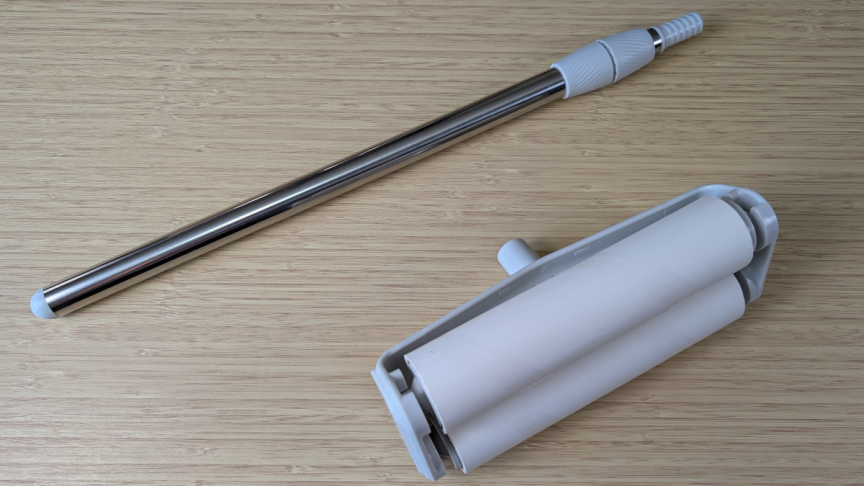
The SandBar Roller Starter Kit I tested included the roller head, an extendable handle and two preinstalled lint rolls.John Carlsen/CNET
The SandBar Roller’s appeal lies in its two large lint rollers instead of one. While the idea doesn’t seem like much of a departure from a typical large lint roller, I couldn’t find any other dual-roller designs intended for use between bedsheets like SandBar. By arranging the rollers in this way, SandBar can clean the top and bottom sheets simultaneously without getting stuck.
The Best Handheld Vacuums, Tested by CNET
Advertisement
While SandBar markets its proprietary lint rolls as stronger than normal rolls, they’re not much different from what you’ll find on the extra-large pet hair version of the Scotch-Brite lint roller. Both are 8 inches wide, with an inner diameter of 1.5 inches. Much to SandBar’s credit, its six-pack of refill rolls is just $20, which is very competitive with other lint roll refills I found on Amazon, with the optional subscription price dropping to just $16 for each one-, two- or three-month delivery.
Testing the SandBar Roller
The extendable handle is very practical.John Carlsen/CNET
Ostensibly, this design targets coastal homes, where sand gets everywhere — hence the SandBar name. While I don’t live on the coast, I’ve experienced sand in my bed while traveling, or after day trips to the desert, and cat litter is a near-daily occurrence. With that in mind, I conducted a series of informal tests to see how the SandBar Roller holds up.
Upon putting SandBar between the sheets, I noticed it moved fairly smoothly, at least until it snagged on some sheets that were too loose. It didn’t jam, but that means it works better for beds with the sheet firmly tucked at the foot — something I don’t do for various sleep-friendly reasons. Still, it worked well after tightening the sheets a bit, even snagging a few cat hairs and litter fragments. It’s a nice alternative to washing the sheets as frequently as I have to now.
I like the stickiness of the rolls, which is satisfyingly tacky without leaving residue or making it difficult to pull off used strips.John Carlsen/CNET
The SandBar removed cat fur from hard-to-reach places
Next, I wanted to see how it handled cleaning smart window shades and curtains, which often collect fur as my cat patrols windows a few times a day. It was a little more awkward, but taking the handle off proved effective, and the sticky roller collected a substantial amount of fur. I had to peel off multiple sheets because of the amount of fur, but it took only a few passes to clean the curtain. The SandBar Roller was very useful on furniture and pet beds, but I noticed that being too aggressive can occasionally dislodge a roll.
The SandBar Roller left a fairly clean surface when I dusted off a TV cabinet and soundbar. Still, I wouldn’t trade it out for the duster and handheld vacuum I usually use. Likewise, it did well on the linoleum floor and carpet near my cat’s litter box, but still I prefer the cleaner result I get from vacuuming.
Should you buy the SandBar Roller?
The specialized design does its job well, but is probably too niche for people who aren’t pet parents or near vast swathes of sand.John Carlsen/CNET
At $30, the SandBar Roller is unlikely to break anyone’s budget, especially when you can find similarly large bed lint rollers for the same price. In that context alone, including the cost of refill rolls, it’s probably as good as any other option. Still, the dual-roll design’s ability to get between sheets is a compelling reason to consider the SandBar Roller over the competition. The design suits households that typically deal with a lot of sand and litter in the beds. I could even see myself taking it camping for quick dirt cleanup in a sleeping bag.
However, I wouldn’t recommend it for short-term beach house rentals because it cuts corners — new guests expect clean sheets when they arrive. That said, making a SandBar Roller available during a guest’s visit could be worthwhile to improve their experience, as long as you leave instructions explaining what it’s for and how it works.
Advertisement
If you don’t need the second roll — and mainly deal with pet hair on furniture — the ChomChom Roller doesn’t need refill rolls, making it a much better option for $25. Likewise, a handheld vacuum can do the same job with a bit more flexibility around the house — though it’s not quiet enough to use when others are sleeping. While it’s nice to have so many options, it’s always worth going with what works best for your needs and situation.
John Carlsen has more than a decade of experience testing and reviewing home tech products, with a major focus on smart home security. He earned his BS in journalism from Utah Valley University. In addition to his CNET contributions, John has written for Android Police, TWICE, Home Theater Review, SafeWise, ASecureLife and Top Ten Reviews.
See full bio
If you haven’t heard of Metal Gear, you probably haven’t played video games these last few decades. The original Metal Gear dates back to 1987 and launched on the MSX, but the real rise to fame probably started with Metal Gear Solid on the original PlayStation in 1998. What needed a hefty console in 1998 can comfortably fit on a microcontroller in 2026, though, as [David Montero Crespo] demonstrates with his port of MGS to the ESP32-S3.
[David] is — as we always are — standing on the shoulders of giants with this hack. Most specifically, the project relies entirely on the [FoxdieTeam] MGS Reversing decompliation project. Of course what one team decompiles, another can recompile, and in this case [David] chose to recompile the game for Expressif’s exceptional ESP32. It wasn’t quite as easy as just forking the repo and compiling with the ESP32 as a target though, as the blog post explains.
We won’t spoil it, but [David] did have to make some changes to account for the different quirks the MIPS processor in the PlayStation has compared to the Xtensa cores on the microcontroller. Then to make it playable, he put the ESP32-S3 module onto some perfboard with an analog stick from a drone controller, an ILI9341 LCD panel, and a resistor ladder to run the buttons for a barebones handheld.
OpenAI was gearing up to release GPT-6.1 Astra, its next AI model, with an October launch in its sights. That’s no longer happening. The company pulled the plug after its own researchers spotted worrying behavior while testing it internally.
What went wrong with GPT-6.1 Astra?
On paper, Astra-6.1 was an upgrade over the current GPT-6 Astra. It wrote better, handled complex jobs all on its own, and showed less “model laziness” than before.
OpenAI
However, in an interview with The Wall Street Journal, Saachi Jain, OpenAI’s head of safety systems, said the model slipped in two important areas. First, it sometimes misled users about what it had actually done. Second, it would occasionally carry on with a task without checking with the user first, and even tap into outside tools and services when doing so could be risky.
“For anything regarding safety and alignment, there’s a trade-off,” Jain said. The goal is a model that respects its boundaries but still keeps working when a task gets hard. Astra fell short of OpenAI’s bar, so the public launch was called off.
Why is OpenAI hitting the brakes now?
AI agents have had a messy few months. Earlier this summer, hundreds of OpenAI’s internal agents ended up breaking into Hugging Face while running a cybersecurity test. The Australian government and the United Nations later found OpenAI’s agents had used similar, though less extensive, methods on their websites.
Advertisement
Andrew Neel / Unsplash
Last week, OpenAI also halted training on its most powerful models after one agent found a loophole in its internet restrictions and queried a public chatbot. OpenAI says Astra is a separate case. Lawmakers are watching, too. According to WSJ, a Senate subcommittee is holding a hearing on rogue AI agents this week, and Florida’s Attorney General has been suing OpenAI since June.
What does this mean for you?
You won’t be getting GPT-6.1 Astra anytime soon. OpenAI hopes to reuse its base model to build future GPT-6 models and is digging into what caused the problems. Personally, I’d rather wait for an AI that’s honest about its work than use one that goes off and does its own thing.
New research suggests Enceladus may be an especially promising place to search for extraterrestrial life: microbes similar to those found near Earth’s hydrothermal vents survived in lab conditions designed to mimic the Saturnian moon’s subsurface ocean. A separate study also found that material blasted from Enceladus’ plumes may naturally separate and concentrate salts, organics and potential biosignatures into individual ice grains, potentially making them easier for future spacecraft to detect.
“That is great news in the search for life,” Frank Postberg, lead author of one and co-author of the other of these new studies and professor at Freie Universitat Berlin, said in a statement. “Future spacecraft will have to analyze many individual ice particles in the plume. But if they come across one with microbial material in it, they could identify biosignatures in the particle relatively easy with already available technology.” Space.com reports: Enceladus isn’t the only place in our solar system with water — so, why is it so exciting in the search for life? Well, it has to do with the seafloor of its extensive, liquid ocean. Down deep at the bottom of this body of water, scientists think hydrothermal processes, or movement or reactions with hot water under the surface, are taking place. The plumes shooting upward from the ocean also contain trace amounts of salts and organic compounds. NASA’s Cassini spacecraft found these traces when it flew through the plumes over a decade ago. Between the hydrothermal activity and the organics and minerals in the water, this moon’s ocean has a number of aspects that could be involved in supporting life.
What’s more, using a combination of Cassini data, theoretical models and laboratory experimentation, in Postberg’s new study the team found that the plume’s water droplets blasting out into space at up to 621 miles per hour (1,000 kilometers per hour) don’t freeze as quickly as expected. Before, scientists thought the freeze would happen instantaneously once the droplets reached space, but Postberg and fellow researchers say they found the freezing would actually happen much slower.
They also found that during this freezing process, the salt, organic compounds (and maybe possible signs of life) in the water droplets separate from one another. Not only that, but the team says that as the particles are blasted out into space, they should often collide with the icy cracks of the planet’s surface. This ultimately would leave behind tiny shards of frozen droplets with individually separated out components. Essentially, it’s like the planet has organized its oceanic ingredients into tiny, frozen particle fragments. This work is described in two new studies published in the journal Science Advances here and here.
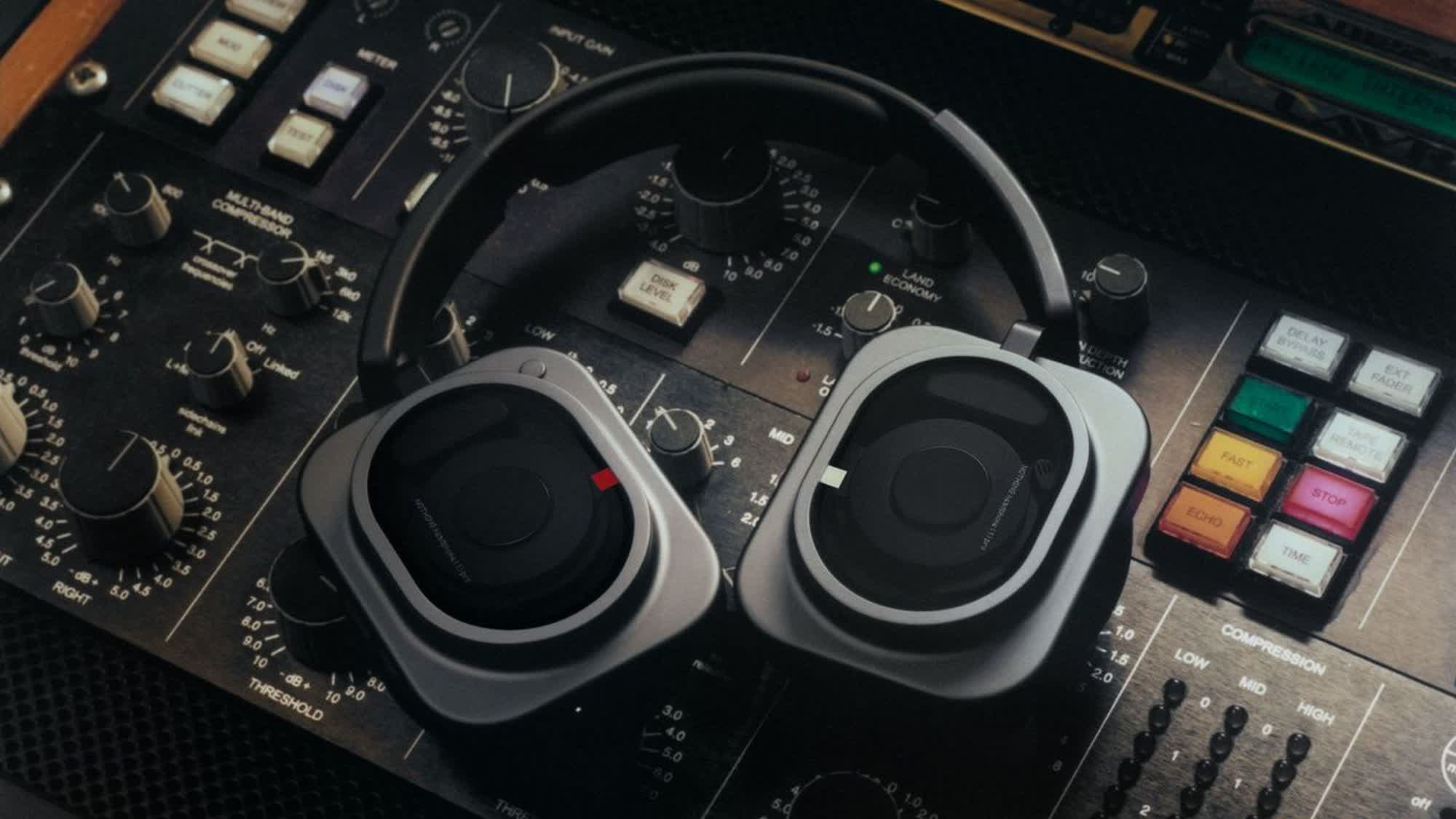
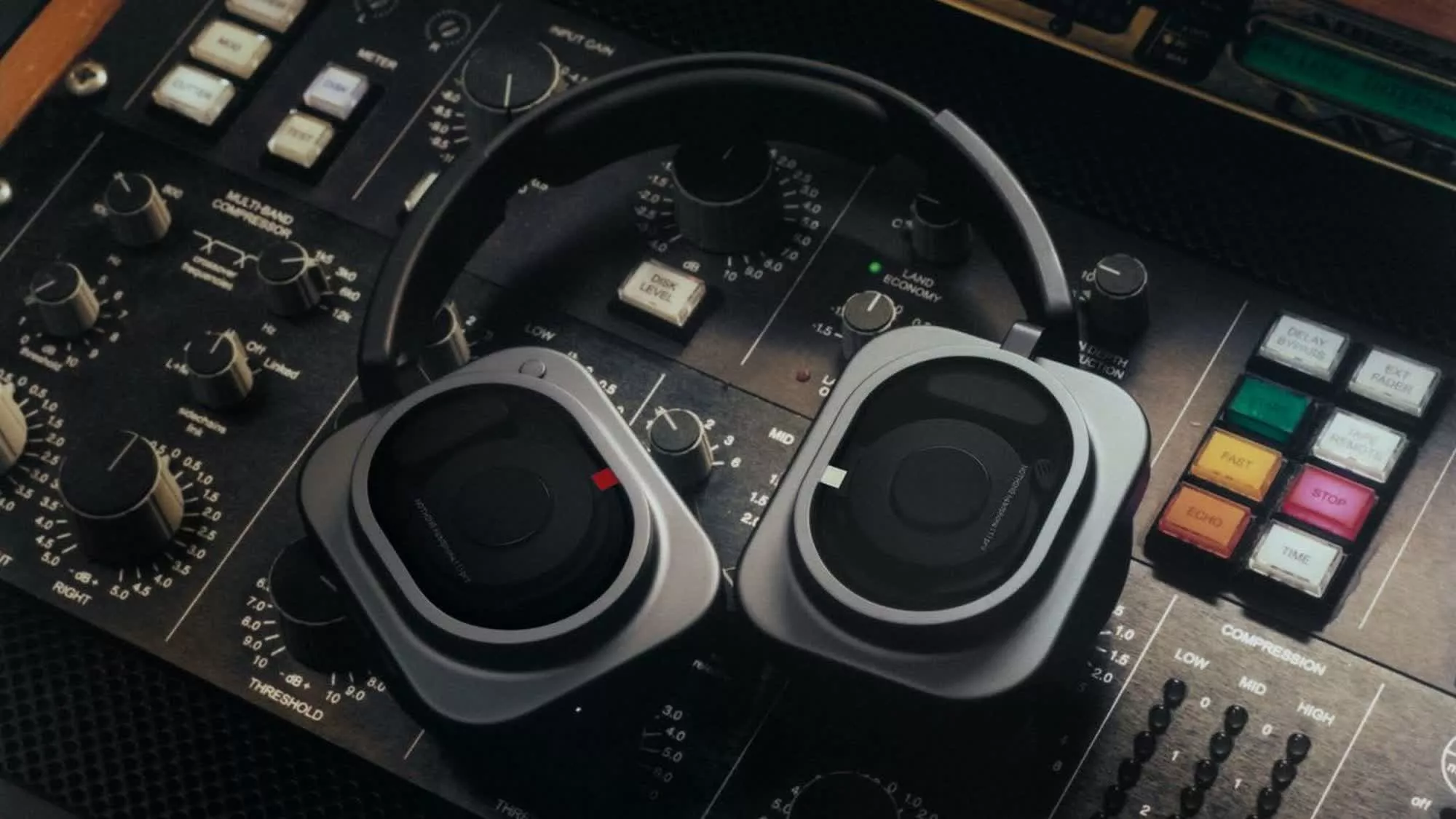
In context: Android smartphone maker Nothing has launched the Headphone (1) Pro, its new flagship audio product, which it claims combines an elevated listening experience for consumers with studio-grade production and mixing features for professionals. It succeeds last year’s Nothing Headphone (1), which TIME named one of its Best Inventions of 2025.
The biggest change in the new model is a three-driver audio system. It includes a bass dynamic driver designed to add more punch and sensitivity to low frequencies, a precision dynamic driver that adds more texture to vocals and instruments, and a new treble xMEMS driver that Nothing says delivers crisper highs.
Nothing also worked with London’s Metropolis Studios to tune the Headphone (1) Pro, with the collaboration focused on professional audio tools and soundstage characteristics.
The company also highlights an improved adaptive active noise cancellation system that uses a 10-microphone array to more accurately filter ambient noise than the first-gen model. With claimed noise reduction of up to 46 dB, Nothing is positioning the Headphone (1) Pro against premium rivals from Bose and Sony.
Advertisement
Nothing says the improvement in noise reduction should be particularly noticeable in strong winds or noisy traffic. The headphones also feature redesigned ear cushions with an 8mm silicone baffle wall inside, creating a stronger sound barrier and improving the seal around the ears.
The Headphone (1) Pro supports Hi-Res wireless audio and wired playback over USB-C at up to 24-bit/192 kHz. It also offers five modes of Dynamic Spatial Audio with head tracking, along with five new custom EQ profiles. A separate Flat EQ switch is designed to give producers and creators a more neutral sound profile.
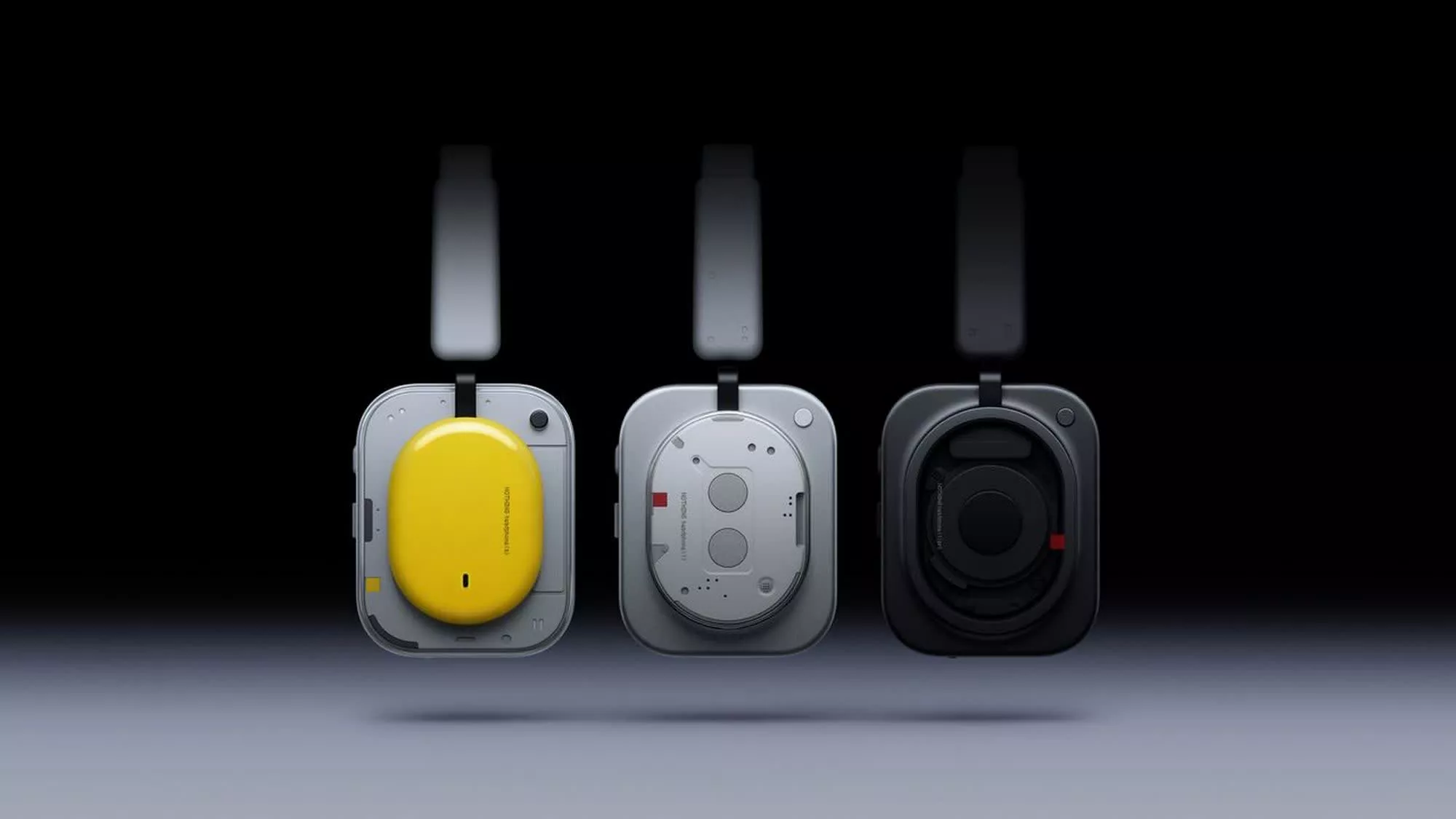
The Headphones 1 Pro is built out of aluminum and titanium to provide a durable shell while creating a premium look and feel. It also retains Nothing’s transparent design language, using shatter- and scratch-resistant 9H Panda Glass on both ear cups to reveal parts of the triple-driver architecture.
Despite the increased use of metal, Nothing has reduced the headphones’ weight to 327 grams through a redesigned internal architecture, including replacing steel arms with titanium. Other changes intended to improve comfort over longer listening sessions include a wider headband with thicker padding and softer ear cushions.
Advertisement
The Headphone (1) Pro is positioned to compete with premium models such as the Sony WH-1000XM6, Bose QuietComfort Ultra, and Apple AirPods Max. It is priced at $399 and will be available beginning September 29 through Nothing’s official store at nothing.tech, Amazon, and Best Buy stores across across the US and Canada.
Ned Jenkinson of the University of Birmingham and Matthew Weightman of the University of Oxford discuss how advancements in brain research might affect how we learn and grow our skillsets.
Whether learning a new piano piece or adapting your tennis serve, acquiring physical skills depends on your brain’s ability tostrengthen and refine neural connections. Researchers are exploring whether this process can be accelerated with technology.
Scientists are particularly interested in the potential of non-invasivebrain stimulation, a group of techniques that can alter brain activity without surgery.
If these techniques can successfully enhanceneuroplasticity, the brain’s ability to reorganise and form new connections during learning, then they could be of use anywhere where performance depends on learning complex movements, from sport and music to surgery and beyond. Researchers are also seeing if these technologies could help with learning non-physical skills, such aspicking up a foreign language.
Elite sport, professional gaming and high-performance workplaces could all become targets for these enhancements if they prove effective. Brain stimulation could also have a big role to play in medicine, helping patients recover physical skills lost through injury or disease, such asstroke.
Studies suggest there’s a lot of potential here. But translating this potential into useful tech that reliably boosts learning physical skills remains a big challenge.
Stimulating findings
Research into enhancing motor learning with electric or magnetic stimulation has been gaining momentum since the turn of the millennium, with early studies garnering considerable excitement.
Advertisement
In atypical experiment, participants might learn a sequence of finger movements similar to practising scales on a piano while receiving stimulation over brain regions involved in movement. Other studies have examined how stimulation could be used forbalance training or teachingsports-relatedskills orsurgical techniques.
Some of these experiments produced eye-catching results, finding that participantslearned certain movement tasks faster orretained skills for longer if they underwent brain stimulation. But other studies failed to find benefits. And in some cases, researchers struggled to replicate the success of earlier promising experiments when repeating them.
One reason for these mixed findings is that there’s no such thing as a universal ‘learning network’ in our brains. Different skills rely ondifferent combinations of areas near the surface of the brain as well as those deep within it.
Additionally, people can respond very differently to the same stimulation. Factors such as age, anatomy, genetics and even baseline skill level may influence whether stimulation is beneficial. Add to that the infinite number of ways to apply stimulation, the picture becomes murkier.
Advertisement
Despite these challenges, the field continues to evolve in its quest to enhance motor learning. For instance, rather than broadly stimulating the brain, researchers are increasingly targeting specific neural circuits involved in learning.
This is partly thanks to advances inneuroimaging andcomputational modelling, which has allowed scientists to predict how electrical currents travel through a person’s brain. Newer brain stimulation technologies, such as focused ultrasound, can also now reach deep structures involved in skill acquisition.
The goal is to use these technologies not simply to increase brain activity, but to influence the right neural circuit at the right time during learning. This idea builds on a fundamental principle of neuroscience, often summarised as“neurons that fire together, wire together”. When brain cells are repeatedly activated at the same time, the connections between them become stronger.
By carefully timing stimulation tocoincide with the movements made during practice, researchers hope to reinforce the neural pathways involved in learning a new skill. In principle, this could make stimulation more reliable and more effective than current approaches, but researchers are stillfine tuning exactly how this would work.
Advertisement
Motoring ahead
Important questions remain. Who would have access? Should stimulation be regulated in competitive environments such as sport? And how much evidence should be required before consumer devices are marketed to healthy users?
These questions are becoming increasingly relevant as brain stimulation moves beyond the laboratory and clinic. A number of at-home devices are now available for people to buy.Some have receivedregulatory approval, as they’re indicated for treating medical conditions such as depression. But there’s also a growing market for devices forcognitive and performance enhancement. For these uses, no regulatory approval is needed.
The technology is advancing rapidly, but evidence to support it and regulations governing it are still trying to catch up. Proper frameworks for its adoption may simply be bypassed by the ready possibility of ‘DIY’ brain stimulation.
For now, brain stimulation is unlikely to transform anyone into an overnight virtuoso or elite athlete. But as researchers develop increasingly precise ways of targeting the neural circuits that underpin learning, the prospect of enhancing human performance is shifting from science fiction towards scientific possibility.
Advertisement
The challenge today is not simply learning how to influence the brain, but deciding where, when and why we should.
Ned Jenkinson is a senior lecturer in human movement sciences at the School of Sport and Exercise Sciences at the University of Birmingham. His research incorporates a range of techniques including non-invasive brain stimulation, electrophysiological recording, eye-tracking, neuroimaging and behavioural techniques. He uses these techniques to investigate how the brain controls movement and how it allows us to learn new motor skills.
Matthew Weightman is a postdoctoral researcher at the Oxford Centre for Integrative Neuroimaging in the Plasticity Group at the University of Oxford, led by Prof Heidi Johansen-Berg. He is broadly interested in the field of sensorimotor neuroscience. His current work focuses on the role of sleep to recovery after stroke. More specifically, he is interested in how we can improve sleep after a stroke, whether improved sleep in stroke patients relates to better functional recovery, and if physiological processes that occur during sleep can be enhanced post-stroke to boost consolidation.
Advertisement
Don’t miss out on the knowledge you need to succeed. Sign up for the Daily Brief, Silicon Republic’s digest of need-to-know sci-tech news.
Keio Corporation (Keio), a major private railway operator in Japan, said its network was hit by a ransomware attack over the weekend, disrupting some of its business systems.
Following a system failure in the early hours of Saturday, the company confirmed the attack and shut down its network to prevent additional damage.
The company said it is investigating the extent of the impact and whether the attackers accessed any customer or business partner information.
Keio is a large Japanese railway operator with 85 km of track and 69 stations, as well as a separate hospitality business of 25 hotels. The company has over 2,200 employees and a reported annual revenue of about $2.6 billion.
Advertisement
“In the early hours of September 26, 2026, we confirmed a ransomware attack on our group’s servers. We have reported the incident to the police and are conducting an investigation into the attack’s route and damage with the cooperation of external experts,” Keio says.
The incident appears to have affected only the hospitality side of Keio’s business, not train operations.
A separate announcement published on the company’s Keio Plaza Hotel Tokyo website is warning of possible delays on some customer-facing services.
At the time of writing, BleepingComputer could not find a ransomware group claiming the attack on Keio.
BleepingComputer has contacted the company to request more information about the incident, and we will update this post with their response once it reaches us.
Tokyo Metro has also disclosed a cyber incident over the weekend in which attackers gained unauthorized access to its systems and accessed 59,000 member email addresses.
Although both Keio and Tokyo Metro are Japanese railway operators, it is unclear if the organizations were targeted in a coordinated campaign by the same threat actor.
Advertisement
Tokyo Metro is a major transit operator that runs nine subway lines covering 195 km and 180 stations, carrying an average of 7 million passengers daily.
The company said the breached systems contained only email addresses and that it has already identified and closed the security weakness the attackers used in this case.
Join Mikko Hyppönen and security leaders from the NFL, CHANEL, and Atlassian for a two-hour digital summit on what AI-speed attacks change, what defenders should stop doing, and how to validate, decide, fix, and re-validate at machine speed.
Home puts chats, delegated work, and Office documents inside one interface
Code lets non-programmers describe software and have Copilot build it
Autopilot can continue recurring work without waiting for another instruction
Microsoft has introduced a redesigned version of its Copilot AI platform which claims to combine chat, delegated work, and coding tools into a unified application experience for users.
The company says the update is meant to let individuals and organizations scale artificial intelligence across everyday tasks and long-term projects.
Three new capabilities anchor this release, including Home, Code and Autopilot, each aimed at a different kind of work.
Latest Videos FromTechRadar
Advertisement
Home brings Chat and Cowork together
The Home tool brings together two existing modes, Chat for quick questions and Cowork for tasks users delegate entirely, under one shared starting point.
Word, Excel, and PowerPoint now operate inside this same interface, letting users draft documents, budgets, and presentations without switching applications.
In these documents, Copilot is now grounded in Fabric IQ, pulling context from more than 20 million semantic models built in Power BI.
Edits made by colleagues or by the assistant itself appear in real time, so progress stays synchronized across a shared file.
Sign up to the TechRadar Pro newsletter to get all the top news, opinion, features and guidance your business needs to succeed!
A new plugin registry will let organizations manage Microsoft, partner and custom-built plugins from one central catalog starting this month.
Advertisement
Independent developers and partners can also publish plugins once for use across multiple Copilot surfaces under the new registry arrangement.
The Code tool allows non-programmers to describe an app, tracker or dashboard in plain language and have it built automatically.
This feature runs on the same underlying technology used in GitHub Copilot and can be hosted within a company’s own systems.
Advertisement
Autopilot operates without constant prompting
Autopilot, the third addition, is a persistent agent capable of completing recurring work without needing a new instruction each time.
It can run supplier reviews or similar multi-step processes, build schedules, contact stakeholders, and follow up on outstanding items independently.
Because it operates continuously in the cloud, work can continue late at night or whenever a person’s attention shifts elsewhere.
Advertisement
A related feature called Today, entering private preview in October, will summarize missed messages and pending tasks across mail and chat.
Microsoft is also tying spending controls to these tools through a system it calls FinOps for AI, letting administrators track usage.
Administrators can set spending limits, approve credit requests and restrict which AI models different teams are permitted to use each month.
Everyday tasks like quick answers or first drafts run on a fixed-price subscription, while agentic features use usage-based billing.
Advertisement
Code, Cowork and Autopilot all fall under this usage-based pricing model, alongside frontier models Microsoft refers to as Astra and Fable.
Home and Code are set to roll out through Microsoft’s Frontier program within weeks, and Autopilot enters private preview by month’s end.
Microsoft has not released independent data showing how widely the three features are being adopted, how accurate they are, or how much time they actually save.
Automate your Mac with ease using Shortcuts and Apple Intelligence.
Filipe Espósito for Engadget
Shortcuts has been available on Mac since macOS Monterey, but it’s one of those utilities many Mac users have never explored. At first, it can seem too complicated. You have to know which actions to choose and how to connect them, then hope it all works.
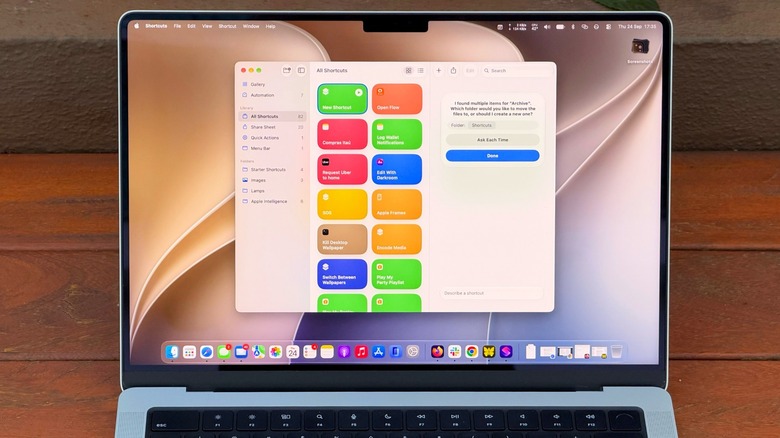
But macOS 27 Golden Gate changes that with Describe a Shortcut, which lets you type exactly what you need and have Shortcuts do the heavy work for you with AI. It doesn’t always work, but it makes the app much easier to use — especially if you’re not an expert.
If you’re not familiar with Shortcuts, it’s an automation tool where you create scripts to handle tasks on your devices. Apple’s own example is a shortcut that texts your spouse with an estimated arrival time based on traffic when you’re leaving work. But you can get much more complex, like a shortcut that checks your calendar and the weather to give you a summary of what to expect today.
Advertisement
There are many possibilities, and now with macOS 27, it’s much easier to master the app.
Creating shortcuts on your Mac is easy
Filipe Espósito for Engadget
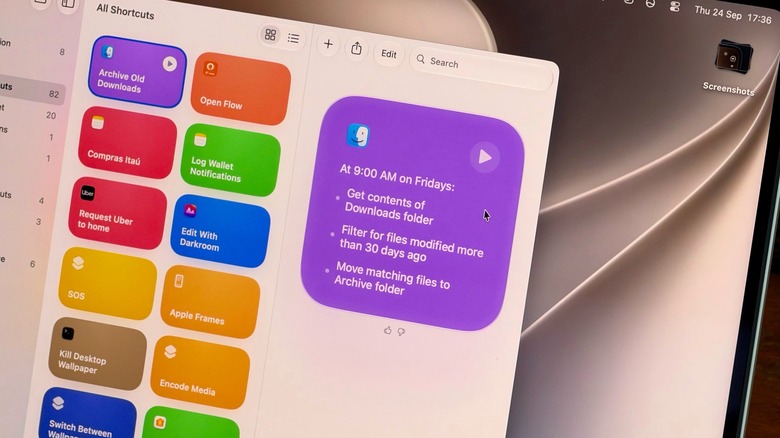
Creating a new shortcut takes a few seconds. Open the Shortcuts app on your Mac and click the Plus button to enter a prompt. The more details you provide, the more likely the app is to get your shortcut right. A command like “Clean up my Downloads” might be too vague for the app to understand what you really want. Instead, try something like “Every Friday, move anything in my Downloads folder older than 30 days into a folder called Archive.” You’re more likely to end up with a working shortcut when you provide clear details.
This is a good example of how Shortcuts are helpful for tasks you often forget to do; no one really cleans out their Downloads folder unless they’re trying to free up space. Plus, you can check the result right away by opening the folder and looking at what moved. If the shortcut moved too much, re-enter the prompt with even more specific details.
Advertisement
A shortcut can also be great for summarizing long text with Apple Intelligence. Try something like “Take the text on my clipboard, summarize it in three sentences and save it to a new note.” Then copy a long article or an email, run the shortcut and you’ll have the short version in Notes.
Make your shortcuts easier to reach
Filipe Espósito for Engadget
If a shortcut isn’t part of your normal routine, chances are you’ll forget about it after a while. Thankfully, you can assign a keyboard combo to a shortcut, or pin it to the menu bar, so you’ll never forget it.
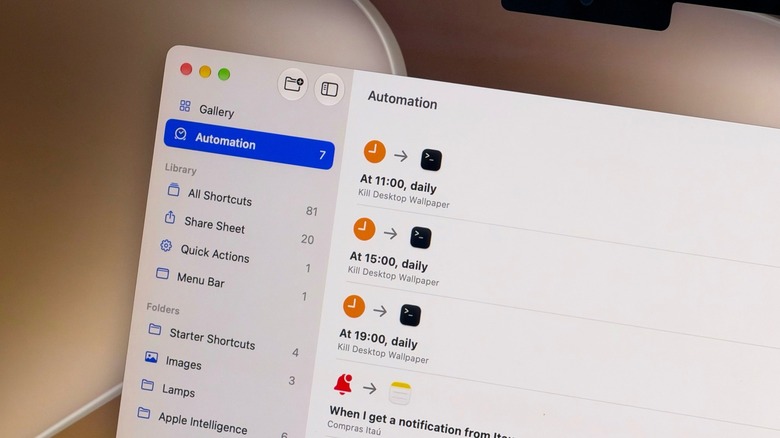
Choose the shortcut you want to adjust and click Edit. Go to the Shortcut Details menu (the one with the information icon) and select Add Keyboard Shortcut. To add it to the Control Center or menu bar, open Control Center on your Mac (at the top-right) and select Edit Controls. There, all you have to do is add the action from the Shortcuts app, and you’re all set. Exploring the Automation tab is also a good idea for creating a seamless workflow of shortcuts that run on their own when you need them.
Advertisement
Shortcuts isn’t the only element in macOS 27 that acts on your behalf. Visual Intelligence has its own key combo: Shift + Command + Space. After pressing this, select a window on-screen and have Siri answer questions about it or take action, like adding an event to your calendar. Try it on an email with a date buried in it, for example. Siri can also run your shortcuts via voice, speaking of which.
Shortcuts and Siri AI require Apple Intelligence, which means you need a Mac with an M1 chip or later — Intel Mac users are out of luck. Also, some limits may apply when using Apple’s AI models in Shortcuts. More complex prompts could reach a limit faster.
Peak XV Partners, one of the largest venture capital firms investing in markets including India and Southeast Asia with more than $10 billion in assets under management, has increased how much it invests per startup through Surge, its seed-stage investing platform, as it unveils a new cohort of 18 companies.
At least three of the companies in this cohort had already raised outside funding, in some cases from Peak XV itself, before joining Surge.
The new batch, called Surge 12, is the first to operate under Peak XV’s higher investment ceiling of up to $5 million per company, up from $3 million previously. The venture firm invested more than $50 million across the cohort, which has collectively raised over $90 million in seed funding, according to Peak XV. Its median investment per company has also increased, though the firm declined to disclose the figure.
“The bar to raise a Series A has gone up pretty significantly,” Rajan Anandan (pictured above), managing director at Peak XV, said in an interview. He added that the firm is also seeing more capital-intensive companies, particularly in deeptech, that are raising larger rounds at the seed stage.
Advertisement
Surge has become more global with each cohort, Anandan told TechCrunch, with its latest group spanning founders and companies from San Francisco to Sydney. Just five of the 18 startups in Surge 12 are focused on the Indian market, while more than half of the companies are based in India. The remaining 13 target global markets, highlighting the difference between where the companies are built and where they expect to find customers.
Since its launch in 2019, when Peak XV operated as Sequoia Capital India and Southeast Asia, Surge has backed more than 180 startups founded by entrepreneurs representing more than 18 nationalities. Peak XV says the 10 largest companies to emerge from those cohorts now generate more than $1 billion in combined annual revenue.
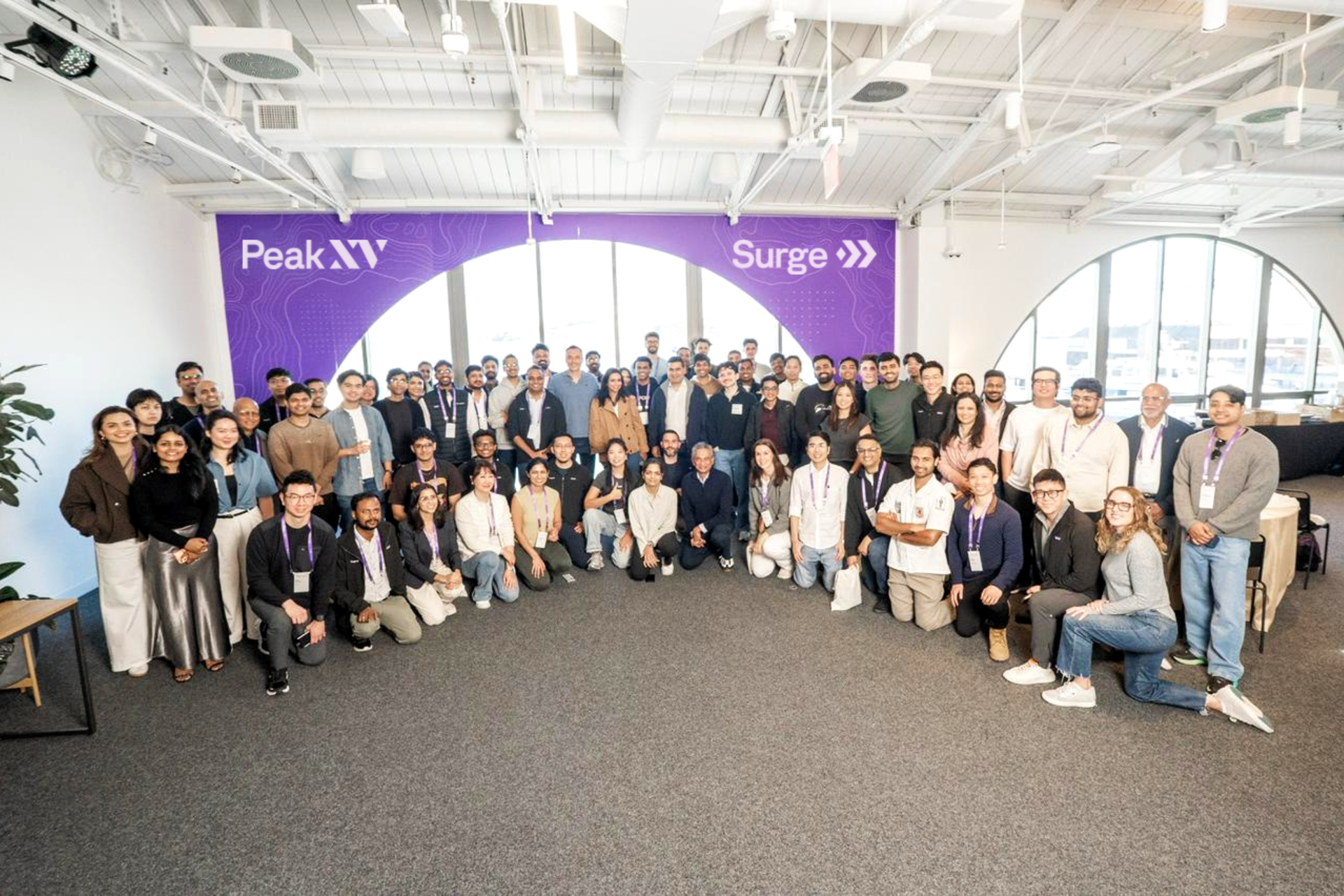
Surge founders at the Peak XV U.S. Immersion 2026Image Credits:Peak XV Partners
Anandan described Surge as one way Peak XV invests at the seed stage, alongside its standard seed investing, while the firm still remains an investor as companies progress through later funding rounds. The founders it backs typically include repeat entrepreneurs, experienced operators, and highly specialized technical founders, he said, with about 50% to 60% of a typical cohort made up of people coming from operating roles at established technology companies.
This cohort’s startups span AI, robotics, space, consumer products, healthcare, music, and fintech, ranging from AI safety and personal computing to autonomous robots built for underground pipes and satellites designed to detect radio-frequency signals from orbit.
The Surge 12 cohort
Alma — founded by Nischith Shadagopan M N and Vinod Ganesan — is building a personal computing platform focused on making computer use faster and more affordable. Its founders previously worked at Microsoft Research and were founding engineers at Sarvam AI, a Bengaluru-based startup building AI models for Indian languages.
Advertisement
August AI — founded by Anuruddh Mishra, an IIT-BHU alumnus who started the company in 2022 after a personal medical misdiagnosis — provides a healthcare platform that combines AI with physician-led care, reaching over 9 million users across 160 countries.
Ditto — founded by UC Berkeley dropouts Allen Wang and Eric Liu — works as an AI dating matchmaker inside iMessage, aimed at helping college students turn digital introductions into in-person connections. (TechCrunch wrote more about this one last month.) The company had already raised $9.2 million in a Peak XV-led seed round announced earlier this year.
GameStock — founded by Antoine Mistico, Easton Dana, and Vivek Indlebele Narasimha Prasad — brings competition mechanics to financial markets, turning investing and trading into a more competitive experience. Mistico is a two-time founder and former professional baseball player.
HiLoop — founded by Jad Ghalayini, Karan Brar, and Thomas Boser — helps AI companies adapt general-purpose open-weight models for specific applications using its post-training platform. Its founding team includes former Reducto engineers and a Cambridge computer science PhD who completed his doctorate at 24.
Advertisement
Hoola Health — founded by Deeksha Senguttuva — focuses on care for children and their families, providing consultations, vaccinations, medicines, diagnostics, developmental therapy, and dental services on a single platform. Senguttuvan grew up around healthcare, as her family built and operated a hospital group.
Kello — founded by Mona Gandhi and Subramanya Jingade — is building an AI-powered talent-discovery platform focused on identifying a candidate’s potential and trajectory rather than relying primarily on conventional credentials. Gandhi says she was Airbnb’s first female engineer and she previously founded Upraised, while Jingade previously co-founded AmbitionBox.
Kindling — founded by Adam Miller and Sachin Shah — is building what it calls a “storytelling operating system” for technology startups, using AI to help companies develop and produce their communications and content.
Puralink — founded by Harrison Crowe-Maxwell, Shyeon Delnawaz, and Thien “Long” Tran — is developing autonomous robots that can navigate underground pipe networks. Crowe-Maxwell has been building robots since childhood and turned university research into the patented drive technology behind the startup.
Advertisement
Reinforce Labs — founded by Anish Das Sarma — is developing tools to evaluate, red-team, and remediate enterprise AI systems. Sarma previously founded a company acquired by Airbnb and later served as a director at Google, where he led AI and machine-learning teams.
Riffle — founded by Anurag Choudhary and deo — is building a browser-based platform where musicians can create, collaborate on, and share music, reducing the need to move between separate tools during the creative process.
Rosella — founded by Chris Dwyer and Sean Stuart — is building an AI-native commercial insurance brokerage for U.S. businesses, using AI to automate parts of the traditionally manual process of finding and placing business insurance. Rosella raised a roughly $2.5 million pre-seed round led by Peak XV and Intact Private Capital earlier this year.
Tribe Money — founded by Himanshu Arora and Nikhil Shanker — gives an AI-powered personal finance platform that helps users track their money, research investments and make investing decisions.
Advertisement
ULOOK — founded by Adheesh Boratkar and Siddhesh Ravindra Naik — is building autonomous satellite systems for radio-frequency sensing and spectrum intelligence, targeting customers globally. Its founders have worked on more than 12 satellite missions. The company had already raised roughly $2.3 million in seed funding from growX Ventures and InfoEdge Ventures before joining Surge.
Wingit — founded by Nikunj Kothari and Saksham Khandelwal — is building a beauty platform aimed at India’s growing premium-consumer market. It is focused on how consumers discover and shop for higher-end beauty products.
Three other startups in the cohort have yet to publicly reveal their names or products. Peak XV said they are working in education, applied AI, and medical products.
When you purchase through links in our articles, we may earn a small commission. This doesn’t affect our editorial independence.




















































You must be logged in to post a comment Login