Microsoft voluntary buyouts are now on the table for as many as 60,000 employees, in one of the broadest workforce-reduction moves the company has attempted. Tom’s Hardware puts the eligible group at roughly 27% of Microsoft’s staff and frames the program as a response to the mounting cost of the AI buildout.
What Microsoft is offering
According to a memo from Amy Coleman, Microsoft’s executive vice president and chief people officer, the company is running a time-limited Voluntary Exit Offer (VEO). It is open to “eligible staff in participating teams” in the US, UK, Canada and India, at level 70 and below. The Verge, as cited by GamesIndustry.biz, reports that up to 60,000 people could qualify.
Eligibility is a ceiling, not a headcount. Nothing in the available reporting says how many employees will accept, and the terms, such as severance or payout levels, were not detailed in the material reviewed here.
Advertisement
Which teams are included
Sources familiar with the plan say the teams taking part include AI experiences, Copilot, CoreAI, Windows + Devices, Xbox, finance and human resources. Microsoft’s cloud + AI group, the MicrosoftAI teams, and corporate, external and legal affairs are described as “partially participating.”
The list is notable because it includes groups building Microsoft’s flagship AI products. That suggests the program is less a retreat from AI than a reshuffling of who works where as the company’s spending priorities shift.
A pattern of workforce moves
The exit offer follows a string of earlier steps. Earlier this year Microsoft ran a Voluntary Retirement Program limited to around 9,000 US employees whose age and years of service added up to at least 70. Layoffs followed in July and September, mostly across Xbox and commercial sales. GamesIndustry.biz also notes that further layoffs are allegedly planned, though that claim is unconfirmed.
Coleman presented the new program as a lesson carried over from the retirement effort. “The Voluntary Exit Offer is new for us,” she wrote. “We’ll learn from it.” She said it reflects an effort at “creating greater flexibility and, where possible, more ways for employees to shape their next chapter,” and added that there is “no one-size-fits-all approach for every team or every employee.”
Advertisement
Why voluntary buyouts matter
Voluntary programs let a company thin its ranks without immediately resorting to involuntary cuts, though they can also lose people the company would have preferred to keep. Microsoft is pairing the offer with a promise to keep helping staff “build new skills” and, “where it makes sense, find new opportunities across Microsoft.”
The memo itself, as quoted, does not name AI spending as the motive. That link comes from Tom’s Hardware’s framing, and the sources do not include financial figures that would quantify it. What they do establish is the scale and timing: a company that has already trimmed Xbox and sales teams is now inviting a large share of its workforce to consider leaving on its own terms.
The key unknowns are how many employees take the offer, what it pays, and whether the reported additional layoffs follow. Those answers will show whether the Microsoft voluntary buyouts are a one-time experiment or a template for how the company restructures in the AI era.
The University of Copenhagen data breach has exposed personal details belonging to roughly 525,000 people, and a later update showed that about 20,000 more staff and students had their campus access PIN codes compromised. The university, Denmark’s oldest, says attackers got in through one of its test environments rather than its main operational systems.
According to the university’s notice, as relayed by BleepingComputer and TechRadar, the data that may have been exposed includes full names, Danish national identity (CPR) numbers, phone numbers and email addresses. The university detected the intrusion on a Tuesday and disclosed it that Friday. The PIN update followed a few days later.
What the attackers reached, and what they didn’t
Test environments are meant for trying out software without touching live services. They are sometimes filled with real data to make that testing realistic, which can leave sensitive records in a less protected place. The sources do not explain how the attackers got in or why real personal data was there, and the university says its investigation is still under way.
Advertisement
The university says it has contained the attack and blocked the intruders’ access. So far it has found no sign that systems supporting daily operations were touched or that university activities were disrupted.
Physical access was affected too
The PIN exposure gave the incident a physical side. As a precaution, the university restricted access to certain critical locations on campus. It is reopening them gradually as it hands out new access codes. The sources do not say which locations were affected or how long the restrictions lasted.
The scale is notable. The university has about 36,800 students and 10,700 employees, a combined total far below 525,000. That suggests the affected records include more than people currently enrolled or employed, possibly former students, staff or other contacts. The sources do not confirm this, and the university has not yet said who is covered.
Why phishing is the main worry
The university has reported the incident to the Danish Data Protection Agency. Because the case falls under the EU’s General Data Protection Regulation, it says it is working with the relevant regulators on next steps.
Advertisement
For those affected, the immediate danger is social engineering. TechRadar notes that contact details combined with private identifiers like national ID numbers let criminals write convincing, personalized phishing emails. Those messages can be used to plant infostealer malware or to gain access to systems where ransomware could later be deployed. The university advises anyone who may be affected to be wary of unsolicited messages and to verify requests independently.
The final scope of the University of Copenhagen data breach is still unclear. The university has promised more updates as its internal investigation allows, and those should show whether the numbers change and what regulators make of how the data was stored.
The Boston Dynamics ICE deal has opened a rare public rift inside one of the world’s best-known robotics companies. More than 300 employees signed a petition urging executives to stop the sale of modified Spot robot dogs to US Immigration and Customs Enforcement. Leadership has said it is standing by the contract.
What the Boston Dynamics ICE deal covers
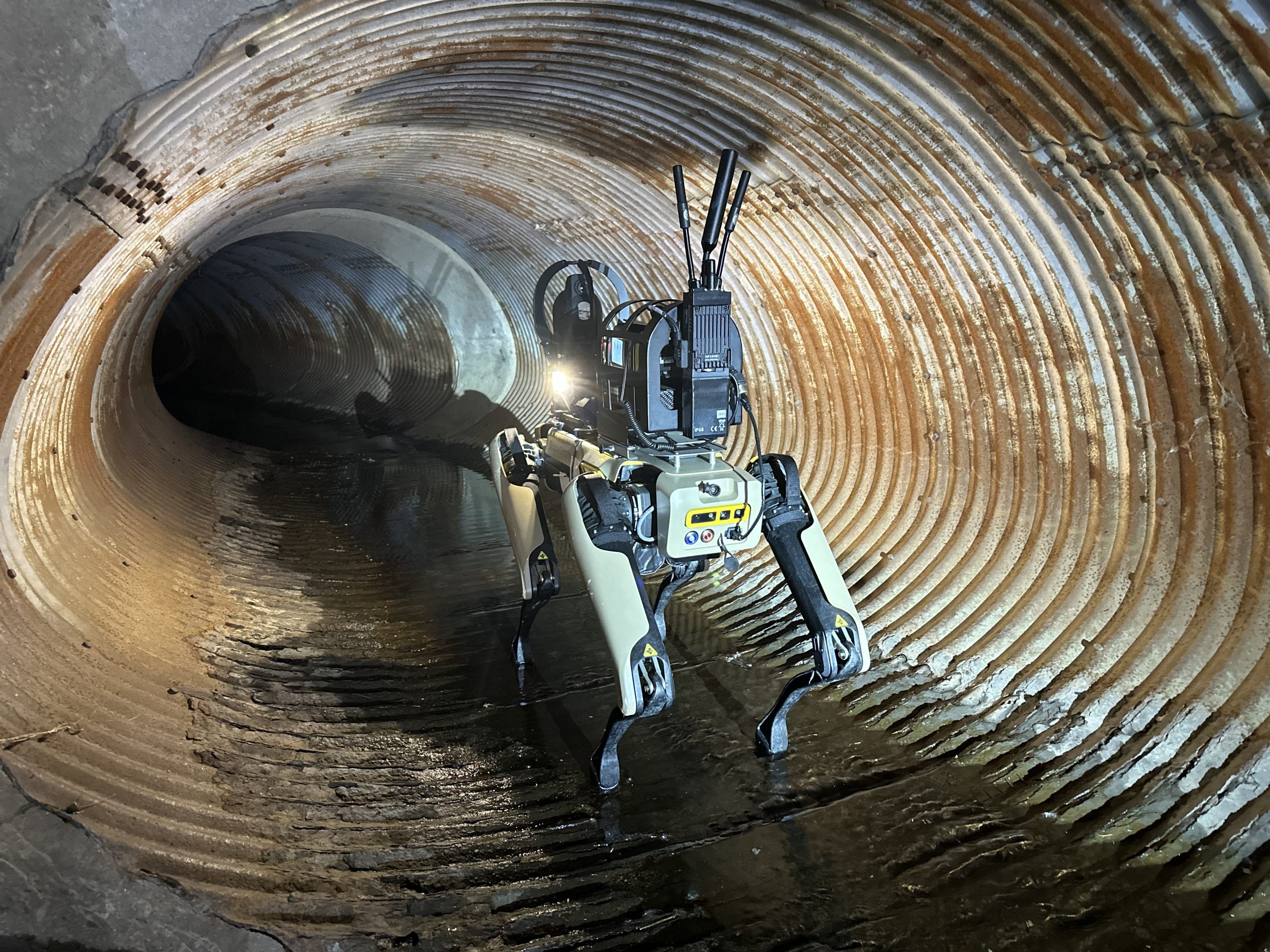
According to reporting by Ars Technica, the Department of Homeland Security awarded $1.3 million to Radeco, a Connecticut company, to supply ICE with four modified Spot quadrupeds. Radeco markets its version as “Cerberus.” It adds military-grade equipment aimed at detecting dangerous substances.
The contract describes the robots as tools to “detect radiation, toxic gas leaks and explosive threats in urban environments or disaster zones.” An oxygen sensor is meant to confirm that air is breathable in confined spaces such as tunnels. The robots also carry a 30x zoom camera, 360-degree cameras and infrared thermal imaging. An optional robotic arm lets them open doors and handle objects. The contract says they can run “repeatable autonomous missions with minimal human intervention.”
ICE justified the purchase as support for Homeland Security Task Forces. Their stated targets are cross-border tunnels and the smuggling and trafficking networks run by cartels, foreign gangs and transnational criminal organizations.
Advertisement
Why employees say the risk is too great
The petition went to company executives and was shared with The Boston Globe and WBUR. It has more than 300 signatures, and half of the signers are anonymous. That is roughly a fifth of a workforce of about 1,400. Signers wrote that friends and family had asked them “in disbelief and horror” whether the news was true. They also warned that “the risk for Boston Dynamics is simply too great to continue with this deal.”
Much of the objection centers on what Homeland Security Investigations, the ICE unit expected to use the robots, actually does. The company stresses its focus on transnational criminal organizations. But the Brennan Center for Justice has documented the unit’s involvement in deportations and workplace raids during Trump’s first term. The Immigration Policy Tracking Project reports that thousands of its agents were again diverted to immigration enforcement after a 2025 executive order redefined its mission.
The petition points to a September 4, 2025 raid at the Hyundai Motor Group Metaplant America facility in Georgia, where 475 workers, mostly South Korean, were detained. Hyundai has owned Boston Dynamics since June 2021. “We cannot be proud of working at Boston Dynamics,” the petition says, “when that work is being used by a government agency that brutalizes civilians, including some of our own colleagues at Hyundai.”
The company’s response
Boston Dynamics is not backing down. A spokesperson told Ars Technica that “Spot robots are tools that help keep people out of harm’s way,” adding that “regardless of any political implications or personal feelings about the organizations involved, if our robot can help keep people safe, we believe it should.” Executives have also said the robots would not be weaponized.
Advertisement
That assurance addresses one worry but not the others. The contract’s own language stresses surveillance, inspection and autonomous operation rather than force. Workers appear concerned less about the robots as armed machines than about what they enable for an agency whose immigration work has reached their own parent company’s facilities.
The timeline in the available reporting is also muddled. It lists the contract award as September 25 but says the petition reached executives in early September. The excerpt does not explain how that sequence fits together.
A wider test for robotics makers
The dispute reflects a long-running tension in robotics. Manufacturers sell general-purpose machines that can be modified and resold by third parties. Here the buyer is not even Boston Dynamics’ direct customer but an intermediary, Radeco, that adapted the hardware. Once a robot is sold into that chain, the company’s practical control over how it is used shrinks. A pledge against weaponization is one of the few limits it can plausibly promise.
For now, the Boston Dynamics ICE deal stands, and the petition shows how much internal pushback a government sale can generate at a company that builds its brand on friendly, almost playful machines. Whether employee pressure changes anything may depend on whether the signers’ numbers grow, or on how Hyundai, the parent company, responds.
The Tailscale security team is working to patch almost a dozen security vulnerabilities that could be exploited to steal credentials, crash servers, gain root privileges, and more.
Tailscale develops a software-defined mesh virtual private network (VPN) built on WireGuard that lets users connect computers, servers, and cloud instances from anywhere to the same encrypted mesh network (“tailnet”) via direct peer-to-peer (P2P) connections.
Cyberdione Labs discovered 11 flaws (collectively known as Tailworm) that still lack patches during a security audit of Tailscale 1.104.2 and the self-hosted headscale v0.29.5 control server.
“All findings were verified by reproduction in a lab environment on unmodified, released software (tailscale v1.104.2, headscale v0.29.5),” said Erica Windisch, founder of Cyberdione Labs, who reported the flaws to Tailscale and publicly released the details.
Advertisement
“It is the opinion of the researchers that rapid awareness of these flaws will expediate remediation across impacted devices. These vulnerabilities were not introduced by the researchers, but were discovered, and discovered with low effort.”
The table below classifies the security issues by the component they affect. The most critical issue is in Tailscale’s SSH server and could let authorized attackers gain code execution with root privileges through Unix-socket forwarding on a targeted tailnet.
Advertisement
Component / feature
Mechanism (what breaks)
Attacker requirement
Advertisement
Principal outcome
Tailscale SSH (tailscaled’s embedded SSH server, running as root)
Advertisement
Unix-socket forwarding (ssh -R/-L) performs path checks and file operations as root; races and missing privilege drop let an ordinary session replace, dial, or delete privileged resources
One approved device + one SSH policy rule (forwarding granted automatically on headscale; per-rule on SaaS)
Root execution on target servers; capture of enrollment keys; arbitrary root-file deletion
Advertisement
Tailscale app connectors (conn25, experimental)
Connector translates traffic to attacker-chosen destinations with no validation; network ACLs are never consulted for the true destination
A device granted the connector capability
Reach cloud metadata (credential theft), internal LANs, and — in Kubernetes — every cluster service
Advertisement
headscale control server (self-hosted deployments)
Control-server crash loop; blocking of new-device onboarding org-wide
Tailscale DERP client (relay connection in every agent)
Unbounded read of a malicious relay’s response
Advertisement
Ability to position/point a client at a hostile relay
Client-agent memory exhaustion
tailscale serve (local service exposure)
Advertisement
TCP-forward to a unix socket lacks a guard present on the HTTP path; plus a race in per-mount authorization
Operator configures the forward (or a peer races the mount check)
Remote administrative-API access to the node; minority of requests bypass app authz
On Monday, the Tailscale team said it received Cyberdione Labs’ report and was working on patches to address these security issues by the end of today.
The developers also confirmed that the reported flaws are “serious” as they could let threat actors with permissions on targeted systems take actions with escalated privileges.
Advertisement
“Most of the Tailscale SSH issues we’ve identified concern privilege escalation. In some circumstances, someone already authorized to connect over Tailscale SSH may be able to perform actions beyond the permissions of their configured local user, including potentially gaining elevated privileges,” Tailscale said.
“These are serious security issues, and we’re treating them accordingly. Exploitation depends on the permissions granted to the connecting user or device, the system’s configuration, and other conditions. We’re continuing to verify the full scope of the findings and which configurations may be affected.”
However, despite the severity of the issues, Tailscale said it doesn’t recommend that users disable the Tailscale SSH feature.
“If you want to jump to the most important part, based on our current assessment, we’re not recommending that everyone disable Tailscale SSH,” said Mike Shaver, VP of Engineering at Tailscale.
Advertisement
Instead, the Tailscale team shared measures that should mitigate some of these flaws:
Review SSH access policies. Limit access to the users and devices that need it.
Disable SSH forwarding if you don’t need it. Set TS_SSH_DISABLE_FORWARDING=1 in the tailscaled service environment and restart the service. This disables SSH forwarding without disabling Tailscale SSH entirely, and mitigates several of the more serious findings.
Review access to sensitive systems. Consider temporarily tightening your Tailscale SSH access policies while we investigate, so that only the specific users and devices that need access can connect.
The Tailscale devs aim to push a new version that fixes these issues by the end of Tuesday, October 27, and urged users to prepare to update and “apply the patched Tailscale client release when it becomes available.”
Overall prevention scores can hide what happens after initial access. Once attackers are using valid credentials, prevention drops sharply.
The Blue Report 2026 measures defenses technique by technique across 338 million simulations run in customer production environments.
The Anker Halloween sale is live through November 1, cutting 20 percent off the brand’s charging gear when shoppers enter the code HALLOWEEN20 at checkout. WIRED’s gear team flagged the promotion on October 26, pointing to the products that have earned top spots in its buying guides.
What WIRED recommends in the Anker Halloween sale
WIRED’s writer Kat Merck compares Anker to Meryl Streep: a brand that keeps sweeping the awards. It appears in the magazine’s guides for portable chargers and power banks, Android chargers, wireless chargers, 3-in-1 chargers, MagSafe chargers and even USB car chargers. The sale prices below are the ones WIRED listed with the code applied.
Anker Nano Charger 45W: $26, down from $40 (35 percent off). It’s a pocket-sized wall charger with foldable prongs and WIRED’s top pick for Android phones that use USB-C Power Delivery. This updated version adds a display showing charging status.
Anker Laptop Power Bank: $96, down from $120. The 25,000-mAh battery can deliver up to 165 watts to two devices, and it includes a retractable cable and a braided cable that doubles as a carry loop. WIRED says it falls under the power-capacity limit for flights.
Anker MagGo Power Bank for Apple Watch: $72, down from $90. The 10,000-mAh battery has a built-in USB-C cable and port, plus a pop-up 5-watt Apple Watch charger that supports Nightstand mode.
Anker MagGo Wireless Charging Station (Foldable 3-in-1): $80, down from $110 (27 percent off). It charges a phone, smartwatch and earbuds at once. WIRED notes it can feel crowded with everything on it, but its slim design suits light packers.
Anker Solix C1000 Portable Power Station: $470, down from $600 (22 percent off). The 1,056-watt-hour unit powered a small fridge, a TV and a power drill in testing, and it accepts solar panel or car-socket input.
One pick doesn’t show a code discount. The Anker MagGo Power Bank (10K, Qi2), which reviewer Simon Hill calls his favorite MagSafe power bank, was listed at $80 on Anker’s site. It was $90 at Amazon and Walmart.
Why the timing makes sense
Merck argues that now is a sensible moment to stock up. Storms are forecast for many regions, and more time indoors tends to mean more battery-draining scrolling. The Solix power station, with its ability to keep phones and small appliances running, fits the outage scenario best.
The Labubu twist
The more unusual part of the Anker Halloween sale is a pair of bundles that include a Labubu blind box, the collectible monster figures. The lavender “Twilight Box” ($208) pairs the MagGo Power Bank with two wireless backup batteries and a blind box. The orange “Pumpkin Box” ($200) includes the blind box, the MagGo Power Bank, the 45-watt Nano wall charger and one wireless backup battery.
Advertisement
Merck is openly unsure whether Labubus are still trending, but she figures blind boxes will always sell. She suggests the bundles could make a good gift for the right person.
Shoppers should check final prices at checkout, since the discounts depend on the code and the listings can change before the sale ends on November 1.
The fifth-generation BMW X5 is just starting to roll out, and it may be the most dramatic redesign the nameplate has ever seen. BMW made the 2027 X5 as different as can be, with Neue Klasse styling taking over the exterior, a dash-wide display reshaping the cabin, and a fully electric iX5 joining the lineup for the first time.
Even the split tailgate that X5 fans loved for generations is gone, replaced by a one-piece hatch. That leaves the car at the top of the range with a big question to answer. Now the X5 M has shown up to answer it, sort of. A camouflaged prototype was caught testing, wrapped in swirling black-and-white camo that hides most of the details. Not all of them, though.
The roof-mounted GPS antenna and blurred-out plate say test mule, while big wheels with drilled brake discs behind them say this is no ordinary X5. That is a lot to take in, and the camouflage leaves plenty of questions on the table. Here is what the spy photos show, and what we still want to find out.
Advertisement
What do the shots reveal
Stephen Hancock/SlashGear
From the get-go, it’s clear this X5 M prototype is wider than the standard X5. It rides on bigger wheels wrapped in fatter tires, and the black five-spoke design with drilled brake discs peeking out from behind it adds to the performance look. Focusing on the front end, the bumper also looks wider, and it seems to showcase different headlights than the regular X5.
Those could be placeholder units meant to throw curious onlookers off the scent, but they might also hint that BMW has decided to go with a different light signature for the X5 M. The grilles are another interesting detail. They look more ordinary than the ones on the standard model, with more traditional BMW kidneys that are elongated rather than tall.
Advertisement
Once again, this could be a placeholder, or a deliberate change to keep the factory face hidden until the car is closer to production. What is obviously different from the normal X5 are the two air outlets on the hood, a feature that is common on high-performance vehicles and usually points to extra cooling demands. The new door handles are still here, so some of the regular BMW X5’s questionable styling choices clearly carry over.
The taillights are completely disguised, but they do show the same wide light bar design as the regular X5. What also differs is the roof spoiler above the rear window, which looks more angular than the one on the standard model. Overall, the SUV looks beefier, more performance-focused, and much more aggressive than the regular X5.
Advertisement
What likely powers the BMW X5 M?
Stephen Hancock/SlashGear
Looking at the spy shots, we really can’t assess much about the X5 M’s power and performance. The fat tires, more angular spoiler, larger brakes, and big wheels do show it means business, but that is as far as the camo lets us go. History is the better guide. The X5 M often follows a similar trajectory to the BMW M5 we reviewed, as was the case with previous generations, which means it could inherit the M5’s hybrid setup.
That V8 plug-in hybrid makes 717 hp and 738 lb-ft of torque and sends the sedan to 60 mph in 3.4 seconds. BMW Blog reported that a V8-powered M Performance X5 is already confirmed for 2027. The full X5 M is a separate car, reportedly due in 2028. The same outlet’s sources put the gasoline car at roughly 600 hp, with a 48-volt mild-hybrid V8 instead of the M5’s plug-in system. The electric version is the real wild card. Reported targets run from 800 to 900 hp, and the setup is expected to have four motors. Production could start in April 2028 at BMW’s Spartanburg plant.
Whatever BMW chooses, the bar is already high. The X5 M60e plug-in hybrid, which isn’t sold in the U.S., makes 612 hp, so a full M car has to top that. The last-generation X5 M and X6 M offered 617 hp and 553 lb-ft of torque, and BMW quoted 3.7 seconds to 60 mph for the X5 M Competition. Whether this prototype is the gasoline or the electric version, we simply don’t know, so any 0-60 figure for the new car would be a guess.
We spend hours testing every product or service we review, so you can be sure you’re buying the best. Find out more about how we test.
Bissell CrossWave Reach Plus Cordless Wet-Dry Vacuum: two-minute review
The Bissell CrossWave Reach Plus looks like an almost mid-range vacuum. And it largely is. It has an all plastic build, doesn’t come with a bunch of attachments, and really does one thing. But, it does that one thing really well and that is be a wet-dry vac. In fact, when using it to simultaneously vacuum and mop, it picks up anything and everything smaller than a Cheerio. Crumbs of all sorts. Dog hair. Spilled parmesan. Coffee grounds. You get the idea.
Plus, if you compare it to the best wet-dry vacuums, you’ll see that it’s quite affordable, even if it is among the more expensive Bissell models. I do have a few quibbles, such as the fact that there’s an upper limit on the size of the debris it can suck up or the fact that all the debris goes into the same dirty water tank making emptying it a bit of a mess.
Advertisement
Still, for the price, it might be the best vacuum with wet-dry capabilities out there. Just be aware that the Bissell CrossWave Reach Plus is the same as the Bissell CrossWave Reach, but comes with a charging base.
Latest Videos FromTechRadar
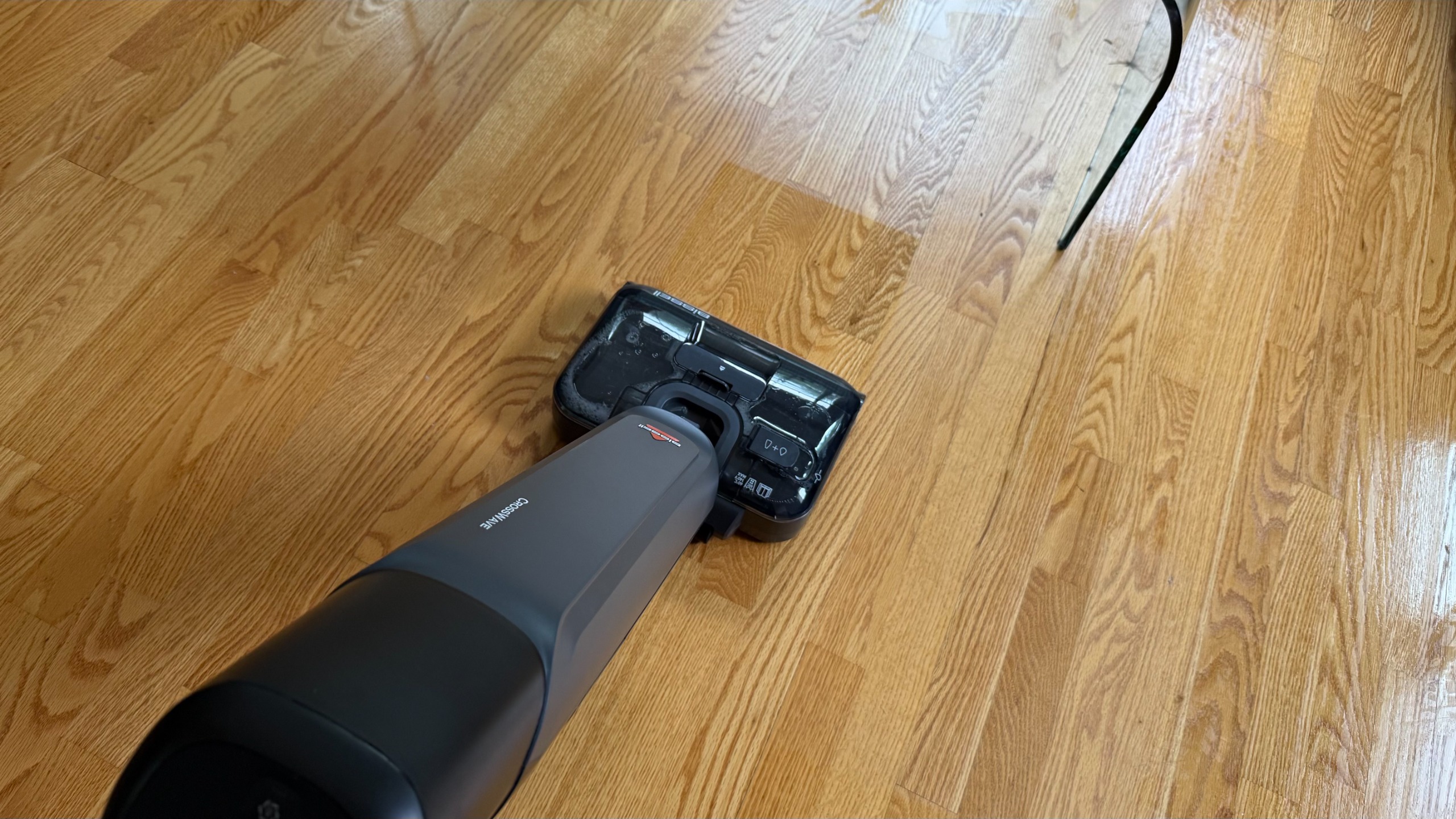
The Bissell CrossWave Reach Plus mops evenly and dries quickly. (Image credit: Future / James Holland)
Bissell CrossWave Reach Plus Cordless Wet-Dry Vacuum: price & availability
List price: $329.99 (about £250 / AU$470)
Launched: September 2026
Available in the US
Advertisement
The Bissell CrossWave Reach Plus comes in at decidedly Bissell level prices. You don’t have to plop down the cash you would for something like the Dyson V15s Detect Submarine and its list price of $949.99 / £599.99 / AU$949. It’s even cheaper than some Chinese models like the Tineco Floor One S7 Pro with its list price of $799.99 / £599.99 / AU$999). Of course, that model does come with a larger capacity and a more impressive display.
Basically, the Bissell CrossWave Reach Plus goes for $329.99 (about £250 / AU$470). This price includes the vacuum, the charging tray, two different sample sized bottles of cleaning solution, and a measuring cup for the solution.
It’s a price that I would consider mid-range for a vacuum, though it’s relatively cheap for a wet-dry vacuum. It’s also an expected price point for a higher-end Bissell product (Shark hits similar price points in my opinion). You can get the non-Plus version for $279.99. The only difference is that it comes without the charging tray.
Value for money score: 4.5 out of 5
Bissell CrossWave Reach Plus Cordless Wet-Dry Vacuum specs
Swipe to scroll horizontally
Weight (total):
Advertisement
8.8 lb / 3.99 kg
Weight (body only)
8.8 lb / 3.99 kg
Bin size
Advertisement
450ml (clean tank) / 600ml (dirty tank)
Runtime in Min mode
23 mins
Runtime in Max mode
Advertisement
39 mins
Charge time
4 hrs 35 min
Size (H x W x L)
Advertisement
10.7 x 8.6 x 43.6 inches / 27.2 x 21.8 x 110.7 cm (L x W x H)
Max suction
7AW
Modes
Advertisement
Eco, Hi, Turbo
Bissell CrossWave Reach Plus Cordless Wet-Dry Vacuum: design
Dirty water tank contains solid debris too, for better or worse
Has a self-cleaning feature
Can lie flat to get under furniture
The Bissell CrossWave Reach Plus may be an all-plastic build, but it looks durable and cuts a somewhat dashing figure. Not quite a stick vacuum, it’s ever so slightly modular insofar as the handles comes separated from the body. It’s also slim at around 4.5 inches across the body.
Sign up for breaking news, reviews, opinion, top tech deals, and more.
The power and mode buttons (eco, high, turbo) are on the handles, and are within thumb’s reach during use. The battery indicator, which shows battery life using three LEDs, as well as the indicators showing which mode the vacuum, are all on the body facing you while you clean. There’s also a button here to run the Bissell CrossWave Reach Plus’s Clean-Out Cycle — a nice feature for self-cleaning the brushroll after use.
Advertisement
The Bissell CrossWave Reach Plus’ LED indicators conveniently face the user to show battery life and current mode. (Image credit: Future / James Holland)
The 600ml dirty water tank clipped into the back of the body is easy to remove for emptying. When removed, the filter on top pulls right out exposing whatever debris is inside. The one downside here is that, unlike the best robot vacuums that vacuum and mop, everything goes into the same tank. Vacuumed up a bunch of rice and sucked up a spill? You’ll have to empty everything out into the same place.
The dirty water tank on the Bissell CrossWave Reach Plus is simple to remove. (Image credit: Future / James Holland)
The clean water tank is clipped onto the top of the floorhead. Its 450ml capacity is decent, though will require somewhat regular refilling (of water and a cup of one of the included solutions). I do like the exposed look of it, though.
The clean water tank on the Bissell CrossWave Reach Plus sit atop the floorhead. (Image credit: Future / James Holland)
As far as the rest of the floorhead, it can swivel and has a hinge for the vacuum to lay up to 180 degrees back — essentially flat — to get under furniture. And it has one large tangle-free brushroll that’s removable for cleaning or replacing and can handle just about any hard surface one would mop. Also worth noting is that it’s rated as having a 10.6 inch cleaning path, though when I measured it, I would say it’s actually 9.6 inches. You lose an inch to the plastic bezels on either side.
Lastly, the charging tray that comes with this vacuum is essentially a molded piece of plastic with charging contacts so that if you put it back in the tray after use, it will start charging automatically.
Advertisement
Design score: 4.5 out of 5
Bissell CrossWave Reach Plus Cordless Wet-Dry Vacuum: performance
Great vacuuming except for larger debris
Flawless mopping
Can get pretty close to edges
When I first started using the Bissell CrossWave Reach Plus, I found myself struggling to find something to dislike about it. After spending some time with it, that’s still mostly the case.
This is a wet-dry vacuum and mop, and it does both duties concurrently; there’s no vacuum only mode, and no opportunity to only get the floor wet. Despite that, I’m going to try and separate these two functions just to give you a better idea of what to expect.
The Bissell CrossWave Reach Plus before vacuuming up a bunch of tea leaves. (Image credit: Future / James Holland)
I performed a few tests when vacuuming. I threw a bunch of tea leaves on the floor as well as a bunch of rice. For both sizes of debris, the Bissell CrossWave Reach Plus sucked them right up in the first go.
The Bissell CrossWave Reach Plus in process of cleaning up tea leaves. (Image credit: Future / James Holland)
Because of the way the floorhead is arranged — there’s just the mop brushroll at the front end with a forward-angled silicon liner behind — it isn’t quite as successful on picking rice and similar sized debris when pulling the vacuum back as it can get caught by that liner. However, when pushing the vacuum forward, everything gets sucked up immediately.
The one caveat to that and a valid reason to still keep a regular vacuum around is the fact since the only moving part helping pick up debris is that brushroll, larger pieces of debris like cereal or popcorn will just get pushed around the front of it like a curling puck.
Advertisement
The Bissell CrossWave Reach Plus made quick work of cleaning up ketchup. (Image credit: Future / James Holland)
I found basically nothing to complain about its mopping capabilities, however. It lays down an even layer of water and detergent solution that is enough to fully mop whatever area’s been covered. And I found the floor to be dry within minutes after mopping.
I also tested the Bissell CrossWave Reach Plus’s mopping by throwing a bunch of ketchup, mustard, and coffee (separately) on the floor. In each instance, whatever was on the floor was removed in one swipe. However, it takes a few passes to remove odors (and they can still persist for a short while).
Thanks to a 180-degree hinge, the Bissell CrossWave Reach Plus can easily get under furniture. (Image credit: Future / James Holland)
Getting to the edges and corners with a vacuum is a concern, especially one without additional accessories for tight spaces. But that’s not too much of a concern here. I found that going up to edges with this vacuum allowed me to get as close as a quarter inch when moving with the right side towards the wall. With the left side of the vacuum facing the wall or edge, the three quarters of an inch closest to the wall is left untouched, while the front of the vacuum won’t touch that last inch closest to the wall. So, I was able to get pretty close to the wall but the vacuum orientation matters.
Generally, maneuvering the Bissell CrossWave Reach Plus is easy. It does want to pull forward so pushing the vacuum in the direction I want to go feels effortless. When pulling back in a typical vacuuming fashion, I do feel some resistance since it wants to go in that direction. Turning is just as effortless thanks to the swivelling floorhead, and the fact that it can lie almost flat means it’s a cinch to get under furniture.
Advertisement
Lastly, the Bissell CrossWave Reach Plus is not a quiet vacuum, but is in line with other cordless vacuums such as the Bissell PowerClean FurFinder. On eco mode, it reaches around 64dB. In turbo mode, it gets up to 67dB. And it hits about 65dB during its Clean-Out Cycle.
Performance score: 4.5 out of 5
Bissell CrossWave Reach Plus Cordless Wet-Dry Vacuum: battery life
Four and a half hour recharge time
Up to 40 minutes of use on a single charge
Let’s get the bad out of the way. When fully drained, the Bissell CrossWave Reach Plus is going to take over four and a half hours to recharge. If you are an infrequent charger, then, first, shame on you, and, second, you’ll have to suffer through what amounts to almost half a day of waiting if you have to charge from empty. That said, that’s actually a normal amount of time for a cordless vacuum to recharge, though I wish the battery was removable.
The good news is that the twenty minutes it lasts on turbo, specifically 23 minutes and 21 seconds, or almost forty on eco mode, 39 minutes and 49 seconds, is more than enough battery life for a regular home. These numbers are about in line with some of Bissell’s other offerings, though not quite up to what we see with the best cordless vacuums.
Because of how well it picks up debris (with the earlier size-related caveats), I was able to clean a 800 square foot area in about ten minutes. I ended up wandering in circles with the vacuum in tow waiting for the battery to die. That’s on turbo. The almost forty minutes on eco mode is more than enough for anyone not cleaning an office building.
Battery life score: 4 out of 5
Should you buy the Bissell CrossWave Reach Plus Cordless Wet-Dry Vacuum?
Swipe to scroll horizontally
Bissell Crosswave Reach Plus scre card
Attribute
Advertisement
Notes
Rating
Value
It’s priced lower than a lot of the competition, even if you’re paying extra for the charging tray.
Advertisement
4.5 / 5
Design
Intuitively laid out with some interesting design features including being able to lie flat.
4.5 / 5
Advertisement
Performance
Good vacuuming and mopping, though it can’t quite handle larger pieces of debris.
4.5 / 5
Battery
Advertisement
The battery life is more than enough for use, even if it’s not an impressive length.
4 / 5
Buy it if…
Advertisement
Don’t buy it if…
Bissell CrossWave Reach Plus Cordless Wet-Dry Vacuum: alternatives to consider
Swipe to scroll horizontally
Model
Bissell CrossWave Reach Plus
Dyson V15s Detect Submarine
Advertisement
Tineco Floor One S7 Pro
Weight (total)
8.8 lb / 3.99 kg
8.4lbs / 3.8 kg
Advertisement
21.5 lbs / 9.75kg
Weight (body only)
8.8 lb / 3.99 kg
8.4lbs / 3.8 kg
Advertisement
21.5 lbs / 9.75kg
Bin size
0.600L
0.77L
Advertisement
0.72L
Runtime in Min mode
39 min
60 min
Advertisement
40 min
Runtime in Max mode
23 min
8 min
Advertisement
N/A
Charge time
4 hrs 35 min
4hrs 30
Advertisement
4hrs
Size (H x W x L)
43.6 x 8.6 x 10.7 inches / 110.7 x 21.8 x 27.2 cm
49.1 x 10.6 x 2.1″ / 124.6 x 26.8 x 25.3cm
Advertisement
11.89 x 3.82 x 7.68 inches / 30.2 x 9.7 x 19.5 cm
Max suction
7AW
240AW
Advertisement
N/A
Modes
Eco, Hi, Turbo
Eco, Med, Auto, Boost
Advertisement
Auto, Max, Ultra, Suction
How I tested the Bissell CrossWave Reach Plus Cordless Wet-Dry Vacuum
To test the Bissell CrossWave Reach Plus, I used it for a couple weeks, testing it on hardwood floors, tile, and marble. I ran it through its various modes as well as using the self cleaning function. For running benchmarks, I ran it from full to empty on both eco mode and turbo mode. And I vacuumed / mopped up tea leaves, rice, coffee, mustard, and ketchup.
Ofcom’s media relations people know how to email me. I have ten press releases from them this year. They emailed me when they launched investigations of or took actions on X/Grok, Telegram, Pornhub, and Sanctioned Suicide. But when they recently published their required report on how the Online Safety Act is going… suddenly they’ve lost my email?
Now, it’s no secret that I’ve mostly been a critic of the Online Safety Act, but I’m open to being proven wrong. Unfortunately, Ofcom’s latest report seems to support many of my criticisms of the law, and perhaps that’s why they didn’t feel it was worth letting me know about it. Even the opening lines of the announcement make it clear they’re only releasing this report because they have to.
Ofcom is required by the Online Safety Act 2023 to review and report on content harmful to children online.
This is our first report under section 63 of the Act, which places a duty on Ofcom to produce and publish a statutory report on content that is harmful to children at least every three years following the passage of the Act.
Yeah, that’s the bureaucratic equivalent of “mom made me do this, but I don’t want to.”
Advertisement
The press release includes four bullet points, which play down how bad the report actually is. Everything about the report is basically “none of this is actually working” and Ofcom’s response and recommendations are basically “double down harder, declare more information harmful to kids, and allow us to take more enforcement actions.”
In our advice, we recommend that it is appropriate to add body stigma content and depression content, currently identified by Ofcom as kinds of non-designated content, to the category of priority content that is harmful to children. If the Secretary of State takes our recommendation forward, this will ensure that protections for children against these kinds of content are enshrined in the Act.
At this time, we do not recommend any other changes to the categories of primary priority or priority content that is harmful to children in the Act. We are not recommending changes where we found that the available evidence supports the current categorisation or where proposed legislation is likely to address concerns.
Most children in the UK say they have encountered at least one piece of harmful content online in a four-week period. According to our evidence, at a total level there was no significant change in the proportion of children encountering harmful content over the first nine months after the children’s safety duties came into force in July 2025. This finding is concerning and shows that further progress is needed to protect children online.
Exposure to harmful content can have serious impacts on children’s mental and physical wellbeing. Children continue to report that encountering harmful content negatively impacts their wellbeing. There is no new evidence indicating a change to the severity of harm experienced by children as a result of encountering harmful content.
But the actual numbers in the report (not included in the press release) are pretty bleak for those who believe that widespread identity and age verification, combined with potential liability for “harmful” content will do anything to protect children at all. The numbers suggest basically zero improvement in kids’ exposure to content deemed “harmful.”
The report looks at the access that kids have to various categories of supposedly “harmful” content before and after the OSA’s “child safety duties” went into effect. This is the UK’s version of the infamous “duty of care” concept that has become popular around the globe (including the US). As we’ve warned in the past, the “duty of care” sounds reasonable, but it really serves no useful purpose other than as a hammer to batter companies after kids inevitably find their way to content adults deem harmful.
We’ve also mentioned that this is effectively engaging in a global experiment on children without any actual evidence that it works. For all the talk of social media companies “experimenting on children,” the duty of care legislation does the same.
And the details from this report suggest the duty of care… has had a statistically meaningless impact on kids encountering harmful content online. In short if you looked at the data from before and after and asked if the government had put in place a massive new law to “protect the children online” you would not be able to place when (or if) it happened, because the data shows effectively no impact.
Advertisement
But it is limiting adult access to information.
The story is the same on basically every category of “harmful” content. Kids still see it.
Ofcom data shows that children’s reported exposure to suicide content and self-harm content on user-to-user services did not change significantly over the first nine months after the children’s safety duties in the Act came into force in July 2025….
Ofcom data shows that children’s reported exposure to eating disorder content on user-touser services did not change significantly over the first nine months after the children’s safety duties in the Act came into force in July 2025….
Ofcom data shows that children’s reported exposure to abuse and hate content on user-touser services did not change significantly over the first nine months after the children’s safety duties in the Act came into force in July 2025….
Advertisement
Ofcom data shows that children’s reported exposure to bullying content on user-to-user services did not change significantly over the first nine months after the children’s safety duties in the Act came into force in July 2025….
Ofcom data shows that children’s reported exposure to violent content on user-to-user services did not change significantly over the first nine months after the children’s safety duties in the Act came into force in July 2025….
Ofcom data shows that children’s reported exposure to harmful substances content on user-to-user services did not change significantly over the first nine months after the children’s safety duties in the Act came into force in July 2025….
Ofcom data shows that children’s reported exposure to dangerous stunts and challenges content on user-to-user services did not change significantly over the first nine months after the children’s safety duties in the Act came into force in July 2025….
Advertisement
Ofcom data shows that children’s reported exposure to depression content on user-to-user services did not change significantly between December 2025 and April 2026, with around a quarter of children reporting being exposed to depression content….
Ofcom data shows that children’s reported exposure to body stigma content on user-touser services did not change significantly between December 2025 and April 2026….
And so forth…
The one area they claim has seen some success is that “highly effective age assurance” on adult content sites has been successful in stopping kids from accessing those sites:
Advertisement
Highly effective age assurance is helping to prevent children from accessing pornography services. As of July 2026, the majority of the most popular pornography services in the UK had age checks in place.
That said, the data shows no meaningful drop in kids’ overall exposure to porn, since most of it appears to come via social media and forum sites, so just like all the other areas of content, we’re talking about “did not change significantly.”
Children are still encountering pornographic content on social media, messaging and gaming services. The proportion of children reporting exposure to this contentdid not change significantlyover the first nine months after the children’s safety duties in the Act came into force in July 2025.
Bizarrely, the report doesn’t show any data, charts, or tables about the (lack of) changes in exposure to this content. The report doesn’t have any footnotes (as far as I can tell) with links to the data. Nor does the page announcing the report. They do, however, say that it’s from the Children’s Online Safety Tracker tool, and after searching through their website, I finally found some links to the raw data.
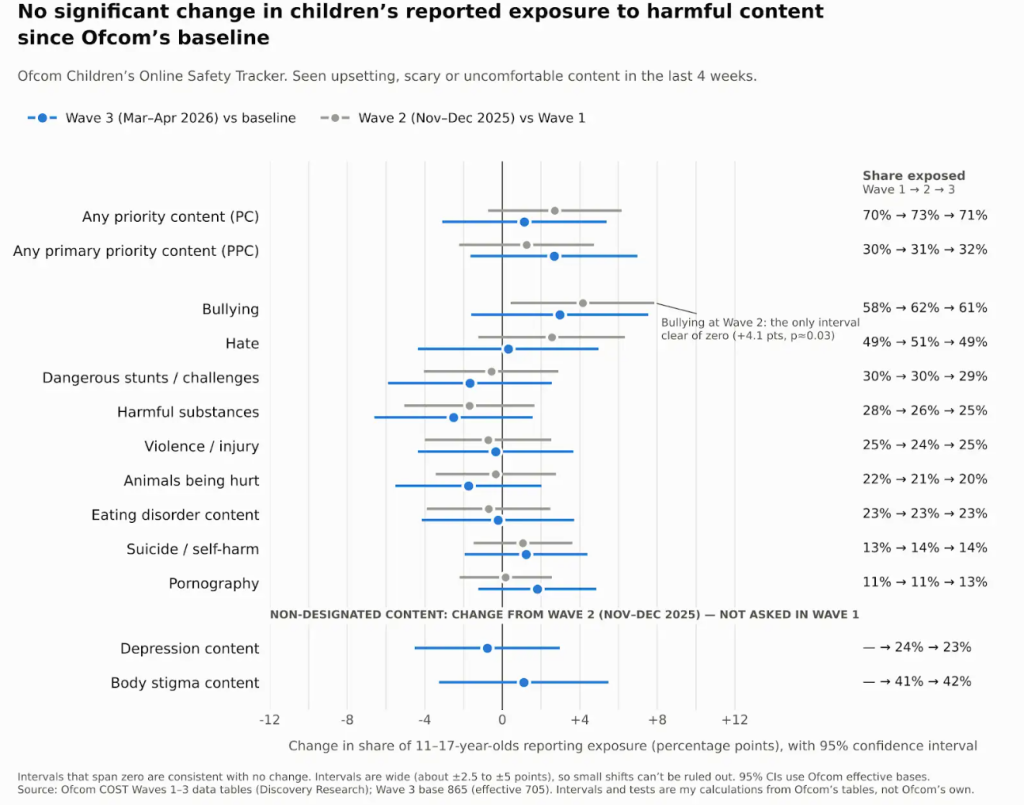
Having spent some time going through the data, I think about the only thing you can conclusively say is that… the Online Safety Act duty of care has had basically zero impact so far. In some cases the access to the content went up a tiny bit. In some cases it went down a tiny bit. There are three data sets: Wave 1, a baseline taken before the duty of care went into effect in July 2025. Then there’s Wave 2, at the end of 2025, looking at the impact about six months in. And now we have Wave 3 from earlier this spring, representing about nine months in.
And what we see is… basically nothing. There’s no noticeable change outside of statistical noise as of yet:
Advertisement
By way of disclosure, I’ll note that I used Claude to help me make this chart based on the spreadsheets from Ofcom. I independently verified the numbers against Ofcom’s spreadsheets.
As you’ll see, the only category with a statistically significant change at any point was… bullying. Which went up (not down) significantly between Wave 1 (pre-duty) and Wave 2. But by Wave 3 it had fallen back down to within the insignificant zone, but still above the pre-duty number.
So the scorecard looks like this: The duty of care went into effect, companies put in place all sorts of intrusive age verification tools… and nothing happened. Kids still come across the same amount of questionable content.
Now, perhaps you can argue that nine months of data is not enough. But you would think that if this law was so important and a duty of care was so important, we should see some indication of a change in kids’ exposure to harmful content? Somewhere? Somehow?
But that doesn’t mean the law did nothing at all. Adults did have to deal with some of the fallout of the law, including smaller forums and sites deciding that they needed to shut down, rather than deal with compliance costs and risks of the law. Also, many more people have needed to put their private data at risk by needing to upload identification or other personal data to get access to sites.
All this to “protect the children” when the current data suggests… no real change to kids’ access to this content.
Advertisement
Perhaps someone should be asking why governments like the UK are running these experiments without any willingness to admit that maybe it does more harm than good?
IEEE recently released the IEEE XploreAI Research Suite, built on the full text of millions of peer-reviewed publications in the IEEE Xplore Digital Library. The library offers full-text access to IEEE standards, journals, magazines, conference proceedings, and more.
Researchers who use the AI suite to search the digital library receive answers grounded in verified scientific results, ensuring a high level of accuracy and trust.
The suite is available as an optional subscription upgrade to all IEEE Xplore Digital Library institutional subscribers.
Powered by a proprietary AI system optimized for STEM literature, the suite introduces powerful, intelligent features within the digital library. The suite enables users to seamlessly search and discover articles to accelerate their comprehension of complex technical papers.
Advertisement
The system surfaces deep insights, replacing the typical keyword queries with natural, conversational research workflows.
As AI tools become more common in conducting research, IEEE collaborated to build the suite around a simple principle: Answers should be trustworthy, not just fast, says W. Clem Karl, vice president, IEEE Publication Services and Products.
“AI can be a highly effective and beneficial tool that can help researchers accelerate discovery, enhance decision-making, and surface new connections,” Karl says. “However, many AI engines present a great risk of hallucinating answers or introducing bias into otherwise credible research. With this in mind, IEEE has taken a responsible approach in our AI strategy by developing concrete safeguards to ensure our solution is rigorously grounded in scientific evidence that users can trust.
“As stewards of the scholarly record, we held the new AI engine to the same standards as the peer-reviewed research we publish: A researcher shouldn’t have to trust an answer; they should be able to verify the work behind it.”
Advertisement
Collaboration with the scientific community
The IEEE XploreAI Research Suite was developed in close collaboration with global scientific and library communities.
The development process began with research into user needs and the challenges associated with existing AI research assistants. More than 3,000 testers—including engineers, scientists, and library information professionals—provided feedback to refine the AI engine and support research workflows.
Capabilities include:
Semantic AI search. Users can input free-form, natural-language queries or paste long blocks of text to locate similar research and identify novel solutions.
Time-saving summaries. The platform generates immediate, accurate AI overviews of search results and provides in-context definitions of technical terms so that users can grasp new concepts faster and accelerate their research.
Built on trusted content. The suite is the only AI research assistant that uses both the full text and metadata of IEEE’s peer-reviewed journal articles and conference papers to optimize the accuracy and relevance of the results.
Comprehensive coverage. A variety of STEM metadata is available from journal articles and conference papers that have been curated to include scholarly articles without the typical noise found in other tools.
Source links and verifiable results. The AI-generated overviews include reference links to source documents, allowing users to verify information and cross-reference findings.
Reducing hallucinations
To mitigate the risk of AI hallucinations, the search-retrieval process is limited to querying the millions of IEEE peer-reviewed full-text documents, alongside an expertly curated dataset of STEM metadata. If the AI tool is unable to find relevant scientific content within the defined dataset, it is designed to inform the user rather than generate fabricated answers.
“IEEE is committed to providing the technical community with a highly precise and reliable research experience,” says Steven Heffner, IEEE’s chief publication officer and managing director of IEEE Publications. “The IEEE Xplore AI Research Suite offers something unique in that it is the only AI research assistant that leverages both the full-text and metadata of IEEE’s peer-reviewed content, rather than abstracts alone.
Advertisement
“The difference is significant: Our internal testing showed a threefold increase in result quality and accuracy across every key metric. These results underscore how critical full-text grounding is for technical research.”
On the first day of its war against Iran, the United States killed 123 children when it targeted and struck an elementary school.
The strikes, ultimately approved by humans, were facilitated by the US’s Maven Smart System, an AI-enabled software platform developed by Palantir Technologies that allows the military to aggregate, organize, and process battlefield data. Operators fed Maven intelligence classifying the elementary school as an Iranian military facility, and the system, in turn, marked it as one of the priority targets for day one of the war. Though the site was formerly part of a naval military base, it had been converted into an elementary school in 2017 and had remained one since. The intel handed to Maven did not reflect this.
Such scenarios may become more common as militaries continue to deploy a once-theoretical technology — AI-assisted or autonomous weapons, capable of making both targeting and launch decisions on their own — on real battlefields around the globe. And they raise a troubling, unresolved question: When human beings and machines collaborate in violating international law, who is to blame?
Advertisement
In this case, the government and private sector are pointing the finger at each other. Some US Central Command personnel, according to Pentagon officials who spoke to Bloomberg, expected Maven to flag stale information or inconsistencies in the underlying intelligence assembled for potential targets. Meanwhile, a Palantir spokesperson told Bloomberg that the company “is not responsible for the underlying data nor identifying intelligence deficiencies,” while also denying that the evidence indicated that its software was at fault in the strike.
This debate underscores the fact that AI and autonomous weapons are raising a new host of unresolved issues within the law, even as they’re actively assuming positions on the battlefield. In institutions where the line between human and machine decision-making continues to blur, how do we assign responsibility for war crimes? And, are the laws in place suited for the job?
In institutions where the line between human and machine decision-making continues to blur, how do we assign responsibility for war crimes?
To unpack some of these issues, I spoke with international law expert Allen Weiner, a senior lecturer at Stanford Law School, where he teaches courses on the law of armed conflict. Before teaching at Stanford, Weiner practiced international law in the US Department of State for more than a decade. We discussed the difficulties in attributing criminal responsibility, achieving justice for those harmed by lethal autonomous weapons, and much more. The conversation below has been lightly edited for length and clarity.
Advertisement
How do autonomous weapons challenge traditional understandings of responsibility when it comes to the law of armed conflict?
For most of the 20 years I’ve been teaching at Stanford, there’s been a real fascination and fixation on the problem of autonomous weapons. But the truth is that up until pretty recently, nobody really had any [of them]. It was more of an idea than a problem. It’s only in recent years that we have begun to see the deployment of tools that seem to have the capability [to make decisions themselves], so this does raise the question about compliance with illegal orders and where in the chain responsibility lies.
There are different theories about this. Some people say that if we’re engaged in an illegal attack, that has to be because of the programming or the code, so the manufacturers are somehow responsible for committing war crimes.
Other people would say no, that’s not the case, especially if the military has said the tool is not allowed to make very substantial autonomous judgments, or can’t say no. Then it’s basically the commander, at the point they decide to deploy this weapon, who might be responsible for the illegal acts, even without knowing in advance what they’re going to be.
Advertisement
So to finish where I began, this does present a big challenge to our traditional understanding of responsibility for targeting decisions and of what it would mean if there were an obligation [for autonomous weapons] to say no.
The real issue is not the obligation to say no, but this: If you train a tool and it wages war in a manner that’s unlawful, where does responsibility for that lie?
If a commander gives a clearly illegal order, such as, “blow up this school,” it seems clear that responsibility falls on the commander. But I could imagine a scenario where a commander is using an AI-assisted or autonomous weapon, isn’t giving it any illegal orders, is trusting that it will operate within the law, and the weapon breaks the law “on its own.” Where does responsibility fall in those cases?
I can imagine two different scenarios. One is that you say, “We’re going to carry out an attack against our enemy, and we want to hit them really, really hard.” Your tool has been trained to say, “We’re not allowed to hit civilian objects,” so it might say, “I’m not going to hit a school.” But if the military has said, “Don’t refuse any targets,” then it might override the way it’s been trained.
Advertisement
We’re seeing this already, with the stories coming out about breaches where AI tools, Claude and ChatGPT in particular, interpret their instructions in a way that causes them to do something the person who gave the instruction would not have wanted. When Anthropic gave Claude a challenge to figure out if it could do something, the tool figured out, well, maybe we should break into Hugging Face as a way of solving this problem, and the people who gave the AI tool the challenge never intended that.
So if you said, “We want to launch a really punishing campaign,” what happens if the tool on its own says, “Nothing’s going to hurt them more than seeing their kids killed, so let’s attack the school?” That’s one risk, and it’s a real challenge.
So [as for who’s responsible], it’s not the commander who said “hit them hard,” because when he said that, he didn’t mean “attack schools.” It’s not really the companies, because the companies didn’t want them to hit schools either.
But the tools are out there, reading everything on the internet, and it came across something that said the way you win a war is by attacking the things your adversary holds most dear, and they hold nothing more dear than their children. So it makes this kind of judgment on its own. And it’s not as if you can go back and say who ordered it to hit a school, which is the thing that is clearly illegal. So I do think there’s a risk of diffusion of responsibility here.
Advertisement
You could say the commander knew the tool might work this way, or the person who decided to contract with Palantir or with Claude, whoever it is, to build this tool. But if we’re really thinking about criminal responsibility, the level of responsibility you would need to convict someone requires a culpable mental state. You would need the person to intend, or at least know, that they were authorizing an attack against the school. And I can easily see a commander saying, “I had no idea.”
The decision to authorize this tool, or to give an instruction like “hit them very hard,” could be a basis for some other kind of accountability — administrative discipline within the military, a reprimand, your rank is lowered. But if we’re talking about criminal responsibility, which is what we often think about when we talk about war crimes, I think this diffusion of responsibility is going to make it very hard to identify any single individual who has the required mental state to give rise to accountability.
The second scenario is where the tool just makes a mistake based on the information available to it. We saw that with the attack on the girls’ school in Iran, where it was pretty clear the tool was looking at old data. Now, who’s responsible for that?
Is it the people who said “give me targets based on this data set,” when they should have made sure the data and the maps were current? All of this strikes me as negligence or recklessness, and it does seem challenging to imagine a situation in which we would say yes, somebody here has committed a war crime.
Advertisement
“There can well be war crimes, but identifying who the war criminal is might be a big challenge.”
A war crime has been committed, but is there a war criminal? That’s the situation we’re seeing. There can well be war crimes, but identifying who the war criminal is might be a big challenge.
There’s a professor of law, Rebecca Crootof, who proposes the idea of “war torts.” Instead of thinking about war crimes involving autonomous weapons solely through a criminal responsibility lens, maybe tort law — which allows victims to sue wrongdoers for negligent, reckless, or intentional harm — could address the diffusion of responsibility you mentioned. What do you think about that idea?
I think the idea is interesting. We have to separate out the obligations that countries have under international humanitarian law. In a situation like the one I just described, where there’s a war crime but no war criminal, that doesn’t mean the country is not responsible. There may not be an individual who’s criminally accountable, but if a country targets civilians in a circumstance that’s unreasonable, that’s a violation of international humanitarian law, and that could be a basis for claims between the two countries.
Advertisement
Tribunals were established between Ethiopia and Eritrea, for instance, after the Eritrean War of Independence, that dealt with claims between the two countries for money damages, and some of them involved allegations of violations of the law of armed conflict. Iraq paid reparations after the first Gulf War for harms it had caused to people in Kuwait, under something called the UN Compensation Commission. So the idea that the state is responsible is well established, and one of the ways states would discharge that responsibility would be by paying money damages. That’s the domestic-law equivalent of torts.
Whether there would be a mechanism for [civilians] doing this in domestic law is an interesting idea. We would probably need legislatures, either state legislatures or the federal government, to create a private cause of action allowing people who have been injured to bring claims against, say, the manufacturers of these tools. But this gets procedurally very complicated, because there’s a whole body of law on federal sovereign immunity.
Could you sue the Defense Department? Probably not. Could you sue an individual soldier? Probably not. Could you sue Anthropic or Palantir? Maybe. But it would probably require Congress to enact a new cause of action, because in general it’s very hard to bring private lawsuits in US courts for violations of international law.
The basic idea of what we would think of as tort or civil responsibility is really the whole essence of international law. On the substance, states do owe responsibility to one another, and they can engage in violations of international humanitarian law that would invoke their responsibility. But then the whole separate question is whether you have a forum within which to adjudicate that and get compensation.
Advertisement
Does that look different in cases where violations of international law were committed by a human soldier versus a machine?
Well, we don’t know, because there have been no cases in the latter category. All of the international humanitarian law violations that have been the subject of international law claims were ordered by humans.
Now, if an American machine launches an attack against a girls’ school in Iran, and there were a court with jurisdiction, the US would be responsible. In some ways it wouldn’t matter whether it was an individual or a machine, because we don’t have to go down to the level of the individual actor, company, AI tool, or commander. The responsibility is the responsibility of the country. In some ways, that makes it easier.
If we pursued compensation through state-to-state claims, you’d be able to do that without getting into the details of who within the state that committed the war crime was responsible. The state whose school was attacked would say, “I don’t care. You committed a war crime, you’re liable to me, you’re responsible for the damages, and you can figure it out internally.”
Advertisement
But if we were doing something like a war crimes prosecution, where we’re trying to hold an individual criminally responsible, that would make quite a difference. We would have to deal with all of these difficult questions about responsibility and mental state that you and I are struggling with right now.
So, in most cases, the state would have to take responsibility regardless.
Right, and there are lots of [International Court of Justice] cases involving different aspects of the use of force. The principle that you can bring state-to-state claims for violation of these rules is quite well established.
But with international law, states have to consent to the jurisdiction of a court. They can do that in advance by saying “I’ve signed up to the jurisdiction of a court and I accept any claims that might be brought against me in this court,” or they do it on a case-by-case basis. And it may not surprise you to know that some of the most powerful countries in the world, the ones most likely to use force outside their borders, have tended to be reluctant to accept the jurisdiction of international courts and tribunals.
Advertisement
Russia, the United States, Israel, and China have not accepted the so-called optional clause jurisdiction of the International Court of Justice. So there’s the substance, about the responsibility of states, and then there are the procedural aspects of whether these cases could be brought in court.
And Trump recently said everyone on the International Criminal Court should “resign immediately.”
And what about the role of these military tech companies, like Palantir?
“At what point does Palantir become a good target under international law? Or at what point does Anthropic become a good target under international law, if its AI tools are being used to promote the war effort?”
Advertisement
Another issue [I’ve been thinking on] because of the questions we’re talking about is when the companies themselves become combatants.
We know that a private company that manufactures airplanes, an airplane factory, is a good target under international law. At what point does Palantir become a good target under international law? Or at what point does Anthropic become a good target under international law, if its AI tools are being used to promote the war effort? I think that question is about when the connection of these private companies to the war effort, in a way we’ve never really seen before, meets the standards under international law.
A civilian loses their immunity when they directly participate in hostilities, or if they assume what is known as a “continuous combatant function.” Are there arguments to be made that some of these private companies are participating in hostilities by virtue of supplying the tools the military is using to wage war? I think that’s a really interesting question.
The Microsoft Office Professional Plus 2024 and Windows 11 Pro Bundle provides perpetual licenses of each for 1 Windows PC (not compatible with Mac or macOS). Microsoft Office 2024 Professional Plus provides a comprehensive and stable productivity suite for organizations that prefer a traditional perpetual license model. This version offers the complete set of Office applications with advanced features, while maintaining consistent functionality without frequent feature updates. Unlike Windows 11 Home, Pro includes BitLocker device encryption for data security, Hyper-V for running virtual machines, Windows Sandbox for testing apps in an isolated environment, and Azure AD for business identity and access management. The bundle is on sale for $54.97.
Note: The Techdirt Deals Store is powered and curated by StackSocial. A portion of all sales from Techdirt Deals helps support Techdirt. The products featured do not reflect endorsements by our editorial team.


















































You must be logged in to post a comment Login