Tech
10 Portable CD Players You Can Buy in 2026

The portable CD player is back, but today’s models have almost nothing in common with the plastic Discman that spent the 1990s eating AA batteries inside your Jansport backpack.
The compact disc was supposed to be dead by now.
Vinyl received the comeback tour, streaming took over the car, and the last laptop with an optical drive probably shares a drawer with your BlackBerry charger and three unidentified power supplies. For most of the past decade, buying a portable CD player meant choosing between a questionable Amazon special and something recovered from a basement beside a Case Logic binder filled with scratched copies of Ten, Automatic for the People, and the soundtrack to Singles.
Something has changed.
U.S. CD sales climbed 16 percent during the first half of 2026 to 16.3 million units, substantially outpacing vinyl’s 2.4 percent growth over the same period. K-pop and its collectible physical releases contributed to that increase, but CD sales were still up 6.7 percent without them.
That is not 2000 all over again, when a new Radiohead album meant a trip to HMV and enough change left for a sweet veal sandwich on the way home, but it is no longer statistical background noise either.
There is also a wonderfully strange wrinkle to the revival: close to half of the Gen Z and millennial consumers buying CDs reportedly do not own a CD player. For younger listeners, the disc has become a collectible object, a direct way to support an artist, or something tangible that exists outside a streaming service.
Manufacturers have noticed.
Why Portable CD Players Are Coming Back
The renewed interest in CDs is not difficult to understand once you remove the assumption that every physical format has to become vinyl.
Used CDs remain plentiful and generally inexpensive. Entire catalogs can be assembled for considerably less than the price of new vinyl reissues, and the discs are easier to store, clean, ship, and replace. You can also leave one on the passenger seat without treating the car like a temperature-controlled archive.
There is also the increasingly appealing concept of actually owning the music.
Streaming remains essential, but subscription prices keep rising, albums can disappear or be replaced with different masters, and the listening experience is constantly interrupted by recommendations, notifications, podcasts, social features, and algorithms convinced that one Steely Dan song means you want to hear yacht rock until the day you die.
A compact disc does something almost radical in 2026: it plays the album you selected, in the order the artist intended, and then stops.
It does not ask whether you enjoyed the experience. It does not generate a playlist called “Ian’s Sophisticated Tuesday Vibes.” It just plays the music.
For Gen X listeners, there is another obvious reason. Many of us already own hundreds or thousands of CDs purchased over several decades. We bought the album once and considered the transaction complete.
What disappeared was not the music collection but the convenient hardware required to play it. New cars rarely include optical drives, computers abandoned them years ago, and many modern audio systems were designed as though everyone willingly donated their record collection to a server farm.
The current generation of portable CD players fills that hardware gap, although the word “portable” now requires some flexibility.
These Are Not the Discmans We Grew Up With
The portable players of the 1980s and 1990s were designed around one primary task: spinning a disc while attempting not to skip whenever you stepped off a curb.
They were generally made from plastic, ran on AA batteries, offered a single 3.5mm headphone output, and delivered just enough amplification for the inexpensive headphones supplied in the box. Anti-skip protection was treated like military technology. A wired remote clipped to your jacket was considered progress.
Today’s models are very different machines.
Depending on the price, they can include aluminum construction, rechargeable batteries, balanced headphone outputs, Bluetooth, digital connections, USB DAC operation, CD ripping, R2R conversion, selectable amplifier modes, and even vacuum tubes.
A Discman played CDs. Some of these products are complete digital source components, DACs, headphone amplifiers, wireless transmitters, and desktop transports that also happen to spin a disc.
They are not necessarily smaller. Several belong in a messenger bag rather than a jacket pocket, and nobody should attempt to jog with a 700-gram tube CD player unless the route ends at an orthopedic surgeon.
They are, however, far more useful inside a modern audio system.
A Note About This Guide
This is not a ranked list of the “best” portable CD players.
We have personally used three of the models included below. The remaining selections are based on verified specifications, current availability, features, intended use, and our existing product coverage.
As more review samples become available, this guide will be updated with additional listening impressions and direct comparisons.
Prices were checked on July 27, 2026 and may change.
Syitren R300 ($99)

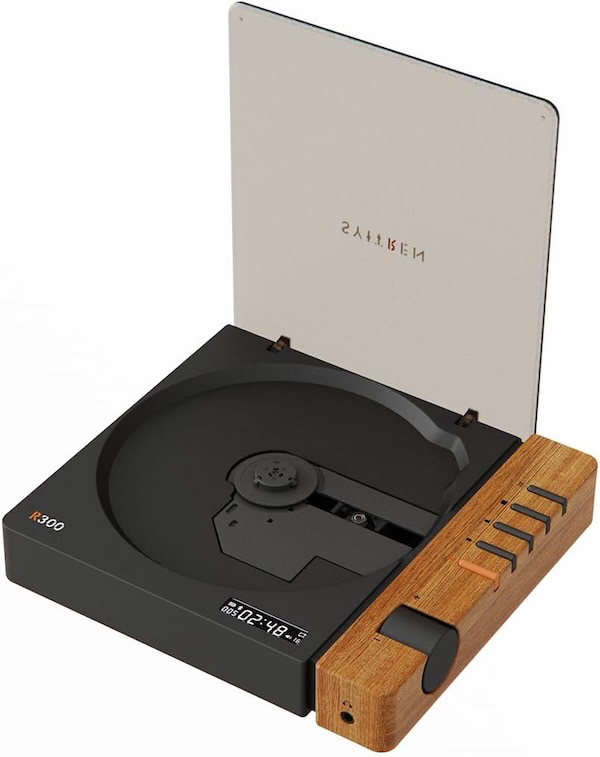
The Syitren R300 is the least expensive model in this guide and the one that looks least like traditional audio equipment. Its rounded enclosure, raised controls, and range of finishes suggest that Braun and Muji designed a CD player after spending an afternoon inside Tower Records.
It supports standard CDs, CD-G discs, and MP3 CDs. Bluetooth 5.3 can transmit playback to wireless speakers or headphones, while wired connections include a 3.5mm analog output and an optical digital output. Its 2,000mAh battery is rated for up to six hours.
The R300 does not include a balanced output, USB DAC operation, ripping, or a particularly powerful headphone amplifier. It is primarily a stylish and uncomplicated way to play discs through basic wired headphones, an external DAC, or a Bluetooth speaker.
Bluetooth compatibility may vary with automotive systems, so buyers hoping to restore CD playback in a newer car should temper their expectations.
At $99.99, however, it remains the most approachable entry point for someone who wants physical playback without studying an output-power chart first.
Where to buy: $109.99 $99.99 at Amazon
FiiO DM13 ($164)


The FiiO DM13 helped establish the current portable CD player category by demonstrating that an affordable model could offer considerably more than a headphone jack and a prayer.
Its dual Cirrus Logic CS43198 DACs feed both 3.5mm and 4.4mm balanced headphone outputs, with up to 180mW and 660mW per channel into 32 ohms, respectively. It also offers line-level operation, optical and coaxial digital outputs, Bluetooth transmission, gapless playback, and more than ten hours of rated battery life.
The DM13 can rip CDs directly to a FAT32-formatted USB storage device as WAV files, making it one of the least expensive ways to play and archive a collection without involving an aging computer or external optical drive.
It does not function as a USB DAC. The USB connection is used for power and ripping rather than accepting digital audio from a computer.
At $164.99, the DM13 remains one of the strongest combinations of price, output power, connectivity, wireless playback, and ripping support. It lacks the R2R conversion and more elaborate amplifier architecture of the DM15, but covers the fundamentals without turning a portable CD player into a graduate-level engineering course.
Where to buy: $164.99 at Amazon | Apos Audio
Moondrop DiscDream 2 ($179)


The Moondrop DiscDream 2 takes a more focused approach than the FiiO DM13.
There is no Bluetooth transmitter, balanced headphone connection, or onboard ripping. What it provides instead is a straightforward wired player with a transparent lid, clearly marked controls, USB DAC operation, and a nine-hour battery.
Its 3.5mm headphone output delivers 124mW into 32 ohms, while a multifunction connection provides line-level and optical output for use with an amplifier or external DAC. The DiscDream 2 supports CD, CD-R, and CD-RW playback, and its USB DAC mode handles high-resolution PCM and DSD files.
This is the model for listeners who want their portable CD player to remain primarily a CD player.
The absence of Bluetooth will be a deal breaker for some buyers, but it also means fewer menus, codecs, pairing routines, and negotiations with whatever wireless device happens to be nearby.
The design is more distinctive than the DM13, and the nine-hour battery makes it suitable for travel or extended desktop listening. Its headphone amplifier is best suited to reasonably efficient headphones and IEMs rather than difficult planar models.
Where to buy: $179.99 at Amazon | Apos Audio
Shanling EC Play ($220)
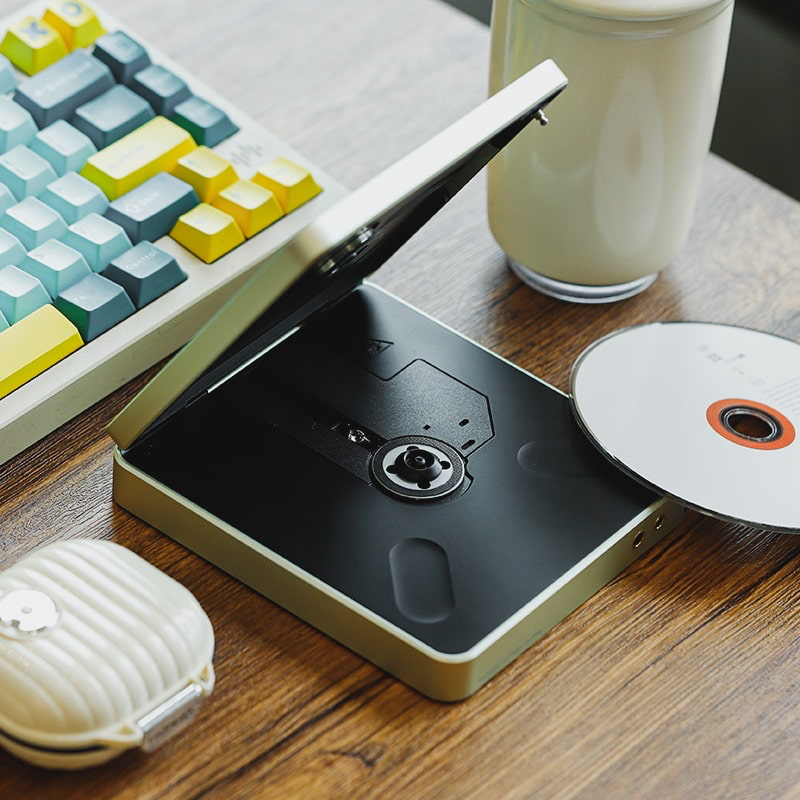
The EC Play is Shanling’s smallest, lightest, and least expensive portable CD player, although “lightest” still means approximately 418 grams.
That is considerably more substantial than the plastic players we carried during the first Bush administration, but the aluminum construction, active magnetic disc clamp, and internal hardware also belong to a different class.
A Cirrus Logic CS43198 DAC and dual SGM8262-2 amplifiers deliver 177mW through the 3.5mm output and as much as 700mW into 32 ohms through the balanced connection. The EC Play can also operate as a USB DAC and provides coaxial digital output for an external converter.
Bluetooth 6.0 works in both directions, although codec support depends on the operating mode. Receiver mode supports LDAC, AAC, and SBC, allowing the EC Play to function as a wireless DAC and headphone amplifier for a phone. CD transmission is limited to SBC.
Its 3,450mAh battery is rated for up to 12 hours, currently the longest claimed CD playback time among the models in this guide.
There is no ripping function, but the combination of balanced output, USB DAC operation, two-way Bluetooth, and excellent battery life makes the EC Play one of the most practical all-around designs under $200.
Where to buy: $220 at Amazon
FiiO DM15 R2R
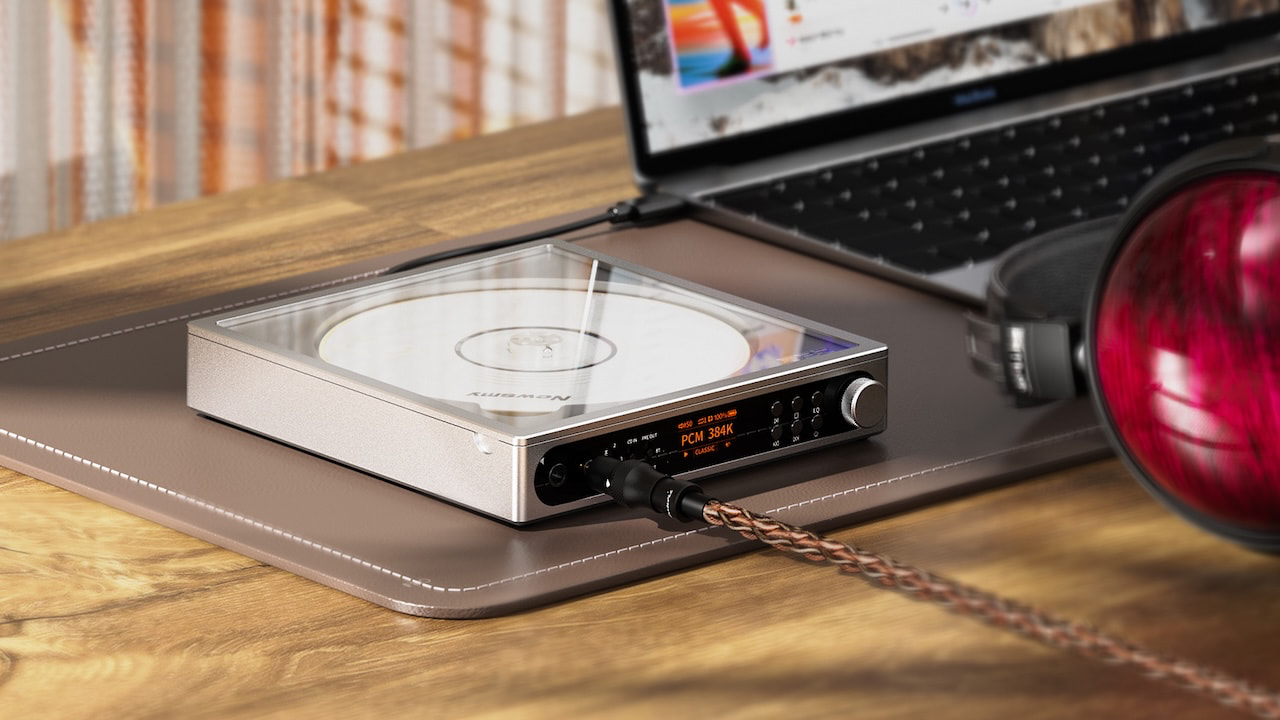
The FiiO DM15 R2R takes the basic formula established by the DM13 and adds a 24-bit resistor-ladder DAC, stronger amplification, USB DAC operation, improved controls, and a transparent lid that lets you watch the disc spin.
Because apparently we missed doing that.
FiiO’s fully differential R2R DAC uses 192 precision thin-film resistors and supports PCM up to 32-bit/384kHz and DSD256 in USB DAC mode. Bluetooth transmission includes aptX, aptX HD, aptX Adaptive, and SBC, while optical and coaxial outputs allow the DM15 to serve as a transport inside a larger system.
Output power rises substantially over the DM13. In battery mode, the DM15 provides approximately 220mW through its 3.5mm output and 812mW through its balanced connection into 32 ohms. Desktop mode increases those figures to roughly 310mW and 1,150mW.
Battery life is rated at more than seven hours during CD playback.
The DM15 can also rip CDs to WAV while listening and includes three bass settings and eight EQ presets. At $269.99, it is the point where this category begins to resemble proper headphone hardware rather than a modern reproduction of something purchased at RadioShack.
Where to buy: $269.99 at Amazon | Apos Audio
Shanling EC Zero AKM ($319)

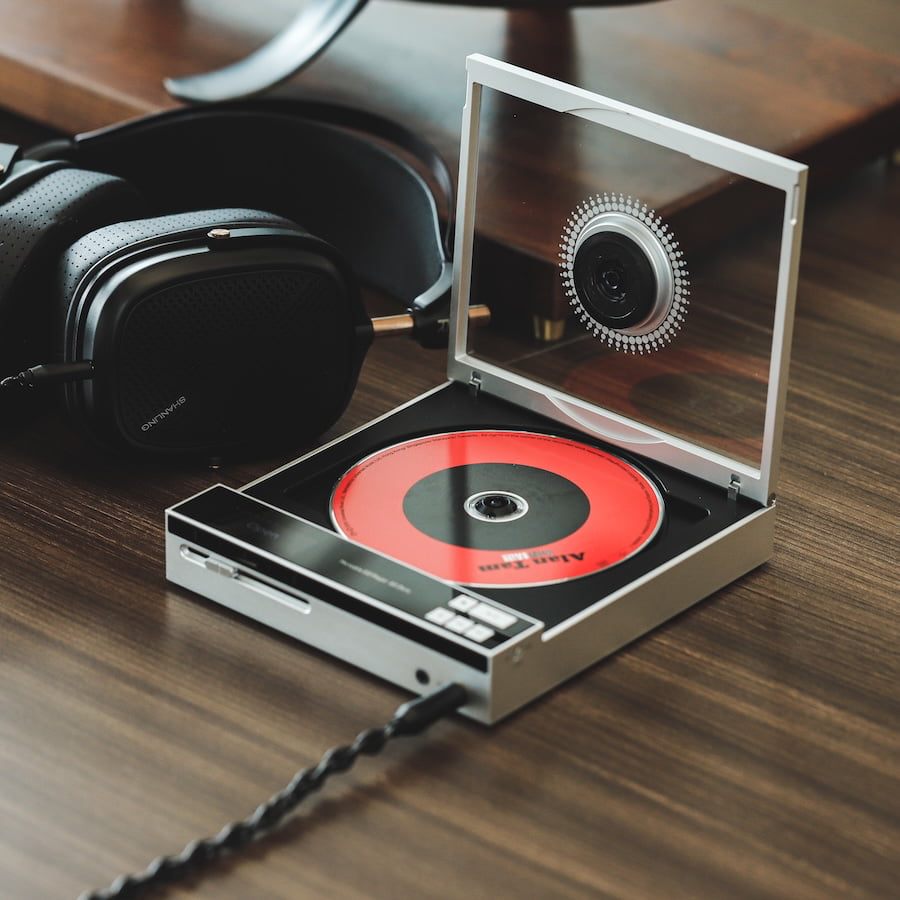
The Shanling EC Zero AKM uses the same basic enclosure, disc mechanism, display, controls, inputs, and outputs as the more expensive EC Zero T but removes the R2R converter and JAN6418 vacuum tubes.
In their place are an AKM AK4493S DAC and dual SGM8262-2 amplifiers. The change reduces the price to $319, extends rated wired playback to ten hours, lowers the output impedance for better compatibility with sensitive IEMs, and still provides up to 836mW through the balanced connection.
The EC Zero AKM includes dedicated headphone and line outputs, USB DAC operation, Bluetooth transmission with aptX Adaptive, combined optical and coaxial digital output, and real-time CD ripping to compatible USB storage.
It does not receive Bluetooth audio, and there is no LDAC support.
What it offers instead is most of the EC Zero platform’s flexibility without asking the buyer to pay for tubes or R2R conversion. For listeners who plan to use the player with several pairs of headphones, powered speakers, a desktop amplifier, and an external DAC, it may be the most rational member of the family.
Yes, “rational” is a relative term when discussing a $319 portable CD player in 2026.
Where to buy: $319 at Amazon
Moondrop DiscDream 2 Ultra ($349)


The DiscDream 2 Ultra is the more ambitious and substantially more expensive sibling of the standard DiscDream 2. Current pricing has climbed to approximately $349.99, although the model originally entered the market closer to $289.99.
Its CNC-machined aluminum clamshell enclosure is one of the most distinctive designs in the category. Connectivity includes 3.5mm and balanced 4.4mm headphone outputs, along with a separate multifunction connection for line-level and optical output.
The balanced output delivers 222mW into 32 ohms, while the single-ended connection supplies 112mW. USB DAC operation supports PCM up to 384kHz and DSD256, and the 3,500mAh battery is rated for eight hours of CD playback.
As with the less expensive DiscDream 2, there is no Bluetooth or ripping function. The Ultra is therefore less versatile than similarly priced alternatives from FiiO and Shanling, and its headphone amplifier is not intended for especially difficult loads.
What it offers is a more luxurious enclosure, balanced wired playback, and a focused operating experience without wireless features or an extensive menu structure.
It is also more transportable than genuinely pocketable, unless your jeans were designed by the same people responsible for JNCO.
Where to buy: $349.99 at Amazon | Apos Audio
Shanling EC Zero T ($559)
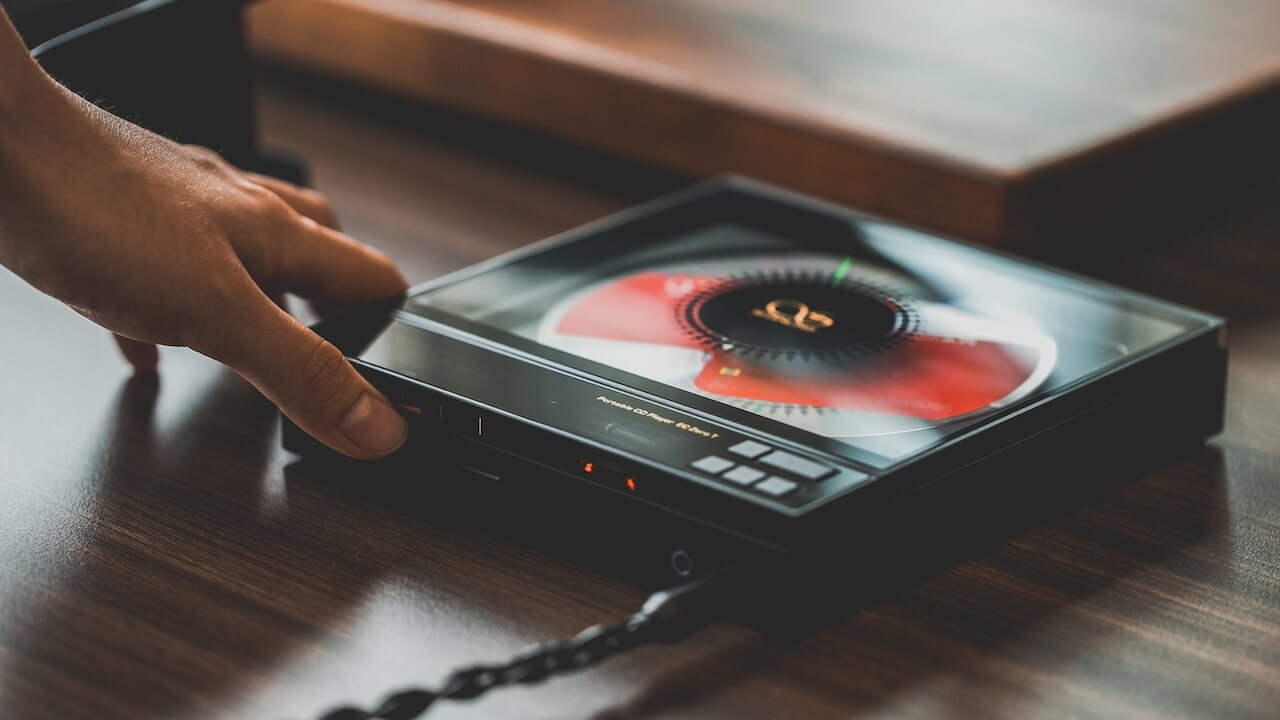
The original EC Zero T marked the point where portable CD players stopped pretending to be simple devices.
Its in-house R2R DAC uses 192 precision resistors and offers selectable non-oversampling and oversampling modes. Dual JAN6418 vacuum tubes allow users to switch between tube and transistor output stages, while a TPA6120 headphone amplifier drives both single-ended and balanced headphones.
The EC Zero T also includes dedicated line outputs, Bluetooth transmission with aptX Adaptive, digital output, high-resolution USB DAC operation, and real-time CD ripping. Its 5,500mAh battery is rated for eight hours.
Output power depends on the operating mode and power source. On battery power, the balanced output reaches 551mW into 32 ohms. Connecting external DC power raises that figure to 1,220mW in transistor mode or 1,087mW in tube mode.
At 669 grams, about the weight of six Sony NW-A306 Walkmans, the EC Zero T stretches the definition of portable without completely snapping it.
The arrival of the more powerful EC Zero T Max makes the original harder to justify at its full MSRP, but current pricing around $519 changes the equation substantially.
Where to buy: $559 at Amazon
Shanling EC Zero T Max ($632)

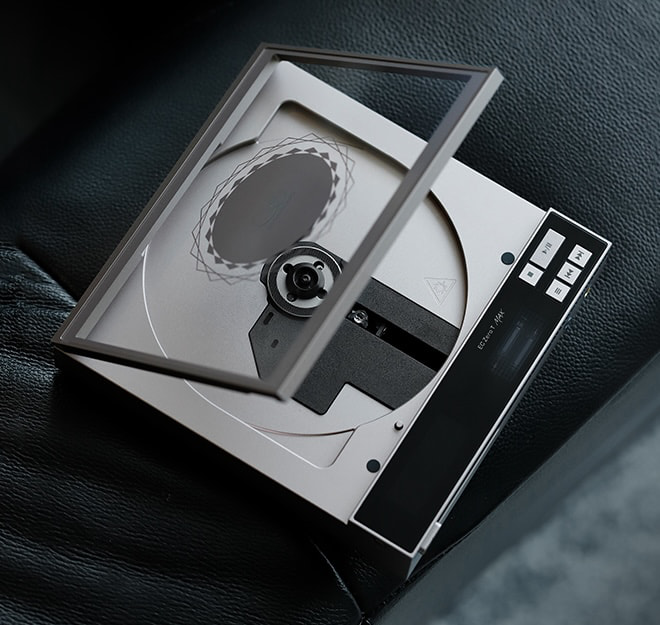
The EC Zero T Max is not a completely new player.
It takes the original EC Zero T’s R2R DAC, dual JAN6418 tubes, disc mechanism, USB DAC support, Bluetooth transmission, digital outputs, and ripping capabilities and addresses one of the original model’s primary limitations: maximum headphone power while operating from its internal battery.
The upgraded amplifier circuit is built around AD8397 devices and delivers up to 361mW into 32 ohms through the 3.5mm output and 1,300mW through the balanced connection without requiring external power. Output impedance has also been reduced, potentially improving compatibility with both demanding full-size headphones and sensitive IEMs.
Shanling also applied power-supply and circuit refinements derived from its newer R2R products, while the titanium-gray finish and patterned disc cover distinguish the Max from the original.
The important distinction is not merely another number on a specification sheet. The original EC Zero T required external power to deliver its maximum output, while the Max can produce 1.3 watts per channel from its battery.
That makes the “portable” part of its description considerably more convincing, even if Eugene Pontecorvo would need a larger Members Only jacket to carry it.
Shanling had not published a final battery-life rating for the Max when this guide was prepared.
Where to buy: $632.64 at AliExpress
Cayin CP6


The Cayin CP6 is the most ambitious and expensive portable CD player in this group, combining dual Raytheon JAN6418 tubes, three selectable timbre modes, switchable amplifier operation, a discrete headphone output stage, dual DACs, two-way Bluetooth, USB DAC operation, CD ripping, and enough aluminum to make its definition of portability somewhat theoretical.
Its three output modes include Classic Tube, Modern Tube, and Solid State. Classic Tube is intended to provide a smoother and warmer presentation, while Modern Tube emphasizes openness and resolution. Solid State bypasses the tube character for a cleaner and more neutral output.
The digital section uses two Cirrus Logic CS4308P DACs operating in mono mode, followed by OPA1612 devices for current-to-voltage conversion and filtering. An XMOS XU316 processor manages USB audio, allowing the CP6 to operate as a high-resolution external DAC when it is not playing discs.
The CP6 includes single-ended and balanced headphone outputs, optical and coaxial digital connections, and Bluetooth 5.4 through a Qualcomm QCC3083 chipset. Unlike most of the players in this guide, it can transmit CD playback to wireless headphones or receive audio from a phone.
Battery operation is rated for up to 7.5 hours. When connected to external DC power, the balanced amplifier can deliver as much as 1,300mW per channel into 16 ohms.
The CP6 does not include Wi-Fi, Ethernet, native streaming applications, SACD playback, or conventional RCA and XLR outputs. It is not a network player, and it is not trying to replace a full-size disc transport.
It is better understood as a tube DAC and powerful balanced headphone amplifier with a rechargeable battery, Bluetooth, and a CD mechanism installed on top.
Calling it a Discman is rather like calling a Porsche 911 a Volkswagen with better seats.
Where to buy: $699 at Apos Audio
Which Portable CD Player Makes the Most Sense?
Below $200, the FiiO DM13 offers the broadest feature set, especially for listeners who want balanced headphone output, wireless transmission, digital outputs, and ripping. The Shanling EC Play costs slightly more but counters with USB DAC operation, two-way Bluetooth, greater balanced power, and longer battery life.
The Syitren R300 makes sense as an inexpensive and design-focused entry point, while the Moondrop DiscDream 2 is better suited to listeners who prefer a simpler wired player and have no need for Bluetooth or ripping.
Between $250 and $400, the FiiO DM15 R2R provides the most aggressive combination of output power, R2R conversion, USB DAC operation, Bluetooth, and ripping. The Shanling EC Zero AKM costs more but adds dedicated line outputs, a larger battery, and a broader range of system connections.
The DiscDream 2 Ultra prioritizes enclosure quality and straightforward wired playback over features.
The Shanling EC Zero T, EC Zero T Max, and Cayin CP6 occupy a very different part of the market. These are transportable audiophile source components designed for listeners who want tube output, stronger headphone amplification, multiple operating modes, and integration with desktop or full-size audio systems.
None of them will recreate the experience of skating to school with a Discman clipped to your belt and Dookie skipping every time you hit a crack in the sidewalk.
That is probably for the best.
Portable CD Player Comparison
Prices and specifications checked Aug 2, 2026. Manufacturer-rated battery life and output figures are shown.
| Model | Price | Headphone Outputs | Bluetooth | USB DAC | CD Ripping | Rated Battery Life | Maximum Headphone Output |
|---|---|---|---|---|---|---|---|
| Syitren R300 | $99 | 3.5mm | Bluetooth 5.3 transmit | No | No | Up to 6 hours | Not specified |
| FiiO DM13 | $164 | 3.5mm, 4.4mm balanced | Bluetooth 5.2 transmit with aptX, aptX HD, aptX Low Latency, and SBC | No | Yes, WAV to USB storage | More than 10 hours | 180mW SE / 660mW balanced at 32 ohms |
| Moondrop DiscDream 2 | $179 | 3.5mm | None | Yes | No | 9 hours | 124mW at 32 ohms |
| Shanling EC Play | $220 | 3.5mm, 4.4mm balanced | Bluetooth 6.0 transmit and receive; LDAC reception, SBC transmission | Yes, up to 32-bit/384kHz and DSD256 | No | Up to 12 hours | 177mW SE / 700mW balanced at 32 ohms |
| FiiO DM15 R2R | $269 | 3.5mm, 4.4mm balanced | Transmit with aptX, aptX HD, aptX Adaptive, and SBC | Yes, up to 32-bit/384kHz and DSD256 | Yes, WAV to USB storage | More than 7 hours | 220mW SE / 812mW balanced on battery; 310mW SE / 1,150mW balanced in desktop mode |
| Shanling EC Zero AKM | $319 | 3.5mm, 4.4mm balanced | Bluetooth 5.3 transmit with aptX Adaptive, aptX, and SBC | Yes | Yes | Up to 10 hours wired | Up to 525mW SE / 836mW balanced at 32 ohms |
| Moondrop DiscDream 2 Ultra | $349 | 3.5mm, 4.4mm balanced | None | Yes, up to 32-bit/384kHz and DSD256 | No | 8 hours | 112mW SE / 222mW balanced at 32 ohms |
| Shanling EC Zero T | $559 | 3.5mm, 4.4mm balanced | Bluetooth 5.3 transmit with aptX Adaptive, aptX, and SBC | Yes, up to 32-bit/768kHz and DSD512 | Yes | Up to 8 hours | 551mW balanced on battery; up to 1,220mW balanced with external power |
| Shanling EC Zero T Max | $632 | 3.5mm, 4.4mm balanced | Bluetooth transmit | Yes | Yes | Not specified | 361mW SE / 1,300mW balanced at 32 ohms on battery |
| Cayin CP6 | $699 | 3.5mm, 4.4mm balanced | Bluetooth 5.4 transmit and receive | Yes | Yes | Up to 7.5 hours | Up to 1,300mW per channel at 16 ohms with external DC power |
The Bottom Line
Portable CD players make sense because many of them use rather good DACs for the application, can drive everything from sensitive IEMs to demanding headphones, and fit comfortably on a desk, an airline tray at 30,000 feet, or a nightstand.
Just make sure the headphone cable is long enough. That awful thud at 3 a.m. when you roll over, pull the player onto the floor, and mumble something about not touching the last piece of biltong is not part of the listening experience anyone needs.
They are practical, increasingly capable, easy to move around, and yes, still undeniably cool.
You must be logged in to post a comment Login