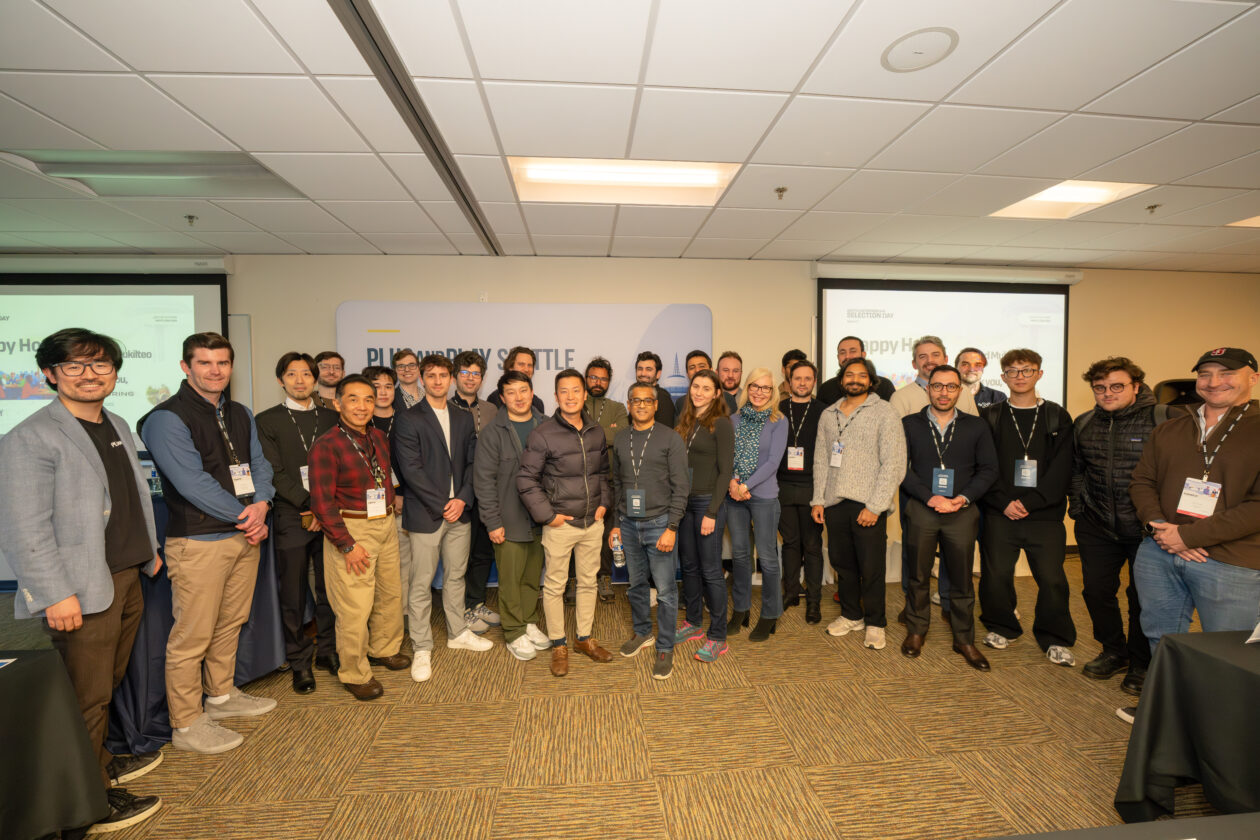
Startup founders who pitched for a chance to join the latest Plug and Play Cohort. (Photo courtesy of Plug and Play)
Plug and Play has selected the 10 startups that will take part in its third Seattle-area accelerator cohort as the program marks its one-year anniversary in the region.
The companies — nine of which are Seattle based — are participating in a 12-week program running through mid-June. Cohort participants are innovating across enterprise software, biotech, physical AI, robotics, and health tech.
“Seattle has one of the deepest pools of technical talent in the world, and this cohort reflects that,” said Jack Callaghan, director of Plug and Play Seattle, in a news release Monday.
Each startup receives one-on-one guidance to refine business models, strengthen go-to-market strategies, and build strategic partnerships. The program also supports the development of proof-of-concepts, pilot projects, and commercial relationships.
Here are the 10 startups, with descriptions of their work provided by Plug and Play:
Advertisement
Ally AI, Seattle. An AI-powered customer engagement platform built specifically for auto dealerships, offering 24/7 intelligent virtual agents across multiple communication channels.
Clockwork Bio, Seattle. Developing the data engine to power the AI revolution in drug discovery by leveraging AI at every step of the Experimental Biology Loop.
ElastixAI, Seattle. Developing a novel AI inference infrastructure that co-designs machine learning optimizations, the inference software stack, and the compute backend together in real time.
Glacis, Seattle. Building the trust infrastructure for production AI by providing a cryptographically verifiable layer that independently attests every AI decision in real time.
ImYoo Health, Sunnyvale, Calif. A direct-to-consumer single-cell transcriptomics company aiming to deliver personalized, biology-driven health insights by connecting people with similar immune profiles.
Reflection Robotics, Seattle. Building robot foundation models that make it dramatically faster and cheaper to automate physical tasks in manufacturing without requiring custom hardware or bespoke machines.
Sigma Genetics, Seattle. Building a non-invasive device that can deliver charged molecules, such as DNA, RNA, and proteins into patient cells to treat the most challenging diseases.
Strum AI, Seattle. Building an AI-first platform designed to lower the barrier for any enterprise to adopt algorithm-driven decision-making for supply chain excellence.
Tibbling Technologies, Seattle. A research-driven AI and scientific discovery company focused on developing advanced multimodal AI systems to solve complex problems in health tech and neuroscience.
Vicino AI, Seattle. A multi-agent GenAI platform for text/image-to-3D generation, enabling stepwise, personalized, and accurate asset generation for gaming, AR/VR product prototyping, and e-commerce.
A majority of the programming will take place virtually, but startups will have access to Plug and Play’s Seattle office inside the University of Washington’s CoMotion Labs. Plug and Play also has space at SNBL Global Gateway in Everett, Wash.
Plug and Play Seattle will host its Expo on June 5 at UW’s Kane Hall, where the cohort will showcase its progress.
Silicon Valley-based Plug and Play first announced it was coming to Seattle in November 2024, adding to its more than 60 locations worldwide.
In addition to startup accelerators, Plug and Play runs corporate innovation programs and has an in-house venture capital fund that has backed companies such as Dropbox, Gurdant Health, Honey, Lending Club, and PayPal.
It seems like everybody takes their turn doing an ESP32-based weather display, and why not? They’re cheap, they’re easy, and you need to start somewhere. With the Cheap Yellow Display (CYD) and modules like it, you don’t even need to touch hardware! [likeablob] had the CYD, and he’s showing weather on it, but the Cydintosh is a full Macintosh Plus Emulator running on the ESP32.Honey, I stretched the Macintosh!
The weather app is his own creation, written with the Retro68k cross-compiler, but it looks like something out of the 80s even if it’s getting its data over WiFi. The WiFi connection is, of course, thanks to the whole thing running on an ESP32-S3. Mac Plus emulation comes from [evansm7]’s Micro Mac emulator, the same one that lives inside the RP2040-based PicoMac that we covered some time ago. Obviously [likeablob] has added his own code to get the Macintosh emulator talking to the ESP32’s wireless hardware, with a native application to control the wifi connection in System 3.3. As far as the Macintosh is concerned, commands are passed to the ESP32 via memory address 0xF00000, and data can be read back from it as well. It’s a straightforward approach to allow intercommunication between the emulator and the real world.
The touchpad on the CYD serves as a mouse for the Macintosh, which might not be the most ergonomic given the Macintosh System interface was never meant for touchscreens, but evidently it’s good enough for [likeablob]. He’s built it into a lovely 3D printed case, whose STLs are available on the GitHub repository along with all the code, including the Home Assistant integration.
If you’re a Warhammer fan of a certain age, some of these may be formative experiences for you. I know they are for me. I can’t count how many hours I spent playing Chaos Gate when I first discovered 40K at the age of 10. Yes, it was an XCOM clone, but by that point I didn’t know about the MicroProse original, and Space Marines were cool.
Years later and as a Tau collector at the time, I also loved Fire Warrior, even if it wasn’t the most polished or deep first-person shooter. I haven’t played the other five games included in today’s announcement, but I’ve heard Warhammer: Shadow of the Horned Rat and Warhammer 40K: Rites of War are pretty good if you’re into the setting or, in the latter case, a fan of the Eldar.
To celebrate the re-release of these old gems, Games Workshop is running a Classics sale on Steam, with discounts on all 19 re-releases. Plus, you can get discounts on some more recent releases, including the excellent Dawn of War – Definitive Edition and Dawn of War 2 – Anniversary Edition. If you’re new to the Warhammer 40K universe, and would rather avoid a plastic addiction, one of those would be my first port of call, along with the excellent Space Marine 2.
Roblox is among the internet’s busiest digital playgrounds, but keeping it safe, especially for the youngest users, has been an ongoing challenge.
Well, on April 13, 2026, the platform’s founder and CEO, David Baszucki, announced two new age-based account tiers, which will launch in June.
Roblox
So, What Exactly Is Changing For Young Players?
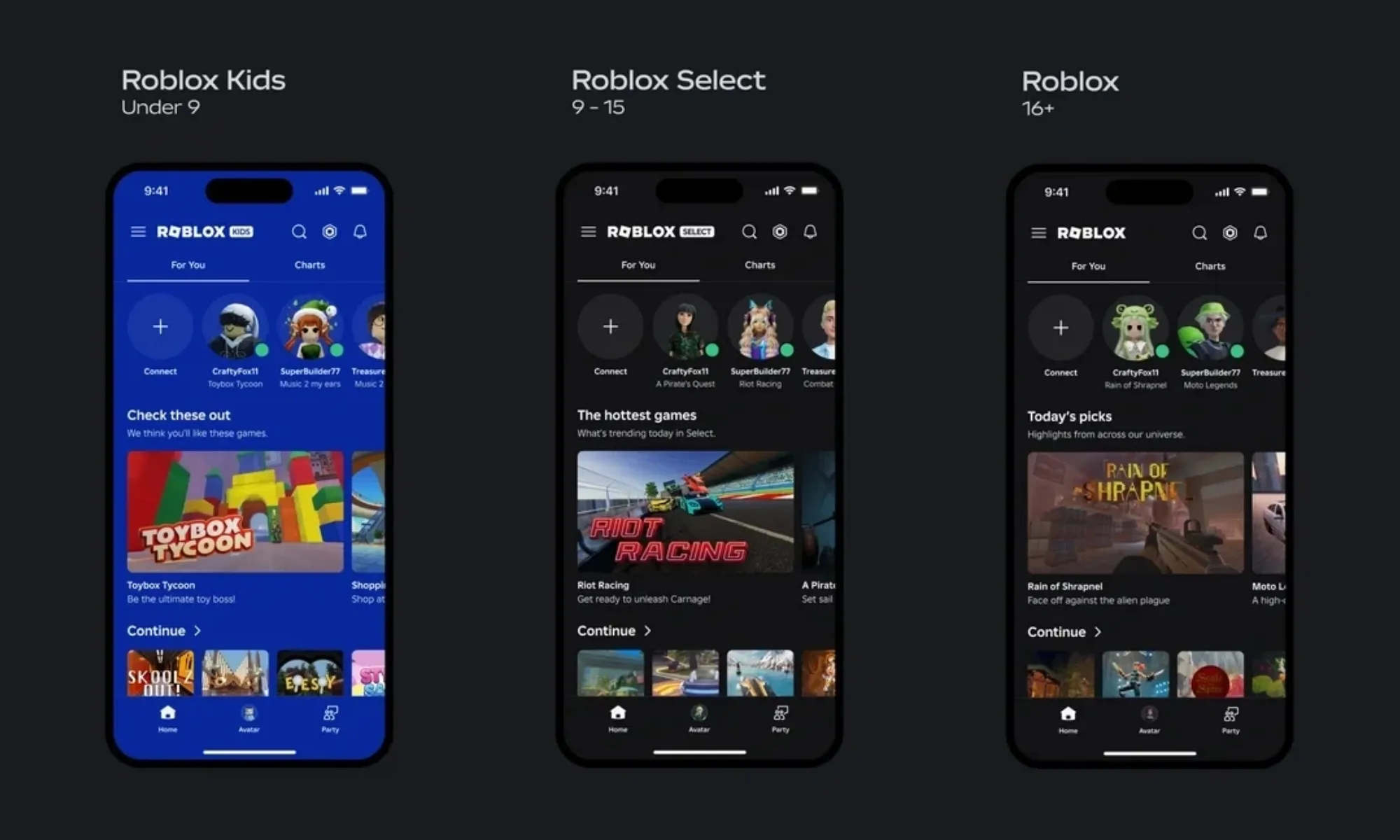
The platform is launching Roblox Kids for users between the ages of five and eight and Roblox Select for those aged between nine and 15.
Both categories are assigned automatically through the platform’s existing facial age-check mechanism, the system made mandatory for accessing the in-built chat feature in January 2026.
For the youngest group, Roblox Kids, chat is completely disabled by default. Game access is also restricted to content carrying only Minimal or Mild maturity ratings. Selected users get more freedom with Moderate-rated games and chat that can be gradually enabled based on age.
Advertisement
Once a user hits 16, they graduate to a standard account.
Roblox
What Does This Mean For Parents And Developers?
Parents gain sharper controls, including the ability to individually block or approve titles up to age 15. Meanwhile, developers face a tougher entry bar. To reach younger audiences, they must provide ID verifications, two-step authentication, and an active Roblox Plus subscription (which costs $4.99 per month).
As mentioned in the beginning, the new age-based accounts will roll out globally at the beginning of June 2026. Users will also get a transition period to verify their age.
If you’re wondering where the sudden strategic pivot comes from, it stems from the lawsuits by the attorneys general of Louisiana and Texas over child safety concerns.
It’s food that platforms can no longer keep child safety on the back burner, and if the platform does well, it could set a benchmark for age-appropriate access.
The FBI searched the Texas home of a 20-year-old man accused of throwing a Molotov cocktail at Sam Altman’s San Francisco residence. Authorities say the suspect also made threats at OpenAI’s headquarters, and reports indicate he had written extensively about fears over AI and opposition to AI executives.
The suspect reportedly authored a Substack blog and was a member of the Discord server PauseAI, an activist group focused on banning the development of the most powerful AI models to protect the public. In one post, they wrote: “These machines have already shown themselves to be unaligned with the interest of the people creating them. Models have often been found lying, cheating on tasks, and blackmailing their own creators whenever convenient; let alone the broader question of aligning them to whatever general ‘human interest’ may be.” The Houston Chronicle reports: The search happened hours before the Justice Department charged 20-year-old Daniel Moreno-Gama with possession of an unregistered firearm and damage and destruction of property by means of explosives. An FBI spokesperson on Monday morning confirmed agents were executing a search warrant in Spring, but provided no other information.
Around the same time, FOX News reported the search was being conducted at the home of Daniel Moreno-Gama, 20, who last week was arrested by San Francisco police suspicion of attempted murder, making criminal threats and possession of a destructive device. The charges were first reported by the Associated Press. When Moreno-Gama was arrested Friday, he was carrying a document that “identified views opposed to Artificial Intelligence (AI) and the executives of various AI companies,” the Associated Press reported. Moreno-Gama has no criminal history in Harris or Montgomery counties, according to public records. […] Agents had left the cul-de-sac by 1 p.m. It was unclear if they removed any items from the house. Another incident occurred outside Sam Altman’s residence early Sunday morning. “Early Sunday morning, a car stopped and appears to have fired a gun at the Russian Hill home of OpenAI’s CEO,” reports The San Francisco Standard, citing reports from the local police department. Two suspects were arrested and booked for negligent discharge.
Looking for the most recent Connections answers? Click here for today’s Connections hints, as well as our daily answers and hints for The New York Times Mini Crossword, Wordle, Connections: Sports Edition and Strands puzzles.
Today’s NYT Connections puzzle is rather tricky. Read on for clues and today’s Connections answers.
The Times has a Connections Bot, like the one for Wordle. Go there after you play to receive a numeric score and to have the program analyze your answers. Players who are registered with the Times Games section can now nerd out by following their progress, including the number of puzzles completed, win rate, number of times they nabbed a perfect score and their win streak.
Here are four hints for the groupings in today’s Connections puzzle, ranked from the easiest yellow group to the tough (and sometimes bizarre) purple group.
Yellow group hint: Surfing the web.
Advertisement
Green group hint: Think Muhammad Ali.
Blue group hint: You might try to do this with a pinball machine.
Xbox’s new chief exec, Asha Sharma, has only been in charge for a few months but things already seem like they might be changing for the better. Or at the very least, they might be getting cheaper. The Verge reported that the new Xbox CEO wrote a memo to employees addressing the current pricing of the Game Pass subscription service.
“Game Pass is central to gaming value on Xbox. It’s also clear that the current model isn’t the final one,” Sharma allegedly said. “Short term, Game Pass has become too expensive for players, so we need a better value equation. Long term, we will evolve Game Pass into a more flexible system which will take time to test and learn around.”
After Microsoft upped the price for Game Pass twice within 15 months, many of us certainly felt that the service had gotten too costly to keep. Xbox is still offering a wide range of titles on Game Pass; the April update is adding indies like Hades 2 and new Double Fine project Kiln alongside AAA hits like the remake of Call of Duty: Modern Warfare. The Verge‘s sources suggested that the addition of the CoD franchise might have been a factor in some of the Game Pass price increases, since Microsoft would lose out on revenue by making the latest entries in the series available under the subscription.
It’s too early to say whether this memo from Sharma means Xbox is on the brink of a resurgence. And there are changes the company could make, like adding ever more complicated tiers, that would further hamper interest and uptake of Game Pass. But acknowledging the problem, even internally, is refreshing to see after so many baffling moves from Xbox in recent years.
Top earners use AI tools to verify decisions before execution, not to create ideas
Executives now prioritize accuracy and error prevention over speed in AI workflows
Mid-level professionals rely less on AI for structured decision validation processes
The early narrative around artificial intelligence promised speed, scale, and unprecedented output.
A different picture is now emerging from recent survey data collected by Use.AI which found high-earning professionals are not racing to produce more content faster.
Instead, the study found they are deliberately slowing down to let AI examine their work for flaws before those flaws become expensive problems.
Article continues below
Advertisement
Among professionals in the top income quartile, 62% report using AI primarily to validate decisions and prevent errors rather than to generate ideas or increase speed.
This contrasts sharply with mid-level earners, where only 38% use AI in this defensive manner.
Advertisement
The difference appears to stem from accountability. As responsibility grows, the cost of a single mistake rises, and the value of verification rises alongside it.
A senior manager who signs off on a flawed campaign or an ambiguous legal document faces consequences that a junior professional simply does not.
Sign up to the TechRadar Pro newsletter to get all the top news, opinion, features and guidance your business needs to succeed!
One respondent noted that AI tools now function as a pre-mortem mechanism, auditing messaging before launch and interrogating strategic assumptions before final calls are made.
Advertisement
The survey found over two-thirds (67%) of executives and senior managers regularly use AI to challenge their own thinking before making a decision.
Only 29% rely on it primarily for idea generation, suggesting a clear reprioritization: accuracy over volume, judgment over velocity.
Among all senior decision-makers surveyed, 71% said AI had helped them avoid at least one costly mistake in the past year – an important consideration as at their level, such errors usually come with financial, reputational, or operational consequences.
Advertisement
For junior professionals, that figure drops to 44%. The gap suggests that less experienced users may be outsourcing thinking to LLMs rather than using them as a second layer of scrutiny.
Use.AI data also shows that 58% of top earners now consider AI a standard part of their decision-making process, compared to 34% of respondents overall.
What began as an optional productivity layer is becoming embedded infrastructure for those operating under higher accountability.
Professionals are not handing decisions over to AI Agents but are using them to reveal surface blind spots and, when necessary, decide against action entirely.
Advertisement
However, it is worth noting that this data is not foolproof because it reflects what professionals say about their workflows rather than what actually happens.
The distinction between verification and mere confirmation bias is difficult to measure.
Still, the direction of the shift is clear: the most strategic users of AI tools are not those who move fastest, but those who use them to pause, assess, and avoid regret.
Despite indie darling Stardew Valley only being built by a single developer, you certainly wouldn’t know it by the amount of support the game has received since its launch in 2016. Regular updates, ports to other platforms, and even a fully-fledged online multiplayer mode make the game feel essentially endless. In fact, it’s one of Digital Trends’ top 50 video games of all time.
With Stardew Valley’s 1.6 update adding that multiplayer mode, fans have been begging for cross-platform play, as well as cross-progression. So, if you’re looking to recruit some fellow agriculture enthusiasts or some farming friends, read on to find out whether or not you can pull them from across console, PC, and mobile.
Is Stardew Valley cross-platform?
While developer ConcernedApe has worked in an awful lot of new content, at the time of writing (October 2025) Stardew Valley still does not offer cross-platform support, so you’ll need to play with friends on the same platform.
One reason for this could be that, since it launched in 2016, Stardew Valley predates the big cross-platform push spearheaded by the likes of Fortnite.
Advertisement
As a result, you’ll need to play on PlayStation 4, PlayStation 5, Xbox One, Xbox Series X, Nintendo Switch, or PC with other players on the same system, but you can at least enjoy multiplayer thanks to the 1.6 update.
Back in 2018, one fan asked ConcernedApe if cross-platform play is likely to come to the farming sim.
“Unfortunately, there will not be crossplay. Apparently, the technical barriers are very high. It’s still something I really want to add and I promise to look into it more closely, but first priority is getting the update out there,” he responded, and the trail has gone quiet since.
ConcernedApe
As for cross-save, that’s not here either. You can’t save on your PC and pick up where you left off on your Xbox, for example, or jump between Nintendo Switch and PlayStation.
Arguably the closest you’ll get is using Steam’s Cloud Save functionality to play on PC and then pick up on a laptop or Steam Deck, but that won’t be a solution that suits everyone.
Advertisement
Haunted Chocolatier, the next game from ConcernedApe, is certainly looking promising, so here’s hoping cross-platform play and cross-save make it into that one at least. And hey, who knows? Maybe the dev will surprise us with crossplay and cross-save in the future.
Current status in 2026
The most relevant recent change is not full crossplay, but experimental multiplayer on mobile. Stardew Valley’s official mobile multiplayer guide confirms that Android and iOS now have a hidden experimental multiplayer feature tied to the 1.6 mobile release.
Which Stardew Valley platforms can play together?
Windows, Mac, and Linux: Yes
PlayStation with PlayStation: Yes
Xbox with Xbox: Yes
Switch with Switch: Yes
PC with console: No
PlayStation with Xbox or Switch: No
Console with mobile: No standard crossplay
Mobile with PC: Experimental only, with setup required
So if the goal is easy co-op with friends, the safest advice is still painfully boring: buy the game on the same platform.
What about Stardew Valley mobile multiplayer?
This is the one part of the answer that now needs nuance.
According to the official Stardew Valley mobile multiplayer guide, Android and iOS have a hidden experimental multiplayer mode. It isn’t enabled like standard multiplayer, and it comes with extra steps. Players need to be on the same game version, connect by IP, and often be on the same local network unless they’re using more advanced setup methods such as port forwarding. The official guide also warns that the feature is experimental and may have bugs or save-related issues.
Advertisement
That means mobile multiplayer exists, but it isn’t polished, full-featured crossplay. It’s closer to an official experimental workaround than a seamless “buy anywhere, play anywhere” system.
Does Stardew Valley have cross-save?
No. Stardew Valley still doesn’t offer broad, official cross-save or cross-progression across its major platform ecosystems. A save on Switch, for example, isn’t meant to flow neatly into Xbox, PlayStation, or PC in the way players now expect from fully connected live-service games.
Why doesn’t Stardew Valley have full crossplay?
Part of the answer is timing. Stardew Valley launched in 2016, long before full cross-platform support became an expected multiplayer feature for almost every popular co-op game. Multiplayer support expanded over time, and the current game supports up to eight players in multiplayer in supported environments, but that still doesn’t mean broad crossplay across every platform family.
In other words, Stardew Valley has multiplayer, but not the universal version modern players expect.
Advertisement
Stardew Valley cross-platform status in 2026
Stardew Valley still isn’t fully cross-platform in 2026. PC players can play together across Windows, Mac, and Linux. Console players generally need to stay within their own platform ecosystem. Mobile now has an official experimental multiplayer option, including the ability to connect in ways that blur the old boundaries a bit, but it’s still limited, hidden, and far from full crossplay.
If the goal is to start a farm with friends and avoid technical nonsense, everyone should still plan to buy the same version on the same platform. It’s not glamorous advice, but it beats discovering too late that your multiplayer plans were built on wishful thinking and turnips.
Autonomous agents are compressing software delivery timelines from weeks to days. The enterprises that scale agents safely will be the ones that build using spec-driven development.
There’s a moment in every technology shift where the early adopters stop being outliers and start being the baseline. We’re at that moment in software development, and most teams don’t realize it yet.
A year ago, vibe coding went viral. Non-developers and junior developers discovered they could build beyond their abilities with AI. It lowered the floor. It made prototyping much quicker, but it also introduced a surplus of slop. What the industry then needed was something that raised the ceiling — something that improved code quality and worked the way the most expert developers work. Spec-driven development did that. It laid the foundation for trustworthy autonomous coding agents.
Advertisement
Specs are the trust model for autonomous development
Most discussions of AI-generated code focus on whether AI can write code. The harder question is whether you can trust it. The answer runs directly through the spec.
Spec-driven development starts with a deceptively simple idea: before an AI agent writes a single line of code, it works from a structured, context-rich specification that defines what the system is supposed to do, what its properties are, and what “correct” actually means. That specification is an artifact the agent reasons against throughout the entire development process — fundamentally different from pre-agentic AI approaches of writing documentation after the fact.
Enterprise teams are building on this foundation. The Kiro IDE team used Kiro to build Kiro IDE — an agentic coding environment with native spec-driven development — cutting feature builds from two weeks to two days. An AWS engineering team completed an 18-month rearchitecture project, originally scoped for 30 developers, with six people in 76 days using Kiro. An Amazon.com engineering team rolled out “Add to Delivery” — a feature that lets shoppers add items after checkout — two months ahead of schedule by using Kiro and spec-driven development. Alexa+, Amazon Finance, Amazon Stores, AWS, Fire TV, Last Mile Delivery, Prime Video, and more all integrate spec-driven development as part of their build approaches.
That shift changes everything downstream.
Advertisement
Verifiable testing is what makes autonomous agents safe to run
The spec becomes an automated correctness engine. When a developer is generating 150 check-ins per week with AI assistance, no human can manually review that volume of code. Instead, code built against a concrete specification can be verified through property-based testing and neurosymbolic AI techniques that automatically generate hundreds of test cases derived directly from the spec, probing edge cases no human would think to write by hand. These tests prove that the code satisfies the spec’s defined properties, going well beyond hand-written test suites to provably correct behavior.
Verifiable testing enables the shift from one-shot programming to continuous autonomous development. Traditional AI-assisted development operates as a single shot: you give the agent a spec, the agent produces output, and the process ends. Today’s agents continuously correct themselves, feeding build and test failures back into their own reasoning, generating additional tests to probe their own output, and iterating until they produce something both functional and verifiable. The spec is the anchor that keeps that loop from drifting. Instead of developers constantly checking in to see if the agent is making the right decisions, the agent can check itself against the spec to make sure it is on the right path.
The autonomous agent of the future will write its own specs, using specifications as the mechanism for self-correction, for verification, for ensuring that what it produces matches the intended behavior of the system.
Multi-agent, autonomous, and running right now
The developers setting the pace today operate in a fundamentally different way. Developers spend significant time building their spec, as well as writing steering files used by the spec to make sure the agent knows what and how to build — more time than their agent may spend building the actual software. They run multiple agents in parallel to critique a problem from different perspectives, as well as run multiple specs, each written for a different component of the system they are building. They let agents run for hours, sometimes days. They use thousands of Kiro credits because the output justifies it.
Advertisement
A year ago, agents would lose context and fall apart after 20 minutes. Now, every week you can run them longer than the week before. Agentic capabilities have improved significantly in the last six months that genuinely complex problems are tractable. Newer LLMs are more token-efficient than the previous generation, so for the same spend, you get dramatically more done.
The challenge is that doing this well requires deep expertise. The tools, methodologies, and infrastructure exist, but orchestrating them is hard. The goal with Kiro is to bring these capabilities with deep expertise to every developer, not just the top one percent who’ve figured it out.
Infrastructure is catching up to ambition
Agents will be ten times more capable within a year. That’s the rate of improvement we’re seeing week over week.
The infrastructure to support that level of capability is converging at the same time. Agents are now running in the cloud rather than locally, executing in parallel at scale with secure, reliable communication between agent systems. Organizations can now run agentic workloads the way they’d run any enterprise-grade distributed system — with governance, cost controls, and reliability guarantees that serious software demands. Spec-driven development is the architecture of tomorrow’s autonomous systems.
Advertisement
Developers are no longer restricted by how they want to solve the problem. The developers who thrive in this world are the ones building that foundation now: using spec-driven development, prioritizing testability and verification from the start, working with agents as collaborators, and thinking in systems instead of syntax.
Deepak Singh is VP of Kiro at AWS.
Sponsored articles are content produced by a company that is either paying for the post or has a business relationship with VentureBeat, and they’re always clearly marked. For more information, contact sales@venturebeat.com.
Stop Killing Games is backing a new bill from Chris Ward, a member of the California State Assembly since 2020. Introduced earlier this year, the Protect Our Games Act would require gaming companies to make clear commitments to long-term support for “server-connected” video games. The bill has undergone a significant… Read Entire Article Source link

























































You must be logged in to post a comment Login