Connect with us

Tech

3D Printed Jack Mixes Two Filaments For Great Performance

Published

on

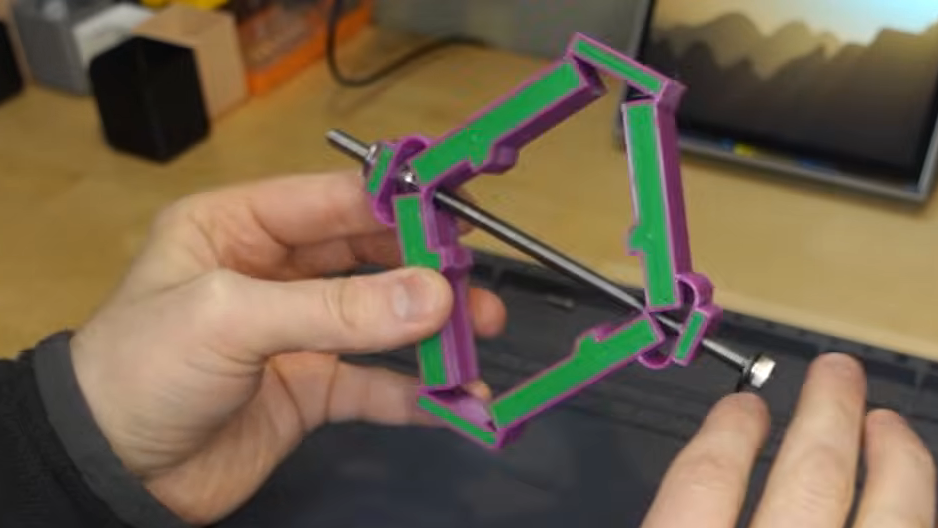
If you’re looking to jack up your car and you don’t have anything on hand, your 3D printer might not be the first tool you look towards. With that said, [Alan Reiner] had great success with a simple idea to create a surprisingly capable scissor jack with a multi-material print.

The design will look familiar if you’ve ever pulled the standard jack out of the back of your car. However, this one isn’t made fully out of steel. It relies on an M6 bolt and a rivet nut, but everything else is pure plastic. In this scissor jack design, rigid PETG arms are held in a scissor jack shape with a flexible TPU outer layer. Combined with the screw mechanism, it’s capable of delivering up to 400 pounds of force without failing. It’s an impressive figure for something made out of 80 grams of plastic. The idea came about because of [Alan’s] recent build of a RatRig VCore4 printer, which has independent dual extruders. This allowed the creation of single prints with both rigid and flexible filaments included.

[Alan] did test the jack by lifting up his vehicle, which it kind of achieved. The biggest problem was the short stroke length, which meant it could only raise the back of the car by a couple inches. Printing a larger version could make it a lot more practical for actual use… if you’re willing to trust a 3D-printed device in such use.

Advertisement

Files are on Printables if you wish to make your own. It’s worth paying attention to the warning upfront that [Alan] provides—”THIS CAN CREATE A LOT OF FORCE (400+ lbs!), WHICH MEANS IT CAN STORE A LOT OF ENERGY THAT MIGHT BE RELEASED SUDDENLY.  Please be cautious using 3d-printed objects for high loads and wear appropriate safety equipment!”

Funnily enough, we’ve featured 3D printed jacks before, all the way back in 2015! Video after the break.

Advertisement

Source link

Continue Reading
Click to comment

Leave a Reply

Your email address will not be published. Required fields are marked *

Tech

You might want to double-check before buying laptops from this Chinese brand

Published

on

Independent testing has recently uncovered what it describes as a potential CPU mislabeling issue affecting multiple Chuwi laptops. In its latest report, Notebookcheck found that the Chuwi CoreBook Plus, which is marketed as using an AMD Ryzen 5 7430U, actually shipped with the older Ryzen 5 5500U processor instead.

What makes the situation more unusual is that the laptop’s packaging, product pages, BIOS, and even Windows system tools reportedly identify the chip as a Ryzen 5 7430U, making it difficult for buyers to detect the discrepancy without deeper inspection. The discovery has raised concerns about transparency in the budget laptop market, especially since this isn’t the first time such a mismatch has been reported.

What exactly is the CPU controversy about?

According to Notebookcheck’s investigation, the CoreBook Plus is actively marketed with the Ryzen 5 7430U, a newer Zen 3 processor launched in 2023. However, after purchasing and opening a retail unit, the reviewers discovered the laptop actually contained the Ryzen 5 5500U, an older Zen 2 chip released in 2021.

The difference may not sound huge on paper, but the newer processor has a higher boost clock and double the L3 cache (16 MB vs 8 MB), which can translate to better performance in certain workloads. In other words, buyers may believe they are getting a newer chip typically found in laptops priced €100–€200 higher, potentially making the system appear like a better bargain than it actually is. Even more surprising is the fact that the laptop’s firmware and software identifiers were configured so that system utilities still report the CPU as a Ryzen 5 7430U, masking the true hardware unless the device is physically opened.

Is this an isolated case or something bigger?

Unfortunately, the CoreBook Plus may not be the only device involved. Earlier testing found a similar issue with another model, the Chuwi CoreBook X, which was also advertised with a Ryzen 5 7430U but reportedly shipped with the same Ryzen 5 5500U chip instead. With two separate laptop models showing the same mismatch, investigators say the issue appears unlikely to be a simple labeling mistake.

Chuwi has reportedly responded to inquiries by saying it is investigating the matter internally. However, Notebookcheck says the company also repeatedly asked the publication to take down its earlier reports, warning of potential legal action due to alleged reputational damage, which ultimately prompted the outlet to dig deeper into the issue.

For consumers, the takeaway is fairly simple: always verify specs, the best you can. If a laptop deal looks unusually good, it might be worth taking a closer look.

Advertisement

Source link

Continue Reading

Tech

GNU Radio Gets A Makeover With PimpMyGRC

Published

on

[idealdealy] had a problem. GNU Radio Companion was proving to be a powerful tool, but it just didn’t look… cool enough. The solution? A custom bit of software called PimpMyGRC, designed to jazz things up a bit in everyone’s favorite open-source SDR package.

In the creator’s own words, PimpMyGRC solves the problem nobody had with GNU Radio. It stemmed from [idealdealy]’s desire to have a plain black background in the software to ease eye strain during late night debug sessions. From there, it developed into a full theming package coded in Python, complete with all kinds of fun color schemes.

You can go with “arctic” if you’re somewhere cold, “bubblegum” if you’re feeling young and fun, or “neon hacker” if you’re still obsessed with early 90s movies with terrible plot holes around computers.

Advertisement

None of these themes will help you work faster, but they’ll probably make your friends jealous that your setup looks a little bit cooler than theirs. Plus, there are some really fun animated effects to catch your eye if your attention is fading. You might get flames dancing on the bottom of the screen, or binary digits falling through the display in a manner vaguely akin to terminals from The Matrix.

If you’re new to this world, you might like to check out this primer on getting started with GNU Radio. Meanwhile, if you’re cooking up your own SDR hacks of value, don’t hesitate to notify the tipsline!

Advertisement

Source link

Continue Reading

Tech

As people look for ways to make new friends, here are the apps promising to help

Published

on

In recent years, people have been increasingly looking for new ways to form platonic connections, as loneliness and social isolation have become more prevalent.

In 2023, the U.S. Surgeon General went so far as to label this issue a public health crisis. Remote workers, who miss the everyday interactions found in an office, and younger individuals eager to create their adult social circles based on shared interests and hobbies, are among those seeking meaningful friendships.

Thanks to online dating apps, the stigma associated with finding connections online has largely faded away. This has welcomed a new wave of apps focused on fostering friendships and building local communities.

According to estimates from Appfigures, over a dozen local-focused friendship apps have collectively generated approximately $16 million in consumer spending in the U.S. so far this year. Some notable examples include Timeleft, Meet5, and Bumble’s BFF. Additionally, these apps have garnered approximately 4.3 million downloads thus far in 2025.

Advertisement

The apps aim to provide a less awkward solution than, for instance, approaching a stranger at the gym or local café and trying to strike up a conversation. These platforms clearly indicate that everyone using the app is looking for the same thing — friendship, not romance — making it much less intimidating to initiate conversations.

From major players like Meetup to newer ones like 222, there are plenty of apps that cater to the growing demand for meaningful friendships. We’ve compiled a list of them for you to try out.

222

Image Credits:222 (screenshot)

The app 222 is an iOS-only social events platform that facilitates in-person meetups by pairing a group of strangers based on their personality test results. The app sends invitations to nearby public social events, such as wine bars and comedy clubs. There is then a vetting process, and selected participants are notified on the day of the event. A bonus for those who feel socially anxious: You’re allowed to bring a plus-one. 

Techcrunch event

San Francisco, CA
|
October 13-15, 2026

Advertisement

The service charges a $22.22 curation fee or a monthly subscription for the same price.

BFF

Image Credits:Bumble

Dating giant Bumble is among the more established players to enter the friendship space, launching its friend-finding feature in 2016, which then spun out into a stand-alone app in 2023. The friend-making app has recently undergone a significant redesign, with an increased emphasis on facilitating group meetups, catering to users’ desires to grow their social circles.

BFF is available for free download on iOS and Android devices.

Advertisement

Clyx

Image Credits:Clyx

Clyx is another emerging app in the group-based social networking landscape, with a strong focus on discovering local events. The social platform helps users find community events by integrating data from platforms like Ticketmaster and TikTok. Additionally, Clyx allows users to upload their contact lists, helping them see which events their friends plan to attend. The app also includes a feature that recommends other users to connect with at these events.

As of now, Clyx operates exclusively in two cities: Miami and London. However, it has plans to expand to additional areas in the near future, with New York City and São Paulo at the top of the list. The app is available on the App Store and Google Play Store.

Les Amís

Image Credits:Les Amis

Les Amís is a friendship app tailored for women, transgender, and LGBTQ+ individuals that leverages AI to match users based on similar interests and encourages participation in local events, such as pottery classes, book clubs, and wine tastings. Matches are made every Monday, allowing users to chat and plan meetups later in the week. 

Available on iOS and Android, Les Amís serves cities across Europe, including Amsterdam, Barcelona, Berlin, Madrid, Paris, and Stockholm. In the U.S., the app is available in Austin and New York, with plans to expand to Boston, Miami, and Los Angeles.

The app uses a paid membership model that varies by city, with fees of $70 in New York and €55 in Amsterdam.

Meetup

Image Credits:Meetup

The local event-discovery platform has been around since 2002, helping millions of users connect with others who share similar interests. Users can RSVP to events; join groups that cater to a variety of hobbies, professions, or social causes; and create their own groups and events. They can also chat with group members and post updates and photos from gatherings. 

Meet5

Image Credits:Meet5

This European community-building app recently launched in the U.S., targeting users over 40 who want to meet new people in their area and participate in group activities such as picnics, concerts, and hiking. Notably, in a short time, there have been around 777,000 U.S. downloads so far across the App Store and Google Play Store, according to Appfigures estimates.

Pie

Image Credits:Pie

Pie is another one of the newer social apps on the market. It features an AI-driven quiz designed to predict which users are most likely to be compatible with each other. Each person who RSVPs to a Pie event takes a brief personality assessment, and the algorithm organizes attendees into groups of six, who are then added to a group chat within the Pie app, allowing them to interact with each other before the event.

Currently, the app is only available in Austin, Chicago, and San Francisco. Users can download Pie from the App Store and Google Play Store.

Advertisement

Timeleft

Image Credits:Timeleft

Timeleft is a relatively new platform that helps you organize weekly dinner dates with groups of strangers. The app uses a special algorithm to match you with others, taking into account your age, gender, and personality. Users are matched with four other people, but they only learn minor details about them the night before, including their occupations and zodiac signs.

Dinners take place at a selected restaurant on Wednesday evenings at 7:00 p.m. To help everyone break the ice, the app offers a game with conversation starters. After dinner, there is an after-party at a local bar.

Users can book dinners online or through the app. In terms of pricing, it varies depending on the country and restaurant. Users pay for a ticket up front and are responsible for covering their own dinner and drinks. 

Washed Up

Image Credits:Washed Up

Washed Up is a social event discovery app that launched in early 2026, designed for people in the Los Angeles area who want an easier way to find things to do and meet new people. 

The app helps users discover local events, such as concerts, trivia nights, and comedy shows, while also giving them a built-in way to connect with others who plan to attend. Instead of going to events alone, users can create or join “plans,” which are small group meetups tied to specific events. Users can browse these plans and request to join, chat with the group, and add new friends, making it easier to show up to events with people rather than by themselves.

It’s available to download on the App Store.

Advertisement

Wyzr Friends

Image Credits:Wzyr Friends

Wyzr Friends is an activity-based friendship app designed for adults 40 and older, catering to empty nesters, those who are divorced, and other users seeking to connect with like-minded individuals. Users can thumbs up or down potential friends and arrange in-person activities based on shared interests, such as going to the movies or hiking. 

It’s available on iOS and Android devices in the U.S., Canada, Australia, Ireland, the Philippines, Singapore, and Mexico.

Mmotion

Mmotion
Image Credits:Mmotion (Image has been modified)

Mmotion is a newly launched friendship app that blends location tracking with social discovery to help users connect with people nearby and explore new bars and restaurants in their area. Upon joining, users can participate in interest-based groups — such as hiking, basketball, or art — view a map of active users, and send messages to those nearby. The app also highlights new places on the map, making it easy to find a restaurant or venue to try.

Mmotion is currently only available to users in New York City on iOS and Android devices. Users must first submit an application to be considered.

This story was updated after publication.

Source link

Advertisement
Continue Reading

Tech

America’s First Large-Scale Offshore Wind Project Finally Finishes Construction

Published

on

It’s America’s first large-scale offshore wind project, reports WBUR — enough clean energy to power 400,000 homes in Massachusetts from 62 offshore wind turbines generating 800 megawatts.

But it took a while… The plant’s first construction delay happened back in 2019, they point out — and then “Just three months ago, when the project was 95% complete, the U.S. Interior Department issued a stop-work order.” But after successfully challenging that order in court, and “with a stretch of good weather offshore, the developers behind the $4.5 billion project managed to get over the finish line.”

The Associated Press notes it was “one of five major East Coast offshore wind projects the Trump administration halted construction on days before Christmas, citing national security concerns.”

Developers and states sued, and federal judges allowed all five to resume construction, essentially concluding that the government did not show that the national security risk was so imminent that construction must halt. Another one of the five, Revolution Wind, began sending power for the first time to New England’s electric grid on Friday and will scale up in the weeks ahead until it is fully operational.
“That project is nearly complete as well,” notes WBUR, “and will eventually be capable of powering up to 350,000 homes.”

Advertisement

Source link

Continue Reading

Tech

Drone strikes halt a third of the world's helium supply, threatening chip production

Published

on


At the center of the issue is the precision gas vital to chip manufacturing and cryogenics. Helium cools silicon wafers during fabrication, maintaining the extremely low temperatures required for etching and lithography. Unlike other industrial gases, there is no effective substitute, and experts warn that even short disruptions can ripple…
Read Entire Article
Source link

Continue Reading

Tech

ByteDance has reportedly suspended the global rollout of its new AI video generator

Published

on

A month after Seedance 2.0’s launch in China sparked cease-and-desist letters from Disney and Paramount Skydance over its use of copyrighted materials, its developer ByteDance has reportedly hit pause on the release of the AI video tool in other regions. According to The Information, which spoke to two anonymous sources with knowledge of the matter, ByteDance has suspended Seedance 2.0’s global rollout. Engadget has reached out to ByteDance for comment and will update this story if we hear back with more information.

Seedance 2.0 caught heat from Hollywood studios almost immediately upon its release, after user-generated videos including a viral AI clip of Brad Pitt fighting Tom Cruise sparked concerns that copyrighted works were used in training the model. In February, ByteDance told the BBC that it is “taking steps to strengthen current safeguards as we work to prevent the unauthorised use of intellectual property and likeness by users.” It’s unclear when exactly ByteDance planned to release the tool more widely.

Source link

Continue Reading

Tech

Windows 11 is readying support for 1,000+ Hz monitors, assuming you got one

Published

on

Microsoft is quietly preparing Windows 11 for a new class of ultra-fast gaming monitors, even if most gamers won’t see them anytime soon. According to a recent Windows Insider blog post, new Release Preview builds 26100.8106 and 26200.8106 introduce support for monitors that report refresh rates higher than 1,000Hz. The change effectively removes a previous limitation in Windows’ display stack that prevented the operating system from properly recognizing extremely high refresh-rate panels.

Microsoft appears to be future-proofing Windows as monitor manufacturers push refresh rates beyond current limits. While displays this fast are still rare, the software groundwork suggests Microsoft expects the hardware to arrive sooner rather than later.

Why is Windows suddenly supporting 1,000Hz monitors?

The update is largely about keeping Windows aligned with the rapid pace of display technology. Gaming monitors have steadily progressed from 144Hz to 240Hz, then 360Hz, to 500Hz, and even 720Hz in recent years. Now, manufacturers are experimenting with panels that can reach 1,000Hz refresh rates, sometimes by lowering resolution or using dual-mode designs.

Until now, Windows has had an internal refresh-rate ceiling that made it difficult for the OS to properly detect displays exceeding that threshold. The latest Insider builds remove that limitation, allowing monitors to report refresh rates above 1kHz through the Windows graphics stack. Interestingly, Blur Busters says a Microsoft contact hinted that the limit could eventually be raised to 5,000Hz. While that number sounds extreme today, it highlights just how aggressively display makers are pushing refresh-rate technology.

Are 1,000Hz gaming monitors already here?

While they’re far from mainstream, a few ultra-high refresh rate monitors are already starting to appear. Acer recently introduced the Predator XB273U F6, which can hit 1,000Hz at 720p, while the Samsung Odyssey G6 reportedly supports 600Hz at QHD and up to 1,040Hz at HD. Meanwhile, the HKC Antgamer MAX pushes a 540Hz native refresh rate at 2K and up to 1,080Hz at 720p. Displays like these are largely aimed at competitive gaming, where extremely high refresh rates can reduce motion blur and input lag when paired with powerful GPUs capable of producing very high frame rates.

By lifting its refresh-rate ceiling now, Microsoft is essentially future-proofing Windows for the next wave of display technology. Even if most gamers won’t see a 1,000Hz monitor on their desks anytime soon, removing the software limitation ensures the operating system won’t hold back the hardware as display makers continue pushing refresh rates to new extremes.

Advertisement

Source link

Continue Reading

Tech

Adobe CEO to step down after 18 years in charge

Published

on

Shantanu Narayen will help choose his successor and is to remain on as chair of the company board.

The CEO of creative software giant Adobe, Shantanu Narayen, is to resign after 18 years in the role, with lead independent director Frank Calderoni tasked with running the process of finding a replacement.

Narayen will stay in position until the recruitment of his successor is completed, and is to remain on as chair of the Adobe board.

In a message to employees posted on Adobe’s website, Narayen said he and Calderoni would work together in the coming months to choose a successor “and to ensure a smooth transition”.

Advertisement

Narayen noted that in his 28 years with the company, it had grown from having around 3,000 employees to more than 30,000, and from revenues of less than $1bn to more than $25bn.

He said that the “AI era” presents large opportunity for the company, adding that AI, new workflows and “entirely new forms of expression” are currently shaping “the next era of creativity”.

During his time in charge, Adobe’s stock increased more than sixfold, with the S&P 500 up around 350pc across the same period, noted CNBC, which also reported that Narayen earned $51m in the 2025 fiscal year and owns $118m in Adobe shares.

Calderoni said of Narayen’s departure: “On behalf of the board, I want to recognise Shantanu’s contributions as CEO and architect of Adobe’s transformation over the past 18 years, and for positioning Adobe for success in the AI-driven era.

Advertisement

“As we take the next step in succession planning, we are focused on selecting the right leader for this next exciting chapter of the company’s growth and are grateful for Shantanu’s continued leadership as CEO to ensure a smooth transition.”

Outsider tributes to Narayen and his tenure came through X from Microsoft CEO Satya Nadella and Dylan Field, the CEO of Figma, which Adobe spent more than a year trying to buy before the deal was abandoned in December 2023.

Adobe, founded in 1982, is a leading provider of creative software, offering household-name applications such as InDesign, Dreamweaver, Acrobat, Photoshop and After Effects.

In recent years, it has developed a suite of generative AI tools known as Firefly – which the company says has generated more than 29bn images to date – to mitigate the general surge away from traditional software products and towards AI offerings.

Advertisement

Shares in many software providers have dipped this year over prevailing fears around their prospects in the age of AI technologies. This week, collaboration software provider Atlassian announced plans to cut 10pc of its workforce in order to “self-fund further investment in AI and enterprise sales”.

Bloomberg noted that Adobe’s stock has declined about 23pc in 2026, putting it near its lowest level in three years, adding that although Adobe’s financial metrics have shown little noticeable change since early last year, share prices dropping almost 40pc in that time is likely a reason for the planned CEO transition.

Yesterday, Adobe announced its Q1 2026 financial results, which included record quarterly operating cashflows of $2.96bn and a year-on-year trebling of AI-first ARR.

Don’t miss out on the knowledge you need to succeed. Sign up for the Daily Brief, Silicon Republic’s digest of need-to-know sci-tech news.

Advertisement

Source link

Continue Reading

Tech

iPhone Fold: Launch Date, Price, Huge Battery and Everything We Know

Published

on

For years, rumors have swirled that Apple has been toiling away on a foldable iPhone, nicknamed the iPhone Fold. Over the last year, numerous leaks have suggested that it could actually be released in 2026. The latest rumor, from a leaker on Weibo, suggests that Apple’s first foldable will have a 5,500-mAh battery, which would make it the largest on any iPhone, surpassing the 5,088-mAh capacity on the iPhone 17 Pro Max

But most of the curiosity has been around how Apple’s mystery foldable will look. Recently, an Apple fan made a 3D-printed mock-up for an Apple book-style foldable’s possible design, looking more like a Microsoft Surface Duo merged with an iPhone 17 Pro than the Galaxy Z Fold 7 or Pixel 10 Pro Fold. In other words, a vision of two separate iPhone screens linked together rather than a continuous, folding display.

That’s an interesting proposition considering rumors have spoken of Apple’s efforts to reduce the seam where a foldable screen bends. The one on the iPhone Fold is rumored to have little or no crease, according to a recent report by the Chinese publication UDN. Screen creases, especially on early foldable phones, have long annoyed some consumers and critics. And while the crease on more recent foldables looks a lot less deep, it’s still there. Samsung’s new Galaxy Z TriFold has two screen creases, one for each of its hinges. It would be a major breakthrough if Apple has indeed found a way to fold a screen in half without leaving a crease.

Advertisement

We’ve yet to hear any official word on a foldable iPhone from Apple.

Potential iPhone foldable designs: a clamshell on the left and book-style foldable on the right, with an iPhone lying face down toward the bottom edge.

Mock-ups of potential iPhone foldables, including a clamshell “iPhone Flip” on the left and book-style foldable on the right, along with a flat iPhone for comparison on the bottom.

Zain bin Awais/CNET

Foldable phones represent a tiny fraction of all phones sold globally. CNET found that 64% of people surveyed said they don’t want a foldable phone. But those numbers could change if Apple were to sell a foldable iPhone. Analysts at IDC forecast a 30% year-over-year growth if Apple were to launch a foldable iPhone in 2026.

Advertisement

Apple launched the iPhone 17 series along with the new super-thin iPhone Air in September. Given all the engineering it took to cram cameras and components into the top half of the Air, some have theorized that the device is a stepping stone to a foldable, which could take advantage of the Air’s internal design.

A lot of hope and expectation has been placed on Apple to release one, and if rumors are correct, we won’t have to wait much longer for the company to do so.

Watch this: iPhone Flip: What Apple’s Foldable Future Could Look Like

iPhone Fold history

Advertisement
Two mock-ups of possible designs for foldable iPhones, in both clamshell (left) and book-style (right) formats.

Mock-ups of what the iPhone foldables could look like.

Zain bin Awais/CNET

Rumors suggest Apple is developing a book-style foldable like the Galaxy Z Fold 7. Years ago, in 2017, folks predicted that a foldable iPhone could launch in the then-near future of 2020 — which didn’t happen. Analysts and leakers have been kicking the release date down the road ever since, and rumors and wish lists have lingered as phone fans keep their hopes alive. Absent any confirmed details from Apple, here’s everything we know so far about the company’s future foray into foldables.

A new patent granted to Apple in July 2024, which was applied for years ago, shows how long the company has been working on a folding iPhone. Kuo’s report in early March said that an Apple foldable could launch at the end of 2026, with a 7.8-inch crease-free inner display and a 5.5-inch outer display.

Advertisement

Accordingly, Kuo believes the price would match that of other similar folding devices, at $2,000 to $2,500. Despite the high price tag, he says projected shipments are 3 to 5 million devices, which is a confident estimate given only 19.3 foldables were sold in 2024, market research firm IDC reported

Although many reports have focused on the company’s struggles to eliminate the crease within the internal folding display, Apple’s patent indicates that the development has been ongoing for some time. Creases have plagued foldable phones since their introduction in 2020, and although the most recent Samsung Galaxy Z Fold 7 and Samsung Galaxy Z Flip 7 have reduced the crease, it is still visible and noticeable. 

By mid-2024, market analysts at TrendForce estimated that display crease issues might push back an Apple foldable until 2027, according to 9to5Mac. Prior rumors said Apple may not launch its own flexible screen device until 2025, and Samsung hasn’t let phone fans forget it by releasing an app that will let Apple phone owners experience a Z Fold-esque experience by placing two iPhones side-by-side

Read more: I Visited Samsung’s Home Turf to See if Foldable Phones Are Really the Future

Advertisement

iPhone 2026 lineup

There mockups of the rumored iPhone 18 Pro

CNET’s Jeffrey Hazelwood created these custom renders of what an iPhone 18 Pro might look like.

Jeffrey Hazelwood/CNET

There’s no guarantee about which phones Apple will release during its usual September window, but the safest bet is on another series of flat phones, which we expect to be the iPhone 18 series. But what else could be coming alongside the usual lineup?

There could be an iPhone Air 2, though rumors conflict on whether to expect one next year or not. There’s been a lot more evidence for an iPhone Fold, though whether it comes out in 2026 or in later years is still uncertain. If the iPhone Fold does launch next year, more rumors have suggested a clamshell device has been prioritized and may come first — given reports of Apple researching a book-style foldable, we could get one of those as well. 

Advertisement

In mid-January, MacRumors reportedly saw a research note from analyst Jeff Pu suggesting that the iPhone Fold will pack 12GB of memory — as will the entire iPhone 18 line. Apple never discloses how much RAM is included in its phones, but specs sites like GSMArena have reported that the standard iPhone 17 has 8GB of RAM, while the rest of the series (iPhone Air, 17 Pro and Pro Max) all have 12GB. If correct, that means Apple doesn’t think its foldable will need more memory than its standard flat phones — it’ll have more screen area, but potentially no better hardware than its iPhone 18 siblings.

It’s also interesting to see the standard iPhone 18 packing 12GB of memory, as the RAM shortage is predicted to hike prices on phones released in 2026. Apple may be willing to pay the price for a more capable basic model of iPhone 18, or perhaps it’ll pass those costs on to the consumer with a price hike. 

iPhone Fold or iPhone Air 2?

A rendering of the iPhone Air 2's back

Here is a mock-up that CNET designer Zooey Liao made showing what an iPhone Air 2 with dual-rear cameras might look like.

Advertisement

Zooey Liao/CNET

There’s the chance that we get an iPhone Fold next year, which rumors have said could launch in 2026 at the earliest, though it could also come out in 2027 or later. It should be noted that analysts and rumors had predicted a foldable iPhone release from as far back as 2022, so the rolling prospective launch windows don’t lend confidence that we’ll necessarily see the device come out next year. Given Samsung’s six-year head start on making foldables, Apple seems to be in no rush to get one out.

While the iPhone Air came out with the iPhone 17 handsets, there are conflicting rumors on whether we’ll see an iPhone Air 2 in 2026. A recent report from The Information says that Apple is delaying the release of the next version of the iPhone, citing people familiar with the matter. This follows rumors that disappointing iPhone Air sales after launch led Apple to dial back production, though even that claim was denounced by TD Cowen, according to a note from the investment research firm that was seen by AppleInsider that asserted the company would continue producing the thin phone. The Information’s story was amended to say that the delay could be caused by engineers who are re-considering the Air’s design so that it could support a second rear camera.

All of which casts doubt on whether we’ll get an iPhone Air 2 next year, but there’s not enough evidence yet to roundly dismiss the possibility. 

iPhone Fold specs

Advertisement
Two mock-ups of a foldable iPhone: one with the folding display facing the viewer, the other with the back facing the viewer that shows a triple rear camera.

A mock-up of a possible book-style foldable iPhone design.

Zain bin Awais

There are no confirmed specs for the iPhone Fold, because Apple hasn’t even confirmed one exists or is coming out. Given we don’t have a year of expected release, we can’t much predict what kind of internal specs the iPhone Fold will have — presumably, Apple will want its most powerful A-series chip to run it, along with enough RAM to handle two or three displays (depending on whether it folds inward or outward and needs a dedicated outer screen). 

We do have some predictions for other specs, though only for the book-style Fold (not the clamshell). In March, analyst Kuo predicted the larger Fold could have a 5.5-inch outer screen and 7.8-inch inner display. When folded up, it will be 9-9.5mm thick and 4.5-4.8mm when unfolded. A front-facing camera will be available whether the phone is folded or unfolded, while it will also have two rear cameras. 

Kuo predicted that the device will use the same high-density battery cells as used in what he referred to then as the “ultra-thin iPhone 17” which is presumably the iPhone Air. But that trim thickness means the foldable may forgo Face ID, so the device may use Touch ID in a side button. 

Advertisement

Some rumors about hardware have emerged. In January, an analyst note seen by MacRumors suggests Apple’s foldable could launch with 12GB of RAM, the same amount in the Galaxy Z Fold 7‘s starting configuration. That could mean Apple doesn’t need a lot of memory to handle multiple screens or that it isn’t banking on big AI features that can take up a lot of RAM.

We finally have a prediction on the iPhone Fold’s battery, with Weibo leaker Fixed Focus Digital posting that it will have a 5,500-mAh capacity, as 9to5Mac first reported. That’s substantially larger than batteries on some other foldables — for example, the Galaxy Z Fold 7 has a 4,400-mAh capacity — but Samsung has been in the foldable game for so many years that it’s bound to have increased efficiency, likely in an effort to slim down the thickness of its devices. Yet if the Weibo leak is true, this will be the largest battery ever on an Apple handset. The iPhone 17 Pro Max has a 5,088-mAh battery.

iPhone Fold release date

apple-iphone-flip-patent-folding-display

Two cross-sectional illustrations of potential displays that fold around a recess where a hinge would go, in Apple’s patent (No. 12,041,738).

Advertisement

USPTO

Apple has neither confirmed the iPhone Fold nor announced a proper release date. Analysts and rumors have predicted that the foldable could come out in 2026 or be pushed until next year.

As for timing, since the iPhone Air was released alongside the iPhone 17 models, the Fold could come alongside the iPhone 18 series. But since Apple released the iPhone 16E early this year, far before the September window for its main iPhone release, the company could do the same with the iPhone 17E in 2026. Apple could even delay the launch of the standard iPhone 18 to the spring of 2027 to make room for the iPhone Fold in Apple’s Sept. 2026 launch, according to an ET News report. Given that Samsung offsets its standard and foldable phone releases at Unpacked events months apart from each other, Apple could do the same.

What Apple’s new patent says about the iPhone Flip

A mockup of iOS on a Galaxy Z Flip

Here is a mock-up of a Galaxy Z Flip running iOS to gives us some idea of what an iPhone FLip could possibly look like.

Advertisement

Justin Reynoso/CNET

After years of rumors that Apple was working on foldable phones, a patent was finally granted to the company, confirming that it has been working toward a folding iPhone. The 22-page patent (PDF), simply titled “Electronic Devices With Durable Folding Displays,” was filed in November 2021 and granted on July 16, 2024.

Sadly for folding iPhone hopefuls, the patent doesn’t offer much illumination of what an iPhone Flip might look like. Most of the pages show figures depicting cross-sections of potential displays that fold about a hinge but not the device they’re folding around. 

There are some tidbits deeper into the text of the patent that hint at potential design choices Apple might make, like a hinge that holds the display flat when unfolded but which would let the display “slightly fold about the bend axis when the electronic device is jolted during the drop event” — in other words, if dropped, the device would fold inward slightly so that it lands on its edges to protect the inner display. 

It’s important to note that all evidence shows Apple working on a foldable iPhone, but the patent broadly applies to folding displays in general — to wit, some figure schematics describe a device that “may be a cellular telephone, tablet computer, laptop computer, wristwatch device or other wearable device, a television, a stand-alone computer display or other monitor” or screens as far-ranging as on vehicles, in kiosks, in media players or other electronic equipment. 

Advertisement

The rest of the patent describes what an Apple device with a folding display may have and categorically lists things like batteries and wireless charging, Bluetooth and Wi-Fi connectivity, LED or LCD displays, microphones and capacitive sensors, haptics and so on. There’s explicit mention of a display folding 180 degrees, or fully flat, which follows most other foldables — presumably, Apple isn’t going to leapfrog the competition in following Samsung’s concept displays we saw at CES that unfold nearly 360 degrees

Two foldable iPhone Flips?

Foldable iPhone hopefuls will at least be encouraged that Apple seemingly continues to tinker with an iPhone Flip design. The company is said to be working on two sizes of folding iPhones: a book-style and a clamshell-style, according to an older report by The Information, although this may be contradicted by a newer report by the same site suggesting Apple had settled on the latter for a smaller device. This aligns with prior rumors hinting the iPhone Flip will be in the clamshell format similar to the Samsung Galaxy Z Flip series or Motorola Razr Ultra. 

It sounds like Apple’s been struggling to meet its high expectations: The company’s design team wants the iPhone Flip to be half as thin as current iPhone models and to have displays on the outside that are visible when the device is folded shut, according to the report.

Development on the iPhone Flip was halted around 2020, the older report noted, in order to focus on a new project, a folding iPad. This device would have an 8-inch display, around the size of the iPad Mini. The foldable tablet supposedly had less strict durability and thickness requirements, as it wouldn’t need to fit in pockets like an iPhone Flip. Apple was still working on ways to reduce the crease in the middle of the folding display and get the iPad to lie fully flat. 

Advertisement

Release date: The iPhone Flip could launch in 2027

The logo for Apple’s fall 2025 event invitation is interactive: a heat signature stays where you touch or click and hold.

Screenshot by Jeff Carlson/CNET

The latest indications of an iPhone Flip release date came back in June, when analyst Kuo suggested production could kick off in 2026 with phones coming out that year. This follows Kuo’s earlier prediction in March that the company could release a crease-free foldable by the end of 2026. Furthermore, this would likely be a book-style foldable with a 7.8-inch internal display and 5.5-inch external screen, which is counter to other predictions anticipating a clamshell-style foldable. 

It’s possible that these timeline predictions apply to one or the other or, due to the vague nature of rumors, even both — that is, Apple could be working on both a book-style and clamshell style foldable, though it’s less clear if release date expectations would be interchangeable or if Apple would stagger their release.

Advertisement

It’s been an open secret for years that Apple is working toward a foldable iPhone. The company has been registering patents for foldable technologies for almost a decade, and while there’s no guarantee that one will come out even after all that research (remember AirPower?), there’s still been buzz and possible release dates floated for years — though still not one solid enough to get excited about. 

Early rumors pointed as far back as 2021 as a potential target date, but the year passed with no foldable iPhone in sight. A March 2021 report from longtime analyst Kuo (via MacRumors) suggested 2023 might be more realistic (though that year has come and gone). According to Kuo, Apple still needs to figure out technology and mass production issues before bringing a device like this to market, hence the wait. Speculation later in 2021 from Bloomberg’s Mark Gurman aligned with Kuo’s predictions: In his Power On Newsletter, Gurman said that the foldable iPhone may not arrive for another two to three years.

Since then, new rumors have pointed to an even later release. Reliable display analyst Ross Young said in February 2024 that the foldable iPhone had been pushed back to 2025, and Kuo reaffirmed his predicted release window in a tweet in April 2022.

“Apple may launch its first foldable product in 2025 at the earliest, which may be a foldable iPad or a hybrid of iPad and iPhone,” Kuo wrote in the tweet.

Advertisement

Another rumor, first noticed by MacRumors in February of 2024 by Weibo-based blogger Fixed Focus Digital, suggested that the foldable iPhone project is delayed for the foreseeable future. The problem? Apple, which is rumored to be using Samsung folding panels for its iPhone Flip’s display, was dissatisfied with the screens’ performance after they broke down a few days into testing.

That’s echoed by the most recent estimate by TrendForce market analysts, reported in 9to5Mac, which predicted that an Apple foldable might not be released until 2027 at the earliest. Why? Apple’s strict requirements for reliability and the phone display’s crease. But Kuo’s more recent March 2025 predictions explicitly noted a crease-free foldable display, suggesting Apple might have moved past this roadblock — if all these rumors are to be believed, of course.

Read more: Top Foldable Phones for 2025

Advertisement

Watch this: Foldable Phones May Be the Future. In South Korea, They’re the Present

Design: What will the foldable iPhone look like?

foldableiphone.png

This illustration, according to Apple’s patent filing, shows a “device that bends along a flexible portion such as a flexible seam associated with a hinge.”

Apple/US Patent and Trademark Office

A 2021 report from Bloomberg indicated Apple already had a working prototype of a foldable iPhone display. While it wasn’t a working model, it was a step up from a patent — which, until then, was all we had seen. 

Apple seems to have taken out every patent under the sun when it comes to foldable displays, including an origami-style folding display, a flip-up display and even a wraparound display. We don’t know which one will make the final cut, but both Kuo and Bloomberg seem to agree that the current prototype is more of a traditional fold-out design.

Advertisement

Unlike Microsoft’s Surface Duo, which has hinges on the exterior, Apple’s would have one continuous display with a hidden hinge mechanism like the Galaxy Fold. 

Apple leaker Jon Prosser reported in early 2021 that the iPhone Flip will likely use a clamshell design and come in several “fun colors.” Between the bright pastels of the iPhone 15 and Plus and the sleeker deep blue of the iPhone 15 Pro and Pro Max, an array of fun colors for Apple’s first foldable device is definitely a possibility.

YouTuber ConceptsiPhone also gave us a glimpse into what the iPhone Flip could look with concept art of the foldable iPhone in the colors blue, red, gold and green.

In March 2025, analyst Kuo had some very specific but non-clamshell predictions: that Apple would release a book-style foldable with a 5.5-inch outer screen that unfolded to have a 7.8-inch internal screen, and be 4.5-4.8mm when unfolded but 9-9.5mm thick. It would have the same high-density battery cells as the “ultra-thin iPhone 17” and a hinge with stainless steel and titanium alloy (a favorite material of Apple’s iPhone 16 Pro and Pro Max as well as the Apple Watch Ultra 2). 

Advertisement

Per Kuo’s predictions, the foldable will have two rear cameras and a front-facing camera on both the external and internal displays. Most interestingly, Kuo also expects that Apple’s book-style foldable will see the return of Touch ID as a side button, as Face ID might be left out due to space constraints — presumably for the array of depth-of-field sensors and cameras needed for the tech. 

Roadblocks: What still stands in Apple’s way? 

A woman bending a piece of glass

CNET’s Vanessa Hand Orellana is testing the flexibility of a Corning glass display.

CNET

Samsung and others have been testing the waters, but Apple has been learning from the pain points of their foldable devices and figuring out how they’d be used.

Advertisement

One of these pain points is the crease. A lot of the current cover materials, including the glass and plastic mix that Samsung uses for the Z Fold and Z Flip, show a visible crease when folded out to full screen. To avoid it, Apple would likely have to wait for Corning, Apple’s glass provider, to create some kind of bendable version of its Ceramic Shield screen. The company is already working on a bendable glass but hasn’t announced a launch date for it. 

Kuo tweeted in April 2022 that Apple was testing a foldable OLED screen. Korean tech news site The Elec also reported that Apple was working with LG to develop a foldable OLED panel. 

Cost: Foldable phones don’t come cheap

Price is another major problem for these types of devices. Although Samsung still has the most affordable folding phone with the clamshell Motorola Razr at $700, most others in the category are book-style foldables like the Galaxy Z Fold 7 and the Pixel 9 Pro Fold, which are around twice the price of most flagship phones. We wouldn’t expect a foldable iPhone to be cheaper than its rivals. Apple’s foldable needs to be in line with current foldable and nonfoldable models to be able to compete against other brands and entice iPhone users to ditch their single-screen devices and pay more for a foldable.

Analyst Kuo predicted that a book-style iPhone foldable coming in 2026 could be priced anywhere from $2,000 to $2,500 as it’s “expected to generate strong replacement demand-despite the premium price-provided quality meets expectations.”

Advertisement

A report last year found that half of American consumers are interested in buying a foldable phone, though Apple customers are slightly less willing to make the leap than Samsung or LG users. Perhaps the “Apple effect” will change those stats if and when a foldable iPhone ever becomes a reality.

Source link

Advertisement
Continue Reading

Tech

Hollywood’s biggest filmmaker just came out clean about using AI in movies

Published

on

Legendary filmmaker Steven Spielberg voiced concerns about the growing role of artificial intelligence in creative industries during an appearance at SXSW in Austin. Speaking during an interview session at the 2026 event, Spielberg made it clear that while he supports technology in many fields, he strongly opposes AI replacing human creativity in filmmaking.

Spielberg Draws A Line On AI In Creative Work

During the discussion, Spielberg revealed that he has never used AI in any of his films, a statement that drew enthusiastic applause from the audience. The director emphasized that although artificial intelligence can be useful in certain disciplines, it should not replace the people responsible for storytelling and artistic expression.

“I am not for AI if it replaces a creative individual,” Spielberg said during the conversation.

The filmmaker explained that in his own creative process, including television writing rooms, he still relies entirely on human collaboration. According to Spielberg, there is no “empty chair with a laptop in front of it” representing an AI contributor. For him, the development of stories and characters remains a fundamentally human activity.

Spielberg’s stance reflects broader concerns across Hollywood, where writers, directors, and actors have increasingly debated how AI might affect jobs and creative control in the entertainment industry.

Advertisement

A Director Known For Exploring Technology

Despite his skepticism toward AI replacing creative professionals, Spielberg is not opposed to technology itself. Throughout his career, many of his films have explored futuristic technologies and their potential consequences.

His filmography includes classics such as Jaws, E.T. the Extra-Terrestrial, Close Encounters of the Third Kind, and Raiders of the Lost Ark. Spielberg has also examined the relationship between humans and advanced technology in projects like Minority Report, Ready Player One, and A.I. Artificial Intelligence.

These films often present technology as both a powerful tool and a potential threat, themes that echo Spielberg’s real-world perspective on artificial intelligence.

AI’s Growing Presence In The Entertainment Industry

Spielberg’s comments come at a time when AI tools are increasingly entering the filmmaking and television production landscape. Technology startups are developing AI-powered platforms designed to assist with script development, editing, and visual effects, often marketing them as tools that can reduce production costs.

Advertisement

Major streaming platforms are also exploring how artificial intelligence might streamline content creation. Amazon has reportedly begun testing AI tools for film and television production. Meanwhile, Netflix recently acquired an AI-focused filmmaking company associated with Ben Affleck in a deal reportedly valued at around $600 million.

While these developments could reshape how films and shows are produced, they have also sparked ongoing debates about whether AI will assist creative professionals or eventually replace them.

The Future Of AI In Hollywood

Spielberg’s remarks highlight a central question facing the entertainment industry: how to integrate new technologies without undermining the human creativity that defines filmmaking.

For independent filmmakers working with limited resources, AI tools may offer opportunities to reduce production costs or speed up certain tasks. However, many established creators argue that storytelling should remain driven by human imagination rather than automated systems.

As AI continues to evolve and spread across the entertainment industry, discussions like the one at SXSW suggest that Hollywood’s biggest names are determined to ensure technology enhances creativity rather than replacing it.

Advertisement

Source link

Continue Reading

Trending

Copyright © 2025