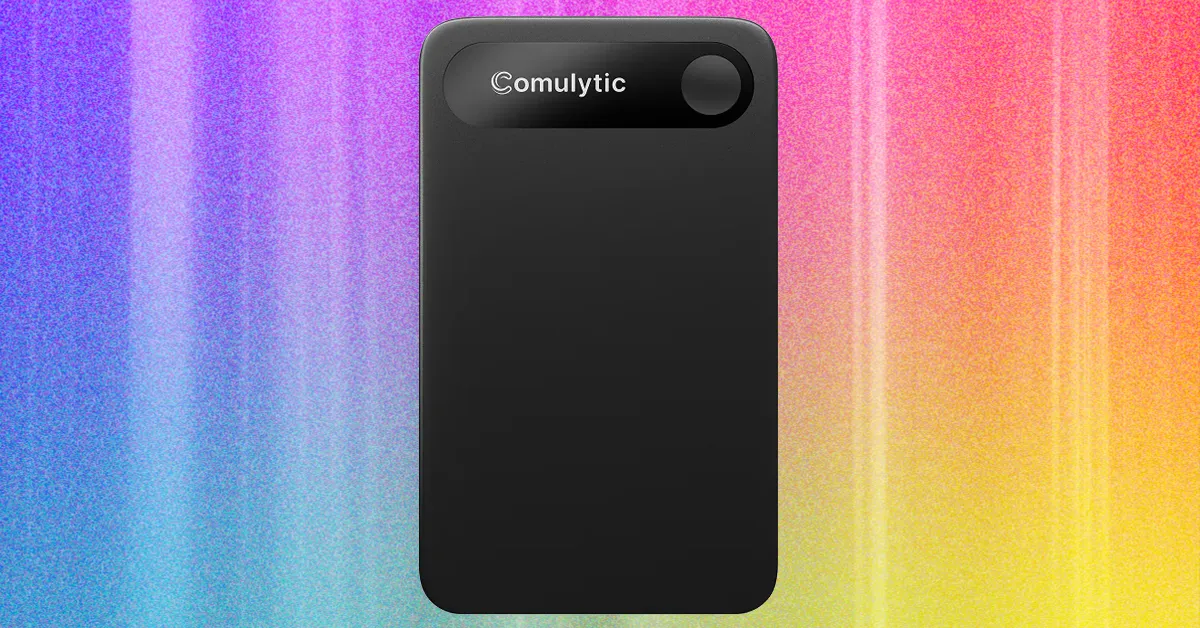





I had low expectations for the rather generic Comulytic Note Pro, but it surprised me as not only the most useful all-around notetaker on available but also the cheapest after you consider the cost of a premium subscription.
The slim device, at 28 grams, is small enough to fit in a wallet or attach unobtrusively with the included magnetic ring to the back of your handset (note: it requires a special USB dongle to charge). The 64 GB of storage space and a 45-hour battery life aren’t massive, but both should be more than enough to handle a full week of interviews without offloading or recharging, all processed through OpenAI’s GPT-5 and Google’s Gemini. The small LCD is helpful (and rare in this market), indicating when you’re recording and offering a recording duration. This makes it a lot more foolproof than other notetakers, which offer nothing more than a colored LED to tell you if it’s on.
The Note Pro supports 113 languages—sort of. It will record in a foreign tongue and offer a verbatim transcript in the native language, but insights and summaries are delivered in your language of choice. It’s not a full solution if you need a complete, direct translation, but if you just need the gist of a foreign news story or speech, Comulytic can uniquely handle it.
The proof is in the quality of the abstracts and insights provided. Of all the devices I tested, Comulytic’s summaries were the most insightful and least rambling (though better than its transcripts), effectively picking out the most relevant portions of interviews and pulling the best quotes from my conversations (perhaps too many at times). It was also the only device to correctly transcribe a punny product nickname mentioned in passing in one interview, indicating that a more sophisticated language model may be behind the scenes.
Advertisement
Comulytic isn’t perfect. It doesn’t transcribe in real time, it’s one of the slowest products at completing analyses, and I never got its “fast transfer” mode working, which meant all recordings had to be sent to my phone via a pokey Bluetooth connection, but these are minor dings against an otherwise solid solution. Best of all, for a limited time, the company includes a generous three months of premium service at no charge. Even if you don’t want to subscribe, the free plan, which offers three “deep dives” and 10 abstracts a month, is better than nothing.
Earlier this year Donut Lab caused quite the furore when they unveiled what they claimed was the world’s first production-ready solid state battery, featuring some pretty stellar specifications. Since then many experts and enthusiasts in the battery space have raised concerns that this claimed battery may not be real, or even possible at all. After seeing the battery demonstrated at CES’26 and having his own concerns, [Ziroth] decided to do some investigating on what part of the stated claims actually hold up when subjected to known science.
On paper, the Donut Lab battery sounds amazing: full charge in less than 10 minutes, 400 Wh/kg energy density, 100,000 charge cycles, extremely safe and low cost. Basically it ticks every single box on a battery wish list, yet the problem is that this is all based on Donut’s own claims. Even aside from the concerns also raised in the video about the company itself, pinning down what internal chemistry and configuration would enable this feature set proves to be basically impossible.
In this summary of research done on Donut’s claimed battery as well as current battery research, a number of options were considered, including carbon nanotube-based super capacitors. Yet although this features 418 Wh/kg capacity, this pertains only to the basic material, not the entire battery which would hit something closer to 50 Wh/kg.
Other options include surface-redox sodium-ion chemistry with titanium oxide. This too would allow for fast charging and high endurance, but Donut has already come out to state that their battery is not capacitor-based and uses no lithium, so that gets shot down too.
Advertisement
Combined with the ‘cheap’ and ‘scalable’ claims this effectively shoots down any potential battery chemistry and architecture. Barring some amazing breakthrough this thus raises many red flags, especially when you consider Donut Lab’s major promises for investors that should make any reasonable person feel skittish about pouring money into the venture.
Sadly, it seems that this one too will not be the battery breakthrough that we’re all waiting for. Even new chemistries like sodium-ion arestruggling to make much of inroads, although lithium-titanate shows real promise. Albeit it not with amazing power density increases that would make it better than plain lithium-ion for portable applications.
The Heat Pass Block first appeared in Samsung’s 2nm Exynos 2600, reportedly delivering a 16 percent improvement in thermal resistance. It’s a copper-based layer built directly onto the processor die, providing a direct pathway for heat to dissipate before it can radiate through surrounding components. Read Entire Article Source link
‘It’s been a rollercoaster year for Irish SMEs looking to raise capital,’ said Caroline Gaynor, chair of the IVCA.
For the first time since 2018, annual venture capital (VC) funding into Irish technology small and medium enterprises (SMEs) has fallen, according to the Irish Venture Capital Association (IVCA) Venture Pulse report.
The report, which was published today (8 February), in partnership with Irish law firm William Fry, indicated that funding in 2025 fell by 23pc to €1.1bn – a decline from 2024’s record €1.48bn. A total of 186 deals were completed in 2025, down from 217 in 2024 – representing a drop of 14pc.
Meanwhile, funding in the fourth quarter specifically fell by 46pc to €291.4m.
Advertisement
For Sarah-Jane Larkin, the director general of IVCA, the fourth quarter and IVCA’s research highlighted the weakness of not being able to tap into local private capital. “A major reason for the 46pc decline in fourth quarter funding was the 71pc fall off in international investment,” she said.
“Another reason for the decrease in international funding may be that US investors may be overly focused on local AI opportunities and certainly the amount of money being invested there is sucking up a lot of venture capital. Unicorn status is being achieved by early stage start-ups in generative AI in the US much quicker than in the past.”
The lack of overseas investment, according to Larkin, is reflected in the significant drop in deals valued at more than €30m, which saw a drop of more than 33pc compared to 2024 at €540.8m. In the fourth quarter specifically, this category fell by 69pc to €111m.
Funding in the €10m-30m range for the year overall also fell, dropping 14pc to €269.4m, while deals under €1m dropped by 26pc to €21.3m.
Advertisement
However, the IVCA indicated that transactions for other smaller rounds held up “reasonably well” in 2025, with funding in the €3m-5m category rising by 39pc to €113.8m. There was a small decline of 3pc in the €1-3m range to €102.2m, and seed funding dropped by 5pc to €141m.
Life science companies attracted the most funding in 2025 in Ireland, raising 40pc of the total at €461m. This was followed by software at €156m, cybersecurity with €136m, AI and machine learning with €104m, and fintech with €96m.
Remaining positive
“It’s been a rollercoaster year for Irish SMEs looking to raise capital,” commented Caroline Gaynor, who is the chair of IVCA. She suggested that instability as a result of US president Donald Trump’s tariffs has, in part, led to the worst second quarter on record seen in the last 10 years.
Advertisement
“In addition, the fourth quarter saw a 71pc retreat from the Irish market by international investors from €470m to €132.4m. This may be due to hesitation and uncertainty by US VC firms due to a number of factors including an ‘America first’ focus, negativity from across the Atlantic about Europe and the impact of a weakening dollar.”
However, Gaynor said she remained positive about Irish entrepreneurs looking to raise capital in 2026. She explained that the Irish Government’s Seed and Venture Capital Scheme 2025 has a record allocation of €250m and the benefits of the scheme should be coming into effect shortly.
“Progress is being made on the Government’s important Enterprise Scaling Fund 2, as well as other policy measures to mobilise capital to Irish SMEs. Current geopolitical events have highlighted the need for us to be more self-reliant, have more access to local capital and not be dependent on overseas investors to fund our indigenous tech sectors.”
With additional reporting by Colin Ryan
Advertisement
Don’t miss out on the knowledge you need to succeed. Sign up for the Daily Brief, Silicon Republic’s digest of need-to-know sci-tech news.
A new open-source and cross-platform tool called Tirith can detect homoglyph attacks over command-line environments by analyzing URLs in typed commands and stopping their execution.
Available on GitHub and also as an npm package, the tool works by hooking into the user’s shell (zsh, bash, fish, PowerShell) and inspecting every command the user pastes for execution.
URLs in commands look identical but are different Source: GitHub
The idea is to block deceptive attacks that rely on URLs containing symbols from different alphabets that appear identical or nearly identical to the user but are treated as different characters by the computer (homoglyph attacks).
This lets attackers create a domain names that looks the same as that of a legitimate brand but have one or more characters from a different alphabet. On the computer screen, the domain looks legitimate for the human eye, but machines interpret the anomalous character correctly and resolve the domain to the server controlled by the attacker.
While browsers have addressed the issue, terminals continue to be susceptible as they can still render Unicode, ANSI escapes, and invisible characters, says Tirith’s author, Sheeki, in the description of the tool.
According to Sheeki, the Tirith can detect and block the following types of attack:
Advertisement
Homograph attacks (Unicode lookalike characters in domains, punycode, and mixed scripts)
Unicode homoglyph characters have been used in the past in URLs delivered over email that led to a malicious website. One example is a phishing campaign last year impersonating Booking.com.
and hidden characters in commands are very common in ClickFix attacks used by a broad range of cybercriminals, so Tirith could provide some level of defense against them on supported PowerShell sessions.
It should be noted that Tirith does not hook onto Windows Command Prompt (cmd.exe), which is used in many ClickFix attacks that instruct users to execute malicious commands.
Sheeki says the overhead of using Tirith is sub-millisecond level, so the checks are performed instantaneously, and the tool terminates immediately when done.
The tool can also analyze commands without running them, break down a URL’s trust signals, perform byte-level Unicode inspection, and audit receipts with SHA-256 for executed scripts.
Advertisement
The creator assures that Tirith performs all analysis actions locally, without making any network calls, does not modify the user’s pasted commands, and does not run in the background. Also, it does not require cloud access or network, accounts, or API keys, and does not send any telemetry data to the creator.
Tirith works on Windows, Linux, and macOS, and can be installed through Homebrew, apt/dnf, npm, Cargo, Nix, Scoop, Chocolatey, and Docker.
BleepingComputer has not tested Tirith against the listed attack scenarios, but the project has 46 forks and almost 1,600 stars on GitHub, less than a week from being published.
Modern IT infrastructure moves faster than manual workflows can handle.
In this new Tines guide, learn how your team can reduce hidden manual delays, improve reliability through automated response, and build and scale intelligent workflows on top of tools you already use.
Deep tech startups in sectors such as space, semiconductors, and biotech take far longer to mature than conventional ventures. Because of that India is adjusting its startup rules, and mobilizing public capital, hoping to help more of them make it to commercial products.
This week, the Indian government updated its startup framework, doubling the period for which deep tech companies are treated as startups to 20 years and raising the revenue threshold for startup-specific tax, grant, and regulatory benefits to ₹3 billion (about $33.12 million), from ₹1 billion (around $11.04 million) previously. The change aims to align policy timelines with the long development cycles typical of science- and engineering-led businesses.
The change also forms part of New Delhi’s effort to build a long-horizon deep tech ecosystem by combining regulatory reform with public capital, including the ₹1 trillion (around $11 billion) Research, Development and Innovation Fund (RDI), announced last year. That fund is intended to expand patient financing for science-led and R&D-driven companies. Against that backdrop, U.S. and Indian venture firms later came together to launch the India Deep Tech Alliance, $1 billion-plus private investor coalition that includes Accel, Blume Ventures, Celesta Capital, Premji Invest, Ideaspring Capital, Qualcomm Ventures, and Kalaari Capital, with chipmaker Nvidia acting as an adviser.
For founders, these changes may fix what some see as an artificial pressure point. Under the previous framework, companies often risked losing startup status while still pre-commercial, creating a “false failure signal” that judged science-led ventures on policy timelines rather than technological progress, said Vishesh Rajaram, founding partner at Speciale Invest, an Indian deep tech venture capital firm.
Advertisement
“By formally recognizing deep tech as different, the policy reduces friction in fundraising, follow-on capital, and engagement with the state, which absolutely shows up in a founder’s operating reality over time,” Rajaram told TechCrunch.
Still, investors say access to capital remains a more binding constraint, particularly beyond the early stages. “The biggest gap has historically been funding depth at Series A and beyond, especially for capital-intensive deep tech companies,” Rajaram said. That is where the government’s earlier RDI fund is meant to play a complementary role.
“The real benefit of the RDI framework is to increase the funding available to deep tech companies at early and growth stages,” said Arun Kumar, managing partner at Celesta Capital. By routing public capital through venture funds with tenors similar to private capital, he said, the fund is designed to address chronic gaps in follow-on funding without altering the commercial criteria that govern private investment decisions.
Techcrunch event
Advertisement
Boston, MA | June 23, 2026
Siddarth Pai, founding partner at 3one4 Capital and co-chair of regulatory affairs at the Indian Venture and Alternate Capital Association, said India’s deep tech framework avoids a “graduation cliff” that has historically cut companies off from support just as they scale.
Advertisement
These policy changes come as the RDI fund is beginning to take shape operationally, Pai said, with the first batch of fund managers identified and the process of selecting venture and private equity managers under way.
While private capital for deep tech already exists in India — particularly in areas such as biotech — Pai told TechCrunch the RDI Fund is intended to act as a nucleus around which greater capital formation can occur. Unlike a traditional fund-of-funds, he noted, the vehicle is also designed to take direct positions and provide credit and grants to deep tech startups.
India’s deep tech funding grows
In terms of scale, India remains an emerging rather than dominant deep tech market. Indian deep tech startups have raised $8.54 billion in total to date, but recent data point to renewed momentum. Indian deep tech startups raised $1.65 billion in 2025, a sharp rebound from $1.1 billion in each of the previous two years after funding peaked at $2 billion in 2022, per Tracxn. The recovery suggests growing investor confidence, particularly in areas aligned with national priorities such as advanced manufacturing, defence, climate technologies, and semiconductors.
“Overall, the pickup in funding suggests a gradual move toward longer-horizon investing,” said Neha Singh, co-founder of Tracxn.
Advertisement
In comparison, U.S. deep tech startups raised about $147 billion in 2025, more than 80 times the amount deployed in India that year, while China accounted for roughly $81 billion, data from Tracxn shows.
The disparity highlights the challenge India faces in building capital-intensive technologies, even with its wealth of engineering talent. So the hope is that these moves by the Indian government will lead to more investor participation over the medium term.
Image Credits:Jagmeet Singh / TechCrunch
A longer-term signal
For global investors, New Delhi’s framework change is being read as a signal of longer-term policy intent rather than a trigger for immediate shifts in allocation. “Deep tech companies operate on seven- to twelve-year horizons, so regulatory recognition that stretches the lifecycle gives investors greater confidence that the policy environment will not change mid-journey,” said Pratik Agarwal, a partner at Accel. While he said the change would not alter allocation models overnight or eliminate policy risk entirely, it increased investor comfort that India is thinking about deep tech on longer time horizons.

“The change shows that India is learning from the U.S. and Europe on how to create patient frameworks for frontier building,” Agarwal told TechCrunch.
Whether the move will reduce the tendency of Indian startups to shift their headquarters overseas as they scale remains an open question.
Advertisement
The extended runway strengthens the case for building and staying in India, Agarwal said, though access to capital and customers still matters. Over the past five years, he added, India’s public markets have shown a growing appetite for venture-backed tech companies, making domestic listings a more credible option than in the past. That, in turn, could ease some of the pressure on deep tech founders to incorporate overseas, even if access to procurement and late-stage capital will continue to shape where companies ultimately scale.
For investors backing long-horizon technologies, the ultimate test will be whether India can deliver globally competitive outcomes. The real signal, Kumar of Celesta Capital said, would be the emergence of a critical mass of Indian deep tech companies succeeding on the world stage.
“It would be great to see ten globally competitive deep tech companies from India achieve sustained success over the next decade,” he said, describing that as the benchmark he would look for in assessing whether India’s deep tech ecosystem is maturing.
A new NYT Connections puzzle appears at midnight each day for your time zone – which means that some people are always playing ‘today’s game’ while others are playing ‘yesterday’s’. If you’re looking for Sunday’s puzzle instead then click here: NYT Connections hints and answers for Sunday, February 8 (game #973).
Good morning! Let’s play Connections, the NYT’s clever word game that challenges you to group answers in various categories. It can be tough, so read on if you need Connections hints.
What should you do once you’ve finished? Why, play some more word games of course. I’ve also got daily Strands hints and answers and Quordle hints and answers articles if you need help for those too, while Marc’s Wordle today page covers the original viral word game.
Advertisement
SPOILER WARNING: Information about NYT Connections today is below, so don’t read on if you don’t want to know the answers.
Advertisement
NYT Connections today (game #974) – today’s words
(Image credit: New York Times)
Today’s NYT Connections words are…
APPROACH
BONUS
POKER
NEEDLE
STRAWS
LOOM
STYLE
ADVANCE
NEAR
WAY
SCISSORS
FEE
ROYALTY
YARN
MANNER
THE LINE
NYT Connections today (game #974) – hint #1 – group hints
What are some clues for today’s NYT Connections groups?
YELLOW: Things needed for textile production
GREEN: How it’s done
BLUE: How writers are paid
PURPLE: Begin with an artistic word
Need more clues?
We’re firmly in spoiler territory now, but read on if you want to know what the four theme answers are for today’s NYT Connections puzzles…
Sign up for breaking news, reviews, opinion, top tech deals, and more.
Advertisement
NYT Connections today (game #974) – hint #2 – group answers
What are the answers for today’s NYT Connections groups?
YELLOW: USED IN WEAVING
GREEN: METHOD
BLUE: KINDS OF PAYMENT FOR AN AUTHOR
PURPLE: DRAW _____
Right, the answers are below, so DO NOT SCROLL ANY FURTHER IF YOU DON’T WANT TO SEE THEM.
NYT Connections today (game #974) – the answers
(Image credit: New York Times)
The answers to today’s Connections, game #974, are…
YELLOW: USED IN WEAVING LOOM, NEEDLE, SCISSORS, YARN
GREEN: METHOD APPROACH, MANNER, STYLE, WAY
BLUE: KINDS OF PAYMENT FOR AN AUTHOR ADVANCE, BONUS, FEE, ROYALTY
PURPLE: DRAW _____ NEAR, POKER, STRAWS, THE LINE
My rating: Easy
My score: Perfect
I whizzed through today’s game, without knowing what the groups were, just seeing the links between the words.
I should have spotted KINDS OF PAYMENT FOR AN AUTHOR first, as this is something I have experienced. Getting an ADVANCE is quite the thrill and feels a bit like cheating as you haven’t actually supplied anything, but that feeling soon subsides as you begin to feel the pressure to hit the deadline and get the far bigger check that follows. It’s actually a pretty good system to motivate procrastinators.
Despite speeding through, I still enjoyed the tingle of getting the four groups in difficulty order, something I’ve now done 150 times according to the app. What are your Perfect Puzzle stats?
Advertisement
Yesterday’s NYT Connections answers (Sunday, February 8, game #973)
YELLOW: SUPPRESS GAG, INHIBIT, MUZZLE, SILENCE
GREEN: SAME OLD STUFF DRILL, GRIND, HABIT, ROUTINE
BLUE: FEATURES OF A STRONG PASSWORD LENGTH, NUMBER, SYMBOL, UPPERCASE
PURPLE: WORDS AFTER “TWO” BIT, CENTS, FACED, TIMER
What is NYT Connections?
NYT Connections is one of several increasingly popular word games made by the New York Times. It challenges you to find groups of four items that share something in common, and each group has a different difficulty level: green is easy, yellow a little harder, blue often quite tough and purple usually very difficult.
On the plus side, you don’t technically need to solve the final one, as you’ll be able to answer that one by a process of elimination. What’s more, you can make up to four mistakes, which gives you a little bit of breathing room.
It’s a little more involved than something like Wordle, however, and there are plenty of opportunities for the game to trip you up with tricks. For instance, watch out for homophones and other word games that could disguise the answers.
Advertisement
It’s playable for free via the NYT Games site on desktop or mobile.
A new NYT Strands puzzle appears at midnight each day for your time zone – which means that some people are always playing ‘today’s game’ while others are playing ‘yesterday’s’. If you’re looking for Sunday’s puzzle instead then click here: NYT Strands hints and answers for Sunday, February 8 (game #707).
Strands is the NYT’s latest word game after the likes of Wordle, Spelling Bee and Connections – and it’s great fun. It can be difficult, though, so read on for my Strands hints.
Want more word-based fun? Then check out my NYT Connections today and Quordle today pages for hints and answers for those games, and Marc’s Wordle today page for the original viral word game.
Advertisement
SPOILER WARNING: Information about NYT Strands today is below, so don’t read on if you don’t want to know the answers.
Advertisement
NYT Strands today (game #708) – hint #1 – today’s theme
What is the theme of today’s NYT Strands?
• Today’s NYT Strands theme is… Frequent flyer
NYT Strands today (game #708) – hint #2 – clue words
Play any of these words to unlock the in-game hints system.
TRAP
SPORT
PITY
GROPE
MURAL
COIL
NYT Strands today (game #708) – hint #3 – spangram letters
How many letters are in today’s spangram?
• Spangram has 8 letters
Advertisement
NYT Strands today (game #708) – hint #4 – spangram position
What are two sides of the board that today’s spangram touches?
First side: left, 5th row
Last side: right, 5th row
Right, the answers are below, so DO NOT SCROLL ANY FURTHER IF YOU DON’T WANT TO SEE THEM.
Advertisement
NYT Strands today (game #708) – the answers
(Image credit: New York Times)
The answers to today’s Strands, game #708, are…
Advertisement
RUNWAY
LUGGAGE
SECURITY
PASSPORT
PILOT
TARMAC
SPANGRAM: AIRPORTS
My rating: Hard
My score: Perfect
After initially thinking we were looking for airlines and then, after getting the spangram first, the names of AIRPORTS I was relieved when it was simply a case of airport-related words.
Sign up for breaking news, reviews, opinion, top tech deals, and more.
Airport terminals are often described as being a living hell, but I’d reserve that description for any branch of Build A Bear Workshop on a Saturday afternoon. There are many things I don’t like about them, but I’ve found arriving for flights four hours earlier relieves my tension and allows me to enjoy the frisson of international jet set travel and the unique availability of gigantic Toblerones.
Anyway, this search presented minimal surprises, but I did find it slow going. I hope your passage was smoother.
Advertisement
Yesterday’s NYT Strands answers (Sunday, February 8, game #707)
OLIVE
CHERRY
SHRIMP
TWIST
CELERY
SPRIG
SPANGRAM: COCKTAILGARNISH
What is NYT Strands?
Strands is the NYT’s not-so-new-any-more word game, following Wordle and Connections. It’s now a fully fledged member of the NYT’s games stable that has been running for a year and which can be played on the NYT Games site on desktop or mobile.
I’ve got a full guide to how to play NYT Strands, complete with tips for solving it, so check that out if you’re struggling to beat it each day.
The Milano Cortina 2026 Winter Olympics torch, dubbed “Essential,” is a quiet game changer in an object that has been passing the flame around the world for decades. Carlo Ratti, the architect, approached the project with a question in mind: how does an object transmit emotion? His instruction was to pare down to the bare essentials and let the flame do the talking.
So his team set out to reduce the size of the holder while keeping the fire as the main attraction. A little slot runs along the side of the object, allowing viewers to have a good look at the burner mechanism and see the fire burning away inside. As the torch moves from person to person, they get to experience the entire thing come to life.
MODEL KIT FOR ADULTS – Adults ages 18 and up can embrace their love of architecture with this LEGO building set (21064), which makes striking home…
DETAILED PARIS DECOR – This detailed model features 4 iconic Paris landmarks—the Eiffel Tower, Notre-Dame de Paris, the Arc de Triomphe, and the…
HANG OR STAND TO DISPLAY – Your completed cityscape includes a buildable frame and a decorated ‘City of Love’ brick and can be hung on a wall or…
The materials Ratti picked felt quite restrained, since the body is comprised of recyclable aluminum with a bit of brass tossed in; it weighs just under 2.5 pounds, making it the lightest Olympic torch ever produced. That was no small effort given that all of the usual suspects were involved: engineers, Olympic committees, and sponsor Versalis all worked together over three years to perfect the design. They even included a fancy heat-resistant coating that makes the torch look like the Italian skies on a sunny day, as opposed to the Paralympic torch, which has a gold finish, but both of them have this lovely quality where the light bounces off and appears to change in the light, similar to how the mountains or city lights reflect back at you.
Sustainability is the name of the game here, as the torch is powered by a special, bio-friendly kind of gas manufactured from sustainable materials, courtesy of ENI. Instead of burning out after a single use, this torch can be recharged up to ten times, requiring fewer of them in the first place, which is better for the environment. The flame, however, remains as steady as a rock, even when the wind is howling, it is raining, or you are stuck up a mountain, and it all began in Olympia, Greece, then traveled to Italy, where it toured all 110 provinces before eventually arriving in Milan for the big ceremony on February 6th.
Advertisement
The clean lines and exquisite shape reflect the Italian design history. Ratti describes it as sleek, extended, and appears to be constructed of almost nothing at all due to the body’s receding shape. The flame simply pokes out at you and pulls your attention straight to it, as it should, emphasizing its function as a symbol of all that is good in the world, including togetherness, friendship, and people working together.
Boston Dynamics is finishing up a long chapter in the Atlas robot’s existence before shifting its focus to the electric production model that will be used on the factory floor. The company collaborated with the Robotics & AI Institute to push this robot’s full-body movement and control capabilities one last time.
The test begins with Atlas strolling around an open area, moving its legs in a manner that is quite similar to how humans walk, but things rapidly become much more fascinating and demanding when it attempts a cartwheel. Atlas moves cleanly sideways, with its arms and legs functioning in perfect harmony to maintain motion. The cartwheel transitions into a backflip. The robot tucks its body and spins in the air, arms and legs still in perfect sync, before landing smoothly on both feet. Even when spinning through the air, the robot remains tight and controlled, and when it falls, the impact is absorbed so it does not simply collapse.
Height, width and thickness (standing): 1270x450x200mm Height, width and thickness (folded): 690x450x300mm Weight with battery: approx. 35kg
Total freedom (joint motor): 23 Freedom of one leg: 6 Waist Freedom: 1 Freedom of one arm: 5
Maximum knee torque: 90N.m Maximum arm load: 2kg Calf + thigh length: 0.6m Arm arm span: approx. 0.45m Extra large joint movement space Lumbar Z-axis…
Later on, you can see how effectively Atlas recovers from difficult situation, whether it be jumping onto platforms, clearing gaps, or even when its equilibrium moves unexpectedly. One of the most memorable moments is when the robot takes a step, lands, and then adjusts its foot position before continuing on. These adjustments highlight the precision built within the control software. Some of the runs are smooth and flawless, while others show the robot stumbling and even losing part of its foot cover during a hard landing.
Working with the RAI Institute was an important aspect of the project, and their whole-body learning method paid off handsomely. It allowed the scientists to teach behaviors in simulation that could be applied directly to the physical robot, implying that both everyday walking and these high-speed acrobatics may be performed using the same approaches. This points to computers that can handle a wide range of tasks without requiring distinct programming for each.
Rather than delid the $12,000 workstation chip, the team reverse-engineered its heat spreader to design a replacement from scratch. They borrowed an integrated heat spreader (IHS) through Asus China’s general manager Tony Yu and then used older Ryzen Threadripper 1900X chips as test subjects. Read Entire Article Source link