There are many factors to consider when buying a vehicle, whether new or used. Not only are there vital questions to ask oneself before committing to any new car, but there’s also the seemingly endless parade of vehicles to choose from, be they practical crossovers or svelte, two-seater performance cars.
One of the main ways that manufacturers differentiate their cars from one another, at least on paper, is through the specs. Some, like fuel efficiency and cargo room, are pretty mundane, while others, like the performance numbers that sportier cars often lead with, can be quite eye-catching. The thing is, though, not all of the latter are all that useful — at least, not for the general driver.
Advertisement
Figures like peak horsepower, 0-60 mph times, and lateral g are nice if you’re bench racing, but they aren’t the be-all-end-all of cars. This isn’t to say that they’re wholly unimportant for everyone, mind you; someone looking for a car to take to weekend track days should, of course, pay a lot of attention to a car’s horsepower and acceleration numbers. However, if you’re mostly driving on public roads, you really don’t need to stress out about these when you’re trying to whittle down your shortlist to a handful of vehicles.
Advertisement
Horsepower
Toa55/Getty Images
A car’s horsepower is often one of the most emphasized numbers when marketing a vehicle, especially for performance cars. After all, more horsepower supposedly equals better. And while having 717 hp on tap does make cars like the 2025 BMW M5 we reviewed a hoot to drive, there’s more to a vehicle’s driving experience than its horsepower.
Peak engine horsepower is one of the most common ways to express an engine’s capabilities, but regardless of how you measure it, horsepower is undeniably essential for racers seeking to eke out the best lap (or quarter-mile) times possible. But how often is the average driver wringing every last bit of juice out of an engine on a long straightaway? Not very, we’d imagine — unless, of course, they’re blessed enough to have access to the unrestricted sections of Germany’s infamous Autobahn. Even then, they’ll still have to deal with start-stop city traffic and low-speed driving, where even all the horsepower in the world won’t matter as much as having a responsive, torquey engine.
Now, we’re not trying to say that one should always prioritize torque over horsepower, especially since you can’t really have one without the other. Besides, many modern high-horsepower engines will also make more than enough torque to feel responsive at low speeds, offering the best of both worlds. However, if you’re primarily driving around town and rarely, if ever, get into situations where you can stretch your car’s legs, horsepower is one number that should take a backseat to other, more practical considerations.
Advertisement
0-60 times
A car’s 0-60 mph time is often held up as a key metric to indicate its performance. And it’s not entirely baseless. All other things being equal, a car with a lower 0-60 mph time will indeed accelerate better and be objectively quicker from a standstill (well, kind of — more on this later). However, therein lies the rub: Realistically, how often will you be making high-rpm launches from standing starts on the road?
An amazing 0-60 mph time, on its own, won’t matter that much if you rarely find yourself in that sort of a situation … and we’d venture that most people won’t. This isn’t to say that acceleration is entirely pointless, though; it’s essential when pulling out to overtake cars — the quicker you can do that, the better. However, in those situations, numbers like 30-50 mph acceleration times — which some reviewers test for — are more important, as they better represent a car’s midrange power and responsiveness.
Beyond that, 0-60 mph times are often fraught with caveats that make them less definitive than you might expect. Many U.S.-based car reviewers publish 0-60 mph times that omit a 1-foot rollout — leading to arguably misleading figures. Similarly, these numbers don’t always reflect real-world situations, either. Journalists are known for treating cars roughly to get the best possible times, while manufacturers aren’t above stacking things in their favor, either. Some headline-grabbing 0-60 mph times, like the 1,250-hp Corvette ZR1X’s crazy 1.68 seconds, were recorded on prepared surfaces that do not reflect typical public road conditions.
Advertisement
Engine displacement
There’s no replacement for displacement, as the saying goes — or is there? Well, that depends entirely on who you ask and what their interests are, but we’d suggest the average driver really doesn’t need to care much about how big their engine is these days. Unless you need massive grunt for towing heavy loads — or just drive a big car, which is why so many American vehicles still have big engines — then many drivers will be fine with a smaller, turbocharged, four- or six-cylinder engine instead.
Advertisement
But even in those situations, bigger may not always be better. Case in point: Ram reintroduced the 5.7-liter HEMI V8 into the 2026 Ram 1500, which, if one were to go solely by displacement, would be the best engine for the truck. However, as we found out when we reviewed a 2026 Ram 1500, the 5.7-liter V8 makes less horsepower and torque than the 3.0-liter Hurricane inline-six and actually feels slower in the real world, too. On top of that, it’s less economical and doesn’t tow as much as the inline-six.
Smaller engines reduce a car’s weight, which, in turn, allows for better fuel economy. And you don’t necessarily have to give up raw performance, either. Thanks to forced induction, there are even four-cylinder engines that make more power than a traditional V8. Now, that won’t apply to all engines, but it’s a great example of how you can’t solely go by displacement to determine a vehicle’s worthiness — or lack thereof.
Advertisement
Top speed
JustPhotos22/Shutterstock
Ah, top speed. Is there a performance number that more readily evokes the thrills of high-end motoring? Probably not. And yet, for the average driver who sticks to public roads, top speed is a mostly pointless number — as are, arguably, ultra-high-end hypercars like the Rimac Nevera R and its many equally pointless records.
This isn’t to say that the Nevera R isn’t an impressive feat of engineering, or that we don’t respect the amount of work that it takes to get a car like the Koenigsegg Regera to hit its top speed. However, we imagine that even owners of those cars won’t be taking them to the limit regularly, if ever. Scale that down to the much more mundane lives most of us lead, and top speed is almost silly to even pay any attention to — and that’s even without taking into account the risk of falling foul of laws such as Florida’s harsh new “super speeder” law.
Some modern cars have speed limiters anyway, with German automakers like BMW, for example, restricting cars to 155 mph, rendering the spec meaningless. Two cars may have wildly different performance profiles but look the same on paper if one were to go solely by the top speed figure, rendering it a useless point of comparison.
Advertisement
Skidpad lateral gs
Jbromley/Getty Images
Numbers like horsepower, 0-60 mph times, and top speed generally focus on a car’s straight-line performance, but conventional cars don’t go only in a straight line. A car’s ability in the corners is often just as important, and there’s a stat that supposedly covers that, too: G-forces measure the forces acting on objects when accelerating or decelerating.
Now, this usually isn’t a spec that automakers publish; instead, you’ll most often find it in third-party reviews from the likes of Motor Trend and Car and Driver, both of which will include a skidpad lateral g figure in their reviews. The latter calls it “roadholding,” and the idea, then, is that a car with good roadholding (and higher skidpad G-force numbers) will be able to stick to the road and maintain its direction of travel better. More gs equals more grip, generally speaking, and a bigger number will represent how hard a car can take corners.
However, while it can be a useful number, it’s not the be-all and end-all of car handling. For one, even Motor Trend itself had to admit that cars can perform significantly differently on track than the numbers might suggest, depending on various factors. One might uncharitably suggest that makes the number entirely meaningless, then, although we won’t go that far. Beyond that, there’s also the question of how often the majority of drivers will be pushing their cars’ limits and carving up corners at high speeds in their daily lives anyway, and the phrase that comes to mind is “almost never.”
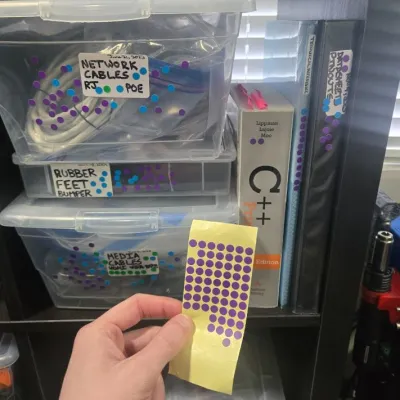
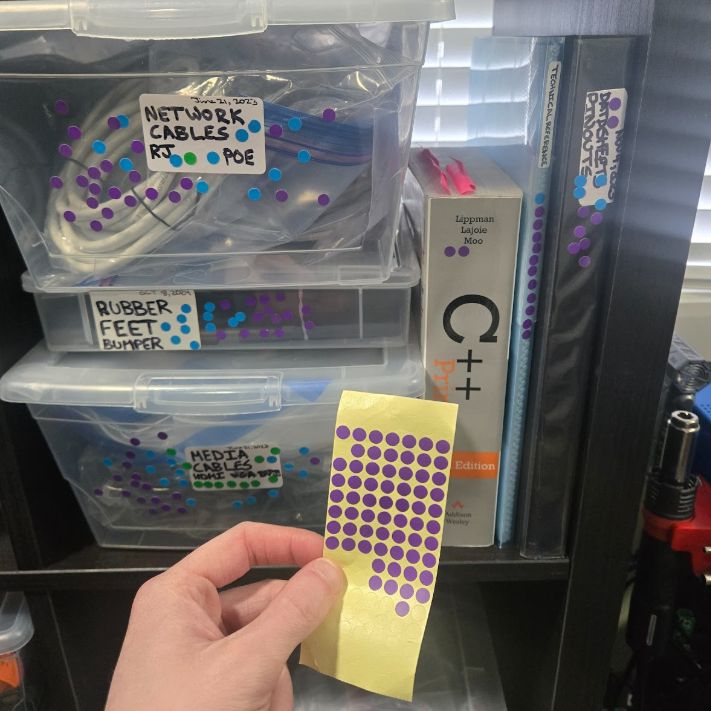
Many of us are guilty of toeing the line between having a ready supply of components at hand and simply hoarding for fear of throwing anything out. In a first admission of this problem, [Scott Lawson] decided to implement a couple of changes to assess his own position on this sliding scale.
The first change was to only put parts, components, and supplies in transparent boxes. Next was to add a sticker on each box noting the contents and box creation date. This was extended to plastic bags inside the boxes when further subdivision was warranted.
Next, the question was about usage patterns, as you may think that you know how often you use something from a specific box, or how important its contents are, but it helps to add some objectivity to this. For this, [Scott] used sheets of dot stickers, with a sticker added each time he opened a box and used something from it.
By persistently doing this for a few years at his home lab, [Scott] was able to assess which boxes fell into any of three categories: hot, warm, and cold. Cold boxes are very rarely — if ever — accessed, and can thus be readily moved to the attic, shed, or even sold off if they have spent a year or longer in cold storage. Hot boxes should obviously be kept near the work areas. This way, one can make objective decisions of what boxes should go where for optimal access, and what things in your home lab are basically just there to look pretty and gather dust.
Advertisement
This is an effective low-tech way to get organized. Or you can go the opposite direction.
KPop Demon Hunters fans, get to McDonald’s fast. For a limited time, you can nab a meal that might seem like an April Fool’s Day joke, but isn’t. Participating McDonald’s restaurants are offering both the HUNTR/X meal, named for the girl group from Netflix’s Oscar-winning animated film, KPop Demon Hunters, and the Saja Boys Breakfast Meal, named for the movie’s boy band.
I beat a path to McDonald’s on Tuesday, the first day the new meals were out, so I could try everything.
Advertisement
I mean, yay, holographic photo cards, but I think I would have preferred a KPop Demon Hunters figurine. Or patterned socks, like those that were given out with the Grinch meal.
NYT/Screenshot by CNET
And the KPop Demon Hunters items are surprisingly pretty good! Be warned: Once word gets around, they might be hard to get. The McDonald’s holiday Grinch Meal sold out quickly at some locations (too bad if you wanted a pair of the adorable Grinch-themed socks that came with it), so don’t wait on this limited-edition menu.
Shake up the fries, skip the Demon sauce
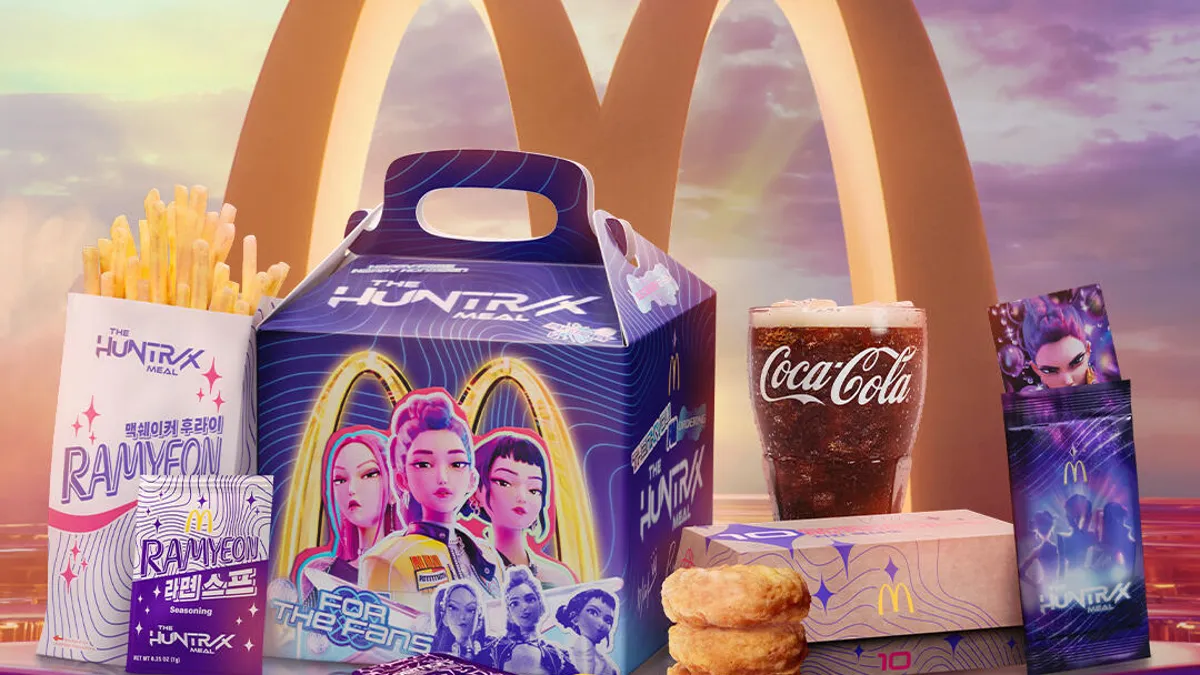
The HUNTR/X Meal, named for the K-pop girl group in KPop Demon Hunters, is a 10-piece chicken McNuggets meal that includes a medium drink and three special menu items.
Advertisement
The top fry is one I shook up with the Ramyeon seasoning, while the other one is just a regular McDonald’s fry. I was surprised by how much I liked the seasoning!
Gael Fashingbauer Cooper/CNET
Ramyeon McShaker fries come with a small bag of soy, garlic, sesame and spice seasoning, along with regular McDonald’s fries. You sprinkle the seasoning into the provided bag, dump in the fries, shake it all up and eat.
McDonald’s does not skimp on the amount of fry seasoning they give you.
Advertisement
NYT/Screenshot by CNET
My take: McDonald’s fries are legendary, and honestly, I didn’t want to season them and risk wrecking the taste. Here’s the shocker: I loved it. They give you a ton of seasoning, and the fries become thickly coated, which I thought would be a nightmare. But they were a salty, tasty delight. There’s no meat in the seasoning, but it reminded me of a fried-chicken coating — tasty and rich.
The meal includes two new sauces for the fries and nuggets. Hunter sauce is a sweet chili sauce mixing notes of chili, garlic and pepper. If you’re familiar with McDonald’s longtime sweet-and-sour sauce, this reminded me of that, with just a touch of heat.
You can order one of each of the two KPop Demon Hunters sauces. Hunter sauce is better than the shockingly purple Demon sauce, in my humble opinion.
Advertisement
Gael Fashingbauer Cooper/CNET
The other new sauce is Demon sauce, a mustard sauce with some heat and a bold purple color. There’s just not enough dark purple food out there. But while the color was cool, I ended up scraping the Hunter sauce cup almost empty, leaving most of the purple Demon sauce behind. I appreciated the almost-but-not-quite wasabi flavor of the mustard, but I wouldn’t order this sauce again.
Look! My McNugget is wearing a purple wig! The best thing about the Demon sauce was the bold purple color, not the kind-of-meh hot-mustard sauce itself.
NYT/Screenshot by CNET
You can try both sauces without an extra charge. I ordered via the app and just selected one of each of the two new sauces.
Advertisement
Ramyeon McShaker fries come with a small bag of a soy, garlic, sesame and spice seasoning that customers sprinkle into a bag with the fries and shake up before eating.
McDonald’s
There’s also a new dessert, the Derpy McFlurry, which blends creamy vanilla soft serve with berry-flavored popping boba pearls and a swirl of wild berry sauce. McDonald’s named it for the supernatural feline, Derpy Tiger, from the KPop Demon Hunters movie.
You know all the jokes about how McDonald’s ice-cream machine is always broken? I tried to order the Derpy McFlurry at my local McDonald’s, but the app said it wasn’t available. I don’t know if that location’s ice cream machine was actually broken or if they didn’t get their shipment of popping pearls, but this is America: There was another McDonald’s less than a mile away that had the dessert.
Advertisement
My McFlurry had kind of melted by the time I got home because the McDonald’s closest to my house didn’t have it. Insert your favorite “McDonald’s eternal broken ice-cream machine” joke here.
NYT/Screenshot by CNET
And I’m glad they did! Although I’m not a berries-in-ice-cream fan, the thick soft-serve and wildberry sauce (blueberry? raspberry? both? I couldn’t tell) were a smooth, sweet mash-up. The boba pearls were fun to pop inside my mouth, too, though beware, they kind of leave behind a little… boba skin?
Advertisement
The Derpy McFlurry blends creamy vanilla soft serve with berry popping pearls.
McDonald’s
If breakfast is your bag, the new morning meal is the Saja Boys Breakfast Meal.
It includes a Spicy Saja McMuffin sandwich, which is a sausage McMuffin with egg and a spicy Saja sauce, hash browns and a small drink. I hadn’t had the chance to tell my husband what was in the sandwich when he swooped through the kitchen while talking on a work call and nabbed a bite. He widened his eyes and waved at his mouth in the universal signal for “HOT!”
At first, I thought he was exaggerating, but then I had a second bite, and the orangish, peppery sauce is hot. It’s also too sweet for my taste, and I wouldn’t reorder this. Without the sauce, the breakfast is just an Egg McMuffin.
Advertisement
The Spicy Saja McMuffin is a sausage McMuffin with egg, topped with a peppery sauce.
NYT/Screenshot by CNET
Both meals come with a photocard for one of the bands and a Derpy card. My breakfast meal included a photo card of Jinu, and my lunch meal featured one of Zoey. Each meal also had a Derpy card with a picture of Derpy Tiger and a QR code that, for some reason, I found incredibly difficult to scan. When I finally did, it took me to the McDonald’s app on my phone and asked for the code on the card. Then it didn’t really do anything.
A McDonald’s rep told me that’s by design: Entering the code means I will unlock content that won’t appear until April 26 and will reveal “the winner of McDonald’s ultimate battle for the fans.” So, I got that goin’ for me.
Advertisement
Demon sauce is a bold mustard sauce with heat and tang — and best of all, it’s bright purple.
McDonald’s
The full KPop Demon Hunters menu should be available at participating McDonald’s locations now, and while I nudged McDonald’s reps for an exact ending date, it’s just “while supplies last.”
Advertisement
Hunter sauce is a sweet chili sauce mixing notes of chili, garlic and pepper.
McDonald’s
My final take: KPop Demon Hunters fans will get a kick out of the meals, though if they are kids, they may wish for a smaller Happy Meal-style option. Ten McNuggets and fries are a lot, and a spicy Egg McMuffin probably isn’t for everybody. I tried to order a mini version of the Derpy McFlurry, but it was grayed out in my app, and the regular one was enormous.
If you do want to try the meals, I highly recommend the fries with the Ramyeon seasoning, the Hunter sauce and the Derpy McFlurry with its satisfying popping boba (share it with a friend if you have a small appetite or if, like me, you’re slogging through the full KPop Demon Hunter menu). I’d give a pass to the Demon sauce and the Spicy Saja McMuffin.
It’s also a bit of a bummer that the only extras in the meals (besides the colorful themed Happy Meal-style boxes) were glittery holographic photo cards and a code for online content that’s still a month away. No collectible figurines or even patterned socks a la the Grinch? That hit a bit of a sour note in this musical munch-fest.
Apple has signed a driver for AMD or Nvidia eGPUs connected to Apple Silicon but there are some big caveats, and it won’t improve your graphics. Here’s what they’re for.
An earlier time when you could use eGPUs with Macs
When Apple announced the use of eGPUs with AMD Radeon cards in 2016, we were pretty excited. Full support shipped in early 2017 and for a few short years, Thunderbolt provided an excellent graphics-accelerating one-cable dock to our MacBook Pros. But even then, Apple has stubbornly prevented modern Nvidia GPUs from working with Macs. And, with the change to Apple Silicon, Apple effectively killed off any real use of an externally usable Nvidia GPU with its Mac lineup. Continue Reading on AppleInsider | Discuss on our Forums
Lindsay-Rae McIntyre is the new chief people officer at Seattle-based Alaska Airlines. She joins the airline from Microsoft, where she most recently served as chief diversity officer and corporate VP of Talent and Learning.
“There is a vast, complex world counting on Microsoft to help bend the arc of the future toward good,” McIntyre said in LinkedIn post framed as a two-part letter to the tech giant and her new employer.
“I am honored to have been part of this transformation for the past eight years,” she said of her time at Microsoft. “Please take good care of one another, and of our customers.”
Addressing the combined teams at Alaska and Hawaiian Airlines, McIntyre noted deep family ties to the industry: her grandfather and uncle were pilots for Air Canada, and her aunt was a flight attendant. “I grew up in awe of airplanes and of the extraordinary people who make air travel possible,” she said.
Prior to Microsoft, McIntyre was with IBM for more than 18 years serving in top leadership roles.
Advertisement
Armon Dadgar. (LinkedIn Photo)
— Armon Dadgar, the Seattle-based co-founder and chief technology officer for HashiCorp, is leaving the infrastructure software company. Dadgar launched HashiCorp in 2012 with co-founder Mitchell Hashimoto after the two graduated from the University of Washington. IBM acquired the San Francisco company for $6.4 billion last year.
“For me, HashiCorp was always more than a job, and I’ve always felt a deep sense of responsibility for the people, products, customers, and community,” Dadgar said on LinkedIn. “The role I’ve played has always been rewarding, but equally it has been demanding.”
Dadgar, whose last day at HashiCorp is Friday, said he will take time to “pause and recharge” and will be moving from Seattle to New York City.
Omar Shahine. (LinkedIn Photo)
— After nearly three decades at Microsoft, Omar Shahinehas taken on a new role leading a team developing personal assistants for Microsoft 365 customers. He previously served as corporate vice president for Microsoft Word.
“My goal is to help usher in a new generation of proactive assistants, ones that lighten your load by taking on tasks end-to-end, and that can also step in proactively when they can help,” Shahine said on LinkedIn.
His role includes partnering with the OpenClaw and Microsoft 365 communities. Shahine’s new assignment comes amid a steady stream of new releases in Microsoft’s Copilot tools for businesses in the competitive agentic AI landscape.
Advertisement
Damon Lanphear. (Artera Photo)
— Damon Lanphear is the new chief technology officer at Artera, a company using agentic AI to help healthcare providers communicate with patients. Lanphear joins the company from Amazon, where he spent more than five years across two stints, most recently as a director of engineering. He previously held the same title at AWS.
A veteran of the Seattle health-tech scene, Lanphear was the CTO for pioneering telehealth startup 98point6 for nearly seven years, joining that company at its inception.
Lanphear will work in a hybrid role for the Santa Barbara, Calif.-based Artera.
Atul Deo. (LinkedIn Photo)
— Atul Deo has joined SAP as senior VP and global head of AI Product Management and Partnerships, where he will lead work on the company’s AI assistant and broader AI platform. Based in Seattle, Deo will work in a hybrid role for the German-headquartered software giant.
Deo joins SAP from Amazon, where he spent nearly 12 years and was the founder and general manager for Amazon Bedrock, the flagship generative AI platform for Amazon Web Services (AWS).
“This next chapter is a deliberate shift. It brings together my experience with a deeper focus on how AI is applied to business processes and outcomes,” Deo said on LinkedIn. “The opportunity to make AI genuinely useful in real systems of record and decision-making is what drew me here.”
Advertisement
John He. (LinkedIn Photo)
— John Heis spearheading the launch of the first U.S. office for PixVerse, a Singapore-based video generation startup. Serving as U.S. general manager, builder and chief of staff, He is setting up the new office in Bellevue, Wash.
He spent more than a decade at Microsoft early in his career, departing in 2018, and most recently came to PixVerse from Salesforce. His background also includes co-founding MinMax AI and a tenure at Alibaba Group.
— Truveta named Robin Damschroder, an executive VP and CFO at Henry Ford Health, as chair of its board of directors. She succeeds Dr. Rod Hochman. The Seattle-area health data company has made numerous changes to company leadership in recent months.
— Abdurazak Mudesir is resigning from the T-Mobile board of directors, effective today. The Bellevue, Wash.-based wireless carrier disclosed the news in a recent SEC filing.
— Starcloud, a startup building solar-powered, space-based data centers, added Benchmark general partner Chetan Puttagunta to its board of directors as part of a $170 million funding round announced Monday. The Redmond, Wash.-based company has achieved unicorn status with a $1.1 billion valuation.
Advertisement
— Glynis Thakur is joining Inmedix as chief revenue officer. The Normandy Park, Wash.-based startup is developing medical diagnostic tools related to stress biology.
— Nicholas Anderson, former chief technologist for Cool Amps, is now materials chemist for Seattle startup Emerald Battery Labs. Anderson’s past roles include director of R&D for BlueDot Photonics.
A new NYT Connections puzzle appears at midnight each day for your time zone – which means that some people are always playing ‘today’s game’ while others are playing ‘yesterday’s’. If you’re looking for Saturday’s puzzle instead then click here: NYT Connections hints and answers for Saturday, April 4 (game #1028).
Good morning! Let’s play Connections, the NYT’s clever word game that challenges you to group answers in various categories. It can be tough, so read on if you need Connections hints.
What should you do once you’ve finished? Why, play some more word games of course. I’ve also got daily Strands hints and answers and Quordle hints and answers articles if you need help for those too, while Marc’s Wordle today page covers the original viral word game.
Advertisement
SPOILER WARNING: Information about NYT Connections today is below, so don’t read on if you don’t want to know the answers.
Article continues below
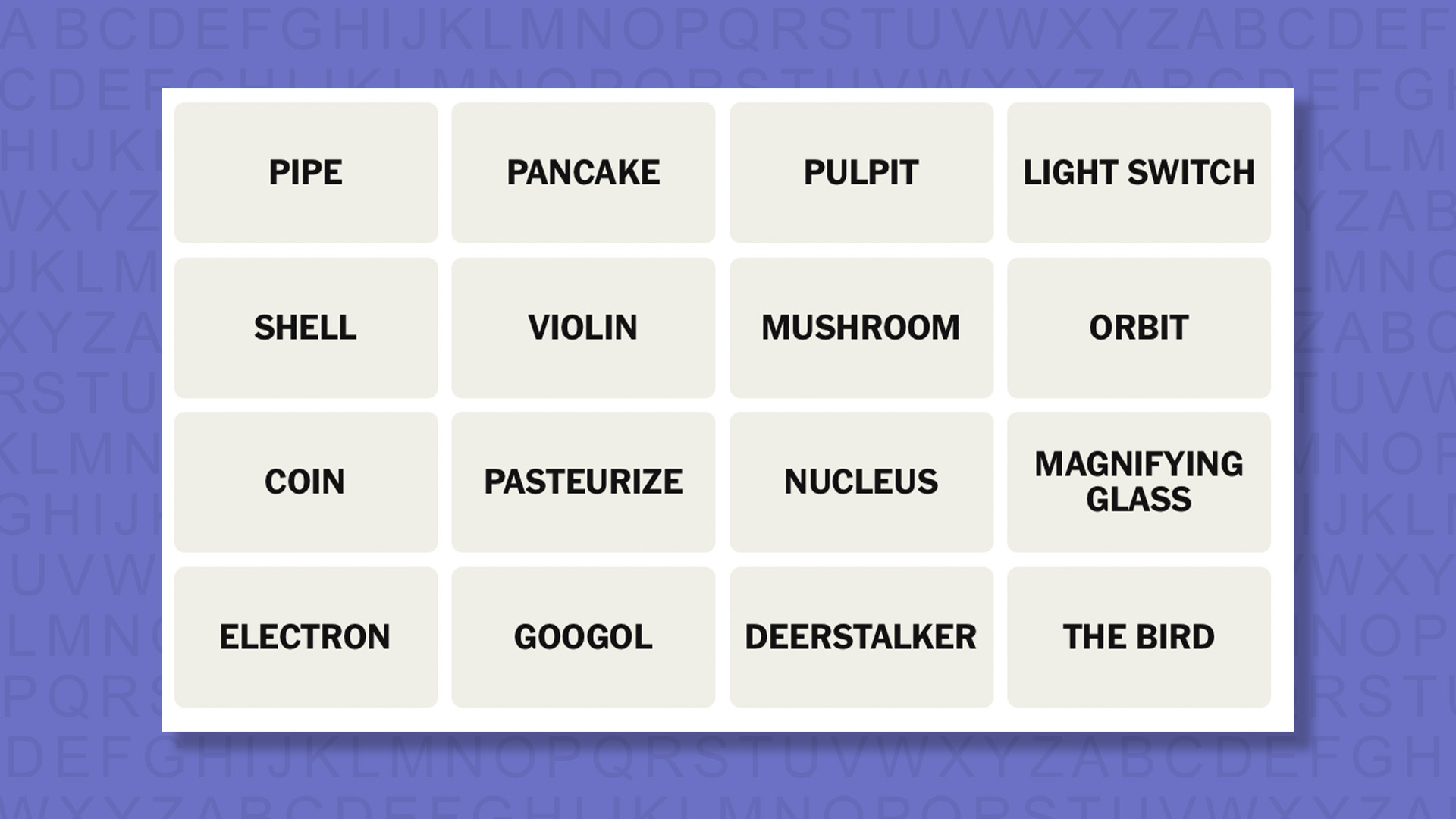
NYT Connections today (game #1029) – today’s words
(Image credit: New York Times)
Today’s NYT Connections words are…
PIPE
PANCAKE
PULPIT
LIGHT SWITCH
SHELL
VIOLIN
MUSHROOM
ORBIT
COIN
PASTEURIZE
NUCLEUS
MAGNIFYING GLASS
ELECTRON
GOOGOL
DEERSTALKER
THE BIRD
NYT Connections today (game #1029) – hint #1 – group hints
What are some clues for today’s NYT Connections groups?
YELLOW: Particle science
GREEN: A sleuth’s stuff
BLUE: Use your fingers
PURPLE: Look for types of mush
Need more clues?
We’re firmly in spoiler territory now, but read on if you want to know what the four theme answers are for today’s NYT Connections puzzles…
Advertisement
Sign up for breaking news, reviews, opinion, top tech deals, and more.
NYT Connections today (game #1029) – hint #2 – group answers
What are the answers for today’s NYT Connections groups?
YELLOW: ATOMIC STRUCTURE TERMS
GREEN: PARTS OF A SHERLOCK HOLMES COSTUME
BLUE: THINGS TO FLIP
PURPLE: STARTING WITH SYNONYMS FOR “SLUSH”
Right, the answers are below, so DO NOT SCROLL ANY FURTHER IF YOU DON’T WANT TO SEE THEM.
Advertisement
NYT Connections today (game #1029) – the answers
(Image credit: New York Times)
The answers to today’s Connections, game #1029, are…
GREEN: PARTS OF A SHERLOCK HOLMES COSTUME DEERSTALKER, MAGNIFYING GLASS, PIPE, VIOLIN
BLUE: THINGS TO FLIP COIN, LIGHT SWITCH, PANCAKE, THE BIRD
PURPLE: STARTING WITH SYNONYMS FOR “SLUSH” GOOGOL, MUSHROOM, PASTEURIZE, PULPIT
My rating: Hard
My score: Perfect
The first thing that stood out from today’s tiles was DEERSTALKER, an item of headwear that will forever be associated with one person — Sherlock Holmes. I was less certain of the other items, but MAGNIFYING GLASS and PIPE seemed to fit and I’ve got vague recollections of Benedict Cumberbatch’s version playing VIOLIN, so I went for it.
Happily I was correct but I’d like to take issue with a violin being considered PARTS OF A SHERLOCK HOLMES COSTUME.
Anyway, pressing onwards, and slightly disappointed that my shot in the dark wasn’t a purple group, a distant memory of science revision helped me connect the four ATOMIC STRUCTURE TERMS.
Grinding to a halt and initially seeing no links between the remaining eight tiles I decided that PANCAKE, COIN, LIGHT SWITCH and THE BIRD were all THINGS TO FLIP.
Advertisement
Yesterday’s NYT Connections answers (Saturday, April 4, game #1028)
YELLOW: “LET SLEEPING DOGS LIE” DOGS, LET, LIE, SLEEPING
GREEN: OBSCURE COVER, MASK, SCREEN, SHIELD
BLUE: COASTAL LANDFORMS BLUFF, CAPE, POINT, SPIT
PURPLE: ____ CAMP BAND, BASE, BOOT, SUMMER
What is NYT Connections?
NYT Connections is one of several increasingly popular word games made by the New York Times. It challenges you to find groups of four items that share something in common, and each group has a different difficulty level: green is easy, yellow a little harder, blue often quite tough and purple usually very difficult.
On the plus side, you don’t technically need to solve the final one, as you’ll be able to answer that one by a process of elimination. What’s more, you can make up to four mistakes, which gives you a little bit of breathing room.
It’s a little more involved than something like Wordle, however, and there are plenty of opportunities for the game to trip you up with tricks. For instance, watch out for homophones and other word games that could disguise the answers.
It’s playable for free via the NYT Games site on desktop or mobile.
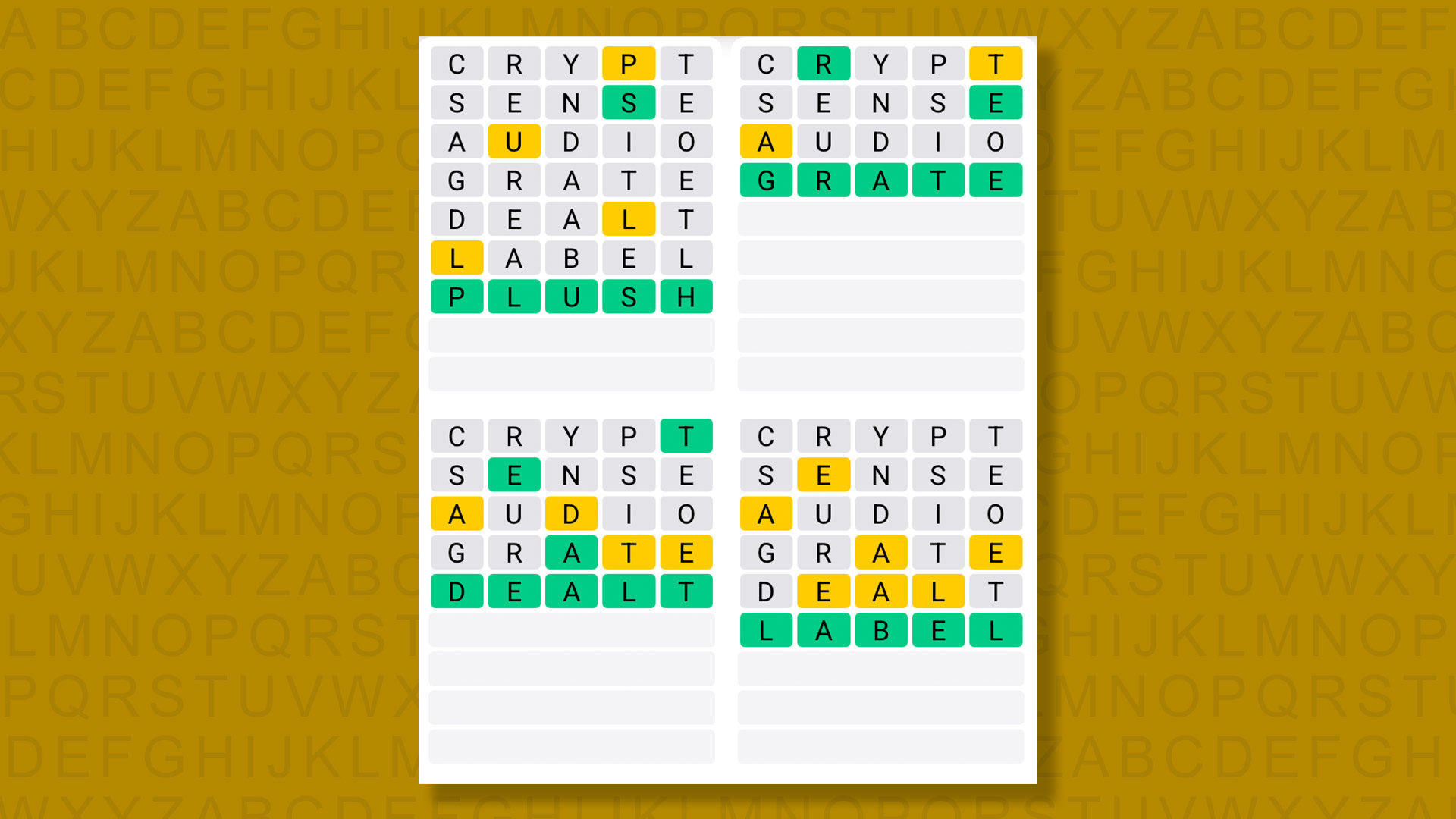
A new Quordle puzzle appears at midnight each day for your time zone – which means that some people are always playing ‘today’s game’ while others are playing ‘yesterday’s’. If you’re looking for Saturday’s puzzle instead then click here: Quordle hints and answers for Saturday, April 4 (game #1531).
Quordle was one of the original Wordle alternatives and is still going strong now more than 1,400 games later. It offers a genuine challenge, though, so read on if you need some Quordle hints today – or scroll down further for the answers.
Enjoy playing word games? You can also check out my NYT Connections today and NYT Strands today pages for hints and answers for those puzzles, while Marc’s Wordle today column covers the original viral word game.
Advertisement
SPOILER WARNING: Information about Quordle today is below, so don’t read on if you don’t want to know the answers.
Article continues below
Quordle today (game #1532) – hint #1 – Vowels
How many different vowels are in Quordle today?
• The number of different vowels in Quordle today is 3*.
* Note that by vowel we mean the five standard vowels (A, E, I, O, U), not Y (which is sometimes counted as a vowel too).
Advertisement
Quordle today (game #1532) – hint #2 – repeated letters
Do any of today’s Quordle answers contain repeated letters?
• The number of Quordle answers containing a repeated letter today is 1.
Quordle today (game #1532) – hint #3 – uncommon letters
Do the letters Q, Z, X or J appear in Quordle today?
• No. None of Q, Z, X or J appear among today’s Quordle answers.
Ruadhri McGarry explores the DevOps career route and offers advice to professionals considering work in this sector.
“The DevOps space in 2026 is certainly busy but more selective,” according to Ruadhri McGarry, an associate director at IT Search and a DevOps, cloud and cybersecurity specialist recruiter.
While hiring is active, companies are moving more slowly than in recent years, he explained, leading to an environment in which platform engineering teams are generally stable, despite ongoing expectations to continue to automate, and workplaces are subject to a more measured pace of hiring.
“Overall, the market is stable with steady demand, with growth expected to remain consistent as organisations continue to invest in platform modernisation,” McGarry told SiliconRepublic.com.
Advertisement
So, with that in mind, what should students and professionals aiming for a career in this space know about the current landscape?
In the know
Qualifications and certifications are, for many, the first step into the DevOps or platform engineering world. McGarry noted cloud certifications across AWS, Azure or GCP can enable candidates to demonstrate foundational knowledge and understanding of modern infrastructure environments.
“However, for more senior positions a key differentiator is the ability to demonstrate experience working on production workloads building, scaling and operating systems. In practice, candidates who have ownership of infrastructure and clear exposure to automation and delivery pipelines will stand out.”
A major advantage in today’s STEM landscape, when building a career, is the improved access to roles and opportunities that may have previously required a third-level degree. DevOps is no different and there are multiple alternate routes, which McGarry said reflects the range of the discipline itself.
Advertisement
“Many professionals transition from software engineering, infrastructure or systems administration backgrounds. Others move from networking or security roles, particularly as DevSecOps continues to grow in importance.
“It is also increasingly common to see candidates move into DevOps from adjacent areas such as data engineering, particularly where MLOps and real-time platforms are involved.”
When it comes to employment, he explained that opportunities remain strong, though there is specific demand in certain areas, namely in Kubernetes and cloud-native engineering, site reliability engineering (SRE), DevSecOps and cloud security automation.
“There is also steady demand in observability and FinOps-related DevOps, alongside a growing increase in hybrid data/DevOps roles, particularly within MLOps and real-time platforms.”
Advertisement
Skills and challenges
While skills and abilities often evolve and change on the job, and experience is a teaching moment in itself, there are still a number of skills that McGarry believes experts and students should prioritise.
He explained that the most critical skills combine technical depth with an operational mindset, adding that from a technical perspective, key capabilities include depth of cloud experience in AWS, Azure or GCP; Kubernetes and container orchestration; infrastructure as code using Terraform, CloudFormation or Helm; CI/CD pipeline ownership, particularly across GitHub or Jenkins; security fundamentals, including least-privilege IAM and secrets management.
“Beyond tooling, candidates who can demonstrate ownership of platforms and systems, rather than just execution of tasks, are consistently the most in demand.”
Experts also need to have a number of soft skills, one of them being the ability to adapt to emerging challenges: for example, the breadth of DevOps, which spans infrastructure, software delivery, security and operations.
Advertisement
McGarry said, “This can make it difficult for individuals to develop sufficient depth. Another challenge is the pace of change. Tools, platforms and practices continue to evolve rapidly, requiring continuous learning and adaptation.
“These challenges are typically overcome by focusing on core principles of automation, scalability, reliability and security rather than individual tools, and by gaining hands-on experience in real-world environments. From an organisational perspective, success depends on embedding DevOps practices into engineering culture, rather than treating it purely as a tooling function.”
Ultimately, McGarry finds that the DevOps space is on an evolving trajectory, moving from simpler roles into a broader engineering discipline where the key focus is on building reliable, scalable and secure platforms.
Looking to the future, he expects there to be fewer senior generalist DevOps roles, and for more value to be placed on defined platform engineering, SRE and DevSecOps skillsets.
Advertisement
“AIOps and automation will continue to expand, particularly within observability and incident management. In my opinion, engineers who can design systems, automate processes and build strong feedback loops will be best positioned for long-term success.”
Don’t miss out on the knowledge you need to succeed. Sign up for the Daily Brief, Silicon Republic’s digest of need-to-know sci-tech news.
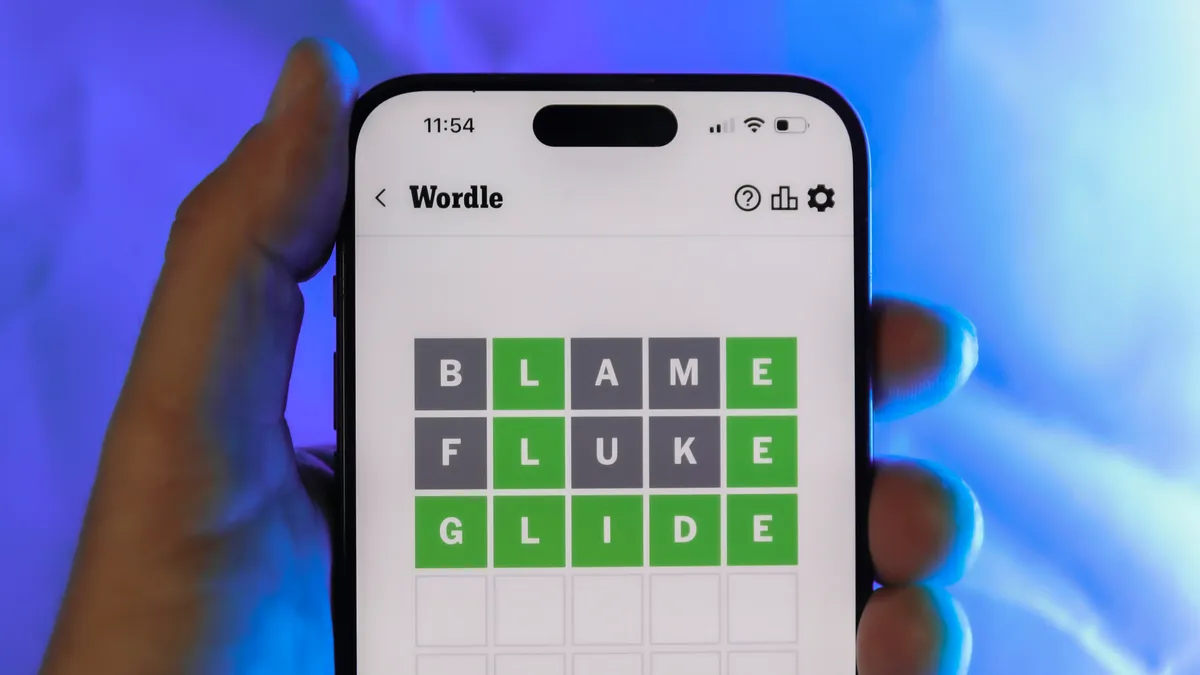
Looking for the most recent Wordle answer? Click here for today’s Wordle hints, as well as our daily answers and hints for The New York Times Mini Crossword, Connections, Connections: Sports Edition and Strands puzzles.
All-season tires are meant to be driven year-round, so you’d expect them to last several seasons, especially on a commuter car that racks up miles. However, Michelin’s Primacy All-Season tires are not lasting as long as expected — not even close — causing a lot of backlash from drivers. “These tires lose tread quickly and will not last,” one customer wrote. “It only took 8,000 miles to consume over half of the tire’s tread. If your vehicle comes with these tires, do your best to get them changed.”
This sentiment is shared by many customers on Michelin’s website, where the tires sit at a 2.5 star rating due to the large number of one-star reviews. At this point, there are more one-star reviews than five-star ones. A Lexus owner said the tire was punctured at 3,900 miles. Someone with a Mercedes-Benz GLC 300 4-Matic had their rear tire blow out at 7,500 miles. Another added, “These are the worst tires I have ever owned. They have only 18,000 miles and are already half worn.”
Advertisement
On top of losing tread quite quickly, many drivers feel that Michelin’s Primacy All-Season tires are not meant for all seasons. One customer driving a Volvo EX30 said that the performance in icy and snowy conditions was “dangerously poor”. Another customer questioned how they can be all-season tires if they don’t work well in the rain or snow.
Advertisement
How long are all-season tires supposed to last?
Yacobchuk/Getty Images
The lifespan of your tires will depend on a lot of factors, but a (very extensive) test by Consumer Reports found that all-season tires can last 55,000 to 95,000 miles. This was the result after testing 44 tires over 352,000 miles, driving in 500-mile shifts at a time. Results can vary as you may be driving on different road conditions in a different kind of car. It’s safe to say, however, that the Michelin Primacy All-Season tires used by the one-star reviewers are not lasting anywhere near long enough.
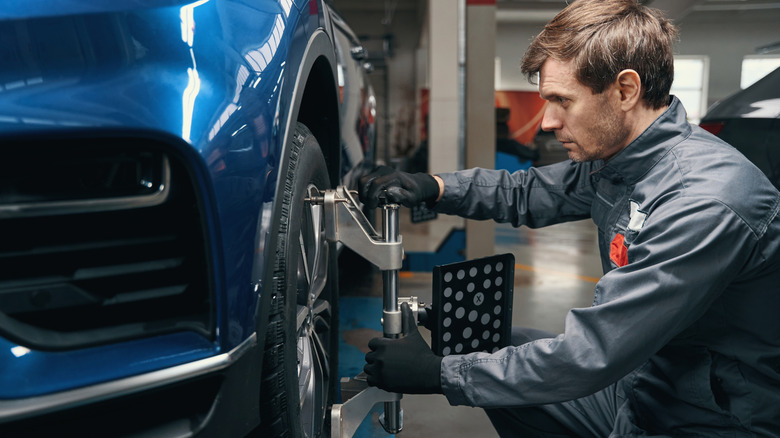
You can extend your tires’ lifespan by checking your tire pressure every 3,000 miles, rotating your tires every 6,000 to 8,000 miles, getting your alignment checked periodically (or when your vehicle starts pulling to one side), and checking the tires’ treadwear. Also, you should avoid using the wrong tires for the season or for your vehicle. If you’re looking for an alternative to Michelin Primacy All-Season tires, try the CrossClimate2 — a favorite Michelin tire.
To use Area mode, you first have to define the boundaries of the area. This is done in the app via a process similar to what I’ve encountered on some competing hardware devices. You fire up the mapping mode, and the sprinkler engages. Then, using a simple remote-control system, you dial the water pressure to the appropriate level, aiming at the edge of your yard but not the fence; once the water is where you want it, you drop a pin to mark the boundary of the watering area. You then rotate the nozzle on top of the sprinkler a few degrees and repeat, setting the strength of the flow to cover the desired area. Repeat again and again until you’ve gone through 360 degrees and have dropped pins to visually represent the entirety of your yard. The company says the maximum supported area is a vast 4,800 square feet, with spray reaching up to 39 feet.
ScreenshotAiper app via Chris Null
In the app, you can watch this area map being created in real time. The process is quite intuitive except for the final couple of points, where Aiper’s system makes it difficult to complete the 360-degree circuit. If you look at the completed map in the screenshot below, you’ll see a tiny sliver of yard that no amount of finagling could get Aiper to close up.
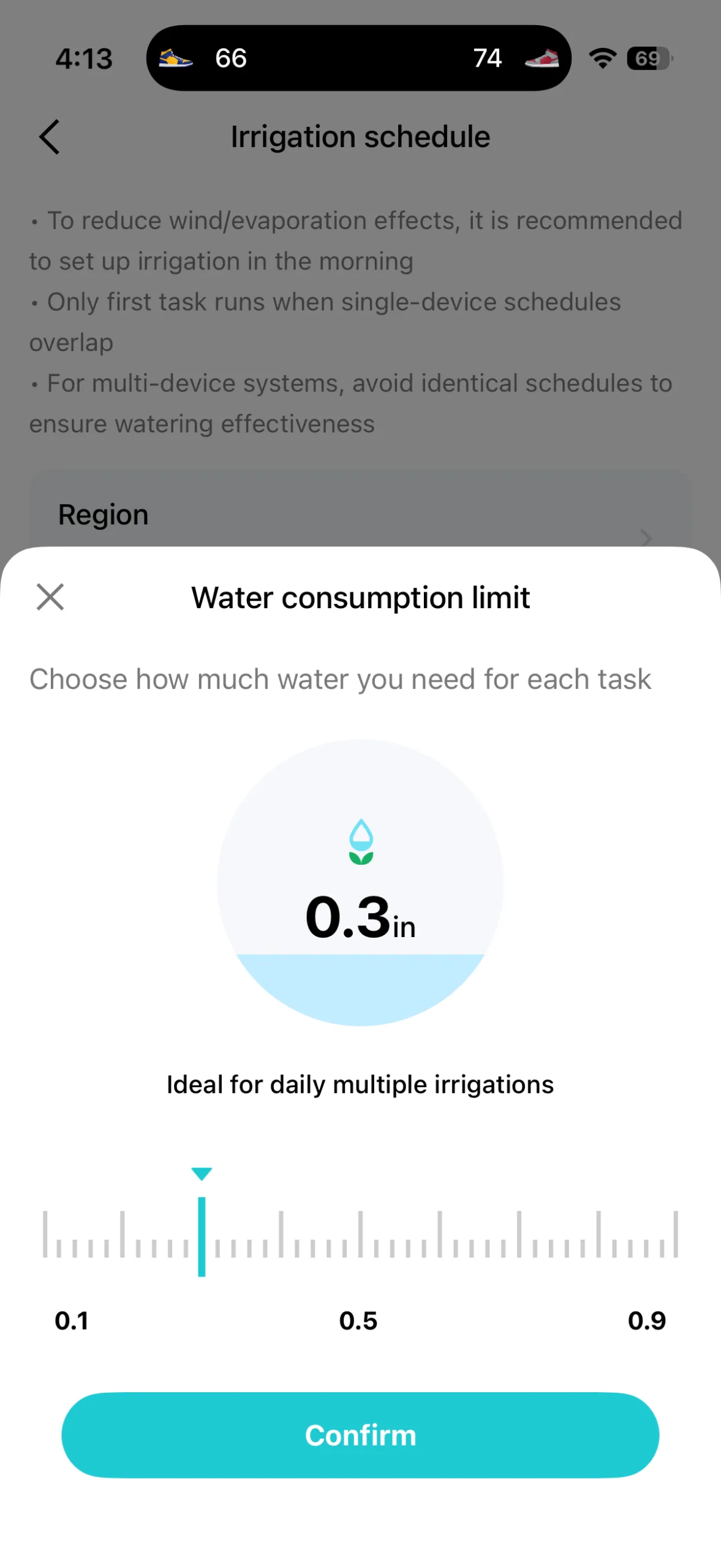
Watering runs can be initiated on demand or on a schedule, and you intriguingly define not an amount of time to run but a “water consumption limit,” measured in inches of water you want applied to the soil. While it’s nearly impossible to measure how accurate this is, qualitatively, those estimates felt about right in my testing.
In Area mode, the IrriSense 2 delivers water by spraying a jet in a single direction, rotating clockwise through its 360 degrees until it’s gone all the way around the map you’ve set before turning back and doing it again in a counter-clockwise direction, repeating this cycle until the desired irrigation depth has been reached.
Advertisement
While the IrriSense 2’s spray system is officially described as a gentle “mist,” it’s really more of a jet, particularly when it has to reach the far-away parts of the yard near the terminus of its range. That results in a lot more water being delivered to the edges of the yard than to the central portion of the mapped area, but that’s a common issue I’ve seen with rotary sprinklers like this. To account for this, the IrriSense 2 doesn’t just blast at full speed for the entirety of its run. Instead, repeated rotations reduce the pressure delivered bit by bit, until the final rotations are little more than a trickle of water hitting just a few inches away from the unit. (Note that canceling a run early means that only the outermost portions of the area will receive water.)



 Many of us are guilty of toeing the line between having a ready supply of components at hand and simply hoarding for fear of throwing anything out. In a first admission of this problem, [Scott Lawson] decided to implement a couple of changes to assess his own position on this sliding scale.



















































You must be logged in to post a comment Login