Samsung has had a busy few weeks with the launch of its 2026 foldable and wearable ranges, with pre-orders just wrapping up last week. If you missed out on the pre-order deals or you have your eyes set on something else from the brand, then fret not — Samsung has just unveiled a slew of deals across its product portfolio.
The latest Samsung Secret Sale event features lots of top-rated tech that we’ve reviewed here at TechRadar, with savings of up AU$1,200 or 50% with the code SECRETAUG — but it’s only running for 48 hours, with deals ending at 10am AEST on Wednesday, August 19.
One standout deal is the excellent Samsung Galaxy Watch 8 with a 50% discount, bringing it down to just AU$374.50 for the 40mm LTE model. Given that the new Watch 9 has relatively modest upgrades for AU$699 (with a current deal), this offer is hard to pass up.
Most instruments, with maybe the exception of pianos, have consumable parts. Guitars need string changes, bows need rosin, saxophones need reeds. [Co:Creation Lab]’s balloon banjo requires both fishing line and a party balloon, lest it be semi-silent.
If you want to change the resonance, just increase or decrease the amount of air inside the balloon. Neither the balloon nor the strings need tools to adjust, but we might argue that tuning pegs are tools.
The balloon banjo was the result of a design constraint: a parent should be able to build it with their child. To that end, there are no metal screws, no recurring snap-fits in the assembly, and a single, internal, one-time-use snap fit for the adult’s tactile satisfaction. Instead, the balloon banjo uses 3D-printed screws. A six-year-old can turn them with their fingers, and it’s difficult to over-tighten them and strip the plastic threads.
Advertisement
Be sure to check it out in action after the break. If you would rather use extant plastic to make music, the Bottlephone 2.0 is calling.
The iPhone 18 Pro will be a powerhouse for photography while the iPhone Ultra will focus on the novelty of folding, your hosts discuss this and the AI competition in the latest AppleInsider Podcast.
Apple’s September event will focus on premium iPhone models, but not everything is known about these products just yet. Apple’s pitch for iPhone 18 Pro will likely be around its advanced camera system while the foldable will have the obvious going for it.
What is still up for debate, however, is the naming scheme for the foldable iPhone. AppleInsider took to calling it iPhone Fold as a placeholder that mimics Samsung’s naming, but others chose “iPhone Ultra.”
Reports suggest that staff within Apple have started calling the foldable “iPhone Ultra” as well, though this isn’t indicative of it being the actual name. Your hosts discuss the rumor, what’s coming at the event, and what’s next.
Advertisement
Apple’s competition in the AI space is heating up too, as OpenAI’s mysterious product was detailed in a report. It’s going to be an odd fall for Apple as it deals with a new product line, limited supply, and a wider AI launch.
BONUS: Subscribe via Patreon or Apple Podcasts to hear AppleInsider+, the extended edition. This time, your hosts discuss what it means to be an “Ultra” product and if Apple’s foldable can earn that moniker.
CleanMyMac by MacPaw: Get Tidy Today! Try 7 days free and use code APPLEINSIDER20 for 20% off at clnmy.com/APPLEINSIDER
Links from the show:
More AppleInsider podcasts
Tune in to our Smart Home Insider podcast covering the latest news, products, apps, and everything HomeKit related. Subscribe in Apple Podcasts, Overcast, or just search for HomeKit Insider wherever you get your podcasts.
Those interested in sponsoring the show can reach out to us at: [email protected].
Advertisement
Subscribe to AppleInsider on:
Keep up with everything Apple in the weekly AppleInsider Podcast. Just say, “Hey, Siri,” to your HomePod mini and ask for these podcasts, and our latest HomeKit Insider episode too. If you want an ad-free main AppleInsider Podcast experience, you can support the AppleInsider podcast by subscribing for $5 per month through Apple’s Podcasts app, or via Patreon if you prefer any other podcast player.
Samsung owns enough audio brands to fill a respectable section of an audio show, yet Galaxy smartphone owners looking for a premium pair of Samsung-branded over-ear headphones have been staring at an empty shelf for years.
That might finally be changing.
Code discovered by SamMobile inside Samsung’s Galaxy Wearable app points to a new pair of full-size wireless headphones being developed under the internal name “Galaxy H1.” The code confirms Bluetooth connectivity, while accompanying graphics depict an over-ear headphone design. Samsung has not announced the product, Galaxy H1 may not be the final name, and there are currently no confirmed specifications, price, or release date. SamMobile believes the project is still relatively early and could surface sometime in early 2027.
That last paragraph matters because some reports have already started filling in the blanks with ANC, Bluetooth 6.0, Samsung Seamless Codec UHQ, AI integration, battery-life estimates and other features that would certainly make sense — but none of them have been confirmed for Galaxy H1. At this point, Bluetooth and the existence of the project are the solid parts. Everything else remains educated speculation.
Advertisement
Related Reviews:
Samsung Has Been Here Before
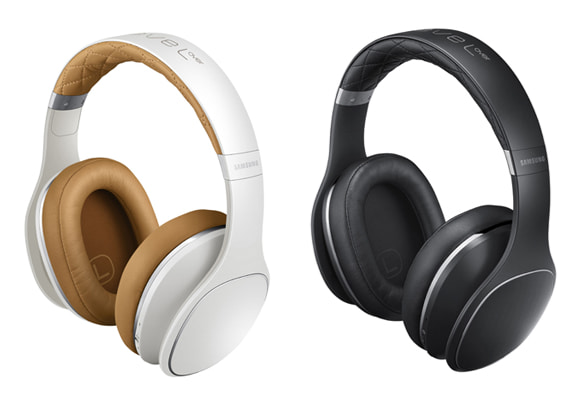
Samsung Level Over (2014 model)
Galaxy H1 would not be Samsung’s first over-ear headphone. Back in 2014, Samsung introduced the Level Over, a premium wireless over-ear model with a 50mm dynamic driver, Bluetooth, touch controls and hybrid active noise cancellation. That product predates Samsung’s 2017 acquisition of HARMAN and therefore belongs to an entirely different period in the company’s audio history.
And that is what makes Galaxy H1 potentially interesting.
Samsung now sits above an enormous audio portfolio through HARMAN, including JBL, AKG and Harman Kardon, while HARMAN’s 2025 acquisition of Sound United added brands including Bowers & Wilkins, Denon and Marantz. There is no evidence whatsoever that engineers from any of those companies are involved with Galaxy H1, and suggesting otherwise would be pure speculation. What is fair to say is that Samsung in 2026 has considerably more audio expertise within the broader organization than it did when the Level Over appeared 12 years ago.
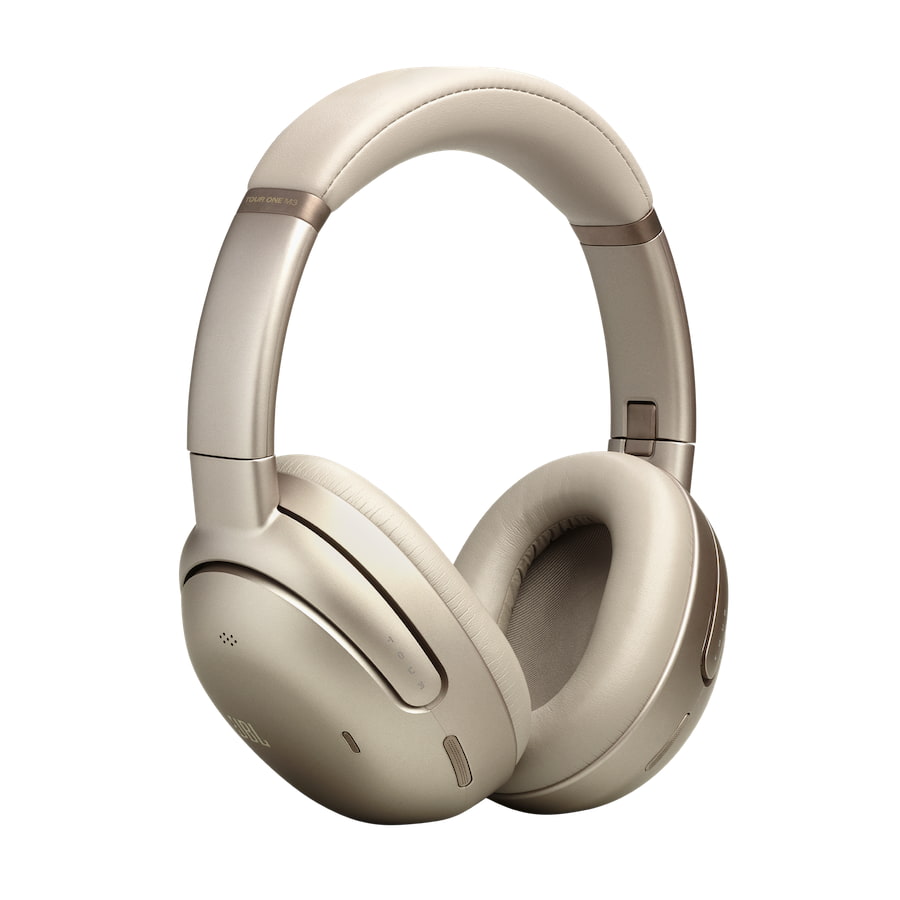
The amusing part is that Samsung already owns a formidable competitor to whatever Galaxy H1 becomes. The JBL Tour One M3 offers adaptive ANC, Spatial 360 with head tracking, Hi-Res Audio, Auracast and up to 70 hours of playback. Samsung therefore does not need another over-ear headphone simply to prove that someone inside the building knows how to make one.
It needs a Galaxy headphone.
Advertisement
JBL Tour One M3 Wireless Headphones (2026 model)
What Could Make Galaxy H1 Different?
The opportunity is ecosystem integration rather than some magical new driver technology we know nothing about.
Samsung’s current Galaxy Buds4 Pro already support Samsung Seamless Codec UHQ at up to 24-bit/96kHz with compatible Galaxy devices, Auto Switch, 360 Audio, adaptive ANC and hands-free access to Bixby, Gemini and Perplexity. None of those features are confirmed for Galaxy H1, but they demonstrate the ecosystem Samsung has already built and what a flagship over-ear model could potentially inherit.
Advertisement. Scroll to continue reading.
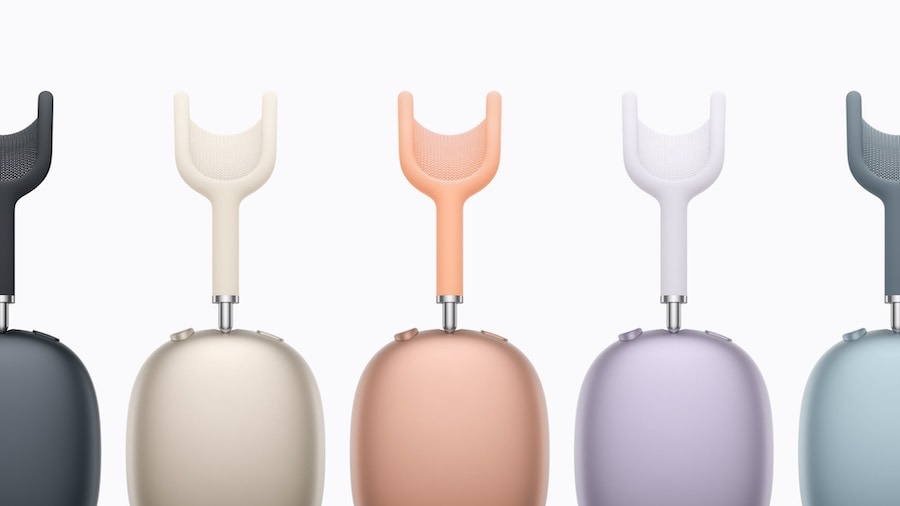
Apple understands this game extremely well. AirPods Max are not successful merely because they reproduce music; they are designed to work as an extension of Apple’s hardware and software ecosystem. Samsung has Galaxy smartphones, tablets, televisions, watches and an increasingly sophisticated AI platform, but no premium over-ear headphone carrying the Galaxy name.
That is a rather obvious hole.
Advertisement
Who Would Galaxy H1 Be For?
Assuming Samsung positions these as a flagship model, Galaxy smartphone and tablet owners are the obvious audience, particularly those who want better isolation, longer battery life and the more substantial presentation of an over-ear design without surrendering the convenience they already get from Galaxy Buds.
They could also appeal to Android users who have been choosing Sony or Bose largely because Samsung has offered no equivalent product. The larger question will be how many of Galaxy H1’s eventual features work outside Samsung’s ecosystem. Samsung notes that some advanced Buds4 features require compatible Galaxy hardware, and pushing that strategy too far with an expensive headphone could narrow the audience considerably.
Apple AirPods Max 2
The Competition Will Not Be Amused
If Galaxy H1 lands in the $400 to $600 range, Samsung will be walking directly into one of the nastiest fights in personal audio.
The Apple AirPods Max 2 are $549 and now offer improved ANC, Adaptive Audio, Personalized Spatial Audio, Live Translation and lossless USB-C playback. The Sony WH-1000XM6 remain one of the obvious benchmarks for ANC, portability and everyday usability, while the Bose QuietComfort Ultra Headphones (2nd Gen) sell for $449 and focus heavily on noise cancellation and comfort.
Advertisement
Listeners placing greater emphasis on sound quality also have the $799 Bowers & Wilkins Px8 S2, Sennheiser’s headphones, and ironically Samsung-owned JBL’s Tour One M3 to consider. And that’s before the rumoured Sonos Ace Ultra appear in September according to recently filed FCC documentation..
Samsung therefore does not need to make another perfectly competent ANC headphone with some AI sprinkled over the top like parsley.
It needs to explain why someone carrying a Galaxy S26 should stop buying Sony, Bose or Bowers & Wilkins and buy this instead.
The Bottom Line
The most interesting thing about the rumored Galaxy H1 is not anything we currently know about its drivers, battery life or noise cancellation — because we know almost nothing about those things.
Advertisement
It is that Samsung finally appears ready to close one of the most conspicuous gaps in the Galaxy ecosystem.
A decade ago, Samsung’s Level Over was competing in a very different headphone market. Today, Samsung owns HARMAN, has a mature Galaxy audio ecosystem and would be entering a category dominated by Apple, Sony and Bose at a moment when premium wireless headphones have become increasingly sophisticated and expensive.
Advertisement. Scroll to continue reading.
Galaxy H1 could be extremely interesting. It could also be $500 worth of Galaxy AI looking for a reason to exist. Until Samsung actually announces it, keep both possibilities on the table.
Mozilla is rolling out an ad blocker built into Firefox for iOS. It’s a move that can help users protect their privacy more, except in some lucrative situations.
Online advertising can be burdensome for web users, and for many years, some elect to use plug-ins like Adblock to cut down on the ads they see. Now, Mozilla is giving users a way to do it on iOS.
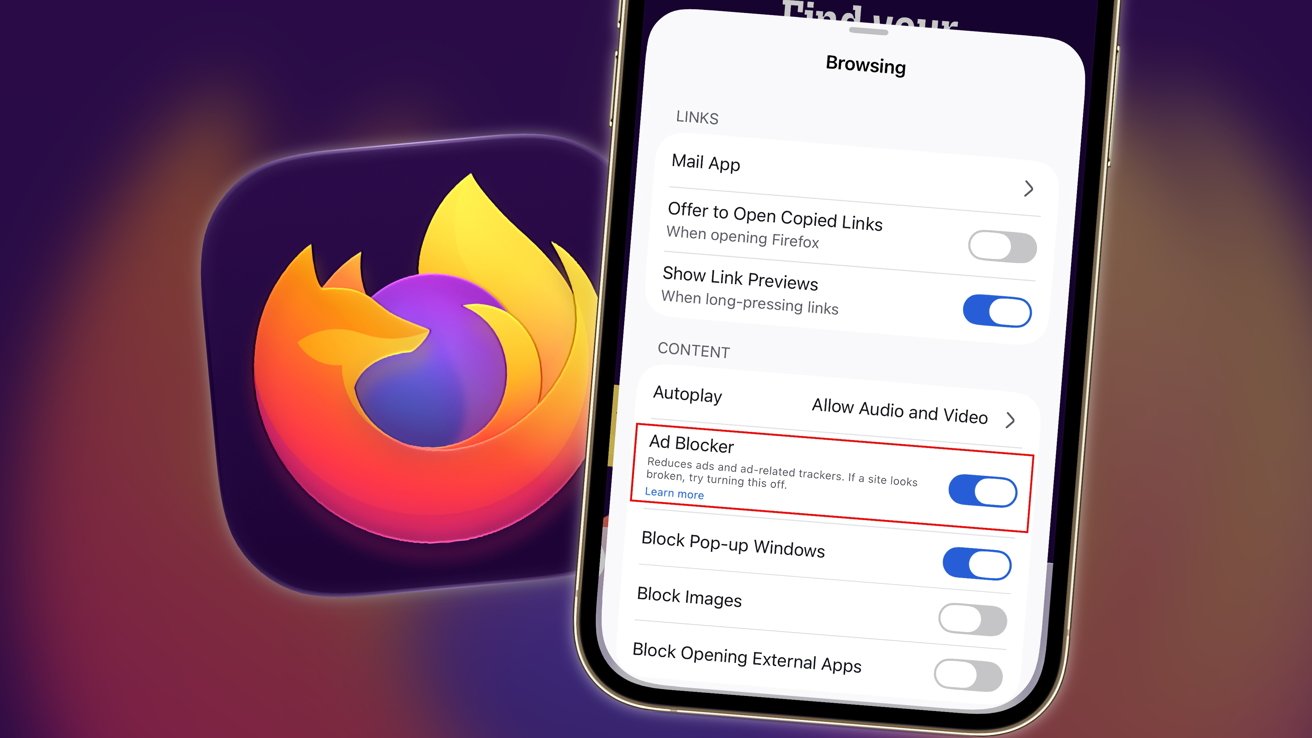
Introduced on Saturday via a support page, Firefox for iOS now includes an optional ad blocker. As Mozilla describes, it is a tool to reduce the amount of advertising shown as you browse the Internet.
The feature is listed as “experimental” and is being rolled out gradually to all users.
Advertisement
Blocking is carried out at a network level, including affecting third-party advertising networks and exchanges, ad-related trackers, and many third-party ads served by websites. The blocking also impacts more intrusive formats, such as pop-ups and overlays.
Not all ads
While the system does use a filter list based on EasyList and blocks ads before loading, there are exceptions.
Mozilla explains that the ad blocker will not block ads shown on search engine results pages. That includes Google, Bing, DuckDuckGo, and other search companies.
It also won’t block sponsored content on the Firefox Home or New Tab page. This makes sense, as it’s a source of revenue for the organization.
Advertisement
While seemingly not as lucrative, the search deal adblock situation is also going to be down to revenue. Like Apple’s Safari, Mozilla also benefits from search deals with Google.
In 2025, the non-profit said that 90% of its revenue came from Firefox. Of that 90%, approximately 85% stemmed from a Google deal.
That certainly gives Firefox an incentive not to bite the hand that feeds it.
How to enable ad-blocking in Firefox for iOS
Open Firefox and open a webpage.
Tap the menu and bring up the Site menu.
Tap Ad Blocker. In the Settings menu that comes up, toggle Ad Blocker on.
“Epic Games has confirmed that it is working on a Linux version of its storefront, potentially removing the need for third-party launchers on platforms such as Steam Deck,” reports PC Guide:
The confirmation came during an Ask Me Anything (AMA) on the Epic Games Store’s community Discord server. When a user asked whether Epic had any plans for a Linux version of its launcher, an Epic staff member confirmed that it is coming “soon(TM)” in emoji form. Of course, that is far from confirming any kind of date, but it is official confirmation of a Linux version nonetheless.
“On top of that, Nvidia’s GeForce Now [cloud gaming] app for Linux is also official, having emerged from beta,” writes TechRadar, calling it all part of “a rosier future for Linux gamers.”
And while it’s not related to gaming, OpenAI’s [“preview”] release of a ChatGPT app for Linux is another milestone for the platform… OpenAI said: “Linux has been one of the most-requested platforms for the desktop app, and this launch extends ChatGPT and Codex across every major desktop operating system.” The Epic Games Store arriving natively is great news for gamers running Linux — including SteamOS — as it means a much more convenient way of playing games from the store, as opposed to the current situation with fudging and workarounds (using a third-party app such as the Heroic Games Launcher)…
Epic’s own Fortnite doesn’t work on Linux (and that’s down to Epic actively blocking the game from running due to issues around cheating, which remains a source of controversy). Given the apparent changing attitude here with its launcher being ported over, maybe Epic will reverse course on Fortnite eventually. Some gamers on Reddit are highly skeptical about that possibility though, and as one doubting Redditor put it: “I wouldn’t hold my breath.”
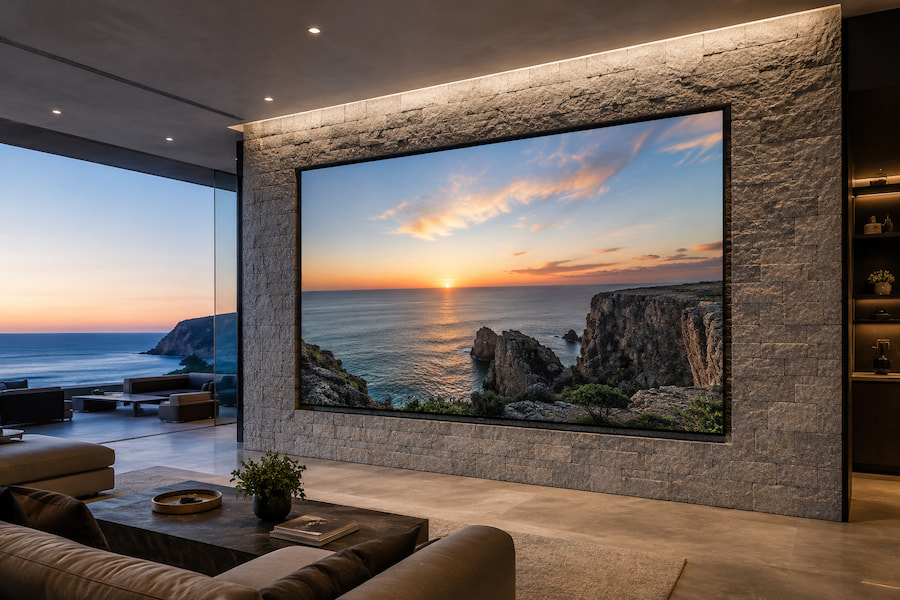
When eCoustics walked into the Quantum Media Systems room at CEDIA Expo 2025, we were not expecting a 20-foot-wide video wall to become one of our favorite displays of the show. The company’s XDR4-8K delivered excellent color, deep black levels, enormous scale, and most importantly, none of the distracting seams that can undermine modular MicroLED displays. The approximately 20-foot-wide system started around $350,000 and ultimately earned our Best Ultra Large TV award for CEDIA Expo 2025.
Quantum Media Systems is returning to CEDIA Expo 2026 with the fifth-generation XDR5-8K, but the story this time is not simply another gigantic display with more pixels. The new processing platform can handle multiple simultaneous native 8K video streams without downscaling, while an integrated Visual Media Server allows different sources, graphics, widgets, control interfaces, security feeds, sporting events, games, and digital artwork to share the same massive canvas.
That makes the XDR5-8K more than another demonstration designed to make people stare at an enormous screen for five minutes before returning to something they can actually afford.
Quantum XDR5-8K: What’s New?
At the heart of the XDR5-8K is Quantum’s next-generation Visual Media Server, which is designed to process multiple native 8K streams simultaneously while retaining their resolution. Users can arrange those sources in customizable windows, including combinations of 8K and 4K content, without having the processor reduce an 8K source to a lower resolution simply because several images are being displayed at the same time.
Advertisement
For a conventional television, that might be overkill. On a video wall measuring 15, 18, or 20 feet across, it starts to make considerably more sense. A homeowner could watch several sporting events simultaneously, keep a security feed or statistics window open alongside them, display artwork when the system is not being used for movies, or create entirely different layouts depending on the application.
The XDR5-8K uses a 0.9mm pixel pitch and is designed to provide studio-reference color accuracy and Digital Cinema-compliant performance. One important clarification, however, is that the pixel pitch itself is not an improvement over the specific XDR4-8K demonstration eCoustics saw last year. Quantum described that 20-foot XDR4 system as using a finer 0.7mm pixel pitch, so the significant generational change with XDR5 appears to be centered more on processing, system flexibility, visualization, and installation support than simply shrinking the distance between pixels.
Native 8K Finally Has Something to Play
One of the longstanding problems with 8K displays has been painfully obvious: what are you supposed to watch on them?
That situation has started to change. Kaleidescape introduced its $4,995 Strato K in June 2026, giving its movie ecosystem native 8K playback for the first time while also introducing the higher-bitrate 4K Cinematic format with up to 4:4:4 chroma. The Strato K supports native 8K playback in SDR and HDR10 and is the first movie player certified under the 8K Association’s current performance and interoperability requirements.
Advertisement
When eCoustics covered the Strato K in June, we noted that the more interesting feature at launch might actually be 4K Cinematic, because native 8K movie availability remained extremely limited. The important difference at CEDIA 2026 is that Quantum can now demonstrate an 8K display using a consumer movie player capable of delivering actual native 8K content instead of relying exclusively on demonstration material, upscaling, or specialized professional playback equipment.
The XDR5-8K will be demonstrated in CEDIA Expo Room 201 with the Strato K supplying native 8K material. Quantum will also provide an 18-foot-wide LED wall at Kaleidescape’s Booth 3706.
Why Does This Matter?
For most consumers, an enormous custom video wall costing well into six figures remains about as relevant to the monthly household budget as yacht maintenance. But technologies demonstrated at this level have a habit of moving downstream, and direct-view LED systems are increasingly challenging the assumption that projection is the only practical route to truly enormous home theater images.
Advertisement. Scroll to continue reading.
Advertisement
Projection remains capable of delivering spectacular results, particularly in properly designed dark rooms, but a direct-view LED wall does not require a projector hanging from the ceiling or a projection surface across the room. It can also serve as a large-format display for television, sports, gaming, artwork, and other content rather than functioning primarily as a cinema screen.
Our experience with Quantum at CEDIA 2025 demonstrated the potential. The biggest issue we have encountered with modular LED walls has been visible seams and differences in brightness or color between individual display modules. Quantum’s precision installation and extensive calibration made those module boundaries essentially disappear on the XDR4 system we saw, even from unusually close viewing distances.
The XDR5 expands on that concept by treating the wall as something closer to a giant programmable visual environment instead of merely an enormous television.
That is probably its most interesting feature.
Advertisement
More Than Hardware
Quantum is also addressing one of the less glamorous problems associated with a system of this complexity: getting the damn thing installed correctly.
The company is introducing an integrated visualization platform that allows custom integrators to create realistic renderings of a proposed room before construction begins, including the video wall, loudspeakers, seating, lighting, and furnishings. Quantum also offers engineering, system configuration, installation assistance, calibration and commissioning, remote diagnostics, ongoing support, and spare display modules stored on-site for servicing.
That turnkey approach matters when the display costs more than many houses. A modular LED wall is not something you want delivered on Tuesday afternoon with an Allen key and a QR code linking to a YouTube installation video.
Who Is the Quantum XDR5-8K For?
The obvious audience is the ultra-high-end custom-installation market: dedicated home theaters, luxury media rooms, sports-focused entertainment spaces, yachts, and residences where a conventional 100- or 115-inch television simply is not large enough.
Advertisement
It is also aimed at customers who want one giant display to perform several jobs. The ability to divide an enormous screen among multiple sporting events, games, security feeds, artwork, videoconferencing, and other sources makes more practical sense in a multipurpose entertainment space than buying an 8K wall solely to watch the still-small selection of native 8K movies.
Quantum has not announced pricing for the XDR5-8K in its current CEDIA 2026 announcement. For context, the 20-foot Quantum system eCoustics experienced at CEDIA 2025 started at approximately $350,000, with configurations capable of exceeding $550,000 depending on options.
Nobody should therefore expect this to appear beside the 98-inch TVs at Costco anytime soon.
The XDR5-8K takes a different step forward. Native 8K support itself is no longer particularly shocking, but processing several native 8K sources simultaneously without downscaling them, integrating those sources into customizable layouts, and turning the wall into a broader entertainment and smart-home interface makes this considerably more interesting than another resolution upgrade.
Native 8K content still needs to catch up with the hardware, and nobody is going to confuse the XDR5 with a mainstream television. But pairing Quantum’s enormous direct-view display with Kaleidescape’s new Strato K means that, for perhaps the first time at CEDIA, we can evaluate a genuine consumer 8K source-to-display chain rather than watching another carefully selected 8K demo loop.
After what we saw from Quantum last year, this is one room we will be visiting again at CEDIA Expo 2026.
Whatever it was broke a PC and led to a face-saving lie
WHO, ME? Is it a mistake to return to work on Monday? While you ponder that question, pause a minute to read this installment of “Who, Me?” – The Register’s week-opening column that shares your stories of workplace errors and escapes.
This week, meet a reader we’ll Regomize as “James,” who told us that in the early 2000s he worked in the biology department of a famous American university.
Advertisement
“We custom-built all our PCs from the cheapest available parts at the time we ordered,” James wrote.
Which was how he found himself struggling to attach a heatsink to a CPU destined for use in a new PC.
“The stupid hook wouldn’t go over the plastic tab and so the heatsink didn’t want to stay on,” he wrote. “Not one to let a computer component get the better of me, I grabbed a flathead screwdriver, stuck it into the little leverage point in the heatsink clamp’s arm and leveraged the hell out of it.”
The result of that decision was audible.
Advertisement
“It went PING! and a tiny piece of something went flying away, but the heatsink was now securely mounted,” James told The Register. He therefore connected the PC to power, turned it on, and… wondered why its fans blew up a storm, but nothing appeared on screen.
“I removed the CPU, removed heatsink, and took a closer look to find the source for the PING. And there it was, or rather wasn’t – a very tiny and apparently very important surface-mounted component of some sort was missing right next to where the metal clamps for the heatsink hook in.”
James was very clearly at fault, but decided the way to fix the problem was to fib about it.
“I played dumb and called it into tech support at the company we ordered the heatsink from,” he confessed. “They were very nice, accepted the part was dead on arrival, and sent me a replacement right away.”
Advertisement
“Needless to say I was much more careful with the replacement, which worked great,” James told Who, Me?
What have you broken with a screwdriver? And how did you get away with it? Click here to share your story with The Register. If you want us to use your story in a future Who, Me? we suggest using a keyboard and mouse – not a screwdriver. ®
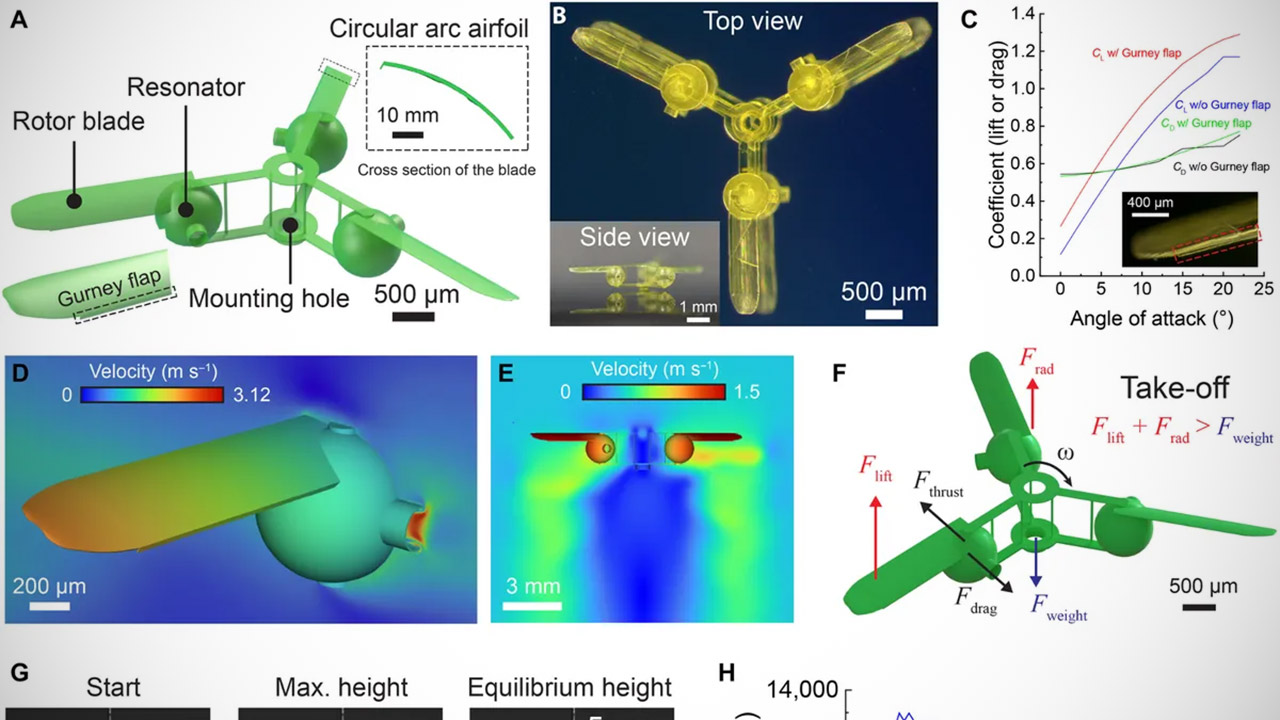
Researchers at EPFL’s MicroBioRobotic Systems laboratory have built ultralight flying machines that carry no motors, batteries, or electronics. Hollow cavities printed into their structures turn ordinary sound waves into focused jets of air. Those jets provide the thrust that lifts the devices off a surface and keeps them aloft.
The idea begins with a classic physics demonstration: blow across the mouth of a bottle and watch the air trapped within begin to vibrate. When you strike the correct pitch, the vibration intensifies sufficiently to generate a distinct tone. The phenomenon is known as Helmholtz resonance. A team of EPFL researchers applied the same method to form small polymer cavities. When they did, they discovered that the resonance causes air to be forced out one end of the cavity far more powerfully than it is sucked back in the other, resulting in a continuous jet of air that gently but persistently nudges the entire construction in a specific direction.
Due to platform compatibility issue, the DJI Fly app has been removed from Google Play. DJI Neo must be activated in the DJI Fly App, to ensure a…
Lightweight and Regulation Friendly – At just 135g, this drone with camera for adults 4K may be even lighter than your phone and does not require FAA…
Palm Takeoff & Landing, Go Controller-Free [1] – Neo takes off from your hand with just a push of a button. The safe and easy operation of this drone…
Everything, from the micro flying objects to the larger versions, is constructed using additive manufacturing, which is essentially a fancy word for 3D printing, and the tiny ones, like the larger counterparts, were created using two-photon polymerization. This is a highly high-resolution method that allows you to create structures that are only a few millimeters wide and weigh next to nothing, simply a few micrograms. As a result, the finished items have a lot of empty space and very little actual material.
Advertisement
Two different designs have already gone to the skies. The first one resembles a little rocket, with three chambers directed directly down toward the ground. When an ultrasonic field of 40 kilohertz is concentrated on the object, each cavity spits forth a jet of air, and presto!The entire contraption begins to ascend like a small rocket. The thing weighs 150 micrograms and has enough power to hover at nearly a five-to-one thrust-to-weight ratio. In certain lab testing, the device was able to climb a few millimeters into the air before settling into a steady hover with an upward force that properly matched its weight.
The second design adds a variation to the same basic concept. This one has thin blades linked to its chambers. Each resonator is positioned at the base of a curved blade and points rearward. When the matching ultrasonic frequency is detected, the jets begin spinning the entire assembly at a pace of more than 13,000 revolutions per minute. The rotating blades, like those on a helicopter rotor, provide aerodynamic lift, allowing it to stay afloat. In fact, this form of the gadget is slightly more reliable at remaining steady and level because the rotating mass itself is sufficient to prevent tilting.
The control system is also really neat. The concept is that separate cavities can be set to various frequencies. Changing the frequency of the sound input is sufficient to activate only the chosen set of resonators, allowing you to utilize the same external speaker or ultrasonic array to propel, turn, or even stop the item. When the crew tested several of their boats at centimeter scale, they used auditory tones. In one boat, a resonator was utilized to propel it forward and some side-mounted resonators to steer it. All the operator had to do to steer the boat was switch the frequencies, and it would turn around in response. In some later tests, the boats even carried their own little transducers and batteries along for the ride, allowing them to follow programd paths without any external assistance.
One of the most brilliant aspects of this technology is that it operates almost completely silently. Because the only moving parts are the air molecules themselves, the machines make barely a sound when powered by ultrasound, and even when they don’t, the jets themselves make almost no noise at all, at least not enough for human ears to detect. [Source]
AMD has raised $4.75bn in its biggest ever US dollar bond offering, sold in four tranches with maturities from three to ten years. It held $13.1bn in cash against $3.2bn of debt at the end of June, and has committed up to $5bn to Anthropic.
AMD has raised $4.75bn in the largest dollar bond sale it has ever done. The notes went out in four tranches with maturities from three to ten years, and demand was strong enough that the longest tranche priced about a quarter of a percentage point tighter than first indicated, at 0.9 points over Treasuries.
The company was not short of money. At the end of June it held $13.1bn in cash and short-term investments against $3.2bn of debt, which is an unusually clean balance sheet for a chipmaker at this scale.
What it has taken on is a commitment to a customer. In July AMD agreed to invest up to $5bn in Anthropic, alongside a partnership to deploy as much as two gigawatts of its Instinct MI450 chips to run Claude.
Advertisement
AMD has not connected the two. The filing says proceeds are for general corporate purposes, possibly including debt repayment, and the company has $875mn of bonds maturing next month.
The sizes are still hard to look past. The raise is $4.75bn and the Anthropic commitment is up to $5bn.
Either way it fits the shape the AI trade has taken, in which suppliers fund the customers who buy from them. Google has been running the same circular playbook with Anthropic, and Nvidia has gone further still, discussing guarantees over OpenAI’s data centre debt.
The underlying business is not imaginary. Analysts expect AMD revenue to climb 47% this year to more than $51bn, helped by the Anthropic agreement and a separate deal with Microsoft.
Advertisement
The borrowing is part of something much bigger. Big Tech’s AI debt has passed $350bn, and investment-grade issuers are now a routine part of that total rather than an exception.
Six banks ran the deal, among them JPMorgan, Citigroup and Bank of America. AMD last visited the investment-grade market in March 2025, when it raised $1.5bn, so this is more than three times that in 17 months.
A spokesperson said the company is “committed to maintaining its strong financial balance sheet,” which by any conventional measure it has. The interesting question is what a chipmaker holding $13bn in cash wants another $4.75bn for.
LG will unveil a bipedal humanoid robot in the first quarter of 2027, built on Nvidia’s Jetson Thor processor, Isaac GR00T foundation model and Halos safety system. The two signed the agreement at Nvidia’s Santa Clara headquarters on 13 August.
LG will show a bipedal humanoid robot in the first quarter of next year. The company signed an agreement with Nvidia at its Santa Clara headquarters on 13 August, with LG Corp chairman Kwang Mo Koo and Jensen Huang both present.
Nvidia is supplying the thinking parts. The robot runs Jetson Thor for onboard processing and motion control, uses the Isaac GR00T foundation model, and carries Halos, which Nvidia describes as the first full-stack safety framework built for robots.
LG is supplying the body, and that is the argument for why an appliance company belongs in this race. Actuators and sensors come from LG Electronics and LG Innotek, batteries from LG Energy Solution, so most of the bill of materials stays inside the group.
Advertisement
Something arrives before the humanoid does. LG will put CLOiD, its wheel-based robot, onto the production line at its washing machine plant in Tennessee by the end of 2026, feeding results into a data operation built on LG CNS’s PhysicalWorks platform that generates synthetic training sets alongside real ones.
The compute comes after. An AI factory reference site on Nvidia’s Vera Rubin platform is due in the first half of 2027, followed by an 80 megawatt facility at Cheonan in South Korea by the first half of 2028, with Nvidia’s DRIVE Hyperion platform going into LG’s vehicle work.
None of this makes LG special to Nvidia, which is the point. Nvidia is not backing a winner in humanoids, it is selling the same stack to every contender, and has already signed up Japan’s robotics establishment for its open world models.
It has been widening the roster deliberately. Nvidia has been courting manufacturers beyond China’s Unitree, which has been outselling Tesla on humanoids.
Advertisement
LG is not even alone at home. Samsung has set up a CEO-led robotics division chasing the same market, and Hyundai owns Boston Dynamics.
The safety layer is the part worth watching. Humanoids sharing floor space with people is the liability question the industry has never answered, and Huang framed the whole partnership around it, calling the opportunity of physical AI giving every machine the ability to “understand the real world, reason and act safely.”
Everything else here is dated 2027 or 2028. The only machine going to work this year is a robot on wheels in Tennessee.























































You must be logged in to post a comment Login