




Connect with us
DAPA Banner
DAPA Coin
DAPA
COIN PAYMENT ASSET
PRIVACY · BLOCKDAG · HOMOMORPHIC ENCRYPTION · RUST
ElGamal Encrypted MINE DAPA
🚫 GENESIS SOLD OUT
DAPAPAY COMING

Tech

A new attack uses a BioShock-style puzzle to convince AI browsers they're not in the real world

Published

on


Researchers from LayerX recently unveiled BioShocking, a new type of vulnerability designed to target AI-powered browsers capable of executing autonomous tasks on the open web. The security firm explained that BioShocking can “game” an AI-based browser, causing the system to execute malicious instructions after effectively bypassing its intended security guardrails.
Read Entire Article
Source link

Continue Reading
Click to comment

You must be logged in to post a comment Login

Leave a Reply

Tech

Daily Deal: MYNT3D Professional Printing 3D Pen with OLED Display

Published

on

from the good-deals-on-cool-stuff dept

The MYNT3D 3D Printing Pen is a handheld creative tool that allows users to draw in three dimensions using heated plastic filament. Instead of printing from a machine, this pen lets you manually create 3D objects by extruding melted plastic that quickly hardens. It uses FDM technology similar to 3D printers and is designed for applications like crafting, prototyping, and artistic modeling. The kit includes the pen, PLA filament, and a power adapter, making it ready to use out of the box. Its main features include adjustable temperature control, allowing precise material handling for different effects and variable speed control for smoother, more accurate drawing. It also has an OLED display for monitoring settings and a slim, ergonomic design for comfortable use during extended sessions. It’s on sale for $40.

Note: The Techdirt Deals Store is powered and curated by StackSocial. A portion of all sales from Techdirt Deals helps support Techdirt. The products featured do not reflect endorsements by our editorial team.

Filed Under: daily deal

Source link

Advertisement
Continue Reading

Tech

News – CNET

Published

on

Darren Aronofsky’s ‘1776’ AI Video Series Is Unhinged, and I Can’t Look Away


1 hour ago

Goodbye, Energy-Saving Appliances? US Eyes Efficiency-Rule Rollback


2 hours ago

Amazon Has New AI Chips for Home Tech Devices and Future Mobile Gadgets


2 hours ago

SpaceX Secretly Unveiled New AI Device to Investors. Is It a Phone or Not?


3 hours ago

Advertisement

‘Does He Think He’s Real?’ Social Media Reacts to Trump’s Talk With AI Teddy Roosevelt


4 hours ago

Government-Backed AI? OpenAI Reportedly in Talks Over US Equity Stake


4 hours ago

Apple Reportedly Revamping iPad Pro Lineup and Building More Foldables


4 hours ago

Google Has Been Fighting a Gargantuan Fine in Court. The Final Verdict? It Must Pay Up


8 hours ago

Advertisement

New Poll Connects Social Media and Chatbots With Spread of Vaccine Misinformation


12 hours ago

Winners of the 2026 iPhone Photography Awards Redefine the Notion of ‘iPhone Photos’


13 hours ago

I Did the Scrolling So You Don’t Have To: Here Are the 70+ Best Fourth of July Deals


18 hours ago

56% of US Adults Would Support a Social Media Ban for Teens


1 day ago

Advertisement

Major Apple Bug Appears to Disclose All Real Emails for ‘Hide My Email’ Users


1 day ago

Meta Limits the Usage of an AI Glasses Feature, Even if You Pay for a $20 Subscription


1 day ago

Record-Breaking Heat Waves Continue in the US. How to Stay Safe


1 day ago

Advertisement

Source link

Continue Reading

Tech

How to watch Switzerland vs Algeria: Free Streams & TV Channels at World Cup 2026

Published

on

After two contrasting group-stage campaigns, Switzerland and Algeria will now meet in a round-of-32 World Cup 2026 clash in Vancouver.

Switzerland’s road to the knockouts has been relatively smooth. Since conceding a late equalizer to Qatar, Murat Yakin’s men bossed Bosnia and Herzegovina 4-1 before beating co-hosts Canada 2-1 in their final group-stage match. Johan Manzambi has three goals and an assist, despite starting the tournament on the bench, and the 20-year-old Newcastle target will likely again be the Nati’s prime goal threat. Granit Xhaka will lead by example in midfield.

Advertisement

Source link

Continue Reading

Tech

A leaked Microsoft experiment reveals a new OS built entirely around Copilot and AI agents

Published

on


Back when Copilot was still a brand-new AI experience, Microsoft was already trying to turn the service into a cloud-based OS. That experiment appears to be long gone now, but Microsoft is apparently still trying to bring Copilot everywhere, despite stating otherwise.
Read Entire Article
Source link

Continue Reading

Tech

iFixit Shows How Replacement iPhone Batteries Take Shape Inside a Chinese Factory

Published

on

iFixit How iPhone Replacement Batteries are Made
A visit by iFixit to one of China’s large battery production sites offers a rare look at how replacement batteries for iPhones actually get finished and tested. The team captured the work on video, showing lead teardown technician Shahram Mokhtari walking through the final assembly steps that turn a bare lithium-polymer cell into a complete, safe pack ready for installation.


The facility operates on a massive scale, manufacturing approximately 13 million battery cells per month. These cells begin life as a stack of dozens of ultra-thin layers that are sealed to extremely tight tolerances, ensuring that the chemistry inside remains stable and efficient throughout years of continuous use. Quality control tests are performed at each stage to detect any potential problems that could affect capacity, heat buildup, or long-term reliability, down to the smallest details that can make a significant difference.

Sale


UGREEN Nexode Power Bank 20000mAh 165W with Built-in USB C Cable Laptop Travel Portable Charger, 100W…
  • 25.6-inch Retractable Cable (65cm) – Built-in & Clutter-Free: Stay organized during business travel. The integrated 25.6inch (65cm) retractable…
  • 165W Max Output – Dual Device Power Without Compromise: Charge your MacBook Pro and iPhone simultaneously with 100W + 65W output. Efficiently handle…
  • 100W Fast Recharging – Fully Recharged in Just 1.9 Hours: Quick top-ups between flights or overnight hotel stays. With 100W max input, this power…

When a finished cell reaches the assembly area, the true integration begins. Rows of blank battery management system boards, or BMS boards, are waiting to be programmed. A machine places a contact pin into each board and applies the firmware that protects the cell from damage. That software protects the battery from overcharging or overdischarge, monitors the temperature, and delivers correct health data to the phone. Without it, even raw cells cannot be trusted to function securely within an iPhone.

Advertisement

iFixit How iPhone Replacement Batteries are Made
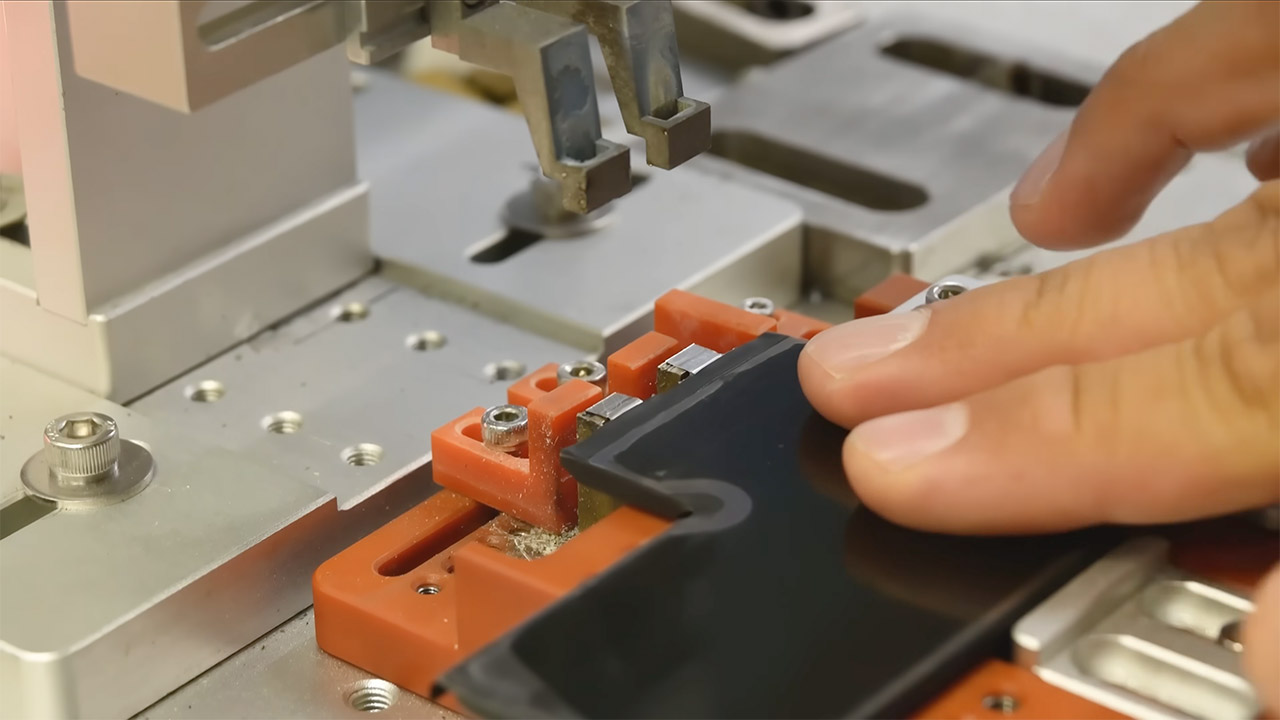
The next step is attachment, which involves a machine pressing a programmed BMS board and its flexible cable onto the bare cell extremely nicely. It’s critical that the connection is solid but small, as any misalignment at this step could come back to get you later when the battery needs to fit into an iPhone. Folding follows, with workers or machines folding the BMS board down twice to fit snuggly against the cell. The edges are wrapped with Kapton tape to prevent any exposed contacts from contacting and causing a short, and the sticker machine applies a little label that folds back on itself to keep the board in place and from shifting during handling or installation.

iFixit How iPhone Replacement Batteries are Made
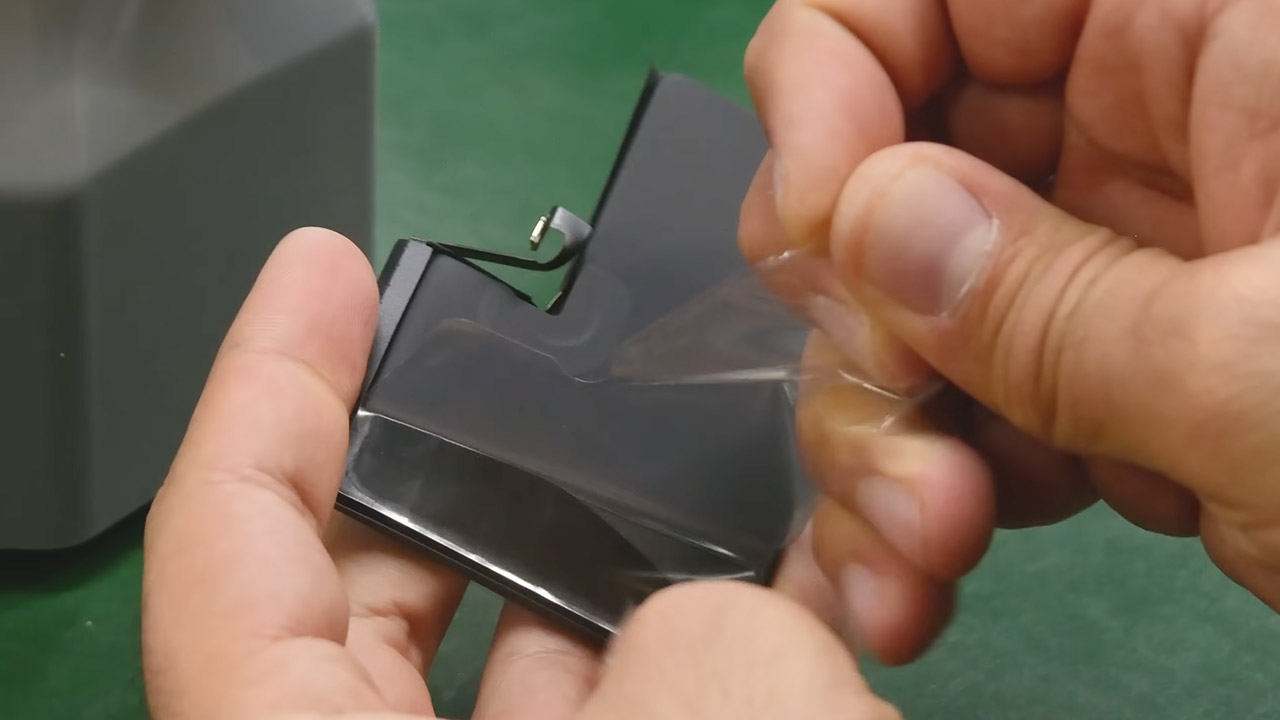
Now it’s time to remove the protective films that were applied to both sides of the cell during early manufacture. Those films have kept the surfaces pristine up until now. Removing them prepares the battery for the adhesive strips that will keep it securely in place within the iPhone case. Quality control must be nearly excellent at this time. A testing machine takes the battery through a variety of checks, including impedance, capacity, and overcurrent tests, and returns a simple pass or fail result. A pass indicates that the battery is in good working order and will behave as expected in a genuine device, whereas failed batteries are removed.

iFixit How iPhone Replacement Batteries are Made
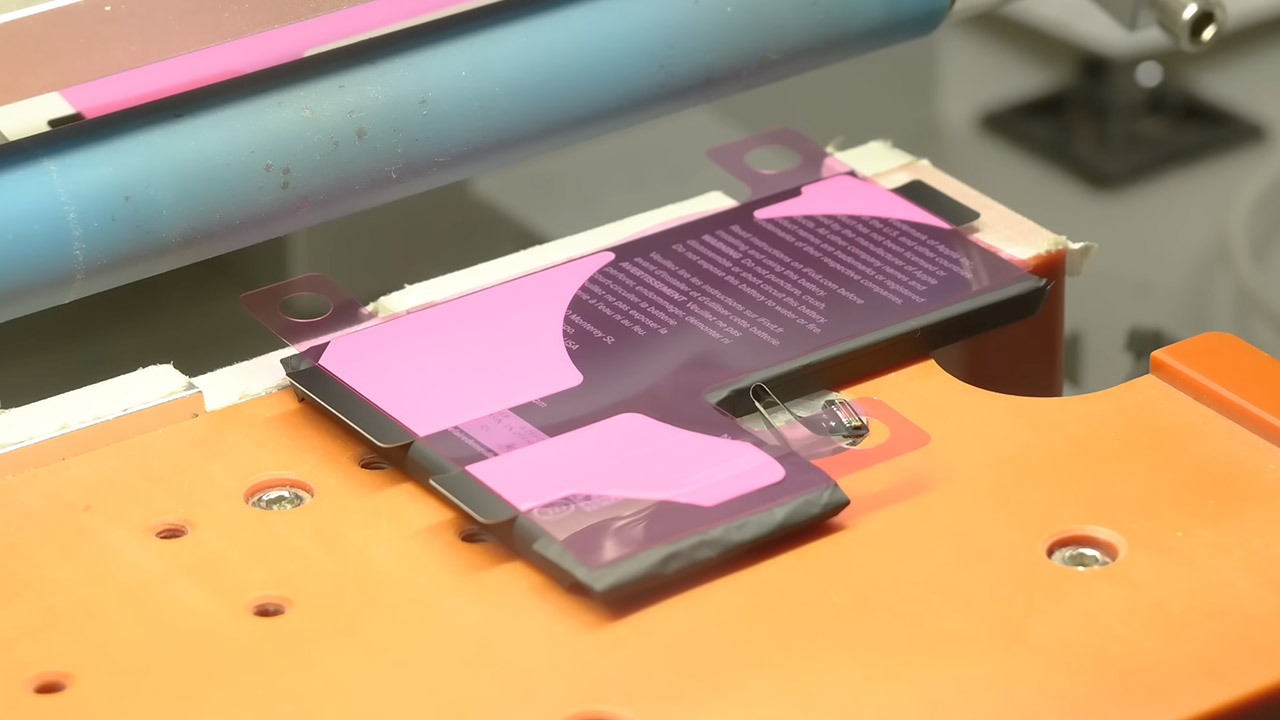
Mohktari then plugs the finished battery with a diagnostic tool. The screen displays all of the live data obtained directly from the BMS, such as the current charge level, condition of health, temperature, design capacity, and actual maximum capacity. It’s all the proof you need to know the battery will function correctly, just like a fresh new pack in a phone. The final step in preparation is to apply the adhesive pull strips that Apple uses to secure batteries inside iPhones. Those strips allow technicians to cleanly remove the old battery during a repair and secure the new one without adding excessive bulk. To ensure that everything works properly, the completed battery is inserted into an actual iPhone, which switches on without a hitch, demonstrating that the pack works from start to finish. Every step up to that point has been taken to ensure that the last bit happens as planned.

Source link

Continue Reading

Tech

Claude Fable 5 isn’t permanently leaving subscriptions, Anthropic says

Published

on

claude

Anthropic says Claude Fable 5 won’t be accessible via Claude subscriptions after July 7, but it’s not a permanent change, and the company expects the model to return outside the usage-based plan soon.

Fable 5 was recently restored after the US government lifted export controls on Anthropic’s most powerful models, Fable 5 and Mythos 5.

As part of the redeployment, Anthropic said Fable 5 would be available globally on Claude.ai, Claude Code, Claude Cowork, and the Claude Platform.

image

However, Anthropic has restricted Claude Fable usage due to high demand, and plans to move the model to usage-based billing next week.

“For Pro, Max, Team, and select Enterprise plans, Fable 5 will be included for up to 50% of weekly usage limits through July 7, after which it will be available via usage credits,” Anthropic said in its original blog post.

Advertisement

That line led to concerns that Fable 5, Anthropic’s most powerful model, was becoming a permanent pay-to-play upgrade for regular Claude users.

However, a Claude Code lead engineer has now clarified that Fable is expected to return to subscriptions once Anthropic has enough capacity.

“I’ve heard a lot of questions about Fable’s availability on subscription plans,” the engineer wrote in a post on X. “While it will come off subscriptions after July 7th, we aim to restore Fable as a standard part of our subscriptions as soon as capacity allows, as we mentioned in our original blog post.”

Anthropic says Fable 5 demand is difficult to predict

In its announcement, Anthropic said it expects demand for Fable 5 to be “very high, and difficult to predict.”

Advertisement

The company said Fable 5 is fully available today on the Claude API and consumption-based Enterprise plans, but access on subscription plans is being handled more conservatively.

“For subscription plans, we’d rather give access sooner than later, so we’re rolling out more conservatively, in stages,” Anthropic said.

Anthropic also said that after the included subscription window ends, it aims to restore Fable 5 as a standard part of subscription plans “when sufficient capacity allows us to do so.”

For now, Claude users who rely on Fable 5 should expect usage-credit billing after the deadline, and there’s nothing you can do about it.

Advertisement

article image

Security teams log 54% of successful attacks and alert on just 14%. The rest move through your environment unseen.

The Picus whitepaper shows how breach and attack simulation tests your SIEM and EDR rules so threats stop slipping by detection.

Get the whitepaper

Source link

Continue Reading

Tech

Meta Has Released An App For Making Generative AI Games

Published

on

Vibe-coding right in your Pocket.

Meta appears to have soft-launched a new app called Pocket that’s aimed at getting people to vibe-code their own minigames. Mobile developer and reverse engineer Alessandro Paluzzi spotted Pocket and posted about it to X today, but reporting platform AppFigures told TechCrunch that the app has been available on both iOS and Android since June 29. Though the app is listed publicly, it’s not available in the US on any of the half dozen phone models associated with our Google accounts, and a help page on Meta’s site says “the Pocket app is not yet available everywhere.” 

The company has not made any public announcement yet about the launch or where the app is being trialed. We’ve reached out for comment and will update this post if we receive a response.

From cosmetic tweaks to a standalone app for AI slop, Meta has been going gangbusters on getting artificial intelligence into its services in the past year. TechCrunch suggested that Pocket may be the result of the company wholesale hiring the team behind of Gizmo, an app that used AI to create interactive experiences based on prompts from users, earlier this year. Pocket uses that exact same nomenclature, dubbing itself “a creative platform for making and sharing gizmos” in the app listing, and the Play Store shortcode of “com.facebook.gizmo” does little to dispel the notion either.

Advertisement

Source link

Continue Reading

Tech

Claude Fable relaunch disappoints users with nerfed performance

Published

on

Claude

Claude Fable, the company’s most powerful model, is now available to all users, but early impressions are disappointing, as it appears to be nowhere near the original release.

When the Department of Commerce announced that it was lifting the ban on Claude Fable, I was holding my breath and counting seconds for the model to show up on Claude Code. I had also loaded up my usage-based credit wallet, just in case the model debuted as strictly usage-based.

To our surprise, Claude Fable shipped for everyone, including those with a $100 Max subscription, but there are multiple restrictions.

image

According to Anthropic, while Fable 5 is included in Max, Pro, and Team plans, it is heavily capped.

For example, you can use Fable for up to 50% of your weekly usage limits, which is not significant for such a powerful model. But it’ll get worse after July 7, as the model will transition entirely to a pay-to-play system via usage credits.

Advertisement

However, the real gut punch is the degraded performance, or as famously used in the AI community, the “nerfed” performance.

On Reddit, users are reporting that the restored Fable 5 feels weaker, or is simply being routed through stricter safety systems more often than before.

“The new guardrails are kicking in on way too many tasks and falling back to Opus 4.8,” one user wrote in a Reddit post. “This is not the model that got banned.”

The problem is not just limited to Claude desktop, as Claude Code is also struggling with similar issues.

Advertisement

One user said Fable “didn’t even let me search for dead code without switching to Opus,” while another said it was “very very obvious” when the fallback triggers because Claude tells the user and visibly shifts to Opus.

Another developer claimed the model was unusable for some systems-level coding work, saying that C, C++, Rust, Win32 API references, memory-related work, and files mentioning words like “security,” “vulnerable,” “unsafe,” or “hook” appeared to trigger a fallback or block.

Fable 5 may still be powerful when it actually handles the task, but the restored version appears to be far more sensitive to prompts, project files, and security-adjacent language.

However, BleepingComputer understands that the model itself has not been nerfed. Instead, it is likely that Anthropic is being extra careful with the safety guardrails, which is negatively affecting Fable’s daily use cases.

Advertisement

In fact, we observed that Fable is sometimes routed to Opus 4.8 even when the task does not appear to be a safety risk.

Anthropic has said that its updated safeguards rely on a large “safety margin,” which could explain the subpar experience some users are seeing with Fable.

Anthropic hasn’t acknowledged the reports of false positives yet, but it’s likely the company is aware of the problem and will address it in a future update.


article image

Security teams log 54% of successful attacks and alert on just 14%. The rest move through your environment unseen.

The Picus whitepaper shows how breach and attack simulation tests your SIEM and EDR rules so threats stop slipping by detection.

Advertisement

Get the whitepaper

Source link

Continue Reading

Tech

Thin-Skinned Palantir Loses Its Bid To Bully A Swiss Magazine Into Publishing Its Rebuttals To Embarrassing Reporting

Published

on

from the swiss-slapp-suits dept

Earlier this year we wrote about the ridiculous thin-skinned executives at Palantir suing a small independent Swiss online magazine, Republik, that had reported on the great lengths the company had gone to, trying to get the Swiss government to purchase Palantir’s surveillance technology. Palantir knew they couldn’t sue for defamation because, you know, everything Republik reported was true. Instead, they sued, trying to invoke a Swiss “right of reply” law, claiming that because Republik refused to publish the press release Palantir wanted to run in response to the reporting, the magazine had violated the law.

As we said at the time, this is the height of entitlement. Palantir doesn’t get to tell Republik how and what it must publish.

And, thankfully, a court has agreed. Zurich’s commercial court rejected 22 of 23 claims that Palantir made.

The data analytics company lost on 22 out of 23 counts of the suit. In a ruling on Friday, Zurich’s commercial court dismissed the majority of counterstatement requests filed by the company and its Swiss subsidiary finding that only a single passage in one article warranted a published response from the company.

While the court agrees that there is a “right of reply” law in Switzerland, it has limitations:

Advertisement

While Swiss media law allows the subjects of a story to request a right of reply, this has caveats: the right of reply has to be concise and stick to the facts of the story.

The one count that stuck: the court found that a single passage in just one article warranted a limited published reply from Palantir.

Also, the court told Palantir to pay Republik for its legal expenses wasted on this SLAPP suit:

The court on Friday ordered Palantir to bear 95% of the 9,000 Swiss francs ($11,300; £8,400) court costs and to pay Republik 9,900 francs in legal expenses.

Of course, this case was always less about the ‘right of reply’ than about making it clear to anyone who reports critically on Palantir that the company will go to war with them, seeking any legal theory, no matter how ridiculous, to tie them up in court — the textbook logic of a SLAPP suit. Republik has said that defending the case cost the small organization quite a lot in time and resources:

Balz Oertli, a journalist with WAV research collective, said: “We invested a great deal of effort into this case, and we are very pleased with the outcome.”

Anyway, given that Palantir seems really upset about Republik’s reporting, it sure would be a shame if you decided to go read this critical reporting of Palantir’s relentless attempts to win business from the Swiss government.

Advertisement

Filed Under: chilling effects, free speech, right of reply, switzerland

Companies: palantir, republik

Source link

Advertisement
Continue Reading

Tech

Bubbles, Belts, And Bulbs: How The Scantron Works

Published

on

Many of us remember back in our school days taking tests and filling out answers on a Scantron sheet, those long rows of A, B, C, D, and E that had to be filled in with a #2 pencil. Ever wonder why it needed a #2 pencil, or what the point of using a Scantron was at all? That question is answered in the latest video from [SimonRetro], where he takes a look at the Scantron and how it works.

One of the more interesting things about the Scantron is that it’s such a standalone device. No software needed, no keypad to mess with just two rocker switches. The on/off switch is also the way you tell it to forget the last answer sheet and allow you to program in a new test. Upon booting, you feed in a Scantron sheet with some specific boxes filled in, and then it’s programmed and ready to take in and grade all the students’ answers. Opening up the Scantron reveals it’s pretty interesting inside: one control board with early-’90s-era chips. There’s also a lightbulb (no LEDs) shining through the six reading sections of the card, as well as an arrangement of belts and motors to move the card through the machine. The printer is a seven-pin printer used in conjunction with a pair of ink rollers to print out the results on the cards.

[SimonRetro] also went ahead and tried different ways to mark the sheets including pens, Sharpies, colored pencils, and different thicknesses of pencils besides the #2 to see which would and wouldn’t work in the Scantron. Thanks [SimonRetro] for exploring this machine from many of our childhoods and sharing its inner workings. Be sure to check out some of our other reverse engineering articles that explore how classic devices work.

Advertisement

Source link

Advertisement
Continue Reading

Trending

Copyright © 2025